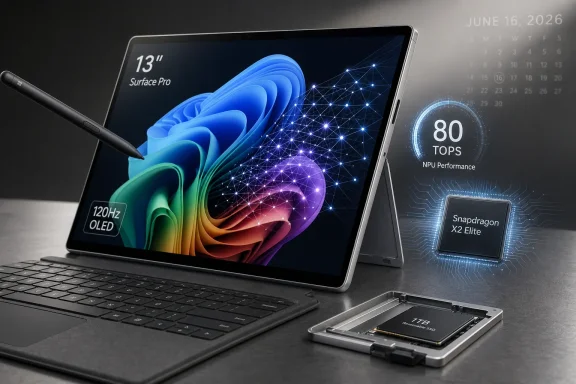
Microsoft’s next 13-inch Surface Pro with Qualcomm’s Snapdragon X2 Elite has reportedly leaked ahead of a rumored June 16 announcement, pointing to a refreshed Windows-on-Arm flagship that would follow Microsoft’s Intel-first Surface business launch in May 2026. The leak is small in the way hardware leaks often are, but the timing is large. Microsoft is not merely updating a tablet; it is trying to prove that the first Copilot+ PC wave was not a one-season experiment.
The original Snapdragon X Elite Surface Pro was Microsoft’s cleanest argument yet for Windows on Arm. It was thin, fanless or near-silent in many everyday workloads, dramatically better on battery than earlier Surface Pro generations, and good enough at emulating many x86 apps that the old “Windows RT” jokes finally started to feel stale. But it was also a first-generation statement machine, launched into a Windows ecosystem still learning how to live with Arm as a mainstream architecture rather than a curiosity.
That is what makes the reported Snapdragon X2 Elite Surface Pro more interesting than a simple spec bump. A second-generation Arm Surface does not get the luxury of novelty. It has to answer the harder question: whether Microsoft can turn Windows on Arm from a keynote demo into a predictable annual platform.
The rumored 13-inch model also matters because it appears to sit in the grown-up Surface Pro line, not the smaller, cheaper 12-inch Surface Pro family. Microsoft’s compact Surface devices are useful, but the 13-inch Pro is where the company traditionally makes its case for the detachable PC as a real laptop replacement. If that machine moves to Snapdragon X2 Elite in the consumer lane, Microsoft is again putting Arm at the center of the Surface story.
The date floating around the reports — June 16 — should still be treated as unconfirmed. But the broader direction is not surprising. Microsoft has already signaled that Snapdragon X2 Surface models are coming later in 2026, after a first wave of Intel Core Ultra Series 3 Surface machines aimed at business buyers. The leak fits a pattern that now looks less like confusion and more like segmentation.
The rumored Snapdragon X2 Elite Surface Pro is the other half of the strategy. It is the aspirational launch, the one meant to say Windows can compete with the MacBook Air and iPad Pro on mobility, battery life, instant-on behavior, and local AI performance. Microsoft has tried to say that before, but the first Snapdragon X wave was burdened with the job of proving the concept. The X2 generation can focus on sharpening it.
This split launch is not accidental. Enterprise IT has good reasons to be cautious with Arm PCs, especially in environments full of VPN clients, endpoint protection agents, device management extensions, printer packages, accessibility tools, and ancient line-of-business software. Even when Windows on Arm works beautifully for a normal productivity user, one bad driver or kernel-level utility can turn a fleet rollout into an expensive support story.
Consumers and enthusiasts, by contrast, are more tolerant of edge cases if the daily experience is good. They are also more likely to be pulled by visible benefits: long battery life, quiet operation, better standby, and stronger AI features. Microsoft is effectively saying that Intel remains the safe enterprise bridge while Snapdragon is the high-efficiency future it wants people to desire.
That is a delicate balance. If Microsoft leans too hard into Intel for business, it risks making Snapdragon look like a consumer experiment. If it leans too hard into Arm, it risks spooking customers who still buy Surface because it is a Windows PC first and a design object second. The leaked Surface Pro sits right in the middle of that tension.
That NPU figure matters because Microsoft’s Copilot+ PC branding has made local AI acceleration a buying criterion, whether users asked for it or not. The first Snapdragon X generation crossed the 40 TOPS threshold Microsoft required for Copilot+ features. Snapdragon X2 Elite pushes far beyond that, with Qualcomm advertising much higher neural processing performance for the new generation.
But raw NPU numbers are not the whole story. The first Copilot+ PC cycle revealed a mismatch between hardware marketing and everyday software reality. Users bought machines with neural processors, but the most visible AI features arrived unevenly, changed shape after privacy backlash, or depended on Windows updates that did not always feel tightly coupled to the hardware launch.
That is why the Surface Pro leak should be read as a test of software follow-through as much as silicon. If Microsoft wants the X2 Elite Surface Pro to feel meaningfully different from last year’s machine, it needs more than a faster benchmark. It needs Windows features, creative apps, conferencing tools, search improvements, and on-device assistants that make the NPU feel like hardware users are actually exploiting.
The irony is that the Surface Pro’s traditional strengths are not AI-specific at all. The form factor wins when it is light, responsive, durable, color-accurate, pen-friendly, and capable of lasting through travel days. The X2 Elite may help on all those fronts, but Microsoft will almost certainly market the device through the Copilot+ lens. Whether buyers care depends on whether Copilot+ becomes a lived advantage rather than a sticker.
None of that is new, but it matters more as Surface prices climb. A leaked 13-inch Snapdragon X2 Elite Surface Pro will inevitably be compared not just with older Surface models, but with MacBook Airs, iPad Pros, OLED Windows laptops, and business ultrabooks that include a keyboard by default. Microsoft’s detachable design still has unique appeal, but it also asks users to pay extra for the privilege of assembling the obvious configuration.
That is where the rumored device’s positioning becomes important. If Microsoft prices it like a tablet, it could be one of the more compelling Windows machines of the year. If it prices it like a luxury laptop before the keyboard and pen enter the cart, the conversation changes quickly. Surface fans are loyal, but they are not immune to arithmetic.
The company has spent years teaching buyers that Surface is the reference implementation of Windows hardware. That gives Microsoft room to charge more than bargain PC makers. But the Arm transition complicates the value equation because customers are also being asked to accept some compatibility uncertainty, even if that uncertainty is much smaller than it used to be.
For many WindowsForum readers, that is the practical question underneath the leak. Not “is Snapdragon X2 Elite fast?” but “is the whole Surface Pro package worth it once I add the keyboard, pen, warranty, storage, and whatever compromises still exist in my software stack?” The answer will vary wildly between a student, a traveling executive, a developer, a photographer, and an admin supporting 500 seats.
But IT trust does not move at the speed of a benchmark chart. Organizations remember the weird failures. They remember the finance plugin that did not load, the scanner driver that lacked advanced features, the VPN client that installed but behaved strangely, the old CAD helper tool that refused to run, or the security agent that arrived months late.
This is why Microsoft’s Intel-first business launch makes sense even as the company promotes Snapdragon for the future. Enterprise buyers often prefer boring compatibility to elegant efficiency. A machine that is 20 percent less exciting but 5 percent easier to certify may win every time in a managed environment.
The Snapdragon X2 Elite Surface Pro could still find a place in business fleets, especially among executives, field workers, consultants, sales teams, and roles where mobility outranks legacy hardware support. But broad enterprise adoption will depend on boring things: driver readiness, deployment tooling, firmware cadence, repair logistics, and whether vendors certify their Windows Arm builds without treating them as second-class ports.
Microsoft cannot solve that alone, but Surface can create pressure. When Microsoft ships a flagship Arm PC, software vendors have fewer excuses to ignore the platform. The leaked device, if real, is another nudge toward an ecosystem where Arm64 Windows is no longer an optional checkbox.
A Snapdragon X2 Elite Surface Pro gives Microsoft a chance to reset the narrative. The company can talk about faster on-device models, better image and audio processing, smarter search, more responsive assistants, and creative workflows that do not round-trip everything to the cloud. Those are credible directions, especially on a portable device where battery and latency matter.
The danger is that Microsoft repeats the same mistake: leading with a grand AI abstraction instead of concrete user value. People understand a laptop that lasts longer. They understand a camera that looks better on calls. They understand transcription that works on a plane, search that finds a local file, and photo tools that do not punish the battery. They are less patient with branding that makes every routine feature sound like a moonshot.
Surface is at its best when the hardware makes the software feel inevitable. The pen made OneNote and markup feel natural. The kickstand made the tablet-laptop hybrid legible. Windows Hello made logging in feel modern. Copilot+ still needs that kind of moment.
The X2 Elite’s NPU may be technically impressive, but Microsoft’s job is to hide the spec sheet inside experiences users miss when they go back to older PCs. If the new Surface Pro cannot do that, it will still be a nice Arm tablet. It just will not be the platform shift Microsoft wants it to be.
Microsoft’s challenge is harder. Windows is not one hardware platform, one app distribution model, or one tightly controlled ecosystem. It is an enormous compatibility machine stretched across corporate fleets, gaming rigs, industrial devices, home laptops, weird peripherals, and decades of assumptions. Moving that world toward Arm takes longer.
But the Surface Pro is one of the few Windows devices that can credibly invite the comparison. Like the iPad Pro, it is a premium tablet with a keyboard ecosystem and pen support. Like the MacBook Air, it is pitched around mobility and all-day computing. Unlike either, it runs full Windows, which remains its greatest strength and its most stubborn complication.
If the Snapdragon X2 Elite delivers the expected performance and battery improvements, Microsoft will have a stronger answer to Apple than it had in 2024. The question is whether the answer is clean enough. Apple sells confidence; Microsoft often sells possibility. Enthusiasts love possibility, but mainstream buyers usually prefer confidence.
That confidence will depend on details the leak does not yet settle. Display quality, thermals, weight, keyboard pricing, storage tiers, repairability, battery life under real workloads, and the exact Snapdragon X2 Elite variant all matter. A great chip in a cramped chassis can become an expensive disappointment. A slightly restrained chip in a balanced Surface Pro could be the better product.
That is why the reported 13-inch Snapdragon X2 Elite configuration is the right place for Microsoft to make the next Arm push. The Surface Pro’s display, keyboard ecosystem, Slim Pen support, and tablet mode all make more sense at this size. It is big enough to serve as a daily computer, but still portable enough to justify the detachable design.
It also creates a clearer product ladder. The smaller Surface Pro can serve users who want a compact Copilot+ tablet for notes, browsing, travel, and light productivity. The 13-inch Surface Pro can remain the premium choice for people who want the full detachable PC experience without stepping into a traditional laptop.
The problem, again, is price. A flagship 13-inch Surface Pro with Snapdragon X2 Elite, 16GB or more of RAM, a decent SSD, OLED, keyboard, and pen could easily land in territory where buyers start comparing it with excellent clamshell laptops that offer fewer compromises. Microsoft will need to make the detachable advantage feel worth paying for.
Surface die-hards already believe that. The broader Windows market is less sentimental. It will judge the device the way it judges every expensive PC: by whether the trade-offs are obvious on day one.
That is a healthier strategy than the old Surface Pro X era, when Arm felt like a parallel universe. In 2026, the Surface line can contain both paths without making either one look illegitimate. A business buyer can choose Intel and feel safe. A mobility-focused user can choose Snapdragon and feel modern.
The risk is fragmentation. Windows already suffers from too many overlapping hardware stories: x86, Arm, NPUs of varying capability, Copilot+ eligibility, different Windows feature availability, and vendor-specific driver realities. If Microsoft does not communicate clearly, buyers may not understand why one Surface Pro is better for them than another.
The rumored June Snapdragon launch could help if Microsoft keeps the message simple. Intel Surface for business compatibility. Snapdragon Surface for battery life, mobility, and next-generation AI features. That is not the whole truth, but it is at least a coherent starting point.
For sysadmins, the nuance comes after that. They will want to know which security tools are native, how Autopilot behaves, what firmware servicing looks like, whether peripherals work, and how long Microsoft will support the platform. The marketing page will not answer all of that, but the product’s success in business-adjacent roles will depend on it.
That execution includes the mundane parts of PC ownership. Sleep must be reliable. External monitors must behave. Bluetooth must not become a ritual. Printers must work. App installers must not confuse normal users with architecture caveats. Games are still a separate minefield, but even non-gamers expect a premium PC to avoid weirdness.
For developers, the X2 Surface generation is also a signal. Native Arm64 Windows support is becoming harder to ignore, especially for tools that already support macOS on Apple Silicon. The more Microsoft ships premium Arm hardware under its own brand, the more awkward it becomes for major software vendors to treat Windows Arm as niche.
For security-minded users, the story is mixed but promising. Newer Surface devices typically pair modern firmware, Pluton security, secured-core concepts, and strong Windows Hello integration. But security software compatibility and management tooling remain critical, and those are precisely the layers where architecture transitions can expose weak spots.
The leaked Surface Pro therefore becomes a measuring device for the whole Windows ecosystem. If it feels boring in the best way — fast, quiet, compatible, well-supported — Windows on Arm will have crossed an important threshold. If it feels like a beautiful machine with asterisks, the old doubts will survive another generation.
 Microsoft’s Arm Bet Is Moving From Demonstration To Discipline
The original Snapdragon X Elite Surface Pro was Microsoft’s cleanest argument yet for Windows on Arm. It was thin, fanless or near-silent in many everyday workloads, dramatically better on battery than earlier Surface Pro generations, and good enough at emulating many x86 apps that the old “Windows RT” jokes finally started to feel stale. But it was also a first-generation statement machine, launched into a Windows ecosystem still learning how to live with Arm as a mainstream architecture rather than a curiosity.That is what makes the reported Snapdragon X2 Elite Surface Pro more interesting than a simple spec bump. A second-generation Arm Surface does not get the luxury of novelty. It has to answer the harder question: whether Microsoft can turn Windows on Arm from a keynote demo into a predictable annual platform.
The rumored 13-inch model also matters because it appears to sit in the grown-up Surface Pro line, not the smaller, cheaper 12-inch Surface Pro family. Microsoft’s compact Surface devices are useful, but the 13-inch Pro is where the company traditionally makes its case for the detachable PC as a real laptop replacement. If that machine moves to Snapdragon X2 Elite in the consumer lane, Microsoft is again putting Arm at the center of the Surface story.
The date floating around the reports — June 16 — should still be treated as unconfirmed. But the broader direction is not surprising. Microsoft has already signaled that Snapdragon X2 Surface models are coming later in 2026, after a first wave of Intel Core Ultra Series 3 Surface machines aimed at business buyers. The leak fits a pattern that now looks less like confusion and more like segmentation.
The Two-Stage Surface Launch Says More Than The Leak
Microsoft’s 2026 Surface rollout has been unusually revealing because it separates the company’s two audiences so cleanly. In May, Microsoft showed new Surface Pro and Surface Laptop for Business devices with Intel’s latest Core Ultra chips, upgraded displays, haptics, and enterprise-friendly configurations. That was the practical launch: the one for procurement departments, fleets, dock compatibility, legacy software, and managers who still want x86 as the default answer.The rumored Snapdragon X2 Elite Surface Pro is the other half of the strategy. It is the aspirational launch, the one meant to say Windows can compete with the MacBook Air and iPad Pro on mobility, battery life, instant-on behavior, and local AI performance. Microsoft has tried to say that before, but the first Snapdragon X wave was burdened with the job of proving the concept. The X2 generation can focus on sharpening it.
This split launch is not accidental. Enterprise IT has good reasons to be cautious with Arm PCs, especially in environments full of VPN clients, endpoint protection agents, device management extensions, printer packages, accessibility tools, and ancient line-of-business software. Even when Windows on Arm works beautifully for a normal productivity user, one bad driver or kernel-level utility can turn a fleet rollout into an expensive support story.
Consumers and enthusiasts, by contrast, are more tolerant of edge cases if the daily experience is good. They are also more likely to be pulled by visible benefits: long battery life, quiet operation, better standby, and stronger AI features. Microsoft is effectively saying that Intel remains the safe enterprise bridge while Snapdragon is the high-efficiency future it wants people to desire.
That is a delicate balance. If Microsoft leans too hard into Intel for business, it risks making Snapdragon look like a consumer experiment. If it leans too hard into Arm, it risks spooking customers who still buy Surface because it is a Windows PC first and a design object second. The leaked Surface Pro sits right in the middle of that tension.
Snapdragon X2 Elite Gives Microsoft A Bigger Hammer
Qualcomm’s Snapdragon X2 Elite platform gives Microsoft a more serious foundation than the first Snapdragon X Elite did. The new chips move the pitch beyond “finally good enough” and toward a more aggressive claim: that Arm laptops can compete at the high end without surrendering the battery and thermal advantages that made Arm attractive in the first place. Qualcomm has promoted the X2 Elite family around stronger Oryon CPU cores, higher memory bandwidth, and a substantially more capable NPU.That NPU figure matters because Microsoft’s Copilot+ PC branding has made local AI acceleration a buying criterion, whether users asked for it or not. The first Snapdragon X generation crossed the 40 TOPS threshold Microsoft required for Copilot+ features. Snapdragon X2 Elite pushes far beyond that, with Qualcomm advertising much higher neural processing performance for the new generation.
But raw NPU numbers are not the whole story. The first Copilot+ PC cycle revealed a mismatch between hardware marketing and everyday software reality. Users bought machines with neural processors, but the most visible AI features arrived unevenly, changed shape after privacy backlash, or depended on Windows updates that did not always feel tightly coupled to the hardware launch.
That is why the Surface Pro leak should be read as a test of software follow-through as much as silicon. If Microsoft wants the X2 Elite Surface Pro to feel meaningfully different from last year’s machine, it needs more than a faster benchmark. It needs Windows features, creative apps, conferencing tools, search improvements, and on-device assistants that make the NPU feel like hardware users are actually exploiting.
The irony is that the Surface Pro’s traditional strengths are not AI-specific at all. The form factor wins when it is light, responsive, durable, color-accurate, pen-friendly, and capable of lasting through travel days. The X2 Elite may help on all those fronts, but Microsoft will almost certainly market the device through the Copilot+ lens. Whether buyers care depends on whether Copilot+ becomes a lived advantage rather than a sticker.
The Surface Pro Still Has To Beat Its Own Accessories
The Surface Pro has always been a brilliant product with an asterisk. It is a tablet that becomes a laptop only after you buy the keyboard. It is a pen computer only after you buy the pen. It is a premium mobile workstation only if you are willing to tolerate the compromises of a kickstand on an airplane tray table.None of that is new, but it matters more as Surface prices climb. A leaked 13-inch Snapdragon X2 Elite Surface Pro will inevitably be compared not just with older Surface models, but with MacBook Airs, iPad Pros, OLED Windows laptops, and business ultrabooks that include a keyboard by default. Microsoft’s detachable design still has unique appeal, but it also asks users to pay extra for the privilege of assembling the obvious configuration.
That is where the rumored device’s positioning becomes important. If Microsoft prices it like a tablet, it could be one of the more compelling Windows machines of the year. If it prices it like a luxury laptop before the keyboard and pen enter the cart, the conversation changes quickly. Surface fans are loyal, but they are not immune to arithmetic.
The company has spent years teaching buyers that Surface is the reference implementation of Windows hardware. That gives Microsoft room to charge more than bargain PC makers. But the Arm transition complicates the value equation because customers are also being asked to accept some compatibility uncertainty, even if that uncertainty is much smaller than it used to be.
For many WindowsForum readers, that is the practical question underneath the leak. Not “is Snapdragon X2 Elite fast?” but “is the whole Surface Pro package worth it once I add the keyboard, pen, warranty, storage, and whatever compromises still exist in my software stack?” The answer will vary wildly between a student, a traveling executive, a developer, a photographer, and an admin supporting 500 seats.
Compatibility Is Better, But Trust Is Slower Than Emulation
Windows on Arm in 2026 is not Windows on Arm in 2012, and it is not even Surface Pro X in 2019. The app ecosystem is broader, Chromium-based browsers are native, Microsoft 365 is native, many creative and communication apps have caught up, and emulation has improved enough that ordinary users may not notice the architecture most of the time. That is real progress.But IT trust does not move at the speed of a benchmark chart. Organizations remember the weird failures. They remember the finance plugin that did not load, the scanner driver that lacked advanced features, the VPN client that installed but behaved strangely, the old CAD helper tool that refused to run, or the security agent that arrived months late.
This is why Microsoft’s Intel-first business launch makes sense even as the company promotes Snapdragon for the future. Enterprise buyers often prefer boring compatibility to elegant efficiency. A machine that is 20 percent less exciting but 5 percent easier to certify may win every time in a managed environment.
The Snapdragon X2 Elite Surface Pro could still find a place in business fleets, especially among executives, field workers, consultants, sales teams, and roles where mobility outranks legacy hardware support. But broad enterprise adoption will depend on boring things: driver readiness, deployment tooling, firmware cadence, repair logistics, and whether vendors certify their Windows Arm builds without treating them as second-class ports.
Microsoft cannot solve that alone, but Surface can create pressure. When Microsoft ships a flagship Arm PC, software vendors have fewer excuses to ignore the platform. The leaked device, if real, is another nudge toward an ecosystem where Arm64 Windows is no longer an optional checkbox.
Copilot+ Needs A Better Reason To Exist Than Recall
The first Copilot+ PC launch was supposed to make local AI the new dividing line in Windows hardware. Instead, much of the public conversation was consumed by Recall, privacy concerns, feature delays, and confusion over which AI experiences were actually available on which machines. That was not fatal, but it did blur the message.A Snapdragon X2 Elite Surface Pro gives Microsoft a chance to reset the narrative. The company can talk about faster on-device models, better image and audio processing, smarter search, more responsive assistants, and creative workflows that do not round-trip everything to the cloud. Those are credible directions, especially on a portable device where battery and latency matter.
The danger is that Microsoft repeats the same mistake: leading with a grand AI abstraction instead of concrete user value. People understand a laptop that lasts longer. They understand a camera that looks better on calls. They understand transcription that works on a plane, search that finds a local file, and photo tools that do not punish the battery. They are less patient with branding that makes every routine feature sound like a moonshot.
Surface is at its best when the hardware makes the software feel inevitable. The pen made OneNote and markup feel natural. The kickstand made the tablet-laptop hybrid legible. Windows Hello made logging in feel modern. Copilot+ still needs that kind of moment.
The X2 Elite’s NPU may be technically impressive, but Microsoft’s job is to hide the spec sheet inside experiences users miss when they go back to older PCs. If the new Surface Pro cannot do that, it will still be a nice Arm tablet. It just will not be the platform shift Microsoft wants it to be.
The Mac Comparison Is Unavoidable, And Microsoft Knows It
Every modern Arm Surface lives in Apple’s shadow. That is not because Windows users secretly want macOS, but because Apple proved the business case for moving mainstream laptops to Arm-derived silicon. The M-series transition gave Apple better battery life, strong performance, and a simplified software message: buy the new Mac, your apps probably work, and the machine will feel fast.Microsoft’s challenge is harder. Windows is not one hardware platform, one app distribution model, or one tightly controlled ecosystem. It is an enormous compatibility machine stretched across corporate fleets, gaming rigs, industrial devices, home laptops, weird peripherals, and decades of assumptions. Moving that world toward Arm takes longer.
But the Surface Pro is one of the few Windows devices that can credibly invite the comparison. Like the iPad Pro, it is a premium tablet with a keyboard ecosystem and pen support. Like the MacBook Air, it is pitched around mobility and all-day computing. Unlike either, it runs full Windows, which remains its greatest strength and its most stubborn complication.
If the Snapdragon X2 Elite delivers the expected performance and battery improvements, Microsoft will have a stronger answer to Apple than it had in 2024. The question is whether the answer is clean enough. Apple sells confidence; Microsoft often sells possibility. Enthusiasts love possibility, but mainstream buyers usually prefer confidence.
That confidence will depend on details the leak does not yet settle. Display quality, thermals, weight, keyboard pricing, storage tiers, repairability, battery life under real workloads, and the exact Snapdragon X2 Elite variant all matter. A great chip in a cramped chassis can become an expensive disappointment. A slightly restrained chip in a balanced Surface Pro could be the better product.
The 13-Inch Model Is Where Microsoft Cannot Hide
The existence of multiple Surface Pro sizes has given Microsoft flexibility, but it has also muddied the message. A 12-inch Surface Pro can be excused for being more limited because it is smaller and cheaper. A 13-inch Surface Pro does not get that excuse. It is the flagship detachable, and buyers expect it to carry the best version of the idea.That is why the reported 13-inch Snapdragon X2 Elite configuration is the right place for Microsoft to make the next Arm push. The Surface Pro’s display, keyboard ecosystem, Slim Pen support, and tablet mode all make more sense at this size. It is big enough to serve as a daily computer, but still portable enough to justify the detachable design.
It also creates a clearer product ladder. The smaller Surface Pro can serve users who want a compact Copilot+ tablet for notes, browsing, travel, and light productivity. The 13-inch Surface Pro can remain the premium choice for people who want the full detachable PC experience without stepping into a traditional laptop.
The problem, again, is price. A flagship 13-inch Surface Pro with Snapdragon X2 Elite, 16GB or more of RAM, a decent SSD, OLED, keyboard, and pen could easily land in territory where buyers start comparing it with excellent clamshell laptops that offer fewer compromises. Microsoft will need to make the detachable advantage feel worth paying for.
Surface die-hards already believe that. The broader Windows market is less sentimental. It will judge the device the way it judges every expensive PC: by whether the trade-offs are obvious on day one.
Intel Is No Longer The Villain In Microsoft’s Story
It would be easy to frame this leak as another sign that Microsoft is abandoning Intel, but that misses the more interesting reality. Microsoft is not choosing between Intel and Qualcomm as much as it is designing different Surface lanes for different kinds of trust. Intel remains the compatibility anchor. Qualcomm is the efficiency and AI-forward bet.That is a healthier strategy than the old Surface Pro X era, when Arm felt like a parallel universe. In 2026, the Surface line can contain both paths without making either one look illegitimate. A business buyer can choose Intel and feel safe. A mobility-focused user can choose Snapdragon and feel modern.
The risk is fragmentation. Windows already suffers from too many overlapping hardware stories: x86, Arm, NPUs of varying capability, Copilot+ eligibility, different Windows feature availability, and vendor-specific driver realities. If Microsoft does not communicate clearly, buyers may not understand why one Surface Pro is better for them than another.
The rumored June Snapdragon launch could help if Microsoft keeps the message simple. Intel Surface for business compatibility. Snapdragon Surface for battery life, mobility, and next-generation AI features. That is not the whole truth, but it is at least a coherent starting point.
For sysadmins, the nuance comes after that. They will want to know which security tools are native, how Autopilot behaves, what firmware servicing looks like, whether peripherals work, and how long Microsoft will support the platform. The marketing page will not answer all of that, but the product’s success in business-adjacent roles will depend on it.
The Leak Points To A Bigger Windows Hardware Reset
If the reports are accurate, the Snapdragon X2 Elite Surface Pro will arrive into a PC market that has changed since the first Copilot+ machines. Arm PCs are no longer surprising. NPUs are no longer exotic. Battery life claims are no longer enough. Microsoft and Qualcomm now have to compete on execution.That execution includes the mundane parts of PC ownership. Sleep must be reliable. External monitors must behave. Bluetooth must not become a ritual. Printers must work. App installers must not confuse normal users with architecture caveats. Games are still a separate minefield, but even non-gamers expect a premium PC to avoid weirdness.
For developers, the X2 Surface generation is also a signal. Native Arm64 Windows support is becoming harder to ignore, especially for tools that already support macOS on Apple Silicon. The more Microsoft ships premium Arm hardware under its own brand, the more awkward it becomes for major software vendors to treat Windows Arm as niche.
For security-minded users, the story is mixed but promising. Newer Surface devices typically pair modern firmware, Pluton security, secured-core concepts, and strong Windows Hello integration. But security software compatibility and management tooling remain critical, and those are precisely the layers where architecture transitions can expose weak spots.
The leaked Surface Pro therefore becomes a measuring device for the whole Windows ecosystem. If it feels boring in the best way — fast, quiet, compatible, well-supported — Windows on Arm will have crossed an important threshold. If it feels like a beautiful machine with asterisks, the old doubts will survive another generation.
The June Surface Story Has Only A Few Details That Truly Matter
The coming launch, if the rumored date holds, will generate plenty of spec-sheet noise. That is inevitable. But most buyers should keep their attention on a smaller set of practical questions, because those will decide whether this Surface Pro is a real upgrade or just a more glamorous entry in Microsoft’s long detachable experiment.- Microsoft is reportedly preparing a 13-inch Surface Pro with Snapdragon X2 Elite, which would place the new Arm chip in the flagship detachable Surface tier rather than only in smaller or cheaper devices.
- The rumored June 16 timing fits Microsoft’s broader 2026 pattern of launching Intel business Surface hardware first and reserving Snapdragon X2 models for a later wave.
- Snapdragon X2 Elite should improve performance, memory bandwidth, and on-device AI capability, but the value depends on real Windows features and native app support, not TOPS figures alone.
- Compatibility is much better than in earlier Windows-on-Arm generations, but enterprises still need to validate drivers, security agents, VPNs, peripherals, and line-of-business software before standardizing on Arm.
- Pricing will be decisive because Surface Pro buyers must usually budget for the keyboard and pen to get the complete experience Microsoft advertises.
- The most important review metric will not be a single benchmark, but whether the device feels like a normal premium Windows PC with better battery life rather than a special-case Arm machine.
References
- Primary source: gsmarena.com
Published: Wed, 03 Jun 2026 17:21:02 GMT
Leak: a Microsoft Surface Pro 13" with a Snapdragon X2 Elite is coming soon - GSMArena.com news
The tablet will join the Surface Pro with Intel Core Ultra Series 3 processors that was unveiled a couple of weeks ago. A couple of weeks ago, Microsoft...www.gsmarena.com
- Independent coverage: The Shortcut | Matt Swider
Published: Wed, 03 Jun 2026 17:07:34 GMT
Microsoft Surface Pro with Snapdragon X2 Elite leaks ahead of rumored June 16 release date
It looks just like the Surface Pro from 2024, with a few notable changes under the hood www.theshortcut.com
- Independent coverage: thurrott.com
Published: Wed, 03 Jun 2026 17:03:07 GMT
Microsoft's New Surface Pro With Snapdragon X2 Elite Chip Leaks
Leaked marketing images of Microsoft's refreshed 13-inch Surface Pro with a Snapdragon X2 Elite chip suggest that an official announcement is imminent.www.thurrott.com - Related coverage: windowscentral.com
Surface Laptop Ultra: Microsoft and NVIDIA reveal the 128GB RAM, mini‑LED, RTX Spark powerhouse redefining Windows on Arm | Windows Central
Uncompromising raw NVIDIA N1x power meets legendary Surface craft, but can people afford it?www.windowscentral.com - Related coverage: notebookcheck.net
New Microsoft Surface PCs launching with Qualcomm Snapdragon X2 in 2026 - Notebookcheck News
Microsoft has released Surface Laptop 8 and Surface Pro 12 devices globally. At the same time, the company has confirmed that Qualcomm Snapdragon X2 models are coming, but not until 'later this year'. www.notebookcheck.net
- Related coverage: notebookcheck.com
Microsoft Surface Pro und Surface Laptop mit Snapdragon X2 könnten später starten - Notebookcheck News
Ein neuer Leak hat eingegrenzt, wann Microsoft seinen Surface Laptop und das Surface Pro aktualisieren wird. Überraschenderweise sollen die neuen Intel-Modelle schon mehrere Monate vor ihren Pendants mit Snapdragon X2 auf den Markt kommen. www.notebookcheck.com
- Related coverage: winbuzzer.com
Microsoft Confirms Snapdragon X2 Surface Launch for 2026
Microsoft confirmed Snapdragon X2 versions of Surface Pro and Surface Laptop will arrive later in 2026 after Intel business models went on sale first. winbuzzer.com
- Related coverage: tomshardware.com
Microsoft announces colorful new 12-inch Surface Pro and 13-inch Surface Laptop with Snapdragon X Plus | Tom's Hardware
No Surface Connect port to be foundwww.tomshardware.com - Related coverage: techradar.com
Microsoft's next-gen Surface devices don't sound exciting going by rumors — and I worry they'll be poor value even compared to MacBooks | TechRadar
A minor upgrade, but with major prices hikes?www.techradar.com - Related coverage: pcworld.com
Microsoft's new Intel-powered Surface Laptop 5G lands in August | PCWorld
Microsoft announced the Surface Laptop 5G on Tuesday, a version of the Surface Laptop for Business with an integrated 5G radio for on-the-go connectivity.www.pcworld.com - Related coverage: howtogeek.com
The New Surface Pro Doesn't Feel Pro
Where's my headphone jack, Microsoft? www.howtogeek.com
- Official source: microsoft.com
Surface Pro for Business Fact Sheet May 2024
</rdf:Alt> </dc:description> <dc:creator><rdf:Seq><rdf:li>Joseph Galbraith (MBO Partners, Inc.)www.microsoft.com
- Related coverage: axios.com
Microsoft debuts Nvidia-powered Microsoft Surface Ultra laptop
Microsoft is trying again to redefine the PC for the AI era.www.axios.com
- Official source: support.microsoft.com
Surface Pro (11th Edition) features | Microsoft Support
Learn what features are included with Surface Pro (11th Edition).support.microsoft.com - Related coverage: qualcomm.com
- Official source: learn.microsoft.com
Especificaciones técnicas: Surface Pro para empresas, Copilot+ PC, procesador snapdragon serie X, 11ª edición - Surface | Microsoft Learn
Consulte las especificaciones técnicas de Surface Pro 11ª edición con procesadores Snapdragon, incluida la pantalla, la duración de la batería y los puertos.learn.microsoft.com - Related coverage: itpro.com
Microsoft reveals Surface Pro and Surface Laptop for Business with Intel Core Ultra 3 series processors | IT Pro
New 13in Pro and Laptop claim big performance improvements and vast AI capabilitieswww.itpro.com