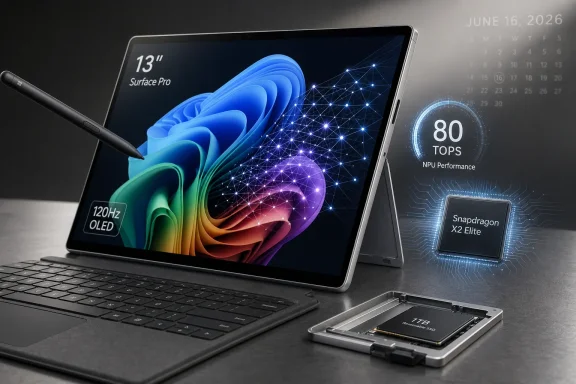
Leaked 13-inch Surface Pro with Snapdragon X2 Elite: Arm, Copilot+ and June 16

Microsoft’s next 13-inch Surface Pro with Qualcomm’s Snapdragon X2 Elite has reportedly leaked ahead of a rumored June 16 announcement, pointing to a refreshed Windows-on-Arm flagship that would follow Microsoft’s Intel-first Surface business launch in May 2026. The leak is small in the way hardware leaks often are, but the timing is large. Microsoft is not merely updating a tablet; it is trying to prove that the first Copilot+ PC wave was not a one-season experiment.

Tablet with stylus displaying an abstract golden swirl on a circuit-themed workspace.Microsoft’s Arm Bet Is Moving From Demonstration To Discipline​

The original Snapdragon X Elite Surface Pro was Microsoft’s cleanest argument yet for Windows on Arm. It was thin, fanless or near-silent in many everyday workloads, dramatically better on battery than earlier Surface Pro generations, and good enough at emulating many x86 apps that the old “Windows RT” jokes finally started to feel stale. But it was also a first-generation statement machine, launched into a Windows ecosystem still learning how to live with Arm as a mainstream architecture rather than a curiosity.
That is what makes the reported Snapdragon X2 Elite Surface Pro more interesting than a simple spec bump. A second-generation Arm Surface does not get the luxury of novelty. It has to answer the harder question: whether Microsoft can turn Windows on Arm from a keynote demo into a predictable annual platform.
The rumored 13-inch model also matters because it appears to sit in the grown-up Surface Pro line, not the smaller, cheaper 12-inch Surface Pro family. Microsoft’s compact Surface devices are useful, but the 13-inch Pro is where the company traditionally makes its case for the detachable PC as a real laptop replacement. If that machine moves to Snapdragon X2 Elite in the consumer lane, Microsoft is again putting Arm at the center of the Surface story.
The date floating around the reports — June 16 — should still be treated as unconfirmed. But the broader direction is not surprising. Microsoft has already signaled that Snapdragon X2 Surface models are coming later in 2026, after a first wave of Intel Core Ultra Series 3 Surface machines aimed at business buyers. The leak fits a pattern that now looks less like confusion and more like segmentation.

The Two-Stage Surface Launch Says More Than The Leak​

Microsoft’s 2026 Surface rollout has been unusually revealing because it separates the company’s two audiences so cleanly. In May, Microsoft showed new Surface Pro and Surface Laptop for Business devices with Intel’s latest Core Ultra chips, upgraded displays, haptics, and enterprise-friendly configurations. That was the practical launch: the one for procurement departments, fleets, dock compatibility, legacy software, and managers who still want x86 as the default answer.
The rumored Snapdragon X2 Elite Surface Pro is the other half of the strategy. It is the aspirational launch, the one meant to say Windows can compete with the MacBook Air and iPad Pro on mobility, battery life, instant-on behavior, and local AI performance. Microsoft has tried to say that before, but the first Snapdragon X wave was burdened with the job of proving the concept. The X2 generation can focus on sharpening it.
This split launch is not accidental. Enterprise IT has good reasons to be cautious with Arm PCs, especially in environments full of VPN clients, endpoint protection agents, device management extensions, printer packages, accessibility tools, and ancient line-of-business software. Even when Windows on Arm works beautifully for a normal productivity user, one bad driver or kernel-level utility can turn a fleet rollout into an expensive support story.
Consumers and enthusiasts, by contrast, are more tolerant of edge cases if the daily experience is good. They are also more likely to be pulled by visible benefits: long battery life, quiet operation, better standby, and stronger AI features. Microsoft is effectively saying that Intel remains the safe enterprise bridge while Snapdragon is the high-efficiency future it wants people to desire.
That is a delicate balance. If Microsoft leans too hard into Intel for business, it risks making Snapdragon look like a consumer experiment. If it leans too hard into Arm, it risks spooking customers who still buy Surface because it is a Windows PC first and a design object second. The leaked Surface Pro sits right in the middle of that tension.

Snapdragon X2 Elite Gives Microsoft A Bigger Hammer​

Qualcomm’s Snapdragon X2 Elite platform gives Microsoft a more serious foundation than the first Snapdragon X Elite did. The new chips move the pitch beyond “finally good enough” and toward a more aggressive claim: that Arm laptops can compete at the high end without surrendering the battery and thermal advantages that made Arm attractive in the first place. Qualcomm has promoted the X2 Elite family around stronger Oryon CPU cores, higher memory bandwidth, and a substantially more capable NPU.
That NPU figure matters because Microsoft’s Copilot+ PC branding has made local AI acceleration a buying criterion, whether users asked for it or not. The first Snapdragon X generation crossed the 40 TOPS threshold Microsoft required for Copilot+ features. Snapdragon X2 Elite pushes far beyond that, with Qualcomm advertising much higher neural processing performance for the new generation.
But raw NPU numbers are not the whole story. The first Copilot+ PC cycle revealed a mismatch between hardware marketing and everyday software reality. Users bought machines with neural processors, but the most visible AI features arrived unevenly, changed shape after privacy backlash, or depended on Windows updates that did not always feel tightly coupled to the hardware launch.
That is why the Surface Pro leak should be read as a test of software follow-through as much as silicon. If Microsoft wants the X2 Elite Surface Pro to feel meaningfully different from last year’s machine, it needs more than a faster benchmark. It needs Windows features, creative apps, conferencing tools, search improvements, and on-device assistants that make the NPU feel like hardware users are actually exploiting.
The irony is that the Surface Pro’s traditional strengths are not AI-specific at all. The form factor wins when it is light, responsive, durable, color-accurate, pen-friendly, and capable of lasting through travel days. The X2 Elite may help on all those fronts, but Microsoft will almost certainly market the device through the Copilot+ lens. Whether buyers care depends on whether Copilot+ becomes a lived advantage rather than a sticker.

The Surface Pro Still Has To Beat Its Own Accessories​

The Surface Pro has always been a brilliant product with an asterisk. It is a tablet that becomes a laptop only after you buy the keyboard. It is a pen computer only after you buy the pen. It is a premium mobile workstation only if you are willing to tolerate the compromises of a kickstand on an airplane tray table.
None of that is new, but it matters more as Surface prices climb. A leaked 13-inch Snapdragon X2 Elite Surface Pro will inevitably be compared not just with older Surface models, but with MacBook Airs, iPad Pros, OLED Windows laptops, and business ultrabooks that include a keyboard by default. Microsoft’s detachable design still has unique appeal, but it also asks users to pay extra for the privilege of assembling the obvious configuration.
That is where the rumored device’s positioning becomes important. If Microsoft prices it like a tablet, it could be one of the more compelling Windows machines of the year. If it prices it like a luxury laptop before the keyboard and pen enter the cart, the conversation changes quickly. Surface fans are loyal, but they are not immune to arithmetic.
The company has spent years teaching buyers that Surface is the reference implementation of Windows hardware. That gives Microsoft room to charge more than bargain PC makers. But the Arm transition complicates the value equation because customers are also being asked to accept some compatibility uncertainty, even if that uncertainty is much smaller than it used to be.
For many WindowsForum readers, that is the practical question underneath the leak. Not “is Snapdragon X2 Elite fast?” but “is the whole Surface Pro package worth it once I add the keyboard, pen, warranty, storage, and whatever compromises still exist in my software stack?” The answer will vary wildly between a student, a traveling executive, a developer, a photographer, and an admin supporting 500 seats.

Compatibility Is Better, But Trust Is Slower Than Emulation​

Windows on Arm in 2026 is not Windows on Arm in 2012, and it is not even Surface Pro X in 2019. The app ecosystem is broader, Chromium-based browsers are native, Microsoft 365 is native, many creative and communication apps have caught up, and emulation has improved enough that ordinary users may not notice the architecture most of the time. That is real progress.
But IT trust does not move at the speed of a benchmark chart. Organizations remember the weird failures. They remember the finance plugin that did not load, the scanner driver that lacked advanced features, the VPN client that installed but behaved strangely, the old CAD helper tool that refused to run, or the security agent that arrived months late.
This is why Microsoft’s Intel-first business launch makes sense even as the company promotes Snapdragon for the future. Enterprise buyers often prefer boring compatibility to elegant efficiency. A machine that is 20 percent less exciting but 5 percent easier to certify may win every time in a managed environment.
The Snapdragon X2 Elite Surface Pro could still find a place in business fleets, especially among executives, field workers, consultants, sales teams, and roles where mobility outranks legacy hardware support. But broad enterprise adoption will depend on boring things: driver readiness, deployment tooling, firmware cadence, repair logistics, and whether vendors certify their Windows Arm builds without treating them as second-class ports.
Microsoft cannot solve that alone, but Surface can create pressure. When Microsoft ships a flagship Arm PC, software vendors have fewer excuses to ignore the platform. The leaked device, if real, is another nudge toward an ecosystem where Arm64 Windows is no longer an optional checkbox.

Copilot+ Needs A Better Reason To Exist Than Recall​

The first Copilot+ PC launch was supposed to make local AI the new dividing line in Windows hardware. Instead, much of the public conversation was consumed by Recall, privacy concerns, feature delays, and confusion over which AI experiences were actually available on which machines. That was not fatal, but it did blur the message.
A Snapdragon X2 Elite Surface Pro gives Microsoft a chance to reset the narrative. The company can talk about faster on-device models, better image and audio processing, smarter search, more responsive assistants, and creative workflows that do not round-trip everything to the cloud. Those are credible directions, especially on a portable device where battery and latency matter.
The danger is that Microsoft repeats the same mistake: leading with a grand AI abstraction instead of concrete user value. People understand a laptop that lasts longer. They understand a camera that looks better on calls. They understand transcription that works on a plane, search that finds a local file, and photo tools that do not punish the battery. They are less patient with branding that makes every routine feature sound like a moonshot.
Surface is at its best when the hardware makes the software feel inevitable. The pen made OneNote and markup feel natural. The kickstand made the tablet-laptop hybrid legible. Windows Hello made logging in feel modern. Copilot+ still needs that kind of moment.
The X2 Elite’s NPU may be technically impressive, but Microsoft’s job is to hide the spec sheet inside experiences users miss when they go back to older PCs. If the new Surface Pro cannot do that, it will still be a nice Arm tablet. It just will not be the platform shift Microsoft wants it to be.

The Mac Comparison Is Unavoidable, And Microsoft Knows It​

Every modern Arm Surface lives in Apple’s shadow. That is not because Windows users secretly want macOS, but because Apple proved the business case for moving mainstream laptops to Arm-derived silicon. The M-series transition gave Apple better battery life, strong performance, and a simplified software message: buy the new Mac, your apps probably work, and the machine will feel fast.
Microsoft’s challenge is harder. Windows is not one hardware platform, one app distribution model, or one tightly controlled ecosystem. It is an enormous compatibility machine stretched across corporate fleets, gaming rigs, industrial devices, home laptops, weird peripherals, and decades of assumptions. Moving that world toward Arm takes longer.
But the Surface Pro is one of the few Windows devices that can credibly invite the comparison. Like the iPad Pro, it is a premium tablet with a keyboard ecosystem and pen support. Like the MacBook Air, it is pitched around mobility and all-day computing. Unlike either, it runs full Windows, which remains its greatest strength and its most stubborn complication.
If the Snapdragon X2 Elite delivers the expected performance and battery improvements, Microsoft will have a stronger answer to Apple than it had in 2024. The question is whether the answer is clean enough. Apple sells confidence; Microsoft often sells possibility. Enthusiasts love possibility, but mainstream buyers usually prefer confidence.
That confidence will depend on details the leak does not yet settle. Display quality, thermals, weight, keyboard pricing, storage tiers, repairability, battery life under real workloads, and the exact Snapdragon X2 Elite variant all matter. A great chip in a cramped chassis can become an expensive disappointment. A slightly restrained chip in a balanced Surface Pro could be the better product.

The 13-Inch Model Is Where Microsoft Cannot Hide​

The existence of multiple Surface Pro sizes has given Microsoft flexibility, but it has also muddied the message. A 12-inch Surface Pro can be excused for being more limited because it is smaller and cheaper. A 13-inch Surface Pro does not get that excuse. It is the flagship detachable, and buyers expect it to carry the best version of the idea.
That is why the reported 13-inch Snapdragon X2 Elite configuration is the right place for Microsoft to make the next Arm push. The Surface Pro’s display, keyboard ecosystem, Slim Pen support, and tablet mode all make more sense at this size. It is big enough to serve as a daily computer, but still portable enough to justify the detachable design.
It also creates a clearer product ladder. The smaller Surface Pro can serve users who want a compact Copilot+ tablet for notes, browsing, travel, and light productivity. The 13-inch Surface Pro can remain the premium choice for people who want the full detachable PC experience without stepping into a traditional laptop.
The problem, again, is price. A flagship 13-inch Surface Pro with Snapdragon X2 Elite, 16GB or more of RAM, a decent SSD, OLED, keyboard, and pen could easily land in territory where buyers start comparing it with excellent clamshell laptops that offer fewer compromises. Microsoft will need to make the detachable advantage feel worth paying for.
Surface die-hards already believe that. The broader Windows market is less sentimental. It will judge the device the way it judges every expensive PC: by whether the trade-offs are obvious on day one.

Intel Is No Longer The Villain In Microsoft’s Story​

It would be easy to frame this leak as another sign that Microsoft is abandoning Intel, but that misses the more interesting reality. Microsoft is not choosing between Intel and Qualcomm as much as it is designing different Surface lanes for different kinds of trust. Intel remains the compatibility anchor. Qualcomm is the efficiency and AI-forward bet.
That is a healthier strategy than the old Surface Pro X era, when Arm felt like a parallel universe. In 2026, the Surface line can contain both paths without making either one look illegitimate. A business buyer can choose Intel and feel safe. A mobility-focused user can choose Snapdragon and feel modern.
The risk is fragmentation. Windows already suffers from too many overlapping hardware stories: x86, Arm, NPUs of varying capability, Copilot+ eligibility, different Windows feature availability, and vendor-specific driver realities. If Microsoft does not communicate clearly, buyers may not understand why one Surface Pro is better for them than another.
The rumored June Snapdragon launch could help if Microsoft keeps the message simple. Intel Surface for business compatibility. Snapdragon Surface for battery life, mobility, and next-generation AI features. That is not the whole truth, but it is at least a coherent starting point.
For sysadmins, the nuance comes after that. They will want to know which security tools are native, how Autopilot behaves, what firmware servicing looks like, whether peripherals work, and how long Microsoft will support the platform. The marketing page will not answer all of that, but the product’s success in business-adjacent roles will depend on it.

The Leak Points To A Bigger Windows Hardware Reset​

If the reports are accurate, the Snapdragon X2 Elite Surface Pro will arrive into a PC market that has changed since the first Copilot+ machines. Arm PCs are no longer surprising. NPUs are no longer exotic. Battery life claims are no longer enough. Microsoft and Qualcomm now have to compete on execution.
That execution includes the mundane parts of PC ownership. Sleep must be reliable. External monitors must behave. Bluetooth must not become a ritual. Printers must work. App installers must not confuse normal users with architecture caveats. Games are still a separate minefield, but even non-gamers expect a premium PC to avoid weirdness.
For developers, the X2 Surface generation is also a signal. Native Arm64 Windows support is becoming harder to ignore, especially for tools that already support macOS on Apple Silicon. The more Microsoft ships premium Arm hardware under its own brand, the more awkward it becomes for major software vendors to treat Windows Arm as niche.
For security-minded users, the story is mixed but promising. Newer Surface devices typically pair modern firmware, Pluton security, secured-core concepts, and strong Windows Hello integration. But security software compatibility and management tooling remain critical, and those are precisely the layers where architecture transitions can expose weak spots.
The leaked Surface Pro therefore becomes a measuring device for the whole Windows ecosystem. If it feels boring in the best way — fast, quiet, compatible, well-supported — Windows on Arm will have crossed an important threshold. If it feels like a beautiful machine with asterisks, the old doubts will survive another generation.
The June Surface Story Has Only A Few Details That Truly Matter​

The coming launch, if the rumored date holds, will generate plenty of spec-sheet noise. That is inevitable. But most buyers should keep their attention on a smaller set of practical questions, because those will decide whether this Surface Pro is a real upgrade or just a more glamorous entry in Microsoft’s long detachable experiment.
  • Microsoft is reportedly preparing a 13-inch Surface Pro with Snapdragon X2 Elite, which would place the new Arm chip in the flagship detachable Surface tier rather than only in smaller or cheaper devices.
  • The rumored June 16 timing fits Microsoft’s broader 2026 pattern of launching Intel business Surface hardware first and reserving Snapdragon X2 models for a later wave.
  • Snapdragon X2 Elite should improve performance, memory bandwidth, and on-device AI capability, but the value depends on real Windows features and native app support, not TOPS figures alone.
  • Compatibility is much better than in earlier Windows-on-Arm generations, but enterprises still need to validate drivers, security agents, VPNs, peripherals, and line-of-business software before standardizing on Arm.
  • Pricing will be decisive because Surface Pro buyers must usually budget for the keyboard and pen to get the complete experience Microsoft advertises.
  • The most important review metric will not be a single benchmark, but whether the device feels like a normal premium Windows PC with better battery life rather than a special-case Arm machine.
The Surface Pro has always been Microsoft’s argument that the PC can be more flexible than the laptop without becoming less serious. A Snapdragon X2 Elite refresh would sharpen that argument at exactly the moment Windows on Arm needs to stop sounding like a comeback story and start behaving like a normal buying option. If Microsoft gets the price, software, and compatibility story right, the next Surface Pro could be remembered less as another leaked device and more as the point where Arm Surface became routine — which, for Windows, would be the real breakthrough.

References​

  1. Primary source: gsmarena.com
    Published: Wed, 03 Jun 2026 17:21:02 GMT
  2. Independent coverage: The Shortcut | Matt Swider
    Published: Wed, 03 Jun 2026 17:07:34 GMT
  3. Independent coverage: thurrott.com
    Published: Wed, 03 Jun 2026 17:03:07 GMT
  4. Related coverage: windowscentral.com
  5. Related coverage: notebookcheck.net
  6. Related coverage: notebookcheck.com
  1. Related coverage: winbuzzer.com
  2. Related coverage: tomshardware.com
  3. Related coverage: techradar.com
  4. Related coverage: pcworld.com
  5. Related coverage: howtogeek.com
  6. Official source: microsoft.com
  7. Related coverage: axios.com
  8. Official source: support.microsoft.com
  9. Related coverage: qualcomm.com
  10. Official source: learn.microsoft.com
  11. Related coverage: itpro.com
 

Microsoft’s next Surface Pro with Qualcomm’s Snapdragon X2 Elite appeared in a leaked product image published June 3, 2026, pointing to a coming Arm-based refresh of Microsoft’s flagship Windows tablet after the company already confirmed Snapdragon X2 Surface models for later this year. The leak is not a launch, and it is not a spec sheet. But it matters because Surface is where Microsoft tells the rest of the Windows PC industry what kind of machine it wants Windows to become. This time, the message is less about a detachable keyboard and more about whether Windows on Arm is ready to stop being an experiment.

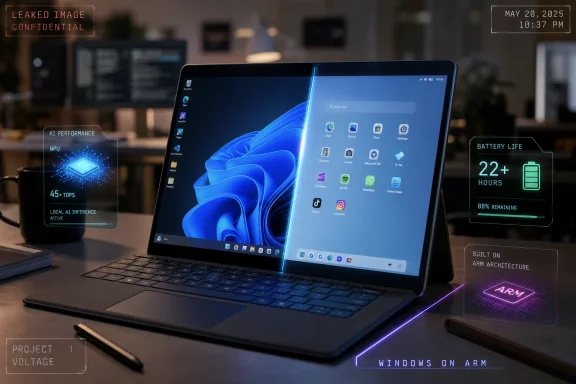
Futuristic Windows-on-ARM laptop on desk with HUD overlays showing AI performance and battery life.Microsoft’s Arm Bet Has Moved From Evangelism to Product Cadence​

For years, Windows on Arm was a promise that arrived in awkward installments. The Surface Pro X looked like the future, then spent too much time explaining why the present did not quite work. App compatibility, driver gaps, performance cliffs under emulation, and enterprise caution kept the category in a permanent state of “almost.”
The 2024 Copilot+ PC wave changed the tone. Snapdragon X Elite systems did not magically make every x86 assumption disappear, but they gave Windows on Arm something it had rarely enjoyed: mainstream credibility. Battery life improved, responsiveness improved, and Microsoft finally had a story that sounded less like an engineering demo and more like a laptop pitch.
The leaked Snapdragon X2 Elite Surface Pro image lands in that context. It suggests Microsoft is not treating the first Copilot+ generation as a one-off showcase, but as the beginning of a regular upgrade cycle. That is the crucial difference between a category experiment and a platform strategy.
Surface has always carried more symbolic weight than its market share alone would justify. OEMs watch it, IT departments benchmark against it, and Microsoft uses it to define the acceptable shape of Windows hardware. A Snapdragon X2 Elite Surface Pro would be Microsoft saying that Arm is no longer the alternate path for adventurous buyers; it is part of the main road.

The Leak Fits a Two-Track Surface Strategy​

Microsoft has already refreshed its Surface for Business portfolio with Intel Core Ultra Series 3 processors, upgraded displays, and business-first positioning. At the same time, the company has said Snapdragon X2 Surface models are coming later in 2026. That creates a familiar but increasingly consequential split: Intel first for the fleet buyer, Qualcomm next for the mobility-and-AI story.
That split is not just about silicon availability. It reflects the different anxieties of Microsoft’s customers. Enterprises still care deeply about driver support, manageability, old line-of-business software, VPN clients, endpoint security agents, and peripherals that may have been bought five procurement cycles ago. Consumers and mobile professionals, meanwhile, are easier to sell on battery life, instant wake, fan behavior, and AI branding.
Surface Pro sits directly across those worlds. It is sold as a tablet, used as a laptop, marketed as a creative device, and deployed in boardrooms, hospitals, classrooms, and field environments. That makes the chip choice unusually political. Intel represents continuity; Snapdragon represents the Windows Microsoft wants to build toward.
The interesting part is that Microsoft appears to be keeping both tracks alive. It is not forcing a single architecture decision across the Surface line, at least not yet. Instead, it is creating a market test: if the Snapdragon X2 Elite model delivers enough performance and compatibility, the argument for Intel in thin, detachable Windows machines becomes narrower.

Snapdragon X2 Elite Is Really a Test of Windows, Not Qualcomm​

Qualcomm’s second-generation PC silicon will naturally be judged by benchmarks. Reviewers will measure CPU gains, GPU improvements, NPU throughput, thermals, battery life, and whether the device throttles under sustained work. Those numbers will matter, especially in a Surface Pro chassis where heat and power budgets are unforgiving.
But the bigger test is Windows itself. A fast Arm chip is useful only if the operating system, app ecosystem, drivers, and management tools make the architecture feel invisible. Apple solved this problem by controlling the whole stack and forcing the transition through Rosetta, developer pressure, and relentless product execution. Microsoft does not have that luxury.
Windows is a federation of decades-old expectations. Users expect ancient utilities to run. Admins expect imaging tools and security stacks to behave. Developers expect local environments to work without architecture footnotes. Gamers expect anti-cheat systems and launchers to function. Every one of those expectations becomes a stress point for Arm.
That is why the Surface Pro leak is more than a hardware rumor. If Microsoft ships a Snapdragon X2 Elite Surface Pro as a flagship, it is implicitly promising that Windows on Arm is mature enough for fewer disclaimers. Not no disclaimers — that would be fantasy — but fewer of the kind that make buyers return machines after discovering one essential workflow is still x86-only in practice.

The Copilot+ Branding Is the Wrapper, Not the Core Story​

Microsoft will almost certainly frame the new Surface Pro around Copilot+ PC capabilities, local AI acceleration, and whatever Windows 11 features are ready when the device ships. That is the marketing layer. It is also the least interesting part for many WindowsForum readers, because the current AI PC pitch often feels ahead of the everyday software value.
The NPU arms race is real, and Snapdragon X2 is expected to push Qualcomm’s local AI performance beyond the first Snapdragon X generation. Microsoft wants developers to build for that hardware. It wants Windows to be seen as an AI-native client platform, not merely a place where cloud chatbots run in browser windows.
But for buyers, the practical questions are still more basic. Does Teams run all day without turning the tablet into a hand warmer? Does Outlook stop stuttering under a normal office load? Does Visual Studio Code feel native? Do printers, docks, smart cards, audio interfaces, and endpoint agents work? Does the machine sleep properly in a bag?
Those are not glamorous questions, but they decide whether a platform transition succeeds. The history of Windows on Arm is full of moments where the headline feature looked better than the lived experience. Snapdragon X2 Elite gives Microsoft a chance to reverse that pattern, but only if the mundane parts work.

Surface Pro Is the Hardest Place to Prove the Point​

A Surface Laptop can hide a lot. It has more space for battery, cooling, speakers, ports, and thermal headroom. A Surface Pro has to do nearly everything in a thin tablet body while pretending to be a no-compromise PC. That makes it the most ambitious and least forgiving member of the Surface family.
The detachable design also intensifies the battery-life argument. If Snapdragon X2 Elite can deliver strong performance without punishing battery life, Surface Pro becomes a more convincing travel machine, note-taking device, and meeting-room computer. If it cannot, the product risks feeling like an expensive compromise dressed up as innovation.
There is also a display and accessory story. Surface Pro buyers do not just buy a processor; they buy a screen, pen support, keyboard cover, stand, camera system, and a set of ergonomic trade-offs. Microsoft has spent years refining that formula, but the processor can still make or break the experience. A cool, quiet, always-ready Surface Pro feels magical. A hot, inconsistent one feels like a tablet losing an argument with a laptop.
The leaked image alone cannot answer which version Microsoft has built. But the very fact that a Snapdragon X2 Elite Surface Pro is visible enough to leak suggests the device is moving through the late stages of the usual product choreography. The real question is whether Microsoft has solved enough of the platform friction to let the hardware speak for itself.

The Missing “Extreme” Option Says Something About Surface Discipline​

Reports around the coming Surface wave have suggested Microsoft may avoid Qualcomm’s highest-end Snapdragon X2 Elite Extreme tier for this generation, focusing instead on X2 Plus and X2 Elite models. If accurate, that choice will disappoint spec hunters. It may also be the right call.
Surface Pro has never been a workstation, no matter how often marketing departments flirt with that idea. Its appeal is portability, flexibility, and premium fit-and-finish. Chasing the hottest chip in a detachable chassis can create a product that wins a slide and loses a lap.
The smarter Surface Pro strategy is to optimize for sustained responsiveness, battery life, thermals, and reliability. A chip that looks slightly less heroic on a comparison chart may make more sense if it lets the device remain thin, quiet, and predictable. Microsoft has learned, sometimes painfully, that Surface designs are judged as complete systems rather than motherboard showcases.
That restraint also helps keep the product line legible. If Microsoft wants extreme Arm performance, a laptop-class device is a better venue. A Surface Pro with Snapdragon X2 Elite should be the best expression of mobile Windows, not a detachable MacBook Pro rival with a kickstand.

Intel Still Owns the Comfort Zone​

None of this means Intel is being pushed out of Surface overnight. The business Surface launch made the opposite point. Microsoft still needs Intel because the Windows ecosystem still needs Intel, especially in organizations with complicated software estates.
For IT departments, architecture is not a lifestyle choice. It is a support burden. A single incompatible driver can block a deployment. A security product with incomplete Arm support can kill a pilot. A vendor’s “coming soon” statement can become six months of help-desk tickets. Intel PCs may be less exciting, but boring is often a procurement virtue.
That is why the Snapdragon X2 Surface Pro will likely be adopted unevenly. Consultants, executives, students, writers, developers with modern toolchains, and mobile workers may find it compelling. Specialized enterprise users may wait. Gamers and people dependent on niche hardware may remain better served by x86 machines.
Microsoft’s challenge is not to pretend those differences do not exist. It is to make the Arm option good enough that choosing Intel becomes a specific compatibility decision rather than the default safe answer. That is a much harder target than winning a benchmark, and much more important.

The Windows 11 Timing Is Part of the Product​

The Snapdragon X2 generation is also tied to a peculiar Windows release story. Microsoft has treated Windows 11 version 26H1 as a targeted release for new Snapdragon X2 devices rather than a broad update for the existing PC base. That makes the operating system part of the hardware launch in a way that Windows users are not always used to seeing.
In one sense, this is sensible. New silicon often needs platform enablement, firmware coordination, power-management work, and scheduler tuning that are irrelevant to older machines. A targeted release can be cleaner than pretending every Windows update must matter equally to every PC.
In another sense, it underlines how dependent Windows on Arm remains on tight coordination. Microsoft, Qualcomm, OEMs, app developers, and driver vendors all have to move together. If any one of those groups lags, the user experiences the result as a Windows problem.
A Snapdragon X2 Elite Surface Pro will therefore arrive as both a device and a referendum on Microsoft’s ability to orchestrate its ecosystem. The hardware can be elegant, but the platform must be ready on day one. Surface buyers tend to be less forgiving when the product carrying Microsoft’s own logo exposes Microsoft’s own gaps.

The Surface Pro Leak Is a Warning to OEMs​

If Microsoft puts Snapdragon X2 Elite into Surface Pro, other Windows OEMs will not be able to treat Arm as a boutique SKU. They will have to decide whether their premium ultraportables, detachables, and business notebooks need equivalent Arm options. Some already will. Others will hedge until buyer behavior is clearer.
That creates competitive pressure in two directions. Qualcomm gets a flagship Windows tablet that can anchor its PC ambitions. Intel gets a reminder that efficiency and AI acceleration are now central to the premium Windows story, not secondary features. OEMs get a signal that Microsoft expects architectural diversity to be normal.
The danger is fragmentation. Windows buyers already navigate a confusing mess of model numbers, processor tiers, NPU claims, OLED options, RAM ceilings, and keyboard bundles. Adding architecture-specific caveats can make that worse. A customer choosing between Intel Core Ultra and Snapdragon X2 should not need a compatibility matrix and a theology degree.
Microsoft’s job is to make the buying decision honest. If the Snapdragon Surface Pro is better for battery life and mobile AI but weaker for some legacy workflows, say so clearly. If the Intel model remains the safer enterprise default, say that too. The worst outcome would be another round of Arm PCs sold with glossy confidence and discovered through painful exceptions.

The Price Will Decide How Patient Buyers Are​

Surface has rarely been cheap, and a Snapdragon X2 Elite Surface Pro is unlikely to change that. The economics of a premium detachable already push buyers toward expensive configurations, because the keyboard and pen are often effectively part of the real purchase. Add OLED, more RAM, and larger storage, and Surface Pro pricing can climb quickly.
That matters because patience declines as price rises. A $699 experiment can have rough edges. A $1,799 productivity machine cannot. If Microsoft asks premium money for Snapdragon X2 Elite, it must deliver a premium level of confidence.
The RAM question is particularly important. Arm Windows machines lean heavily on unified memory, and AI workloads only increase pressure on capacity. A base model that technically qualifies for the product family but feels constrained after two years would undermine the “future-facing” pitch.
Storage is similar. Surface devices have often irritated power users with upgrade constraints and expensive jumps between configurations. If Microsoft wants the Snapdragon X2 Surface Pro to feel like a serious PC rather than a stylish appliance, the configuration ladder needs to respect how people actually use Windows machines in 2026.

The Real Upgrade Is Trust​

The leaked Surface Pro image is easy to treat as a gadget story: new chip, new device, coming soon. But the deeper story is trust. Microsoft is asking users to trust that Windows on Arm has crossed a threshold from intriguing to dependable.
Trust is earned in boring places. It is earned when a VPN connects, when a printer installs, when a dock wakes the monitor, when an app updater does not fail silently, when a Teams call does not spike the system, and when battery estimates resemble reality. It is earned when a user stops thinking about whether an app is native.
That is where Surface has an advantage. Microsoft can tune the firmware, drivers, display stack, camera experience, keyboard behavior, and Windows image more tightly than most partners. If any Windows on Arm device can feel coherent, it should be Surface.
But that also raises the standard. A rough Snapdragon X2 Surface Pro would not merely be a bad Surface. It would weaken Microsoft’s argument that Arm is ready for the mainstream Windows premium tier. The company has put its own brand in the witness chair.

The Clues That Matter Before Launch​

The coming months will determine whether this leak becomes a meaningful turning point or just another entry in the Surface rumor cycle. The image tells us Microsoft has a device story. It does not tell us whether the software story is finished.
Here is what Windows buyers and administrators should watch as the Snapdragon X2 Surface Pro moves from leak to launch:
  • Microsoft has already confirmed that Snapdragon X2 Surface models are coming later in 2026, so the leak reinforces an announced direction rather than inventing a new one.
  • The most important specs will not be peak CPU scores, but sustained performance, battery life, thermals, RAM options, and real-world compatibility.
  • Intel Surface models remain the safer business default where legacy software, drivers, and management tooling are non-negotiable.
  • The Snapdragon X2 Elite Surface Pro will succeed only if Windows on Arm feels ordinary during daily work, not impressive only during demos.
  • Pricing and configuration choices will determine whether buyers see the device as a premium PC or an expensive architecture gamble.
The Snapdragon X2 Elite Surface Pro, if it ships as expected, will not settle the Windows on Arm debate by itself. But it may mark the moment when Microsoft stops asking whether Arm belongs in Surface and starts asking how much of Surface’s future should be built around it. For Windows users, that is the real story hiding behind the leaked image: the next Surface Pro is not just a tablet refresh, but a measure of whether Microsoft can finally make a different kind of Windows PC feel like the normal one.

References​

  1. Primary source: thurrott.com
    Published: Wed, 03 Jun 2026 19:51:22 GMT
  2. Related coverage: windowscentral.com
  3. Related coverage: notebookcheck.net
  4. Related coverage: notebookcheck.info
  5. Related coverage: winbuzzer.com
  6. Related coverage: ebisuda.net
  1. Related coverage: techrepublic.com
  2. Related coverage: gizmochina.com
  3. Related coverage: phonearena.com
  4. Related coverage: tomshardware.com
  5. Related coverage: techradar.com
  6. Related coverage: pcworld.com
  7. Related coverage: windowslatest.com
  8. Related coverage: notebookcheck.com
  9. Related coverage: pcgamer.com
  10. Related coverage: tomsguide.com
  11. Official source: microsoft.com
  12. Related coverage: axios.com
  13. Official source: learn.microsoft.com
  14. Official source: support.microsoft.com
  15. Official source: news.microsoft.com
  16. Official source: blogs.windows.com
  17. Related coverage: itpro.com
 

Microsoft’s next 13-inch Surface Pro has reportedly appeared in retailer materials ahead of an alleged June 16 launch, showing a familiar detachable Windows tablet design upgraded with Qualcomm’s Snapdragon X2 Elite, up to 32GB of RAM, OLED display options, and a claimed 15.5 hours of local video playback. The leak, first surfaced through retail-channel reporting and echoed by follow-up coverage, suggests Microsoft is not preparing a dramatic Surface reinvention. It is preparing something more revealing: a confidence test for Windows on Arm after the first Copilot+ PC wave proved the concept but did not end the debate.

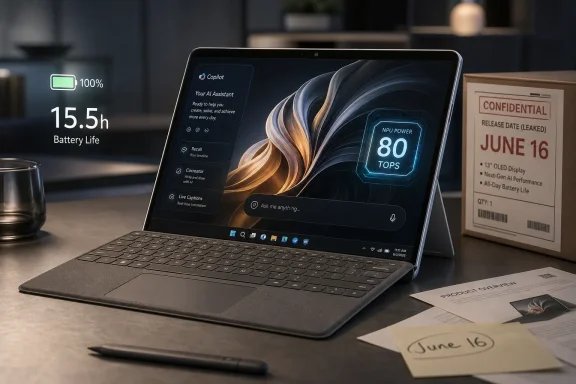
A laptop on a desk shows “Copilot” and “80 TOPS NPU power” specs, with battery life and a labeled box.Microsoft Is Betting That Familiar Hardware Can Sell a Platform Shift​

The most important detail in this leak is not the kickstand, the OLED panel, or even the rumored June 16 date. It is the absence of drama. If the leaked marketing material is accurate, Microsoft’s next Surface Pro looks substantially like the current Surface Pro because Microsoft wants the chip change to feel normal.
That is a strategic choice. Surface used to be Microsoft’s hardware provocation: a tablet that could be a laptop, a hinge that dared reviewers to complain, a keyboard cover that became a category. In 2026, the Surface Pro’s job is different. It is the reference PC that tells buyers, developers, and IT departments that Arm-based Windows is no longer an experiment.
That makes the rumored Snapdragon X2 Elite upgrade more consequential than the chassis suggests. The current Surface Pro generation helped establish the first serious Copilot+ PC wave, but it also arrived with the usual caveats around app compatibility, driver support, gaming, and enterprise readiness. A second-generation Arm Surface is Microsoft’s chance to argue that those caveats are shrinking faster than the reasons to buy Intel by default.
If the hardware barely changes, that is not laziness by accident. It is Microsoft trying to remove every variable except the platform itself.

The Snapdragon X2 Elite Is the Real Surface Redesign​

The leak points to a 12-core Snapdragon X2 Elite configuration rather than the most extreme version of Qualcomm’s new PC silicon. That matters because Surface Pro is thermally constrained, battery-conscious, and designed around mobility rather than benchmark theater. Microsoft does not need the fastest possible Snapdragon X2 part here; it needs the one that makes Windows feel quick while preserving the tablet’s thin-and-light identity.
Qualcomm’s second-generation PC push is built around a stronger CPU architecture, improved graphics, and an NPU rated at up to 80 TOPS. That last number will dominate the marketing because Copilot+ PCs are now sold as AI machines, but the CPU and platform maturity may matter more in daily use. Users notice whether apps launch quickly, whether sleep behaves, whether Teams and browser tabs chew through battery, and whether their old peripherals still work.
The rumored 32GB RAM ceiling is also significant. The first wave of Arm Windows devices often felt aimed at consumers and mobile professionals, even when Microsoft talked up enterprise. A 32GB Surface Pro does not turn a detachable tablet into a workstation, but it does give developers, analysts, consultants, and power users a more plausible configuration for serious multitasking.
The reported 1TB user-replaceable PCIe 4.0 SSD continues one of Surface’s more practical recent improvements. Microsoft will never be Framework, and Surface remains a tightly integrated device family, but replaceable storage gives IT departments and repair-minded users at least one lever for serviceability, data handling, and lifecycle management.

The OLED Screen Is No Longer the Headline​

The leak suggests Microsoft will retain a 13-inch OLED option, which is good news for anyone who values contrast, color, and premium tablet use. But OLED is not the story anymore. It has become table stakes for the higher end of the Surface Pro line.
That shift says something about how mature the detachable category has become. The Surface Pro’s display, kickstand, pen support, and keyboard ecosystem are known quantities. Microsoft does not have to explain the device class anymore; it has to justify the platform inside it.
That also means the display cannot rescue the machine from broader Windows-on-Arm skepticism. A beautiful OLED panel does not help if a crucial VPN client, scanner utility, endpoint agent, CAD plugin, or game anti-cheat system fails to cooperate. The Surface Pro’s premium hardware polish raises expectations, and those expectations increasingly land on the software stack.
Color changes will attract some attention, especially the reported disappearance of the Blue finish in favor of Black, Platinum, and Dune. But color is a retail story, not a platform story. The deeper question is whether Microsoft has made the Arm version of Surface Pro feel like the default Surface Pro rather than the interesting one.

Copilot+ Needs Better PCs More Than Better Slogans​

The rumored 80 TOPS NPU gives Microsoft an easy marketing number. It is also a trap. TOPS figures are useful for comparing hardware capability in a narrow sense, but they do not tell buyers whether the AI features are indispensable, privacy-preserving, fast, or meaningfully better than cloud-assisted alternatives.
Microsoft has spent the Copilot+ era trying to make local AI feel like a reason to buy new hardware. Some of that argument is technically sound. Running workloads on-device can reduce latency, avoid round trips to cloud services, and enable features that work without a constant connection. For privacy-sensitive environments, local processing can also be easier to justify than sending more data elsewhere.
But the consumer pitch has been uneven. Many users still understand Copilot primarily as a sidebar, a subscription feature, or a branding layer applied across Microsoft products. For the NPU to matter, Microsoft has to make local AI feel less like a spec-sheet promise and more like something that changes the rhythm of using a PC.
That is why a new Surface Pro is so important. Microsoft controls the hardware, the Windows image, the drivers, the firmware, and the demos. If Copilot+ cannot feel coherent on Surface, it will struggle to feel coherent across the wider Windows ecosystem.

Battery Life Is the Promise Windows Users Actually Understand​

The leaked 15.5-hour local video playback claim should be read carefully. Local video playback is a controlled workload, not a guarantee for a day of browser tabs, Slack, Teams, OneNote, remote desktop, and a dozen background agents. Still, battery life remains the simplest and most emotionally persuasive argument for Arm-based Windows.
For years, Windows ultraportables have improved, but they have rarely matched the combination of instant wake, quiet operation, standby endurance, and unplugged confidence that Apple’s Arm-based MacBooks made mainstream. Qualcomm and Microsoft know this. The Copilot+ label may be the banner, but battery life is the bridge.
Surface Pro is a particularly sharp test because it is not a conventional clamshell. Its tablet-first form factor leaves less room for battery and cooling, and its detachable keyboard changes how people use it throughout the day. A Surface Pro that lasts long enough to make chargers optional during normal work would do more for Windows on Arm than another AI demo.
The risk is that marketing claims outrun lived experience. If reviewers and early buyers find that real-world battery life is merely decent, the Snapdragon X2 Elite will be judged against the very expectations Qualcomm and Microsoft have raised. Efficiency is not a bonus feature here; it is the central bargain.

Compatibility Remains the Ghost in the Kickstand​

Windows on Arm is much better than it used to be. That is not the same as saying the compatibility question is over. The customers most likely to buy a premium Surface Pro are often the same customers with the strangest mix of legacy tools, corporate agents, browser extensions, external devices, and niche utilities.
For ordinary productivity, the picture is increasingly strong. Microsoft 365, modern browsers, mainstream communication apps, and many creative tools either run natively or acceptably through emulation. For users who live in Edge, Office, web apps, and cloud services, an Arm Surface can be a perfectly rational choice.
The trouble appears at the edges, and the edges are where IT gets nervous. Printer and scanner drivers, VPN stacks, security products, virtualization tools, old line-of-business apps, developer dependencies, and game compatibility can turn “mostly works” into a procurement headache. A single unsupported component can matter more than ten benchmark wins.
This is why Microsoft’s Surface strategy has to be more than launch-day hardware. The company needs developers to ship native Arm64 builds, vendors to update drivers, and enterprise software makers to treat Arm Windows as a first-class platform. The Surface Pro can showcase progress, but it cannot single-handedly close the ecosystem gap.

The 12-Core Choice Reveals Microsoft’s Priorities​

If the leaked configuration is correct, Microsoft is not chasing the absolute top Snapdragon X2 Elite Extreme tier for this Surface Pro. That will disappoint spec maximalists, but it may be the more coherent decision. A detachable tablet is the wrong place to win a desktop-class performance contest.
The choice suggests Microsoft is optimizing for balance: thermals, battery life, weight, sustained performance, and cost. Surface Pro buyers want speed, but they also want the machine to stay cool in tablet mode and quiet in a meeting. A faster chip that throttles or drains battery would undermine the device’s core identity.
There is also product segmentation to consider. Microsoft has to leave room for Surface Laptop, business configurations, and partner devices. If Surface Pro took the most aggressive chip and still had the limitations of a tablet form factor, it could create the wrong comparison both inside and outside Microsoft’s lineup.
Still, the decision carries risk. Premium Surface pricing has often asked buyers to pay more for fit, finish, and the Microsoft reference experience. If rival Snapdragon X2 laptops offer stronger silicon, more ports, larger batteries, or lower prices, Microsoft will need the Surface Pro’s versatility to do a lot of work.

Surface Pro Is Becoming Microsoft’s Arm Compliance Test​

For consumers, this leak is about whether to wait before buying a new 2-in-1. For Microsoft, it is about whether the company can normalize Arm across the Windows ecosystem without making users feel like early adopters. That is a much harder problem.
The first Copilot+ PC wave made Arm Windows visible again. It also forced old questions back into the open. Should buyers choose battery life over total compatibility? Should developers prioritize native Arm builds when x86 still dominates? Should IT departments certify a second architecture for users who may not need it?
A new Surface Pro with Snapdragon X2 Elite would arrive into that unresolved conversation. Its job is not just to be faster than the previous Surface Pro. Its job is to make the previous objections feel dated.
That is why the leak’s conservative industrial design is almost symbolic. Microsoft appears to be saying: this is still Surface Pro; only the assumptions have changed. The company wants the architecture transition to feel boring, because boring is what enterprise adoption looks like when it succeeds.

The Retail Leak Undercuts the Launch but Sharpens the Message​

Retail leaks are messy, but they often reveal how a company expects a product to be sold. In this case, the apparent emphasis is predictable: Snapdragon X2 Elite, Copilot+ capability, OLED, battery life, familiar design, premium finishes. That is not a bad pitch, but it is a narrow one.
The missing details matter. Pricing has not been confirmed. Exact configurations may vary by region. Keyboard and pen bundling will affect the real cost of ownership. Business availability, warranty options, and manageability details could determine whether this is a serious fleet candidate or primarily a premium consumer refresh.
The alleged June 16 timing also places Microsoft in a competitive window where AI PCs are no longer novel. Intel, AMD, Qualcomm, and Apple are all selling versions of the same broad idea: more local AI acceleration, better efficiency, and tighter integration between hardware and software. Microsoft cannot simply announce another Copilot+ device and expect the market to applaud.
The upside of the leak is that it gives the Surface Pro a cleaner frame before the official pitch machine starts. This looks less like a revolutionary tablet and more like a second-generation platform correction. That is less glamorous, but it may be exactly what Windows on Arm needs.

The Surface Brand Has to Earn Its Premium Again​

Surface has always occupied an unusual place in the Windows world. It is both a Microsoft product and a signal to OEMs. It competes with partners while also trying to define the standard they should chase.
That dual role becomes more complicated in the Snapdragon X2 era. If Microsoft’s own Arm hardware feels polished, reliable, and well-supported, it strengthens the whole Windows-on-Arm push. If it feels expensive, conservative, or compromised, it gives skeptics permission to wait another generation.
Surface fans have also become harder to impress. The Pro form factor is mature, and many longtime users want bigger leaps: better repairability, more ports, stronger lapability, lower keyboard prices, improved webcams, lighter designs, or more daring hardware. A chip refresh wrapped in a familiar shell can look underwhelming unless the experience changes enough to be felt.
That is the tension at the heart of this leak. Microsoft may be making the right engineering move by keeping the design stable and improving the silicon. But the Surface brand once trained users to expect visible invention. Now it has to persuade them that invisible platform maturity is worth paying for.

IT Departments Will Read the Leak Differently Than Consumers​

A consumer sees a thinner decision tree: wait for June 16, compare price and reviews, decide whether Snapdragon X2 is worth it. An IT department sees an architecture choice with operational consequences. That is where the Surface Pro’s success will be decided more slowly.
The questions are practical. Do endpoint security tools support Arm cleanly? Do deployment images and management policies behave the same way? Are firmware updates predictable? Are critical apps native, emulated, or blocked? Can help desks troubleshoot user issues without creating a separate playbook?
Microsoft has advantages here. It owns Windows, Intune, Defender, Office, and Surface. If any company can package Arm PCs into a manageable enterprise story, it should be Microsoft. But that also means the company has fewer excuses when the experience is uneven.
The leaked Surface Pro therefore functions as a kind of proof point. If Microsoft wants enterprises to believe Arm Windows is ready for broader use, Surface must be the machine that makes the case with the fewest asterisks.

The June 16 Surface Leak Leaves Buyers With a Short, Specific Checklist​

If the leaked June 16 launch window holds, buyers do not have long to wait. That makes the smart move obvious: anyone considering a premium Surface Pro should pause until Microsoft confirms the product, pricing, configurations, and availability. The rumor is credible enough to affect buying decisions, but incomplete enough to make pre-launch certainty foolish.
  • Buyers should wait for confirmed pricing because the value of the Snapdragon X2 Elite upgrade depends heavily on keyboard, pen, RAM, and storage bundles.
  • Windows-on-Arm skeptics should watch early reviews for app compatibility, driver behavior, standby reliability, and sustained performance rather than focusing only on benchmarks.
  • IT teams should treat the device as a candidate for pilot testing, not an automatic replacement for Intel-based Surface fleets.
  • The reported 80 TOPS NPU is meaningful only if Microsoft’s local AI features become useful enough to change daily workflows.
  • The familiar Surface Pro design suggests Microsoft is prioritizing platform maturity over hardware reinvention.
  • The rumored 15.5-hour video playback claim should be tested against real productivity workloads before anyone treats it as an all-day guarantee.
Microsoft’s next Surface Pro, if this leak is accurate, will not be remembered because it changed what a Surface looks like. It will matter because it tests whether Windows on Arm can finally become ordinary: not a developer curiosity, not a battery-life compromise, not an AI-branded side quest, but a mainstream Windows PC architecture that users can buy without keeping a mental list of exceptions. That is a less theatrical ambition than the Surface line once carried, but in 2026 it may be the more important one.

References​

  1. Primary source: Windows Report
    Published: 2026-06-03T21:52:06.999739
  2. Related coverage: qualcomm.com
  3. Related coverage: notebookcheck.net
  4. Official source: 9to5google.com
  5. Related coverage: gadgets360.com
  6. Related coverage: windowscentral.com
  1. Related coverage: computerbase.de
  2. Related coverage: techradar.com
  3. Related coverage: pcworld.com
  4. Related coverage: tomshardware.com
  5. Related coverage: profesionalreview.com
 

Leaked marketing material published this week points to a new 13-inch Microsoft Surface Pro with Qualcomm’s Snapdragon X2 Elite processor, OLED display, up to 32GB of RAM, and up to 1TB of storage, with an official announcement reportedly planned for June 16. The leak is not just another SKU shuffle in the Surface aisle. It suggests Microsoft is preparing to make Arm the default story for its most iconic Windows tablet again, this time with fewer apologies and a much harder performance pitch. For Windows users and IT buyers, the question is no longer whether Windows on Arm exists; it is whether Microsoft can finally make it feel boring enough to trust.

Secure tablet computer setup with Windows interface and shield icon in a modern office.Microsoft’s Arm Bet Is Moving From Experiment to Product Cadence​

Surface has always been Microsoft’s public argument about what Windows hardware should become. Sometimes that argument has been persuasive, as with the original Surface Pro line eventually dragging the PC industry toward detachable keyboards and pen-first workflows. Sometimes it has been a warning label, as with the early Windows RT era, when Microsoft’s Arm ambitions arrived before the software ecosystem was ready to meet them.
The leaked Snapdragon X2 Elite Surface Pro matters because it appears to continue a cadence rather than restart a crusade. The 2024 Copilot+ PC launch put Snapdragon X Elite and X Plus machines into the mainstream conversation, including the Surface Pro 11. The 2026 leak, if accurate, shows Microsoft treating Qualcomm’s next-generation platform not as a novelty but as the expected successor path for the consumer Surface Pro.
That is a subtle but important shift. A one-off Arm Surface can be dismissed as a showcase device. A second consecutive flagship generation starts to look like product strategy.
It also places pressure on Intel in a way Microsoft has historically avoided. Surface has long been a diplomatic platform, giving Intel, AMD, Qualcomm, and occasionally more exotic silicon partners a chance to fit into the Windows roadmap. But a premium Surface Pro built around Snapdragon X2 Elite would make clear that Microsoft sees Arm as more than a battery-life variant.

The Leak Tells a Familiar Surface Story With New Silicon​

The reported configuration is exactly the kind of Surface spec sheet Microsoft likes: thin tablet body, OLED display, premium memory and storage tiers, and detachable keyboard and pen accessories sold as part of the broader ecosystem rather than always bundled in the box. Nothing about that formula is surprising. The surprise is that the silicon is now doing more of the storytelling than the hinge, kickstand, or pen.
Qualcomm’s Snapdragon X2 Elite family was introduced as the second generation of the company’s Windows PC push, following the Snapdragon X Elite chips that helped define the first Copilot+ PC wave. The headline claims around the X2 generation have centered on more CPU headroom, stronger graphics, and an NPU intended to keep pace with Microsoft’s local AI requirements. In plain terms, Qualcomm wants the X2 generation to be judged less like a mobile chip that can run Windows and more like a PC platform that happens to use Arm.
That distinction matters for Surface Pro. A detachable tablet has less thermal room than a conventional laptop, so Microsoft has to balance the promise of performance with the reality of sustained workloads. Surface Pro buyers do not expect workstation behavior from a slate, but they do expect the machine to feel premium when multitasking, driving external displays, editing photos, joining long video calls, and surviving a day away from power.
The leaked 32GB RAM and 1TB storage ceiling also tells us where Microsoft likely wants to position the device. This is not just a student note-taking tablet or a couch computer. It is a machine for consultants, developers, executives, creators, and IT-managed professionals who want a single Windows device that can pass as both tablet and laptop without feeling like a compromise in either role.

Windows on Arm’s Real Enemy Was Never the CPU Benchmark​

For years, the debate around Windows on Arm was flattened into benchmark theater. Could it beat Intel here? Could it match Apple there? Would an emulated app lose 10 percent or 40 percent? Those questions still matter, but they were never the whole problem.
The deeper issue was trust. Windows users carry decades of assumptions about peripherals, utilities, VPN clients, printer drivers, audio tools, game launchers, developer dependencies, and obscure line-of-business applications. The Windows promise is not elegance; it is that the thing you need will probably run, even if it looks like it was designed during the Bush administration.
Arm challenges that promise at the edges. Microsoft’s modern emulation layer is far better than the early Windows RT disaster or the first Snapdragon PC efforts. Windows 11 can run many x86 and x64 applications on Arm, and native Arm64 software has grown meaningfully. But kernel drivers still need native Arm64 builds, and that single sentence explains why IT departments remain cautious.
A Surface Pro with Snapdragon X2 Elite can be fast, efficient, and beautifully built, but it cannot repeal the laws of enterprise compatibility. If a business depends on a hardware dongle, a legacy security agent, a niche print driver, or a VPN client that is not Arm-ready, the experience can still collapse into a support ticket. That is why Microsoft’s strongest argument is not just performance; it is ecosystem maturity.

Copilot+ PCs Need Hardware That Feels Normal​

Microsoft’s Copilot+ PC branding was built around the NPU, local AI features, and a new baseline for Windows laptops. The early rollout was messier than Microsoft wanted, especially after the Recall controversy forced the company to rework how it presented security and privacy around local activity capture. But the hardware direction did not go away.
The Snapdragon X2 Elite Surface Pro leak should be read in that context. Microsoft needs Copilot+ PCs to stop feeling like a special category and start feeling like the normal premium Windows purchase. Surface Pro is the right stage for that transition because it is already a device people understand as slightly futuristic but still practical.
The danger is that “AI PC” branding can obscure more useful improvements. Most users will notice battery life, standby reliability, fan noise, app responsiveness, display quality, webcam performance, and cellular connectivity before they notice whether an AI model ran locally or in the cloud. If Snapdragon X2 Elite helps the Surface Pro deliver those everyday wins, Copilot+ becomes a bonus rather than the burden of the sales pitch.
That is where Microsoft has to be disciplined. The best version of this device is not a tablet that constantly reminds users it is running AI features. It is a Windows PC that wakes instantly, lasts through travel, handles Teams and Edge and Office without drama, and occasionally performs local AI tasks quickly enough that users stop thinking about the plumbing.

The Surface Pro Is Still a Compromise Machine by Design​

Every Surface Pro generation lives inside the same unresolved bargain. It is a tablet that wants to replace a laptop, and a laptop that becomes less laptop-like the moment you use it anywhere other than a desk. The kickstand and detachable keyboard are brilliant in a conference room and awkward on a cramped airplane tray. The pen is useful if your workflow includes ink, markup, drawing, or whiteboarding, and decorative if it does not.
Snapdragon X2 Elite does not change that physical equation. What it can change is how much performance and endurance Microsoft can pack into the same kind of chassis. If the chip allows a thinner, cooler, longer-lasting Surface Pro without sacrificing responsiveness, that strengthens the product’s core argument.
But the leak also hints at the familiar Surface pricing trap. A high-end OLED configuration with 32GB of RAM and 1TB of storage will almost certainly land in premium territory, and Surface keyboards and pens have historically added real cost to the package. Microsoft can advertise the tablet price, but most buyers experience Surface Pro as a bundle.
That matters because competition is no longer theoretical. Apple’s iPad Pro dominates the pure tablet conversation, while the MacBook Air sets a brutal standard for battery life and quiet performance in a traditional laptop shape. On the Windows side, Lenovo, HP, Dell, ASUS, and others have become much more aggressive with OLED panels, convertible designs, and Arm or x86 Copilot+ hardware. Surface Pro has prestige, but prestige is not immunity.

IT Departments Will Read the Leak Differently Than Consumers​

For enthusiasts, the leaked Surface Pro is a performance and design story. For IT departments, it is a deployment story. The difference is everything.
A consumer can buy a Snapdragon Surface, discover one app or peripheral does not behave, and decide whether the tradeoff is acceptable. A company rolling out hundreds or thousands of devices has to validate security tools, management agents, firmware servicing, docking behavior, VPN compatibility, printer fleets, accessibility hardware, and application packaging before anyone gets excited about battery life.
Microsoft knows this, which is why its Arm messaging to businesses has increasingly emphasized manageability, App Assure support, and compatibility guidance. But enterprise confidence does not come from a keynote. It comes from pilots that do not generate surprise escalations.
The Surface Pro form factor adds another layer. Many businesses like it for field work, healthcare, sales, inspection, and executive mobility because it can be carried, docked, touched, inked, and used in tight spaces. Those are also environments where peripheral compatibility and device durability become more important than benchmark wins.
If Microsoft wants Snapdragon X2 Surface devices to move beyond the executive toy category, it has to make the operational case. That means predictable firmware updates, clear lifecycle support, stable docking, strong driver availability, and honest compatibility documentation. The faster chip gets Microsoft into the room; the boring parts close the deal.

Qualcomm’s Second Generation Has Less Room for Excuses​

The first Snapdragon X generation benefited from surprise. Reviewers and users saw Windows on Arm machines that were finally competitive in ways earlier attempts were not. Battery life was strong, performance was credible, and the app situation was no longer an automatic dealbreaker for mainstream productivity.
The second generation will be judged more harshly. That is normal. Once a platform proves it can exist, the next question is whether it can improve quickly enough to justify trust.
Snapdragon X2 Elite needs to show gains in sustained performance, GPU capability, external display handling, native developer workflows, and emulation edge cases. Qualcomm also has to fight the perception that Windows on Arm is excellent for Microsoft’s preferred demo apps but less certain once users leave the curated path. That perception is not entirely fair, but it is grounded in years of Windows history.
Microsoft’s role is equally important. Surface gives Qualcomm credibility, but Surface also exposes Qualcomm to the most demanding Windows audience. Enthusiasts will test old utilities, niche games, virtualization tools, audio interfaces, scanners, docks, and development stacks. If the experience is good, the narrative improves quickly. If it is uneven, the old Windows on Arm skepticism returns with receipts.

The Timing Suggests a Broader Surface Reset​

The reported June 16 announcement window would come after a busy period for Surface and Windows hardware. Microsoft has been pushing new Surface devices for business, developer-focused machines, and next-generation silicon partnerships. A Snapdragon X2 Elite Surface Pro would fit into a larger portfolio where Microsoft is no longer trying to make one Surface device carry every message.
That may be the smartest part of the strategy. The Surface Pro can be the mobile, flexible, Arm-forward Windows flagship. Intel-based Surface systems can serve customers who need traditional compatibility and predictable enterprise deployment. More powerful developer or creator hardware can explore GPU-heavy AI workloads without forcing the tablet to pretend it is a workstation.
This segmentation is healthier than the old Surface habit of implying one device could be everything to everyone. A Surface Pro is not a gaming laptop, not a desktop replacement, and not the best typing experience for every road warrior. It is a premium detachable Windows machine. If Microsoft presents it honestly, the Snapdragon X2 Elite version has a clearer job to do.
The risk is marketing inflation. If Microsoft sells the device primarily as an AI revolution, it invites disappointment from users who simply want a better PC. If it sells it as the most mature expression yet of Windows on Arm in a Surface Pro body, the claim is narrower and more credible.

The Leak Is Really About Confidence​

The most interesting thing about the leaked Surface Pro is not that Microsoft may announce another Surface. Microsoft announces Surface hardware all the time. The interesting thing is that the company appears willing to let Qualcomm sit at the center of one of its most visible Windows products again, after years in which Arm was both the future and the caveat.
That confidence is not baseless. The Windows on Arm software picture is better, native Arm64 applications are more common, and Microsoft’s own development tools are in a stronger place than they were during earlier pushes. The industry is also more receptive to heterogeneous computing, NPUs, and battery-first laptop design than it was when Windows RT tried to explain itself to a skeptical world.
But confidence can shade into overreach. Microsoft must avoid pretending that Arm compatibility is a solved problem for everyone. It is solved for many mainstream users. It is improving for developers. It is still conditional for organizations with legacy dependencies, kernel-level tools, specialized peripherals, or strict validation requirements.
That distinction is the difference between a successful product and another round of backlash. Windows users do not mind tradeoffs when they are named. They resent discovering them after purchase.

The June Surface Story Has a Few Hard Edges​

If the leak holds, the next Surface Pro will not be judged by its spec sheet alone. It will be judged by whether Microsoft can make the Arm transition feel ordinary, whether Qualcomm can deliver a second-generation leap, and whether the total package is priced like a serious PC rather than an accessory-dependent luxury tablet.
  • The leaked device reportedly centers on a 13-inch Surface Pro design with Snapdragon X2 Elite, OLED, up to 32GB of RAM, and up to 1TB of storage.
  • The reported June 16 announcement would position the device as part of Microsoft’s 2026 Surface refresh rather than a distant roadmap promise.
  • The biggest practical question remains software and driver compatibility, especially for business users with legacy tools or hardware-dependent workflows.
  • The Snapdragon X2 Elite generation needs to improve not just peak performance but sustained behavior, graphics, emulation, and platform reliability.
  • Microsoft’s strongest pitch will be a better everyday Windows tablet-laptop, not another round of vague AI hardware enthusiasm.
  • Buyers should treat the keyboard, pen, warranty, dock, and configuration price as part of the real Surface Pro cost, not optional trivia.
The leaked Snapdragon X2 Elite Surface Pro looks less like a surprise and more like a checkpoint: Microsoft has spent years trying to make Windows on Arm credible, and now it has to make it routine. If the June announcement delivers a fast, cool, long-lived Surface Pro that runs the software people actually need, Microsoft will have moved the argument forward. If it leans too hard on AI slogans while compatibility caveats remain in the fine print, the company will have proved only that the future of Windows still depends on the oldest PC virtue of all: trust.

References​

  1. Primary source: Neowin
    Published: Wed, 03 Jun 2026 19:10:00 GMT
  2. Independent coverage: Liliputing
    Published: Wed, 03 Jun 2026 18:09:44 GMT
  3. Related coverage: windowscentral.com
  4. Related coverage: t3.com
  5. Related coverage: tomsguide.com
  6. Related coverage: notebookcheck.net
  1. Related coverage: techrepublic.com
  2. Related coverage: winbuzzer.com
  3. Related coverage: phoronix.com
  4. Related coverage: pcworld.com
  5. Related coverage: windowsreport.com
  6. Related coverage: techspot.com
  7. Related coverage: tomshardware.com
  8. Related coverage: qualcomm.com
  9. Official source: news.microsoft.com
  10. Official source: microsoft.com
 

Microsoft’s next 13-inch Surface Pro is reportedly set for a June 16 reveal with Qualcomm’s Snapdragon X2 Elite, a 13-inch OLED display, 32GB of soldered memory, replaceable PCIe 4.0 storage, and an 80 TOPS neural processor for Copilot+ workloads. The leak matters less because it describes another Surface spec bump and more because it suggests Microsoft is preparing to make Windows on Arm the premium Surface story again. After years of hedging between Intel compatibility and Arm efficiency, Redmond appears to be building a two-track Surface lineup in which x86 is the safe business default and Arm is the bet on where Windows is supposed to go next.
That is a familiar promise, and Surface buyers have heard versions of it before. But the timing is different now. Qualcomm’s second-generation PC silicon, Microsoft’s increasingly aggressive Copilot+ branding, and the slow normalization of Arm-native Windows apps give this rumored Surface Pro a sharper edge than the awkward Surface Pro X era ever had.

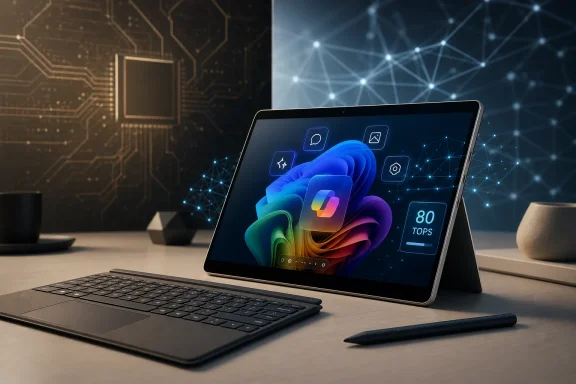
Laptop with colorful Windows logo and “80 TOPS” display on a desk, set against a futuristic circuit backdrop.Microsoft’s Surface Strategy Is Becoming a Split-Screen Story​

The reported Surface Pro 13-inch does not arrive in a vacuum. Microsoft recently moved its business Surface line forward with Intel Core Ultra Series 3 processors, including updated Surface Laptop and Surface Pro models aimed at organizations that still prize predictable manageability, established drivers, and application certainty. That is the conservative half of the story.
The other half is the Arm push. Microsoft has already said Snapdragon X2-based Surface models are coming later this year, and this leak appears to put shape around one of the flagship devices. If the June 16 date holds, Microsoft will be doing what it increasingly likes to do with Surface: using hardware not merely to sell hardware, but to signal where Windows itself is headed.
That signal is important because Surface has rarely been about market share alone. The line exists as a reference design, a pressure tactic against OEMs, and a showcase for Windows features that may feel abstract on a spec sheet. A Snapdragon X2 Elite Surface Pro would be Microsoft telling the PC ecosystem that Arm is no longer the experimental branch; it is part of the main road.
The company still needs Intel, of course. Corporate Windows fleets are not going to abandon decades of x86 assumptions because a tablet promises better battery life and AI acceleration. But Microsoft can now present Intel Surface systems as the dependable choice and Snapdragon Surface systems as the aspirational one. That division may be awkward, but it is also strategically useful.

The Snapdragon X2 Elite Leak Is About More Than Core Counts​

The reported chip configuration is intriguing because it points to the Snapdragon X2 Elite rather than the most extreme possible Qualcomm option. The leak describes a 12-core Oryon design paired with 32GB of soldered RAM and an 80 TOPS Hexagon NPU. On paper, that is enough to place the device firmly in the Copilot+ PC category while avoiding the thermal and pricing implications of the highest-end Snapdragon X2 Elite Extreme tier.
That choice says something about the Surface Pro form factor. A detachable tablet is not a workstation, no matter how often vendors photograph it next to a stylus, a coffee cup, and a rendered 3D model. Microsoft has to fit performance, thermals, battery life, display quality, and thinness into a chassis that still needs to work comfortably as a tablet. The fastest chip is not automatically the best chip for that job.
The 80 TOPS NPU number will inevitably feature in marketing because it is easy to print and hard to contextualize. TOPS, or trillions of operations per second, has become the horsepower rating of the AI PC era: useful in broad comparisons, but not a guarantee that the software stack will make your daily work feel dramatically faster. Still, it matters because Microsoft is tying more Windows features to local AI acceleration rather than cloud-only processing.
The more interesting question is not whether 80 TOPS sounds impressive. It is whether Microsoft can make those TOPS visible to normal users without turning Windows into a bundle of demos. Recall, Click to Do, Studio Effects, live captions, local image generation, and future agentic features all need hardware headroom. But they also need trust, polish, and a reason to be used after the novelty fades.

The Surface Pro Is Still the Hardest PC to Get Right​

The Surface Pro remains one of Microsoft’s most influential designs because it is also one of the most compromised. It tries to be a tablet, a laptop, a digital notebook, a portable meeting machine, and a premium Windows showcase. Every generation improves some part of that equation, but the basic tension never disappears.
A Snapdragon X2 Elite model sharpens that tension. Arm should help with battery life, standby behavior, fan noise, and always-ready portability — precisely the qualities a tablet-first device needs. If Microsoft can deliver those gains while keeping performance credible, the Surface Pro becomes a better expression of its original promise.
But the Surface Pro also asks buyers to accept the detachable keyboard tax, the lapability trade-off, and the reality that Windows remains a desktop-first operating system wearing some tablet clothing. The optional Surface Pro Flex Keyboard sounds useful, especially if it again supports both attached and wireless use, but “optional” is doing a lot of work in Surface pricing. A Surface Pro without a keyboard may be technically complete, but few Windows users experience it that way.
The reported OLED display is another premium marker. Microsoft’s 13-inch Surface Pro line already moved into OLED territory in recent generations, and a refreshed model with another OLED panel would make sense for a high-end Arm device. For media, inking, presentation work, and general perceived quality, OLED helps Surface feel expensive in a way a processor spec never can.

Replaceable Storage Is the Quietly Sensible Part of the Leak​

The leaked storage story is more practical than glamorous. Reported configurations include 256GB, 512GB, and 1TB SSD options, with PCIe 4.0 storage and a replaceable SSD. That matters because Surface has not always been friendly to repair, upgrade, or service conversations, even as Microsoft has improved its posture in recent years.
A replaceable SSD does not turn the Surface Pro into a Framework-style modular machine. The memory is still reportedly soldered, and most buyers will not open the device. But storage replacement is valuable for business serviceability, data retention policies, end-of-life handling, and users who refuse to pay steep vendor premiums for capacity they might outgrow.
It also creates a useful distinction between memory and storage. If the leaked 32GB RAM figure applies broadly to this Snapdragon X2 Elite configuration, Microsoft may be avoiding one of the most irritating AI PC compromises: selling a premium machine with memory that feels barely adequate two years later. Soldered RAM is defensible in this form factor, but undersized soldered RAM is not.
The 256GB base storage option, if it ships on a high-end configuration, will still deserve scrutiny. Windows, recovery partitions, Office, Teams caches, local AI models, development tools, and creative apps can make 256GB feel cramped quickly. Replaceable storage softens that problem, but it does not erase the optics of a premium PC starting with entry-level capacity.

Windows on Arm Is Better, but Compatibility Is Still the Sales Objection​

The leak reportedly points to x86 emulation support, which is both necessary and slightly revealing. Nobody buys a Windows PC because it can run only the modern, clean, Arm-native future. They buy a Windows PC because it runs the messy present: old utilities, VPN clients, printer software, line-of-business tools, obscure installers, shell extensions, and that one accounting package nobody wants to touch.
Windows on Arm has improved dramatically since the Surface Pro X. App compatibility is broader, emulation is better, and major developers have had more time to ship native Arm64 builds. Browsers, Office, Teams, many creative tools, and core productivity apps are no longer the problem they once were.
But for IT departments, “mostly fine” is not the same as “fleet ready.” Kernel-level drivers, endpoint security tools, virtualization workflows, developer dependencies, hardware peripherals, and niche business software remain the areas where Arm compatibility can turn from a benchmark story into a help desk ticket. This is why Microsoft’s Intel-first business launch makes sense even as it talks up Snapdragon models.
For enthusiasts, the question is simpler but no less important: will the apps you personally care about run well? If the answer is yes, the Snapdragon Surface Pro could feel like the version of the device Microsoft has been trying to build for a decade. If the answer is no, no amount of NPU marketing will matter.

Copilot+ PCs Need a Reason to Exist Beyond the Sticker​

The rumored Surface Pro is almost certainly a Copilot+ PC, and that label is now central to Microsoft’s consumer Windows hardware pitch. Copilot+ began as a way to distinguish machines with sufficiently powerful NPUs for local AI features. It is now becoming something broader: a branding umbrella for the next Windows experience Microsoft wants to sell.
That makes the Surface Pro 13-inch a test of whether Copilot+ is becoming useful or merely unavoidable. Microsoft has spent the last two years trying to make AI feel native to Windows rather than bolted onto the taskbar. Some features are genuinely practical; others feel like early-stage experiments waiting for better integration, clearer privacy controls, and real user habits.
The NPU helps only if the operating system and apps use it well. Local inference can reduce latency, improve privacy, and lower cloud dependency, but the value is workload-specific. A user who spends the day in browser tabs and remote desktops may not notice much. A user who relies on live captions, background effects, image tools, search recall, dictation, or AI-enhanced productivity workflows may notice more.
The danger for Microsoft is overpromising the AI PC moment. Buyers understand battery life, display quality, keyboard feel, app compatibility, and price. They do not yet have the same intuitive grasp of why an 80 TOPS NPU should change their next laptop purchase. Surface is Microsoft’s chance to make that argument in hardware, not just in keynote language.

Battery Life Is Where the Rumor Meets Reality​

The reported battery estimate of up to 15.5 hours of video playback sounds plausible and marketable, but local video playback is one of the friendliest battery tests a modern PC can face. It says less about a real workday full of browser tabs, Teams calls, OneDrive sync, Bluetooth accessories, background indexing, and mixed native and emulated apps. Surface buyers should treat the number as a ceiling, not a promise.
That said, battery life is where Arm can still make its strongest emotional argument. Users may forgive a modest benchmark deficit if the device wakes instantly, runs cool, lasts through travel, and does not sound like it is preparing for takeoff during a video call. The Surface Pro form factor benefits disproportionately from those qualities because it is meant to be carried, held, and used away from a desk.
Intel has improved efficiency, and modern Core Ultra chips are far from the hot, short-lived ultrabook CPUs of old. But Qualcomm’s pitch remains attractive in thin devices: strong performance per watt, integrated connectivity potential, and a smartphone-like expectation of standby behavior. Microsoft does not need Snapdragon X2 Elite to beat every x86 chip in every workload. It needs it to make the Surface Pro feel less like a laptop pretending to be a tablet.
The risk is that Windows itself can blunt the advantage. Background processes, legacy app behavior, driver differences, and web workload sprawl all influence battery life. A great Arm chip inside a Windows machine still lives in the Windows ecosystem, with all the flexibility and chaos that implies.

The Optional Keyboard Problem Has Never Gone Away​

The reported Surface Pro 13-inch Flex Keyboard is exactly the sort of accessory Microsoft loves: technically clever, visually polished, and very likely expensive. The ability to use the keyboard attached or wirelessly is not a gimmick. It can make a Surface Pro more comfortable on a cramped desk, a couch, or a meeting room table, and it reinforces the device’s hybrid identity.
But Surface pricing has long depended on a strange fiction. Microsoft sells the Pro as a tablet, then markets it as a laptop replacement, while the keyboard and pen often remain separate purchases. That may be defensible in product segmentation terms, but it makes price comparisons messy and sometimes unflattering.
If this Snapdragon X2 Elite model lands as a premium device, the real-world bundle price will matter more than the starting price of the tablet alone. A buyer who wants the OLED display, 32GB of RAM, 1TB of storage, keyboard, pen, and warranty coverage may quickly move from “premium portable” to “why not buy a laptop and an iPad?” territory. Surface has always lived dangerously close to that comparison.
The Alcantara keyboard finish, reportedly returning in matching colors, will please some longtime Surface fans and worry others who remember wear, staining, and texture changes over time. Microsoft’s industrial design remains one of Surface’s strengths, but materials choices are not just aesthetic. They affect how a device ages.

The June 16 Date Would Put Microsoft Back in the Arm Spotlight​

A June 16 reveal would give Microsoft a neatly timed second act after its Intel business Surface announcements. It would also let the company talk about Windows on Arm while Computex-era PC news is still fresh and while Qualcomm’s Snapdragon X2 story has momentum. The calendar is part of the message.
The rumored colors — Black, Platinum, and Dune — suggest Microsoft is not planning a radical redesign. That is probably wise. The Surface Pro silhouette is recognizable, and the market does not need a new hinge experiment every cycle. The battle is now inside the chassis: silicon, thermals, battery behavior, display quality, and software.
A conservative exterior also helps Microsoft frame the device as continuity rather than risk. The company can say, in effect, that this is the Surface Pro users already understand, now with a more efficient Arm platform and stronger AI hardware. That is a much easier sell than asking buyers to embrace both a new architecture and an unfamiliar form factor at the same time.
Still, leaks are leaks. Final configurations, prices, regional availability, business versus consumer positioning, and ship dates may differ. The most important unknown is not whether the device exists, but where Microsoft places it in the lineup. A Snapdragon Surface Pro can be a halo product, a mainstream option, or an expensive curiosity depending on pricing.

Enterprise IT Will Read the Fine Print Before the Hype​

For IT pros, the rumored Surface Pro is interesting but not automatically deployable. The Surface brand carries enterprise credibility, but Arm introduces validation work that many organizations would rather avoid unless there is a clear payoff. That payoff could be battery life, portability, security features, or better support for AI-enabled workflows.
The first question will be application compatibility. The second will be device management. The third will be supportability over a normal corporate lifecycle. Microsoft can answer some of that through Windows, Intune, firmware management, and Surface support channels, but every organization has its own software graveyard.
There is also a procurement question. If Intel Surface Pro systems are available now and Snapdragon X2 models arrive later, businesses may choose the platform that fits refresh schedules rather than the one that looks more future-facing. Corporate fleets move on budget cycles, not keynote cycles.
Security-minded buyers will watch the AI features closely. Local processing can be a privacy advantage, but features that index user activity, inspect screen contents, or integrate deeply with productivity data need clear controls. Microsoft has learned, sometimes painfully, that AI features in Windows must be designed for trust as much as capability.

The Real Upgrade Is Microsoft’s Confidence​

What makes this leak notable is not any single specification. OLED is expected. USB-C 4.0 is expected. Replaceable SSDs are welcome but not revolutionary. An 80 TOPS NPU is impressive, but it belongs to the broader Snapdragon X2 platform story.
The notable part is Microsoft’s apparent confidence that a flagship Surface Pro can again lead with Arm. That was not always obvious. The Surface Pro X was beautiful but compromised, a device whose hardware ambition outpaced Windows on Arm’s software readiness. The first Copilot+ wave improved the equation, but still had to prove that Arm PCs could be normal PCs, not special-case machines for patient early adopters.
A Snapdragon X2 Elite Surface Pro would enter a different market. Users are more familiar with Arm laptops because Apple forced the industry to take the architecture seriously. Developers have had more time to adapt. Microsoft has had more time to improve emulation and align Windows features around NPUs. Qualcomm has had another generation to address performance and efficiency.
That does not guarantee success. But it does mean the conversation can move from “does Windows on Arm work?” to “is this the better Surface Pro?” That is the question Microsoft has wanted buyers to ask all along.

The Surface Pro Leak Draws a Cleaner Map for Buyers​

If the leak holds, the buying logic around Microsoft’s 2026 Surface lineup becomes clearer, even if the lineup itself becomes more crowded. The Intel systems are the known quantity. The Snapdragon systems are the mobility and AI bet. The trick is matching the machine to the workload rather than treating one architecture as universally superior.
  • The rumored Surface Pro 13-inch is best understood as an Arm-first premium refresh, not merely a faster version of the Intel business model.
  • The reported Snapdragon X2 Elite and 80 TOPS NPU would make the device a serious Copilot+ showcase, but AI performance will matter only where Windows and apps use it well.
  • The replaceable PCIe 4.0 SSD is a practical win for serviceability and long-term storage flexibility, even though soldered memory still limits upgradeability.
  • The biggest remaining risk is not raw performance but compatibility with older apps, drivers, peripherals, and enterprise tools.
  • The final value judgment will depend heavily on Microsoft’s bundle pricing for the tablet, Flex Keyboard, Slim Pen, storage upgrades, and warranty coverage.
The rumored Surface Pro 13-inch with Snapdragon X2 Elite looks less like a surprise and more like the next logical step in Microsoft’s long campaign to make Windows on Arm feel ordinary. If Microsoft gets the pricing, compatibility, and battery-life story right, June 16 could mark the moment Surface stops apologizing for Arm and starts using it as the reason to buy.

References​

  1. Primary source: TechJuice
    Published: 2026-06-04T14:43:09.153918
  2. Related coverage: windowscentral.com
  3. Related coverage: phonearena.com
  4. Related coverage: frandroid.com
  5. Related coverage: notebookcheck.com
  6. Related coverage: windowsforum.com
  1. Related coverage: gadgetsnow.indiatimes.com
  2. Official source: 9to5google.com
  3. Related coverage: notebookcheck.net
  4. Official source: microsoft.com
  5. Related coverage: fanaticosdelhardware.com
  6. Related coverage: thurrott.com
  7. Related coverage: itpro.com
  8. Related coverage: tomshardware.com
  9. Related coverage: techradar.com
  10. Official source: news.microsoft.com
  11. Official source: cdn-dynmedia-1.microsoft.com
  12. Related coverage: qualcomm.com
  13. Official source: support.microsoft.com
  14. Related coverage: insight.com
  15. Related coverage: pcgamer.com
 

Microsoft’s next 13-inch Surface Pro has reportedly leaked ahead of an expected June 16, 2026 reveal, with early specifications pointing to Qualcomm’s Snapdragon X2 Elite processor, an OLED option, up to 32GB of LPDDR5X memory, removable SSD storage, and an 80 TOPS neural processor. If accurate, this is not just a routine Surface refresh. It is Microsoft’s clearest attempt yet to make Windows on Arm feel less like an experiment and more like the default premium Windows experience. The risk is that Microsoft is once again asking buyers to believe in a platform transition before every part of the ecosystem has fully caught up.

Tablet on a desk with a stylus, keyboard, and highlighted Snapdragon X2 Elite NPU specs.Microsoft’s Surface Bet Has Moved From Form Factor to Silicon​

For most of its life, Surface Pro has been defined by the hinge, the kickstand, and the detachable keyboard. Microsoft’s pitch was that the PC did not have to choose between tablet and laptop, even if the market often treated the result as a compromise. The Surface Pro became the device Microsoft used to show OEMs what Windows hardware could be, even when OEMs were not always eager to follow.
That argument has changed. The form factor is now familiar, widely copied, and no longer enough to carry the story. The leak around this new Surface Pro 13 suggests Microsoft’s real message for 2026 is not “look at our tablet,” but “look at our chip strategy.”
That matters because the last two years have been the most serious Windows-on-Arm push Microsoft has ever mounted. The Snapdragon X Elite generation finally made Arm PCs plausible for mainstream Windows users, especially those who valued battery life and quiet operation more than legacy edge cases. The rumored Snapdragon X2 Elite Surface Pro would test whether Microsoft can move from plausibility to preference.
The leaked spec sheet reads like a checklist for that ambition: a 13-inch PixelSense Flow display, OLED at the high end, 120Hz refresh, 12-core Oryon CPU, 80 TOPS NPU, up to 32GB of RAM, up to 1TB of removable SSD storage, Surface Slim Pen support, and a detachable keyboard. None of those pieces is shocking in isolation. Together, they sketch a machine designed to make Intel feel optional in the very category Microsoft created.

The Snapdragon X2 Elite Is the Real Product Launch​

The easiest way to misread this leak is to focus on the Surface branding. Microsoft’s hardware matters, but the Snapdragon X2 Elite is the part that would decide whether this device becomes a footnote or a marker.
Qualcomm’s first Snapdragon X generation gave Windows on Arm its long-delayed credibility moment. It did not erase every compatibility problem, and it did not suddenly make every x86 laptop look obsolete. But it did put real pressure on the old assumptions around Windows battery life, thermals, instant wake, and integrated AI hardware.
The X2 Elite, if these leaked details line up with shipping hardware, is an attempt to turn that pressure into a platform. The rumored 12-core Oryon CPU suggests Microsoft is not positioning the Surface Pro as a thin-client companion or a consumption tablet. It is meant to be a primary PC, and that is exactly where Arm Windows machines have historically struggled to win trust.
The 80 TOPS NPU figure is the more politically important number. Microsoft has spent the Copilot+ PC era telling users and developers that local AI acceleration is not just a spec-sheet flourish. A jump from the Snapdragon X Elite’s 45 TOPS class to 80 TOPS would give Microsoft more room to push on-device features without immediately bouncing users to the cloud.
That does not mean every Copilot+ feature will suddenly become indispensable. The industry has a bad habit of turning raw AI throughput into marketing fog. But local transcription, translation, image search, summarization, and assistive workflows all become more credible when the device has enough dedicated silicon to run them without hammering battery life or sending every sensitive interaction off-device.

The NPU Race Is Becoming the New Megahertz War​

PC buyers have seen this movie before. First came megahertz, then cores, then GPU compute, then battery-runtime claims that depended on unrealistic test loops. Now the premium Windows market is drifting toward NPU TOPS as the new shorthand for future-readiness.
That is both useful and dangerous. It is useful because local AI performance does require dedicated hardware, and not all NPUs are equivalent. It is dangerous because TOPS is a simplified metric that can hide software support, model optimization, memory bandwidth, thermals, and whether anyone has built workflows that users actually care about.
Microsoft’s challenge is to make the NPU feel less like a number and more like an everyday advantage. Copilot+ PCs launched with a promise that Windows would become more personal, contextual, and responsive. Some of that promise has arrived in pieces; some of it has remained aspirational; some of it has been slowed by privacy concerns and uneven rollout pacing.
A Surface Pro 13 with an 80 TOPS NPU would give Microsoft a better technical foundation. It would not, by itself, solve the product question. The company still has to show why a student, lawyer, designer, analyst, developer, or sysadmin should care that the NPU is faster after the first week of ownership.
That is where Surface matters. Microsoft controls the hardware, firmware, Windows image, keyboard, pen stack, display calibration, and management story. If it cannot make local AI feel polished on its own flagship detachable, it will be harder to persuade buyers that the broader Copilot+ PC category is ready.

OLED Finally Makes the Surface Pro Feel Less Conservative​

The rumored OLED option is less strategically important than the chip, but it may be more immediately visible. Surface Pro displays have generally been good, and Microsoft’s PixelSense branding has long emphasized sharpness, touch, pen input, and aspect ratio. But the premium tablet and laptop market has moved aggressively toward OLED, especially for users who care about contrast, media, and creative work.
A 13-inch 120Hz OLED Surface Pro would be a natural fit. The Surface Pro’s whole premise is that the screen is the computer. Unlike a clamshell laptop, where the display is one component among several, the tablet slab is dominated by glass. If Microsoft wants the device to feel premium at first touch, display quality is the fastest way to do it.
The risk, as ever, is price segmentation. Microsoft has often reserved its best Surface configurations for expensive models, then advertised the family at a lower starting price that buys a less exciting machine. If OLED, 32GB of RAM, and 1TB of storage land only in costly upper tiers, the leaked Surface Pro 13 may be less a mass-market Windows-on-Arm breakthrough than a halo device for people already willing to pay Surface money.
Still, OLED would help answer one persistent criticism of Surface Pro: that it can feel like a technically elegant device whose price outruns its sensory appeal. A better panel does not fix app compatibility, accessory pricing, or repair costs. But it makes the machine feel more like the premium object Microsoft has always claimed it to be.

Removable Storage Is a Small Spec With Outsized Meaning​

The leaked removable SSD deserves more attention than it will probably get. In a market where premium thin devices often treat storage as a permanent factory decision, user-accessible or serviceable storage is not just a convenience. It is a statement about device lifespan.
Surface hardware has had a complicated repairability history. Early models were famously difficult to service, and Microsoft spent years moving toward more repair-conscious designs under pressure from customers, regulators, and enterprise buyers. A removable SSD does not make a tablet fully modular, but it gives IT departments and advanced users a practical lever.
For businesses, removable storage can simplify data retention and device redeployment. For power users, it reduces the sting of choosing the wrong capacity at purchase. For security-minded buyers, it adds another path for handling sensitive data when a device is repaired, retired, or transferred.
This is also where Surface Pro’s business identity overlaps with its consumer marketing. Microsoft sells Surface as a polished personal device, but much of its credibility comes from enterprise manageability. A premium Arm detachable with removable storage, Autopilot support, Intune integration, and a modern NPU story is not only a Best Buy shelf product. It is a fleet candidate.

Battery Life Claims Are Where the Leak Meets Reality​

The leaked 15-hour battery-life figure is plausible enough to be interesting and vague enough to require skepticism. Arm-based Surface devices have already shown real battery advantages over many Intel designs, especially in light productivity and standby scenarios. But vendor battery numbers rarely reflect the messiness of a real workday.
The Surface Pro form factor also has physical limits. It is a thin tablet with a display, battery, motherboard, cameras, radios, speakers, and thermal constraints packed behind the screen. It does not have the same internal volume as a traditional laptop, and that matters when sustained performance enters the conversation.
The real test will not be whether Microsoft can produce a benchmark loop that approaches the claimed number. The test will be whether the device can last through a mixed day of browser tabs, Teams calls, note-taking, file sync, remote desktop, document work, and occasional AI tasks without making users think about the charger.
That is the practical promise of Windows on Arm. Not that it wins every benchmark. Not that it makes x86 irrelevant overnight. The promise is that a Windows PC can behave more like a modern mobile device while still running the software people need to do their jobs.

The Compatibility Story Is Better, Not Finished​

The strongest argument for the leaked Surface Pro 13 is that Windows on Arm is no longer where it was in the Surface Pro X era. Native Arm64 apps are more common, emulation has improved, browsers and Microsoft 365 are well covered, and many mainstream workflows no longer feel like a compatibility scavenger hunt.
But “better” is not the same as “done.” Certain VPN clients, device drivers, niche utilities, older enterprise applications, anti-cheat systems, audio tools, and hardware-adjacent workflows can still cause trouble. For some buyers, one unsupported component is enough to disqualify the entire machine.
That is why Microsoft’s messaging has to be more precise this time. The company should not pretend that every Windows user can move to Arm without homework. It should instead make the case that a large and growing share of users can, and that the trade-off now favors Arm in enough mainstream scenarios to matter.
This is especially important for the Surface Pro audience. A detachable tablet attracts people who want flexibility, but it also attracts professionals who often rely on very specific tools. Designers, field workers, consultants, medical staff, students, and IT admins may all love the form factor for different reasons. Their tolerance for compatibility surprises is not the same.

Intel Is No Longer the Default Answer Inside Surface​

The broader Surface lineup now looks less like a single family and more like a map of Microsoft’s competing bets. Intel remains important, especially for business customers with legacy dependencies and procurement processes built around x86. Qualcomm is becoming the efficiency and Copilot+ story. Nvidia’s emerging Arm-and-RTX push adds another layer for high-performance AI and graphics workloads.
That fragmentation can look messy, but it also reflects the state of the PC market. There is no longer one obvious architecture that solves every problem. Microsoft is trying to make Windows the layer that absorbs this hardware diversity rather than the thing constrained by it.
The leaked Surface Pro 13 would sit in the most symbolically important part of that map. Surface Pro is not the biggest-screen workstation, the cheapest student laptop, or the easiest device to cool. It is the poster child. If Microsoft chooses Snapdragon X2 Elite for the consumer flagship detachable, it is effectively saying that Arm is not a side branch.
That does not mean Intel disappears from Surface. It means Intel has to compete inside a product family it once defined by default. For buyers, that competition could be healthy. For IT departments, it means the purchasing matrix gets more complicated.

The June 16 Date Gives Microsoft a Narrow Window to Control the Story​

The reported June 16 reveal date matters because leaks create expectations before Microsoft gets to frame the product. If the company announces a device that matches the leak, it will need to explain not only what the specs are, but why this Surface exists now.
The answer cannot simply be “because the new Qualcomm chip is faster.” That is table stakes. Microsoft needs to connect the device to Windows 11’s Arm roadmap, Copilot+ features, app readiness, battery-life improvements, enterprise management, and the broader Surface lineup.
It also needs to avoid overpromising. The first Copilot+ wave suffered from a mismatch between the scale of the marketing and the unevenness of feature availability. Some features arrived later than expected, some were region- or language-dependent, and some carried privacy concerns that required more careful handling.
A June launch gives Microsoft a chance to reset the tone. The better pitch would be pragmatic: this is a premium Windows tablet-laptop for users whose workflows are ready for Arm, with better local AI headroom and a display that finally matches the price. That is less grandiose than “the future of the PC,” but more believable.

Apple Is the Unspoken Comparison, but Not the Only One​

Every Windows-on-Arm discussion eventually circles Apple Silicon, and for good reason. Apple proved that an Arm transition could deliver huge gains in battery life, performance per watt, and platform coherence when the hardware, operating system, and developer ecosystem move together. Microsoft wants some of that story, but it cannot copy the playbook exactly.
Windows is more diverse, more backward-compatible, and more dependent on third-party hardware and software choices. That is its strength and its burden. Microsoft cannot force the ecosystem through a narrow transition the way Apple can, because Windows exists precisely to support breadth.
The leaked Surface Pro 13 is therefore not an Apple Silicon moment in the clean historical sense. It is more incremental, more negotiated, and more Windows-like. Microsoft is not flipping the entire platform; it is making Arm increasingly attractive at the premium end and waiting for the ecosystem to follow.
The competition is also internal. A buyer comparing a Snapdragon X2 Surface Pro with an Intel Surface Pro, an AMD ultraportable, an Nvidia-powered AI laptop, or a traditional business machine is not just choosing between brands. They are choosing a risk profile. Microsoft’s job is to make the Arm risk feel small enough that the battery, display, and AI advantages win.

Surface Pro Still Has a Keyboard Problem​

No Surface Pro analysis is complete without acknowledging the accessory tax. The device is marketed as a laptop replacement, but the keyboard is often treated as an add-on. That has always made the real price higher than the headline price.
If Microsoft launches this Surface Pro 13 with premium pricing and separately priced keyboard and pen accessories, the value argument will face immediate scrutiny. A detachable can justify some premium because the engineering is more complex and the form factor is more flexible. But buyers still compare it against excellent clamshell laptops that include a keyboard because, of course, they are laptops.
This becomes sharper if the leaked high-end specs are locked behind expensive configurations. A Surface Pro with OLED, 32GB of RAM, 1TB of storage, and a keyboard could easily move into territory where buyers expect workstation-class performance or MacBook Pro-level polish. Microsoft will need to be clear about what kind of “Pro” this is.
The Surface Pro’s best defense is not raw value. It rarely has been. Its defense is that no other Windows device quite combines tablet, pen, detachable keyboard, premium screen, Windows software, and enterprise manageability in the same way. The Snapdragon X2 Elite only strengthens that case if the price does not make the trade-offs feel punitive.

The Enterprise Case Is Stronger Than the Consumer Hype​

Consumer coverage will focus on OLED, AI, and whether the new chip can beat Apple or Intel in benchmarks. Enterprise buyers will ask duller and more important questions. Can it be deployed at scale? Can it run the required security stack? Can it survive three or four years of use? Can support teams troubleshoot Arm-specific issues without creating a parallel IT universe?
Microsoft has a credible answer to some of that. Surface devices tie neatly into the Microsoft management stack, and Windows on Arm is no longer an exotic branch from a tooling perspective. Autopilot, Intune, firmware updates, and security baselines are exactly where Microsoft can make Surface feel less risky than a random experimental ultraportable.
The harder issue is application assurance. Enterprises do not adopt platforms because a spec sheet says 80 TOPS. They adopt them when the help desk does not drown, when executives stop asking for exceptions, and when the finance department sees a reason to approve the refresh. Arm’s improved battery life and thermals can help, especially for mobile workers, but only after compatibility has been validated.
That is why Microsoft’s confirmation that Snapdragon X2-powered Surface hardware is coming matters even before the leaked model is official. It gives organizations a reason to begin testing and planning. In enterprise IT, the future arrives first as a pilot program.

The AI PC Needs a Better Definition Than “Has an NPU”​

The leaked Surface Pro 13 is being framed as a Copilot+ PC, which is inevitable. But Microsoft and the wider PC industry still have a messaging problem: an AI PC cannot just mean a computer with a qualifying NPU. That definition is too thin for users and too easy for vendors to abuse.
A better definition would focus on where local intelligence changes the experience. A useful AI PC should understand files and context without uploading everything by default. It should make accessibility features faster and more private. It should help search personal data in ways that conventional indexing never quite managed. It should let developers and power users run smaller models locally without turning the laptop into a space heater.
The Snapdragon X2 Elite’s rumored NPU gives Microsoft more room to build that kind of experience, but the operating system has to earn it. If Copilot+ remains a bundle of demos rather than a layer of daily utility, the hardware will outrun the software.
This is the central tension of the leak. The Surface Pro 13 may be ready for a more AI-native version of Windows. The question is whether Windows is ready to make that silicon matter.

The Leak Points to a Confident Microsoft, but Also a More Complicated One​

Microsoft’s hardware story used to be easier to understand. Surface was the premium Windows device, Intel was the default processor, and Windows compatibility was assumed. The new story is more interesting and less tidy.
Now Microsoft is juggling Intel business refreshes, Qualcomm Arm flagships, Copilot+ requirements, potential Nvidia-powered AI hardware, OLED display segmentation, and the long tail of Windows compatibility. That complexity is not necessarily a weakness. It may be the only realistic way for Windows to modernize without abandoning what made it dominant.
The leaked Surface Pro 13 sits at the center of that trade-off. It promises a better tablet, a better mobile PC, and a better local AI platform. It also asks users to understand which Windows world they are buying into.
For enthusiasts, that is exciting. For sysadmins, it is another matrix. For Microsoft, it is the cost of trying to move the PC forward while keeping the past bootable.

The June 16 Surface Leak Leaves Buyers With Five Practical Truths​

The useful way to read this leak is not as a finished buying guide, because Microsoft has not announced the device. It is to treat it as a preview of where the premium Windows market is heading: toward Arm, toward local AI acceleration, and toward more differentiated hardware tiers.
  • The leaked Surface Pro 13 appears to be a premium Arm-first detachable, not a minor cosmetic refresh of the current Surface Pro line.
  • The rumored Snapdragon X2 Elite and 80 TOPS NPU would make local AI performance one of the device’s central selling points.
  • The OLED and 120Hz display combination would finally give the Surface Pro line a more obviously premium screen story at 13 inches.
  • The removable SSD could matter more to IT departments and long-term owners than the flashier AI claims.
  • The biggest unanswered questions are price, real-world battery life, sustained performance, and whether a user’s required Windows apps are fully comfortable on Arm.
  • The reported June 16, 2026 reveal should be treated as the point where the leak either becomes Microsoft’s roadmap or collapses into another pre-launch overreach.
If the leak is accurate, the next Surface Pro will not simply be a faster tablet with a nicer screen. It will be Microsoft’s argument that the premium Windows PC is ready to move beyond x86 as the default assumption, with Arm efficiency and on-device AI carrying the next phase of the platform. That argument is stronger than it has ever been, but it is not self-proving; on June 16, Microsoft will need to show not just that the silicon is ready, but that Windows, Surface, developers, and enterprise buyers are ready to move with it.

References​

  1. Primary source: TechnoSports Media Group
    Published: 2026-06-04T19:47:07.323981
  2. Related coverage: windowscentral.com
  3. Related coverage: tomshardware.com
  4. Related coverage: phonearena.com
  5. Related coverage: frandroid.com
  6. Related coverage: techspot.com
  1. Related coverage: windowsforum.com
  2. Official source: blogs.windows.com
  3. Related coverage: notebookcheck.com
  4. Related coverage: techrepublic.com
  5. Related coverage: notebookcheck.net
  6. Official source: 9to5google.com
  7. Related coverage: qualcomm.com
  8. Official source: microsoft.com
  9. Related coverage: download.intel.com
 

Back
Top