

Tesla’s 2026 Model 3 Premium Long Range Rear-Wheel Drive arrives in Australia at $61,900 before on-road costs with a 750km WLTP claim, a single rear motor, restored indicator stalk, front bumper camera, and the burden of proving that a decade-old EV can still define the market it created. After an 11-day evaluation covering urban roads, highways, and a Brisbane-to-Yamba range test, reviewer Henry Man found that it largely succeeds—not because every Tesla promise survives contact with reality, but because the underlying car remains extraordinarily efficient, technologically cohesive, and competitively priced. Its weaknesses are equally revealing: the quoted range is optimistic, charging falls short of the headline peak, the cabin sacrifices comfort to packaging, and Tesla still treats ordinary controls as software-design experiments. The result is less a revolution than a mature product finally correcting some of its own unnecessary mistakes.
The Model 3 was unveiled 10 years ago as Tesla’s attempt to bring its battery technology, software model, and minimalist design philosophy to a more accessible market. Released in 2017 and arriving in Australia in 2019, it helped turn the electric car from a specialist purchase into a plausible alternative to familiar petrol, diesel, and hybrid sedans.
That transformation did not happen because the original Model 3 was flawless. It happened because Tesla understood earlier than most established manufacturers that an EV should be more than a conventional car with batteries under the floor. Charging, navigation, remote control, software updates, energy management, and route planning had to function as one system.
The 2021 update and subsequent price cuts strengthened that proposition, while the major late-2024 refresh—allegedly codenamed Highland—addressed some of the car’s most obvious weaknesses in ride quality, refinement, interior materials, and styling. The 2026 changes are smaller but symbolically important: Tesla has restored an indicator stalk, added a front bumper camera with a washer, introduced matte black badging, and converted the Long Range into a single-motor rear-wheel-drive model.
That last change sounds like a downgrade when expressed purely as a motor count. In practice, it reveals where the mainstream EV contest is now being fought. The new Long Range is not trying to win an acceleration arms race; it is using a smaller mechanical burden and Tesla’s efficiency advantage to claim 750km on the WLTP combined cycle.
As EV Central and CarExpert have also observed in their Australian coverage, that figure makes this configuration the longest-range EV presently offered in the country. The more important qualification, established by Man’s real-world testing, is that buyers should not treat 750km as an ordinary, repeatable driving expectation.
2019 — Australian deliveries began, putting Tesla’s mass-market EV proposition in direct competition with the country’s established midsize cars.
2021 — An update, accompanied by price reductions over time, helped accelerate Model 3 sales.
Late 2024 — Tesla introduced the major refresh reportedly known as Highland, improving the design, cabin quality, ride, and refinement.
2026 — The Australian Model 3 regained an indicator stalk, received a front bumper camera and matte black badging, and added the single-motor Premium Long Range RWD tested here.
July 12, 2026 — Henry Man published his evaluation after 11 days with a Tesla Australia press vehicle, including a Brisbane-to-Yamba range test.
Across the 11-day test, the Model 3 recorded 11.8kWh/100km over a mixture of urban and highway driving. That is not merely good for a relatively large, fast electric sedan; it is remarkable. Man’s comparison with two very different EVs underlines the achievement: a 71kW Hyundai Inster micro car had returned 13.6kWh/100km in his experience, while a Cupra Tavascan midsize SUV consumed 17.6kWh/100km.
Efficiency matters more than many headline specification comparisons acknowledge. A car that travels farther per kilowatt-hour can extract more useful distance from a given battery, spend less time replenishing the energy used, and impose lower running costs when charged at home. It can also avoid some of the weight, material, and cost penalties associated with simply fitting an enormous pack.
Tesla does not officially disclose the Long Range battery’s usable capacity. Man’s review works from a reported estimate of approximately 78kWh, or about 82kWh gross, using an NMC chemistry. At the observed consumption rate, that estimate produces a theoretical range of roughly 660km, while the car itself indicated approximately 640km of real-world driving range.
That is still exceptional for a vehicle starting below $70,000 before on-road costs. But it is 110km below the official 750km claim, a difference large enough to affect trip planning rather than merely offend statistical purists.
The more consequential number is about 512km of everyday range. Tesla recommends charging this NMC battery to 80 percent for routine use, meaning owners who follow the battery-care guidance will not ordinarily leave home with the full advertised capacity available.
This distinction is common across the EV market, but the Model 3 makes it particularly visible because the 750km figure is central to the Long Range’s identity. The car is genuinely one of the most efficient long-distance EVs available; it does not need the laboratory number to be treated as an everyday guarantee.
Owners should therefore regard the maximum claim as a comparative certification result. For normal charging and mixed Australian driving, roughly 500km is the more useful planning baseline, with conditions, speed, elevation, temperature, traffic, wheel selection, and climate-control demand capable of moving the result in either direction.
The car never reached its advertised maximum. Even with battery pre-conditioning enabled across multiple sessions, the highest observed rate was 193kW, while the average across the measured charging session was 103kW as the car gradually reduced power.
Those results illustrate the danger of comparing EVs by peak charging speed alone. A maximum figure represents what the vehicle might accept under a narrow set of battery temperature, charger, and state-of-charge conditions. It says less about how quickly a useful amount of energy enters the pack across an entire stop.
Newer 800-volt competitors can charge more aggressively, making the Model 3’s electrical platform appear increasingly conventional. Yet Tesla retains an advantage that cannot be captured by one charging-rate figure: its car, navigation software, account, payment system, and Supercharging network operate as a single product.
When the battery cannot complete a planned route, the built-in navigation can select charging stops and show availability and pricing. At a compatible Tesla charger, the owner opens the charge port, connects the cable, and the session starts without a separate payment ritual or charger-specific application.
That integration sounds mundane until it is contrasted with the fragmented experience still common elsewhere. A theoretically faster EV is not necessarily easier to travel in if its driver must cross-reference several charging networks, create accounts, verify payment methods, and guess whether a listed charger is available or operational.
Tesla’s advantage is therefore not that every Model 3 charging claim was reproduced in Man’s test. It is that the company has reduced the cognitive load surrounding charging more successfully than most rivals. The hardware is no longer unrivalled, but the complete charging workflow remains an industry benchmark.
The tested Long Range wore Stealth Grey paint, adding $1800, and the black-and-white interior, adding $1500. Tesla charges between $1500 and $2600 for non-white exterior paint, making cosmetic personalisation a meaningful expense rather than an incidental option.
Full Self-Driving (Supervised) added another $149 per month, while Premium Connectivity cost $13.99 per month. The front and rear glass-roof sunshades supplied with the test vehicle added $300 combined.
Subscriptions complicate the value calculation. Standard Connectivity is included for eight years, but Premium Connectivity is required for features including satellite-view maps, built-in audio and video streaming, and live camera viewing through the mobile app. Its monthly price has risen from $9.99 to $13.99.
The $7000 step from the Premium RWD to the Premium Long Range RWD buys a substantially larger travel buffer, but most owners do not drive several hundred kilometres every day. Man ultimately preferred the cheaper model on the basis that it retains most of the same equipment and supplies adequate range for ordinary use.
That conclusion does not undermine the Long Range. It clarifies its purpose. This is the Model 3 for drivers who regularly make regional journeys, lack convenient home charging, or are willing to pay for a larger reserve against poor weather, detours, unavailable chargers, and high-speed consumption.
For everyone else, the entry model may be the sharper expression of Tesla’s value proposition. The Long Range is technically impressive, but the very efficiency that makes it impressive also makes the cheaper Model 3 difficult to dismiss.
Because the new Long Range uses one motor, it no longer carries the dual-motor identification that previously distinguished it from the entry-level car. That visual anonymity will appeal to buyers who prefer a restrained appearance, though it gives the more expensive variant little external identity of its own.
The cabin makes a stronger case. Tesla’s minimalist design is not visually adventurous compared with newer electric sedans, but the review found that material execution and small details create a borderline luxury-car impression.
Door pockets are fully carpeted. Door cards and grab areas are padded, storage compartments are felt-lined, lids use magnets, hinges are damped, the frameless windows feel substantial, and the ambient lighting extends across the dashboard and into the doors. The white interior option further brightens the cabin and raises its perceived quality, even if the $1500 price demands a deliberate commitment.
There are still reminders that manufacturing consistency remains part of the Tesla conversation. Man reported unpainted areas along the bonnet edge on two Stealth Grey Model 3 vehicles tested within the previous year. This is not evidence that every vehicle suffers the same flaw, but it is enough to justify a careful pre-delivery inspection.
Privacy is another strange omission. Rear privacy glass is not standard, and the windows were described as unusually transparent from outside, particularly when paired with the bright white seats. Tinting is therefore likely to become both a comfort and privacy expense for many Australian buyers.
The Model 3’s design succeeds because the minimalism now feels intentional rather than unfinished. But premium perception is fragile: expensive paint, visible cabin contents, and inconsistent finishing can quickly erode the impression created by those carefully padded surfaces.
Cargo capacity is generous on paper. The rear boot offers 594 litres at minimum, while the front compartment adds another 88 litres. The rear seats fold in a 60:40 split, and family hardware includes two ISOFIX positions and three top-tether anchors.
The boot opening is the problem. Rather than providing the broad access of a liftback, the powered tailgate uses an unconventional opening that sits somewhere between sedan and hatchback. It rises high but does not move far enough away, restricting access and creating a risk of taller users hitting their heads.
The front compartment remains one of the more useful examples in the segment, despite becoming smaller over the years. It has an easy-clean plastic surface, although it lacks the drain hole found in the newer Model Y.
Rear accommodation demonstrates why many households will choose that related SUV. Legroom is good, but the combination of a high floor, low seat base, limited foot space beneath the front seats, and a descending glass roof leaves taller occupants with raised knees and compromised headroom.
The glass roof itself is split into two panels rather than being fully panoramic. It brightens the interior, but Tesla supplies no standard shade, and the fixed glass increases the burden on an air-conditioning system that Man found weak in Australian summer conditions.
Tesla’s $300 front and rear sunshade accessory improves heat deflection but relies on fiddly clips wedged between the pillars and glass. It is a workaround for a climate-specific problem that should arguably have been addressed in the car’s standard specification.
Front occupants receive three-level seat heating and ventilation, while the steering wheel has two heating levels. Rear outer passengers also receive three-level seat heating, and an 8.0-inch display allows them to adjust the electronic vents, select media, stream video, and access games.
There are two USB-C fast-charging ports beneath that rear screen. Up front, Tesla supplies two Qi wireless pads, one fast USB-C port, and a 12-volt socket inside the centre-console storage. A 128GB USB-A stick is included for Dashcam and Sentry Mode recordings.
The storage spaces are deep, softly lined, and thoughtfully illuminated, but some elements prioritise visual cleanliness over immediate usability. The narrow glovebox must be opened through the touchscreen or voice control, while the concealed front USB-C port is not especially easy to reach.
Even the doors demand instruction. The flush exterior handles require users to press one end and pull the other, with their ergonomics changing depending on which side of the vehicle they are standing. The interior electronic release is easier, but the emergency release is obvious only at the front; rear occupants must access a hidden wire inside the door pocket.
These are not fatal weaknesses. They are the recurring tax imposed by Tesla’s insistence that familiar objects should be redesigned, hidden, or electronically mediated even when the conventional solution works better.
Tesla’s interface succeeds because it behaves like a coherent operating system rather than a collection of vehicle menus. Persistent controls, customisable shortcuts, familiar gestures, built-in navigation, charging integration, media services, entertainment applications, and vehicle settings share one design language.
Apple CarPlay and Android Auto remain absent, yet the omission is less damaging here than in most cars because Tesla’s own platform is fast and feature-rich. Built-in services include Spotify, Apple Music, Apple Podcasts, YouTube Music, video applications, arcade games, and navigation based on Google Maps data.
The interface is not perfect. Some launcher icons remain small, and even the larger text setting can be less legible than rival systems. Waze is unavailable, Tesla’s speed-camera warnings are limited, and the microphones reportedly struggled to recognise commands consistently during the test.
Grok integration adds another layer of intelligence but remains incomplete. It can reportedly help with tasks such as changing a destination, while traditional Tesla voice control is still required for functions including climate adjustment, opening the front compartment, and sending messages.
That division exposes the difference between adding an AI personality and building dependable vehicle controls. A conversational assistant is impressive when it understands an ambiguous request, but it becomes frustrating if ordinary commands are split across two systems with different capabilities.
Over-the-air updates remain a more substantial advantage. Since Man’s previous Model 3 test, Tesla had added features including ambient-light synchronisation, the ability to disable the wireless charging pads, and additional driving metadata for Dashcam recordings.
Not every update is transformative, and software-defined vehicles introduce their own risks of changing interfaces and subscription terms. But Tesla has normalised the idea that an existing car can gain meaningful functions without a workshop visit.
The mobile app completes the ecosystem. It can control the climate, check charging, locate the vehicle, display camera feeds, operate as a proximity key, transmit audio through the external speaker, and trigger Tesla’s less serious novelty functions.
Commands are generally delivered quickly rather than sitting behind lengthy loading screens. The app can occasionally fail to load correctly, according to the review, but restarting it usually resolves the issue.
Nine speakers are standard in the tested Long Range, and the rear screen can mirror or separate entertainment from the front display. These features make the Model 3 feel less like a car with a large tablet attached and more like a connected device designed around multiple occupants.
The limitation is that Tesla’s software excellence sometimes encourages it to replace physical controls simply because it can. The best software-defined car should use code to remove friction, not to relocate every interaction behind glass.
Those buttons were difficult to locate when the wheel was turned, especially during roundabouts and other manoeuvres requiring rapid directional changes. The restored stalk remains centred after operation and avoids unnecessary secondary functions, making it straightforward to learn and use.
It is tempting to call this a minor ergonomic correction. It is more significant than that because it demonstrates the limits of Tesla’s drive to eliminate conventional controls. Innovation is not measured by how many components a manufacturer removes; it is measured by whether the replacement makes the driver’s task easier.
The gear selector remains on the edge of the touchscreen, requiring a swipe to choose drive or reverse. That interaction becomes tedious during multi-point turns, precisely when a driver must divide attention among steering, cameras, pedestrians, nearby vehicles, and direction changes.
Auto Shift can suggest drive or reverse based on camera input, while the car automatically selects park when the driver unbuckles. Man reported an instance in which he trusted the system to change direction but the vehicle continued reversing, illustrating why an automated convenience cannot replace confirmation by the person in control.
This is the Model 3 contradiction in its clearest form. Tesla can build one of the world’s most intuitive charging experiences and then make a basic three-point turn dependent on a screen gesture and imperfect prediction.
Acceleration is brisk, responsive, and strong enough to provide an obvious rear-driven surge without becoming as excessive as the Model 3 Performance. The car’s small steering wheel and direct steering ratio make it feel more agile than its exterior dimensions suggest.
That directness is entertaining on winding roads and in urban driving but can become tiring on highways. Small steering inputs continue to produce quick responses at speed, preventing the car from settling into the relaxed character expected of a long-range tourer.
Ride comfort is a major strength. Frequency-selective dampers and the standard 18-inch wheels produce a compliant response over bumps and coarse-chip surfaces, with only a slightly firm edge. Noise insulation was judged comparable with significantly more expensive luxury cars.
One-pedal driving is mandatory, with Standard and Chill settings affecting the response. The calibration is smooth and progressive enough that most drivers should quickly learn to decelerate and stop through the accelerator pedal.
The absence of a dedicated instrument cluster is less troublesome after acclimatisation. Speed appears at the driver-side edge of the main display, although reading it still requires a sideways glance rather than the forward view offered by conventional instruments or a head-up display.
The larger problem is physical comfort. The battery raises the floor while the seats remain low, leaving front and rear occupants with compromised leg angles. That becomes particularly noticeable on longer journeys when adaptive cruise control or Full Self-Driving reduces the driver’s need to move the accelerator leg.
The Model 3 therefore drives better than its minimalist appliance image suggests, but its efficient silhouette demands a human compromise. The low body benefits aerodynamics and handling while asking occupants to adapt themselves to the battery beneath them.
Tesla also avoids traditional sonar parking sensors. Camera-based distance estimates can be inconsistent, at times reacting to speed humps while failing to warn convincingly about more obvious obstacles.
The new front bumper camera addresses an important low-level blind spot and includes a built-in washer. Drivers can activate the cameras through a dedicated steering-wheel button, and the feeds remain available at higher speeds rather than cutting out once the car is moving quickly.
Dashcam and Sentry Mode use six surrounding cameras for continuous recording. The included storage makes the feature ready to use, and the ability to capture incidents while driving or parked remains one of Tesla’s most valuable practical advantages.
The cost is energy. Sentry Mode can reportedly drain up to 10 percent of the battery during an eight-hour overnight period, particularly when frequent events trigger recording. That is a substantial penalty for owners who cannot charge conveniently or who leave the vehicle parked for extended periods.
The Model 3 received a five-star ANCAP rating under 2025 testing criteria, with ANCAP highlighting strong adult, child, and vulnerable road-user performance. The formal result confirms that the car’s core crash protection and assistance systems meet a high standard even if individual camera-driven functions remain imperfect.
Full Self-Driving (Supervised) costs $149 per month and uses a different AI model. The subscription structure allows owners to activate or cancel it without committing permanently, and new Teslas include a 30-day trial.
During this Model 3 test, the Australian software was running version 13.2.9. Man found it impressively capable in some situations but stubborn and inconsistent in others, including poor lane selection, unnecessary travel below the speed limit, excessive slowing through corners, and phantom braking caused by incorrectly interpreted speed signs.
Tesla subsequently began rolling out version 14.3.3 in Australia, though Man had not tested that release. Any assumption that the later software resolves the observed weaknesses would therefore be premature.
The returned indicator stalk provides a useful means of correcting the system, whether forcing a lane change or signalling properly when the software fails to indicate while exiting a roundabout. That interaction reinforces the central fact Tesla itself requires drivers to acknowledge: “Importantly, it is not fully autonomous and complete driver attention is required.”
The word Supervised is not a legal decoration. The driver must monitor the environment, verify the system’s decisions, and be prepared to take over immediately.
FSD may be worth sampling because few rival systems attempt such broad on-road behaviour. But its novelty should not be confused with dependable autonomy, and the subscription should be judged as access to rapidly evolving driver-assistance software rather than payment for a self-driving car.
It is at its weakest when the company interprets simplicity as the removal of ordinary controls. The touchscreen gear selector, screen-operated glovebox, hidden ventilation adjustments, flush door handles, concealed rear emergency releases, and lack of a driver display are not all equally problematic, but they emerge from the same philosophy.
The reintroduced indicator stalk is encouraging because it suggests Tesla can reverse an ergonomic mistake without abandoning its broader software-driven approach. The front bumper camera offers a similar correction, filling a practical gap in a vehicle increasingly dependent on visual sensing.
Quality remains more complicated. The cabin’s materials, storage lining, padded surfaces, ambient lighting, magnetic lids, and quiet ride create a credible premium experience. Yet reported bonnet-edge paint issues and costly colour options make it important to distinguish design quality from manufacturing consistency.
Practicality is the other boundary Tesla cannot update away. The large boot, useful front compartment, rear screen, charging ports, and generous storage do not change the restricted tailgate opening or the high-floor, low-seat posture. Buyers carrying adults frequently should test the rear seats for more than a short demonstration drive.
The same applies to climate performance. Ventilated seats and remote pre-conditioning are valuable, but weak vent output and an unshaded glass roof can dominate the experience during an Australian summer. The accessory shade helps, though requiring owners to fit removable panels is not an elegant solution in a car this carefully designed elsewhere.
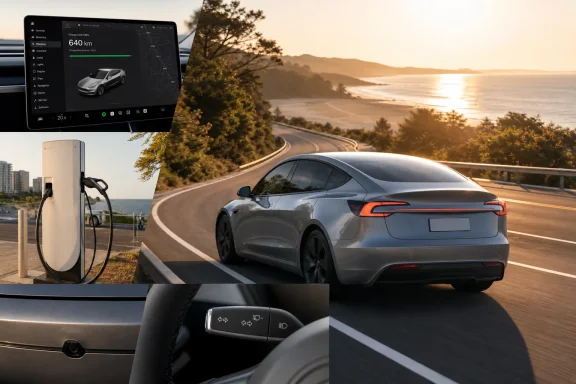 Tesla Has Turned a Radical EV Into the Default Choice
The Model 3 was unveiled 10 years ago as Tesla’s attempt to bring its battery technology, software model, and minimalist design philosophy to a more accessible market. Released in 2017 and arriving in Australia in 2019, it helped turn the electric car from a specialist purchase into a plausible alternative to familiar petrol, diesel, and hybrid sedans.That transformation did not happen because the original Model 3 was flawless. It happened because Tesla understood earlier than most established manufacturers that an EV should be more than a conventional car with batteries under the floor. Charging, navigation, remote control, software updates, energy management, and route planning had to function as one system.
The 2021 update and subsequent price cuts strengthened that proposition, while the major late-2024 refresh—allegedly codenamed Highland—addressed some of the car’s most obvious weaknesses in ride quality, refinement, interior materials, and styling. The 2026 changes are smaller but symbolically important: Tesla has restored an indicator stalk, added a front bumper camera with a washer, introduced matte black badging, and converted the Long Range into a single-motor rear-wheel-drive model.
That last change sounds like a downgrade when expressed purely as a motor count. In practice, it reveals where the mainstream EV contest is now being fought. The new Long Range is not trying to win an acceleration arms race; it is using a smaller mechanical burden and Tesla’s efficiency advantage to claim 750km on the WLTP combined cycle.
As EV Central and CarExpert have also observed in their Australian coverage, that figure makes this configuration the longest-range EV presently offered in the country. The more important qualification, established by Man’s real-world testing, is that buyers should not treat 750km as an ordinary, repeatable driving expectation.
Timeline
2017 — The Tesla Model 3 entered production as the company’s more accessible electric sedan.2019 — Australian deliveries began, putting Tesla’s mass-market EV proposition in direct competition with the country’s established midsize cars.
2021 — An update, accompanied by price reductions over time, helped accelerate Model 3 sales.
Late 2024 — Tesla introduced the major refresh reportedly known as Highland, improving the design, cabin quality, ride, and refinement.
2026 — The Australian Model 3 regained an indicator stalk, received a front bumper camera and matte black badging, and added the single-motor Premium Long Range RWD tested here.
July 12, 2026 — Henry Man published his evaluation after 11 days with a Tesla Australia press vehicle, including a Brisbane-to-Yamba range test.
The Range Number Is Impressive—and Still the Wrong Number to Plan Around
Tesla claims 750km of combined WLTP range and energy consumption of 12.5kWh/100km for the Model 3 Premium Long Range RWD. Those figures are not fabricated, but they are laboratory-standardised measurements rather than a promise that an Australian owner will cover 750km between every charge.Across the 11-day test, the Model 3 recorded 11.8kWh/100km over a mixture of urban and highway driving. That is not merely good for a relatively large, fast electric sedan; it is remarkable. Man’s comparison with two very different EVs underlines the achievement: a 71kW Hyundai Inster micro car had returned 13.6kWh/100km in his experience, while a Cupra Tavascan midsize SUV consumed 17.6kWh/100km.
Efficiency matters more than many headline specification comparisons acknowledge. A car that travels farther per kilowatt-hour can extract more useful distance from a given battery, spend less time replenishing the energy used, and impose lower running costs when charged at home. It can also avoid some of the weight, material, and cost penalties associated with simply fitting an enormous pack.
Tesla does not officially disclose the Long Range battery’s usable capacity. Man’s review works from a reported estimate of approximately 78kWh, or about 82kWh gross, using an NMC chemistry. At the observed consumption rate, that estimate produces a theoretical range of roughly 660km, while the car itself indicated approximately 640km of real-world driving range.
That is still exceptional for a vehicle starting below $70,000 before on-road costs. But it is 110km below the official 750km claim, a difference large enough to affect trip planning rather than merely offend statistical purists.
The more consequential number is about 512km of everyday range. Tesla recommends charging this NMC battery to 80 percent for routine use, meaning owners who follow the battery-care guidance will not ordinarily leave home with the full advertised capacity available.
This distinction is common across the EV market, but the Model 3 makes it particularly visible because the 750km figure is central to the Long Range’s identity. The car is genuinely one of the most efficient long-distance EVs available; it does not need the laboratory number to be treated as an everyday guarantee.
Owners should therefore regard the maximum claim as a comparative certification result. For normal charging and mixed Australian driving, roughly 500km is the more useful planning baseline, with conditions, speed, elevation, temperature, traffic, wheel selection, and climate-control demand capable of moving the result in either direction.
Tesla’s Charging Advantage Lives in the System, Not the Peak
The Model 3 uses a 400-volt-class electrical architecture and supports up to 11kW AC charging and 250kW DC charging through its Type 2 CCS connector. In Man’s public fast-charging test, it moved from 18 to 80 percent in approximately 31 minutes at a station rated for 250kW.The car never reached its advertised maximum. Even with battery pre-conditioning enabled across multiple sessions, the highest observed rate was 193kW, while the average across the measured charging session was 103kW as the car gradually reduced power.
Those results illustrate the danger of comparing EVs by peak charging speed alone. A maximum figure represents what the vehicle might accept under a narrow set of battery temperature, charger, and state-of-charge conditions. It says less about how quickly a useful amount of energy enters the pack across an entire stop.
Newer 800-volt competitors can charge more aggressively, making the Model 3’s electrical platform appear increasingly conventional. Yet Tesla retains an advantage that cannot be captured by one charging-rate figure: its car, navigation software, account, payment system, and Supercharging network operate as a single product.
When the battery cannot complete a planned route, the built-in navigation can select charging stops and show availability and pricing. At a compatible Tesla charger, the owner opens the charge port, connects the cable, and the session starts without a separate payment ritual or charger-specific application.
That integration sounds mundane until it is contrasted with the fragmented experience still common elsewhere. A theoretically faster EV is not necessarily easier to travel in if its driver must cross-reference several charging networks, create accounts, verify payment methods, and guess whether a listed charger is available or operational.
Tesla’s advantage is therefore not that every Model 3 charging claim was reproduced in Man’s test. It is that the company has reduced the cognitive load surrounding charging more successfully than most rivals. The hardware is no longer unrivalled, but the complete charging workflow remains an industry benchmark.
The 2026 Range Makes the Long Range Look Rational but Not Essential
Tesla offers three Model 3 variants in Australia, all priced below the country’s Luxury Car Tax threshold at the time of publication. The lineup stretches from an already well-equipped rear-wheel-drive model to the more specialised Performance, with the new Long Range occupying the ostensibly sensible middle.| Model 3 variant | Drive configuration | Starting price | Position in the range | Best fit |
|---|---|---|---|---|
| Premium RWD | Rear-wheel drive | $54,900 before on-road costs | Entry model | Most private buyers and routine commuting |
| Premium Long Range RWD | Rear-wheel drive | $61,900 before on-road costs | Maximum-range model | Frequent regional and long-distance travel |
| Performance AWD | All-wheel drive | $80,900 before on-road costs | Performance flagship | Buyers prioritising acceleration and performance |
Full Self-Driving (Supervised) added another $149 per month, while Premium Connectivity cost $13.99 per month. The front and rear glass-roof sunshades supplied with the test vehicle added $300 combined.
Subscriptions complicate the value calculation. Standard Connectivity is included for eight years, but Premium Connectivity is required for features including satellite-view maps, built-in audio and video streaming, and live camera viewing through the mobile app. Its monthly price has risen from $9.99 to $13.99.
The $7000 step from the Premium RWD to the Premium Long Range RWD buys a substantially larger travel buffer, but most owners do not drive several hundred kilometres every day. Man ultimately preferred the cheaper model on the basis that it retains most of the same equipment and supplies adequate range for ordinary use.
That conclusion does not undermine the Long Range. It clarifies its purpose. This is the Model 3 for drivers who regularly make regional journeys, lack convenient home charging, or are willing to pay for a larger reserve against poor weather, detours, unavailable chargers, and high-speed consumption.
For everyone else, the entry model may be the sharper expression of Tesla’s value proposition. The Long Range is technically impressive, but the very efficiency that makes it impressive also makes the cheaper Model 3 difficult to dismiss.
Highland’s Real Achievement Is Making Minimalism Feel Expensive
The late-2024 refresh moved the Model 3 much closer to the premium positioning Tesla had long claimed for it. The exterior is cleaner and more distinctive, with narrow headlights, an eyebrow-like daytime-running-light signature, sharper tail-lights, and, for 2026, discreet matte black badging.Because the new Long Range uses one motor, it no longer carries the dual-motor identification that previously distinguished it from the entry-level car. That visual anonymity will appeal to buyers who prefer a restrained appearance, though it gives the more expensive variant little external identity of its own.
The cabin makes a stronger case. Tesla’s minimalist design is not visually adventurous compared with newer electric sedans, but the review found that material execution and small details create a borderline luxury-car impression.
Door pockets are fully carpeted. Door cards and grab areas are padded, storage compartments are felt-lined, lids use magnets, hinges are damped, the frameless windows feel substantial, and the ambient lighting extends across the dashboard and into the doors. The white interior option further brightens the cabin and raises its perceived quality, even if the $1500 price demands a deliberate commitment.
There are still reminders that manufacturing consistency remains part of the Tesla conversation. Man reported unpainted areas along the bonnet edge on two Stealth Grey Model 3 vehicles tested within the previous year. This is not evidence that every vehicle suffers the same flaw, but it is enough to justify a careful pre-delivery inspection.
Privacy is another strange omission. Rear privacy glass is not standard, and the windows were described as unusually transparent from outside, particularly when paired with the bright white seats. Tinting is therefore likely to become both a comfort and privacy expense for many Australian buyers.
The Model 3’s design succeeds because the minimalism now feels intentional rather than unfinished. But premium perception is fragile: expensive paint, visible cabin contents, and inconsistent finishing can quickly erode the impression created by those carefully padded surfaces.
The Sedan Body Extracts a Price for Its Efficiency
At 4720mm long, 2089mm wide, and 1441mm high, with a 2875mm wheelbase, the Model 3 is a substantial midsize car. Its low 138mm ground clearance and streamlined 1441mm height contribute to its efficiency and planted stance, but they also expose the fundamental compromise of building a sleek sedan around a battery floor.Cargo capacity is generous on paper. The rear boot offers 594 litres at minimum, while the front compartment adds another 88 litres. The rear seats fold in a 60:40 split, and family hardware includes two ISOFIX positions and three top-tether anchors.
The boot opening is the problem. Rather than providing the broad access of a liftback, the powered tailgate uses an unconventional opening that sits somewhere between sedan and hatchback. It rises high but does not move far enough away, restricting access and creating a risk of taller users hitting their heads.
The front compartment remains one of the more useful examples in the segment, despite becoming smaller over the years. It has an easy-clean plastic surface, although it lacks the drain hole found in the newer Model Y.
Rear accommodation demonstrates why many households will choose that related SUV. Legroom is good, but the combination of a high floor, low seat base, limited foot space beneath the front seats, and a descending glass roof leaves taller occupants with raised knees and compromised headroom.
The glass roof itself is split into two panels rather than being fully panoramic. It brightens the interior, but Tesla supplies no standard shade, and the fixed glass increases the burden on an air-conditioning system that Man found weak in Australian summer conditions.
Tesla’s $300 front and rear sunshade accessory improves heat deflection but relies on fiddly clips wedged between the pillars and glass. It is a workaround for a climate-specific problem that should arguably have been addressed in the car’s standard specification.
Front occupants receive three-level seat heating and ventilation, while the steering wheel has two heating levels. Rear outer passengers also receive three-level seat heating, and an 8.0-inch display allows them to adjust the electronic vents, select media, stream video, and access games.
There are two USB-C fast-charging ports beneath that rear screen. Up front, Tesla supplies two Qi wireless pads, one fast USB-C port, and a 12-volt socket inside the centre-console storage. A 128GB USB-A stick is included for Dashcam and Sentry Mode recordings.
The storage spaces are deep, softly lined, and thoughtfully illuminated, but some elements prioritise visual cleanliness over immediate usability. The narrow glovebox must be opened through the touchscreen or voice control, while the concealed front USB-C port is not especially easy to reach.
Even the doors demand instruction. The flush exterior handles require users to press one end and pull the other, with their ergonomics changing depending on which side of the vehicle they are standing. The interior electronic release is easier, but the emergency release is obvious only at the front; rear occupants must access a hidden wire inside the door pocket.
These are not fatal weaknesses. They are the recurring tax imposed by Tesla’s insistence that familiar objects should be redesigned, hidden, or electronically mediated even when the conventional solution works better.
Tesla’s Software Remains the Car’s Strongest Competitive Moat
The centre of the Model 3 experience is still its 15.4-inch touchscreen. The related Model Y has moved to a newer 2K-plus 16-inch display, but the Model 3 unit remains clear, responsive, logically arranged, and capable of adjusting automatically for changing light.Tesla’s interface succeeds because it behaves like a coherent operating system rather than a collection of vehicle menus. Persistent controls, customisable shortcuts, familiar gestures, built-in navigation, charging integration, media services, entertainment applications, and vehicle settings share one design language.
Apple CarPlay and Android Auto remain absent, yet the omission is less damaging here than in most cars because Tesla’s own platform is fast and feature-rich. Built-in services include Spotify, Apple Music, Apple Podcasts, YouTube Music, video applications, arcade games, and navigation based on Google Maps data.
The interface is not perfect. Some launcher icons remain small, and even the larger text setting can be less legible than rival systems. Waze is unavailable, Tesla’s speed-camera warnings are limited, and the microphones reportedly struggled to recognise commands consistently during the test.
Grok integration adds another layer of intelligence but remains incomplete. It can reportedly help with tasks such as changing a destination, while traditional Tesla voice control is still required for functions including climate adjustment, opening the front compartment, and sending messages.
That division exposes the difference between adding an AI personality and building dependable vehicle controls. A conversational assistant is impressive when it understands an ambiguous request, but it becomes frustrating if ordinary commands are split across two systems with different capabilities.
Over-the-air updates remain a more substantial advantage. Since Man’s previous Model 3 test, Tesla had added features including ambient-light synchronisation, the ability to disable the wireless charging pads, and additional driving metadata for Dashcam recordings.
Not every update is transformative, and software-defined vehicles introduce their own risks of changing interfaces and subscription terms. But Tesla has normalised the idea that an existing car can gain meaningful functions without a workshop visit.
The mobile app completes the ecosystem. It can control the climate, check charging, locate the vehicle, display camera feeds, operate as a proximity key, transmit audio through the external speaker, and trigger Tesla’s less serious novelty functions.
Commands are generally delivered quickly rather than sitting behind lengthy loading screens. The app can occasionally fail to load correctly, according to the review, but restarting it usually resolves the issue.
Nine speakers are standard in the tested Long Range, and the rear screen can mirror or separate entertainment from the front display. These features make the Model 3 feel less like a car with a large tablet attached and more like a connected device designed around multiple occupants.
The limitation is that Tesla’s software excellence sometimes encourages it to replace physical controls simply because it can. The best software-defined car should use code to remove friction, not to relocate every interaction behind glass.
Restoring the Indicator Stalk Is an Admission Disguised as an Update
The most welcome 2026 change may also be the simplest. Tesla has returned a physical indicator stalk after the Highland refresh moved turn signals to steering-wheel buttons.Those buttons were difficult to locate when the wheel was turned, especially during roundabouts and other manoeuvres requiring rapid directional changes. The restored stalk remains centred after operation and avoids unnecessary secondary functions, making it straightforward to learn and use.
It is tempting to call this a minor ergonomic correction. It is more significant than that because it demonstrates the limits of Tesla’s drive to eliminate conventional controls. Innovation is not measured by how many components a manufacturer removes; it is measured by whether the replacement makes the driver’s task easier.
The gear selector remains on the edge of the touchscreen, requiring a swipe to choose drive or reverse. That interaction becomes tedious during multi-point turns, precisely when a driver must divide attention among steering, cameras, pedestrians, nearby vehicles, and direction changes.
Auto Shift can suggest drive or reverse based on camera input, while the car automatically selects park when the driver unbuckles. Man reported an instance in which he trusted the system to change direction but the vehicle continued reversing, illustrating why an automated convenience cannot replace confirmation by the person in control.
This is the Model 3 contradiction in its clearest form. Tesla can build one of the world’s most intuitive charging experiences and then make a basic three-point turn dependent on a screen gesture and imperfect prediction.
A Better Model 3 Is Still a Physically Demanding Car
The new Long Range uses a single permanent-magnet motor driving the rear wheels. Tesla does not publish power and torque figures for the model, though online reports cited in the original review estimate outputs of approximately 235kW and 450Nm.Acceleration is brisk, responsive, and strong enough to provide an obvious rear-driven surge without becoming as excessive as the Model 3 Performance. The car’s small steering wheel and direct steering ratio make it feel more agile than its exterior dimensions suggest.
That directness is entertaining on winding roads and in urban driving but can become tiring on highways. Small steering inputs continue to produce quick responses at speed, preventing the car from settling into the relaxed character expected of a long-range tourer.
Ride comfort is a major strength. Frequency-selective dampers and the standard 18-inch wheels produce a compliant response over bumps and coarse-chip surfaces, with only a slightly firm edge. Noise insulation was judged comparable with significantly more expensive luxury cars.
One-pedal driving is mandatory, with Standard and Chill settings affecting the response. The calibration is smooth and progressive enough that most drivers should quickly learn to decelerate and stop through the accelerator pedal.
The absence of a dedicated instrument cluster is less troublesome after acclimatisation. Speed appears at the driver-side edge of the main display, although reading it still requires a sideways glance rather than the forward view offered by conventional instruments or a head-up display.
The larger problem is physical comfort. The battery raises the floor while the seats remain low, leaving front and rear occupants with compromised leg angles. That becomes particularly noticeable on longer journeys when adaptive cruise control or Full Self-Driving reduces the driver’s need to move the accelerator leg.
The Model 3 therefore drives better than its minimalist appliance image suggests, but its efficient silhouette demands a human compromise. The low body benefits aerodynamics and handling while asking occupants to adapt themselves to the battery beneath them.
Cameras Expand Tesla’s Awareness Without Eliminating Blind Spots
The 2026 Model 3 uses eight all-round cameras for its environmental visualisation, but it does not provide a conventional stitched 360-degree overhead view. The animated representation can be jerky, and the absence of underside mirror cameras limits the system’s ability to reproduce the familiar top-down parking image offered by many rivals.Tesla also avoids traditional sonar parking sensors. Camera-based distance estimates can be inconsistent, at times reacting to speed humps while failing to warn convincingly about more obvious obstacles.
The new front bumper camera addresses an important low-level blind spot and includes a built-in washer. Drivers can activate the cameras through a dedicated steering-wheel button, and the feeds remain available at higher speeds rather than cutting out once the car is moving quickly.
Dashcam and Sentry Mode use six surrounding cameras for continuous recording. The included storage makes the feature ready to use, and the ability to capture incidents while driving or parked remains one of Tesla’s most valuable practical advantages.
The cost is energy. Sentry Mode can reportedly drain up to 10 percent of the battery during an eight-hour overnight period, particularly when frequent events trigger recording. That is a substantial penalty for owners who cannot charge conveniently or who leave the vehicle parked for extended periods.
The Model 3 received a five-star ANCAP rating under 2025 testing criteria, with ANCAP highlighting strong adult, child, and vulnerable road-user performance. The formal result confirms that the car’s core crash protection and assistance systems meet a high standard even if individual camera-driven functions remain imperfect.
Full Self-Driving Remains a Supervised Experiment With a Monthly Price
Basic Autopilot is standard in Australia, combining adaptive cruise control with lane-centring assistance. Its name may imply more capability than the feature provides, and Man’s related Model Y testing had found its reliability inferior to some rival assistance systems because of recurring phantom braking.Full Self-Driving (Supervised) costs $149 per month and uses a different AI model. The subscription structure allows owners to activate or cancel it without committing permanently, and new Teslas include a 30-day trial.
During this Model 3 test, the Australian software was running version 13.2.9. Man found it impressively capable in some situations but stubborn and inconsistent in others, including poor lane selection, unnecessary travel below the speed limit, excessive slowing through corners, and phantom braking caused by incorrectly interpreted speed signs.
Tesla subsequently began rolling out version 14.3.3 in Australia, though Man had not tested that release. Any assumption that the later software resolves the observed weaknesses would therefore be premature.
The returned indicator stalk provides a useful means of correcting the system, whether forcing a lane change or signalling properly when the software fails to indicate while exiting a roundabout. That interaction reinforces the central fact Tesla itself requires drivers to acknowledge: “Importantly, it is not fully autonomous and complete driver attention is required.”
The word Supervised is not a legal decoration. The driver must monitor the environment, verify the system’s decisions, and be prepared to take over immediately.
FSD may be worth sampling because few rival systems attempt such broad on-road behaviour. But its novelty should not be confused with dependable autonomy, and the subscription should be judged as access to rapidly evolving driver-assistance software rather than payment for a self-driving car.
Ten Years of Progress Have Not Solved Tesla’s Most Tesla-Like Flaws
The Model 3 is at its best when Tesla concentrates on the entire ownership system. Its efficiency, charging integration, navigation, mobile application, remote camera access, software updates, and energy planning reinforce one another in ways that conventional manufacturers still struggle to replicate.It is at its weakest when the company interprets simplicity as the removal of ordinary controls. The touchscreen gear selector, screen-operated glovebox, hidden ventilation adjustments, flush door handles, concealed rear emergency releases, and lack of a driver display are not all equally problematic, but they emerge from the same philosophy.
The reintroduced indicator stalk is encouraging because it suggests Tesla can reverse an ergonomic mistake without abandoning its broader software-driven approach. The front bumper camera offers a similar correction, filling a practical gap in a vehicle increasingly dependent on visual sensing.
Quality remains more complicated. The cabin’s materials, storage lining, padded surfaces, ambient lighting, magnetic lids, and quiet ride create a credible premium experience. Yet reported bonnet-edge paint issues and costly colour options make it important to distinguish design quality from manufacturing consistency.
Practicality is the other boundary Tesla cannot update away. The large boot, useful front compartment, rear screen, charging ports, and generous storage do not change the restricted tailgate opening or the high-floor, low-seat posture. Buyers carrying adults frequently should test the rear seats for more than a short demonstration drive.
The same applies to climate performance. Ventilated seats and remote pre-conditioning are valuable, but weak vent output and an unshaded glass roof can dominate the experience during an Australian summer. The accessory shade helps, though requiring owners to fit removable panels is not an elegant solution in a car this carefully designed elsewhere.
What Buyers Should Carry Into the Test Drive
The Model 3 Premium Long Range RWD is neither the 750km miracle suggested by its largest number nor an ageing product surviving on reputation. It is an unusually efficient, refined electric sedan whose real-world compromises become clearer precisely because the core engineering is so strong.- Expect approximately 640km of indicated real-world maximum range in similar mixed conditions, not a routine 750km.
- Plan around roughly 512km when observing Tesla’s recommended 80 percent everyday charging limit.
- Treat 250kW as a possible peak, not a guaranteed charging rate; the test reached 193kW and averaged 103kW.
- Compare the $61,900 Long Range carefully with the $54,900 Premium RWD before paying $7000 primarily for additional range.
- Test the seating position, rear headroom, boot opening, air vents, touchscreen gear selector, and door releases personally.
- Budget for paint, tinting, a roof shade, connectivity, or supervised-driving subscriptions only after deciding which genuinely add value.
References
- Primary source: henryman.net
Published: 2026-07-11T21:40:18.050161
2026 Tesla Model 3 review – The Connected by Henry Man
The model that popularised electric vehicles into the mainstream globally continues to be one of the best a decade on, with some flaws… I tested the new Model 3 Long Range Rear-Wheel Drive (RWD) fo…henryman.net - Related coverage: tesla.com
- Related coverage: evcentral.com.au
- Related coverage: carsales.com.au
Tesla Model 3 2026 Long Range Rear-Wheel Drive Pricing & Specifications - carsales
Tesla Model 3 2026 Long Range Rear-Wheel Drive specifications, features and pricingwww.carsales.com.au
- Related coverage: carexpert.com.au
2026 Tesla Model 3 Premium Long Range RWD review | CarExpert
The mid-spec Tesla Model 3 makes a strong case as both the sweet spot in the range and a mid-size sedan standout.www.carexpert.com.au - Related coverage: caranddriver.com
Tested: The New Entry-Level 2026 Tesla Model 3 RWD
Tesla's new base Model 3 ditches a few things in pursuit of a lower price tag, but we don't think you'll miss much of that content.www.caranddriver.com

- Related coverage: consumerreports.org
2026 Tesla Model 3 Road Test Report - Consumer Reports
Check out Consumer Reports 2026 Tesla Model 3 Road Test Report and expert reviews on driving experience, handling, comfort level, and safety features.www.consumerreports.org
