

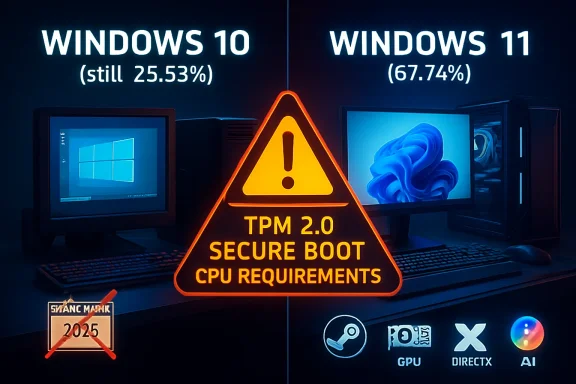
Six months after Microsoft ended free support for Windows 10 on October 14, 2025, Valve’s April 2026 Steam Hardware and Software Survey still shows 25.53 percent of Steam users on Windows 10, while Windows 11 leads at 67.74 percent. That is not a rounding error; it is a migration failure hiding in plain sight. PC gaming is supposed to be the friendly territory for new Windows adoption, the place where driver updates, DirectX features, anti-cheat systems, and new hardware naturally pull users forward. If one in four Steam users is still on the retired operating system here, Microsoft’s Windows 11 problem is not nostalgia — it is trust, hardware friction, and a missing reason to move.
The April Steam numbers are awkward because they arrive after the symbolic deadline has already passed. Windows 10 is no longer the current consumer Windows platform in Microsoft’s lifecycle story, and yet it remains a very current platform in the lived reality of PC gaming. Steam’s audience is not a perfect census of all PCs, but it is a revealing one: these are machines whose owners install clients, update drivers, buy games, and often know enough about hardware to care.
That makes the persistence of Windows 10 more damning, not less. Casual home users can be forgiven for missing a lifecycle date buried in a support page. Gamers have had years of prompts, articles, benchmarks, warnings, and upgrade pitches. They have still made a collective shrug.
Microsoft can claim a partial victory: Windows 11 is now the clear majority on Steam. But five years after launch, and after Windows 10’s formal retirement, 67.74 percent is not the landslide Redmond wanted. It is the kind of majority that says the new system won by attrition, preinstalls, and hardware replacement cycles rather than by persuasion.
The hard truth is that Windows 10 did its job too well. It became the default substrate of PC gaming at precisely the moment when the PC became less disposable. A ten-year-old operating system running on a six- or eight-year-old gaming PC can still play a shocking amount of the modern catalog if the owner is willing to lower settings and ignore ray tracing. That durability has become Microsoft’s enemy.
There was a defensible security argument behind that move. The Windows ecosystem has long carried the cost of permissive hardware support, and Microsoft wanted a cleaner baseline for modern defenses. Credential protection, firmware integrity, and measured boot are not marketing fluff to sysadmins who have spent years dealing with ransomware and credential theft.
But consumers do not experience platform security as an abstract architecture diagram. They experience it as a message that says their working PC is not eligible. For gamers, especially, that feels like an insult when the same machine can still run Baldur’s Gate 3, Counter-Strike 2, or a backlog that stretches back to the Obama administration.
Microsoft’s bet was that the security rationale would be strong enough to force the ecosystem forward. Instead, Windows 11 inherited the worst of both worlds: the company took the reputational hit for excluding hardware while delivering an everyday experience that many users perceived as only modestly different from Windows 10. A hard requirement needs a hard reward. For many users, Windows 11 never supplied one.
That may be the problem. Windows 11’s best argument in 2026 is that it is now close enough to Windows 10 to stop being irritating. That is a maintenance pitch, not a conversion pitch. Nobody rushes to upgrade because the new thing has finally become less annoying.
Microsoft once knew how to sell a Windows upgrade as a generational reset. Windows 7 was the anti-Vista: familiar, faster-feeling, and reassuring. Windows 10 was the anti-Windows 8: the Start menu came back, the desktop was restored to the center of the experience, and Microsoft practically begged users to take the free upgrade. Windows 11 never found an equivalent emotional argument.
Instead, users saw a prettier shell, stricter requirements, more Microsoft account pressure, more cloud prompts, more Edge nudges, and a growing layer of AI branding. For enthusiasts, that combination reads less like modernization and more like rent-seeking. The operating system is the thing they need to reach their games, tools, and files; Microsoft keeps trying to make it the destination.
Part of that is the GPU market. The last half-decade taught players to stretch hardware longer than expected. Pandemic shortages, crypto-driven distortion, inflation, and high-end GPU pricing trained people to treat upgrades as luxury events rather than routine maintenance. A capable GTX, RTX 20-series, RX 5000-series, or older Ryzen/Core system may not be glamorous, but it can remain useful far longer than the industry’s launch-cycle hype admits.
Game optimization has also changed the calculation. When even expensive systems can struggle with shader compilation stutter, VRAM pressure, and uneven PC ports, the promise of a new operating system does not feel like the bottleneck. Players are more likely to blame the game, the engine, or the GPU than Windows 10. Often, they are right.
The irony is that Microsoft’s own gaming strategy depends on a large, stable Windows audience. Game Pass on PC, the Xbox app, DirectX, Play Anywhere, and the Windows Store all assume that the Windows PC remains the natural home of mainstream computer gaming. Yet Windows 11 adoption shows that Microsoft cannot simply declare the shape of that audience anymore. Even gamers who remain loyal to Windows are increasingly willing to resist Microsoft’s preferred version of it.
But the psychological shift matters. A decade ago, Linux gaming was mostly an enthusiast project defined by compromises. Today, thanks to Proton, Vulkan, Mesa, AMD driver work, and Valve’s investment, it is a practical option for a growing slice of the market. The difference between “not viable” and “not for everyone” is enormous.
Microsoft should not fear Linux because 4.52 percent is a large number. It should fear Linux because it gives disaffected users a mental exit ramp. Every time Windows pushes an unwanted prompt, buries a local-account path, or turns another surface into an AI billboard, the alternative feels slightly less theoretical.
The Steam Deck’s greater achievement was not market share; it was narrative. It proved that a Linux-based gaming machine could be friendly, commercial, and desirable without asking users to become hobbyist system administrators. That does not mean the average Windows gamer is ready to install Arch tomorrow. It does mean Microsoft no longer owns the imagination of PC gaming by default.
In Europe especially, the language around Windows 10 has blended security, sovereignty, sustainability, and procurement. The concern is not merely that old PCs will become vulnerable. It is that millions of functional devices may be pushed toward replacement because they cannot officially make the Windows 11 jump. That turns an operating-system deadline into an e-waste argument.
Enterprise IT can buy time through Extended Security Updates, volume licensing, management tools, and staged hardware refreshes. Consumers and small organizations have a messier path. Some can enroll in extended updates, some can bypass hardware checks at their own risk, some can move to Linux, and some will simply keep using Windows 10 until something breaks.
That last group is the one security professionals worry about. Unsupported Windows machines do not vanish; they linger in homes, offices, garages, labs, and small businesses. They keep accessing email, downloading files, syncing passwords, and joining networks. Microsoft’s lifecycle page can say the platform is finished, but attackers care only whether the machine is still online.
That may be an unfair compression of a more complicated product strategy, but perception is the battlefield here. Windows users have been trained by years of prompts, telemetry debates, browser defaults, account nudges, and advertising experiments to read every new feature suspiciously. In that climate, even genuinely useful AI features arrive carrying baggage.
For sysadmins, the issue is governance. AI features embedded at the OS level raise questions about data boundaries, retention, compliance, user training, and disablement. For enthusiasts, the issue is control. They want the machine to do what they asked, not what a cloud-connected assistant guesses might be helpful.
This matters because Windows 11 already needed goodwill. A stricter hardware baseline can be sold if users believe the vendor is acting in their interest. An AI-heavy platform shift can be sold if users trust the steward of the platform. Microsoft is trying to sell both at once, and the Steam numbers suggest many users are not buying.
Vista asked users to absorb pain for a security and driver-model transition that was real but poorly timed. Windows 8 asked desktop users to accept a touch-first interface revolution they had not requested. Windows 11 asks users to accept hardware exclusion and platform nudging for benefits that are often invisible or optional. In each case, Microsoft could defend the strategy internally. In each case, the market judged the experience externally.
The difference is that Microsoft no longer has the same room for error. In the Vista era, smartphones were rising but the PC remained the primary personal-computing hub. In the Windows 8 era, Microsoft was trying to force its way into tablets while the desktop remained structurally important. In 2026, the PC is mature, durable, and increasingly just one device among many. Users have less patience for disruption because Windows is no longer the magical center of their digital lives.
That maturity cuts both ways. It makes Windows harder to displace, because decades of software, habits, and peripherals keep users anchored. It also makes Windows harder to excite, because the baseline is already good enough. The next Windows cannot merely be compatible, secure, and AI-branded. It has to make a case.
The answer cannot be only security. Security matters, but it rarely motivates voluntary consumer behavior unless the threat is immediate and legible. The answer cannot be only AI. AI may become a useful operating-system layer, but Microsoft has spent too much goodwill trying to insert it everywhere at once. The answer cannot be only new hardware. A platform that depends on replacement cycles will always lag when hardware gets expensive.
A better Windows would feel less like a billboard and more like an instrument. It would make local control obvious, not hidden. It would separate consumer convenience from enterprise manageability without forcing both audiences through the same funnel. It would give gamers measurable benefits they can feel: smoother updates, fewer background surprises, cleaner driver recovery, better HDR consistency, sharper performance diagnostics, and a gaming mode that is more than a checkbox.
Microsoft also needs to be honest about unsupported-but-capable PCs. If the Windows 11 hardware floor is permanent, then the company should make the endgame cleaner: better migration tools, clearer extended-support terms, and less moralizing at users who are keeping functional hardware alive. If the floor can bend, Microsoft should say so deliberately rather than leaving users to forums, registry edits, and unofficial installers.
The useful reading is that dominance and enthusiasm are no longer the same thing. Windows can remain the default while users resist the current version. It can win platform share while losing affection. It can be essential and resented at the same time.
That is the danger for Microsoft. The company does not need every Windows 10 user to defect to Linux for the strategy to fail. It only needs enough users to delay, enough institutions to question procurement assumptions, enough enthusiasts to normalize alternatives, and enough developers to treat Windows as one target rather than the unquestioned center.
The Steam survey captures a population that is technically engaged, performance-sensitive, and accustomed to upgrades. If even that population is dragging its feet, the broader Windows base is almost certainly messier. Windows 10’s afterlife is not a sentimental holdout. It is a vote of no confidence in the upgrade bargain.
Source: PC Gamer https://www.pcgamer.com/software/wi...ter-of-steam-users-are-still-on-the-dying-os/
 Windows 10 Refuses to Leave the LAN Party
The April Steam numbers are awkward because they arrive after the symbolic deadline has already passed. Windows 10 is no longer the current consumer Windows platform in Microsoft’s lifecycle story, and yet it remains a very current platform in the lived reality of PC gaming. Steam’s audience is not a perfect census of all PCs, but it is a revealing one: these are machines whose owners install clients, update drivers, buy games, and often know enough about hardware to care.That makes the persistence of Windows 10 more damning, not less. Casual home users can be forgiven for missing a lifecycle date buried in a support page. Gamers have had years of prompts, articles, benchmarks, warnings, and upgrade pitches. They have still made a collective shrug.
Microsoft can claim a partial victory: Windows 11 is now the clear majority on Steam. But five years after launch, and after Windows 10’s formal retirement, 67.74 percent is not the landslide Redmond wanted. It is the kind of majority that says the new system won by attrition, preinstalls, and hardware replacement cycles rather than by persuasion.
The hard truth is that Windows 10 did its job too well. It became the default substrate of PC gaming at precisely the moment when the PC became less disposable. A ten-year-old operating system running on a six- or eight-year-old gaming PC can still play a shocking amount of the modern catalog if the owner is willing to lower settings and ignore ray tracing. That durability has become Microsoft’s enemy.
Microsoft Built a Gate and Then Wondered Why the Crowd Stopped
The most important Windows 11 decision was not the centered Start menu, the rounded corners, the widget panel, or the early taskbar regressions. It was the hardware floor. By requiring TPM 2.0, Secure Boot-capable configurations, and a narrower range of supported CPUs, Microsoft turned what had once been a routine Windows upgrade into a compatibility referendum.There was a defensible security argument behind that move. The Windows ecosystem has long carried the cost of permissive hardware support, and Microsoft wanted a cleaner baseline for modern defenses. Credential protection, firmware integrity, and measured boot are not marketing fluff to sysadmins who have spent years dealing with ransomware and credential theft.
But consumers do not experience platform security as an abstract architecture diagram. They experience it as a message that says their working PC is not eligible. For gamers, especially, that feels like an insult when the same machine can still run Baldur’s Gate 3, Counter-Strike 2, or a backlog that stretches back to the Obama administration.
Microsoft’s bet was that the security rationale would be strong enough to force the ecosystem forward. Instead, Windows 11 inherited the worst of both worlds: the company took the reputational hit for excluding hardware while delivering an everyday experience that many users perceived as only modestly different from Windows 10. A hard requirement needs a hard reward. For many users, Windows 11 never supplied one.
The Upgrade Pitch Collapsed Into “Because We Said So”
Windows 11 has improved substantially since its debut. The rough edges around the taskbar, default apps, context menus, and window management have been sanded down. Performance problems that colored early impressions have been narrowed, corrected, or made irrelevant by newer hardware. The operating system today is not the caricature that many users encountered in late 2021.That may be the problem. Windows 11’s best argument in 2026 is that it is now close enough to Windows 10 to stop being irritating. That is a maintenance pitch, not a conversion pitch. Nobody rushes to upgrade because the new thing has finally become less annoying.
Microsoft once knew how to sell a Windows upgrade as a generational reset. Windows 7 was the anti-Vista: familiar, faster-feeling, and reassuring. Windows 10 was the anti-Windows 8: the Start menu came back, the desktop was restored to the center of the experience, and Microsoft practically begged users to take the free upgrade. Windows 11 never found an equivalent emotional argument.
Instead, users saw a prettier shell, stricter requirements, more Microsoft account pressure, more cloud prompts, more Edge nudges, and a growing layer of AI branding. For enthusiasts, that combination reads less like modernization and more like rent-seeking. The operating system is the thing they need to reach their games, tools, and files; Microsoft keeps trying to make it the destination.
PC Gaming Exposes the Weakness of the New Windows Model
Steam’s survey is particularly uncomfortable because gaming should be the segment most likely to reward forward motion. New GPUs, new CPUs, DirectStorage, HDR improvements, scheduler changes, and driver optimization should all tilt the audience toward the newest Windows. The fact that Windows 10 still holds more than a quarter of Steam users suggests that the old gravitational model has weakened.Part of that is the GPU market. The last half-decade taught players to stretch hardware longer than expected. Pandemic shortages, crypto-driven distortion, inflation, and high-end GPU pricing trained people to treat upgrades as luxury events rather than routine maintenance. A capable GTX, RTX 20-series, RX 5000-series, or older Ryzen/Core system may not be glamorous, but it can remain useful far longer than the industry’s launch-cycle hype admits.
Game optimization has also changed the calculation. When even expensive systems can struggle with shader compilation stutter, VRAM pressure, and uneven PC ports, the promise of a new operating system does not feel like the bottleneck. Players are more likely to blame the game, the engine, or the GPU than Windows 10. Often, they are right.
The irony is that Microsoft’s own gaming strategy depends on a large, stable Windows audience. Game Pass on PC, the Xbox app, DirectX, Play Anywhere, and the Windows Store all assume that the Windows PC remains the natural home of mainstream computer gaming. Yet Windows 11 adoption shows that Microsoft cannot simply declare the shape of that audience anymore. Even gamers who remain loyal to Windows are increasingly willing to resist Microsoft’s preferred version of it.
The Steam Deck Did Not Start a Revolution, But It Changed the Weather
Linux’s Steam share falling back to 4.52 percent in April after crossing 5 percent in March does not mean the Linux gaming story is over. It means the revolution is still uneven, contingent, and heavily shaped by devices like the Steam Deck. Windows remains overwhelming on Steam, and no serious reading of the survey suggests that Linux is about to dethrone it.But the psychological shift matters. A decade ago, Linux gaming was mostly an enthusiast project defined by compromises. Today, thanks to Proton, Vulkan, Mesa, AMD driver work, and Valve’s investment, it is a practical option for a growing slice of the market. The difference between “not viable” and “not for everyone” is enormous.
Microsoft should not fear Linux because 4.52 percent is a large number. It should fear Linux because it gives disaffected users a mental exit ramp. Every time Windows pushes an unwanted prompt, buries a local-account path, or turns another surface into an AI billboard, the alternative feels slightly less theoretical.
The Steam Deck’s greater achievement was not market share; it was narrative. It proved that a Linux-based gaming machine could be friendly, commercial, and desirable without asking users to become hobbyist system administrators. That does not mean the average Windows gamer is ready to install Arch tomorrow. It does mean Microsoft no longer owns the imagination of PC gaming by default.
Governments and IT Departments Hear a Different Warning
The consumer story is only half the problem. Windows 10’s persistence is also a signal to public institutions, schools, and businesses that Microsoft’s lifecycle decisions now carry political and budgetary consequences. When a widely deployed operating system reaches end of support while still working perfectly well for many users, the conversation moves beyond patch management.In Europe especially, the language around Windows 10 has blended security, sovereignty, sustainability, and procurement. The concern is not merely that old PCs will become vulnerable. It is that millions of functional devices may be pushed toward replacement because they cannot officially make the Windows 11 jump. That turns an operating-system deadline into an e-waste argument.
Enterprise IT can buy time through Extended Security Updates, volume licensing, management tools, and staged hardware refreshes. Consumers and small organizations have a messier path. Some can enroll in extended updates, some can bypass hardware checks at their own risk, some can move to Linux, and some will simply keep using Windows 10 until something breaks.
That last group is the one security professionals worry about. Unsupported Windows machines do not vanish; they linger in homes, offices, garages, labs, and small businesses. They keep accessing email, downloading files, syncing passwords, and joining networks. Microsoft’s lifecycle page can say the platform is finished, but attackers care only whether the machine is still online.
The AI Layer Arrived Before the Trust Was Rebuilt
Windows 11 might have had an easier road if Microsoft had spent the last few years making the operating system feel quieter, faster, and more respectful. Instead, the company made Copilot a central brand gesture and turned Recall into a defining controversy before many users had even touched it. The message received by skeptics was simple: Microsoft is more excited about what Windows can observe and monetize than what users need from it.That may be an unfair compression of a more complicated product strategy, but perception is the battlefield here. Windows users have been trained by years of prompts, telemetry debates, browser defaults, account nudges, and advertising experiments to read every new feature suspiciously. In that climate, even genuinely useful AI features arrive carrying baggage.
For sysadmins, the issue is governance. AI features embedded at the OS level raise questions about data boundaries, retention, compliance, user training, and disablement. For enthusiasts, the issue is control. They want the machine to do what they asked, not what a cloud-connected assistant guesses might be helpful.
This matters because Windows 11 already needed goodwill. A stricter hardware baseline can be sold if users believe the vendor is acting in their interest. An AI-heavy platform shift can be sold if users trust the steward of the platform. Microsoft is trying to sell both at once, and the Steam numbers suggest many users are not buying.
The Vista and Windows 8 Comparisons Are Tempting for a Reason
Every unpopular Windows release invites a historical analogy, and Windows 11 has collected several. It is not Vista, because Vista’s problems were more directly tied to performance, drivers, and readiness. It is not Windows 8, because Windows 11 did not detonate the desktop metaphor in pursuit of a tablet future. But it shares something with both: it made users feel that Microsoft’s priorities were not aligned with theirs.Vista asked users to absorb pain for a security and driver-model transition that was real but poorly timed. Windows 8 asked desktop users to accept a touch-first interface revolution they had not requested. Windows 11 asks users to accept hardware exclusion and platform nudging for benefits that are often invisible or optional. In each case, Microsoft could defend the strategy internally. In each case, the market judged the experience externally.
The difference is that Microsoft no longer has the same room for error. In the Vista era, smartphones were rising but the PC remained the primary personal-computing hub. In the Windows 8 era, Microsoft was trying to force its way into tablets while the desktop remained structurally important. In 2026, the PC is mature, durable, and increasingly just one device among many. Users have less patience for disruption because Windows is no longer the magical center of their digital lives.
That maturity cuts both ways. It makes Windows harder to displace, because decades of software, habits, and peripherals keep users anchored. It also makes Windows harder to excite, because the baseline is already good enough. The next Windows cannot merely be compatible, secure, and AI-branded. It has to make a case.
Windows 12 Cannot Be Another Compliance Exercise
If Microsoft is planning a crowd-pleasing Windows 12, the lesson from this Steam snapshot is blunt: do not treat adoption as an entitlement. A new Windows release needs to answer the user’s first question before the user asks it. Why should this machine, this workflow, and this weekend’s gaming session change?The answer cannot be only security. Security matters, but it rarely motivates voluntary consumer behavior unless the threat is immediate and legible. The answer cannot be only AI. AI may become a useful operating-system layer, but Microsoft has spent too much goodwill trying to insert it everywhere at once. The answer cannot be only new hardware. A platform that depends on replacement cycles will always lag when hardware gets expensive.
A better Windows would feel less like a billboard and more like an instrument. It would make local control obvious, not hidden. It would separate consumer convenience from enterprise manageability without forcing both audiences through the same funnel. It would give gamers measurable benefits they can feel: smoother updates, fewer background surprises, cleaner driver recovery, better HDR consistency, sharper performance diagnostics, and a gaming mode that is more than a checkbox.
Microsoft also needs to be honest about unsupported-but-capable PCs. If the Windows 11 hardware floor is permanent, then the company should make the endgame cleaner: better migration tools, clearer extended-support terms, and less moralizing at users who are keeping functional hardware alive. If the floor can bend, Microsoft should say so deliberately rather than leaving users to forums, registry edits, and unofficial installers.
The April Steam Numbers Say the Quiet Part Out Loud
The useful reading of Valve’s April survey is not that Windows is doomed. Windows still dominates Steam at 93.47 percent. Linux remains a niche, macOS remains marginal for mainstream PC gaming, and most developers will continue to target Windows first. Microsoft’s moat is still wide.The useful reading is that dominance and enthusiasm are no longer the same thing. Windows can remain the default while users resist the current version. It can win platform share while losing affection. It can be essential and resented at the same time.
That is the danger for Microsoft. The company does not need every Windows 10 user to defect to Linux for the strategy to fail. It only needs enough users to delay, enough institutions to question procurement assumptions, enough enthusiasts to normalize alternatives, and enough developers to treat Windows as one target rather than the unquestioned center.
The Steam survey captures a population that is technically engaged, performance-sensitive, and accustomed to upgrades. If even that population is dragging its feet, the broader Windows base is almost certainly messier. Windows 10’s afterlife is not a sentimental holdout. It is a vote of no confidence in the upgrade bargain.
The Numbers Microsoft Cannot Patch Away
The cleanest lesson from this moment is that Windows 11 adoption is no longer a launch problem; it is a value problem. Six months after Windows 10’s support deadline, Microsoft has the majority it wanted but not the mandate it expected.- Windows 10 still accounts for roughly one quarter of Steam users despite reaching end of support on October 14, 2025.
- Windows 11’s Steam majority shows momentum, but its 67.74 percent share nearly five years after release is weaker than Microsoft’s default-platform power would suggest.
- The TPM 2.0 and CPU requirements made Windows 11 a hardware decision for many users, not just a software update.
- Linux’s 4.52 percent Steam share is not a Windows-killer, but it is large enough to keep the escape hatch visible.
- Microsoft’s AI-first messaging risks deepening resistance among users who already see Windows 11 as more intrusive than transformative.
Source: PC Gamer https://www.pcgamer.com/software/wi...ter-of-steam-users-are-still-on-the-dying-os/
