

Nvidia used GTC Taipei 2026, held June 1–4 alongside Computex in Taiwan, to unveil RTX Spark, a Grace Blackwell-based superchip for Windows laptops and desktops promising up to one petaflop of local AI performance. That is not just another “AI PC” sticker for the palm rest. It is Nvidia’s clearest bid yet to move the center of gravity in personal computing from cloud services back toward the machine on your desk. The striking part is not only what Nvidia said, but what it left behind: crypto, once inseparable from the consumer GPU story, was nowhere near the stage.
For most of the PC era, Nvidia’s power over Windows users has been indirect. It made the graphics silicon that gamers wanted, creators needed, and crypto miners occasionally hoarded into absurdity. The CPU, the operating system, and the overall PC platform belonged to others.
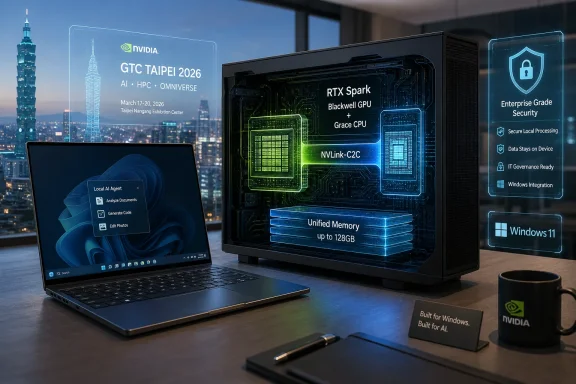
RTX Spark changes that posture. By combining a Blackwell RTX GPU with a 20-core Grace CPU, Nvidia is no longer merely attaching acceleration to someone else’s PC architecture. It is proposing a new center of the Windows machine: an Arm-based superchip where CPU, GPU, memory, and AI software stack are designed as a single argument.
The company’s language around the launch was deliberately grandiose. The PC, Nvidia says, is being reinvented for personal AI agents. Strip away the keynote gloss and the claim is still consequential: Nvidia believes the next premium PC will be judged less by browser tabs, battery life, and frame rates than by how much intelligence it can run locally without phoning home.
That is a direct challenge to the comfortable hierarchy of the Windows ecosystem. Intel and AMD have spent decades defining what a PC processor is. Qualcomm has been trying to make Windows on Arm credible. Microsoft has been pushing Copilot+ PCs as the new category. Nvidia, with RTX Spark, is attempting to arrive over the top of all three.
The more interesting number is 128 GB of unified memory. In AI workloads, memory is often the wall users hit before compute. A fast GPU is of limited use when the model, context, embeddings, or working data cannot fit close enough to the processor to run efficiently.
Unified memory is not new, and Apple deserves credit for making the concept legible to mainstream buyers through its M-series Macs. But Nvidia’s version matters because it arrives inside the Windows ecosystem with CUDA, RTX, Tensor cores, and a developer base that already thinks in terms of GPU acceleration. For Windows users, that could be the difference between “AI features” as a vendor-curated set of buttons and AI capability as a local computing resource.
NVLink-C2C is the quiet architectural tell. Nvidia is importing ideas from its server-class Grace Blackwell designs into consumer form factors, connecting CPU and GPU with the sort of coherent high-bandwidth fabric that makes the machine behave less like a traditional PC and more like a compact AI appliance. The line between workstation and laptop is not disappearing, but it is being redrawn.
That has implications for thermals, battery life, pricing, and repairability, none of which are answered by a keynote. Windows enthusiasts have learned to be skeptical of miracle form factors, especially when powerful silicon meets thin chassis and ambitious battery claims. If RTX Spark machines throttle under sustained local AI workloads, the spec sheet will age badly.
But the form-factor ambition still matters. Nvidia is not merely telling developers to buy a workstation. It is telling OEMs to design the next Windows flagship around local AI as a first-class use case. That shifts the PC industry’s design target from “thin, light, connected” to “thin, light, locally intelligent.”
The OEM list reinforces the point. ASUS, Dell, HP, Lenovo, Microsoft Surface, MSI, Acer, and GIGABYTE are not a boutique coalition. If those names produce real shipping hardware in fall 2026, RTX Spark will not be an experiment hiding in a corner of the market. It will be a reference point every premium Windows laptop will have to answer.
Microsoft has spent the last two years trying to make Copilot feel inevitable. The problem is that much of the AI PC story has remained cloudy in both senses of the word. Users see AI features arrive through Microsoft 365, Edge, search, Recall-style indexing, and cloud-backed assistants, but the local hardware often feels like a justification after the fact.
RTX Spark gives Microsoft a more serious local substrate. A PC with 128 GB of unified memory and Nvidia’s AI stack can plausibly run models and agents locally in ways that current low-power NPUs cannot. That does not make cloud AI irrelevant, but it changes the default assumption. The question becomes not “Why run this locally?” but “Why send this out?”
For enterprise IT, that distinction is enormous. Local execution can reduce latency, preserve data locality, and avoid sending sensitive prompts or documents to third-party services. It can also create a new class of endpoint risk: autonomous agents with access to files, credentials, internal apps, and user context. A more capable local machine is not automatically a safer one.
Microsoft therefore has to walk a narrow path. If it locks RTX Spark too tightly into Copilot branding, developers and power users will see another platform gate. If it leaves the ecosystem too open, administrators will inherit a messy new world of local models, agent permissions, and shadow AI workloads. The winners will be the vendors that make the policy layer as serious as the silicon.
For consumers, the appeal is obvious. A local agent could search files, summarize projects, prepare drafts, inspect photos, automate repetitive tasks, and coordinate across apps without every request leaving the device. For developers, it could mean code assistants and test runners that understand a local repository without uploading the whole thing to a remote service. For creators, it could make generative workflows feel less dependent on subscription queues and cloud credits.
But the control problem arrives immediately. If an AI agent can act locally, what exactly can it touch? Does it have access to your browser profile, password manager, document folders, Git credentials, email archive, or corporate SharePoint sync? Can it install packages, execute scripts, send messages, or modify files at scale?
These are not philosophical questions. They are the difference between a useful assistant and a malware multiplier. The PC industry has spent decades teaching users to mistrust executables, macros, unsigned drivers, and suspicious attachments. Now it is preparing to normalize local agents that can chain actions across the desktop.
That does not make RTX Spark a bad idea. It makes it a serious one. The more capable the silicon, the less the industry can hide behind toy demos and cheerful prompts. A petaflop AI PC demands a petaflop security model.
During the mining boom, GPUs became financial instruments with video outputs. Gamers could not find cards at sane prices, retailers became battlegrounds, and Nvidia had to navigate the awkward distinction between organic gaming demand and speculative mining demand. Dedicated mining products did not erase the association; they underlined it.
By 2026, Nvidia has a much better story to tell investors and developers. AI workloads are stickier, more institutional, and more aligned with Nvidia’s software moat. A crypto miner buys hash rate and exits when economics turn. An AI developer, enterprise, or OEM plugs into CUDA, TensorRT, drivers, frameworks, model tooling, and deployment workflows.
That is why the absence matters. Crypto was a demand shock. AI is a platform strategy. Nvidia does not want to be remembered as the company that sold shovels during a speculative gold rush; it wants to be the company that defines the next computing layer.
The irony is that both eras rely on the same broad truth: GPUs are useful when parallel computation becomes economically valuable. The difference is social legitimacy. AI, for all its hype and unresolved problems, lets Nvidia stand onstage with Microsoft, OEMs, governments, hospitals, factories, and developers. Crypto never offered that kind of institutional coalition.
RTX Spark brings that lesson into a very different ecosystem. Windows is messier, broader, and more backward-compatible. It supports more hardware, more drivers, more enterprise management patterns, and more decades-old software baggage. That mess is part of its value.
Nvidia’s challenge is to deliver the benefits of vertical integration without pretending Windows can become macOS. Apple controls the operating system, silicon roadmap, app frameworks, and retail narrative. Nvidia controls a huge portion of the acceleration stack, but it still depends on Microsoft, OEMs, Arm compatibility, driver maturity, and application developer adoption.
That is why claims about running Windows apps matter. Windows on Arm has improved, but compatibility remains a psychological obstacle even when emulation works well. Buyers do not merely ask whether their apps run; they ask whether the weird printer utility, VPN client, old game, CAD plug-in, or line-of-business tool will behave on Monday morning.
Nvidia has the credibility to make developers care, but it does not get a free pass. If RTX Spark machines feel like exotic AI devices that are merely compatible with Windows, they will struggle outside enthusiasts and developers. If they feel like premium Windows PCs that happen to have extraordinary local AI capability, the category becomes dangerous to incumbents.
Intel has been pushing NPUs, platform branding, and efficiency improvements, but it still carries the weight of the x86 PC establishment. AMD has strong CPU and GPU assets, and its APUs are natural candidates for more ambitious unified-memory AI designs. Qualcomm has already made Windows on Arm more credible with Snapdragon X systems. None of them can ignore Nvidia’s ability to show up with Blackwell, CUDA, OEM partners, and Microsoft on the same stage.
The competitive problem is not just hardware. Nvidia’s advantage is that developers already associate it with AI acceleration. When a researcher, startup, or enterprise team thinks “local model,” Nvidia is often the default mental model. That brand gravity matters when the PC category itself is being rebranded around AI.
Intel and AMD can respond with better TOPS numbers, larger NPUs, faster integrated graphics, and improved memory architectures. They can also argue that most users do not need a petaflop-class AI machine. That argument may be true, but it is not always commercially sufficient. Premium categories are often defined by what only some users need first.
The old PC market rewarded compatibility, price bands, and incremental performance. The new AI PC market may reward ecosystem depth, model support, developer tooling, and the ability to make local intelligence feel inevitable. That is a contest Nvidia is unusually well positioned to enter.
The OEM list matters because it signals that PC makers are not treating RTX Spark as a curiosity. They want a credible answer to Apple’s unified-memory Macs, Qualcomm’s Arm momentum, and Microsoft’s Copilot+ roadmap. Nvidia is offering them a premium story that does not depend on shaving another millimeter off the bezel or inventing another hinge.
For investors, the risk is execution. Fall 2026 is close enough to generate excitement and far enough away for competitors to counterpunch. Pricing could confine the first wave to expensive halo systems. Battery life could disappoint. Windows on Arm compatibility could become the story despite Nvidia’s assurances. Local AI demand could prove narrower than the keynote implied.
There is also the cloud tension. If local inference becomes powerful enough, it may reduce some dependence on cloud AI services. But it could also increase AI usage overall, pushing heavier training, fine-tuning, orchestration, and enterprise deployment back into data centers. Nvidia benefits either way if it owns both ends of the compute continuum.
That is the real strategy. RTX Spark is not an attack on the cloud so much as a way to make Nvidia’s architecture present wherever AI work happens. The company wants the same developer mindset to carry from laptop to workstation to server rack.
A locally running model is not just another app. It can generate code, summarize confidential documents, transform data, automate workflows, and make decisions based on user context. If wrapped in an agent framework, it may interact with other software on the user’s behalf. That means the endpoint becomes not merely a place where work happens, but a place where semi-autonomous work is initiated.
The familiar management questions still apply, but the stakes change. Which models are approved? Where are model weights stored? Can users download third-party agents? Are prompts logged? Can administrators audit tool calls? How are hallucinated actions prevented from becoming real changes in files, tickets, databases, or customer communications?
This is where Microsoft’s involvement becomes decisive. Enterprises will not manage RTX Spark systems one laptop at a time through vendor utilities and wishful thinking. They will expect policy surfaces through Windows, Intune, Defender, Entra, Purview, and whatever agent governance Microsoft chooses to expose.
If that management layer arrives late, the first wave of local AI PCs will be split between enthusiasts who accept risk and enterprises that disable the most interesting features. If it arrives early and works well, RTX Spark could become one of the rare hardware shifts that IT departments do not merely tolerate, but actively plan around.
A machine with large unified memory and Nvidia acceleration could run coding models, embedding pipelines, test-generation tools, documentation assistants, and local retrieval systems without sending proprietary repositories to the cloud. That is not a niche concern. Many organizations want AI-assisted development but remain cautious about data exposure, licensing, and model-provider lock-in.
Local execution also improves experimentation. Developers can test agent frameworks, build multimodal apps, benchmark models, prototype enterprise tools, and iterate without waiting for cloud quota approvals or worrying about per-token costs. The PC becomes a lab again.
That matters historically. The personal computer became important not because it ran polished applications alone, but because it let people build things locally. If RTX Spark makes advanced AI development feel native on Windows, Nvidia could help restore some of that original PC energy after years in which the browser and the cloud absorbed so much of the action.
The danger is fragmentation. Developers need stable APIs, predictable drivers, clear model deployment paths, and a sane story across Nvidia laptops, desktops, and servers. If RTX Spark becomes another premium island with bespoke optimizations, its influence will be limited. If it becomes the local node in a broader Nvidia AI development continuum, it could be much more consequential.
The most plausible early wins are in creative and productivity workflows. Local image generation, video enhancement, transcription, summarization, translation, and document analysis all benefit from fast local inference. Gaming may also gain from Nvidia’s existing RTX ecosystem, though RTX Spark’s identity is clearly broader than gaming.
The harder sell is the “personal agent” itself. Users have been promised digital assistants for decades. Most became either voice-command novelties or search boxes with personality. For RTX Spark to matter, agents need to complete real tasks across real apps with enough reliability that users trust them more than they babysit them.
That is a software problem as much as a hardware one. Nvidia can provide the compute. Microsoft can provide the Windows integration. But application developers must expose actions, data, permissions, and context in ways agents can safely use. Without that layer, local AI remains impressive but underemployed.
The first generation of RTX Spark PCs should therefore be judged less by keynote demos than by boring daily usefulness. Does the machine make search better? Does it keep private data local? Does it accelerate work users already do? Does it run existing Windows software without drama? Those answers will matter more than the petaflop headline.
 Nvidia Is No Longer Content to Sell the Accelerator
For most of the PC era, Nvidia’s power over Windows users has been indirect. It made the graphics silicon that gamers wanted, creators needed, and crypto miners occasionally hoarded into absurdity. The CPU, the operating system, and the overall PC platform belonged to others.RTX Spark changes that posture. By combining a Blackwell RTX GPU with a 20-core Grace CPU, Nvidia is no longer merely attaching acceleration to someone else’s PC architecture. It is proposing a new center of the Windows machine: an Arm-based superchip where CPU, GPU, memory, and AI software stack are designed as a single argument.
The company’s language around the launch was deliberately grandiose. The PC, Nvidia says, is being reinvented for personal AI agents. Strip away the keynote gloss and the claim is still consequential: Nvidia believes the next premium PC will be judged less by browser tabs, battery life, and frame rates than by how much intelligence it can run locally without phoning home.
That is a direct challenge to the comfortable hierarchy of the Windows ecosystem. Intel and AMD have spent decades defining what a PC processor is. Qualcomm has been trying to make Windows on Arm credible. Microsoft has been pushing Copilot+ PCs as the new category. Nvidia, with RTX Spark, is attempting to arrive over the top of all three.
The Spec Sheet Is a Platform Manifesto
The headline number is one petaflop of AI performance, which is the sort of figure that sounds simultaneously enormous and context-free. For everyday users, it does not mean a laptop will suddenly become a pocket data center in every meaningful sense. It means Nvidia wants local inference, agent orchestration, and model execution to feel like normal PC workloads rather than exotic developer demos.The more interesting number is 128 GB of unified memory. In AI workloads, memory is often the wall users hit before compute. A fast GPU is of limited use when the model, context, embeddings, or working data cannot fit close enough to the processor to run efficiently.
Unified memory is not new, and Apple deserves credit for making the concept legible to mainstream buyers through its M-series Macs. But Nvidia’s version matters because it arrives inside the Windows ecosystem with CUDA, RTX, Tensor cores, and a developer base that already thinks in terms of GPU acceleration. For Windows users, that could be the difference between “AI features” as a vendor-curated set of buttons and AI capability as a local computing resource.
NVLink-C2C is the quiet architectural tell. Nvidia is importing ideas from its server-class Grace Blackwell designs into consumer form factors, connecting CPU and GPU with the sort of coherent high-bandwidth fabric that makes the machine behave less like a traditional PC and more like a compact AI appliance. The line between workstation and laptop is not disappearing, but it is being redrawn.
The 14 mm Claim Is About More Than Thinness
A laptop as thin as 14 mm is a marketing detail until you consider what Nvidia is trying to normalize. The company does not want RTX Spark to live only in chunky developer boxes or boutique mobile workstations. It wants a petaflop-class AI platform to be plausible in the same physical category as premium consumer laptops.That has implications for thermals, battery life, pricing, and repairability, none of which are answered by a keynote. Windows enthusiasts have learned to be skeptical of miracle form factors, especially when powerful silicon meets thin chassis and ambitious battery claims. If RTX Spark machines throttle under sustained local AI workloads, the spec sheet will age badly.
But the form-factor ambition still matters. Nvidia is not merely telling developers to buy a workstation. It is telling OEMs to design the next Windows flagship around local AI as a first-class use case. That shifts the PC industry’s design target from “thin, light, connected” to “thin, light, locally intelligent.”
The OEM list reinforces the point. ASUS, Dell, HP, Lenovo, Microsoft Surface, MSI, Acer, and GIGABYTE are not a boutique coalition. If those names produce real shipping hardware in fall 2026, RTX Spark will not be an experiment hiding in a corner of the market. It will be a reference point every premium Windows laptop will have to answer.
Microsoft’s Role Makes This a Windows Story, Not Just an Nvidia Story
The partnership with Microsoft is the part WindowsForum readers should watch most closely. Nvidia can build the silicon, but a local agent machine only becomes useful if Windows treats that capability as native rather than ornamental. That means scheduling, permissions, model access, storage, identity, app integration, and security boundaries all have to work in ways ordinary users and administrators can understand.Microsoft has spent the last two years trying to make Copilot feel inevitable. The problem is that much of the AI PC story has remained cloudy in both senses of the word. Users see AI features arrive through Microsoft 365, Edge, search, Recall-style indexing, and cloud-backed assistants, but the local hardware often feels like a justification after the fact.
RTX Spark gives Microsoft a more serious local substrate. A PC with 128 GB of unified memory and Nvidia’s AI stack can plausibly run models and agents locally in ways that current low-power NPUs cannot. That does not make cloud AI irrelevant, but it changes the default assumption. The question becomes not “Why run this locally?” but “Why send this out?”
For enterprise IT, that distinction is enormous. Local execution can reduce latency, preserve data locality, and avoid sending sensitive prompts or documents to third-party services. It can also create a new class of endpoint risk: autonomous agents with access to files, credentials, internal apps, and user context. A more capable local machine is not automatically a safer one.
Microsoft therefore has to walk a narrow path. If it locks RTX Spark too tightly into Copilot branding, developers and power users will see another platform gate. If it leaves the ecosystem too open, administrators will inherit a messy new world of local models, agent permissions, and shadow AI workloads. The winners will be the vendors that make the policy layer as serious as the silicon.
Local AI Is the Feature, but Control Is the Product
Nvidia’s pitch rests on a seductive premise: your PC should become a teammate. That phrase is both powerful and dangerous. A tool waits for instruction; a teammate anticipates, acts, and sometimes gets things wrong with confidence.For consumers, the appeal is obvious. A local agent could search files, summarize projects, prepare drafts, inspect photos, automate repetitive tasks, and coordinate across apps without every request leaving the device. For developers, it could mean code assistants and test runners that understand a local repository without uploading the whole thing to a remote service. For creators, it could make generative workflows feel less dependent on subscription queues and cloud credits.
But the control problem arrives immediately. If an AI agent can act locally, what exactly can it touch? Does it have access to your browser profile, password manager, document folders, Git credentials, email archive, or corporate SharePoint sync? Can it install packages, execute scripts, send messages, or modify files at scale?
These are not philosophical questions. They are the difference between a useful assistant and a malware multiplier. The PC industry has spent decades teaching users to mistrust executables, macros, unsigned drivers, and suspicious attachments. Now it is preparing to normalize local agents that can chain actions across the desktop.
That does not make RTX Spark a bad idea. It makes it a serious one. The more capable the silicon, the less the industry can hide behind toy demos and cheerful prompts. A petaflop AI PC demands a petaflop security model.
The Crypto Silence Was the Loudest Break With the Past
The submitted report notes that cryptocurrency received zero mentions across the event’s keynote, workshops, and demonstrations. That omission is not surprising, but it is revealing. Nvidia’s consumer GPU business spent years entangled with crypto mining, whether the company liked the association or not.During the mining boom, GPUs became financial instruments with video outputs. Gamers could not find cards at sane prices, retailers became battlegrounds, and Nvidia had to navigate the awkward distinction between organic gaming demand and speculative mining demand. Dedicated mining products did not erase the association; they underlined it.
By 2026, Nvidia has a much better story to tell investors and developers. AI workloads are stickier, more institutional, and more aligned with Nvidia’s software moat. A crypto miner buys hash rate and exits when economics turn. An AI developer, enterprise, or OEM plugs into CUDA, TensorRT, drivers, frameworks, model tooling, and deployment workflows.
That is why the absence matters. Crypto was a demand shock. AI is a platform strategy. Nvidia does not want to be remembered as the company that sold shovels during a speculative gold rush; it wants to be the company that defines the next computing layer.
The irony is that both eras rely on the same broad truth: GPUs are useful when parallel computation becomes economically valuable. The difference is social legitimacy. AI, for all its hype and unresolved problems, lets Nvidia stand onstage with Microsoft, OEMs, governments, hospitals, factories, and developers. Crypto never offered that kind of institutional coalition.
Apple Proved the Memory Argument Before Nvidia Brought It to Windows
Apple’s M-series chips changed expectations around performance per watt and unified memory. Even Windows loyalists had to concede that Apple made certain creative and AI-adjacent workloads feel unusually coherent because the system was designed as a whole. The GPU was not a card bolted onto the machine; it was part of the same memory story.RTX Spark brings that lesson into a very different ecosystem. Windows is messier, broader, and more backward-compatible. It supports more hardware, more drivers, more enterprise management patterns, and more decades-old software baggage. That mess is part of its value.
Nvidia’s challenge is to deliver the benefits of vertical integration without pretending Windows can become macOS. Apple controls the operating system, silicon roadmap, app frameworks, and retail narrative. Nvidia controls a huge portion of the acceleration stack, but it still depends on Microsoft, OEMs, Arm compatibility, driver maturity, and application developer adoption.
That is why claims about running Windows apps matter. Windows on Arm has improved, but compatibility remains a psychological obstacle even when emulation works well. Buyers do not merely ask whether their apps run; they ask whether the weird printer utility, VPN client, old game, CAD plug-in, or line-of-business tool will behave on Monday morning.
Nvidia has the credibility to make developers care, but it does not get a free pass. If RTX Spark machines feel like exotic AI devices that are merely compatible with Windows, they will struggle outside enthusiasts and developers. If they feel like premium Windows PCs that happen to have extraordinary local AI capability, the category becomes dangerous to incumbents.
Intel and AMD Are Being Boxed In From Above and Below
RTX Spark does not need to destroy Intel or AMD to hurt them. It only needs to redefine the premium narrative. If the most exciting Windows laptops in late 2026 are Nvidia-powered AI machines, the traditional CPU vendors will be forced into a comparison they did not choose.Intel has been pushing NPUs, platform branding, and efficiency improvements, but it still carries the weight of the x86 PC establishment. AMD has strong CPU and GPU assets, and its APUs are natural candidates for more ambitious unified-memory AI designs. Qualcomm has already made Windows on Arm more credible with Snapdragon X systems. None of them can ignore Nvidia’s ability to show up with Blackwell, CUDA, OEM partners, and Microsoft on the same stage.
The competitive problem is not just hardware. Nvidia’s advantage is that developers already associate it with AI acceleration. When a researcher, startup, or enterprise team thinks “local model,” Nvidia is often the default mental model. That brand gravity matters when the PC category itself is being rebranded around AI.
Intel and AMD can respond with better TOPS numbers, larger NPUs, faster integrated graphics, and improved memory architectures. They can also argue that most users do not need a petaflop-class AI machine. That argument may be true, but it is not always commercially sufficient. Premium categories are often defined by what only some users need first.
The old PC market rewarded compatibility, price bands, and incremental performance. The new AI PC market may reward ecosystem depth, model support, developer tooling, and the ability to make local intelligence feel inevitable. That is a contest Nvidia is unusually well positioned to enter.
The Investor Story Is Ecosystem Capture, Not Just Chip Sales
The submitted material frames RTX Spark partly through the lens of investors, and that is appropriate. Nvidia’s data center business remains the main engine, but the company’s PC push is strategically valuable because it expands the surface area of AI computing. The more places AI runs on Nvidia hardware, the stronger Nvidia’s software and developer lock-in becomes.The OEM list matters because it signals that PC makers are not treating RTX Spark as a curiosity. They want a credible answer to Apple’s unified-memory Macs, Qualcomm’s Arm momentum, and Microsoft’s Copilot+ roadmap. Nvidia is offering them a premium story that does not depend on shaving another millimeter off the bezel or inventing another hinge.
For investors, the risk is execution. Fall 2026 is close enough to generate excitement and far enough away for competitors to counterpunch. Pricing could confine the first wave to expensive halo systems. Battery life could disappoint. Windows on Arm compatibility could become the story despite Nvidia’s assurances. Local AI demand could prove narrower than the keynote implied.
There is also the cloud tension. If local inference becomes powerful enough, it may reduce some dependence on cloud AI services. But it could also increase AI usage overall, pushing heavier training, fine-tuning, orchestration, and enterprise deployment back into data centers. Nvidia benefits either way if it owns both ends of the compute continuum.
That is the real strategy. RTX Spark is not an attack on the cloud so much as a way to make Nvidia’s architecture present wherever AI work happens. The company wants the same developer mindset to carry from laptop to workstation to server rack.
Windows Admins Should Treat Personal Agents Like a New Endpoint Class
For sysadmins, the RTX Spark pitch is both exciting and exhausting. Local AI could make endpoints more useful, more private, and less dependent on flaky cloud round trips. It could also create an entirely new management burden at the exact moment many organizations are still writing basic AI usage policies.A locally running model is not just another app. It can generate code, summarize confidential documents, transform data, automate workflows, and make decisions based on user context. If wrapped in an agent framework, it may interact with other software on the user’s behalf. That means the endpoint becomes not merely a place where work happens, but a place where semi-autonomous work is initiated.
The familiar management questions still apply, but the stakes change. Which models are approved? Where are model weights stored? Can users download third-party agents? Are prompts logged? Can administrators audit tool calls? How are hallucinated actions prevented from becoming real changes in files, tickets, databases, or customer communications?
This is where Microsoft’s involvement becomes decisive. Enterprises will not manage RTX Spark systems one laptop at a time through vendor utilities and wishful thinking. They will expect policy surfaces through Windows, Intune, Defender, Entra, Purview, and whatever agent governance Microsoft chooses to expose.
If that management layer arrives late, the first wave of local AI PCs will be split between enthusiasts who accept risk and enterprises that disable the most interesting features. If it arrives early and works well, RTX Spark could become one of the rare hardware shifts that IT departments do not merely tolerate, but actively plan around.
Developers May Be the First Real Constituency
The consumer pitch for personal AI agents is still fuzzy. Everyone can imagine a helpful assistant; fewer people can describe the daily workflow that justifies a premium new laptop. Developers, by contrast, already have obvious uses for local AI compute.A machine with large unified memory and Nvidia acceleration could run coding models, embedding pipelines, test-generation tools, documentation assistants, and local retrieval systems without sending proprietary repositories to the cloud. That is not a niche concern. Many organizations want AI-assisted development but remain cautious about data exposure, licensing, and model-provider lock-in.
Local execution also improves experimentation. Developers can test agent frameworks, build multimodal apps, benchmark models, prototype enterprise tools, and iterate without waiting for cloud quota approvals or worrying about per-token costs. The PC becomes a lab again.
That matters historically. The personal computer became important not because it ran polished applications alone, but because it let people build things locally. If RTX Spark makes advanced AI development feel native on Windows, Nvidia could help restore some of that original PC energy after years in which the browser and the cloud absorbed so much of the action.
The danger is fragmentation. Developers need stable APIs, predictable drivers, clear model deployment paths, and a sane story across Nvidia laptops, desktops, and servers. If RTX Spark becomes another premium island with bespoke optimizations, its influence will be limited. If it becomes the local node in a broader Nvidia AI development continuum, it could be much more consequential.
The Consumer Payoff Still Needs Proof
For ordinary Windows users, Nvidia’s announcement is more promise than product. A petaflop sounds impressive, but consumers do not buy floating-point operations. They buy smoother editing, faster search, better battery life, quieter fans, stronger privacy, fewer subscriptions, and machines that do not feel obsolete in three years.The most plausible early wins are in creative and productivity workflows. Local image generation, video enhancement, transcription, summarization, translation, and document analysis all benefit from fast local inference. Gaming may also gain from Nvidia’s existing RTX ecosystem, though RTX Spark’s identity is clearly broader than gaming.
The harder sell is the “personal agent” itself. Users have been promised digital assistants for decades. Most became either voice-command novelties or search boxes with personality. For RTX Spark to matter, agents need to complete real tasks across real apps with enough reliability that users trust them more than they babysit them.
That is a software problem as much as a hardware one. Nvidia can provide the compute. Microsoft can provide the Windows integration. But application developers must expose actions, data, permissions, and context in ways agents can safely use. Without that layer, local AI remains impressive but underemployed.
The first generation of RTX Spark PCs should therefore be judged less by keynote demos than by boring daily usefulness. Does the machine make search better? Does it keep private data local? Does it accelerate work users already do? Does it run existing Windows software without drama? Those answers will matter more than the petaflop headline.
The RTX Spark Bet Comes Down to Five Hard Tests
RTX Spark is best understood as Nvidia’s attempt to make the AI PC category real by giving it workstation-class ambition in consumer-class machines. The announcement is impressive, but the market will decide whether it is a turning point or another premium platform that looks better on stage than in a backpack.- RTX Spark is a full platform play, not just a new GPU, because Nvidia is pairing Grace CPU cores, Blackwell graphics, NVLink-C2C, unified memory, OEM designs, and Microsoft’s Windows strategy.
- The 128 GB unified memory ceiling may matter more than the petaflop figure because local AI workloads often fail on memory capacity and data movement before raw compute.
- The absence of cryptocurrency from the event signals that Nvidia wants its consumer GPU narrative anchored in AI productivity, enterprise legitimacy, and developer ecosystems rather than speculative demand.
- Microsoft’s security and management layer will determine whether personal agents become enterprise-ready tools or another feature administrators disable by default.
- The fall 2026 launch window gives Intel, AMD, Qualcomm, and Apple time to respond, but it also gives Nvidia time to make RTX Spark feel less like a chip announcement and more like the new premium Windows reference design.
References
- Primary source: Crypto Briefing
Published: 2026-06-11T19:52:13.191181
Nvidia showcases GTC Taipei highlights and launches RTX Spark superchip
Nvidia unveiled the RTX Spark superchip at GTC Taipei 2026, delivering 1 petaflop of AI power in slim laptops launching fall 2026 with zero crypto mentions.cryptobriefing.com - Related coverage: pcgamer.com
'Reinventing the PC' is the concept Nvidia wanted to get across this Computex, but I'm not sure the AI room is being read | PC Gamer
Your agentic AI PC is coming.www.pcgamer.com - Related coverage: investor.nvidia.com
NVIDIA Corporation - NVIDIA and Microsoft Reinvent Windows PCs for the Age of Personal AI
RTX Spark — a 1-Petaflop Superchip, the Full CUDA and RTX Ecosystem, and Windows-Native Agents — a New Beginning for Personal Computers News Summary: NVIDIA RTX Spark powers the world’s first Windows PCs purpose-built for personal agents, featuring 1 petaflop of AI performance, industry-leading...investor.nvidia.com - Related coverage: nvidia.com
NVIDIA GTC Taipei 2026
Watch GTC Taipei 2026 On-Demand. Explore the future of AI with experts and experience hands-on workshops at this global AI conference.www.nvidia.com - Related coverage: techspot.com
Nvidia RTX Spark CPU is now official: "superchip" will power Windows laptops and desktops | TechSpot
Ryan Shrout is a longtime technology analyst and industry veteran who has spent over two decades covering PC hardware, graphics, and semiconductors. He previously led technical marketing...www.techspot.com - Related coverage: kucoin.com
Nvidia Unveils RTX Spark Superchip at GTC Taipei 2026 | KuCoin
Nvidia just dropped what might be the most consequential personal computing announcement in years. At GTC Taipei 2026, running June 1 through June 4 alongside twww.kucoin.com
- Related coverage: blogs.nvidia.com
NVIDIA GTC Taipei at COMPUTEX: Live Updates on What’s Next in AI | NVIDIA Blog
At NVIDIA GTC Taipei at COMPUTEX, the world’s developers, researchers and industry leaders are converging to dive into the latest breakthroughs shaping every industry, covering topics spanning AI factories and scaling infrastructure to agentic and physical AI and more.blogs.nvidia.com - Related coverage: taiwanplus.com
- Related coverage: baremetalrt.ai
NVIDIA RTX Spark Superchip — BareMetalRT
BareMetalRT runs on the NVIDIA RTX Spark Superchip (N1X) day one. ARM-native LLM inference with the same CUDA stack and the same TensorRT-LLM kernels. baremetalrt.ai
- Related coverage: tomshardware.com
Nvidia unveils RTX Spark Superchip for laptops and desktop PCs at Computex 2026 – new platform promises to turn Windows into an agentic AI OS with Arm CPU, Blackwell GPU, and 128GB unified memory | Tom's Hardware
Over 30 laptops and 10 desktops coming this fall with "the most efficent platform ever built"www.tomshardware.com - Related coverage: arstechnica.com
Nvidia RTX Spark comes to Windows PCs with Arm CPU, RTX GPU, and unified memory - Ars Technica
Nvidia's new chips will power laptop workstations and mini desktop PCs at first.arstechnica.com - Related coverage: iclarified.com
NVIDIA Unveils RTX Spark Superchip With 128GB Unified Memory to Challenge Apple Silicon - iClarified
NVIDIA has unveiled RTX Spark, a new Arm-based superchip with up to 128GB of unified memory designed to power local AI agents on Windows PCs.www.iclarified.com - Related coverage: windowscentral.com
NVIDIA CEO Jensen Huang promises new 'RTX Spark' Windows on Arm chips will run every Windows app ever made | Windows Central
In an attempt to quell people's concerns around app compatibility with Windows on Arm, NVIDIA's CEO says that its new RTX Spark chips won't have any app compatibility problems.www.windowscentral.com - Related coverage: elpais.com
Nvidia anuncia la reinvención del ordenador personal con un chip de IA con el que reta a Intel y AMD | Economía | EL PAÍS
El gigante crea un procesador diseñado junto a Microsoft. Fabricantes como Dell, HP y Asus se unen al proyectoelpais.com - Related coverage: svd.se
Nvidias vill nå ny miljardmarknad med RTX Spark
God morgon! Nvidia vill ta över allt mer av våra datorer, rekordinvestering i franska datacenter, och öppning för AI-styrd militär utan inblandade människor. www.svd.se
- Related coverage: theweek.com
Nvidia’s superchip and a new PC era | The Week
RTX Spark could be first step towards AI supercomputers becoming a common home appliance in the future, CEO tells Taiwan technology showtheweek.com - Related coverage: ltec-biz.com
25R 0698 15AI Computer Nvidia GB10 Grace Blackwell in NVIDIA DGX Spark Package and Main PCB detailed analysis
PDF documentwww.ltec-biz.com
- Related coverage: tdsynnex.com
- Related coverage: nvidianews.nvidia.com
- Related coverage: docs.nvidia.com
