Windows 11 Local AI APIs Expand to NVIDIA RTX—Copilot+ Badge Gets Cracked

Microsoft is expanding Windows 11’s local Language Model APIs beyond Copilot+ PCs to non-Copilot+ systems with supported NVIDIA GeForce RTX 30-series or newer GPUs and at least 6GB of VRAM, according to updated developer documentation surfaced by Windows Latest on June 11, 2026. That is not the death of Copilot+ PCs, but it is the first serious crack in Microsoft’s neatest AI-PC marketing line. For two years, the company has treated the 40 TOPS NPU as the gatekeeper to Windows’ local AI future. Now Windows is beginning to admit what PC builders already knew: GPUs were never technically irrelevant.

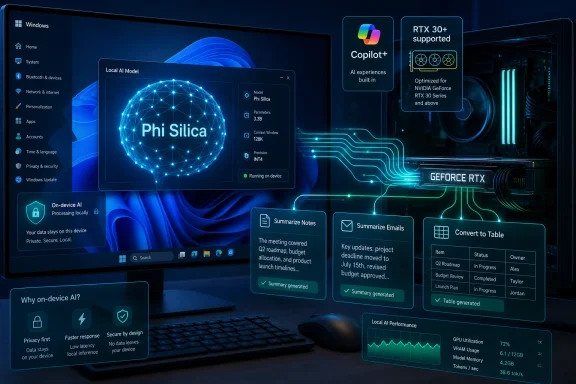
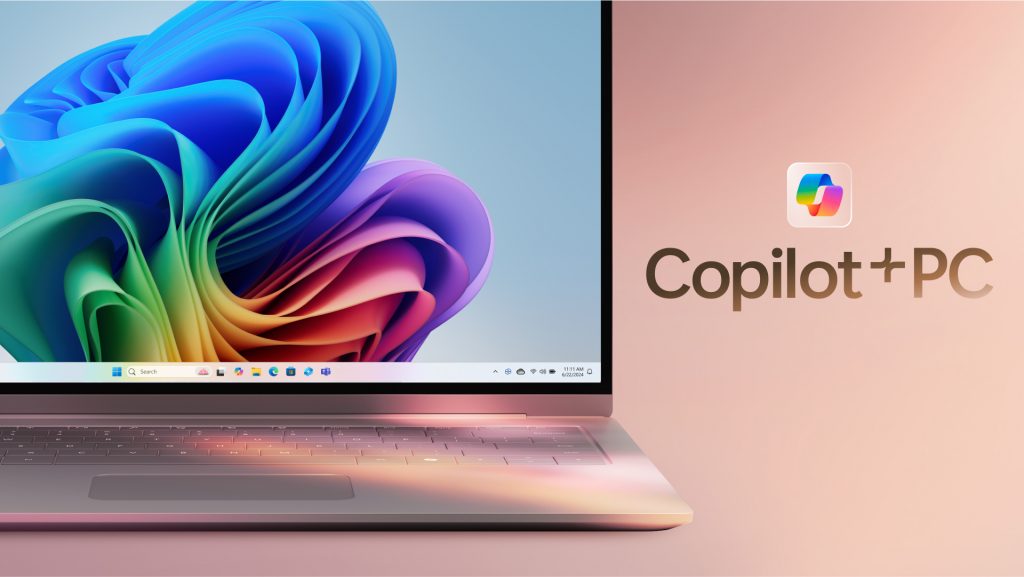
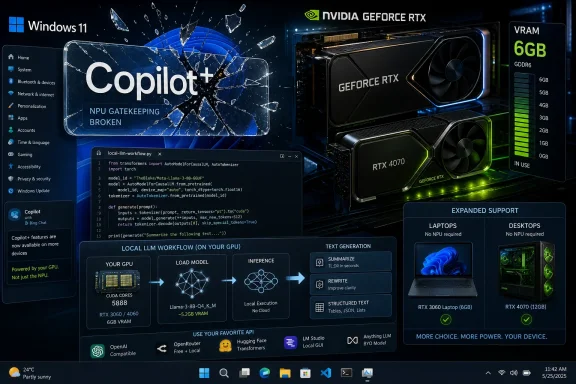
Promotional Windows 11 desktop graphic showing NVIDIA GeForce RTX 4070 with Copilot+ and local LLM workflow UI.Microsoft’s AI-PC Fence Was Always a Product Boundary Masquerading as a Technical One​

When Copilot+ PCs arrived on June 18, 2024, Microsoft’s message was simple enough to fit on a retail placard. A modern Windows AI PC needed 16GB of RAM, solid-state storage, and a neural processing unit rated at 40 TOPS or better. If you did not have that class of NPU, you did not get the marquee local AI experiences.
That framing made sense for Microsoft’s launch campaign. Qualcomm’s Snapdragon X chips gave Windows on Arm a fresh consumer story, OEMs got a clean premium badge, and Microsoft could finally argue that the PC was not merely a client for cloud AI but a local AI device in its own right. The NPU became the symbol of that shift because it was new, efficient, and easy to market.
But it was never the only silicon capable of running local models. NVIDIA GPUs have been the default acceleration hardware for much of the AI boom, and even older RTX cards can run small language models, image models, transcription engines, and developer frameworks with ease. The awkwardness was not that Copilot+ PCs had local AI features. The awkwardness was that many desktop and gaming laptops with far more raw AI compute than a thin-and-light NPU were locked out of Windows’ own local AI platform.
Microsoft’s new GPU path does not erase the Copilot+ category. It does, however, recast it. Copilot+ is no longer the only plausible home for Windows local AI; it is one hardware profile among several, and perhaps the most power-efficient rather than the most capable.

The First Crack Is an API, Not Recall​

The change reported by Windows Latest concerns Windows 11’s local Language Model APIs, not the entire Copilot+ feature set. That distinction matters. This is a developer-platform move first, a consumer-feature move second, and a Windows branding problem third.
The API gives Windows apps a sanctioned way to call local language-model capabilities on the machine. Microsoft’s documentation has described Phi Silica as a small local language model tuned for Windows AI scenarios, with capabilities such as text generation, summarization, rewriting, text-to-table conversion, and structured output. Until now, the practical message around those APIs was that developers needed Copilot+ hardware if they wanted the Windows-provided local model stack to behave as expected.
The new GPU support changes that calculus. A developer building a WinUI, WPF, WinForms, or MAUI app can now think about a larger installed base than the Copilot+ laptop market, at least for experimental language-model features. A gaming desktop with an RTX 3060 and 12GB of VRAM suddenly looks more useful to the Windows AI story than Microsoft’s original branding implied.
That does not mean Recall, Click to Do, Paint image features, or every Copilot+ experience is coming to a GeForce desktop tomorrow. Microsoft has not said that. The reported change is narrower: local language APIs can run on supported NVIDIA RTX 30-series-or-newer GPUs with 6GB or more VRAM. But platform shifts often begin in developer plumbing before they surface as consumer checkboxes.

The NPU Still Has a Job, Just Not the Job Microsoft Sold First​

It would be tempting to declare the NPU overhyped and move on. That would be satisfying, but too simple. NPUs exist for a real reason: they are designed to run certain AI workloads efficiently, with lower power draw, less heat, and less contention with the CPU and GPU. On a laptop, that matters.
A GPU can brute-force local AI in ways an NPU cannot. It also may do so with fan noise, battery drain, and thermal tradeoffs that are unacceptable for the always-available experiences Microsoft has wanted to build into Windows. If Recall is indexing screen activity in the background, Live Captions is translating in real time, and Studio Effects is improving your webcam feed, Microsoft would rather those tasks not hammer the same GPU a user needs for gaming, rendering, or external displays.
That is the strongest defense of the Copilot+ design. The NPU is not necessarily about peak performance; it is about making AI feel ambient. It is the silicon equivalent of plumbing: valuable precisely because you stop noticing it.
The problem is that Microsoft marketed the NPU as the key to local AI generally, not merely the best efficiency target for some local AI experiences. Once the conversation shifts from “only Copilot+ PCs can do this” to “Copilot+ PCs do this in a more power-managed way,” the advantage becomes thinner, more nuanced, and harder to sell at retail.

NVIDIA Gets Pulled Back Into the Windows AI Center of Gravity​

For NVIDIA, this is less a surprise than an overdue acknowledgment. The RTX installed base is enormous, and “AI PC” has always been a strange phrase when applied to laptops with modest NPUs while excluding desktops with Tensor Core-equipped GPUs. If Windows local AI is going to matter outside Microsoft’s own demos, it cannot ignore the hardware enthusiasts, creators, gamers, and developers already have.
The RTX 30-series cutoff is also revealing. Microsoft is not opening this to any GPU with a driver and good intentions. It is choosing a relatively modern baseline with sufficient VRAM and mature AI acceleration support. The 6GB VRAM requirement is modest by local-AI hobbyist standards, but it is high enough to exclude older entry-level cards and thin-client-class graphics hardware.
That suggests Microsoft is trying to avoid the chaos that can come from “it runs locally” promises on underpowered machines. Local AI that takes too long, crashes under memory pressure, or competes badly with foreground workloads becomes a support problem. A supported GPU list gives Microsoft room to broaden access without turning Windows AI into a free-for-all.
It also shifts leverage. In the original Copilot+ rollout, Microsoft’s closest silicon partner was Qualcomm, with Intel and AMD racing to meet the NPU threshold. With GPU-backed APIs, NVIDIA becomes more central to the Windows AI runtime story, especially on desktops and performance laptops. That may be healthy for Windows as a platform, but it complicates the tidy OEM narrative Microsoft spent 2024 building.

Developers Care Less About Badges Than Addressable Hardware​

The most important audience for this change is not the person browsing laptops at Best Buy. It is the developer deciding whether Windows AI APIs are worth integrating. APIs live or die by reach, stability, and trust. If a developer believes an API only works on a narrow set of premium laptops, it becomes a demo feature. If it works across a meaningful slice of Windows hardware, it becomes a platform.
That is why the GPU path matters even while it remains experimental. It tells developers that Microsoft may be willing to meet the Windows ecosystem where it already is, rather than forcing every local AI feature through the Copilot+ funnel. The Windows installed base is too heterogeneous for a single hardware badge to carry the whole strategy.
There is also a practical packaging advantage. Microsoft’s model-management approach allows apps to check whether a required local model is available and, if necessary, trigger model installation through Windows mechanisms. That is more attractive than every app shipping its own model files, inference stack, update logic, and hardware-detection code.
If Microsoft gets this right, Windows apps could gain local summarization, rewriting, classification, and structured-output features without each developer reinventing an AI runtime. If it gets this wrong, Windows AI becomes another API family developers flirt with and abandon because hardware support, licensing, availability, or policy restrictions are too brittle.

Privacy Becomes More Credible When Local AI Stops Being Rare​

The strongest consumer argument for on-device AI is privacy. If a model can summarize, rewrite, classify, or generate text locally, the user’s data does not need to leave the PC for every small task. That is especially meaningful for business documents, personal notes, source code, medical forms, legal drafts, and the ordinary mess of desktop computing.
But privacy arguments only work at scale if the feature is available on real machines people own. A local AI feature limited to the newest Copilot+ PCs sounds good in a launch keynote, but it does not help the user with a three-year-old RTX desktop or a creator laptop that still has years of useful life left. Expanding local language APIs to GPUs makes Microsoft’s privacy pitch less theoretical.
There are limits. Local execution does not automatically make an AI feature safe, accurate, or appropriate. Apps still need clear disclosure, user control, and responsible handling of generated output. A local model can hallucinate just as a cloud model can, and a bad app can still mishandle sensitive content after the model processes it.
Still, the architecture matters. If Microsoft wants users to trust AI embedded inside Windows apps, “this runs on your PC” is a better starting point than “this is sent to a service you do not control.” GPU support makes that starting point available to more of the Windows base.

Recall Remains the Feature Microsoft Cannot Casually Unfence​

The obvious question is whether this foreshadows Recall on non-Copilot+ PCs. Microsoft has not announced that, and it would be a far bigger step than enabling language APIs on RTX GPUs. Recall is not just another model call. It is a system-level memory feature with security, privacy, storage, indexing, and user-consent implications.
Recall also carries political baggage. Its original announcement triggered intense scrutiny because it proposed a searchable timeline of user activity, including screenshots, on the local machine. Microsoft delayed and reworked the feature, emphasizing opt-in behavior, Windows Hello authentication, encryption, and controls over what gets captured. That history makes Recall a poor candidate for a casual hardware expansion.
There is also the efficiency problem. A desktop RTX card could easily handle parts of Recall’s AI pipeline, but a laptop GPU is not necessarily the right place for continuous background analysis. Microsoft may decide that the NPU remains the preferred enforcement boundary for experiences that must be always available, low-power, and predictable.
So the more plausible near-term path is uneven expansion. Text APIs broaden to GPUs. Some image or productivity APIs may follow. Consumer-facing Copilot+ features remain tied to NPUs until Microsoft has enough telemetry, driver confidence, and UX polish to widen eligibility. In other words, the wall does not fall at once; it gets doors.

The Copilot+ Badge Starts Looking More Like Centrino Than Windows Itself​

The history of PC marketing is full of badges that mattered until they didn’t. Intel’s Centrino brand once told buyers something meaningful about wireless laptops, battery life, and a validated platform. Over time, the capabilities it represented became ordinary. The badge did its job, then faded into the background.
Copilot+ may be heading for a similar fate. In 2024, it marked a clean break: this PC could run a new class of Windows AI features locally. By 2026, that line is already blurrier. Intel, AMD, and Qualcomm have NPU-equipped chips. NVIDIA GPUs may now run Windows language APIs. Microsoft is simultaneously trying to define a premium AI-PC category and make AI features common enough for developers to adopt.
Those goals are in tension. Exclusivity sells new hardware. Ubiquity sells platforms. Microsoft can privilege OEM partners for only so long before it harms the developer story and frustrates users with capable existing PCs.
That is why this GPU expansion feels more strategically important than its narrow API scope suggests. It is Microsoft choosing platform gravity over badge purity. Windows wins when more Windows PCs can do useful things, not when artificial segmentation makes the newest sticker look better.

Enterprise IT Will Read This as a Support Matrix Problem​

For administrators, the news is both welcome and annoying. Welcome, because organizations with RTX workstations may be able to test local AI features without buying a fleet of Copilot+ laptops. Annoying, because the Windows AI hardware story now has more branches.
A clean requirement is easy to govern. A Copilot+ PC either meets the NPU, memory, and storage baseline or it does not. A GPU-backed local AI API introduces driver versions, VRAM thresholds, model availability, experimental SDK status, and application-specific behavior. That is manageable, but it is not simple.
Enterprises will also care about where models come from, how they are updated, whether they can be blocked, and what telemetry or policy controls apply. Local AI does not exempt Microsoft from the normal enterprise questions. If anything, it raises new ones because AI capabilities may appear inside ordinary apps rather than as a single branded assistant.
The better Microsoft documents the boundaries, the faster enterprises can test. The worse it communicates them, the more administrators will disable first and ask questions later. Windows AI needs trust from IT departments, not just excitement from developers.

The Real Risk Is Another Half-Platform​

Microsoft has a long history of building promising Windows developer platforms that never quite become unavoidable. Sometimes the problem is timing. Sometimes it is churn. Sometimes the company’s own apps do not commit deeply enough to prove the platform’s value.
Windows AI APIs could fall into that trap. If they remain experimental for too long, if the supported hardware matrix keeps shifting, or if Microsoft reserves the best experiences for its own apps and services, third-party developers will hedge. They will keep using cross-platform AI stacks, cloud APIs, or embedded local runtimes they can control.
The GPU expansion is a good sign because it increases the plausible audience. But it also raises expectations. Once Microsoft says Windows can provide local language capabilities on RTX hardware, developers will expect performance guidance, lifecycle promises, policy controls, and a path out of experimental status.
This is where the company must be disciplined. The Windows AI stack does not need another branding flourish. It needs boring reliability: clear requirements, stable APIs, predictable model delivery, and honest communication about what runs where.
The RTX Door Rewrites the Copilot+ Fine Print​

This is the practical shape of the change, stripped of the launch rhetoric and the anti-hype backlash. Microsoft has not made every Copilot+ feature universal, but it has weakened the idea that local Windows AI belongs only to NPU-equipped PCs.
  • Windows 11’s local Language Model APIs are being opened experimentally to supported NVIDIA GeForce RTX 30-series and newer GPUs with at least 6GB of VRAM.
  • The change applies to developer-facing language capabilities such as local prompting, summarization, rewriting, and related Phi Silica-powered text features, not automatically to every Copilot+ consumer feature.
  • Copilot+ PCs still matter for power-efficient, always-on, laptop-friendly AI workloads, especially where Microsoft wants predictable performance and battery behavior.
  • RTX desktops and gaming laptops now look less like outsiders to the Windows AI story and more like an obvious expansion target.
  • Enterprise administrators should treat this as a new hardware and policy matrix, not as a simple lifting of all Copilot+ restrictions.
  • The long-term significance is that Microsoft is moving from a badge-first AI-PC story toward a broader Windows local-AI platform.
Microsoft’s problem is no longer proving that Windows PCs can run AI locally; enthusiasts proved that before Copilot+ had a logo. The harder task is deciding whether Windows AI is a premium hardware upsell, a developer platform, or a normal operating-system capability that adapts to whatever silicon the user already owns. By opening the Language Model APIs to RTX GPUs, Microsoft has taken a small but revealing step toward the third answer, and that is the answer Windows will need if local AI is going to become more than a sticker on the next laptop refresh.

References​

  1. Primary source: Windows Latest
    Published: Wed, 10 Jun 2026 23:59:47 GMT
  2. Official source: learn.microsoft.com
  3. Official source: blogs.microsoft.com
  4. Related coverage: windowscentral.com
  5. Official source: developer.microsoft.com
  6. Official source: microsoft.com
  1. Related coverage: arstechnica.com
  2. Related coverage: tomshardware.com
  3. Related coverage: pcworld.com
  4. Related coverage: makeuseof.com
  5. Related coverage: next.ink
  6. Official source: news.microsoft.com
  7. Official source: info.microsoft.com
  8. Related coverage: na.ingrammicro.com
 

Microsoft has updated Windows 11’s local Language Model APIs so developers can run Phi Silica workloads on non-Copilot+ PCs with Nvidia GeForce RTX 30-series or newer GPUs and at least 6GB of VRAM, extending native on-device AI beyond the NPU-equipped machines Microsoft promoted in 2024. The change is officially a developer preview, not a mass rollout of every Copilot+ feature to every gaming tower. But strategically, it is much bigger than an API compatibility note. Microsoft is admitting, carefully and indirectly, that the future of local AI on Windows cannot be confined to one badge, one silicon block, or one laptop marketing cycle.

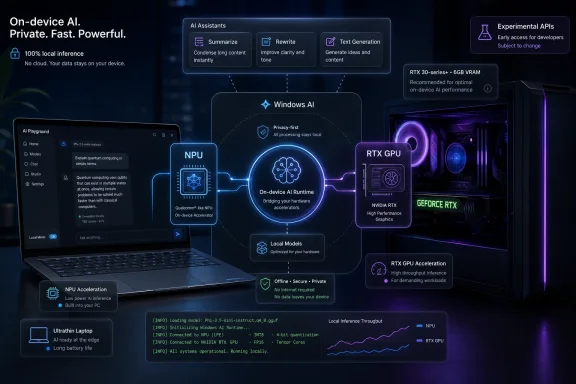
Futuristic Windows PC interface showing local AI model “Phi Silica” running with RTX 30+ support.Microsoft’s AI PC Wall Was Always Built on Efficiency, Not Capability​

When Microsoft introduced Copilot+ PCs, it did not merely describe a new class of hardware. It drew a line through the Windows ecosystem. On one side were machines with at least 16GB of RAM, SSD storage, and an NPU capable of 40 TOPS or more. On the other side were millions of perfectly modern Windows PCs that could game, render, compile, stream, and run local AI tools, but could not qualify for Microsoft’s most visible on-device AI push.
The NPU requirement was not technically absurd. Neural processing units are designed to run certain AI workloads efficiently, often at lower power and with less thermal drama than a discrete GPU. In a thin laptop, that matters. An always-available assistant, a background indexing feature, or a low-latency image tool cannot behave like a game that spins up a 115-watt GPU every time the user opens a document.
But the marketing simplification hardened into something more brittle. “Copilot+ PC” became shorthand for “this is where Windows AI happens,” even though enthusiasts had been running local language models, Stable Diffusion derivatives, transcription engines, and retrieval tools on GPUs long before the badge existed. Microsoft’s claim was strongest when phrased as a battery-life argument. It was weakest when heard as a capability argument.
That distinction matters because Windows is not just a laptop operating system. It is also the platform under gaming rigs, creator workstations, developer desktops, lab machines, and corporate endpoints with discrete graphics hardware. A Windows AI strategy that treats those PCs as second-class citizens was never going to survive contact with the installed base.

The RTX Exception Turns a Badge Into a Negotiation​

The new support path does not make every Windows 11 PC an AI PC. It specifically targets systems with Nvidia GeForce RTX 30-series GPUs or newer and at least 6GB of VRAM. That is still a meaningful hardware floor, and it excludes older GTX cards, low-end integrated graphics, many business desktops, and laptops with cramped graphics memory.
Even so, the symbolic shift is hard to miss. A PC no longer needs to be sold as a Copilot+ machine to participate in Microsoft’s native local language model layer. It can qualify because it has the right GPU. The Copilot+ badge remains relevant, but it is no longer the only doorway into Windows’ built-in AI runtime story.
This is a different kind of fragmentation from the one Microsoft started with. Instead of “NPU equals in, no NPU equals out,” Windows AI begins to look more like the rest of PC computing: feature availability depends on the specific accelerator, driver stack, memory budget, OS version, and app framework. That is messier to explain on a retail shelf, but it is more honest about the PC market.
It also gives Microsoft an escape hatch. The company can preserve Copilot+ as a premium category for certain first-party experiences while letting developers target a broader range of capable machines. That is not a retreat so much as a rebalancing. Microsoft still gets to promote efficient AI laptops, but it no longer has to pretend that a desktop RTX card is somehow less “AI capable” than a laptop NPU.

Phi Silica Becomes a Windows Component, Not Just a Demo Model​

The model at the center of this shift is Phi Silica, Microsoft’s on-device small language model for Windows AI APIs. It is intended for local language tasks such as summarization, rewriting, text generation, formatting, and structured transformations. It is not a full cloud-scale chatbot living inside Windows, and nobody should expect it to behave like the largest frontier models.
That limitation is part of the point. Phi Silica represents the class of AI work that makes sense to run locally: fast, bounded, privacy-sensitive, and deeply integrated into apps. A mail client does not need a gigantic model to rewrite a paragraph. A notes app does not need a cloud round trip to turn meeting bullets into a cleaner outline. A document tool does not need to upload corporate text to a remote server just to produce a table.
The more important architectural change is distribution. If an app needs the model, Windows can obtain the required components through the system rather than forcing every developer to bundle a model, build a downloader, manage updates, and explain storage consumption to users. That turns the model into something closer to a shared runtime dependency.
This is where Microsoft’s platform instincts show. The company does not merely want AI apps to exist on Windows; it wants Windows to become the place where the app asks for a capability and the operating system brokers the hardware, runtime, model, and updates. That is the same playbook that made graphics, media, printing, accessibility, and security APIs strategically important. AI is being pulled into the operating system’s contract with developers.

Developers Care Less About the Badge Than the Call​

For developers, the distinction between an NPU and a GPU is secondary to whether an API is available, predictable, fast enough, and supportable. A developer building a Windows app does not want to write one feature for Copilot+ laptops, another for RTX desktops, another for CPU fallback, and another for cloud-only machines unless the market forces them to. They want a capability they can query and a behavior they can explain.
That is why this preview matters even if the first supported surface is narrow. Once Windows AI APIs can run across more than one accelerator class, Microsoft can begin abstracting the hardware away. The app can ask whether local language generation is available. Windows can decide whether that means an NPU, a GPU, or perhaps another supported backend in the future.
There is still a long way to go before that vision is clean. Developers will need to know latency, model quality, memory behavior, battery impact, and fallback rules. Enterprises will want policy controls. Users will want a simple answer to whether an app feature works on their machine. Support desks will be less amused by a world where “Windows AI” works on one RTX laptop but not another because of VRAM, driver, OS, or preview-channel requirements.
But the direction is sensible. Microsoft cannot win local AI on Windows by making every developer target one premium laptop category. It can win by making local AI feel like a normal Windows capability that scales across hardware. The RTX move is an early, imperfect version of that broader platform promise.

The NPU Was Not a Lie, but the Story Was Too Small​

The easy reaction is to say this proves NPUs were unnecessary. That is too neat. NPUs still make sense for certain workloads, especially on mobile hardware where power efficiency and sustained background operation matter. A laptop that can perform AI tasks without hammering battery life or fan noise has a real advantage.
The problem was not the NPU. The problem was treating the NPU as the defining feature of local AI rather than one implementation of it. GPUs are often better suited for heavier bursts of AI compute, particularly on desktops and gaming laptops where power and thermals are less constrained. CPUs may be appropriate for lighter models or speech and vision tasks. Specialized silicon is not a religion; it is a scheduling decision.
Microsoft now appears to be moving toward that more pragmatic view. Copilot+ PCs can still be the best experience for certain Windows features. RTX systems can become viable targets for local language APIs. Other hardware paths may follow as the stack matures. The platform gets healthier when the operating system stops enforcing a marketing category as if it were a law of physics.
This also puts pressure on Microsoft’s first-party feature strategy. If Phi Silica can run locally on a supported RTX system, users will reasonably ask why some AI experiences remain exclusive to Copilot+ PCs. Sometimes the answer will be privacy, performance, power, or model design. Sometimes the answer will be product segmentation. Microsoft will need to be clearer about which is which.

Enterprise IT Will See Promise Wrapped in Policy Risk​

For administrators, the most interesting part of the change is not that gaming GPUs can run a Microsoft language model. It is that Windows may download AI models as system-managed components when apps request them. That is convenient for developers and consumers, but it also creates new operational questions inside managed environments.
Enterprises have spent years building controls around software installation, data loss prevention, cloud services, and endpoint telemetry. Local AI complicates that map. If the processing happens on the device, the privacy story may improve because sensitive content does not need to leave the PC. But local processing also means the capability may appear inside apps that previously had no generative features at all.
That will force administrators to think beyond the old cloud-versus-local framing. A locally running model can still summarize confidential documents, transform regulated text, or generate content that must be retained, audited, or governed. The absence of a cloud upload does not eliminate compliance obligations. It merely changes where the risk lives.
Microsoft will therefore need robust controls: which models can be installed, which apps can call them, how usage is logged, whether features can be disabled by policy, and how model updates are validated. If Windows AI APIs become a mainstream platform layer, they cannot be managed like a novelty feature. They will need the same administrative seriousness as browser engines, scripting runtimes, and identity brokers.

Nvidia Gets the Installed Base Microsoft Needs​

The Nvidia angle is not incidental. RTX hardware is the most obvious bridge between Microsoft’s Copilot+ ambitions and the existing population of Windows machines powerful enough to run local AI today. Nvidia has spent years turning its consumer GPUs into AI accelerators by another name, helped by CUDA, tensor cores, and a developer ecosystem that already treats RTX cards as practical local inference hardware.
For Microsoft, supporting RTX systems buys reach. Copilot+ PCs may define the new laptop shelf, but RTX PCs define a large slice of enthusiast, creator, and gaming Windows. Those are exactly the users most likely to experiment with local AI, notice performance differences, and pressure app developers to support hardware they already own.
For Nvidia, the move reinforces the idea that an RTX GPU is not just for games. The company has been steadily reframing GeForce and RTX PCs as AI platforms, not merely graphics platforms. Microsoft’s Windows AI APIs give that pitch a native OS hook. Instead of every app relying on its own AI runtime, Windows can become part of the acceleration story.
The awkward part is that this may make Copilot+ branding feel less distinct to power users. If a desktop with an RTX 4070 can run local Microsoft-backed language APIs, the badge on a thin laptop becomes less of a gatekeeper and more of an efficiency certification. That is probably where it should have been all along.

The Consumer Message Gets Messier but More Truthful​

Microsoft now has a messaging problem of its own making. For a year, the company trained consumers to associate local Windows AI with Copilot+ PCs. Now it must explain that some Windows AI APIs can run on some non-Copilot+ PCs with certain Nvidia GPUs, while other headline features remain tied to NPU-equipped systems.
That is not elegant. But PC buyers already live in a world of messy capability charts. Games have minimum and recommended GPUs. Video editors depend on codecs and accelerators. Security features depend on firmware and processor support. AI will be no different, no matter how much the industry wants a single logo to simplify it.
The more honest consumer message is that local AI has tiers. A Copilot+ laptop may be the right choice for battery-friendly, integrated, always-on AI features. An RTX desktop may be excellent for higher-power local inference and developer experimentation. A standard business laptop may rely on cloud AI or CPU-bound features. The badge can indicate one path, but it should not pretend to describe the whole map.
The risk is disappointment. If users hear “Windows AI now works on non-Copilot+ PCs,” some will assume Recall, Click to Do, image tools, and every future AI feature are coming to their older machines. That is not what this change says. Microsoft will need to be precise, because the AI PC category is already full of inflated claims and thin distinctions.

The Real Battle Is Over the Default AI Runtime​

This update is best understood as part of a larger contest over who owns the default local AI runtime on the PC. Microsoft wants developers to call Windows APIs. Nvidia wants developers to exploit RTX acceleration. Intel, AMD, and Qualcomm want NPUs to matter. Cloud AI providers want apps to keep calling hosted models. Open-source developers want portable stacks that are not locked to one vendor’s operating system.
Windows sits in the middle of that fight. If Microsoft can make its AI APIs easy, performant, policy-manageable, and widely available, it can turn local AI into a Windows platform advantage. If it keeps the stack too restricted, developers will route around it with their own model runtimes and hardware-specific libraries. That would leave Windows as the host operating system but not the AI platform.
The RTX preview suggests Microsoft understands that danger. A platform API that only works on a narrow class of recently marketed devices is not really a platform API. It is a product feature wearing platform clothing. Broadening support makes the APIs more credible.
Still, Microsoft must avoid creating a maze. Developers will not embrace Windows AI because it has an appealing architecture diagram. They will embrace it if it reduces complexity. The system needs clear capability detection, dependable model availability, transparent performance expectations, and licensing terms that do not make developers nervous after they have built features around it.

The Copilot+ Line Is Thinner Than Microsoft First Drew It​

The practical lesson is not that Copilot+ PCs are obsolete. It is that the original boundary was overdrawn. Microsoft needed a launch narrative, OEMs needed a reason to sell new machines, and NPUs gave the industry a clean number to print on spec sheets. But local AI was never going to fit neatly inside that campaign.
The Windows PC ecosystem is too broad for that. A 2021-era RTX desktop may have more raw AI throughput than a newly certified ultralight laptop. A workstation may be plugged in all day and unconcerned with power draw. A corporate fleet may value manageability more than model performance. A developer may care more about API stability than whether the machine carries a consumer-facing label.
By extending local language APIs to supported Nvidia GPUs, Microsoft is acknowledging that the installed base matters. That is good for users who already own capable hardware. It is good for developers who want a larger market. It is good for Windows as a platform, because an operating system should expand the usefulness of PCs rather than reserve useful capabilities for the newest marketing category.
But it also weakens the mystique around Copilot+. Once users understand that some local AI features can run on non-Copilot+ PCs, they will judge the badge more critically. It will need to stand for tangible advantages: battery life, latency, integration, security, and feature breadth. A logo alone will not carry the argument.

The New Rules Windows Users Should Actually Remember​

This is a preview-era shift, so the immediate impact will be uneven. The important thing is not to overread it as a universal unlock or underread it as a dry SDK footnote. It is the first visible step toward a Windows AI model where capability follows hardware reality rather than a single badge.
  • Windows 11’s local Language Model APIs are expanding beyond Copilot+ PCs, but the new path currently targets supported Nvidia RTX 30-series or newer GPUs with at least 6GB of VRAM.
  • Phi Silica is aimed at local text intelligence such as summarization, rewriting, formatting, table conversion, and prompt-based generation rather than replacing large cloud chatbots.
  • Copilot+ PCs still matter because NPUs are better suited to efficient, sustained, battery-conscious AI workloads, especially in thin laptops.
  • This change does not automatically bring every Copilot+ feature, including Microsoft’s more visible shell-level AI experiences, to older or non-certified PCs.
  • Developers now have a stronger reason to treat Windows AI APIs as a platform layer, provided Microsoft makes availability, policy control, and performance predictable.
  • The AI PC badge is becoming less of a hard border and more of a signal about one kind of optimized experience.
Microsoft’s quiet RTX expansion does not end the Copilot+ era, but it does end the cleanest version of its story. The next phase of Windows AI will be less about proving that NPUs are special and more about proving that Windows can intelligently use whatever capable silicon is already inside the PC. That is a harder message to sell, but a better foundation to build on.

References​

  1. Primary source: Digital Trends
    Published: Thu, 11 Jun 2026 15:13:03 GMT
  2. Official source: learn.microsoft.com
  3. Official source: developer.microsoft.com
  4. Related coverage: berrall.com
  5. Related coverage: windowscentral.com
  6. Official source: microsoft.com
 

Microsoft has opened experimental Windows AI language-model APIs to Windows 11 PCs with Nvidia GeForce RTX 30-series GPUs or newer and at least 6GB of VRAM, letting some non-Copilot+ PCs run local AI workloads that were previously reserved for NPU-equipped machines. The change is not a consumer-feature unlock so much as a platform signal. Microsoft is no longer pretending that the NPU is the only credible local AI engine in the Windows ecosystem. That matters because the original Copilot+ pitch was built around a hardware boundary that is now becoming more porous.

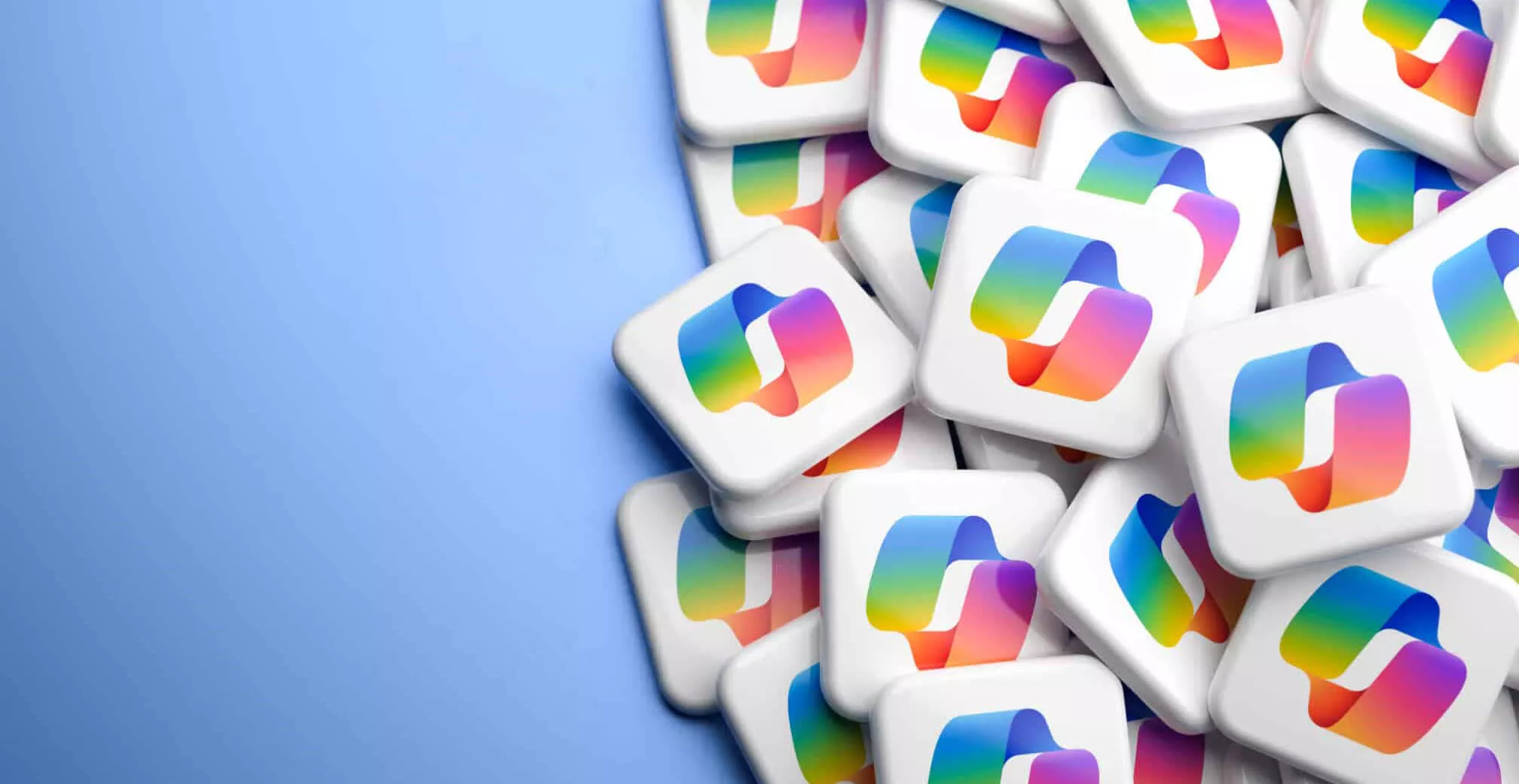
On-device AI interface shows Windows AI runtime, NPU/RTX acceleration, and privacy-first local inference.Microsoft’s Copilot+ Wall Was Always More Marketing Than Physics​

When Microsoft introduced Copilot+ PCs in May 2024 and put the first wave on shelves in June, it sold the category with unusual bluntness: this was not merely a faster Windows laptop, but a new class of machine. The defining number was 40 TOPS of NPU performance, joined by baseline requirements such as 16GB of memory and SSD storage. The implication was simple enough for retail shelves and OEM keynotes: if you wanted the new local AI future of Windows, you needed the new silicon.
That message was useful, but it was never the whole technical story. GPUs have been doing machine-learning work for years, and Nvidia’s RTX line is practically synonymous with consumer-accessible AI acceleration. The difference is not whether a GPU can run a local model; the difference is whether Microsoft was willing to make Windows’ own AI plumbing treat that GPU as a first-class target.
The new experimental support for language-model APIs on RTX hardware does not erase the Copilot+ category. It does, however, puncture the neatness of the original boundary. A desktop or gaming laptop with an RTX 3060, RTX 4070, or newer card may lack the badge Microsoft and its OEM partners spent two years promoting, but it can now begin to participate in part of the same local AI platform.
That is the important distinction. Microsoft has not suddenly turned every RTX gaming rig into a Copilot+ PC. It has acknowledged, in code and documentation, that the local AI runtime cannot remain trapped inside one hardware story forever.

The First Crack Appears in the Developer Layer​

The change arrives in the least flashy place possible: the Windows AI developer stack. Microsoft describes the GPU path as experimental, and the current opening applies to language-model APIs rather than the whole menu of Copilot+ features. Developers can build apps that call into Windows’ local model capabilities on supported Nvidia GPUs, with Microsoft specifying GeForce RTX 30-series or newer hardware with at least 6GB of VRAM.
That phrasing matters. This is not a Start menu toggle, a Windows Settings switch, or an announcement that Recall is coming to your old gaming PC. It is a platform feature for applications that know how to use the Windows AI framework. The user-facing payoff will depend on developers deciding that Microsoft’s local AI APIs are worth targeting.
Still, developer layers are where platform shifts begin. DirectX was not exciting because an API existed; it was exciting because it gave game developers a common path into hardware acceleration. WinRT, Windows Hello, WSL, and countless other Windows features followed the same pattern: first the plumbing, then the apps, then the expectation that the capability is simply part of the operating system.
The Windows AI APIs are now taking a similar step. By allowing a supported GPU to run the local language model, Microsoft reduces the risk that Windows AI becomes a boutique feature limited to the newest premium laptops. It also gives developers a larger addressable base, which is exactly what any platform needs if it wants more than demo-ware.

Phi Silica Becomes Less of a Copilot+ Ornament​

At the center of this change is Phi Silica, Microsoft’s small on-device language model for Windows AI experiences. The model is designed for local inference rather than cloud-scale chat, and it exposes capabilities through Windows.AI.Text APIs such as summarization, rewriting, text generation, and structured text conversion. The model is not meant to replace a frontier cloud model; it is meant to make common language tasks feel instant, private, and integrated.
The practical distribution model is also revealing. Instead of expecting every Windows 11 machine to carry the model by default, Microsoft can deliver it through Windows Update when an app requires it. That keeps the footprint lower while allowing multiple applications to use the same system-managed component.
This is the kind of operating-system move Microsoft understands well. Windows has long absorbed common runtime dependencies so developers do not need to ship their own copy of every library. If local AI becomes another shared runtime service, the question becomes less “Which app bundled which model?” and more “Which hardware target does Windows know how to use?”
GPU support makes that question more interesting. Phi Silica was introduced in the Copilot+ orbit as an NPU-tuned local model, but on-device AI is not a single-silicon religion. A model can be optimized for one kind of accelerator while still being useful on another, provided the software stack can route the work sensibly.

The NPU Still Has the Better Laptop Argument​

The easy reaction is to declare the NPU requirement dead. That would be premature. Microsoft’s original NPU argument was never only about raw performance; it was about sustained, low-power, background inference on thin-and-light PCs.
A discrete GPU can be much faster than a laptop NPU for many AI workloads, but it usually pays for that speed with power draw, heat, fan noise, and competition with graphics or compute tasks. On a desktop tower plugged into the wall, that may be an acceptable trade. On an ultraportable laptop trying to preserve all-day battery life, it is much less attractive.
This is why Microsoft can open a GPU path for language APIs while keeping parts of the Copilot+ experience tied to NPUs. Features that run occasionally, on demand, and inside a developer-controlled app are different from OS-level features that may need to index, observe, caption, translate, or act across the user’s session. The former can tolerate a bursty GPU workload. The latter needs a more carefully budgeted compute envelope.
That distinction is not mere vendor spin. Anyone who has heard a gaming laptop spin up under a local model knows that “on-device” does not automatically mean “quiet” or “efficient.” NPUs are designed to make AI boring in the best possible way: always available, low-power, and unlikely to make the rest of the machine feel worse.
But the NPU’s strength does not make the GPU irrelevant. It simply means Windows needs to become smarter about assigning jobs to hardware. Local AI is not a single feature; it is a workload class. Some jobs belong on an NPU, some on a GPU, some on a CPU, and some still belong in the cloud.

Copilot+ Exclusivity Meets the Installed Base​

The business reason for Microsoft’s original line was obvious. Copilot+ PCs gave OEMs a new upgrade story at a time when the PC market needed one, and they gave Microsoft a way to tie Windows 11’s next act to hardware refresh cycles. The phrase “AI PC” was not just a technical description; it was a replacement pitch.
That pitch has always had a problem: the Windows installed base is enormous, fragmented, and full of machines with capable silicon that does not match Microsoft’s initial checklist. Enthusiasts may own RTX desktops that can run local language models comfortably. Developers may use workstations with far more AI horsepower than a thin-and-light laptop NPU. Gamers may have bought an RTX 30-series card years before Copilot+ existed.
Leaving those systems outside the Windows AI story was defensible only if Copilot+ features required a specific class of always-on NPU behavior. For some features, they may. For basic language-model APIs, the argument was weaker.
Microsoft appears to be recognizing that the developer ecosystem cannot be built solely around newly purchased Copilot+ machines. If the company wants Windows AI APIs to become normal app infrastructure, developers need more test machines, more user machines, and fewer reasons to bypass Microsoft’s stack in favor of direct calls to CUDA, DirectML, ONNX Runtime, llama.cpp, or cloud APIs.
The RTX opening is therefore less a surrender than a recruitment drive. Microsoft is trying to make Windows itself relevant in a local AI world where developers already have other ways to run models on PCs.

Recall Remains the Line Microsoft Is Not Ready to Cross​

The most visible Copilot+ feature remains Recall, the controversial system that captures and indexes a user’s activity so it can be searched later. Recall’s history has made it more than a feature; it is a trust test for Microsoft’s AI ambitions. After the original rollout plan drew heavy criticism from security researchers and privacy advocates, Microsoft reworked the feature with stronger controls, opt-in behavior, and Windows Hello requirements.
That history helps explain why GPU support is arriving first in language-model APIs, not in the headline Copilot+ feature set. Recall is not simply “run a model locally.” It involves data capture, indexing, identity protection, storage security, and user consent. The hardware accelerator is only one part of a much larger system.
Click to Do and other shell-level AI experiences sit in a similar category. They are not ordinary app features. They are Windows experiences that can interact with the user’s screen, content, and workflow. Microsoft will be cautious about expanding those beyond the hardware and security profile it has already defined.
That leaves Windows users in an odd middle ground. A non-Copilot+ RTX PC may gain access to local language capabilities through apps, but it still may not receive the branded experiences Microsoft uses to advertise Copilot+ machines. The wall is no longer solid, but it is not gone.
This may frustrate enthusiasts, especially those with desktops that vastly outperform Copilot+ laptops on many AI benchmarks. Yet Microsoft’s segmentation is partly technical, partly security-driven, and partly commercial. The company wants a broader AI platform, but it also wants the Copilot+ label to keep meaning something.

Nvidia Gets the Validation It Has Been Arguing For​

For Nvidia, Microsoft’s move is a quiet win. Nvidia has spent years telling consumers and developers that RTX PCs are AI PCs, even before Microsoft’s Copilot+ branding gave the term a narrower definition. The company’s argument has been straightforward: tensor cores, mature software, and a huge installed base make RTX hardware a natural home for local inference.
Microsoft’s initial Copilot+ requirements complicated that story. A machine with a powerful RTX GPU could be excluded from Copilot+ features while a laptop with an NPU received the badge. That made sense from Microsoft’s battery-life and platform-control perspective, but it created a messaging clash with Nvidia’s larger AI PC campaign.
By adding GPU support to Windows AI language APIs, Microsoft narrows the gap between those narratives. It does not hand Nvidia the Copilot+ brand outright, but it gives RTX hardware a sanctioned role inside Microsoft’s local AI framework. That is more valuable than a marketing quote because it gives developers a Windows-supported path to the installed base Nvidia already has.
The minimum requirement of RTX 30-series hardware with 6GB of VRAM is also telling. Microsoft is not trying to support every aging GPU that can technically execute a model. It is drawing a pragmatic line around hardware with modern AI acceleration and enough memory to avoid a miserable baseline experience.
That line will still exclude some users. Low-end RTX cards with limited VRAM, older GTX machines, integrated graphics, and AMD or Intel GPUs are not part of this specific Nvidia path. But once Microsoft accepts GPUs as legitimate targets, pressure will grow for a broader hardware matrix.

Developers Now Have a More Interesting Windows AI Pitch​

For developers, the biggest change is not that Phi Silica can run on an RTX GPU. It is that Microsoft’s local AI APIs now have a better chance of reaching users who did not buy a new Copilot+ laptop.
That matters because developers are allergic to tiny platform islands. If an API works only on a narrow slice of premium devices, it becomes a demo feature or an optional flourish. If it works across a meaningful portion of Windows 11 hardware, it can become a design assumption.
The API approach also abstracts some of the mess that has made local AI on PCs both exciting and chaotic. Today’s local AI scene is rich with frameworks, model formats, quantization choices, GPU backends, driver dependencies, and performance caveats. Enthusiasts can navigate that world. Most application developers would rather call a supported Windows API and let the platform handle model delivery and hardware selection.
That is the strategic opening for Microsoft. Windows does not need to beat every open-source local model runner on flexibility. It needs to be predictable, integrated, and good enough for mainstream app scenarios. Summarize this document, rewrite this email, extract structured data from this text, generate a short draft, classify this note: these are not science projects anymore.
The more Windows can make those tasks local by default, the more it can reduce latency, cloud costs, and privacy concerns. The catch is that Microsoft has to earn developer trust after years of shifting Windows app strategies. Experimental APIs are useful, but developers will wait to see what stabilizes, what ships, and what Microsoft keeps supporting.

Local AI Is Becoming a Privacy Feature, Not Just a Performance Feature​

Microsoft’s cloud AI strategy is not going away. Copilot, Azure AI, Microsoft 365 Copilot, and developer-facing cloud models remain central to the company’s business. But local AI has a different kind of appeal: it can answer the growing discomfort around sending everything to remote servers.
For consumers, that appeal is intuitive. A writing tool that rewrites a paragraph locally feels less invasive than one that uploads the text. A summarizer that works on a private file without leaving the PC is easier to trust. A small model that handles routine language tasks offline is useful even when connectivity is poor.
For enterprises, the stakes are sharper. Data residency, compliance, confidentiality, and auditability all shape whether AI features can be deployed broadly. Many organizations are interested in AI but wary of uncontrolled data flows. Local inference does not solve every governance problem, but it changes the risk profile.
That is why the API layer matters. If Windows can provide local AI capabilities that developers can invoke consistently, organizations can begin to evaluate those capabilities as part of endpoint strategy rather than as a pile of separate app integrations. The PC becomes not just a client for AI, but a controlled execution environment.
This is also where Microsoft must be careful. “Local” cannot become a magic privacy word. Users and administrators need to know when data stays on device, when it is sent to the cloud, which models are installed, how updates are handled, and what telemetry surrounds the experience. If Microsoft blurs those lines, the local AI trust advantage will evaporate quickly.

The Copilot+ Brand Looks Less Like a Destination and More Like a Tier​

The Copilot+ PC label is not dead, but it is changing shape. At launch, it sounded like a gate: on one side were ordinary PCs, and on the other were machines capable of the next generation of Windows. GPU support for local language APIs makes the label look more like a tier in a wider spectrum.
That may actually be healthier for Windows. The PC ecosystem has never fit cleanly into single-brand categories. There are gaming desktops with huge GPUs, fanless ultraportables with efficient NPUs, business laptops with conservative driver stacks, workstations with professional accelerators, and budget machines that barely meet Windows 11’s own requirements. A serious AI platform has to adapt to that diversity.
The risk is confusion. Microsoft has already struggled to explain the difference between Copilot, Copilot in Windows, Microsoft 365 Copilot, Copilot+ PCs, Windows AI APIs, Windows Copilot Runtime, Windows ML, and Foundry branding. Adding “some local AI works on RTX non-Copilot+ PCs, but not the famous Copilot+ features” will not make the retail story easier.
But technical reality often wins eventually. If a user’s machine has hardware capable of running a local language model, and if Windows can support it safely, an artificial block becomes harder to defend. Microsoft does not need to abandon Copilot+ branding to soften it. It can keep Copilot+ as the premium, fully validated experience while allowing specific AI capabilities to scale across other machines.
That appears to be the direction now. Copilot+ becomes the best-supported path, not the only path. For Windows, that is a significant philosophical shift.

The RTX Door Opens, but Only a Few Rooms Are Unlocked​

The most practical way to read this change is as a limited but meaningful expansion. It is not a consumer rollout, not a Recall unlock, and not a universal AI upgrade for every Windows 11 PC. It is a sign that Microsoft is beginning to separate Windows AI capabilities from the Copilot+ badge where the technical case allows it.
  • Microsoft’s experimental GPU support applies to Windows AI language-model APIs, not the full Copilot+ feature set.
  • Supported Nvidia hardware currently starts with GeForce RTX 30-series GPUs or newer with at least 6GB of VRAM.
  • Phi Silica can be delivered through Windows Update when an application needs the local model, rather than being preinstalled on every Windows machine.
  • Developers gain a larger potential audience for local summarization, rewriting, text generation, and structured text features.
  • NPU-equipped Copilot+ PCs still have the stronger argument for low-power, always-available laptop AI experiences.
  • The move makes Copilot+ look less like an absolute hardware wall and more like Microsoft’s premium validation tier for Windows AI.
For users, the near-term impact will be modest unless applications adopt the APIs. For developers and IT planners, the signal is larger: Microsoft is preparing for a Windows AI ecosystem in which the accelerator might be an NPU, a GPU, or something else entirely.
Microsoft’s original Copilot+ pitch needed a clean line because new categories require simple stories. Two years later, the platform needs a messier but more durable truth: local AI on Windows will not belong to one chip, one badge, or one generation of laptops. The company can still make the NPU the centerpiece of its most polished experiences, but if Windows is going to be the place where PC AI actually happens, it has to meet capable hardware where it already lives.

References​

  1. Primary source: TechSpot
    Published: Thu, 11 Jun 2026 20:25:50 GMT
  2. Official source: learn.microsoft.com
  3. Official source: developer.microsoft.com
  4. Related coverage: berrall.com
  5. Related coverage: blogs.nvidia.com
  6. Official source: azure.microsoft.com
  1. Related coverage: developer.nvidia.com
  2. Related coverage: build.nvidia.com
  3. Official source: devblogs.microsoft.com
  4. Related coverage: docs.api.nvidia.com
  5. Related coverage: docs.nvidia.com
  6. Related coverage: nvidianews.nvidia.com
  7. Related coverage: docscontent.nvidia.com
  8. Related coverage: nvidia.com
  9. Official source: microsoft.com
  10. Official source: blogs.microsoft.com
  11. Related coverage: tomshardware.com
  12. Related coverage: windowscentral.com
  13. Related coverage: computerworld.com
  14. Official source: news.microsoft.com
  15. Related coverage: skywork.ai
  16. Related coverage: pcgamer.com
 

Microsoft has updated its Windows 11 local AI documentation in June 2026 to let developers run Phi Silica language model APIs on non-Copilot+ PCs with supported Nvidia RTX GPUs, widening on-device text AI beyond machines with dedicated NPUs. The move does not suddenly turn every gaming rig into a full Copilot+ PC, nor does it hand Recall to the GPU crowd. But it does quietly puncture one of the cleanest marketing lines Microsoft has drawn around Windows AI hardware. The new message is messier, more practical, and probably more durable: local AI on Windows is becoming a platform capability, not a single badge on a laptop lid.

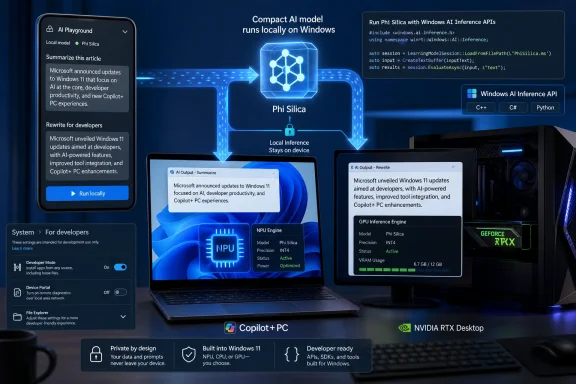
Diagram shows Phi Silica compact AI running locally on Windows AI Inference APIs with Copilot+ PC and RTX Desktop.Microsoft’s NPU Wall Now Has a GPU-Sized Door in It​

When Microsoft introduced Copilot+ PCs in 2024, the pitch was deliberately simple. If you wanted the new wave of Windows AI features to run locally, you needed a new class of PC with a neural processing unit capable of at least 40 trillion operations per second. The NPU was not just another accelerator; it was the hardware foundation for Microsoft’s next version of the Windows client.
That simplicity was useful for marketing and for OEMs trying to sell premium laptops into a sluggish PC refresh cycle. It was also somewhat artificial. Anyone who has watched the last decade of GPU computing knows that Nvidia hardware is perfectly capable of running local language models, image models, speech models, and inference pipelines. The question was never whether GPUs could run AI workloads. The question was whether Microsoft would bless them inside its own Windows AI stack.
The answer is now yes, but with caveats. The updated Windows AI documentation says Phi Silica, Microsoft’s small on-device language model for Windows, can run on non-Copilot+ Windows 11 devices equipped with Nvidia GeForce RTX 30 series GPUs or newer, provided they have at least 6GB of VRAM. AMD GPU support is described as coming later, but today’s live path is Nvidia-first.
That is a meaningful shift because it moves Microsoft’s local language model APIs from a narrow hardware identity to a broader developer target. A Copilot+ PC still gets the cleanest story: the model runs on the NPU, with Microsoft’s intended power and latency profile. But a desktop with an RTX 3060, a gaming laptop with an RTX 4060, or a workstation with a recent Nvidia card now enters the conversation.
This is not consumer magic yet. It is plumbing. The APIs are aimed at developers building Windows apps that call into Microsoft’s local AI framework. End users will feel the change only when applications are written or updated to use those APIs.
That distinction matters because Microsoft is not shipping a big green “AI enabled” switch for every eligible RTX owner. It is expanding the surface area for developers, and that is usually how Windows platform changes become real: slowly, unevenly, and then all at once if the ecosystem finds a reason to care.

Phi Silica Becomes the Test Case for a More Flexible Windows AI Stack​

Phi Silica is the center of this story because it is small enough to run locally, integrated enough to matter to Windows developers, and limited enough to reveal Microsoft’s caution. It is not GPT-5 hiding in the Start menu. It is a compact language model designed for common text tasks such as summarization, rewriting, text generation, and formatting unstructured content into more structured output.
The important part is not that these tasks are novel. They are not. Cloud tools have been summarizing emails and rewriting paragraphs for years. The point is that Phi Silica gives Windows applications a system-provided local model path without requiring every developer to ship, update, tune, and support their own model runtime.
That is the platform play. Microsoft would like app developers to think of local AI in Windows the way they think of notifications, file pickers, camera access, speech recognition, or composition effects. The operating system supplies a capability, the developer calls an API, and the hardware underneath does the work through whatever accelerator Microsoft supports.
Until now, the hardware story for Phi Silica was tied tightly to Copilot+ PCs. On those systems, the model runs on the NPU, and Microsoft can assume a more predictable power envelope. With GPU support, the same model can reach a much larger installed base, especially among enthusiasts and professionals who already own Windows 11 machines with RTX cards but have no NPU meeting Microsoft’s Copilot+ bar.
That broader base is why this documentation change matters more than its dry wording suggests. Developers do not build for platforms that look rare, fragmented, or tied to a single product cycle. By allowing Phi Silica to run on a chunk of the RTX installed base, Microsoft gives developers a better reason to experiment with local AI features now rather than waiting for Copilot+ hardware to saturate the market.
There is still friction. GPU support currently requires Developer Mode, recent Windows Insider-era components, the right Windows App SDK version, and manufacturer-provided GPU drivers rather than relying on the generic driver path many users get through Windows Update. The Phi Silica APIs are also part of a limited-access feature, which means developers need to work through Microsoft’s access process rather than simply flipping a public production switch.
That is why this should be read as a strategic preview rather than a mainstream rollout. Microsoft is laying track, not running a scheduled passenger service.

The Copilot+ Badge Loses Some Exclusivity, Not Its Purpose​

The obvious reading is that Microsoft has weakened the Copilot+ PC proposition. If a non-Copilot+ machine with an Nvidia GPU can run local Windows language model APIs, why buy a Copilot+ laptop at all? That is the sort of neat conclusion that makes for a punchy headline and a shallow analysis.
The better reading is that Microsoft is separating two things it previously bundled together: the Copilot+ PC as a consumer hardware class, and Windows AI as a developer platform. The former still depends heavily on NPUs. The latter cannot afford to be confined to one accelerator category forever.
Copilot+ PCs still have advantages that GPUs do not erase. NPUs are designed for sustained, low-power inference, especially on laptops. They can run AI workloads without waking the discrete GPU, draining the battery, heating the chassis, or competing with games, rendering software, video playback, or GPU-accelerated creative tools. That matters if AI is supposed to become ambient rather than occasional.
The updated Microsoft documentation is unusually clear on this point. GPU execution of Phi Silica is expected to have different performance and power characteristics from NPU execution. Latency may be higher. Battery impact may be worse. The model may compete with other GPU workloads. Features available on the NPU path, such as prompt compression and speculative decoding, are not currently available on the GPU path.
In other words, Microsoft is not saying an RTX-equipped desktop is the same thing as a Copilot+ ultrabook. It is saying the same local model can now run on more machines, with a different trade-off profile. That is the sort of compromise Windows has always made.
For desktop users, the trade-off may be perfectly acceptable. A tower PC with a plugged-in RTX 4070 does not care much about battery life, and a workstation user may prefer local inference over a cloud round trip even if the model is not blazing fast. For laptop users, the calculus is more complicated. A discrete GPU may be available, but using it for background AI tasks can turn a quiet productivity machine into a warm, noisy one.
This is where the Copilot+ badge keeps its purpose. It remains shorthand for a machine designed around local AI as a first-class, always-available workload. Nvidia GPU support, by contrast, makes local language model APIs available to a broader but less uniform set of PCs.

Developers Get a Bigger Addressable Market, but Also a Bigger Testing Problem​

For Windows developers, the upside is obvious. A feature that only works on Copilot+ PCs is a niche feature, at least until the installed base catches up. A feature that also works on recent Nvidia GPUs reaches gamers, creators, engineers, researchers, and power users who often run high-end hardware long before they buy a new AI-branded laptop.
That matters for application categories where local text intelligence is useful but cloud dependence is awkward. A note-taking app could summarize meeting notes without sending them to a remote service. A code editor could offer limited local explanation or transformation features when the user is offline. A legal, medical, or enterprise workflow tool could use local rewriting or formatting while keeping sensitive drafts on the device, though developers would still need to handle accuracy, policy, and data governance carefully.
The problem is that the Windows PC ecosystem is not a console. Supporting “RTX 30 series and newer with 6GB of VRAM” sounds tidy until it collides with real-world machines. There are desktop cards and laptop GPUs, OEM drivers and Nvidia beta drivers, thermal envelopes and power settings, external monitors and hybrid graphics, background game launchers and creative apps already consuming VRAM.
Microsoft’s own notes acknowledge this indirectly by warning that GPU inference depends on GPU generation, available VRAM, driver state, and current load. That is not a footnote. It is the operational reality developers will need to design around.
A well-built app cannot assume that local AI is available just because the user has a supported GPU on paper. It needs runtime checks, graceful fallbacks, clear error messages, and probably a cloud or non-AI path when the local model is missing, unavailable, too slow, or disabled. It also needs to avoid presenting local AI as a magic privacy shield if the rest of the application still syncs, logs, or uploads user content elsewhere.
This is why Microsoft’s decision to make Phi Silica a system-managed component is important. If every app shipped its own language model, Windows would become a junk drawer of duplicate weights, conflicting runtimes, and unpredictable update mechanisms. A shared platform model downloaded and serviced through the operating system is cleaner, at least in theory.
But the theory only works if Microsoft keeps the platform stable. Developers burned by experimental APIs, branding churn, and limited-access gates will not bet core product experiences on a feature that feels like it may be renamed, restricted, or superseded in six months. Microsoft has spent the last two years cycling through terms like Windows Copilot Runtime, Windows AI Foundry, Microsoft Foundry on Windows, and Windows AI APIs. At some point, the vocabulary has to stop moving if the platform underneath is supposed to look dependable.

Nvidia Wins the First Round Because Windows AI Needs Real Silicon Today​

The Nvidia-first nature of the rollout is not surprising. Nvidia owns the cultural and practical mindshare around local AI on PCs. CUDA, TensorRT, RTX branding, and the sheer size of the installed base give Microsoft a ready-made path to developers who already think of GPUs as AI hardware.
For Windows enthusiasts, this is also the most intuitive version of the story. Many users who built or bought gaming PCs in the last few years already own more AI acceleration than the average thin-and-light laptop, even if their machines do not qualify as Copilot+ PCs. The idea that those systems were locked out of Microsoft’s local AI APIs while lower-power NPU laptops were welcomed in always felt more like market segmentation than technical necessity.
Still, the Nvidia dependency cuts both ways. If Windows AI features become more useful on Nvidia hardware than on AMD or Intel hardware, Microsoft risks turning part of the Windows developer story into another GPU ecosystem advantage. That may be acceptable in an experimental phase. It becomes more uncomfortable if local AI becomes a standard expectation for productivity software.
Microsoft says AMD GPU support is planned, but the absence of Intel GPU support from the current headline is notable. Intel has pushed AI PCs aggressively, ships integrated GPUs at massive scale, and has its own NPU story in recent Core Ultra platforms. AMD has both Radeon GPUs and Ryzen AI NPUs. Qualcomm, meanwhile, helped launch the first wave of Copilot+ PCs with Arm-based Snapdragon X chips.
A healthy Windows AI platform cannot remain Nvidia-only outside Copilot+ machines. The Windows franchise is built on hardware pluralism. Users may tolerate “best on Nvidia” in gaming and creative acceleration, but core OS-level AI APIs need to feel broadly available or at least predictably tiered across vendors.
There is also a competitive subtext. Nvidia has been working to make RTX PCs feel like local AI workstations, not just gaming machines. Microsoft, meanwhile, wants Windows to be the place where local AI applications are built and consumed. The two strategies align for now. Nvidia supplies the installed base and performance story; Microsoft supplies the operating system APIs and developer funnel.
The interesting question is who owns the developer relationship in the long run. If developers call Microsoft’s Windows AI APIs, Microsoft owns the abstraction. If developers bypass them for Nvidia’s own tools, model runtimes, and agent frameworks, Windows becomes the stage but not the platform. This Phi Silica expansion is Microsoft’s way of keeping itself in the middle.

Recall Remains the Line Microsoft Is Not Crossing​

The update does not bring Windows Recall to non-Copilot+ PCs. It does not unlock Click to Do across RTX desktops. It does not make every Copilot+ feature portable to a GPU-backed Windows 11 machine. That boundary is important because Recall is not just another model invocation.
Recall is an operating-system-level feature that periodically captures and indexes user activity so it can be searched later. Its controversies have always been about security, privacy, consent, and data handling as much as hardware acceleration. Moving it to a broader set of PCs would require Microsoft to revisit not just performance assumptions but trust assumptions.
By contrast, the language model APIs now expanding to Nvidia GPUs are developer-facing and task-oriented. An app asks the model to summarize text, rewrite content, generate output, or perform a related language task. That is a more contained scenario than building a persistent, searchable memory of user activity across the desktop.
Microsoft is therefore making the least explosive expansion first. Text APIs are useful, developer-friendly, and easier to explain. They also let Microsoft gather experience with GPU-backed local inference without reopening every debate about Recall on day one.
The lack of Recall support should not be treated as a technical impossibility. GPUs could accelerate pieces of such a pipeline. But product eligibility is not the same thing as silicon capability. Microsoft has every incentive to keep the most sensitive Copilot+ features tied to machines it can define, certify, and support more tightly.
That said, the GPU opening makes future boundaries harder to justify if they are framed purely as hardware limitations. If Microsoft says a feature requires a Copilot+ PC because it needs local AI acceleration, users with powerful GPUs will now have an obvious counterargument. The company will need to explain when the requirement is about performance, when it is about battery life, when it is about security architecture, and when it is simply about product segmentation.
The old answer — “you need an NPU” — is no longer enough.

Local AI Is Becoming a Windows Distribution Problem​

One overlooked part of the change is how Phi Silica gets onto a machine. Microsoft’s model is not necessarily preinstalled everywhere. It can be downloaded on demand when an application requires it, managed as a Windows AI component, and removed by the user through system settings.
That sounds mundane, but it is critical. Local AI models are large enough to matter, updated often enough to require servicing, and sensitive enough to raise security and compliance questions. If Windows is going to provide shared models as platform components, then model distribution becomes part of operating system maintenance.
This has benefits. A centrally managed model can receive updates, policy controls, and compatibility fixes without every application reinventing the wheel. It can also reduce duplication, because ten apps can call the same underlying model instead of shipping ten slightly different runtimes into user storage.
But it also creates new administrative questions. Enterprise IT teams will want to know when models are downloaded, where they are stored, how they are patched, whether they can be blocked, what telemetry is generated, and whether model availability changes application behavior. A feature that looks like a developer convenience on a consumer PC can become a governance issue in a managed fleet.
The GPU driver requirement adds another wrinkle. Microsoft’s documentation warns that the latest manufacturer driver may be required and that Windows Update or OEM-provided drivers may not be sufficient. That is an old Windows tension in a new costume. Enterprises like predictable driver channels. AI frameworks often want the newest acceleration stack.
For enthusiasts, installing Nvidia’s latest beta or production driver is routine. For corporate IT, it is a change-management event. If local AI features depend on drivers outside the normal OEM support cadence, adoption will be slower in business environments no matter how compelling the APIs look.
That does not make the move unimportant. It means Microsoft’s next job is not only technical enablement; it is operational domestication. Local AI has to become boring enough to manage.

The Privacy Pitch Is Real, but It Is Not Self-Executing​

Local inference has an obvious appeal: the prompt and output can stay on the device. For users who are wary of sending drafts, notes, source code, documents, or private messages to a cloud model, that is a real advantage. It is also one of the few AI pitches that still resonates with skeptical Windows users.
But “local” is not the same as “private by default.” An application can call a local model and still sync the document to a cloud service. It can generate logs. It can collect telemetry. It can offer a local mode for one feature and a cloud mode for another. The model’s location is only one part of the privacy story.
Microsoft’s own responsible AI materials make the other limitation clear: local models can still hallucinate, produce biased output, misunderstand context, and generate plausible nonsense. Running on an RTX card instead of in a data center does not make a model more truthful. It only changes where computation happens.
That is especially important for the likely first wave of use cases. Summarization and rewriting sound low-risk until they are applied to legal contracts, medical instructions, HR complaints, security logs, or financial documents. Developers need to decide whether local AI output is assistive text, a draft, a suggestion, or an action trigger. Those distinctions should be visible in the user interface, not buried in a policy page.
For WindowsForum readers, the practical advice is to treat local AI like any other local automation tool. It can be valuable, especially when it reduces cloud exposure or works offline. But it should not be trusted blindly, and it should not be allowed to blur the line between assisting a user and acting on their behalf.
The GPU expansion increases the number of machines that can participate in this experiment. It does not remove the need for judgment.

The RTX Door Opens, but the House Is Still Under Construction​

The concrete facts are straightforward enough, but the implications are larger than a hardware compatibility note. Microsoft is broadening Windows 11’s local language model APIs beyond Copilot+ PCs, starting with Nvidia RTX GPUs. That expands the developer target, complicates the Copilot+ message, and gives existing high-end PCs a role in the Windows AI roadmap.
The near-term reality is narrower. This is still developer-facing, still gated by API availability and system prerequisites, and still limited to Phi Silica language features rather than the full Copilot+ portfolio. Most users will not notice anything until software they already use adopts these APIs.
The most useful way to read the change is not as a consumer launch, but as Microsoft admitting that Windows AI cannot be NPU-only if it wants to become a real platform.
  • Phi Silica can now run through Windows AI APIs on non-Copilot+ Windows 11 PCs with supported Nvidia RTX 30 series or newer GPUs and at least 6GB of VRAM.
  • The expansion is aimed at developers first, so end users need applications that are built or updated to call these local language model APIs.
  • Copilot+ PCs still have the cleaner NPU path, with better power characteristics and features such as prompt compression and speculative decoding that are not currently available on the GPU path.
  • Recall, Click to Do, and other Copilot+ experiences remain outside this GPU expansion.
  • AMD GPU support is planned, but the current supported non-Copilot+ GPU path is Nvidia-first.
  • The change makes local AI more realistic for desktops, gaming PCs, and workstations, but it also introduces driver, VRAM, thermal, and enterprise-management complications.
Microsoft’s original Copilot+ story treated the NPU as the admission ticket to the local AI future; this update makes the ticket booth more complicated and more honest. Windows has always succeeded when it absorbed hardware diversity instead of pretending it did not exist, and local AI will be no different. The next phase will be judged less by whether Microsoft can produce another badge and more by whether developers can rely on a stable, well-supported Windows AI layer that runs acceptably across the PCs people already own.

References​

  1. Primary source: gHacks
    Published: Fri, 12 Jun 2026 11:24:44 GMT
  2. Related coverage: techradar.com
  3. Official source: developer.microsoft.com
  4. Related coverage: berrall.com
  5. Official source: learn.microsoft.com
  6. Official source: blogs.microsoft.com
  1. Related coverage: tomshardware.com
  2. Related coverage: developer.nvidia.com
  3. Official source: github.com
  4. Related coverage: docs.nvidia.com
  5. Related coverage: nvidianews.nvidia.com
 

Back
Top