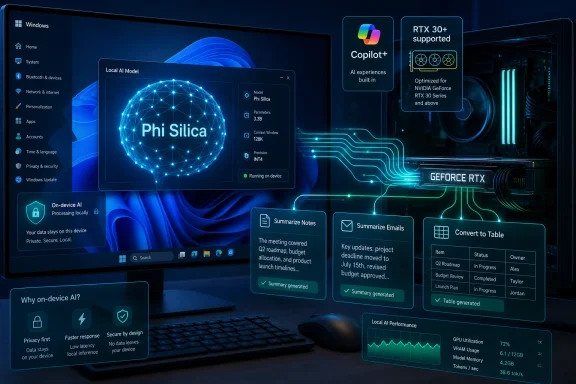
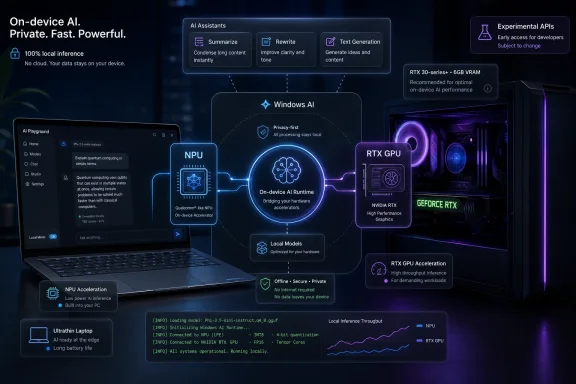
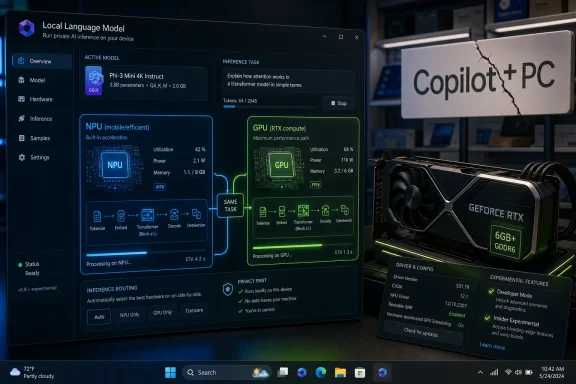
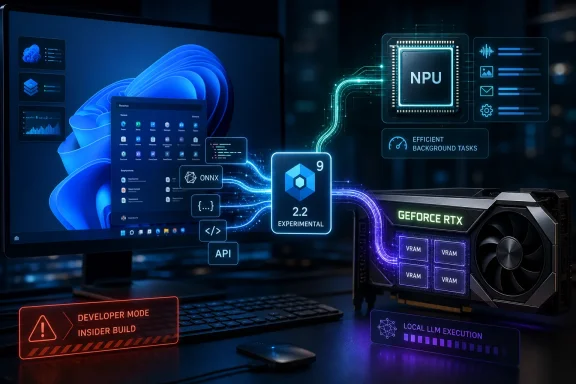
Microsoft is expanding Windows 11’s local Language Model APIs beyond Copilot+ PCs to non-Copilot+ systems with supported NVIDIA GeForce RTX 30-series or newer GPUs and at least 6GB of VRAM, according to updated developer documentation surfaced by Windows Latest on June 11, 2026. That is not the death of Copilot+ PCs, but it is the first serious crack in Microsoft’s neatest AI-PC marketing line. For two years, the company has treated the 40 TOPS NPU as the gatekeeper to Windows’ local AI future. Now Windows is beginning to admit what PC builders already knew: GPUs were never technically irrelevant.
When Copilot+ PCs arrived on June 18, 2024, Microsoft’s message was simple enough to fit on a retail placard. A modern Windows AI PC needed 16GB of RAM, solid-state storage, and a neural processing unit rated at 40 TOPS or better. If you did not have that class of NPU, you did not get the marquee local AI experiences.
That framing made sense for Microsoft’s launch campaign. Qualcomm’s Snapdragon X chips gave Windows on Arm a fresh consumer story, OEMs got a clean premium badge, and Microsoft could finally argue that the PC was not merely a client for cloud AI but a local AI device in its own right. The NPU became the symbol of that shift because it was new, efficient, and easy to market.
But it was never the only silicon capable of running local models. NVIDIA GPUs have been the default acceleration hardware for much of the AI boom, and even older RTX cards can run small language models, image models, transcription engines, and developer frameworks with ease. The awkwardness was not that Copilot+ PCs had local AI features. The awkwardness was that many desktop and gaming laptops with far more raw AI compute than a thin-and-light NPU were locked out of Windows’ own local AI platform.
Microsoft’s new GPU path does not erase the Copilot+ category. It does, however, recast it. Copilot+ is no longer the only plausible home for Windows local AI; it is one hardware profile among several, and perhaps the most power-efficient rather than the most capable.
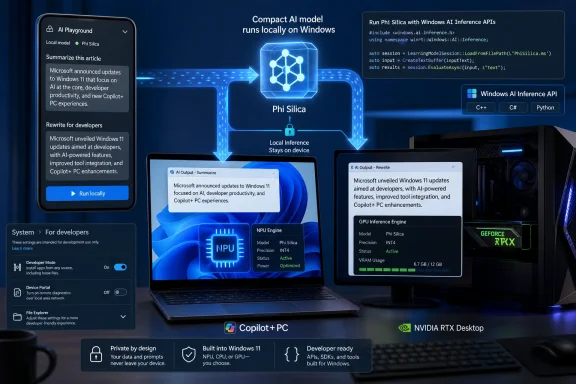
The API gives Windows apps a sanctioned way to call local language-model capabilities on the machine. Microsoft’s documentation has described Phi Silica as a small local language model tuned for Windows AI scenarios, with capabilities such as text generation, summarization, rewriting, text-to-table conversion, and structured output. Until now, the practical message around those APIs was that developers needed Copilot+ hardware if they wanted the Windows-provided local model stack to behave as expected.
The new GPU support changes that calculus. A developer building a WinUI, WPF, WinForms, or MAUI app can now think about a larger installed base than the Copilot+ laptop market, at least for experimental language-model features. A gaming desktop with an RTX 3060 and 12GB of VRAM suddenly looks more useful to the Windows AI story than Microsoft’s original branding implied.
That does not mean Recall, Click to Do, Paint image features, or every Copilot+ experience is coming to a GeForce desktop tomorrow. Microsoft has not said that. The reported change is narrower: local language APIs can run on supported NVIDIA RTX 30-series-or-newer GPUs with 6GB or more VRAM. But platform shifts often begin in developer plumbing before they surface as consumer checkboxes.
A GPU can brute-force local AI in ways an NPU cannot. It also may do so with fan noise, battery drain, and thermal tradeoffs that are unacceptable for the always-available experiences Microsoft has wanted to build into Windows. If Recall is indexing screen activity in the background, Live Captions is translating in real time, and Studio Effects is improving your webcam feed, Microsoft would rather those tasks not hammer the same GPU a user needs for gaming, rendering, or external displays.
That is the strongest defense of the Copilot+ design. The NPU is not necessarily about peak performance; it is about making AI feel ambient. It is the silicon equivalent of plumbing: valuable precisely because you stop noticing it.
The problem is that Microsoft marketed the NPU as the key to local AI generally, not merely the best efficiency target for some local AI experiences. Once the conversation shifts from “only Copilot+ PCs can do this” to “Copilot+ PCs do this in a more power-managed way,” the advantage becomes thinner, more nuanced, and harder to sell at retail.
The RTX 30-series cutoff is also revealing. Microsoft is not opening this to any GPU with a driver and good intentions. It is choosing a relatively modern baseline with sufficient VRAM and mature AI acceleration support. The 6GB VRAM requirement is modest by local-AI hobbyist standards, but it is high enough to exclude older entry-level cards and thin-client-class graphics hardware.
That suggests Microsoft is trying to avoid the chaos that can come from “it runs locally” promises on underpowered machines. Local AI that takes too long, crashes under memory pressure, or competes badly with foreground workloads becomes a support problem. A supported GPU list gives Microsoft room to broaden access without turning Windows AI into a free-for-all.
It also shifts leverage. In the original Copilot+ rollout, Microsoft’s closest silicon partner was Qualcomm, with Intel and AMD racing to meet the NPU threshold. With GPU-backed APIs, NVIDIA becomes more central to the Windows AI runtime story, especially on desktops and performance laptops. That may be healthy for Windows as a platform, but it complicates the tidy OEM narrative Microsoft spent 2024 building.
That is why the GPU path matters even while it remains experimental. It tells developers that Microsoft may be willing to meet the Windows ecosystem where it already is, rather than forcing every local AI feature through the Copilot+ funnel. The Windows installed base is too heterogeneous for a single hardware badge to carry the whole strategy.
There is also a practical packaging advantage. Microsoft’s model-management approach allows apps to check whether a required local model is available and, if necessary, trigger model installation through Windows mechanisms. That is more attractive than every app shipping its own model files, inference stack, update logic, and hardware-detection code.
If Microsoft gets this right, Windows apps could gain local summarization, rewriting, classification, and structured-output features without each developer reinventing an AI runtime. If it gets this wrong, Windows AI becomes another API family developers flirt with and abandon because hardware support, licensing, availability, or policy restrictions are too brittle.
But privacy arguments only work at scale if the feature is available on real machines people own. A local AI feature limited to the newest Copilot+ PCs sounds good in a launch keynote, but it does not help the user with a three-year-old RTX desktop or a creator laptop that still has years of useful life left. Expanding local language APIs to GPUs makes Microsoft’s privacy pitch less theoretical.
There are limits. Local execution does not automatically make an AI feature safe, accurate, or appropriate. Apps still need clear disclosure, user control, and responsible handling of generated output. A local model can hallucinate just as a cloud model can, and a bad app can still mishandle sensitive content after the model processes it.
Still, the architecture matters. If Microsoft wants users to trust AI embedded inside Windows apps, “this runs on your PC” is a better starting point than “this is sent to a service you do not control.” GPU support makes that starting point available to more of the Windows base.
Recall also carries political baggage. Its original announcement triggered intense scrutiny because it proposed a searchable timeline of user activity, including screenshots, on the local machine. Microsoft delayed and reworked the feature, emphasizing opt-in behavior, Windows Hello authentication, encryption, and controls over what gets captured. That history makes Recall a poor candidate for a casual hardware expansion.
There is also the efficiency problem. A desktop RTX card could easily handle parts of Recall’s AI pipeline, but a laptop GPU is not necessarily the right place for continuous background analysis. Microsoft may decide that the NPU remains the preferred enforcement boundary for experiences that must be always available, low-power, and predictable.
So the more plausible near-term path is uneven expansion. Text APIs broaden to GPUs. Some image or productivity APIs may follow. Consumer-facing Copilot+ features remain tied to NPUs until Microsoft has enough telemetry, driver confidence, and UX polish to widen eligibility. In other words, the wall does not fall at once; it gets doors.
Copilot+ may be heading for a similar fate. In 2024, it marked a clean break: this PC could run a new class of Windows AI features locally. By 2026, that line is already blurrier. Intel, AMD, and Qualcomm have NPU-equipped chips. NVIDIA GPUs may now run Windows language APIs. Microsoft is simultaneously trying to define a premium AI-PC category and make AI features common enough for developers to adopt.
Those goals are in tension. Exclusivity sells new hardware. Ubiquity sells platforms. Microsoft can privilege OEM partners for only so long before it harms the developer story and frustrates users with capable existing PCs.
That is why this GPU expansion feels more strategically important than its narrow API scope suggests. It is Microsoft choosing platform gravity over badge purity. Windows wins when more Windows PCs can do useful things, not when artificial segmentation makes the newest sticker look better.
A clean requirement is easy to govern. A Copilot+ PC either meets the NPU, memory, and storage baseline or it does not. A GPU-backed local AI API introduces driver versions, VRAM thresholds, model availability, experimental SDK status, and application-specific behavior. That is manageable, but it is not simple.
Enterprises will also care about where models come from, how they are updated, whether they can be blocked, and what telemetry or policy controls apply. Local AI does not exempt Microsoft from the normal enterprise questions. If anything, it raises new ones because AI capabilities may appear inside ordinary apps rather than as a single branded assistant.
The better Microsoft documents the boundaries, the faster enterprises can test. The worse it communicates them, the more administrators will disable first and ask questions later. Windows AI needs trust from IT departments, not just excitement from developers.
Windows AI APIs could fall into that trap. If they remain experimental for too long, if the supported hardware matrix keeps shifting, or if Microsoft reserves the best experiences for its own apps and services, third-party developers will hedge. They will keep using cross-platform AI stacks, cloud APIs, or embedded local runtimes they can control.
The GPU expansion is a good sign because it increases the plausible audience. But it also raises expectations. Once Microsoft says Windows can provide local language capabilities on RTX hardware, developers will expect performance guidance, lifecycle promises, policy controls, and a path out of experimental status.
This is where the company must be disciplined. The Windows AI stack does not need another branding flourish. It needs boring reliability: clear requirements, stable APIs, predictable model delivery, and honest communication about what runs where.
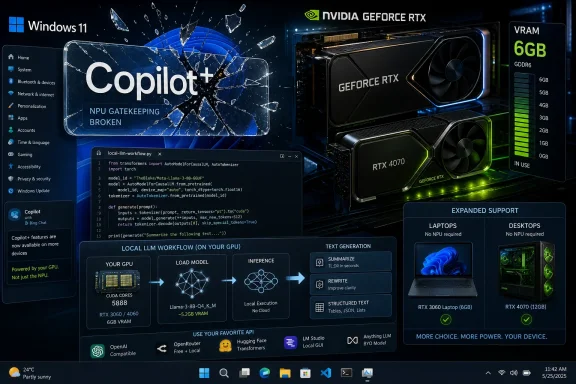 Microsoft’s AI-PC Fence Was Always a Product Boundary Masquerading as a Technical One
When Copilot+ PCs arrived on June 18, 2024, Microsoft’s message was simple enough to fit on a retail placard. A modern Windows AI PC needed 16GB of RAM, solid-state storage, and a neural processing unit rated at 40 TOPS or better. If you did not have that class of NPU, you did not get the marquee local AI experiences.That framing made sense for Microsoft’s launch campaign. Qualcomm’s Snapdragon X chips gave Windows on Arm a fresh consumer story, OEMs got a clean premium badge, and Microsoft could finally argue that the PC was not merely a client for cloud AI but a local AI device in its own right. The NPU became the symbol of that shift because it was new, efficient, and easy to market.
But it was never the only silicon capable of running local models. NVIDIA GPUs have been the default acceleration hardware for much of the AI boom, and even older RTX cards can run small language models, image models, transcription engines, and developer frameworks with ease. The awkwardness was not that Copilot+ PCs had local AI features. The awkwardness was that many desktop and gaming laptops with far more raw AI compute than a thin-and-light NPU were locked out of Windows’ own local AI platform.
Microsoft’s new GPU path does not erase the Copilot+ category. It does, however, recast it. Copilot+ is no longer the only plausible home for Windows local AI; it is one hardware profile among several, and perhaps the most power-efficient rather than the most capable.
The First Crack Is an API, Not Recall
The change reported by Windows Latest concerns Windows 11’s local Language Model APIs, not the entire Copilot+ feature set. That distinction matters. This is a developer-platform move first, a consumer-feature move second, and a Windows branding problem third.The API gives Windows apps a sanctioned way to call local language-model capabilities on the machine. Microsoft’s documentation has described Phi Silica as a small local language model tuned for Windows AI scenarios, with capabilities such as text generation, summarization, rewriting, text-to-table conversion, and structured output. Until now, the practical message around those APIs was that developers needed Copilot+ hardware if they wanted the Windows-provided local model stack to behave as expected.
The new GPU support changes that calculus. A developer building a WinUI, WPF, WinForms, or MAUI app can now think about a larger installed base than the Copilot+ laptop market, at least for experimental language-model features. A gaming desktop with an RTX 3060 and 12GB of VRAM suddenly looks more useful to the Windows AI story than Microsoft’s original branding implied.
That does not mean Recall, Click to Do, Paint image features, or every Copilot+ experience is coming to a GeForce desktop tomorrow. Microsoft has not said that. The reported change is narrower: local language APIs can run on supported NVIDIA RTX 30-series-or-newer GPUs with 6GB or more VRAM. But platform shifts often begin in developer plumbing before they surface as consumer checkboxes.
The NPU Still Has a Job, Just Not the Job Microsoft Sold First
It would be tempting to declare the NPU overhyped and move on. That would be satisfying, but too simple. NPUs exist for a real reason: they are designed to run certain AI workloads efficiently, with lower power draw, less heat, and less contention with the CPU and GPU. On a laptop, that matters.A GPU can brute-force local AI in ways an NPU cannot. It also may do so with fan noise, battery drain, and thermal tradeoffs that are unacceptable for the always-available experiences Microsoft has wanted to build into Windows. If Recall is indexing screen activity in the background, Live Captions is translating in real time, and Studio Effects is improving your webcam feed, Microsoft would rather those tasks not hammer the same GPU a user needs for gaming, rendering, or external displays.
That is the strongest defense of the Copilot+ design. The NPU is not necessarily about peak performance; it is about making AI feel ambient. It is the silicon equivalent of plumbing: valuable precisely because you stop noticing it.
The problem is that Microsoft marketed the NPU as the key to local AI generally, not merely the best efficiency target for some local AI experiences. Once the conversation shifts from “only Copilot+ PCs can do this” to “Copilot+ PCs do this in a more power-managed way,” the advantage becomes thinner, more nuanced, and harder to sell at retail.
NVIDIA Gets Pulled Back Into the Windows AI Center of Gravity
For NVIDIA, this is less a surprise than an overdue acknowledgment. The RTX installed base is enormous, and “AI PC” has always been a strange phrase when applied to laptops with modest NPUs while excluding desktops with Tensor Core-equipped GPUs. If Windows local AI is going to matter outside Microsoft’s own demos, it cannot ignore the hardware enthusiasts, creators, gamers, and developers already have.The RTX 30-series cutoff is also revealing. Microsoft is not opening this to any GPU with a driver and good intentions. It is choosing a relatively modern baseline with sufficient VRAM and mature AI acceleration support. The 6GB VRAM requirement is modest by local-AI hobbyist standards, but it is high enough to exclude older entry-level cards and thin-client-class graphics hardware.
That suggests Microsoft is trying to avoid the chaos that can come from “it runs locally” promises on underpowered machines. Local AI that takes too long, crashes under memory pressure, or competes badly with foreground workloads becomes a support problem. A supported GPU list gives Microsoft room to broaden access without turning Windows AI into a free-for-all.
It also shifts leverage. In the original Copilot+ rollout, Microsoft’s closest silicon partner was Qualcomm, with Intel and AMD racing to meet the NPU threshold. With GPU-backed APIs, NVIDIA becomes more central to the Windows AI runtime story, especially on desktops and performance laptops. That may be healthy for Windows as a platform, but it complicates the tidy OEM narrative Microsoft spent 2024 building.
Developers Care Less About Badges Than Addressable Hardware
The most important audience for this change is not the person browsing laptops at Best Buy. It is the developer deciding whether Windows AI APIs are worth integrating. APIs live or die by reach, stability, and trust. If a developer believes an API only works on a narrow set of premium laptops, it becomes a demo feature. If it works across a meaningful slice of Windows hardware, it becomes a platform.That is why the GPU path matters even while it remains experimental. It tells developers that Microsoft may be willing to meet the Windows ecosystem where it already is, rather than forcing every local AI feature through the Copilot+ funnel. The Windows installed base is too heterogeneous for a single hardware badge to carry the whole strategy.
There is also a practical packaging advantage. Microsoft’s model-management approach allows apps to check whether a required local model is available and, if necessary, trigger model installation through Windows mechanisms. That is more attractive than every app shipping its own model files, inference stack, update logic, and hardware-detection code.
If Microsoft gets this right, Windows apps could gain local summarization, rewriting, classification, and structured-output features without each developer reinventing an AI runtime. If it gets this wrong, Windows AI becomes another API family developers flirt with and abandon because hardware support, licensing, availability, or policy restrictions are too brittle.
Privacy Becomes More Credible When Local AI Stops Being Rare
The strongest consumer argument for on-device AI is privacy. If a model can summarize, rewrite, classify, or generate text locally, the user’s data does not need to leave the PC for every small task. That is especially meaningful for business documents, personal notes, source code, medical forms, legal drafts, and the ordinary mess of desktop computing.But privacy arguments only work at scale if the feature is available on real machines people own. A local AI feature limited to the newest Copilot+ PCs sounds good in a launch keynote, but it does not help the user with a three-year-old RTX desktop or a creator laptop that still has years of useful life left. Expanding local language APIs to GPUs makes Microsoft’s privacy pitch less theoretical.
There are limits. Local execution does not automatically make an AI feature safe, accurate, or appropriate. Apps still need clear disclosure, user control, and responsible handling of generated output. A local model can hallucinate just as a cloud model can, and a bad app can still mishandle sensitive content after the model processes it.
Still, the architecture matters. If Microsoft wants users to trust AI embedded inside Windows apps, “this runs on your PC” is a better starting point than “this is sent to a service you do not control.” GPU support makes that starting point available to more of the Windows base.
Recall Remains the Feature Microsoft Cannot Casually Unfence
The obvious question is whether this foreshadows Recall on non-Copilot+ PCs. Microsoft has not announced that, and it would be a far bigger step than enabling language APIs on RTX GPUs. Recall is not just another model call. It is a system-level memory feature with security, privacy, storage, indexing, and user-consent implications.Recall also carries political baggage. Its original announcement triggered intense scrutiny because it proposed a searchable timeline of user activity, including screenshots, on the local machine. Microsoft delayed and reworked the feature, emphasizing opt-in behavior, Windows Hello authentication, encryption, and controls over what gets captured. That history makes Recall a poor candidate for a casual hardware expansion.
There is also the efficiency problem. A desktop RTX card could easily handle parts of Recall’s AI pipeline, but a laptop GPU is not necessarily the right place for continuous background analysis. Microsoft may decide that the NPU remains the preferred enforcement boundary for experiences that must be always available, low-power, and predictable.
So the more plausible near-term path is uneven expansion. Text APIs broaden to GPUs. Some image or productivity APIs may follow. Consumer-facing Copilot+ features remain tied to NPUs until Microsoft has enough telemetry, driver confidence, and UX polish to widen eligibility. In other words, the wall does not fall at once; it gets doors.
The Copilot+ Badge Starts Looking More Like Centrino Than Windows Itself
The history of PC marketing is full of badges that mattered until they didn’t. Intel’s Centrino brand once told buyers something meaningful about wireless laptops, battery life, and a validated platform. Over time, the capabilities it represented became ordinary. The badge did its job, then faded into the background.Copilot+ may be heading for a similar fate. In 2024, it marked a clean break: this PC could run a new class of Windows AI features locally. By 2026, that line is already blurrier. Intel, AMD, and Qualcomm have NPU-equipped chips. NVIDIA GPUs may now run Windows language APIs. Microsoft is simultaneously trying to define a premium AI-PC category and make AI features common enough for developers to adopt.
Those goals are in tension. Exclusivity sells new hardware. Ubiquity sells platforms. Microsoft can privilege OEM partners for only so long before it harms the developer story and frustrates users with capable existing PCs.
That is why this GPU expansion feels more strategically important than its narrow API scope suggests. It is Microsoft choosing platform gravity over badge purity. Windows wins when more Windows PCs can do useful things, not when artificial segmentation makes the newest sticker look better.
Enterprise IT Will Read This as a Support Matrix Problem
For administrators, the news is both welcome and annoying. Welcome, because organizations with RTX workstations may be able to test local AI features without buying a fleet of Copilot+ laptops. Annoying, because the Windows AI hardware story now has more branches.A clean requirement is easy to govern. A Copilot+ PC either meets the NPU, memory, and storage baseline or it does not. A GPU-backed local AI API introduces driver versions, VRAM thresholds, model availability, experimental SDK status, and application-specific behavior. That is manageable, but it is not simple.
Enterprises will also care about where models come from, how they are updated, whether they can be blocked, and what telemetry or policy controls apply. Local AI does not exempt Microsoft from the normal enterprise questions. If anything, it raises new ones because AI capabilities may appear inside ordinary apps rather than as a single branded assistant.
The better Microsoft documents the boundaries, the faster enterprises can test. The worse it communicates them, the more administrators will disable first and ask questions later. Windows AI needs trust from IT departments, not just excitement from developers.
The Real Risk Is Another Half-Platform
Microsoft has a long history of building promising Windows developer platforms that never quite become unavoidable. Sometimes the problem is timing. Sometimes it is churn. Sometimes the company’s own apps do not commit deeply enough to prove the platform’s value.Windows AI APIs could fall into that trap. If they remain experimental for too long, if the supported hardware matrix keeps shifting, or if Microsoft reserves the best experiences for its own apps and services, third-party developers will hedge. They will keep using cross-platform AI stacks, cloud APIs, or embedded local runtimes they can control.
The GPU expansion is a good sign because it increases the plausible audience. But it also raises expectations. Once Microsoft says Windows can provide local language capabilities on RTX hardware, developers will expect performance guidance, lifecycle promises, policy controls, and a path out of experimental status.
This is where the company must be disciplined. The Windows AI stack does not need another branding flourish. It needs boring reliability: clear requirements, stable APIs, predictable model delivery, and honest communication about what runs where.
The RTX Door Rewrites the Copilot+ Fine Print
This is the practical shape of the change, stripped of the launch rhetoric and the anti-hype backlash. Microsoft has not made every Copilot+ feature universal, but it has weakened the idea that local Windows AI belongs only to NPU-equipped PCs.- Windows 11’s local Language Model APIs are being opened experimentally to supported NVIDIA GeForce RTX 30-series and newer GPUs with at least 6GB of VRAM.
- The change applies to developer-facing language capabilities such as local prompting, summarization, rewriting, and related Phi Silica-powered text features, not automatically to every Copilot+ consumer feature.
- Copilot+ PCs still matter for power-efficient, always-on, laptop-friendly AI workloads, especially where Microsoft wants predictable performance and battery behavior.
- RTX desktops and gaming laptops now look less like outsiders to the Windows AI story and more like an obvious expansion target.
- Enterprise administrators should treat this as a new hardware and policy matrix, not as a simple lifting of all Copilot+ restrictions.
- The long-term significance is that Microsoft is moving from a badge-first AI-PC story toward a broader Windows local-AI platform.
References
- Primary source: Windows Latest
Published: Wed, 10 Jun 2026 23:59:47 GMT
Microsoft is killing the Copilot+ PC advantage, brings Windows 11's local AI to RTX 30+ PCs with 6GB vRAM
Microsoft has quietly expanded Windows 11's local Language Model APIs to non-Copilot+ PCs with NVIDIA RTX 30-series GPUs and 6GB+ vRAM. www.windowslatest.com
- Official source: learn.microsoft.com
Microsoft.Windows.AI Namespace - Windows App SDK | Microsoft Learn
Provides APIs for local, on-device AI features.learn.microsoft.com - Official source: blogs.microsoft.com
Introducing Copilot+ PCs - The Official Microsoft Blog
An on-demand recording of our May 20 event is available. Today, at a special event on our new Microsoft campus, we introduced the world to a new category of Windows PCs designed for AI, Copilot+ PCs. Copilot+ PCs are the fastest, most intelligent Windows PCs ever built. With powerful new...blogs.microsoft.com - Related coverage: windowscentral.com
Microsoft Copilot+ PC guide: What it is, features, how to access it, and PC requirements, and everything you need to know | Windows Central
Microsoft Copilot+ has been announced for upcoming AI PCs, but what exactly is it? Here's everything you need to know.www.windowscentral.com - Official source: developer.microsoft.com
Windows AI | Microsoft Developer
A unified, reliable and secure platform supporting the AI developer lifecycle from model selection, fine-tuning, optimizing and deployment across CPU, GPU, NPU and cloud.developer.microsoft.com - Official source: microsoft.com
Shop High-Performance Laptops, Computers, PCs, and Tablets | Microsoft Windows
Shop high-performance laptops, PCs, and tablets built for multitasking, advanced AI capabilities, powerful graphics, and all-day performance. Explore premium, high-spec Windows devices.www.microsoft.com
- Related coverage: arstechnica.com
Microsoft’s “Copilot+” AI PC requirements are embarrassing for Intel and AMD - Ars Technica
Microsoft demands an NPU capable of at least 40 trillion operations per second.arstechnica.com - Related coverage: tomshardware.com
Copilot+ PCs: All we know about the AI-ready laptops and exclusive Windows features | Tom's Hardware
Microsoft's shiny new AI innovations for the laptop spacewww.tomshardware.com - Related coverage: pcworld.com
Microsoft's Copilot+ PC push leaves existing 'AI PCs' behind | PCWorld
Today's AI-capable NPUs and GPUs are being left in the dust when it comes to Windows 11's new Copilot+ AI experiences.www.pcworld.com - Related coverage: makeuseof.com
Microsoft's Copilot+ Laptops Are Here, but What Does That Actually Mean?
They look sublime and have excellent battery life, but what does Microsoft's new AI-focused branding actually mean? www.makeuseof.com
- Related coverage: next.ink
Copilot+ PC : pourquoi ce seuil imposé de 40 TOPS pour le NPU ? - Next
Depuis l’annonce par Microsoft des Copilot+ PC, une question nous taraude : pourquoi avoir fixé la limite à 40 TOPS ? Certaines fonctionnalités demandent…next.ink - Official source: news.microsoft.com
- Official source: info.microsoft.com
- Related coverage: na.ingrammicro.com