

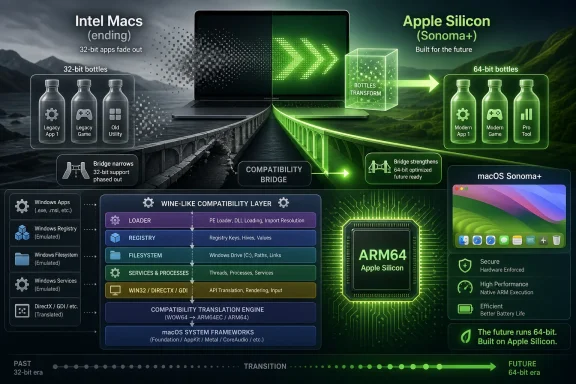
CrossOver 27, announced by CodeWeavers on June 11, 2026, will run on macOS Sonoma or newer and only on Apple Silicon Macs, ending support for Intel-based Macs and removing 32-bit bottle support in the Windows compatibility layer. The change lands just as Apple’s own macOS 27 Golden Gate draws a hard line under the Intel Mac era. For Mac users who rely on CrossOver to run Windows games and applications without a full Windows virtual machine, this is not merely a version bump with a longer requirements list. It is the moment when the compatibility stack stops pretending the Mac is still a two-architecture platform.
The easy reading is that CodeWeavers is abandoning old hardware. The more useful reading is harsher: Apple’s long transition away from Intel has now reached the third-party tooling layer, where developers must decide whether backward compatibility is worth the engineering drag. CrossOver 27 says the answer is no.
CrossOver has always lived in the awkward space between what users want Windows software to do and what the host operating system is willing to allow. On Linux, that tension is familiar. On macOS, it has become increasingly complicated because Apple has spent years tightening the platform around Apple Silicon, 64-bit-only software, notarization, security controls, Metal graphics, and the eventual sunset of Rosetta translation.
CodeWeavers’ decision to make CrossOver 27 Apple Silicon-only is therefore less surprising than it is clarifying. The company is not just dropping support for Intel Macs because those machines are old. It is aligning its commercial product with the architecture Apple has already made central to the Mac’s future.
That distinction matters. Intel Mac owners may experience the change as a cutoff, but CodeWeavers is responding to a platform reality that was already shifting underneath it. Supporting Intel Macs in 2026 is not just a matter of compiling another build. It means testing, debugging, and preserving assumptions for machines Apple itself is no longer designing macOS around.
CrossOver 27 also raises the macOS floor to Sonoma or later. CodeWeavers says the user impact should be limited because a very large majority of its Mac user base is already on Sonoma or newer. That may be statistically true, but statistics flatten the people most affected: users who kept older Intel Macs precisely because compatibility tools like CrossOver extended their useful life.
The product strategy is obvious. CodeWeavers wants to spend less time maintaining paths for old Macs and more time tuning the experience where the Mac platform is actually moving. That means Apple Silicon, ARM64 work, modern macOS APIs, and performance improvements that do not have to be reconciled with a shrinking Intel population.
Intel Macs have benefited from a long twilight. Many remained powerful enough for development, office work, creative applications, and even gaming experiments. Some were sold late enough in the transition that their owners reasonably expected years of useful service. But the support curve was always going to bend sharply once Apple’s own operating system line stopped accommodating them.
macOS 27 Golden Gate is widely reported as the release that completes that break: Apple Silicon is required, and Intel Macs are left on the prior generation. For a Windows compatibility layer on macOS, that matters enormously. If the host OS no longer targets Intel Macs, then continuing to optimize a compatibility product for Intel Macs becomes a defensive move rather than a forward-looking one.
There is a practical reason this hurts more in the CrossOver world. CrossOver users are often not casual Mac users who simply open Safari and Mail. They are people trying to keep a particular Windows application, launcher, game, modding tool, or workflow alive on hardware and an operating system that were never the software’s first home.
That makes compatibility loss feel personal. A Mac can still boot, the old version of CrossOver can still launch, and the Windows app may still run today. But the living ecosystem moves on: games update, launchers change, DRM systems evolve, dependencies shift, and macOS itself keeps moving. Compatibility is not a possession. It is a serviceable relationship between many moving parts.
But “it still works” is not the same as “it remains viable.” CrossOver 26 now becomes a lifeboat release for Intel Mac users rather than the base of a future upgrade path. It can preserve existing workflows, but it cannot guarantee future compatibility with new game builds, new launchers, changed anti-cheat systems, or newer macOS behavior.
This is a familiar endpoint for compatibility software. Users often discover that the true end of support does not arrive with a dramatic crash. It arrives quietly when the one app they cared about updates and the old translation stack no longer handles it. At that point, the user is stuck between freezing the application, freezing the operating system, or replacing the machine.
For administrators and technically minded users, that changes the planning conversation. If CrossOver is part of a real workflow rather than a hobby, CrossOver 26 should now be treated as a fixed dependency. Document the working configuration, keep installers, record bottle settings, and avoid assuming that a future CrossOver update will rescue a fragile setup.
There is also a security dimension. Staying on older software can be reasonable for an offline game or a non-networked utility. It is riskier for software that touches accounts, launchers, cloud saves, stores, or enterprise data. The older the host OS and compatibility layer become, the more each workaround becomes a small wager against time.
That sounds counterintuitive until one remembers that a bottle is not simply an application folder. It is the Windows-like environment CrossOver builds around an app, including registry state, dependencies, architecture assumptions, and runtime behavior. A 32-bit bottle preserved an older world more completely than many users realized.
By removing those bottles, CodeWeavers is simplifying the matrix it must support. That is the same story as dropping Intel Macs, just at a different layer. The company is narrowing the number of historical paths CrossOver must keep open in order to make newer work possible.
For users, the practical advice is blunt: migrate important 32-bit bottle setups before CrossOver 27 enters your production routine. CodeWeavers says 64-bit bottles should be compatible with almost all 32-bit applications, but “almost all” is where niche software lives. Old games, abandonware-era tools, custom launchers, unusual installers, and programs with brittle dependencies are exactly where edge cases tend to hide.
This matters particularly to Mac gaming. CrossOver has become one of the more important routes for running Windows games on Apple Silicon, especially as Apple’s own gaming story remains a mix of technical promise and market hesitation. But gaming libraries are messy archaeological sites. A single user’s collection may span modern DirectX 12 titles, ancient 32-bit games, third-party launchers, installers from defunct publishers, and fan patches held together by community documentation.
CrossOver 27 is not saying those histories are worthless. It is saying that carrying every layer of them forward is no longer compatible with building the product CodeWeavers thinks it needs to build.
Apple Silicon changes that equation. A Windows application built for x86 or x86-64 is now being asked to exist on an ARM-based Mac, through a set of translation and compatibility layers that must cooperate well enough for the user not to notice. CrossOver, Wine-derived technology, Apple’s platform choices, graphics translation, and sometimes additional emulation work all become part of the experience.
That makes engineering focus more valuable. The performance users care about is not achieved by generic compatibility in the abstract. It comes from chasing bottlenecks in very specific places: graphics APIs, synchronization primitives, memory behavior, launcher quirks, controller handling, font rendering, copy protection, and the increasingly hostile assumptions of Windows-first game ecosystems.
The result is a product that cannot be great everywhere at once. CodeWeavers can keep more legacy routes open, or it can put more effort into Apple Silicon. CrossOver 27 makes the company’s choice explicit.
There is a lesson here for Windows users too, even if they never touch a Mac. Compatibility is not magic, and it is not guaranteed by sentiment. Whether the tool is Wine, Proton, CrossOver, Rosetta, WOW64, or an enterprise app virtualization layer, it survives only as long as someone is willing to pay the complexity tax.
The Mac’s shift to Apple Silicon has simply made that tax more visible. The old world was x86 everywhere, or close enough that users could pretend it was. The new world is heterogeneous, with ARM laptops, x86 desktops, cloud PCs, translation layers, and gaming stacks all negotiating what “Windows software” even means.
CrossOver helped make Apple Silicon gaming feel plausible. Alongside Apple’s own Game Porting Toolkit and wider industry experimentation, it showed that many Windows titles could run acceptably on Macs that were never sold as gaming laptops. For users who wanted a Mac for everything else but still had a Steam backlog, CrossOver became a bridge.
Bridges, however, have weight limits. The same community that celebrates a new title working through CrossOver is often the first to notice when an update breaks it. Anti-cheat systems remain a recurring wall. Launchers are a constant annoyance. Games that depend on obscure media frameworks, kernel-level components, or Windows-specific services can still be nonstarters.
By going Apple Silicon-only, CodeWeavers may improve the odds where it can realistically compete. A smaller Mac target means more predictable testing and fewer architectural compromises. That does not turn CrossOver into a console-like compatibility promise, but it may make the supported future better for the users most likely to remain.
The loss is cultural as much as technical. Intel Macs were part of the folk era of Mac gaming workarounds: Boot Camp, Wine builds, virtualization, unofficial patches, and odd combinations of tools that made unlikely things happen. Apple Silicon is more powerful, but it is also more controlled. CrossOver 27 belongs to that newer world.
The immediate enterprise exposure may be small. Most managed Mac fleets that rely on Windows applications are more likely to use virtualization, cloud desktops, remote apps, SaaS replacements, or native ports. But the long tail is where IT pain lives. A design department may have one legacy estimating tool. A lab may have an old Windows-only instrument utility. An executive may rely on a niche financial application that “just works” through a compatibility layer.
Those cases rarely show up in inventory as strategic dependencies until an upgrade breaks them. CrossOver 27 is a reminder to find them before that happens. If an Intel Mac is being kept alive because it is the only machine that runs a particular Windows workflow, it should be treated less like a laptop and more like a legacy system with a retirement plan.
There is also a procurement angle. Apple Silicon has been the obvious Mac buying path for years, but some organizations still have Intel machines in circulation because replacement cycles are long, budgets are uneven, and not every role needs cutting-edge hardware. The problem is that software support cliffs can arrive before hardware failure.
For WindowsForum readers, the parallel to older Windows estates should be obvious. The machine that still runs fine is not necessarily the machine that remains supportable. Once vendors stop testing against it, every month of continued use becomes more dependent on luck, isolation, and institutional memory.
CodeWeavers sells a product. That product needs support staff, QA, release engineering, customer communication, and a development roadmap that pays for itself. Every legacy platform consumes attention that could be spent making current platforms better. At some point, the responsible commercial decision is to disappoint a shrinking group of users rather than degrade the product for everyone.
That does not mean affected users are wrong to be frustrated. Some Intel Macs are not ancient in human terms. A well-specced 2019 MacBook Pro or Mac Pro can still feel expensive, capable, and professionally useful. The fact that it has fallen outside the forward path says more about platform strategy than about raw hardware adequacy.
But platform strategy wins. Apple made an aggressive architecture transition because it wanted control over performance per watt, integrated graphics, neural processing, and hardware-software co-design. Developers serving the Mac market now have to decide whether to fight that transition or exploit it. CrossOver 27 is an exploitation decision.
The irony is that compatibility tools often become most valuable when platforms become less compatible. The more Apple moves away from the assumptions of the Windows PC world, the more users need a tool like CrossOver. Yet the same move forces CrossOver to become more specialized, not less.
Those habits are usually sensible. They are the same habits sysadmins recommend for stable environments: do not upgrade blindly, preserve working configurations, and understand your dependencies. But architecture transitions can punish even disciplined users because they change the ground rules all at once.
The problem is not that CrossOver 26 stops working today. The problem is that it becomes the last good checkpoint for a class of machines that the rest of the ecosystem is leaving behind. Users can stay there, but they cannot expect the road to continue.
There are still paths forward. Some users will migrate to Apple Silicon and rebuild their bottles. Some will move specific games or apps to Windows PCs. Some will keep an Intel Mac frozen as a legacy box. Some will experiment with Wine outside CrossOver, Linux machines, or cloud gaming depending on the workload.
None of those options is as clean as clicking “upgrade.” That is the point. CrossOver 27 changes the Mac compatibility story from “how do I keep this working?” to “which future platform do I choose?”
That does not make the transition painless. Compatibility layers exist because users have histories: old games, purchased software, professional tools, workflows that outlast vendors, and habits that do not fit neatly into a platform owner’s keynote. When those layers narrow their support, users feel the loss of possibility.
But there is a stronger case for CodeWeavers’ move than nostalgia allows. A leaner CrossOver can spend more energy on the difficult work that remains: making Windows applications behave well on ARM Macs, improving game performance, reducing friction, and keeping pace with the software ecosystems that change underneath it. In a world where Apple is no longer splitting the Mac between Intel and Apple Silicon, CrossOver cannot afford to either.
The uncomfortable truth is that compatibility is always temporary; the only question is whether it lasts long enough to carry users to the next workable platform. CrossOver 27 marks the end of that bridge for Intel Macs, but it also shows where the next bridge is being built: not back toward the x86 Mac era, but forward into a Mac ecosystem where Windows software survives only through increasingly specialized translation, focused engineering, and users willing to move with the platform rather than behind it.
The easy reading is that CodeWeavers is abandoning old hardware. The more useful reading is harsher: Apple’s long transition away from Intel has now reached the third-party tooling layer, where developers must decide whether backward compatibility is worth the engineering drag. CrossOver 27 says the answer is no.
 CodeWeavers Chooses the Future Apple Already Picked
CrossOver has always lived in the awkward space between what users want Windows software to do and what the host operating system is willing to allow. On Linux, that tension is familiar. On macOS, it has become increasingly complicated because Apple has spent years tightening the platform around Apple Silicon, 64-bit-only software, notarization, security controls, Metal graphics, and the eventual sunset of Rosetta translation.CodeWeavers’ decision to make CrossOver 27 Apple Silicon-only is therefore less surprising than it is clarifying. The company is not just dropping support for Intel Macs because those machines are old. It is aligning its commercial product with the architecture Apple has already made central to the Mac’s future.
That distinction matters. Intel Mac owners may experience the change as a cutoff, but CodeWeavers is responding to a platform reality that was already shifting underneath it. Supporting Intel Macs in 2026 is not just a matter of compiling another build. It means testing, debugging, and preserving assumptions for machines Apple itself is no longer designing macOS around.
CrossOver 27 also raises the macOS floor to Sonoma or later. CodeWeavers says the user impact should be limited because a very large majority of its Mac user base is already on Sonoma or newer. That may be statistically true, but statistics flatten the people most affected: users who kept older Intel Macs precisely because compatibility tools like CrossOver extended their useful life.
The product strategy is obvious. CodeWeavers wants to spend less time maintaining paths for old Macs and more time tuning the experience where the Mac platform is actually moving. That means Apple Silicon, ARM64 work, modern macOS APIs, and performance improvements that do not have to be reconciled with a shrinking Intel population.
The Intel Mac Was Living on Borrowed Compatibility
Apple’s switch to Apple Silicon began in 2020, but transitions like this do not really end when the first new machines ship. They end when the surrounding ecosystem stops making exceptions for the old one. CrossOver 27 is one of those ecosystem moments.Intel Macs have benefited from a long twilight. Many remained powerful enough for development, office work, creative applications, and even gaming experiments. Some were sold late enough in the transition that their owners reasonably expected years of useful service. But the support curve was always going to bend sharply once Apple’s own operating system line stopped accommodating them.
macOS 27 Golden Gate is widely reported as the release that completes that break: Apple Silicon is required, and Intel Macs are left on the prior generation. For a Windows compatibility layer on macOS, that matters enormously. If the host OS no longer targets Intel Macs, then continuing to optimize a compatibility product for Intel Macs becomes a defensive move rather than a forward-looking one.
There is a practical reason this hurts more in the CrossOver world. CrossOver users are often not casual Mac users who simply open Safari and Mail. They are people trying to keep a particular Windows application, launcher, game, modding tool, or workflow alive on hardware and an operating system that were never the software’s first home.
That makes compatibility loss feel personal. A Mac can still boot, the old version of CrossOver can still launch, and the Windows app may still run today. But the living ecosystem moves on: games update, launchers change, DRM systems evolve, dependencies shift, and macOS itself keeps moving. Compatibility is not a possession. It is a serviceable relationship between many moving parts.
CrossOver 26 Becomes a Lifeboat, Not a Roadmap
Intel Mac users are not being cut off from CrossOver overnight. CrossOver 26 should continue to work as it does now unless users upgrade, reinstall into unsupported territory, or run into changes from the Windows software they depend on. That is an important distinction, and it should prevent panic among people whose current setup is stable.But “it still works” is not the same as “it remains viable.” CrossOver 26 now becomes a lifeboat release for Intel Mac users rather than the base of a future upgrade path. It can preserve existing workflows, but it cannot guarantee future compatibility with new game builds, new launchers, changed anti-cheat systems, or newer macOS behavior.
This is a familiar endpoint for compatibility software. Users often discover that the true end of support does not arrive with a dramatic crash. It arrives quietly when the one app they cared about updates and the old translation stack no longer handles it. At that point, the user is stuck between freezing the application, freezing the operating system, or replacing the machine.
For administrators and technically minded users, that changes the planning conversation. If CrossOver is part of a real workflow rather than a hobby, CrossOver 26 should now be treated as a fixed dependency. Document the working configuration, keep installers, record bottle settings, and avoid assuming that a future CrossOver update will rescue a fragile setup.
There is also a security dimension. Staying on older software can be reasonable for an offline game or a non-networked utility. It is riskier for software that touches accounts, launchers, cloud saves, stores, or enterprise data. The older the host OS and compatibility layer become, the more each workaround becomes a small wager against time.
The 32-Bit Bottle Cut Is the Deeper Architectural Tell
The Intel Mac cutoff will get the headline, but the removal of 32-bit bottles may be the more revealing technical change. CrossOver 27 will no longer support 32-bit bottles at all, and CodeWeavers is pushing users toward 64-bit bottles because those can still handle nearly all 32-bit Windows applications.That sounds counterintuitive until one remembers that a bottle is not simply an application folder. It is the Windows-like environment CrossOver builds around an app, including registry state, dependencies, architecture assumptions, and runtime behavior. A 32-bit bottle preserved an older world more completely than many users realized.
By removing those bottles, CodeWeavers is simplifying the matrix it must support. That is the same story as dropping Intel Macs, just at a different layer. The company is narrowing the number of historical paths CrossOver must keep open in order to make newer work possible.
For users, the practical advice is blunt: migrate important 32-bit bottle setups before CrossOver 27 enters your production routine. CodeWeavers says 64-bit bottles should be compatible with almost all 32-bit applications, but “almost all” is where niche software lives. Old games, abandonware-era tools, custom launchers, unusual installers, and programs with brittle dependencies are exactly where edge cases tend to hide.
This matters particularly to Mac gaming. CrossOver has become one of the more important routes for running Windows games on Apple Silicon, especially as Apple’s own gaming story remains a mix of technical promise and market hesitation. But gaming libraries are messy archaeological sites. A single user’s collection may span modern DirectX 12 titles, ancient 32-bit games, third-party launchers, installers from defunct publishers, and fan patches held together by community documentation.
CrossOver 27 is not saying those histories are worthless. It is saying that carrying every layer of them forward is no longer compatible with building the product CodeWeavers thinks it needs to build.
Apple Silicon Turns Compatibility Into a Translation Stack
On Intel Macs, running Windows software through CrossOver at least had one conceptual advantage: the Windows software and the Mac hardware shared the same broad CPU architecture. The operating system differences were vast, but the processor target was not alien.Apple Silicon changes that equation. A Windows application built for x86 or x86-64 is now being asked to exist on an ARM-based Mac, through a set of translation and compatibility layers that must cooperate well enough for the user not to notice. CrossOver, Wine-derived technology, Apple’s platform choices, graphics translation, and sometimes additional emulation work all become part of the experience.
That makes engineering focus more valuable. The performance users care about is not achieved by generic compatibility in the abstract. It comes from chasing bottlenecks in very specific places: graphics APIs, synchronization primitives, memory behavior, launcher quirks, controller handling, font rendering, copy protection, and the increasingly hostile assumptions of Windows-first game ecosystems.
The result is a product that cannot be great everywhere at once. CodeWeavers can keep more legacy routes open, or it can put more effort into Apple Silicon. CrossOver 27 makes the company’s choice explicit.
There is a lesson here for Windows users too, even if they never touch a Mac. Compatibility is not magic, and it is not guaranteed by sentiment. Whether the tool is Wine, Proton, CrossOver, Rosetta, WOW64, or an enterprise app virtualization layer, it survives only as long as someone is willing to pay the complexity tax.
The Mac’s shift to Apple Silicon has simply made that tax more visible. The old world was x86 everywhere, or close enough that users could pretend it was. The new world is heterogeneous, with ARM laptops, x86 desktops, cloud PCs, translation layers, and gaming stacks all negotiating what “Windows software” even means.
Mac Gaming Gains Focus and Loses Some Folklore
CrossOver’s Mac audience is disproportionately interested in games, and that is where the change will feel most emotionally charged. Apple Silicon Macs are better gaming machines than the Intel Mac line often gets credit for, particularly when translation overhead is managed well. But they are also not PCs, and they do not inherit the full Windows gaming universe by default.CrossOver helped make Apple Silicon gaming feel plausible. Alongside Apple’s own Game Porting Toolkit and wider industry experimentation, it showed that many Windows titles could run acceptably on Macs that were never sold as gaming laptops. For users who wanted a Mac for everything else but still had a Steam backlog, CrossOver became a bridge.
Bridges, however, have weight limits. The same community that celebrates a new title working through CrossOver is often the first to notice when an update breaks it. Anti-cheat systems remain a recurring wall. Launchers are a constant annoyance. Games that depend on obscure media frameworks, kernel-level components, or Windows-specific services can still be nonstarters.
By going Apple Silicon-only, CodeWeavers may improve the odds where it can realistically compete. A smaller Mac target means more predictable testing and fewer architectural compromises. That does not turn CrossOver into a console-like compatibility promise, but it may make the supported future better for the users most likely to remain.
The loss is cultural as much as technical. Intel Macs were part of the folk era of Mac gaming workarounds: Boot Camp, Wine builds, virtualization, unofficial patches, and odd combinations of tools that made unlikely things happen. Apple Silicon is more powerful, but it is also more controlled. CrossOver 27 belongs to that newer world.
Enterprise Mac Shops Should Read This as a Lifecycle Warning
CrossOver is not usually the centerpiece of enterprise Mac management, but its move still carries a broader message for IT departments. If your Mac estate includes Intel hardware, the risk is no longer theoretical. The operating system vendor has moved on, and third-party vendors are now following.The immediate enterprise exposure may be small. Most managed Mac fleets that rely on Windows applications are more likely to use virtualization, cloud desktops, remote apps, SaaS replacements, or native ports. But the long tail is where IT pain lives. A design department may have one legacy estimating tool. A lab may have an old Windows-only instrument utility. An executive may rely on a niche financial application that “just works” through a compatibility layer.
Those cases rarely show up in inventory as strategic dependencies until an upgrade breaks them. CrossOver 27 is a reminder to find them before that happens. If an Intel Mac is being kept alive because it is the only machine that runs a particular Windows workflow, it should be treated less like a laptop and more like a legacy system with a retirement plan.
There is also a procurement angle. Apple Silicon has been the obvious Mac buying path for years, but some organizations still have Intel machines in circulation because replacement cycles are long, budgets are uneven, and not every role needs cutting-edge hardware. The problem is that software support cliffs can arrive before hardware failure.
For WindowsForum readers, the parallel to older Windows estates should be obvious. The machine that still runs fine is not necessarily the machine that remains supportable. Once vendors stop testing against it, every month of continued use becomes more dependent on luck, isolation, and institutional memory.
Open Source Roots Do Not Remove Commercial Constraints
CrossOver is based on Wine, and Wine remains one of the great long-running compatibility projects in computing. That open-source foundation sometimes leads users to assume that old paths can always be preserved somewhere, by someone, indefinitely. In practice, even open-source compatibility has limits.CodeWeavers sells a product. That product needs support staff, QA, release engineering, customer communication, and a development roadmap that pays for itself. Every legacy platform consumes attention that could be spent making current platforms better. At some point, the responsible commercial decision is to disappoint a shrinking group of users rather than degrade the product for everyone.
That does not mean affected users are wrong to be frustrated. Some Intel Macs are not ancient in human terms. A well-specced 2019 MacBook Pro or Mac Pro can still feel expensive, capable, and professionally useful. The fact that it has fallen outside the forward path says more about platform strategy than about raw hardware adequacy.
But platform strategy wins. Apple made an aggressive architecture transition because it wanted control over performance per watt, integrated graphics, neural processing, and hardware-software co-design. Developers serving the Mac market now have to decide whether to fight that transition or exploit it. CrossOver 27 is an exploitation decision.
The irony is that compatibility tools often become most valuable when platforms become less compatible. The more Apple moves away from the assumptions of the Windows PC world, the more users need a tool like CrossOver. Yet the same move forces CrossOver to become more specialized, not less.
The Users Most Hurt Are the Ones Who Planned Carefully
There is a cruel edge to this story: many CrossOver users on Intel Macs were not careless laggards. They were often the opposite. They bought high-end Intel Macs, maintained known-good software setups, avoided unnecessary OS churn, and used compatibility tools precisely to stretch the life of expensive hardware.Those habits are usually sensible. They are the same habits sysadmins recommend for stable environments: do not upgrade blindly, preserve working configurations, and understand your dependencies. But architecture transitions can punish even disciplined users because they change the ground rules all at once.
The problem is not that CrossOver 26 stops working today. The problem is that it becomes the last good checkpoint for a class of machines that the rest of the ecosystem is leaving behind. Users can stay there, but they cannot expect the road to continue.
There are still paths forward. Some users will migrate to Apple Silicon and rebuild their bottles. Some will move specific games or apps to Windows PCs. Some will keep an Intel Mac frozen as a legacy box. Some will experiment with Wine outside CrossOver, Linux machines, or cloud gaming depending on the workload.
None of those options is as clean as clicking “upgrade.” That is the point. CrossOver 27 changes the Mac compatibility story from “how do I keep this working?” to “which future platform do I choose?”
The CrossOver 27 Checklist Is Short, but It Bites
The practical consequences are concrete enough that users should not wait for the installer to teach them the lesson. If CrossOver is a nice-to-have gaming tool, the stakes are manageable. If it supports work, paid software, or an irreplaceable library, the time to audit is now.- CrossOver 27 on macOS requires Apple Silicon and macOS Sonoma or newer.
- Intel Mac users should treat CrossOver 26 as the final stable branch for their hardware, not as a stepping stone to future releases.
- Users with 32-bit bottles should migrate important applications into 64-bit bottles before adopting CrossOver 27.
- Existing CrossOver 26 installations may continue to run, but future game, launcher, operating system, or dependency updates can still break compatibility.
- Organizations with Intel Macs should identify any CrossOver-dependent workflows and decide whether to freeze, replace, or migrate them.
- Apple Silicon users are likely to benefit from a more focused CrossOver roadmap, but they should not mistake that for universal Windows game compatibility.
This Is the Shape of Post-Intel Mac Support
CrossOver 27 is not an isolated product decision. It is part of the normalization of Apple Silicon as the only Mac that matters for future-facing software. Once Apple drew that line in macOS, third-party developers had every incentive to draw their own.That does not make the transition painless. Compatibility layers exist because users have histories: old games, purchased software, professional tools, workflows that outlast vendors, and habits that do not fit neatly into a platform owner’s keynote. When those layers narrow their support, users feel the loss of possibility.
But there is a stronger case for CodeWeavers’ move than nostalgia allows. A leaner CrossOver can spend more energy on the difficult work that remains: making Windows applications behave well on ARM Macs, improving game performance, reducing friction, and keeping pace with the software ecosystems that change underneath it. In a world where Apple is no longer splitting the Mac between Intel and Apple Silicon, CrossOver cannot afford to either.
The uncomfortable truth is that compatibility is always temporary; the only question is whether it lasts long enough to carry users to the next workable platform. CrossOver 27 marks the end of that bridge for Intel Macs, but it also shows where the next bridge is being built: not back toward the x86 Mac era, but forward into a Mac ecosystem where Windows software survives only through increasingly specialized translation, focused engineering, and users willing to move with the platform rather than behind it.
References
- Primary source: GIGAZINE
Published: 2026-06-12T03:10:27.945426
The Windows compatibility layer, CrossOver, has become exclusive to Apple Silicon in its latest version 27, making it unusable on Intel-based Macs. - GIGAZINE
The news blog specialized in Japanese culture, odd news, gadgets and all other funny stuffs. Updated everyday.gigazine.net - Related coverage: techradar.com
Apple quietly kills off support for Intel Macs and MacBooks | TechRadar
macOS 27 Golden Gate will only be available for Apple silicon deviceswww.techradar.com - Related coverage: creativebloq.com
Apple has finally caught up on AI with the new Siri for iPhone, iPad and Mac – but there's one problem | Creative Bloq
Every Apple WWDC 2026 update live as it happened.www.creativebloq.com - Related coverage: codeweavers.com
CodeWeavers Blogs | Meredith Johnson | What's in and what's out for CrossOver 27 | CodeWeavers
See what we have to say.www.codeweavers.com - Related coverage: macworld.com
macOS 27 Golden Gate Guide: All the new features coming to compatible Macs, 2026 release date and more | Macworld
macOS 27 will introduce major Apple Intelligence upgrades, changes to Siri, and improvements across core apps. Here's what you need to know.www.macworld.com - Related coverage: tomshardware.com
Apple demonstrates cross-platform Siri upgrades in macOS 27 Golden Gate at WWDC — update brings Liquid Glass improvements and unifies AI strategy | Tom's Hardware
macOS 27 brings new AI features and, finally, matching corner radii.www.tomshardware.com
- Related coverage: appleinsider.com
CrossOver 27 removes legacy support for Intel
If you're a CrossOver user on Intel or use 32-bit gaming bottles, your time is up with version 27. 64-bit bottles and Apple Silicon are now required.appleinsider.com - Related coverage: macrumors.com
macOS 27 Golden Gate Is the Last to Support Intel Apps via Rosetta 2
macOS 27 Golden Gate is the final version of macOS to feature full Rosetta 2 support, meaning the translation layer that keeps Intel-built apps running on Apple silicon Macs is set to disappear entirely with next year's major macOS release. Golden Gate is the first macOS release limited to Apple...www.macrumors.com - Related coverage: support.codeweavers.com
CrossOver Mac User Guide - CodeWeavers
Introduction CrossOver allows you to run Windows software on your Mac. Because CrossOver integrates the applications with macOS, games like Diablo IV, Re support.codeweavers.com
- Related coverage: macgadget.de
Apple kündigt macOS Golden Gate 27 mit Systemoptimierungen an (19. Update) | MacGadget
MacGadget liefert Nachrichten, Tipps und Hintergründe zu Apple, Mac, macOS, iPhone, iOS und iPadwww.macgadget.de
- Related coverage: qore.com
Apple anuncia macOS 27: fin definitivo de la era Intel
Apple presentó macOS 27 Golden Gate en WWDC 2026, marcando el fin oficial del soporte para Mac con procesadores Intel.www.qore.com - Related coverage: shacknews.com
MacOS 27 AKA 'Golden Gate' announced at Apple WWDC 26 | Shacknews
Apple is boasting a boost in app loading speed, as well as adjustments and improvements to the Liquid Glass UI feature.www.shacknews.com - Related coverage: los40.com
WWDC 2026: Siri AI, macOS "Golden Gate" y el fin de una era en Apple | Tecnología | LOS40
La última keynote liderada por Tim Cook como CEO, nos ha dado una profunda renovación de sistemas operativos y una agresiva integración de la inteligencia artificial nativa a través de Apple Intelligence.los40.com - Related coverage: media.codeweavers.com
