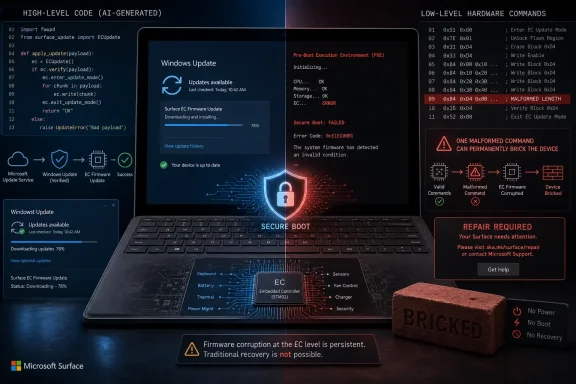
Microsoft has spent the past 90 days patching a Surface firmware flaw that reportedly allowed some unprotected devices to be rendered unbootable by a single malformed command packet, after an Australian security researcher and The Register coordinated disclosure with Microsoft in March 2026. The bug is narrow, awkward, and easy to dismiss if you read only Microsoft’s mitigation language. But it exposes a larger design problem at the seam between Windows, firmware, embedded controllers, and the increasingly confident AI tools now allowed to write and run code near hardware. The story is not that Copilot “bricked a laptop.” The story is that a modern premium PC could still place irreversible hardware state within reach of userspace experimentation once the right guardrails were lowered.
The reported flaw lived in the Surface Aggregator Module path, the software route Windows uses to talk to the embedded controller that helps coordinate hardware functions on Surface devices. In the account given to The Register, researcher Jack Darcy asked Microsoft Copilot for help adjusting screen backlighting on a Surface machine. Copilot generated Python scripts that probed low-level SSAM commands, eventually sending raw ioctl requests to the SAM microcontroller.
That is exactly the sort of task where a helpful AI assistant looks useful and dangerous at the same time. Backlight control sounds mundane. But on a tightly integrated laptop, “brightness” is not just a slider in Settings; it may be mediated through firmware, device-specific drivers, undocumented command IDs, and controller state that survives reboot.
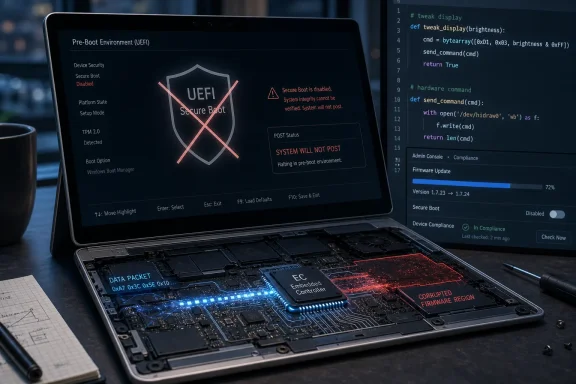
The alleged failure mode is severe. The machine could continue running after the destructive command because the controller had already initialized and was operating from RAM. The brick only became visible after reboot, when the embedded controller tried to reload from corrupted non-volatile storage, failed to initialize, and left the Surface unable to complete POST.
That makes this class of bug especially cruel for users. The system appears to survive the experiment until the next restart, update, shutdown, battery drain, or forced power cycle. Then the owner is left with a machine that will not enter UEFI, will not boot from USB, and cannot be recovered through the normal consumer rituals of factory reset and recovery media.
Microsoft’s line is that the issue required administrator privileges and disabled Secure Boot, and therefore did not represent a realistic attack scenario. That is a defensible security triage position, but it is not the end of the story. Plenty of damaging PC failures are not “realistic attacks” in the red-team sense; they are still unacceptable product failures if an authorized user, a misbehaving tool, or a half-understood script can cross from operating-system space into permanent hardware damage.
That CVE decision will irritate some security people and reassure others. CVEs are not customer-service labels for “bad things that can happen”; they are vulnerability records with scope, exploitability, and impact criteria. If the prerequisites include admin rights and a disabled boot security feature, Microsoft can plausibly argue that an attacker already has enough access to do serious damage by easier means.
But the absence of a CVE does not mean the absence of a design flaw. It means the bug does not map cleanly to the vulnerability taxonomy Microsoft chose to apply. For owners and administrators, the relevant question is not whether the issue deserves a database identifier. It is whether the firmware boundary behaved as if destructive writes required extraordinary proof of intent.
On that measure, the reported behavior looks much worse. Darcy’s complaint is not merely that one command ID was dangerous. It is that the command space allegedly mixed read and write operations in a way that made exploratory enumeration hazardous. If software cannot discover the harmless surface area without risking the destructive one, then the interface is hostile to debugging, reverse engineering, driver development, and accidental misuse.
Microsoft’s mitigations also reveal the layered bet behind modern Windows hardware security. Secure Boot and Secure Core are not decorative checkboxes. They are part of the device’s expected operating envelope. Once they are disabled, the machine may still function, but it is no longer in the condition Microsoft designed, tested, and secured for the broadest population.
That is a reasonable vendor position for managed fleets. It is less comfortable for enthusiasts, Linux users, repair shops, developers, and gamers who routinely alter boot settings for practical reasons. In the real PC ecosystem, “unsupported” and “uncommon” are not synonyms for “irrelevant.”
The safer design pattern is familiar across consumer electronics. Devices that allow firmware writes often require an explicit update mode, a button chord, a signed payload, a physical jumper, a rollback slot, or at least a sanity check before persistent state is overwritten. The point is not that every embedded controller command must be cryptographically ceremonial. The point is that irreversible operations should look different from ordinary control messages.
Darcy’s reported criticism goes to the architecture of the command space. If read and write command IDs are interleaved without a discoverable schema, a probing script can wander into destructive territory. A tool trying to identify backlight controls may send null or empty payloads to command IDs that perform writes, corrupting state the device later needs to boot.
That is the sort of bug AI makes easier to trigger without changing the underlying risk model. Copilot did not invent unsafe firmware. It generated code that behaved like a reckless hardware-probing utility. The novelty is that such utilities are now one prompt away for users who may not understand the difference between a Windows API, a driver ioctl, and a raw controller command.
There is a temptation to blame the user for running generated scripts as administrator. That temptation should be resisted. Admin rights are not supposed to mean the laptop can be permanently destroyed by malformed non-malicious input. Windows administrators can delete the OS, wreck a registry hive, corrupt partitions, or flash bad firmware with enough effort. But there is a meaningful difference between deliberate firmware flashing and accidental controller vandalism during an exploratory backlight script.
Generative AI erodes that barrier. It can synthesize plausible code from scattered examples, constants, kernel headers, forum posts, and driver conventions. Sometimes that code is useful. Sometimes it is confidently wrong. Near hardware, the difference matters.
The reported sequence — progressively more aggressive scripts probing for backlight control values — is the shape of a modern AI-assisted accident. A human asks for a high-level outcome. The assistant tries increasingly low-level approaches when safer ones do not work. Each failure becomes a reason to dig deeper, not a signal to stop.
That matters because AI coding tools are being embedded into workflows where the user may never read every line before execution. In ordinary application development, a bad script throws an exception, deletes a test file, or breaks a build. In firmware-adjacent work, a bad script can cross into device state that was never designed for blind fuzzing.
Microsoft is not alone in facing this problem. Every PC vendor with proprietary controller interfaces, vendor utilities, update tools, and ACPI or HID shims has a similar exposure. But Microsoft has a special burden because Surface is both a device line and a Windows reference platform. When Surface hardware demonstrates a brittle seam between OS-level code and embedded control, it raises questions about the model Microsoft wants the rest of the ecosystem to follow.
But WindowsForum readers know that the PC world is wider than managed fleets. Secure Boot is often disabled for Linux experiments, unsigned drivers, older boot media, specialty hardware, anti-cheat conflicts, kernel debugging, custom hypervisor work, or plain curiosity. Sometimes users disable it temporarily and forget. Sometimes second-hand machines arrive in an unknown state.
That ambiguity is the uncomfortable part. Microsoft can say the exploit path requires a weakened configuration. Users can reply that the configuration is still exposed through firmware menus Microsoft ships on the product. If a supported setting can convert an obscure driver interface into a motherboard replacement, the line between “misconfiguration” and “product hazard” becomes blurry.
For IT pros, the practical implication is straightforward: inventory firmware security posture, not just OS patch level. Secure Boot status, virtualization-based security, device health attestation, and firmware update compliance are not abstract dashboard metrics. They are part of the hardware safety model.
For enthusiasts, the lesson is harsher. If you run a Surface with Secure Boot disabled, treat low-level controller access as radioactive until the relevant firmware update is confirmed. Do not run AI-generated hardware scripts. Do not blindly enumerate vendor command IDs. Do not assume that because a command path is reachable from Windows, it is safe to explore.
Rust is not magic firmware armor. It will not automatically prevent a valid command from performing an unsafe write. Memory safety does not solve every logic bug, every authorization failure, or every bad interface design. A Rust program can still implement a dangerous protocol beautifully.
But the shift does signal that Microsoft understands the old layers are creaking. PC firmware has historically been a patchwork of vendor code, legacy assumptions, opaque interfaces, and survival-oriented engineering. The embedded controller, UEFI environment, and OS driver stack evolved under pressure to ship hardware, not to withstand AI-assisted probing by curious users running scripts as admin.
Secure EC, if done well, should be about more than rewriting C in Rust. It should provide a cleaner trust boundary between the operating system and the microcontroller. It should separate safe queries from state-changing commands. It should require explicit authorization for destructive operations. It should make the dangerous path boringly hard to reach.
Project Patina points in a similar direction for UEFI. A more memory-safe, composable firmware core is valuable, but only if paired with better update discipline, rollback handling, transparency, and interface design. The PC firmware ecosystem needs fewer heroic recovery stories and more systems that assume failure will happen and contain it.
The irony is that this Surface incident is a strong argument for Microsoft’s modernization program, even if Microsoft would rather not make that argument through a bricked laptop story. The company can say the issue is mostly patched and practically constrained. The broader truth is that firmware now sits in the blast radius of everyday software generation, and the old assumption that obscurity protects low-level interfaces is finished.
That matters because Surface devices have long occupied a complicated place in the repair conversation. They are premium machines with excellent industrial design, but the thin, integrated design language that makes them appealing can make deep repair expensive. A firmware failure that requires board-level replacement feels different on a modular desktop than on a tightly packaged laptop.
The Register notes that Darcy was reportedly given a Surface laptop as a gesture of appreciation. That is a decent ending for a researcher. It is not a scalable remedy for ordinary users who encounter unexplained boot failures, especially if those failures are impossible to attribute after the fact.
Microsoft and other vendors should treat firmware resilience as part of repairability. A device that can recover from a corrupted controller image, roll back to a known-good slot, or enter a hardware recovery mode without factory equipment is not merely more secure. It is more repairable, more sustainable, and less likely to turn a software mistake into e-waste.
The hard part is that such resilience costs engineering effort, storage, validation time, and sometimes physical design concessions. It is easier to assume the update path works and the user never reaches the dangerous state. This incident is a reminder that premium devices deserve premium failure handling, not just premium materials.
That is coordinated vulnerability disclosure working, at least in outcome. A researcher found a severe failure mode. A publication held the story. Microsoft shipped mitigations. Users were not handed a detailed public recipe before the update train began moving.
But the story also suggests that the normal intake path felt too cumbersome to the researcher. That should concern Microsoft. If the only way to get attention for a hardware-bricking firmware flaw is through a journalist’s escalation route, the system is too hard to use. MSRC handles a staggering volume of reports, and many are low quality, but high-friction reporting channels push serious researchers toward public disclosure, social pressure, or silence.
Firmware and hardware issues are especially hard to report because they often do not come with tidy proof-of-concept packages. A web bug can be reproduced in a browser tab. A cloud bug can be demonstrated against a test tenant. A firmware bug may require a sacrificial device, undocumented interfaces, and a failure mode that cannot be repeated without destroying more hardware.
Vendors need intake paths that understand that asymmetry. If the artifact is a dead laptop and a log of commands, the process must still work. Otherwise, the researchers most likely to find these bugs will be the least willing to spend weeks navigating forms while holding a device they cannot recover.
The reason is that AI assistants blur the category of “untrusted code.” A user may not think of Copilot as a stranger on a forum. It is a Microsoft-branded assistant running in the Microsoft ecosystem, answering a question about Microsoft hardware. That does not make its code safe, but it changes the user’s expectations.
This is where platform owners need to think beyond disclaimers. AI coding tools should be more cautious when generating code that touches raw device interfaces, kernel objects, ioctl calls, firmware update paths, ACPI methods, HID feature reports, or vendor controller buses. They should warn more clearly when a request has crossed from application automation into hardware control.
The tools can also refuse to generate blind probing loops against unknown command IDs. That would not prevent a determined researcher from writing one, but it would protect the much larger class of users who are trying to solve a mundane problem and do not realize they have stepped into destructive territory.
There is an analogy here to password managers and browsers warning before dangerous downloads or credential reuse. The platform cannot save users from every bad choice, but it can notice when the shape of a request resembles known danger. “Enumerate arbitrary write commands against an embedded controller” is such a shape.
The deeper fix remains in firmware. AI guardrails are probabilistic and policy-driven. Firmware interlocks are deterministic. A well-designed embedded controller should reject malformed destructive writes no matter whether they came from Copilot, a human researcher, malware with admin rights, or a vendor utility gone wrong.
The harder question is which devices remain exposed. The Register’s source suggested a broad range of Surface Laptop and Surface Book generations may have been affected, while noting that Surface Go models appeared exempt and ARM variants were not tested. Microsoft’s public phrasing — “some devices” and “most impacted devices” — leaves room for uncertainty.
That uncertainty is not unusual in firmware stories, but it is frustrating. Surface owners want model numbers, firmware versions, and a clear fixed/not-fixed matrix. Enterprises want compliance signals. Linux users want to know whether they must boot Windows to receive the relevant firmware. Repair shops want to know whether a dead Surface is plausibly recoverable or a board-level loss.
Microsoft should publish a clearer advisory even without a CVE. It does not need to include destructive command details. It can still list affected product families, fixed firmware versions, prerequisites, and recommended configuration. When the company relies on Windows Update as the repair channel, it owes users enough information to know whether the repair arrived.
The absence of a CVE should not become an absence of documentation. Firmware updates are already opaque to ordinary users. If trust in the platform depends on silent repair, users are being asked to believe that the machine became safer without ever understanding what was wrong.
That is progress, but it also means failures are harder for users to reason about. A laptop that will not boot after a firmware bug does not look like a security incident. It looks like a dead board. A security setting disabled for Linux testing does not feel like a hardware warranty boundary. It feels like a firmware menu option.
Microsoft’s Surface line is supposed to simplify that stack. It is the place where Microsoft controls the OS, drivers, firmware strategy, update channel, and hardware design more tightly than on the average PC. When Surface stumbles at the embedded-controller layer, it is a warning for the wider ecosystem, not an isolated embarrassment.
The most generous reading is that Microsoft found, patched, and is now engineering away a class of old design assumptions. The less generous reading is that PC firmware has been granted too much trust for too long, with too little visibility and too few recovery paths. Both readings can be true.
For Windows administrators, the immediate lesson is to treat firmware configuration as operational security. For developers, the lesson is to stop treating undocumented device interfaces as harmless playgrounds. For Microsoft, the lesson is that AI-era tooling turns obscure hardware seams into reachable surfaces.
 A Surface Bug Turns Firmware Trust Into a Userland Problem
The reported flaw lived in the Surface Aggregator Module path, the software route Windows uses to talk to the embedded controller that helps coordinate hardware functions on Surface devices. In the account given to The Register, researcher Jack Darcy asked Microsoft Copilot for help adjusting screen backlighting on a Surface machine. Copilot generated Python scripts that probed low-level SSAM commands, eventually sending raw ioctl requests to the SAM microcontroller.That is exactly the sort of task where a helpful AI assistant looks useful and dangerous at the same time. Backlight control sounds mundane. But on a tightly integrated laptop, “brightness” is not just a slider in Settings; it may be mediated through firmware, device-specific drivers, undocumented command IDs, and controller state that survives reboot.
The alleged failure mode is severe. The machine could continue running after the destructive command because the controller had already initialized and was operating from RAM. The brick only became visible after reboot, when the embedded controller tried to reload from corrupted non-volatile storage, failed to initialize, and left the Surface unable to complete POST.
That makes this class of bug especially cruel for users. The system appears to survive the experiment until the next restart, update, shutdown, battery drain, or forced power cycle. Then the owner is left with a machine that will not enter UEFI, will not boot from USB, and cannot be recovered through the normal consumer rituals of factory reset and recovery media.
Microsoft’s line is that the issue required administrator privileges and disabled Secure Boot, and therefore did not represent a realistic attack scenario. That is a defensible security triage position, but it is not the end of the story. Plenty of damaging PC failures are not “realistic attacks” in the red-team sense; they are still unacceptable product failures if an authorized user, a misbehaving tool, or a half-understood script can cross from operating-system space into permanent hardware damage.
Microsoft’s Mitigations Narrow the Blast Radius, Not the Lesson
Microsoft told The Register that the problem involved a deprecated UEFI interface capable of triggering a boot loop on some devices, and that exploitation required administrator privileges plus Secure Boot being disabled. The company said it had released updates for most impacted devices, with more updates expected in coming weeks. It also concluded that the issue did not meet the bar for a CVE.That CVE decision will irritate some security people and reassure others. CVEs are not customer-service labels for “bad things that can happen”; they are vulnerability records with scope, exploitability, and impact criteria. If the prerequisites include admin rights and a disabled boot security feature, Microsoft can plausibly argue that an attacker already has enough access to do serious damage by easier means.
But the absence of a CVE does not mean the absence of a design flaw. It means the bug does not map cleanly to the vulnerability taxonomy Microsoft chose to apply. For owners and administrators, the relevant question is not whether the issue deserves a database identifier. It is whether the firmware boundary behaved as if destructive writes required extraordinary proof of intent.
On that measure, the reported behavior looks much worse. Darcy’s complaint is not merely that one command ID was dangerous. It is that the command space allegedly mixed read and write operations in a way that made exploratory enumeration hazardous. If software cannot discover the harmless surface area without risking the destructive one, then the interface is hostile to debugging, reverse engineering, driver development, and accidental misuse.
Microsoft’s mitigations also reveal the layered bet behind modern Windows hardware security. Secure Boot and Secure Core are not decorative checkboxes. They are part of the device’s expected operating envelope. Once they are disabled, the machine may still function, but it is no longer in the condition Microsoft designed, tested, and secured for the broadest population.
That is a reasonable vendor position for managed fleets. It is less comfortable for enthusiasts, Linux users, repair shops, developers, and gamers who routinely alter boot settings for practical reasons. In the real PC ecosystem, “unsupported” and “uncommon” are not synonyms for “irrelevant.”
The Single Packet Is a Headline; the Missing Interlock Is the Story
The phrase “bricked by a single packet” sounds like tabloid security prose, but it captures something real about low-level hardware interfaces. A packet to an embedded controller is not a network packet crossing the internet. It is a structured command moving across a privileged internal path, one that can change hardware state with little ceremony if the receiving firmware accepts it.The safer design pattern is familiar across consumer electronics. Devices that allow firmware writes often require an explicit update mode, a button chord, a signed payload, a physical jumper, a rollback slot, or at least a sanity check before persistent state is overwritten. The point is not that every embedded controller command must be cryptographically ceremonial. The point is that irreversible operations should look different from ordinary control messages.
Darcy’s reported criticism goes to the architecture of the command space. If read and write command IDs are interleaved without a discoverable schema, a probing script can wander into destructive territory. A tool trying to identify backlight controls may send null or empty payloads to command IDs that perform writes, corrupting state the device later needs to boot.
That is the sort of bug AI makes easier to trigger without changing the underlying risk model. Copilot did not invent unsafe firmware. It generated code that behaved like a reckless hardware-probing utility. The novelty is that such utilities are now one prompt away for users who may not understand the difference between a Windows API, a driver ioctl, and a raw controller command.
There is a temptation to blame the user for running generated scripts as administrator. That temptation should be resisted. Admin rights are not supposed to mean the laptop can be permanently destroyed by malformed non-malicious input. Windows administrators can delete the OS, wreck a registry hive, corrupt partitions, or flash bad firmware with enough effort. But there is a meaningful difference between deliberate firmware flashing and accidental controller vandalism during an exploratory backlight script.
Copilot Did Not Create the Vulnerability, but It Changed the Failure Mode
The most interesting character in this story is not Copilot as an “AI gone rogue.” It is Copilot as a force multiplier for obscure interfaces. For decades, the practical barrier around low-level PC internals has been knowledge. You had to know where the driver objects were, what ioctl values existed, how to format payloads, and which commands were undocumented or dangerous.Generative AI erodes that barrier. It can synthesize plausible code from scattered examples, constants, kernel headers, forum posts, and driver conventions. Sometimes that code is useful. Sometimes it is confidently wrong. Near hardware, the difference matters.
The reported sequence — progressively more aggressive scripts probing for backlight control values — is the shape of a modern AI-assisted accident. A human asks for a high-level outcome. The assistant tries increasingly low-level approaches when safer ones do not work. Each failure becomes a reason to dig deeper, not a signal to stop.
That matters because AI coding tools are being embedded into workflows where the user may never read every line before execution. In ordinary application development, a bad script throws an exception, deletes a test file, or breaks a build. In firmware-adjacent work, a bad script can cross into device state that was never designed for blind fuzzing.
Microsoft is not alone in facing this problem. Every PC vendor with proprietary controller interfaces, vendor utilities, update tools, and ACPI or HID shims has a similar exposure. But Microsoft has a special burden because Surface is both a device line and a Windows reference platform. When Surface hardware demonstrates a brittle seam between OS-level code and embedded control, it raises questions about the model Microsoft wants the rest of the ecosystem to follow.
Secure Boot Becomes the Line Between Supported PC and Lab Bench
The Register’s reporting emphasizes that managed devices are not at risk under the conditions Microsoft described. That matters. Enterprises generally do not disable Secure Boot casually, and well-run fleets enforce firmware configuration through policy, attestation, and device compliance checks. For those environments, the practical lesson is to keep the guardrails on and let Windows Update deliver the relevant firmware fixes.But WindowsForum readers know that the PC world is wider than managed fleets. Secure Boot is often disabled for Linux experiments, unsigned drivers, older boot media, specialty hardware, anti-cheat conflicts, kernel debugging, custom hypervisor work, or plain curiosity. Sometimes users disable it temporarily and forget. Sometimes second-hand machines arrive in an unknown state.
That ambiguity is the uncomfortable part. Microsoft can say the exploit path requires a weakened configuration. Users can reply that the configuration is still exposed through firmware menus Microsoft ships on the product. If a supported setting can convert an obscure driver interface into a motherboard replacement, the line between “misconfiguration” and “product hazard” becomes blurry.
For IT pros, the practical implication is straightforward: inventory firmware security posture, not just OS patch level. Secure Boot status, virtualization-based security, device health attestation, and firmware update compliance are not abstract dashboard metrics. They are part of the hardware safety model.
For enthusiasts, the lesson is harsher. If you run a Surface with Secure Boot disabled, treat low-level controller access as radioactive until the relevant firmware update is confirmed. Do not run AI-generated hardware scripts. Do not blindly enumerate vendor command IDs. Do not assume that because a command path is reachable from Windows, it is safe to explore.
The Surface Stack Is Being Rebuilt Because the Old PC Model Is Showing Its Age
Microsoft’s response becomes more interesting when placed next to its broader Surface firmware work. The company has been moving pieces of the Surface platform toward Rust, including embedded controller firmware, UEFI-related components, and Windows driver development efforts. The projects named in The Register’s report — Secure EC and Project Patina — fit into Microsoft’s public push through the Open Device Partnership.Rust is not magic firmware armor. It will not automatically prevent a valid command from performing an unsafe write. Memory safety does not solve every logic bug, every authorization failure, or every bad interface design. A Rust program can still implement a dangerous protocol beautifully.
But the shift does signal that Microsoft understands the old layers are creaking. PC firmware has historically been a patchwork of vendor code, legacy assumptions, opaque interfaces, and survival-oriented engineering. The embedded controller, UEFI environment, and OS driver stack evolved under pressure to ship hardware, not to withstand AI-assisted probing by curious users running scripts as admin.
Secure EC, if done well, should be about more than rewriting C in Rust. It should provide a cleaner trust boundary between the operating system and the microcontroller. It should separate safe queries from state-changing commands. It should require explicit authorization for destructive operations. It should make the dangerous path boringly hard to reach.
Project Patina points in a similar direction for UEFI. A more memory-safe, composable firmware core is valuable, but only if paired with better update discipline, rollback handling, transparency, and interface design. The PC firmware ecosystem needs fewer heroic recovery stories and more systems that assume failure will happen and contain it.
The irony is that this Surface incident is a strong argument for Microsoft’s modernization program, even if Microsoft would rather not make that argument through a bricked laptop story. The company can say the issue is mostly patched and practically constrained. The broader truth is that firmware now sits in the blast radius of everyday software generation, and the old assumption that obscurity protects low-level interfaces is finished.
A Bricked Laptop Is Also a Repairability Story
There is another layer here that security triage tends to flatten: the economics of failure. If a malformed command corrupts embedded controller state and the device cannot POST, the user is not debating CVSS scores. The user is looking at a dead machine and a repair path that may involve motherboard replacement.That matters because Surface devices have long occupied a complicated place in the repair conversation. They are premium machines with excellent industrial design, but the thin, integrated design language that makes them appealing can make deep repair expensive. A firmware failure that requires board-level replacement feels different on a modular desktop than on a tightly packaged laptop.
The Register notes that Darcy was reportedly given a Surface laptop as a gesture of appreciation. That is a decent ending for a researcher. It is not a scalable remedy for ordinary users who encounter unexplained boot failures, especially if those failures are impossible to attribute after the fact.
Microsoft and other vendors should treat firmware resilience as part of repairability. A device that can recover from a corrupted controller image, roll back to a known-good slot, or enter a hardware recovery mode without factory equipment is not merely more secure. It is more repairable, more sustainable, and less likely to turn a software mistake into e-waste.
The hard part is that such resilience costs engineering effort, storage, validation time, and sometimes physical design concessions. It is easier to assume the update path works and the user never reaches the dangerous state. This incident is a reminder that premium devices deserve premium failure handling, not just premium materials.
Microsoft’s Disclosure Dance Worked, but It Shows the Friction
The timeline reported by The Register is also worth reading as a disclosure story. The outlet contacted Microsoft on March 10, 2026. Two days later, with media-relations help, Darcy and Microsoft’s Security Response Center were reportedly connected. Publication was delayed for 90 days while Microsoft prepared and shipped fixes.That is coordinated vulnerability disclosure working, at least in outcome. A researcher found a severe failure mode. A publication held the story. Microsoft shipped mitigations. Users were not handed a detailed public recipe before the update train began moving.
But the story also suggests that the normal intake path felt too cumbersome to the researcher. That should concern Microsoft. If the only way to get attention for a hardware-bricking firmware flaw is through a journalist’s escalation route, the system is too hard to use. MSRC handles a staggering volume of reports, and many are low quality, but high-friction reporting channels push serious researchers toward public disclosure, social pressure, or silence.
Firmware and hardware issues are especially hard to report because they often do not come with tidy proof-of-concept packages. A web bug can be reproduced in a browser tab. A cloud bug can be demonstrated against a test tenant. A firmware bug may require a sacrificial device, undocumented interfaces, and a failure mode that cannot be repeated without destroying more hardware.
Vendors need intake paths that understand that asymmetry. If the artifact is a dead laptop and a log of commands, the process must still work. Otherwise, the researchers most likely to find these bugs will be the least willing to spend weeks navigating forms while holding a device they cannot recover.
The AI Era Makes “Don’t Run Weird Scripts” Inadequate Advice
Security guidance often collapses into scolding: do not run untrusted code, do not disable Secure Boot, do not use administrator accounts, do not paste commands from the internet. All true. All insufficient.The reason is that AI assistants blur the category of “untrusted code.” A user may not think of Copilot as a stranger on a forum. It is a Microsoft-branded assistant running in the Microsoft ecosystem, answering a question about Microsoft hardware. That does not make its code safe, but it changes the user’s expectations.
This is where platform owners need to think beyond disclaimers. AI coding tools should be more cautious when generating code that touches raw device interfaces, kernel objects, ioctl calls, firmware update paths, ACPI methods, HID feature reports, or vendor controller buses. They should warn more clearly when a request has crossed from application automation into hardware control.
The tools can also refuse to generate blind probing loops against unknown command IDs. That would not prevent a determined researcher from writing one, but it would protect the much larger class of users who are trying to solve a mundane problem and do not realize they have stepped into destructive territory.
There is an analogy here to password managers and browsers warning before dangerous downloads or credential reuse. The platform cannot save users from every bad choice, but it can notice when the shape of a request resembles known danger. “Enumerate arbitrary write commands against an embedded controller” is such a shape.
The deeper fix remains in firmware. AI guardrails are probabilistic and policy-driven. Firmware interlocks are deterministic. A well-designed embedded controller should reject malformed destructive writes no matter whether they came from Copilot, a human researcher, malware with admin rights, or a vendor utility gone wrong.
The Patch Is Necessary, but Trust Needs a Better Story
Microsoft says most impacted devices have been updated or will be soon. For most Windows users, that means the immediate action is boring and familiar: install firmware updates through Windows Update, keep Secure Boot enabled, and avoid low-level experimentation on production hardware. Boring is good. Boring is how mass-market PC security improves.The harder question is which devices remain exposed. The Register’s source suggested a broad range of Surface Laptop and Surface Book generations may have been affected, while noting that Surface Go models appeared exempt and ARM variants were not tested. Microsoft’s public phrasing — “some devices” and “most impacted devices” — leaves room for uncertainty.
That uncertainty is not unusual in firmware stories, but it is frustrating. Surface owners want model numbers, firmware versions, and a clear fixed/not-fixed matrix. Enterprises want compliance signals. Linux users want to know whether they must boot Windows to receive the relevant firmware. Repair shops want to know whether a dead Surface is plausibly recoverable or a board-level loss.
Microsoft should publish a clearer advisory even without a CVE. It does not need to include destructive command details. It can still list affected product families, fixed firmware versions, prerequisites, and recommended configuration. When the company relies on Windows Update as the repair channel, it owes users enough information to know whether the repair arrived.
The absence of a CVE should not become an absence of documentation. Firmware updates are already opaque to ordinary users. If trust in the platform depends on silent repair, users are being asked to believe that the machine became safer without ever understanding what was wrong.
The Surface Lesson Microsoft Cannot Patch Away
This incident fits a broader pattern in modern Windows hardware: the security boundary is moving downward. Once, most users thought of PC security as antivirus, browser patches, and Windows Update. Now the conversation includes Pluton, Secure Boot databases, UEFI capsules, embedded controllers, measured boot, virtualization-based security, kernel-mode driver policy, and firmware written in memory-safe languages.That is progress, but it also means failures are harder for users to reason about. A laptop that will not boot after a firmware bug does not look like a security incident. It looks like a dead board. A security setting disabled for Linux testing does not feel like a hardware warranty boundary. It feels like a firmware menu option.
Microsoft’s Surface line is supposed to simplify that stack. It is the place where Microsoft controls the OS, drivers, firmware strategy, update channel, and hardware design more tightly than on the average PC. When Surface stumbles at the embedded-controller layer, it is a warning for the wider ecosystem, not an isolated embarrassment.
The most generous reading is that Microsoft found, patched, and is now engineering away a class of old design assumptions. The less generous reading is that PC firmware has been granted too much trust for too long, with too little visibility and too few recovery paths. Both readings can be true.
For Windows administrators, the immediate lesson is to treat firmware configuration as operational security. For developers, the lesson is to stop treating undocumented device interfaces as harmless playgrounds. For Microsoft, the lesson is that AI-era tooling turns obscure hardware seams into reachable surfaces.
The Practical Surface Owner’s Map After the Quiet Fix
The useful part of this story is not panic; it is prioritization. The failure requires a specific chain of conditions, and Microsoft says it has already addressed most impacted devices. But because the consequence is severe, the sensible response is to close the gaps rather than argue about how likely the chain is.- Surface owners should install all available Windows Update firmware packages before experimenting with alternate operating systems, custom boot settings, or unsigned drivers.
- Secure Boot should remain enabled on production Surface devices unless there is a concrete reason to disable it and a plan to restore it afterward.
- Administrators should audit Surface fleets for Secure Boot and firmware compliance rather than assuming Windows patch compliance covers the whole device.
- Users should not run AI-generated scripts that send raw ioctl commands, HID feature reports, ACPI calls, or vendor-controller messages unless they understand the hardware interface and have accepted the risk.
- Microsoft should publish a plain-language firmware advisory with affected models and fixed firmware versions even if the issue never receives a CVE.
- The Surface team’s Rust-based firmware and driver work should be judged not only by memory-safety claims but by whether future devices recover cleanly from malformed or unauthorized hardware commands.
References
- Primary source: The Register
Published: Fri, 12 Jun 2026 13:05:00 GMT
Microsoft has mostly repaired flaw in Surface hardware that allowed unprotected devices to be bricked by a single packet
And it was Microsoft Copilot that unwittingly revealed the longstanding vulnerabilitywww.theregister.com - Related coverage: windowscentral.com
Microsoft announces Litebox, a Rust‑based security OS | Windows Central
LiteBox offers developers a new way to sandbox apps while reducing the system's attack surface.www.windowscentral.com - Official source: learn.microsoft.com
Surface security overview - Surface | Microsoft Learn
Protect your organization with Surface devices. From chip to cloud, Surface offers built-in security features with Zero Trust principles and advanced AI.learn.microsoft.com - Official source: techcommunity.microsoft.com
Surface Joins the Open Device Partnership (ODP) | Microsoft Community Hub
Surface joins the Open Device Partnership (ODP) to drive innovation in secure, reliable, and future-ready device firmware—leveraging Rust, modern EC... techcommunity.microsoft.com
- Related coverage: windowsreport.com
Surface Joins the Open Device Partnership to Advance Firmware Security
Microsoft Surface joins the Open Device Partnership to boost security, reliability, and innovation across devices. windowsreport.com
- Official source: blogs.windows.com
Surface が Open Device Partnership (ODP) に参加 - Windows Blog for Japan
※本ブログは、米国時間 10 月 10 日に公開された “Surface Joins the Open Device Partnership (ODP)” の抄訳を基に掲載しています。 現在と未来に、安全で信頼できる柔軟なデバイスを届けるために Surface では、皆様に常に優れたデバイスをお届けするために、セキュリティ、信頼性、イノベーションをあらゆるレベルで保証する最先端テクノロジの開発に投資し続けています。Surface はこのたび Open Device Partnership (ODP) (英語)...blogs.windows.com
- Official source: support.microsoft.com
Surface Secure Boot Certificates | Microsoft Support
Secure Boot in UEFI firmware verifies pre-boot software using trusted certificates. Microsoft will update expiring Windows Secure Boot certificates starting June 2026 to maintain device protection.support.microsoft.com - Official source: ignite.microsoft.com
Advancing Windows device security through Surface innovation
Discover how Surface and Microsoft boost Windows device security with memory-safe Rust firmware and drivers, reducing vulnerabilities and improving reliability. Learn about the open-source windows-drivers-rs project and how IT and engineering teams can help build safer, resilient devices through...ignite.microsoft.com - Related coverage: techspot.com
Microsoft is turning Rust into a first-class language for developing secure Windows drivers | TechSpot
Microsoft began adopting Rust for core Windows programming a few years ago, praising the relatively new language as a key tool for reducing bugs and enhancing security....www.techspot.com - Related coverage: uefi.org
- Related coverage: creditosocial2023.patos.pb.gov.br
- Official source: microsoft.com