Windows Server 2025 DNS over HTTPS (GA): Encrypt Internal Name Resolution

Microsoft has made DNS over HTTPS support generally available for Windows DNS Server in Windows Server 2025 with the latest June 2026 Patch Tuesday updates, giving enterprise networks a Microsoft-supported way to encrypt DNS traffic between DoH-capable clients and their internal resolvers. The change moves a feature Microsoft had been previewing for months into production territory. It is not a glamorous server feature, but it is the kind of plumbing change that quietly rewrites the security assumptions underneath almost every enterprise application. DNS has always been where trust begins; Microsoft is now trying to make cleartext DNS look like a legacy exception rather than the default.

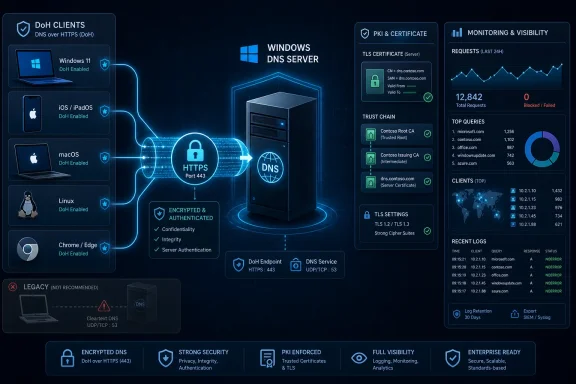
Cybersecurity dashboard showing secure DoH/HTTPS and DNS server monitoring with TLS certificates and client activity.Microsoft Is Finally Encrypting the Directory Assistance Desk of the Network​

DNS is often described as the internet’s phone book, which is accurate enough for civilians and too gentle for administrators. In a corporate network, DNS is more like directory assistance, traffic cop, security witness, and application dependency map rolled into one. Every authentication flow, SaaS session, software update, intranet lookup, and telemetry call tends to leave a DNS footprint before anything else happens.
That is why Microsoft’s Windows Server DoH release matters beyond the checkbox. Windows clients have supported DNS over HTTPS for years, but the server side was the missing enterprise piece. Without a Windows DNS Server endpoint that could terminate DoH, organizations using Microsoft’s built-in DNS role had to choose between sending encrypted queries to outside resolvers, deploying intermediary infrastructure, or staying with conventional DNS on port 53.
General availability changes the deployment conversation. It tells administrators that Microsoft considers the feature stable enough for production use, not merely lab evaluation. It also gives security teams a cleaner way to argue that internal DNS traffic should be treated with the same confidentiality expectations as web traffic, API calls, and identity requests.
The irony is that DNS was never designed with modern enterprise paranoia in mind. It was designed for reachability, speed, and interoperability. The zero-trust era has been forcing old assumptions through new threat models, and plaintext DNS is one of the more obvious leftovers.

The Real Upgrade Is Not Privacy, It Is Control​

Consumer debates about DoH often focus on privacy from internet providers or coffee-shop attackers. Enterprise DoH is different. The prize is not hiding a user’s browsing from a broadband company; it is reducing the number of places where attackers, malware, compromised network devices, or careless observers can read or tamper with name resolution inside an organization.
That distinction matters because enterprise DNS is full of sensitive signals. Internal hostnames can reveal business units, infrastructure patterns, software vendors, domain relationships, and administrative habits. Even when the DNS response itself is not secret, the pattern of queries can be intelligence.
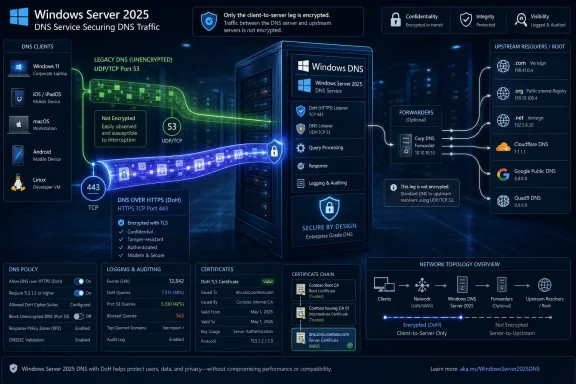
Microsoft’s implementation encrypts communication between capable clients and Windows DNS Server using HTTPS. That means clients can authenticate the server using TLS certificates and send queries through an encrypted channel rather than cleartext UDP or TCP DNS. In plain English: the client is no longer shouting its DNS requests across the local network and hoping nobody nearby is listening or interfering.
This is why Microsoft frames the feature in zero-trust language. Zero trust is not magic dust, and vendors abuse the phrase constantly, but the underlying principle fits here. If the network is no longer presumed trustworthy merely because it is internal, then name resolution cannot remain a soft, unauthenticated conversation by default.

General Availability Makes DoH a Deployment Problem, Not a Research Project​

The move from preview to GA is less about the protocol and more about accountability. Preview features invite experimentation. GA features invite change tickets, architecture reviews, audit questions, and eventually baseline policy.
Microsoft’s documentation still makes clear that this is a Windows Server 2025 story with current security updates applied. That narrows the practical audience. Many enterprise DNS estates are not greenfield Windows Server 2025 deployments; they are layered, inherited, politically sensitive systems where domain controllers, DNS zones, DHCP options, certificate authorities, and firewall rules have years of sediment built up around them.
That means DoH will not arrive everywhere overnight. It will appear first in organizations already moving aggressively on Windows Server 2025, regulated environments with pressure to reduce plaintext protocols, and security-forward shops where DNS has become part of detection and response strategy. The rest will wait for refresh cycles, proof from early adopters, and a few hard lessons from pilot deployments.
Still, GA changes the default objection. Administrators can no longer dismiss Windows DNS Server DoH as an interesting preview. They now have to decide whether the risk of changing DNS is greater than the risk of leaving internal name resolution readable and spoofable.

Certificates Are Where the Clean Story Gets Messy​

The marketing version of DoH is simple: encrypt DNS with HTTPS. The operational version begins with certificates, trust chains, subject alternative names, firewall paths, service bindings, client configuration, monitoring, and rollback plans. That is where many supposedly straightforward security upgrades become real work.
A Windows DNS Server acting as a DoH endpoint needs a certificate that clients trust and that matches the configured DoH URI. That sounds routine until it collides with internal naming practices, split-horizon DNS, legacy clients, certificate template governance, and servers doing double duty as domain controllers. If the certificate story is weak, DoH does not strengthen trust; it adds another brittle dependency to a service that must be boring to be successful.
The use of HTTPS also moves DNS into familiar security territory. Port 443 is well understood, heavily monitored, and often allowed through internal firewalls. But that familiarity cuts both ways. Security teams will need to distinguish legitimate DoH traffic to sanctioned internal resolvers from applications or malware trying to tunnel around policy by using their own encrypted DNS paths.
This is the enterprise paradox of encrypted DNS. Encryption reduces passive exposure, but it can also reduce visibility if organizations do not update their monitoring strategy. The answer is not to reject DoH; it is to make resolver policy, endpoint policy, logging, and network inspection agree on what sanctioned DNS looks like.

Parallel Operation Is the Escape Hatch Microsoft Needed​

One of the smarter parts of Microsoft’s approach is that DoH can run alongside traditional DNS. That matters because DNS migrations are among the least forgiving changes in IT. A botched DNS change does not create one clean outage; it creates a fog of authentication failures, application timeouts, unreachable services, broken updates, and angry users describing symptoms that do not mention DNS at all.
Parallel operation gives administrators a migration path. They can enable DoH on selected servers, configure test clients, monitor behavior, and keep conventional DNS available while they determine which systems can move. That is not just convenience; it is the difference between a practical security upgrade and a heroic all-or-nothing weekend project.
It also reflects an important truth about enterprise Windows environments: not every endpoint will be ready at the same time. Modern Windows clients can participate, but mixed estates include appliances, printers, Linux systems, embedded devices, old servers, network gear, and applications whose DNS behavior nobody has documented since installation. A clean DoH architecture has to account for the messy edges.
The feature’s ability to coexist with legacy DNS also creates a governance challenge. If standard DNS remains available forever, DoH risks becoming an optional improvement rather than a security boundary. The organizations that get the most value will be those that treat coexistence as a migration phase, not a permanent compromise.

The Missing Upstream Piece Keeps This From Being End-to-End​

Microsoft’s first GA release focuses on encrypting client-to-resolver communication. That is a big step, but it is not the whole chain. Microsoft has also indicated that encrypted communication between Windows DNS Server and upstream DNS resolvers is planned for a future update.
That distinction should not be glossed over. If a Windows DNS Server receives encrypted queries from clients but then forwards upstream queries in cleartext, the organization has protected one segment of the path while leaving another exposed. In many enterprise designs, that may still be a meaningful improvement, especially where the internal LAN is the bigger concern. But it is not the same thing as end-to-end encrypted DNS resolution.
For internal authoritative zones, the client-to-resolver protection may be the most important part. Queries for domain controllers, internal apps, management endpoints, and private services often do not need to leave the organization’s DNS infrastructure. For internet-bound lookups, however, the upstream path remains part of the threat model.
This is where Microsoft’s staged delivery makes sense technically but complicates the security story. The company has shipped the part that lets Windows DNS Server become a DoH endpoint for clients. The next credibility test is whether Microsoft completes the chain in a way that fits enterprise forwarding, conditional forwarding, and hybrid DNS designs without forcing administrators into awkward workarounds.

Zero Trust Does Not Mean Zero Visibility​

DoH has always made some network defenders uneasy. If DNS queries become encrypted, what happens to the security tools that rely on seeing DNS traffic? That concern is legitimate, but it is also sometimes used to defend a status quo that was never especially secure.
The answer is architectural discipline. Enterprises should not allow every application to choose its own resolver, its own DoH endpoint, and its own policy. They should centralize encrypted DNS through managed resolvers, enforce resolver configuration on endpoints, and collect logs from the DNS service itself rather than depending only on packet visibility.
In that model, DoH does not blind defenders. It moves visibility from the wire to the resolver and endpoint management layers. That is consistent with the broader direction of enterprise security, where identity, policy, and telemetry increasingly live above raw network inspection.
The danger is a half-migration. If some clients use internal DoH, some use classic DNS, browsers use their own encrypted resolver settings, and unmanaged devices do whatever they want, the organization gets complexity without a clean security gain. DoH should be deployed as policy, not as a preference.

Windows Server 2025 Becomes the Forcing Function​

By tying the server-side feature to Windows Server 2025 and current cumulative updates, Microsoft is using the new server platform as the place where DNS modernization happens. That is understandable. Microsoft rarely wants to retrofit major network-service changes across every supported server generation, especially when TLS handling, PowerShell management, service behavior, and support boundaries are involved.
But this also means DoH may become one more argument in the Windows Server 2025 upgrade file. For organizations still standardizing on Windows Server 2019 or 2022, server-side DoH is not simply a feature toggle; it is part of a platform decision. That makes adoption slower, but it may also make deployments cleaner when they arrive.
Windows Server 2025 has already been positioned around modernization themes: security hardening, hybrid management, identity improvements, and platform refresh. DNS over HTTPS fits that narrative because it upgrades an old core service without asking organizations to abandon the Windows DNS role. Microsoft is not telling enterprises to redesign name resolution around a third-party resolver. It is saying the resolver they already run can now speak a modern encrypted protocol.
That is strategically important. Many enterprises would like stronger DNS security but do not want a new resolver architecture unless forced. Microsoft’s pitch is that encrypted DNS can be an incremental modernization rather than a rip-and-replace project.

The Security Gain Is Real, but It Is Easy to Oversell​

DoH reduces exposure to eavesdropping, interception, and spoofing between clients and DNS servers. It does not make DNS inherently trustworthy. It does not validate that every DNS answer is correct. It does not replace DNSSEC, endpoint security, resolver logging, secure update policies, or careful Active Directory hygiene.
That distinction is important because DNS attacks rarely arrive wearing only one costume. Attackers can poison, redirect, tamper, tunnel, enumerate, and abuse DNS in different ways. Encrypting the transport solves a transport problem. It does not solve every name-resolution problem.
Still, transport security is not trivial. Cleartext DNS has survived partly because it was ubiquitous and convenient, not because it was defensible. In a world where organizations encrypt administrative portals, APIs, authentication flows, mail transport, file sync, and remote access, leaving DNS queries exposed increasingly looks like an inconsistency.
The best way to view Windows Server DoH is as a foundational control. It raises the floor. It makes certain passive and local-network attacks harder. It gives clients a way to verify the resolver they are talking to. But it does not absolve administrators from designing DNS as a security-sensitive service.

Administrators Should Treat This as a DNS Project With a PKI Dependency​

The first deployments should be boring on purpose. Pick controlled client groups, use a well-understood DNS server, verify certificate trust, confirm logging, and test fallback behavior. The goal is not to show that DoH works in a demo; the goal is to prove that it fails predictably when something is misconfigured.
Administrators also need to think about naming. The DoH URI must be stable and match certificate expectations. If an organization has historically treated internal DNS server names as infrastructure trivia, DoH turns that name into part of the trust contract.
Firewall teams have work too. DoH commonly uses TCP 443, but that does not mean every path should be opened blindly. Internal clients should reach approved internal resolvers. Approved resolvers should be monitored. Unapproved encrypted DNS destinations should be blocked or at least investigated.
The change management plan should include user impact, even if users never hear the acronym. DNS failures look like application failures. Help desks need enough context to recognize when a wave of “the internet is broken” tickets might actually be a resolver policy or certificate issue.

The Windows DNS Roadmap Now Has a Clear Direction​

Microsoft’s statement that upstream encrypted resolver communication is planned gives this release a sense of direction. The company is not presenting client-to-resolver encryption as the final form. It is the first production step in making Windows DNS Server fit into encrypted DNS architectures more completely.
That matters because hybrid networks are increasingly complicated. Enterprises may use on-premises Active Directory, Azure services, private endpoints, conditional forwarders, branch networks, VPN clients, and cloud security gateways at the same time. DNS sits underneath all of it, and every layer adds another opportunity for leakage or misconfiguration.
If Microsoft can extend encrypted DNS upstream while preserving the management model Windows administrators expect, it will have a stronger answer to third-party DNS security platforms. If it cannot, Windows DNS Server DoH may remain useful but incomplete, a client-facing shield rather than a full resolver modernization.
For now, the direction is clear enough: Microsoft wants encrypted DNS to become a normal Windows Server capability. That is a meaningful change for a service that has often evolved conservatively because breaking DNS is one of the fastest ways to ruin an administrator’s week.
The Practical Reading for Windows Shops​

This release is not a reason to rush a Friday afternoon change into production. It is a reason to start treating encrypted internal DNS as a near-term planning item rather than a speculative future control. The organizations that benefit most will be those that approach DoH as part of a broader DNS security program.
  • Windows Server DoH is now a production feature for Windows Server 2025 systems with the latest relevant security updates installed.
  • The first GA release encrypts traffic between DoH-capable clients and Windows DNS Server, not the full upstream resolver path.
  • Successful deployment depends on certificate management, trusted names, firewall policy, client configuration, and resolver logging.
  • Parallel operation with traditional DNS makes phased migration possible, but leaving both paths open forever weakens the security outcome.
  • Administrators should align browser, operating system, network, and security-tool policies so encrypted DNS does not become fragmented across the estate.
  • Microsoft’s planned upstream encryption support will determine whether Windows DNS Server becomes a complete encrypted resolver platform or mainly a client-facing DoH endpoint.
Microsoft’s DoH release for Windows Server is not a revolution in the dramatic sense; DNS will still be DNS, administrators will still fear touching it, and attackers will still find creative ways to abuse name resolution. But it is a significant normalization of encrypted infrastructure inside the Windows stack. The old assumption was that internal DNS could be trusted because the internal network could be trusted; the new assumption is that even the most basic lookup deserves authentication, encryption, and policy. That is where enterprise Windows is heading, and this release gives administrators one fewer excuse to leave one of the network’s most revealing conversations in the clear.

References​

  1. Primary source: Neowin
    Published: Fri, 12 Jun 2026 08:44:00 GMT

  2. Official source: learn.microsoft.com
  3. Official source: support.microsoft.com

  4. Related coverage: tomshardware.com
  5. Related coverage: techspot.com
  6. Related coverage: newroman.net
  1. Related coverage: der-windows-papst.de
 

Microsoft has made DNS over HTTPS generally available for Windows DNS Server on Windows Server 2025, moving the encrypted DNS feature from preview into production use for organizations running the latest server release with current security updates installed. The practical significance is not that DNS suddenly became secure everywhere. It is that Microsoft has finally closed a conspicuous gap between Windows clients that could already speak encrypted DNS and Windows Server infrastructure that often still answered them in the clear. For enterprises trying to make zero-trust more than a slide-deck slogan, this is a small protocol change with unusually large architectural consequences.

Secure cloud network diagram with HTTPS shield and server protection icons.Microsoft Finally Encrypts the Enterprise Resolver It Already Owned​

DNS is one of those technologies that disappears when it works and becomes existential when it fails. Every browser launch, domain join, SaaS login, certificate validation, endpoint agent callback, and cloud workload handoff begins with a name lookup. For decades, much of that traffic has crossed internal networks in plain text, protected mainly by assumptions about perimeter trust that no longer survive contact with modern intrusions.
Microsoft’s general availability announcement for DNS over HTTPS in Windows DNS Server matters because Windows DNS Server is not a boutique component. It is embedded in the Active Directory-centered reality of countless enterprises, school districts, hospitals, manufacturers, government agencies, and midmarket companies that may not have the appetite to rebuild name resolution around a new platform. When Microsoft adds encrypted client-to-resolver DNS to that stack, it gives conservative Windows shops a path to harden DNS without making DNS itself an organizational migration project.
That is the real story here. DoH is not new, and privacy-focused consumer browsers have been pushing encrypted DNS for years. What is new is Microsoft treating the enterprise DNS server as a first-class participant in that shift rather than leaving administrators to choose between traditional Windows DNS, third-party resolvers, or ad hoc forwarding designs that create as many governance problems as they solve.
The feature also lands at a moment when “zero trust” has become both a useful security model and an abused procurement phrase. DNS over HTTPS does not make a network zero-trust on its own. But it does remove one of the more awkward contradictions in many zero-trust programs: the insistence that every session be authenticated and encrypted while the network’s naming layer remains observable to anyone with the right vantage point.

Plain-Text DNS Was Always a Bigger Leak Than It Looked​

Traditional DNS over UDP or TCP port 53 is fast, simple, and gloriously old. That longevity is why it is everywhere, and also why its security assumptions feel increasingly brittle. A DNS query does not usually contain a password or a document, but it often reveals intent: which internal systems a user touches, which SaaS services an endpoint calls, which update servers a fleet depends on, and which security tools are alive on the network.
Attackers understand that. DNS traffic can be used for reconnaissance, command-and-control, phishing infrastructure, malware staging, and data exfiltration. Defenders inspect it for the same reason adversaries value it: the naming layer is a map of behavior. The problem is that in a plain-text model, visibility is not limited to authorized defenders.
DoH changes the transport by wrapping DNS messages in HTTPS and using TLS for confidentiality, integrity, and server authentication. The client can validate that it is talking to the expected DNS server, not merely sending a query to whatever endpoint an attacker managed to insert into the path. That does not solve every DNS abuse scenario, but it closes off a class of passive monitoring and manipulation that should have become unacceptable long ago.
The server authentication piece deserves more attention than it usually gets. Encryption without confidence in the other endpoint is just a prettier tunnel to the wrong place. By tying DNS resolution to certificates and HTTPS validation, Microsoft is nudging enterprise DNS toward the same identity-based assumptions that already govern web services, APIs, and modern management planes.

The Standards Bet Keeps This From Becoming Another Windows Island​

Microsoft says its implementation follows the IETF DNS over HTTPS standard defined in RFC 8484. That matters because enterprise DNS is rarely as homogeneous as organizational charts pretend. A Windows domain may still include Linux servers, mobile devices, network appliances, cloud workloads, VPN clients, third-party endpoint agents, and managed browsers that all resolve names in subtly different ways.
A proprietary encrypted DNS scheme would have been worse than useless for many administrators. It would have created a protected lane for Windows clients and left everything else as an exception. Standards-based DoH, by contrast, gives Microsoft a chance to fit into the wider encrypted DNS ecosystem rather than demanding that the ecosystem fit Windows Server.
The company is also positioning the feature as an additive transport option, not an immediate replacement for traditional DNS. That distinction is important in production networks. DNS is too foundational for flag-day cutovers, and administrators will rightly be suspicious of any feature that requires them to break old clients, appliances, or operational tooling in the name of theoretical purity.
The more realistic migration path is mixed mode. DoH-capable clients can be moved to encrypted queries while older systems continue using standard DNS until they are upgraded, segmented, or retired. That is messier than a clean architecture diagram, but it is how enterprise infrastructure usually changes: gradually, defensibly, and with rollback plans.

General Availability Does Not Mean “Flip It Everywhere Monday”​

The phrase “generally available” has a specific comfort value in Microsoft land. It means the vendor considers the feature ready for production support, and it usually signals that preview caveats should no longer scare away mainstream deployments. But GA is not a substitute for engineering judgment, especially when the feature sits on top of DNS, certificates, firewall rules, monitoring, and client configuration.
Deploying DoH on Windows DNS Server requires Windows Server 2025 and the relevant cumulative security updates. It also requires certificate planning, because the DNS server now needs to present an identity that clients trust. That turns a DNS rollout into a PKI rollout for organizations that have historically treated internal DNS as plumbing rather than a service with its own cryptographic boundary.
The operational checklist is not exotic, but it is unforgiving. The server must have a suitable certificate, clients must trust the issuing chain, the certificate name must match the DoH URI template being configured, and firewalls must permit inbound HTTPS traffic on the chosen port, typically TCP 443. Administrators also need to decide how this interacts with load balancers, split DNS, domain controllers that also host DNS, and network inspection devices that may have assumptions about port 53.
There is a cultural shift here as much as a technical one. DNS teams have long relied on packet captures, resolver logs, and network-layer visibility to diagnose failures. Encrypting the client-to-resolver leg changes what middleboxes can see and pushes more observability back into the server, endpoint, and event-log layers. That is manageable, but it demands preparation.

The Missing Upstream Encryption Is the Caveat That Matters​

Microsoft’s first production target is the path between DoH-capable clients and the Windows DNS resolver. That is the most immediate enterprise need, but it is not the whole DNS journey. Communication from Windows DNS Server to upstream resolvers, forwarders, conditional forwarders, or authoritative servers may still rely on traditional DNS depending on the environment.
This is not a fatal flaw, but it is the boundary administrators must understand before overstating the protection. DoH on Windows DNS Server can stop a local network observer from reading a client’s DNS requests as they cross the access network. It does not automatically guarantee that every subsequent lookup performed by the resolver is encrypted across every hop.
That boundary is especially relevant for organizations that forward queries to external resolvers, cloud security gateways, ISP resolvers, or private DNS services across WAN links. If the upstream path remains unencrypted, the organization has improved the first mile but not necessarily the full route. In some environments, that is still a meaningful win; in others, it may be only the first stage of a longer redesign.
Microsoft says upstream resolver encryption is planned for a future update. Until then, security architects should document exactly which legs of resolution are encrypted, which are not, and where sensitive queries may still be exposed. The worst outcome would be a dashboard declaring “encrypted DNS complete” while the resolver quietly sends onward queries in the clear.

Windows Clients Have Been Waiting for the Server Side to Catch Up​

Windows client support for DNS over HTTPS has existed for some time, but client support alone creates an uncomfortable enterprise choice. If the internal Windows DNS infrastructure cannot serve DoH, endpoints may either keep using unencrypted internal DNS or be pointed toward outside encrypted resolvers that bypass corporate resolution policy. Neither option is ideal.
Consumer DoH adoption has often alarmed enterprise administrators because browsers and operating systems can choose encrypted resolvers outside the organization’s control. That may improve individual privacy on hostile networks, but inside a managed enterprise it can undermine split-horizon DNS, internal zones, compliance logging, malware detection, and acceptable-use controls. Security teams do not want endpoint DNS disappearing into a resolver they do not manage.
Windows DNS Server support changes that conversation. Administrators can offer encrypted DNS without surrendering policy control. The organization keeps its resolver, zones, conditional forwarding, and Active Directory integration, while clients gain confidentiality and server authentication on the path to that resolver.
That is the enterprise compromise DoH always needed. It respects the user-security argument for encrypted DNS while preserving the operational reality that corporate DNS is also a control plane. Microsoft is effectively saying: you do not have to choose between privacy and manageability if your resolver can speak the same encrypted language as your clients.

Zero Trust Starts Looking Less Abstract at the Naming Layer​

Zero-trust architecture is often discussed in terms of identity providers, conditional access, device compliance, microsegmentation, and application proxies. DNS can seem too low-level for the marketing diagrams. But name resolution is where many access decisions begin, and an untrusted network can still do damage if it can observe, block, redirect, or spoof the names a client tries to resolve.
Encrypting DNS does not authenticate the user, classify the device, or authorize access to an application. What it does is make the resolver relationship more explicit. The client is no longer just broadcasting a query into a network and hoping the answer came from the right place; it establishes an encrypted session with a server whose identity can be validated.
That aligns with the broader zero-trust principle that location should not equal trust. A laptop on the office LAN should not assume the local network is friendly merely because it is behind a badge reader and a firewall. A branch office, hotel Wi-Fi connection, compromised switch, malicious insider device, or misconfigured VPN path can all create opportunities for DNS manipulation.
In that sense, DoH is less a revolution than a correction. It brings DNS transport closer to the security posture enterprises already expect from web traffic, remote management, and cloud APIs. The fact that this still feels notable in 2026 says more about the inertia of infrastructure than about the novelty of encryption.

The Monitoring Trade-Off Will Divide Security Teams​

Encrypted DNS has always created tension between privacy and inspection. Security teams rely heavily on DNS telemetry to detect malware, policy violations, suspicious domains, domain-generation algorithms, and compromised endpoints. If DNS disappears into opaque HTTPS streams without compensating telemetry, defenders lose one of their most useful signals.
In Microsoft’s enterprise implementation, that trade-off is less severe than in consumer DoH scenarios because the organization still controls the resolver. The encrypted tunnel protects traffic on the wire, but the DNS server can still log queries, expose counters, and feed security tools from the resolver side. The visibility shifts; it does not have to vanish.
That shift still requires work. Packet-level inspection appliances sitting between clients and DNS servers will no longer see the same query contents once clients use DoH. Organizations that built detection pipelines around mirrored port 53 traffic may need to rewire them around DNS server logs, endpoint telemetry, SIEM integrations, and resolver analytics.
There is also a policy question hiding beneath the technical one. If DNS queries are encrypted from endpoint to resolver but then extensively logged and retained, the privacy gain is mostly against unauthorized network observers, not against the organization itself. That may be exactly the intended enterprise model, but it should be stated honestly. DoH is not anonymity; in corporate deployments, it is authenticated confidentiality between managed parties.

Certificates Turn DNS Into a Service With an Identity Problem​

For many Windows administrators, the most fragile part of this rollout will not be DNS. It will be certificates. Internal PKI remains one of the great unevenly maintained systems in enterprise IT: critical when needed, neglected when quiet, and capable of breaking authentication in ways that look unrelated at first glance.
DoH makes the DNS server’s identity visible to clients through the certificate chain. That means certificate expiration, subject alternative names, private key handling, trust distribution, and load-balanced names all become part of DNS availability. A resolver can be perfectly healthy at the DNS layer and still fail encrypted clients if the TLS binding is wrong or the certificate is not trusted.
This will push some organizations toward cleaner internal certificate hygiene, which is good. It may also expose how many environments have allowed certificate management to become artisanal. The administrators who have lived through expired ADFS certificates, broken LDAPS rollouts, or mismatched reverse-proxy bindings will recognize the pattern immediately.
The answer is not to avoid DoH. The answer is to treat DNS encryption as a production service with lifecycle management. Certificates need ownership, monitoring, renewal automation where possible, change control, and test coverage. If DNS is the phonebook, DoH turns the phonebook clerk into someone who must show ID every time.

The Server 2025 Requirement Makes This a Modernization Lever​

Microsoft’s requirement that organizations run Windows Server 2025 is unsurprising, but it gives the feature a second role as a modernization incentive. Many enterprises are still operating older domain controllers and DNS servers because they work, because migration is risky, or because the cost of touching foundational infrastructure is hard to justify until something breaks. Security features like DoH give infrastructure teams a more concrete argument for moving forward.
That does not mean every organization will or should rush to replace DNS servers overnight. Domain controller upgrades, forest functional considerations, application dependencies, backup procedures, and disaster recovery plans all complicate the calendar. But adding encrypted DNS to the Windows Server 2025 column changes the conversation from “new version, same plumbing” to “new version, improved trust boundary.”
The upgrade case is stronger for organizations already standardizing on Windows 11 clients, hybrid identity, modern endpoint management, and zero-trust network access. Those projects often assume transport security and identity validation everywhere else. Leaving DNS resolvers on older server platforms becomes harder to defend as the rest of the stack modernizes.
There is a wider product strategy here, too. Windows Server 2025 has been pitched around security hardening, performance, and cloud adjacency. DoH fits that story because it is not a flashy interface feature; it is the kind of infrastructure capability that helps Microsoft argue Windows Server remains relevant in a world where more workloads are cloud-managed but enterprise identity and name resolution still often live close to Active Directory.

Patch Tuesday Is Now Part of the Feature Delivery Story​

The DoH requirement for current Windows Server 2025 security updates is another reminder that Windows Server features increasingly arrive through the servicing channel, not just major version launches. That has benefits. Microsoft can ship meaningful platform improvements after general release, and customers can receive them through the update mechanisms they already use.
It also creates operational ambiguity. A server may be “Windows Server 2025” in inventory but not actually capable of a given feature until the right cumulative update is installed. For administrators, version numbers alone are no longer enough; build levels, update history, and known-issue status matter.
That matters because recent Windows Server servicing history has not been frictionless. Enterprise admins have seen cumulative updates bring security fixes, feature enablement, and occasional regressions in the same package. Microsoft’s parallel need to move fast and not break domain infrastructure remains one of the most difficult balancing acts in the Windows ecosystem.
For DoH deployments, the lesson is straightforward: patching is prerequisite, but staged validation is still mandatory. Lab resolvers, pilot clients, representative branch networks, certificate renewal tests, monitoring baselines, and rollback procedures should precede broad production rollout. DNS is too central to be the place where an organization discovers that its update confidence was mostly theoretical.

This Is Not a Replacement for DNSSEC, Filtering, or Good Resolver Design​

One predictable mistake will be treating DoH as a universal DNS security feature. It is not. DoH protects the transport between client and resolver. It does not prove that the DNS data itself is valid in the way DNSSEC is designed to do, and it does not decide whether a domain should be blocked, allowed, sinkholed, or investigated.
DNSSEC and DoH address different problems. DNSSEC validates authenticity and integrity of DNS data from authoritative sources where deployed. DoH encrypts and authenticates the transport path between endpoints and resolvers. Used together, they can strengthen the chain; used interchangeably in policy discussions, they create confusion.
The same is true for DNS filtering. A DoH-capable Windows DNS Server can still participate in enterprise policy, but encryption alone does not create those policies. Organizations still need threat intelligence feeds, domain reputation services, conditional forwarding design, logging, alerting, and incident response processes. DoH keeps prying eyes off the wire; it does not decide what the organization should do with what the resolver sees.
Nor does DoH fix broken DNS architecture. Overloaded resolvers, messy conditional forwarding, stale zones, misconfigured scavenging, split-brain naming mistakes, and underdocumented dependencies will remain exactly as unpleasant as before. In fact, encryption may make some latent operational problems more visible because clients will fail in new ways when certificate or HTTPS assumptions collide with old DNS habits.

The Real Win Is Controlled Encryption, Not Encryption Everywhere​

The enterprise value of Microsoft’s move is controlled encryption. Administrators can encrypt client DNS traffic while preserving the resolver as a governed point of policy, logging, and integration. That is a much stronger posture than pretending plain-text DNS is acceptable or allowing every application to choose its own encrypted resolver.
The browser wars around DoH showed what happens when endpoint privacy advances faster than enterprise readiness. Users gain protection from network snooping, but administrators lose consistency. Microsoft’s server-side support is a course correction that lets internal infrastructure meet modern client expectations instead of fighting them.
This is also a reminder that enterprise security improvements often succeed when they minimize architectural disruption. The most elegant security design is not always the one that wins; the one that fits existing operations usually has the better chance. Windows DNS Server with DoH is compelling precisely because it does not ask Windows shops to abandon their resolver model on day one.
That conservatism should not be mistaken for insignificance. The DNS layer has been too exposed for too long. If Microsoft can make encrypted client-to-resolver DNS boring inside Windows estates, it will have accomplished something more useful than another dashboard toggle: it will have moved a default enterprise assumption.

The Windows DNS Upgrade That Admins Should Treat as a Boundary Change​

The immediate action for IT teams is not to enable DoH everywhere by reflex. It is to decide where encrypted DNS belongs in the organization’s trust model, then test it like the identity-bearing service it has become. A sensible rollout starts with clarity about clients, certificates, resolver paths, and logging.
  • Organizations need Windows Server 2025 with the relevant current security updates before Windows DNS Server can provide DoH in this release.
  • DoH protects DNS traffic between capable clients and the Windows DNS resolver, but upstream resolver communication is not automatically encrypted in this first production milestone.
  • Certificate planning is central to the deployment because clients must be able to authenticate the DNS server before trusting the encrypted channel.
  • Traditional DNS can remain available during migration, which makes phased adoption more realistic for mixed fleets and legacy devices.
  • Security monitoring should move closer to the resolver and endpoint layers because encrypted DNS reduces what intermediary network inspection tools can see.
  • DoH should be treated as a complement to DNSSEC, DNS filtering, and resolver governance, not as a replacement for any of them.
Microsoft’s general availability milestone will not make DNS quiet, simple, or universally secure. But it does make encrypted enterprise DNS more deployable for the Windows environments that still anchor much of corporate computing. The next test is whether Microsoft can extend encryption beyond the client-to-resolver leg and whether administrators can resist the temptation to treat GA as a magic word rather than the beginning of disciplined rollout. If they do, DNS over HTTPS in Windows Server could become the rare security upgrade that meaningfully improves the baseline without forcing the enterprise to rebuild the basement while everyone is still standing in the house.

References​

  1. Primary source: Windows Report
    Published: 2026-06-12T10:40:07.454037
  2. Official source: learn.microsoft.com
  3. Official source: microsoft.com
  4. Official source: techcommunity.microsoft.com
  5. Official source: support.microsoft.com
  6. Related coverage: tomshardware.com
  1. Related coverage: techradar.com
  2. Official source: cdn-dynmedia-1.microsoft.com
  3. Related coverage: sra.io
 

Microsoft has moved DNS over HTTPS for Windows Server 2025’s DNS Server role into general availability with the June 9, 2026 cumulative update, giving enterprises a supported way to encrypt DNS queries between Windows clients and their own internal resolvers. The change sounds narrow, but it closes a conspicuous gap in Microsoft’s DNS story. Windows clients have been able to speak encrypted DNS for years, while the Windows Server DNS role — the resolver sitting at the center of many Active Directory networks — remained stuck in the clear. That mismatch mattered because it forced administrators to choose between privacy architecture and operational gravity.

Secure Windows DNS server diagram showing encrypted DoH, port 443, and Active Directory integration.Microsoft Finally Encrypts the Resolver It Told Everyone to Trust​

For most home users, DNS over HTTPS became visible as a browser or Windows privacy setting. For enterprise administrators, it was always a more awkward proposition. A corporate Windows estate does not usually point thousands of machines directly at a public resolver; it points them at internal DNS servers that understand Active Directory, conditional forwarders, split-horizon zones, domain controllers, and the strange little naming dependencies that keep line-of-business systems alive.
That is why the Windows Server 2025 update matters. Microsoft is not merely adding another checkbox to the DNS Manager era. It is giving the native Windows DNS Server service the ability to terminate encrypted DNS traffic from DoH-capable clients, using HTTPS rather than leaving every query visible to anyone with the right network vantage point.
The practical framing is simple: DoH on Windows Server protects the client-to-resolver leg. It does not magically encrypt the entire DNS path, and it does not turn a poorly governed namespace into a secure one. But it does remove one of the most stubborn bits of plaintext from managed Windows networks.
That is a meaningful step because DNS is still one of the most revealing protocols on a network. Even when payloads move through TLS, DNS lookups can disclose application usage, cloud services, internal hostnames, software update behavior, and sometimes organizational structure. Encrypting those queries between endpoints and internal resolvers is not cosmetic hardening; it is a belated alignment with the way the rest of the stack already moved.

The Six-Year Gap Was an Architecture Problem, Not a Feature Delay​

Microsoft signaled support for encrypted DNS in Windows years ago, and Windows client support made the company look relatively forward-leaning in consumer privacy terms. But enterprises do not run on client features alone. They run on the control plane, and DNS is one of the oldest pieces of that control plane.
The gap was not that Windows could not use DoH. The gap was that Windows Server DNS could not be the DoH endpoint. That left administrators with awkward alternatives: send clients to public encrypted resolvers, deploy third-party recursive resolvers in front of or beside Windows DNS, or keep internal DNS plaintext and accept that encrypted DNS was something browsers and consumer devices did elsewhere.
None of those options was clean. Public resolvers can improve privacy from local observers, but they can also bypass internal policy and break enterprise name resolution. Third-party resolvers can be powerful, but they introduce another platform to patch, monitor, integrate, and explain during an outage. Plain old UDP and TCP 53 remained simple, fast, and compatible — which is exactly why so many networks kept using it.
Windows Server 2025’s DoH support changes the default conversation. Enterprises can now keep the Windows DNS role in the architecture while modernizing the transport between clients and resolver. That is less glamorous than a new AI feature, but in infrastructure terms it is the kind of change that removes an excuse.

General Availability Turns a Lab Feature Into a Change-Control Item​

The February 2026 preview gave administrators a signal that Microsoft was finally ready to bring encrypted DNS to the server side. The June 2026 cumulative update is the more important moment because it moves the feature into the world of production planning. Preview features can be tested, argued over, and admired from a distance; generally available features get pulled into baselines, exceptions, and project plans.
Microsoft’s documentation makes clear that this is a Windows Server 2025 story, not a retroactive gift to every supported Windows Server release. That matters. Many domain controllers and DNS servers in the wild still run Windows Server 2016, 2019, or 2022, and they are not suddenly getting native DoH just because the Windows DNS Server role has caught up in 2025.
That version boundary will slow adoption. DNS infrastructure is often conservative by design, and domain controllers are among the last servers many administrators want to disturb. The result is likely to be a phased pattern: test DoH on new Windows Server 2025 DNS servers, use it first for selected client populations, then decide whether the privacy and compliance gains justify accelerating server upgrades.
This is where Microsoft’s timing is interesting. Windows Server 2025 has been positioned around security modernization, hybrid management, and incremental infrastructure improvements rather than a single dramatic reinvention. Native DoH fits that pattern. It is not a reason by itself to upgrade an entire estate, but it strengthens the case for treating older DNS servers as technical debt rather than harmless plumbing.

The Security Win Is Real, but It Has a Boundary​

DoH encrypts DNS traffic between the client and the DNS server using HTTPS. That prevents passive observers on the local network from reading queries in transit and makes tampering harder. In environments where client devices traverse untrusted Wi-Fi, branch networks, shared infrastructure, or hostile internal segments, that is a serious improvement.
But the resolver still sees the query. The organization still has DNS logs if it chooses to collect them. Security tools that depend on resolver visibility still need to be designed around that fact. DoH is not anonymity; it is transport confidentiality.
That distinction is important because encrypted DNS has often been discussed in absolutist terms. Privacy advocates have treated it as a defense against surveillance. Network administrators have treated it as a threat to visibility. Both views can be true depending on where the resolver sits and who controls it.
Microsoft’s implementation is enterprise-friendly precisely because it keeps the resolver inside the administrative boundary. A company can encrypt client traffic without outsourcing resolution to a browser vendor or public DNS provider. That is the version of DoH most likely to survive contact with compliance teams, incident responders, and Active Directory administrators.

Certificates Move DNS Into the HTTPS Operations Queue​

The operational cost is also real. DoH is HTTPS, and HTTPS means certificates, bindings, names, ports, firewall rules, and expiry dates. DNS administrators who have lived for years in the world of zones, scavenging, forwarding, and SRV records now inherit a slice of web PKI practice.
Microsoft’s setup flow reflects that shift. Administrators need a certificate whose subject or subject alternative name matches the configured DoH endpoint. They need server authentication in the certificate’s enhanced key usage. They need TCP 443 open to the DNS server, unless they deliberately choose another port. They need to bind the certificate, restart services, and verify that the server is listening correctly.
That will be straightforward in mature enterprises with internal certificate authorities and configuration management. It will be messier in smaller shops where the Windows DNS server is also a domain controller, DHCP server, print server, file server, and unofficial museum of decisions made in 2014. DoH does not remove complexity; it moves some of it from packet inspection risk into certificate lifecycle management.
This is not an argument against enabling it. It is an argument against treating it as a casual toggle. A broken DNS server is still one of the fastest ways to make a healthy network feel dead, and a mismanaged certificate can turn a security improvement into a help desk event.

Active Directory Makes This More Than a Privacy Setting​

The enterprise value of Windows DNS has never been just name resolution. It is the way Windows domains advertise services, locate domain controllers, support Kerberos flows, and maintain the expectation that clients can find the right internal resource at the right time. That is why replacing Windows DNS with something else is rarely as simple as pointing DHCP at a new IP address.
Native DoH respects that reality. It allows Windows DNS to remain the resolver of record for domain-joined clients while encrypting the hop that was previously exposed. For administrators who have been wary of browser-level DoH bypassing corporate DNS, this is the more coherent model: encrypt the path to the resolver the organization already governs.
There is also a policy angle. Enterprises can now argue that blocking unmanaged DoH to public resolvers is not simply an anti-privacy measure. If they provide an internal encrypted resolver, they can preserve both user protection on the local network and organizational control over resolution policy. That is a stronger position than telling users, auditors, or privacy teams that DNS must remain plaintext because “that is how Windows DNS works.”
The change also helps in zero-trust conversations, where legacy protocols are increasingly hard to defend. A network that encrypts web traffic, tunnels management channels, and hardens identity flows still looks inconsistent if DNS queries move in the clear across every access layer. DoH for Windows Server does not complete a zero-trust design, but it removes an obvious contradiction.

Monitoring Will Have to Move Up the Stack​

Encrypted DNS creates a familiar tradeoff: the network sees less, the endpoint and resolver must account for more. Packet captures on intermediate devices will no longer reveal the same query details once clients use DoH to the internal resolver. That is good from a confidentiality standpoint and inconvenient for teams that built troubleshooting workflows around plaintext DNS.
The answer is not to reject encryption. The answer is to monitor where the data still legitimately exists. DNS server logs, event channels, resolver telemetry, endpoint configuration, and SIEM integration become more important. Administrators will need to know not only whether DNS resolves, but whether clients are using the intended encrypted endpoint.
This may expose a tooling divide. Large enterprises already have centralized logging, certificate inventory, endpoint management, and change control. Smaller organizations may discover that enabling DoH is easy compared with proving it is working consistently. The hard part is not the PowerShell command; it is the operational evidence.
There is also a troubleshooting culture shift. “Can you resolve this name?” remains a first question, but “which resolver did you use and over which transport?” becomes the next one. That is a more complicated world, but it is also a more honest one.

The Browser Wars Made DoH Political; Windows Server Makes It Boring​

DoH became controversial partly because browsers deployed it in ways that could route around local DNS policy. That made encrypted DNS feel like a tug-of-war between user privacy and enterprise governance. Windows Server 2025’s implementation is less dramatic and more important: it makes encrypted DNS boring infrastructure.
Boring is good. Boring means the feature can be documented, templated, audited, and handed to operations. Boring means the privacy gain does not require every application to invent its own resolver behavior. Boring means a domain-joined Windows client can use a known enterprise endpoint rather than scattering DNS decisions across browsers, agents, VPN clients, and security tools.
This is also why Microsoft’s move may matter beyond Windows-only networks. When a platform vendor with deep enterprise penetration normalizes encrypted DNS on the server side, it changes expectations. Network vendors, endpoint security vendors, and auditors will increasingly assume that plaintext DNS inside the perimeter is a choice, not an inevitability.
That will not happen overnight. Legacy clients, non-Windows systems, embedded devices, printers, appliances, and brittle applications will keep port 53 alive for a long time. But the direction is now harder to dispute. The resolver is becoming an HTTPS service, and Windows Server has joined that model natively.

The Upgrade Pressure Lands on the Oldest Servers First​

The most uncomfortable part for many administrators is that this feature arrives as another reason to look hard at aging server estates. Windows Server 2025 is the supported destination for native DoH on Microsoft’s DNS Server role. If an organization wants this capability without third-party infrastructure, it needs to be planning around that platform.
That does not mean every DNS server should be upgraded immediately. DNS is foundational, and rushed migrations create outages. But it does mean organizations should stop treating DNS servers as static appliances simply because they have been quiet. Quiet infrastructure is often quiet because nobody has looked closely enough.
There is a sensible path here. Build a Windows Server 2025 DNS server in a lab, issue a proper certificate, configure DoH, test Windows clients against it, and validate logging and fallback behavior. Then pilot it with a controlled group rather than flipping the entire estate. The objective is not to win a feature race; it is to understand how encrypted DNS behaves in the organization’s real topology.
Administrators should also decide how this interacts with VPN, branch offices, conditional access, and security inspection. DoH may be technically simple in a flat lab and politically complicated in a distributed enterprise. That is normal. DNS is where architecture diagrams go to meet reality.

The Fine Print Belongs in the Change Ticket​

The concrete implications are narrow enough to summarize, but broad enough that they should not be ignored. This is one of those infrastructure features that looks small until it becomes part of the baseline.
  • Windows Server 2025’s DNS Server role can now act as a native DoH endpoint after the June 9, 2026 cumulative update.
  • The feature encrypts DNS traffic between capable clients and the Windows DNS server, not necessarily every upstream resolver path.
  • Administrators need to plan certificates, HTTPS bindings, firewall access, monitoring, and renewal processes before treating DoH as production-ready.
  • Older Windows Server DNS deployments should not be assumed to receive the same native capability.
  • Internal DoH gives enterprises a stronger argument for blocking unmanaged encrypted DNS to public resolvers while still improving client privacy.
  • The biggest operational shift is that DNS troubleshooting and visibility move from the wire toward resolver logs, endpoint policy, and certificate health.
Microsoft’s late arrival to server-side DoH is not a revolution, but it is the kind of plumbing change that quietly redraws the security baseline. The old enterprise compromise — encrypt the web, authenticate the user, harden the endpoint, but leave DNS queries visible on the LAN — is becoming harder to justify. The next phase will be less about whether Windows Server can encrypt DNS and more about whether administrators can modernize the processes around it without turning one of the network’s most reliable services into another certificate-dependent surprise.

References​

  1. Primary source: Tech Times
    Published: Fri, 12 Jun 2026 13:53:57 GMT
  2. Independent coverage: Petri IT Knowledgebase
    Published: Fri, 12 Jun 2026 13:48:39 GMT
  3. Official source: learn.microsoft.com
  4. Official source: techcommunity.microsoft.com
  5. Official source: cdn-dynmedia-1.microsoft.com
  6. Related coverage: newroman.net
 

Windows Server 2025 gained production-ready DNS over HTTPS support for the Windows DNS Server service with Microsoft’s June 2026 security update, extending encrypted client-to-server DNS resolution to server environments that have long depended on clear-text port 53 traffic. That sounds like a small protocol checkbox. It is not. Microsoft has moved one of enterprise Windows networking’s most routine blind spots into the Zero Trust era, but it has done so in a carefully bounded way that leaves plenty of DNS still exposed.

Infographic shows Windows Server 2025 DNS securing traffic with DNS-over-HTTPS, encryption, and auditing.Microsoft Finally Encrypts the Resolver Inside the Windows Estate​

For years, Windows clients could speak DNS over HTTPS to approved resolvers, while many corporate Windows DNS servers remained anchored in the older model: UDP or TCP on port 53, readable to anyone with the right vantage point on the network. That mismatch mattered because enterprise DNS is not merely plumbing. It is a live map of applications, services, domain controllers, SaaS usage, update infrastructure, internal naming conventions, and user behavior.
Microsoft’s move brings DoH to the Windows Server DNS service in Windows Server 2025, meaning compatible clients can encrypt queries and responses between themselves and the organization’s DNS server. In practical terms, the server can now sit as an encrypted resolver inside a Windows environment rather than forcing administrators to choose between legacy internal DNS and external encrypted public resolvers.
That is the strategic significance. The most important DoH deployment for an enterprise was never the consumer laptop talking to a public privacy resolver. It was always the managed endpoint talking to the resolver the organization actually controls.
The feature also lands at a moment when Microsoft has been steadily recasting Windows security around Zero Trust language: assume the network is hostile, assume devices are not automatically trustworthy, and protect every hop that can be protected. DNS has always been awkward in that model. Authentication, endpoint posture, conditional access, and encrypted web traffic are now familiar enterprise concerns, but the first question most applications ask — “where is this name?” — often still travels in the clear.

DNS Was Never Quiet Enough to Ignore​

DNS is old enough to predate the threat model that now surrounds it. The basic lookup system dates to the early internet, and traditional DNS was designed around availability and efficiency rather than confidentiality. It works brilliantly as a distributed naming system, but it leaks by default.
That leakage is not theoretical. A DNS query can reveal a user’s destination before any encrypted HTTPS session begins. Even when the eventual web or application traffic is protected, the lookup may expose the service being contacted, the timing of access, and patterns of activity across a fleet.
For consumers, that has usually been framed as a privacy issue. For enterprises, it is also an intelligence issue. DNS traffic can help an attacker understand what software is deployed, what cloud services are used, which internal systems exist, and when particular workloads are active.
Tampering is the other half of the story. Traditional DNS can be observed, but it can also be manipulated if an attacker controls or can interfere with the path. DoH wraps DNS messages inside HTTPS and protects them with TLS, giving the client a way to validate the resolver’s identity and protect the contents of the exchange in transit.
This does not make DNS magical. It does not prove that an answer is semantically correct, and it does not replace DNSSEC where DNSSEC is needed. But it does shut one of the oldest and most casual windows into network behavior.

The Server-Side Gap Was the Enterprise Problem​

The consumer internet moved faster than the enterprise Windows stack. Browsers, mobile operating systems, and public resolvers have spent years normalizing encrypted DNS. But corporate networks are rarely built around whatever a browser prefers this month. They are built around policy, auditability, conditional forwarding, split-horizon zones, Active Directory integration, logging, and change windows that make even obvious security improvements slow to adopt.
That is why Windows Server support matters. A Windows shop can now think about DoH without immediately surrendering DNS control to an outside resolver. The organization can preserve its internal namespace, its DNS policies, and its familiar Windows DNS Server operational model while encrypting the client-to-resolver leg.
This is also why Microsoft’s implementation is intentionally conservative. DoH can coexist with unencrypted DNS, allowing administrators to phase the feature in rather than detonate a core dependency. In a lab, that sounds dull. In a production network with branch offices, legacy appliances, domain-joined systems, monitoring agents, printers, industrial devices, and security tooling that all expect DNS to behave a certain way, coexistence is the difference between a security feature and an outage generator.
The Windows Server feature also follows the IETF’s RFC 8484 model, which matters for interoperability. DoH is not a Microsoft-only tunnel pretending to be a standard. It is the mainstream version of DNS-over-HTTPS that modern clients and resolvers are expected to understand.

The Encryption Boundary Is Narrower Than the Marketing​

The catch is that this is not end-to-end encrypted DNS for the entire enterprise name-resolution chain. Microsoft’s own documentation is explicit about the boundary: DoH encrypts traffic between DoH-capable clients and the Windows DNS Server. It does not encrypt every DNS conversation the server participates in.
That distinction will matter in real deployments. Upstream DNS communication — including forwarders, conditional forwarders, and authoritative lookups — remains outside this DoH protection. Zone transfers remain unencrypted. Dynamic updates are not automatically protected by DoH. DNS traffic exchanged between DNS servers is not covered simply because the client-to-server path now can be.
This is where the feature should be read as a security improvement, not a security conclusion. The client’s query to the internal resolver can be protected from local eavesdropping and tampering. But once the resolver begins doing resolver things, other protocols and paths still need their own controls.
For administrators, that means the rollout plan cannot stop at “turn on DoH.” The right question is what threat model the organization is trying to improve. If the concern is coffee-shop Wi-Fi, untrusted branch networks, campus packet capture, or compromised local segments, encrypted client-to-resolver DNS is a meaningful gain. If the concern is inter-server DNS replication or upstream resolver trust, DoH on the Windows DNS Server is only one piece of a larger design.
That boundary may disappoint anyone hoping for a single switch that makes DNS private everywhere. But it is also what makes the feature deployable. Microsoft is not rewriting DNS infrastructure in one monthly update; it is encrypting the path where Windows can plausibly make the most immediate difference.

Zero Trust Gets More Credible When It Touches Boring Protocols​

Zero Trust is often sold through dashboards, identity products, endpoint compliance, and cloud policy engines. DNS over HTTPS is less glamorous, which is why it may be more important. The credibility of Zero Trust depends on whether vendors harden the boring dependencies that everything else quietly assumes.
DNS is one of those dependencies. Every authentication flow, software update, telemetry endpoint, SaaS login, VPN connection, and line-of-business application can depend on name resolution before anything interesting happens. If that layer is observable and mutable, then the surrounding security architecture inherits a weakness it may not acknowledge.
Microsoft’s decision to bring DoH into Windows Server DNS is therefore a statement about the baseline. Encrypted DNS should not be an optional privacy flourish reserved for browsers or enthusiasts. It should be available in the managed resolver path that enterprises actually use.
That does not mean every organization should enable it everywhere tomorrow morning. DNS is too central for that. It means Windows administrators now have a first-party way to evaluate encrypted DNS inside the normal server stack, with the same caution they apply to domain controllers, DHCP, certificates, and firewall policy.
The certificate dependency is particularly important. DoH uses HTTPS, which means TLS identity and certificate lifecycle management become part of DNS operations. That is a manageable trade, but it is still a trade. The DNS team and the PKI team may suddenly have more to say to each other.

The Operational Story Is About Coexistence, Not Purity​

Security features often fail in enterprise environments because they demand purity too early. A clean design says all DNS should be encrypted. A real network says some systems are old, some are unmanaged, some are fragile, some are poorly documented, and some belong to vendors who answer tickets slowly.
Microsoft appears to understand that. The ability to run DoH alongside traditional DNS allows administrators to segment adoption. They can test with modern Windows clients, pilot with specific networks, validate behavior against monitoring tools, and decide whether policy should prefer or require encrypted DNS over time.
That matters because DNS is also a visibility layer for defenders. Security teams use DNS logs and DNS inspection to detect malware callbacks, suspicious domains, policy violations, and unusual movement inside a network. Encrypting DNS does not eliminate those uses when the enterprise controls the resolver, but it does change where inspection and logging should happen.
This is the central enterprise distinction between unmanaged DoH and managed DoH. When a browser quietly sends encrypted DNS to a public resolver, administrators may lose visibility and policy control. When a Windows endpoint sends encrypted DNS to the organization’s own Windows DNS Server, the network path gains confidentiality while the resolver can remain a policy and logging point.
In other words, the best enterprise version of DoH is not a rebellion against corporate DNS. It is corporate DNS learning to speak HTTPS.

The Security Gain Is Real, but It Is Easy to Oversell​

DoH reduces exposure to passive monitoring and certain forms of on-path tampering. It can help prevent a local attacker from reading or modifying DNS queries between a client and server. It also gives clients a TLS-backed way to know they are talking to the intended resolver rather than a convenient impostor.
But DoH does not make a malicious domain benign. It does not prevent users from clicking bad links. It does not validate every upstream answer. It does not automatically encrypt DNS server-to-server traffic. And it does not eliminate the need for DNS filtering, endpoint protection, secure web gateways, EDR, logging, or sane network segmentation.
There is also a governance problem hiding in the protocol’s success. If every application decides to bring its own encrypted resolver behavior, enterprise DNS becomes fragmented. Microsoft’s server-side support can help counter that trend by giving administrators an approved encrypted path, but policy still matters. Without clear configuration, clients may behave inconsistently across browsers, VPNs, system resolver settings, and application-specific networking stacks.
That is why the feature should be deployed as part of a DNS policy review rather than as a checkbox. Administrators should decide which clients may use DoH, which resolver names and certificates are trusted, how fallback to unencrypted DNS should behave, and what logging is required at the resolver.
The riskiest outcome is not that DoH fails. The riskiest outcome is that it partially succeeds in an undocumented way, creating a network where some name resolution is encrypted, some is not, some bypasses enterprise policy, and nobody can explain which is which during an incident.

Windows Server 2025 Becomes the Test Bed for a Longer Transition​

It is notable that this support is tied to Windows Server 2025, not broadly backported across every still-supported Windows Server generation in the initial story. That fits Microsoft’s broader pattern: new security architecture arrives first where the platform assumptions are newest, while older server estates continue to receive security fixes but not always the same feature expansion.
For IT shops, that creates a familiar tension. Windows Server 2025 becomes more attractive not because DoH alone justifies an upgrade, but because the accumulation of security capabilities begins to change the baseline. SMB hardening, modern identity assumptions, virtualization security, hotpatching scenarios, and now encrypted DNS all contribute to the case that the newest server platform is where Microsoft wants future enterprise controls to live.
The downside is that many organizations move server operating systems slowly. Domain controllers, DNS servers, and DHCP servers are not usually the first systems administrators upgrade for novelty. They are upgraded when the risk of staying put exceeds the risk of changing something foundational.
DoH may accelerate that conversation in some environments, especially those with regulated data, hostile networks, remote sites, or mature Zero Trust programs. But the more common path will be evaluation: deploy Windows Server 2025 DNS in a controlled role, test DoH with compatible clients, and determine whether the operational friction is acceptable.
That is not a failure. It is how infrastructure security actually advances. First the capability becomes available. Then it becomes supportable. Then it becomes expected. Eventually, the absence of encryption starts to look like the anomaly.

Administrators Inherit a Certificate Problem and a Policy Opportunity​

The practical rollout starts with certificates. Because DoH rides over HTTPS, clients need to trust the server identity. That means DNS administrators must think about certificate names, issuance, renewal, private key protection, and monitoring before the first enthusiastic pilot becomes a production dependency.
The second task is client behavior. Windows clients have supported DoH for years, but enterprise environments vary widely in how DNS settings are delivered and enforced. Group Policy, mobile device management, VPN profiles, interface configuration, and application-specific settings can all influence where DNS queries go and whether encryption is used.
The third task is observability. If DNS traffic is encrypted on the wire but decrypted at the enterprise resolver, logging must be good enough to satisfy security operations without recreating the privacy problem somewhere else. That is an organizational decision, not merely a technical one. Many companies want DNS visibility for defense, but few have carefully revisited retention, access, and minimization policies in light of encrypted transport.
Finally, administrators need to test fallback behavior under failure. What happens if the certificate expires? What happens if HTTPS to the resolver is blocked? What happens if a client supports DoH but a legacy subnet does not? What happens when VPN clients move between trusted and untrusted networks?
Those questions are not arguments against DoH. They are the work of making DoH boring, which is the only way a security feature survives contact with enterprise operations.

The Real Win Is Keeping Encrypted DNS Under Administrative Control​

The broader industry lesson is that encrypted DNS is inevitable, but uncontrolled encrypted DNS is optional. Users, browsers, operating systems, and privacy tools have been moving toward DNS encryption because the privacy argument is obvious. Enterprises resisted parts of that shift because DNS is also a control plane.
Microsoft’s Windows Server 2025 support offers a compromise that should have arrived sooner: encrypt the client-to-resolver path without forcing the resolver outside the organization. That preserves the administrative value of DNS while reducing the network exposure of DNS traffic.
For WindowsForum readers, the enthusiast angle is just as interesting. Homelab operators running Windows Server 2025 can now experiment with a more modern DNS posture without abandoning the Windows DNS Server role. Small businesses that standardize on Microsoft infrastructure get a path toward encrypted internal resolution without learning an entirely separate resolver stack. Security-minded admins get another reason to audit whether legacy port 53 assumptions still make sense.
The catch is that “available” does not mean “enabled well.” The value of DoH depends on deliberate configuration, trusted certificates, compatible clients, and a clear policy about fallback. A sloppy deployment may produce little more than a false sense of security. A careful one can remove a surprisingly rich source of network leakage.

The Port 53 Era Starts Losing Its Default Status​

The concrete message for Windows administrators is not that DNS has suddenly become solved. It is that the default assumptions around DNS are beginning to shift inside Microsoft’s own server platform.
  • Windows Server 2025 can now enable DNS over HTTPS in the Windows DNS Server service after the relevant 2026 security updates are applied.
  • The feature encrypts DNS traffic between DoH-capable clients and the Windows DNS Server, not every DNS exchange the server performs.
  • Traditional unencrypted DNS can continue to run alongside DoH, which makes phased adoption realistic for mixed environments.
  • Upstream lookups, zone transfers, dynamic updates, and DNS server-to-server traffic still require separate scrutiny and controls.
  • The operational burden moves partly into certificate management, client policy, monitoring, and failure-mode testing.
  • The biggest enterprise benefit is not merely privacy, but encrypted DNS that remains inside the organization’s administrative boundary.
Microsoft’s move will not end DNS surveillance, DNS tampering, or DNS misconfiguration, and it will not spare administrators the hard work of documenting how name resolution actually flows through their networks. But it does mark a meaningful turn: encrypted DNS is no longer just a client-side preference or browser privacy feature in the Windows world. It is becoming part of the server-side infrastructure, and once that happens, the old question — “why encrypt DNS?” — slowly gives way to the more uncomfortable one: why is this part of the network still speaking in the clear?

References​

  1. Primary source: TechSpot
    Published: Fri, 12 Jun 2026 17:07:00 GMT
  2. Official source: learn.microsoft.com
  3. Related coverage: techtimes.com
  4. Related coverage: tomshardware.com
  5. Related coverage: newroman.net
 

Back
Top