

Thrustmaster used FlightSimExpo 2026 in Saint Paul, Minnesota, on June 12 to unveil new Microsoft Flight Simulator-focused controls, including the TCA Sky Yoke, TCA Sky Quadrant, HOTAS Warthog MK II, Airbus Add-On Grip, OMNI Extension, and a PlayStation-ready T.Flight Hotas 5. The announcement matters less because it adds another shelf of plastic to the sim aisle, and more because it signals that Microsoft Flight Simulator is finally being treated like a serious cross-platform ecosystem. For years, flight sim hardware has been a PC-first world with console support bolted on later. Thrustmaster is now betting that the cockpit has become mainstream enough to deserve parity.
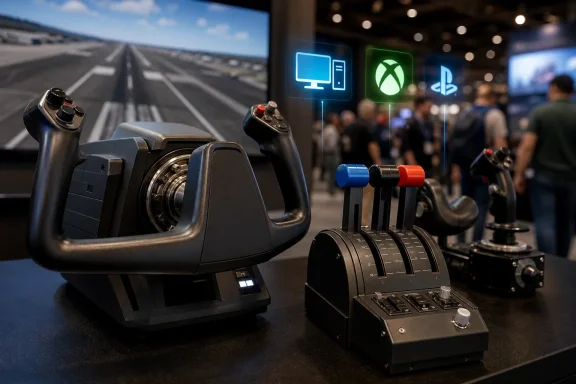
The headline product is the TCA Sky Yoke, a general aviation yoke designed for PC, Xbox Series X|S, and PlayStation 5. That platform list is the story. In a hobby where compatibility charts can read like legal disclaimers, a single yoke that spans Windows, Xbox, and PS5 changes the buying calculation for players who no longer live on just one machine.
The published feature list points to an ambitious middle ground. Thrustmaster says the Sky Yoke includes a built-in steel pitch-axis shaft, seven axes, throttle and trim controls, yaw inputs, 24 action buttons, an eight-way POV hat switch, a mini-stick, and dual analog triggers. That is not a bare-bones entry-level wheel with wings; it is an attempt to compress a lot of cockpit behavior into a device that can sit on a desk without requiring a homebuilt instrument panel.
The companion TCA Sky Quadrant is just as important, even if it sounds less glamorous. A yoke without a convincing throttle solution is only half a cockpit, especially for general aviation aircraft where throttle, propeller, and mixture controls define the rhythm of flying. Thrustmaster’s compact three-lever quadrant looks designed for the Cessna-and-Piper crowd rather than the airliner faithful.
That distinction matters because Microsoft Flight Simulator’s growth has not been driven only by hardcore virtual airline pilots. It has been driven by people who want to take off from a local airport, follow a coastline, practice approaches, or fly over their own town. A general aviation yoke is the hardware equivalent of meeting those players where they already are.
That is a weird sentence to write, but it is where the market is. Microsoft is increasingly treating its biggest franchises as services and ecosystems rather than as console fortifications. Flight Simulator is an ideal candidate for that shift because its identity is not built around competitive lock-in; it is built around scale, realism, add-ons, and community.
For PlayStation players, the hardware situation has been thinner. A DualSense controller can get an aircraft into the air, and the adaptive triggers have their own appeal, but flight simulation exposes the limits of a general-purpose gamepad quickly. Trim, throttle precision, camera control, rudder input, and autopilot interaction all benefit from dedicated physical controls.
That makes the T.Flight Hotas 5 Microsoft Flight Simulator Edition more than a cosmetic refresh. At $109.99, it gives PS5, PS4, and PC players a relatively accessible HOTAS with Microsoft Flight Simulator branding and plug-and-play positioning. It is not aimed at the cockpit-builder with a room full of panels; it is aimed at the player who bought Flight Simulator on PS5 and now wants the game to feel less like a beautiful tech demo and more like a machine.
The broader implication is that Microsoft Flight Simulator is now creating a peripheral market on PlayStation. That used to be the sort of sentence reserved for racing games and fight sticks. Flight sim gear entering that category tells us something about both Microsoft’s strategy and the maturity of the console sim audience.
The TCA Sky Yoke appears to target the space between those worlds. Its general aviation focus is important because the existing Thrustmaster TCA line has leaned heavily into licensed or inspired cockpit families, including Airbus and Boeing-style controls. Those products make sense for airliner simulation, but they do not necessarily fit the player who spends most of their time in a 172, a Cub, a DA40, or a bush plane.
A good general aviation yoke is different from a good airliner yoke. It needs to feel approachable, durable, and precise at small inputs, because hand-flying light aircraft is where simmers notice slop, dead zones, and resistance curves. The promise of a steel pitch-axis shaft suggests Thrustmaster understands that the push-pull motion is the make-or-break feature.
The abundance of buttons is also telling. Real cockpits do not have Xbox face buttons, view hats, or mini-sticks, but home sim setups need them because the pilot is also managing a camera system, menus, ATC windows, checklists, trim, radios, and sometimes a streaming overlay. A successful console-friendly yoke has to be both cockpit control and game controller.
That dual identity is where many sim peripherals either shine or fail. Too few controls, and the player is constantly reaching back to the gamepad or keyboard. Too many controls in the wrong places, and the device becomes a button maze. Thrustmaster’s design will ultimately live or die on ergonomics, but the spec sheet shows the right ambition.
A Warthog refresh is therefore less about Microsoft Flight Simulator specifically and more about Thrustmaster defending its reputation. The company has enormous brand recognition, but flight sim enthusiasts are not short on opinions, and many have become more demanding about sensors, build quality, spring mechanisms, firmware, and long-term serviceability. A nameplate alone is not enough in 2026.
Still, the Warthog line matters because it gives Thrustmaster a halo product. Even if a new simmer buys the cheaper T.Flight or a midrange yoke, the existence of a premium HOTAS at the top of the stack reinforces the brand’s credibility. That is the same logic racing wheel companies use when they sell entry-level bundles under the shadow of direct-drive bases.
The interesting tension is that Microsoft Flight Simulator has broadened the audience while the hardware market has become more specialized. Some players want a yoke and throttle for Sunday sightseeing. Others want a military HOTAS for DCS-style combat sims. Others want Airbus controls for airliner procedures. Thrustmaster’s FlightSimExpo lineup suggests it no longer sees those as separate niches, but as lanes within one larger simulation hardware business.
That is a defensible bet. The modern simmer often plays more than one kind of sim, and Microsoft Flight Simulator itself is broad enough to contain gliders, helicopters, airliners, bush planes, firefighting, search-and-rescue, and career missions. Hardware that invites expansion becomes easier to justify when the software keeps inventing new reasons to use it.
That ecosystem is unusually dependent on physical interaction. A shooter can sell cosmetics forever without changing the mouse. A flight simulator changes character the moment the player replaces a gamepad with a yoke, rudder pedals, or throttle quadrant. The software becomes more legible because the body starts participating in the simulation.
This is why Thrustmaster’s announcement lands differently from a routine accessory reveal. More compatible controls mean more users can cross the threshold from “I tried Flight Simulator” to “I fly Flight Simulator.” That distinction is everything for a platform that depends on long-term engagement rather than a weekend campaign.
The console audience makes that threshold even more important. PC simmers expect configuration pain as part of the hobby; they know about drivers, bindings, calibration, profiles, and community presets. Console players are less forgiving, and rightly so. If the controller does not work cleanly, the fantasy collapses before the aircraft reaches rotation speed.
Thrustmaster’s emphasis on plug-and-play behavior for the T.Flight Hotas 5 is therefore not marketing fluff. It is the price of admission for console flight simulation. The more Microsoft pushes Flight Simulator as a cross-platform service, the more peripheral makers have to make the cockpit feel appliance-like rather than experimental.
The PS5 release complicates that model. Now the same Microsoft-published sim is available to players whose console ecosystem, accessory expectations, and purchasing habits are shaped by Sony. Thrustmaster’s new hardware acknowledges that reality faster than some observers expected.
This does not mean every cockpit accessory will become fully platform-agnostic overnight. Console accessory certification remains a real barrier, and the flight sim world is littered with devices that work beautifully on PC but become useless or limited when plugged into a console. But the direction of travel is clear: major hardware brands can no longer treat PlayStation support as irrelevant.
There is also a subtle competitive angle. If Microsoft wants Flight Simulator to flourish on PlayStation, the experience cannot feel second-class. That does not just mean frame rates, world updates, or VR support. It means the same basic hardware ladder must exist: gamepad, entry HOTAS, yoke, quadrant, pedals, and eventually specialized add-ons.
Thrustmaster is not solving all of that in one announcement, but it is filling several visible holes. The T.Flight Hotas 5 gives PlayStation users a branded starting point. The TCA Sky Yoke points toward a more serious general aviation setup. The Sky Quadrant suggests a path beyond the first purchase.
Community chatter around the reveal has pointed to a possible $199 price for the Sky Yoke, with availability later in 2026, but that should be treated carefully until Thrustmaster publishes final retail details across regions. If the yoke does arrive around that number, it would be aggressive for a cross-platform general aviation control with the stated feature set. If it climbs significantly higher, the comparison changes.
The reason price matters so much is that flight sim purchases tend to cascade. A yoke leads to a throttle quadrant. A throttle quadrant leads to rudder pedals. Rudder pedals lead to mounts. Mounts lead to a desk reorganization, and suddenly the hobby has eaten a room. Hardware makers know this, but new players discover it one receipt at a time.
A $109.99 HOTAS is easy to recommend as a first serious step. A yoke-and-quadrant combination requires a stronger claim on the player’s desk, budget, and attention. Thrustmaster’s challenge is to make that jump feel natural rather than extravagant.
The company has one advantage: Microsoft Flight Simulator’s console audience is now large enough to include people who are not traditional sim gear buyers. If even a small fraction of PS5 and Xbox pilots decide they want better controls, the economics of a mainstream yoke improve. The risk is that “mainstream flight sim yoke” remains a contradiction unless the price and setup experience are right.
That matters because peripheral announcements at a show like this are not only product news. They are signals to a highly concentrated audience of early adopters and influencers. If a yoke feels good on the show floor, the first wave of opinion will form quickly. If it feels flimsy, vague, or overpriced, that will travel just as fast.
The modern flight sim market is unusually transparent in that way. Enthusiasts compare axis smoothness, centering behavior, desk mounting, firmware updates, and button placement with forensic intensity. A mainstream gaming audience might forgive a mushy trigger; a flight sim audience will produce a 20-minute video about it.
Thrustmaster knows this terrain. Its brand is familiar enough to benefit from trust, but familiar enough to inherit baggage. Many simmers have owned its products, loved some, worn out others, modded a few, and argued about all of them. The new lineup will be judged not as a newcomer’s promise, but as the latest move from an incumbent trying to stay relevant.
That is why the FlightSimExpo reveal is a smart venue and a risky one. It puts the hardware in front of exactly the people most likely to care. It also removes the safety of a controlled product page.
This is especially important for families and shared households. A teenager may play on Xbox, a parent may use a Windows PC, and a sibling may have the PS5 in the living room. A single accessory that moves between systems is easier to justify than a platform-locked device that becomes e-waste if the player changes ecosystems.
It also matters for Microsoft’s broader gaming strategy. If first-party Xbox games increasingly live on multiple platforms, accessory ecosystems have to follow or the experience fragments. A Microsoft-published simulator that plays best with hardware unavailable to much of its new audience would undercut the whole multiplatform pitch.
There is a lesson here beyond flight simulation. As platform exclusivity weakens in software, hardware compatibility becomes a new trust signal. Players may not care which corporation “owns” a franchise as much as whether their expensive accessories remain useful. That is particularly true in simulation genres, where hardware investments accumulate over years.
For Windows users, this is mostly upside. PC remains the most flexible platform for flight sim hardware, and cross-platform products rarely reduce that flexibility when they are designed well. The concern is whether console compatibility encourages simplified firmware, fewer advanced configuration options, or compromises in input mapping. That will be worth watching when these devices leave the show floor and enter real setups.
Thrustmaster’s lineup covers several routes into that territory. The T.Flight Hotas 5 is the accessible invitation. The TCA Sky Yoke and Sky Quadrant are the general aviation upgrade path. The Warthog MK II speaks to the high-end combat and enthusiast crowd. The Airbus Add-On Grip and OMNI Extension address the modular, specialized end of the market.
This is not random product sprawl. It is a ladder. The more rungs Thrustmaster can offer, the less likely a player is to leave the ecosystem when their ambitions grow. That is the same logic behind racing wheel bases, camera lens mounts, smart home platforms, and mechanical keyboard families.
The risk is that flight sim hardware buyers are not passive ecosystem captives. They compare across brands, mix devices, and often prefer the best component for each job. A Thrustmaster yoke might sit next to pedals from another company and a custom button box from a hobbyist. Lock-in is weaker here than in many consumer tech categories.
That means Thrustmaster has to win on practicality, not just branding. Compatibility is a start. Availability through mainstream retailers helps. Sensible pricing helps more. But the final verdict will come from the physical details: how the yoke returns to center, how the throttle levers feel, how firmly the device mounts, how cleanly it maps in Microsoft Flight Simulator 2024, and how well it survives months of use.
A steel pitch-axis shaft sounds promising, but it does not tell us the resistance curve. Seven axes sound generous, but usefulness depends on placement and calibration. Twenty-four action buttons sound abundant, but their value depends on whether they are reachable without breaking the flying posture. A mini-stick can be brilliant for camera control or irritating if it is too small, too loose, or poorly mapped.
Console support introduces its own unknowns. On PC, users can often work around imperfect defaults with drivers, configuration tools, community profiles, and simulator bindings. On consoles, the path is narrower. If the default mapping is awkward, the device may feel worse than its hardware deserves.
There is also the question of firmware cadence. Flight Simulator is a live product, and updates can affect peripherals in unexpected ways. A cross-platform yoke needs not only launch compatibility, but maintenance. Serious simmers will watch how quickly Thrustmaster responds to bugs after release.
None of this diminishes the importance of the announcement. It simply moves the story from reveal to execution. The history of flight sim peripherals is full of devices that looked perfect in a booth and became complicated on a desk. Thrustmaster’s opportunity is to prove that mainstream cross-platform gear can also be sturdy, precise, and boringly reliable.
That does not guarantee success. Flight sim hardware is expensive, subjective, and often constrained by desk space as much as by budget. But the path from curiosity to commitment looks clearer than it did before this announcement.
The practical read is straightforward:
 Thrustmaster Is Selling the Cockpit, Not Just the Controller
The headline product is the TCA Sky Yoke, a general aviation yoke designed for PC, Xbox Series X|S, and PlayStation 5. That platform list is the story. In a hobby where compatibility charts can read like legal disclaimers, a single yoke that spans Windows, Xbox, and PS5 changes the buying calculation for players who no longer live on just one machine.The published feature list points to an ambitious middle ground. Thrustmaster says the Sky Yoke includes a built-in steel pitch-axis shaft, seven axes, throttle and trim controls, yaw inputs, 24 action buttons, an eight-way POV hat switch, a mini-stick, and dual analog triggers. That is not a bare-bones entry-level wheel with wings; it is an attempt to compress a lot of cockpit behavior into a device that can sit on a desk without requiring a homebuilt instrument panel.
The companion TCA Sky Quadrant is just as important, even if it sounds less glamorous. A yoke without a convincing throttle solution is only half a cockpit, especially for general aviation aircraft where throttle, propeller, and mixture controls define the rhythm of flying. Thrustmaster’s compact three-lever quadrant looks designed for the Cessna-and-Piper crowd rather than the airliner faithful.
That distinction matters because Microsoft Flight Simulator’s growth has not been driven only by hardcore virtual airline pilots. It has been driven by people who want to take off from a local airport, follow a coastline, practice approaches, or fly over their own town. A general aviation yoke is the hardware equivalent of meeting those players where they already are.
PlayStation Support Turns a Niche Peripheral Into a Platform Signal
The surprise is not that Thrustmaster made another yoke. The surprise is that PlayStation 5 is in the conversation from the beginning. Microsoft Flight Simulator 2024 arrived on PS5 in December 2025, and its presence on Sony’s console has turned what was once an Xbox-and-PC showcase into a rare example of Microsoft’s software strategy creating demand for hardware across rival platforms.That is a weird sentence to write, but it is where the market is. Microsoft is increasingly treating its biggest franchises as services and ecosystems rather than as console fortifications. Flight Simulator is an ideal candidate for that shift because its identity is not built around competitive lock-in; it is built around scale, realism, add-ons, and community.
For PlayStation players, the hardware situation has been thinner. A DualSense controller can get an aircraft into the air, and the adaptive triggers have their own appeal, but flight simulation exposes the limits of a general-purpose gamepad quickly. Trim, throttle precision, camera control, rudder input, and autopilot interaction all benefit from dedicated physical controls.
That makes the T.Flight Hotas 5 Microsoft Flight Simulator Edition more than a cosmetic refresh. At $109.99, it gives PS5, PS4, and PC players a relatively accessible HOTAS with Microsoft Flight Simulator branding and plug-and-play positioning. It is not aimed at the cockpit-builder with a room full of panels; it is aimed at the player who bought Flight Simulator on PS5 and now wants the game to feel less like a beautiful tech demo and more like a machine.
The broader implication is that Microsoft Flight Simulator is now creating a peripheral market on PlayStation. That used to be the sort of sentence reserved for racing games and fight sticks. Flight sim gear entering that category tells us something about both Microsoft’s strategy and the maturity of the console sim audience.
The TCA Sky Yoke Fills the Gap Between Toy and Home Cockpit
Flight sim hardware has long suffered from a brutal split. At one end are affordable sticks and HOTAS units that make flying more intuitive but rarely feel like the real-world aircraft most casual sim pilots want to emulate. At the other end are premium yokes, throttles, pedals, and panels that can quickly cost more than the console or PC running the simulator.The TCA Sky Yoke appears to target the space between those worlds. Its general aviation focus is important because the existing Thrustmaster TCA line has leaned heavily into licensed or inspired cockpit families, including Airbus and Boeing-style controls. Those products make sense for airliner simulation, but they do not necessarily fit the player who spends most of their time in a 172, a Cub, a DA40, or a bush plane.
A good general aviation yoke is different from a good airliner yoke. It needs to feel approachable, durable, and precise at small inputs, because hand-flying light aircraft is where simmers notice slop, dead zones, and resistance curves. The promise of a steel pitch-axis shaft suggests Thrustmaster understands that the push-pull motion is the make-or-break feature.
The abundance of buttons is also telling. Real cockpits do not have Xbox face buttons, view hats, or mini-sticks, but home sim setups need them because the pilot is also managing a camera system, menus, ATC windows, checklists, trim, radios, and sometimes a streaming overlay. A successful console-friendly yoke has to be both cockpit control and game controller.
That dual identity is where many sim peripherals either shine or fail. Too few controls, and the player is constantly reaching back to the gamepad or keyboard. Too many controls in the wrong places, and the device becomes a button maze. Thrustmaster’s design will ultimately live or die on ergonomics, but the spec sheet shows the right ambition.
The Warthog MK II Shows Thrustmaster Still Wants the High-End Halo
Alongside the Sky Yoke, Thrustmaster also showed the HOTAS Warthog MK II, a successor to one of the most recognizable pieces of combat flight sim hardware ever sold. The original Warthog became shorthand for heavy, premium, military-style controls, even as the market around it evolved and boutique competitors pushed hard into metal gimbals, modular grips, and enthusiast-grade customization.A Warthog refresh is therefore less about Microsoft Flight Simulator specifically and more about Thrustmaster defending its reputation. The company has enormous brand recognition, but flight sim enthusiasts are not short on opinions, and many have become more demanding about sensors, build quality, spring mechanisms, firmware, and long-term serviceability. A nameplate alone is not enough in 2026.
Still, the Warthog line matters because it gives Thrustmaster a halo product. Even if a new simmer buys the cheaper T.Flight or a midrange yoke, the existence of a premium HOTAS at the top of the stack reinforces the brand’s credibility. That is the same logic racing wheel companies use when they sell entry-level bundles under the shadow of direct-drive bases.
The interesting tension is that Microsoft Flight Simulator has broadened the audience while the hardware market has become more specialized. Some players want a yoke and throttle for Sunday sightseeing. Others want a military HOTAS for DCS-style combat sims. Others want Airbus controls for airliner procedures. Thrustmaster’s FlightSimExpo lineup suggests it no longer sees those as separate niches, but as lanes within one larger simulation hardware business.
That is a defensible bet. The modern simmer often plays more than one kind of sim, and Microsoft Flight Simulator itself is broad enough to contain gliders, helicopters, airliners, bush planes, firefighting, search-and-rescue, and career missions. Hardware that invites expansion becomes easier to justify when the software keeps inventing new reasons to use it.
Microsoft Flight Simulator Has Become a Hardware Ecosystem With a Game Attached
The revival of Microsoft Flight Simulator in 2020 was initially framed as a software miracle: satellite data, cloud streaming, photogrammetry, weather, and a planet-sized map. But the longer arc has been more interesting. The franchise has become a hardware ecosystem, an add-on marketplace, a streaming spectacle, a training-adjacent tool, and a bridge between aviation hobbyists and traditional gamers.That ecosystem is unusually dependent on physical interaction. A shooter can sell cosmetics forever without changing the mouse. A flight simulator changes character the moment the player replaces a gamepad with a yoke, rudder pedals, or throttle quadrant. The software becomes more legible because the body starts participating in the simulation.
This is why Thrustmaster’s announcement lands differently from a routine accessory reveal. More compatible controls mean more users can cross the threshold from “I tried Flight Simulator” to “I fly Flight Simulator.” That distinction is everything for a platform that depends on long-term engagement rather than a weekend campaign.
The console audience makes that threshold even more important. PC simmers expect configuration pain as part of the hobby; they know about drivers, bindings, calibration, profiles, and community presets. Console players are less forgiving, and rightly so. If the controller does not work cleanly, the fantasy collapses before the aircraft reaches rotation speed.
Thrustmaster’s emphasis on plug-and-play behavior for the T.Flight Hotas 5 is therefore not marketing fluff. It is the price of admission for console flight simulation. The more Microsoft pushes Flight Simulator as a cross-platform service, the more peripheral makers have to make the cockpit feel appliance-like rather than experimental.
The PS5 Arrival Rewrites the Old Xbox Hardware Assumption
For years, the assumption was simple: if a peripheral had console support for Microsoft Flight Simulator, it meant Xbox. That made sense when the current franchise revival lived on Windows and Xbox Series X|S. It also made sense commercially, because Microsoft could align licensing, platform support, and storefront visibility.The PS5 release complicates that model. Now the same Microsoft-published sim is available to players whose console ecosystem, accessory expectations, and purchasing habits are shaped by Sony. Thrustmaster’s new hardware acknowledges that reality faster than some observers expected.
This does not mean every cockpit accessory will become fully platform-agnostic overnight. Console accessory certification remains a real barrier, and the flight sim world is littered with devices that work beautifully on PC but become useless or limited when plugged into a console. But the direction of travel is clear: major hardware brands can no longer treat PlayStation support as irrelevant.
There is also a subtle competitive angle. If Microsoft wants Flight Simulator to flourish on PlayStation, the experience cannot feel second-class. That does not just mean frame rates, world updates, or VR support. It means the same basic hardware ladder must exist: gamepad, entry HOTAS, yoke, quadrant, pedals, and eventually specialized add-ons.
Thrustmaster is not solving all of that in one announcement, but it is filling several visible holes. The T.Flight Hotas 5 gives PlayStation users a branded starting point. The TCA Sky Yoke points toward a more serious general aviation setup. The Sky Quadrant suggests a path beyond the first purchase.
The Price Question Will Decide Whether the Sky Yoke Is a Breakthrough or a Curiosity
The missing detail is price. Without it, the TCA Sky Yoke sits in an awkward fog between exciting and speculative. A yoke can be well designed, cross-platform, and thoughtfully featured, but if it lands too close to premium cockpit-builder territory, its mainstream promise narrows quickly.Community chatter around the reveal has pointed to a possible $199 price for the Sky Yoke, with availability later in 2026, but that should be treated carefully until Thrustmaster publishes final retail details across regions. If the yoke does arrive around that number, it would be aggressive for a cross-platform general aviation control with the stated feature set. If it climbs significantly higher, the comparison changes.
The reason price matters so much is that flight sim purchases tend to cascade. A yoke leads to a throttle quadrant. A throttle quadrant leads to rudder pedals. Rudder pedals lead to mounts. Mounts lead to a desk reorganization, and suddenly the hobby has eaten a room. Hardware makers know this, but new players discover it one receipt at a time.
A $109.99 HOTAS is easy to recommend as a first serious step. A yoke-and-quadrant combination requires a stronger claim on the player’s desk, budget, and attention. Thrustmaster’s challenge is to make that jump feel natural rather than extravagant.
The company has one advantage: Microsoft Flight Simulator’s console audience is now large enough to include people who are not traditional sim gear buyers. If even a small fraction of PS5 and Xbox pilots decide they want better controls, the economics of a mainstream yoke improve. The risk is that “mainstream flight sim yoke” remains a contradiction unless the price and setup experience are right.
FlightSimExpo Is Where Simulation Stops Pretending It Is Small
FlightSimExpo itself is part of the story. Held June 12–14 at the Saint Paul RiverCentre, the event is built around the idea that home flight simulation is no longer a lonely hobby conducted in forum threads and spare bedrooms. It is a public-facing convention with hands-on exhibits, workshops, product launches, and a crowd that includes pilots, students, streamers, developers, and curious players.That matters because peripheral announcements at a show like this are not only product news. They are signals to a highly concentrated audience of early adopters and influencers. If a yoke feels good on the show floor, the first wave of opinion will form quickly. If it feels flimsy, vague, or overpriced, that will travel just as fast.
The modern flight sim market is unusually transparent in that way. Enthusiasts compare axis smoothness, centering behavior, desk mounting, firmware updates, and button placement with forensic intensity. A mainstream gaming audience might forgive a mushy trigger; a flight sim audience will produce a 20-minute video about it.
Thrustmaster knows this terrain. Its brand is familiar enough to benefit from trust, but familiar enough to inherit baggage. Many simmers have owned its products, loved some, worn out others, modded a few, and argued about all of them. The new lineup will be judged not as a newcomer’s promise, but as the latest move from an incumbent trying to stay relevant.
That is why the FlightSimExpo reveal is a smart venue and a risky one. It puts the hardware in front of exactly the people most likely to care. It also removes the safety of a controlled product page.
Cross-Platform Hardware Is the Boring Revolution Flight Sims Needed
The most consequential part of this announcement may be the least romantic: compatibility. Flight simmers love fidelity, but the market grows when ordinary buyers do not have to decode whether a device works on their box. PC, Xbox Series X|S, and PS5 support on the Sky Yoke is the kind of line item that can save a shopper from abandoning the purchase.This is especially important for families and shared households. A teenager may play on Xbox, a parent may use a Windows PC, and a sibling may have the PS5 in the living room. A single accessory that moves between systems is easier to justify than a platform-locked device that becomes e-waste if the player changes ecosystems.
It also matters for Microsoft’s broader gaming strategy. If first-party Xbox games increasingly live on multiple platforms, accessory ecosystems have to follow or the experience fragments. A Microsoft-published simulator that plays best with hardware unavailable to much of its new audience would undercut the whole multiplatform pitch.
There is a lesson here beyond flight simulation. As platform exclusivity weakens in software, hardware compatibility becomes a new trust signal. Players may not care which corporation “owns” a franchise as much as whether their expensive accessories remain useful. That is particularly true in simulation genres, where hardware investments accumulate over years.
For Windows users, this is mostly upside. PC remains the most flexible platform for flight sim hardware, and cross-platform products rarely reduce that flexibility when they are designed well. The concern is whether console compatibility encourages simplified firmware, fewer advanced configuration options, or compromises in input mapping. That will be worth watching when these devices leave the show floor and enter real setups.
The Simmer’s Desk Is Becoming the New Console Battleground
Flight simulation is not a mass-market genre in the way shooters, sports games, or open-world RPGs are. But it has something those categories envy: players who buy hardware specifically to deepen their relationship with one experience. That makes the simmer’s desk a valuable piece of territory.Thrustmaster’s lineup covers several routes into that territory. The T.Flight Hotas 5 is the accessible invitation. The TCA Sky Yoke and Sky Quadrant are the general aviation upgrade path. The Warthog MK II speaks to the high-end combat and enthusiast crowd. The Airbus Add-On Grip and OMNI Extension address the modular, specialized end of the market.
This is not random product sprawl. It is a ladder. The more rungs Thrustmaster can offer, the less likely a player is to leave the ecosystem when their ambitions grow. That is the same logic behind racing wheel bases, camera lens mounts, smart home platforms, and mechanical keyboard families.
The risk is that flight sim hardware buyers are not passive ecosystem captives. They compare across brands, mix devices, and often prefer the best component for each job. A Thrustmaster yoke might sit next to pedals from another company and a custom button box from a hobbyist. Lock-in is weaker here than in many consumer tech categories.
That means Thrustmaster has to win on practicality, not just branding. Compatibility is a start. Availability through mainstream retailers helps. Sensible pricing helps more. But the final verdict will come from the physical details: how the yoke returns to center, how the throttle levers feel, how firmly the device mounts, how cleanly it maps in Microsoft Flight Simulator 2024, and how well it survives months of use.
The Small Print Will Matter More Than the Product Photos
The reveal images make the lineup look clean, modern, and inviting. That is good marketing, but flight sim hardware is not purchased on looks alone. It is purchased on feel, and feel is where spec sheets become unreliable.A steel pitch-axis shaft sounds promising, but it does not tell us the resistance curve. Seven axes sound generous, but usefulness depends on placement and calibration. Twenty-four action buttons sound abundant, but their value depends on whether they are reachable without breaking the flying posture. A mini-stick can be brilliant for camera control or irritating if it is too small, too loose, or poorly mapped.
Console support introduces its own unknowns. On PC, users can often work around imperfect defaults with drivers, configuration tools, community profiles, and simulator bindings. On consoles, the path is narrower. If the default mapping is awkward, the device may feel worse than its hardware deserves.
There is also the question of firmware cadence. Flight Simulator is a live product, and updates can affect peripherals in unexpected ways. A cross-platform yoke needs not only launch compatibility, but maintenance. Serious simmers will watch how quickly Thrustmaster responds to bugs after release.
None of this diminishes the importance of the announcement. It simply moves the story from reveal to execution. The history of flight sim peripherals is full of devices that looked perfect in a booth and became complicated on a desk. Thrustmaster’s opportunity is to prove that mainstream cross-platform gear can also be sturdy, precise, and boringly reliable.
The Real Win Is a Shorter Runway From Curiosity to Commitment
The most encouraging thing about Thrustmaster’s FlightSimExpo lineup is that it reduces friction at multiple stages of the hobby. A PS5 player can buy a branded HOTAS without wondering whether Microsoft Flight Simulator support is a hack. A console or PC player interested in general aviation can look toward a yoke that does not appear to require choosing a platform first. A more advanced simmer can see that Thrustmaster still wants to compete above the entry tier.That does not guarantee success. Flight sim hardware is expensive, subjective, and often constrained by desk space as much as by budget. But the path from curiosity to commitment looks clearer than it did before this announcement.
The practical read is straightforward:
- The TCA Sky Yoke is the most strategically important reveal because it targets general aviation and spans PC, Xbox Series X|S, and PlayStation 5.
- The TCA Sky Quadrant matters because a yoke without dedicated throttle controls rarely completes the experience players are actually chasing.
- The T.Flight Hotas 5 Microsoft Flight Simulator Edition gives PlayStation players a lower-cost, officially positioned entry point at $109.99.
- The HOTAS Warthog MK II keeps Thrustmaster in the premium conversation at a time when enthusiast expectations have risen sharply.
- The final judgment will depend on price, feel, mounting, software mapping, and post-launch support rather than on the reveal images.
- The broader trend is that Microsoft Flight Simulator is now large enough across platforms to pull peripheral makers into a more unified hardware strategy.
References
- Primary source: Windows Central
Published: 2026-06-12T17:50:07.775140
Microsoft Flight Simulator fans are getting all-new flight stick and yoke options from Thrustmaster, made for beginners and pros | Windows Central
If you're heading to the Flight Sim Expo in Minnesota, you'll have a chance to go hands-on with the new sticks.www.windowscentral.com - Related coverage: eshop.thrustmaster.com
TCA Quadrant Add-On Airbus Edition | Shop Thrustmaster
Thrustmaster TCA Quadrant Add-on Airbus Edition, Réplique ergonomique Airbus, Fonctions Avion de Ligne, Levier Aérofreins, Gestion des volets, Technologie Magnétique, compatible PC.eshop.thrustmaster.com
- Related coverage: us.maxgaming.com
Thrustmaster T.Flight Hotas 5 - PC & PS5 - us.MaxGaming.com
T.Flight Hotas 5 Microsoft Flight Simulator Edition delivers a realistic flight experience with 5 control axes and high precision. Order now!us.maxgaming.com - Related coverage: support.thrustmaster.com
TCA Quadrant Add-On Airbus Edition – Thrustmaster
TCA Quadrant Add-On Airbus Edition - Thrustmaster - Manual, Drivers, Firmware, buttons mapping, games settings, Knowledge base, FAQsupport.thrustmaster.com
- Related coverage: pausehardware.com
T.Flight Hotas 5 : Un HOTAS Flight Simulator à 99,99 €
T.Flight Hotas 5 arrive le 12 juin sur PS5, PS4 et PC avec 14 boutons, 5 axes en 16-bit et un tarif conseillé de 99,99 €.pausehardware.com - Related coverage: proshop.se
Thrustmaster Hotas 5 - Microsoft Flight Simulator Edition - Wired Flygsimulator-styrning - Sony PlayStation 5
1 299,00 kr Flygsimulatorstyrsystemet Thrustmaster T.Flight HOTAS 5 MSFS Special Edition levererar en komplett trådbunden joystick- och gasreglageuppsättning med officiell Microsoft Flight Simulator-licens, justerbart motstånd och Plug & Play-igenkänning. Denna...www.proshop.se
- Related coverage: shop.thrustmaster.com
T.Flight Hotas 5 Microsoft Flight Simulator Edition
T.Flight Hotas 5 Microsoft Flight Simulator Edition AWAKEN YOUR INNER PILOTTake flight with T.Flight Hotas 5 Microsoft Flight Simulator Edition — the immersive Plug & Play joystick designed for piloting all types of aircraft. Compatible with PS5, PS4 andshop.thrustmaster.com
- Related coverage: idealo.es
- Related coverage: saturn.de
THRUSTMASTER T.Flight Hotas 5 Microsoft Flight Simulator Edition PS4/PS5/PC Joystick für Flugsimulator | SATURN
THRUSTMASTER T.Flight Hotas 5 Microsoft Flight Simulator Edition PS4/PS5/PC Joystick für Flugsimulator im Onlineshop von SATURN kaufen. Jetzt bequem online bestellen.www.saturn.de - Related coverage: ts.thrustmaster.com
</rdf:Alt> </dc:title> <dc:description> <rdf:Alt> <rdf:li xml:lang="x-default"/> </rdf:Alt> </dc:description> <dc:creator> <rdf:Seq> <rdf:li>ATL | M
</rdf:Alt> </dc:description> <dc:creator> <rdf:Seq> <rdf:li>ATL | Monika Bujanowiczts.thrustmaster.com
- Related coverage: flightsimulator.zendesk.com
Microsoft Flight Simulator 2024 PlayStation 5 FAQ – Microsoft Flight Simulator Support
GeneralQ: When is the release date for MSFS 2024 on PlayStation 5?A: Early Access begins on December 3, 2025 for players who pre-order...flightsimulator.zendesk.com - Related coverage: gematsu.com
Microsoft Flight Simulator 2024 coming to PS5 on December 8 - Gematsu
Publisher Xbox Game Studios and developer Asobo Studio will release Microsoft Flight Simulator 2024 for PlayStation 5 on December 8, the companies announced.www.gematsu.com - Related coverage: playstation.com
Microsoft Flight Simulator 2024 - PS5 Games | PlayStation (US)
Buy Microsoft Flight Simulator 2024 at PlayStation Store. Explore the world with the series' largest fleet of aircraft and take simulation to new heights.www.playstation.com
- Related coverage: blog.es.playstation.com
Microsoft Flight Simulador 2024 despega en PlayStation 5 – PlayStation.Blog en español
Vuela con un nivel de realismo y autenticidad sin precedentes desde el 8 de diciembre.blog.es.playstation.com - Related coverage: notebookcheck.net
Microsoft Flight Simulator 2024 is coming to PS5 in December with PS VR2 support arriving in 2026 - Notebookcheck News
Microsoft Flight Simulator 2024 is finally coming to the PlayStation 5 this December, with full PS VR2 support promised for 2026. The game brings its massive global map, hundreds of aircraft, and varied mission types to Sony’s console, complete with DualSense features. www.notebookcheck.net
- Related coverage: blog.latam.playstation.com
Microsoft Flight Simulator 2024 llega a PlayStation 5 – PlayStation.Blog LATAM
Disfruta un nivel de realismo y autenticidad sin precedentes en la aviación a partir del 8 de diciembre.blog.latam.playstation.com - Related coverage: techradar.com
Microsoft Flight Simulator 2024 is flying onto PS5 in December, with PSVR 2 support coming in 2026 | TechRadar
Microsoft Flight Simulator 2024 is officially coming to PlayStation 5 and PlayStation 5 Pro later this year.www.techradar.com - Related coverage: blog.fr.playstation.com
Microsoft Flight Simulator 2024 prend son envol sur la PlayStation 5 – PlayStation Blog en français
Avec le support du PS VR2 prévu pour 2026, via une mise à jour gratuite.blog.fr.playstation.com - Related coverage: gamespot.com
Microsoft Flight Simulator 2024 PS5 Preorders Are Live - GameSpot
Tour the world on your PS5 when Flight Simulator 2024's lands on December 8.www.gamespot.com - Related coverage: notebookcheck.com
Microsoft Flight Simulator 2024 kommt am 8. Dezember auf die PlayStation 5 (Pro) – Vorbestellungen ab sofort möglich! - Notebookcheck News
Die Sensation ist perfekt: Nach Jahren der Exklusivität fliegt der Asobo-Studio-Titel MS Flight Simulator 2024 ab Dezember auch auf der Sony PlayStation 5 (Pro) Konsole. Mit an Bord: ein Karrieresystem und volle DualSense Wireless Controller Unterstützung. Später kommt sogar PS VR2 für die PS5 dazu. www.notebookcheck.com
