

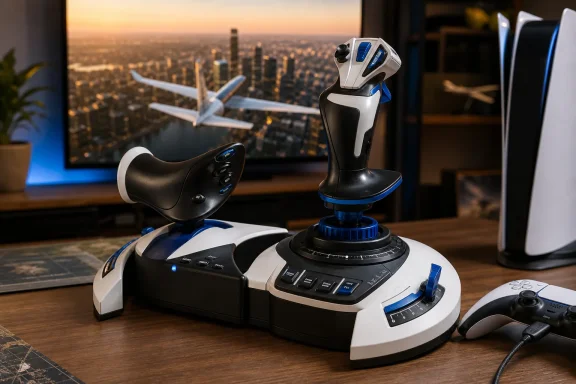
Thrustmaster launched the T.Flight Hotas 5 Microsoft Flight Simulator Edition on June 12, 2026, as a $109.99 officially licensed joystick-and-throttle controller for PlayStation 5, PlayStation 4, and Windows 10/11 PCs, aimed chiefly at Microsoft Flight Simulator 2024 players. The product is not a radical reinvention of consumer flight hardware, and that is precisely the point. It is a platform-signaling accessory: a relatively affordable, officially blessed bridge between console convenience and the stubbornly tactile culture of flight simulation. For Windows users and sim-curious PlayStation owners alike, the real story is not just another HOTAS on the shelf, but Microsoft Flight Simulator continuing its slow migration from specialist hobby to mainstream living-room platform.
Flight simulation has always asked players to suspend disbelief while staring at devices that were never designed for flight. A gamepad can pan a camera, trim an elevator, manage rudder input, nudge a throttle, and click through cockpit instruments, but it does all of that by compressing an aircraft into two thumbsticks and a handful of triggers. That works, in the same way typing a novel on a television remote technically works.
The T.Flight Hotas 5 Microsoft Flight Simulator Edition exists because Microsoft Flight Simulator 2024 is trying to serve two audiences that want different things from the same software. One audience wants the living-room magic trick: boot a console, pick a plane, fly over a photogrammetry city, and feel as though the world has been miniaturized for them. The other wants deliberate control surfaces, stable inputs, repeatable muscle memory, and fewer compromises between camera movement and aircraft handling.
Thrustmaster’s new controller slots directly into that tension. It carries official Microsoft Flight Simulator branding, supports PS5, PS4, and Windows PCs, and promises plug-and-play detection across those platforms. That cross-platform promise matters because the hardware is being pitched less as a specialist cockpit component and more as the next obvious peripheral after a headset, racing wheel, or premium controller.
The result is a product that looks modest on a spec sheet but meaningful in context. Five axes, 14 action buttons, a rapid-fire trigger, a multidirectional hat switch, adjustable stick resistance, a detachable throttle, and rudder control through either stick twist or a tilting lever are not exotic features in the HOTAS world. At $109.99, however, bundled with Microsoft Flight Simulator styling and console compatibility, they become something more commercially useful: permission for beginners to take the hobby seriously without pretending they are building a home cockpit.
That is especially true on consoles. PC players have long tolerated a certain amount of driver archaeology, firmware updating, profile importing, and forum spelunking. Console users are less forgiving, not because they are less technical, but because the console contract is different. A peripheral that says it is for PS5 and Microsoft Flight Simulator 2024 is implicitly promising that the first hour will be spent flying, not decoding axis assignments.
Thrustmaster says the Hotas 5 is automatically recognized on Windows 10, Windows 11, PS5, and PS4, and that plug-and-play framing is central to the pitch. The company is not selling hall-effect sensor evangelism or high-end metal gimbals here. It is selling a short path from curiosity to takeoff.
The color scheme reinforces that message. The familiar white, blue, and black Microsoft Flight Simulator treatment makes the peripheral look like part of the game rather than a generic flight stick that happens to work with it. That may sound superficial, but consumer hardware is full of products whose primary job is to reassure buyers that they have chosen the right box. In a niche where compatibility anxiety can kill a purchase, branding is not decoration; it is friction reduction.
For WindowsForum readers, the interesting wrinkle is that this is Microsoft’s simulator identity showing up on PlayStation-compatible hardware. Microsoft Flight Simulator has already complicated the old platform tribalism by existing as both a showcase for Microsoft’s cloud-and-PC heritage and a product with broader console ambitions. A Microsoft Flight Simulator Edition HOTAS for PS5 is another small sign that the franchise now behaves less like a Windows-only technical monument and more like a cross-platform entertainment ecosystem.
None of this makes the Hotas 5 a premium controller. It is better understood as an onboarding device, and that is not an insult. Every enthusiast category needs a credible first upgrade: the mechanical keyboard that teaches a laptop user what key travel feels like, the entry-level racing wheel that makes analog steering obvious, the budget studio microphone that reveals why headset audio was holding someone back.
Thrustmaster has been in this role for years. Its T.Flight line has long occupied the budget-to-mainstream end of the market, especially for players who want an integrated stick-and-throttle package without the cost or desk footprint of modular gear. The Hotas 5 Microsoft Flight Simulator Edition appears to continue that strategy rather than abandon it.
The adjustable joystick resistance is the most user-facing concession to preference. New pilots often mistake stiffness for precision, only to discover that long sessions become tiring and small inputs become jerky. Experienced sim players may prefer more resistance for aircraft that benefit from steadier movements. Giving users some adjustment lets the device serve both casual couch flying and more deliberate desk setups.
The detachable throttle is the better design decision. Attached, the unit behaves like a compact all-in-one controller that can sit on a lap or a crowded desk. Detached, it starts to approximate the left-hand throttle, right-hand stick layout that makes HOTAS control intuitive. That flexibility acknowledges the reality of modern sim players: many do not have a dedicated rig, and many who do still need to reclaim the desk by Monday morning.
PS5 users already know the value of genre-specific hardware. Racing wheels, arcade sticks, fight pads, VR accessories, and premium controllers all exist because certain games exceed the assumptions of a standard pad. Flight Simulator is one of those games by design. It asks for smooth throttle changes, coordinated turns, camera management, trim adjustments, autopilot interactions, and long-duration comfort.
The Hotas 5 attempts to make those demands approachable. Its PlayStation input layout should reduce the cognitive jump from DualSense to flight stick. Its rudder options avoid forcing a pedal purchase on day one. Its price keeps the upgrade below the psychological threshold where a casual player starts wondering whether the hobby is secretly trying to become aviation school.
That matters because Microsoft Flight Simulator’s mainstream appeal is visual before it is procedural. Many players arrive because they want to see their house, fly over a storm, cross the Alps, or land at a famous airport. They stay only if the act of controlling the aircraft feels rewarding rather than awkward. Hardware cannot solve the complexity of aviation, but it can make that complexity feel physical instead of abstract.
For PlayStation, this is also a credibility test. If the platform becomes a meaningful home for Microsoft Flight Simulator, it will need more than the game binary. It needs peripherals, default mappings, community recommendations, support documentation, and retailer confidence. Thrustmaster’s official edition is an early sign that at least some of that ecosystem is being built around the launch window rather than patched together afterward.
Instead, it targets the Windows user who has been hovering at the edge of the hobby. That user may have Microsoft Flight Simulator 2024 through a subscription, a Steam library, or a holiday sale. They may have tried flying with an Xbox controller and found the spectacle compelling but the controls imprecise. They may not know which hardware works cleanly, which models are aging, or how much they should spend before the hobby proves sticky.
Plug-and-play detection on Windows 10 and Windows 11 is therefore more than a convenience claim. Windows remains the most flexible platform for simulation, but flexibility often manifests as setup burden. A device that appears in the sim with sensible defaults is doing the unglamorous work that keeps beginners from bouncing off.
The 16-bit precision claim also deserves some contextual caution. Higher resolution input can help with fine control, particularly around pitch, roll, throttle, and rudder movement, but the experience depends on the whole mechanical and software chain. Sensor resolution does not automatically equal premium feel. Still, at this price tier, the promise of fine-grained axes gives Thrustmaster an easy talking point against both gamepads and older budget sticks.
For Windows administrators and IT pros, there is a secondary point: consumer peripherals increasingly behave like cross-platform identity products. The same piece of USB hardware may move between a gaming PC, a console, a family laptop, and a cloud-streaming setup. That makes compatibility clarity valuable. It also makes firmware support, driver hygiene, and long-term documentation more important than the flashy unboxing moment.
This is the entire product philosophy in one feature: simulate the real thing just enough to make the game feel different, but not so much that the buyer needs a cockpit, a budget spreadsheet, and a spouse negotiation. Twist rudder is familiar to entry-level flight sticks because it is cheap, compact, and intuitive. A tilting lever gives another path for users who dislike twisting the grip or want a more deliberate rudder input.
The compatibility with Thrustmaster’s TFRP rudder pedals points to the upgrade ladder. You can begin with the Hotas 5, learn what yaw control is doing, and later decide whether pedals are worth the desk space and cost. That is how healthy peripheral ecosystems work: the entry device does not have to be the endpoint, but it should not feel like a dead end.
This is also where the product’s limitations will be felt most clearly. Serious simmers will still prefer separate pedals, sturdier mechanisms, more switches, and more aircraft-specific control layouts. Helicopter pilots may want different collective behavior. Airliner simmers may eventually want a yoke or throttle quadrant. Combat sim players may want more hats, more modes, and more programmable inputs.
But the Hotas 5 does not need to satisfy every advanced use case. Its job is to make the first thousand feet feel better. If it can turn takeoff, trim, basic turns, camera movement, and throttle control into embodied actions, it will have done more for many players than a spec sheet suggests.
That matters because flight simulation has a reputation problem. The genre looks expensive from the outside, even when the software is accessible. Screenshots of multi-monitor cockpit builds, elaborate yokes, custom panels, and dedicated seats are inspiring to enthusiasts but intimidating to newcomers. A branded, console-compatible HOTAS at roughly the cost of a high-end gamepad reframes the entry point.
There is also a market timing argument. Microsoft Flight Simulator 2024 is still working through the long tail of platform growth, content updates, and player expectations. A peripheral launch tied to the game’s expanding audience gives retailers a straightforward bundle story: buy the simulator, then buy the controller that makes it feel like a simulator. That kind of shelf logic has powered racing wheels for years.
The danger is that expectations rise with branding. A Microsoft Flight Simulator Edition product will be judged not merely as a cheap HOTAS, but as an official gateway to a flagship sim. If the plastic feels too light, if centering is inconsistent, if mappings are confusing, or if long-session comfort disappoints, players will blame not only Thrustmaster but the broader promise of console flight simulation.
That is the bargain of official hardware. The badge helps sell the device, but it also makes the device part of the platform experience. Microsoft and Thrustmaster are effectively telling beginners: this is the way in. That makes the first impression more consequential than it would be for a generic peripheral buried in a search result.
That is a healthy instinct. Too often, mainstreaming a simulation means sanding it down until only the graphics remain. Microsoft Flight Simulator has always resisted that completely, partly because its appeal depends on the tension between accessibility and depth. You can fly casually, but the cockpit is still full of systems. You can use assists, but the aircraft still rewards better inputs. You can sightsee, but the weather, weight, trim, and power still matter.
A HOTAS makes that tension legible. Throttle becomes a lever you move instead of a value you nudge. Pitch and roll become hand pressure instead of thumbstick deflection. Rudder becomes something you remember because your aircraft skids when you forget it. The simulation moves from screen abstraction toward bodily habit.
That does not mean every Flight Simulator player needs a HOTAS. Many will be perfectly happy on a controller, especially if they are sightseeing, using heavy assists, or playing in shorter sessions. Others will go straight to yokes, pedals, or more elaborate setups. The Hotas 5 occupies the middle: the point where curiosity becomes commitment.
This middle is where Microsoft Flight Simulator’s future audience may be won or lost. The hardcore will always find hardware. The casual tourist may never need it. But the player who almost becomes a simmer needs a frictionless next step. Thrustmaster is betting that a branded, cross-platform HOTAS can be that step.
The living-room cockpit will not look like the home cockpit builds that populate enthusiast forums. It will be modular, collapsible, shared with other hardware, and frequently temporary. A player may attach the throttle for a couch session, detach it for a weekend desk flight, then put the whole unit away before work on Monday. That kind of use case is not inferior; it is simply different.
The Hotas 5’s physical design gestures toward that reality. The detachable throttle is not merely about realism. It is about domestic adaptability. The weighted base is not just about stability. It is about making a peripheral usable without mounting hardware. The wide hand rest and ergonomic button placement are not just comfort features. They are what lets a beginner fly long enough to care.
This is where Windows and console habits are starting to blur. Windows users increasingly expect plug-and-play polish from peripherals. Console users increasingly accept genre-specific hardware if the payoff is obvious. A device like the Hotas 5 lives in that overlap, and its success will depend on whether it can feel simple without feeling toy-like.
Microsoft benefits either way. Every dedicated peripheral sold for Flight Simulator increases the likelihood that a player treats the sim as a durable platform rather than a one-week visual showcase. Thrustmaster benefits if that player later buys pedals, a more advanced stick, or additional gear. The hobby benefits if more people discover that simulation depth is not the enemy of accessibility.
The community will notice quickly if this is merely an existing design with a new shell and a couple of refinements. Some buyers will not care, especially if it works well out of the box. Others will compare it to earlier T.Flight models, question the value of the Microsoft branding, and scrutinize whether the PlayStation support justifies the upgrade.
That skepticism is useful. Enthusiast communities can be unforgiving, but they are often good at separating marketing language from lived experience. They will test axis smoothness, dead zones, stability, mapping behavior, long-session comfort, and whether the throttle separation cable or mechanism introduces practical annoyances. They will also discover which games beyond Microsoft Flight Simulator make good use of the device.
For Thrustmaster, the branding buys attention but not immunity. The company’s best-case scenario is that the Hotas 5 becomes the default recommendation for PS5 Flight Simulator newcomers and a safe budget pick for Windows users who want a branded setup. Its worst-case scenario is that it becomes another peripheral praised for compatibility and criticized for feeling too close to older budget hardware.
The truth may land somewhere in between. That is common in this category. An entry-level HOTAS can be both overpriced in the eyes of a veteran and transformative for someone leaving a gamepad behind. The relevant question is not whether the Hotas 5 is the best flight controller in absolute terms. It is whether it is good enough to make the next hour of flying feel meaningfully more like flying.
 Microsoft Flight Simulator Gets a Console-Control Problem It Can Actually Sell
Flight simulation has always asked players to suspend disbelief while staring at devices that were never designed for flight. A gamepad can pan a camera, trim an elevator, manage rudder input, nudge a throttle, and click through cockpit instruments, but it does all of that by compressing an aircraft into two thumbsticks and a handful of triggers. That works, in the same way typing a novel on a television remote technically works.The T.Flight Hotas 5 Microsoft Flight Simulator Edition exists because Microsoft Flight Simulator 2024 is trying to serve two audiences that want different things from the same software. One audience wants the living-room magic trick: boot a console, pick a plane, fly over a photogrammetry city, and feel as though the world has been miniaturized for them. The other wants deliberate control surfaces, stable inputs, repeatable muscle memory, and fewer compromises between camera movement and aircraft handling.
Thrustmaster’s new controller slots directly into that tension. It carries official Microsoft Flight Simulator branding, supports PS5, PS4, and Windows PCs, and promises plug-and-play detection across those platforms. That cross-platform promise matters because the hardware is being pitched less as a specialist cockpit component and more as the next obvious peripheral after a headset, racing wheel, or premium controller.
The result is a product that looks modest on a spec sheet but meaningful in context. Five axes, 14 action buttons, a rapid-fire trigger, a multidirectional hat switch, adjustable stick resistance, a detachable throttle, and rudder control through either stick twist or a tilting lever are not exotic features in the HOTAS world. At $109.99, however, bundled with Microsoft Flight Simulator styling and console compatibility, they become something more commercially useful: permission for beginners to take the hobby seriously without pretending they are building a home cockpit.
The White-and-Blue Plastic Is Doing More Work Than It Seems
Official licensing is often dismissed as paint, packaging, and permission. Sometimes that is exactly what it is. But in the flight-sim peripheral market, the Microsoft Flight Simulator badge carries a more practical implication: this device is being sold into a software ecosystem where input mapping, platform recognition, and default assumptions matter almost as much as mechanical feel.That is especially true on consoles. PC players have long tolerated a certain amount of driver archaeology, firmware updating, profile importing, and forum spelunking. Console users are less forgiving, not because they are less technical, but because the console contract is different. A peripheral that says it is for PS5 and Microsoft Flight Simulator 2024 is implicitly promising that the first hour will be spent flying, not decoding axis assignments.
Thrustmaster says the Hotas 5 is automatically recognized on Windows 10, Windows 11, PS5, and PS4, and that plug-and-play framing is central to the pitch. The company is not selling hall-effect sensor evangelism or high-end metal gimbals here. It is selling a short path from curiosity to takeoff.
The color scheme reinforces that message. The familiar white, blue, and black Microsoft Flight Simulator treatment makes the peripheral look like part of the game rather than a generic flight stick that happens to work with it. That may sound superficial, but consumer hardware is full of products whose primary job is to reassure buyers that they have chosen the right box. In a niche where compatibility anxiety can kill a purchase, branding is not decoration; it is friction reduction.
For WindowsForum readers, the interesting wrinkle is that this is Microsoft’s simulator identity showing up on PlayStation-compatible hardware. Microsoft Flight Simulator has already complicated the old platform tribalism by existing as both a showcase for Microsoft’s cloud-and-PC heritage and a product with broader console ambitions. A Microsoft Flight Simulator Edition HOTAS for PS5 is another small sign that the franchise now behaves less like a Windows-only technical monument and more like a cross-platform entertainment ecosystem.
Thrustmaster Is Aiming at the First Serious Upgrade, Not the Last One
The Hotas 5’s feature list reads like a carefully tuned answer to the question a beginner asks after discovering that a gamepad is possible but unsatisfying. There is a separate throttle because power management should not feel like squeezing a trigger. There is twist-rudder input because pedals are an extra purchase. There is a hat switch because looking around the cockpit or trimming view angles is constant work. There is a weighted base because sliding hardware breaks immersion faster than low-resolution scenery.None of this makes the Hotas 5 a premium controller. It is better understood as an onboarding device, and that is not an insult. Every enthusiast category needs a credible first upgrade: the mechanical keyboard that teaches a laptop user what key travel feels like, the entry-level racing wheel that makes analog steering obvious, the budget studio microphone that reveals why headset audio was holding someone back.
Thrustmaster has been in this role for years. Its T.Flight line has long occupied the budget-to-mainstream end of the market, especially for players who want an integrated stick-and-throttle package without the cost or desk footprint of modular gear. The Hotas 5 Microsoft Flight Simulator Edition appears to continue that strategy rather than abandon it.
The adjustable joystick resistance is the most user-facing concession to preference. New pilots often mistake stiffness for precision, only to discover that long sessions become tiring and small inputs become jerky. Experienced sim players may prefer more resistance for aircraft that benefit from steadier movements. Giving users some adjustment lets the device serve both casual couch flying and more deliberate desk setups.
The detachable throttle is the better design decision. Attached, the unit behaves like a compact all-in-one controller that can sit on a lap or a crowded desk. Detached, it starts to approximate the left-hand throttle, right-hand stick layout that makes HOTAS control intuitive. That flexibility acknowledges the reality of modern sim players: many do not have a dedicated rig, and many who do still need to reclaim the desk by Monday morning.
PlayStation Support Changes the Audience Before It Changes the Sim
The most notable platform angle is not Windows compatibility, which is expected, but PlayStation compatibility. Microsoft Flight Simulator 2024 reaching PS5 changes the social geometry around flight simming, and a controller like this is part of the infrastructure required to make that move feel legitimate. A simulator that arrives on console without credible dedicated controls risks becoming a pretty world viewer rather than a durable hobby.PS5 users already know the value of genre-specific hardware. Racing wheels, arcade sticks, fight pads, VR accessories, and premium controllers all exist because certain games exceed the assumptions of a standard pad. Flight Simulator is one of those games by design. It asks for smooth throttle changes, coordinated turns, camera management, trim adjustments, autopilot interactions, and long-duration comfort.
The Hotas 5 attempts to make those demands approachable. Its PlayStation input layout should reduce the cognitive jump from DualSense to flight stick. Its rudder options avoid forcing a pedal purchase on day one. Its price keeps the upgrade below the psychological threshold where a casual player starts wondering whether the hobby is secretly trying to become aviation school.
That matters because Microsoft Flight Simulator’s mainstream appeal is visual before it is procedural. Many players arrive because they want to see their house, fly over a storm, cross the Alps, or land at a famous airport. They stay only if the act of controlling the aircraft feels rewarding rather than awkward. Hardware cannot solve the complexity of aviation, but it can make that complexity feel physical instead of abstract.
For PlayStation, this is also a credibility test. If the platform becomes a meaningful home for Microsoft Flight Simulator, it will need more than the game binary. It needs peripherals, default mappings, community recommendations, support documentation, and retailer confidence. Thrustmaster’s official edition is an early sign that at least some of that ecosystem is being built around the launch window rather than patched together afterward.
The PC Angle Is Less Glamorous and More Important
On Windows, the Hotas 5 is less surprising but still relevant. PC flight simmers already have access to a sprawling peripheral market, from bargain sticks to eye-wateringly expensive yokes, pedals, throttles, panels, and home cockpit hardware. Against that backdrop, a $109.99 licensed HOTAS is not trying to impress the hardcore simmer who already knows the difference between sensor types and gimbal designs.Instead, it targets the Windows user who has been hovering at the edge of the hobby. That user may have Microsoft Flight Simulator 2024 through a subscription, a Steam library, or a holiday sale. They may have tried flying with an Xbox controller and found the spectacle compelling but the controls imprecise. They may not know which hardware works cleanly, which models are aging, or how much they should spend before the hobby proves sticky.
Plug-and-play detection on Windows 10 and Windows 11 is therefore more than a convenience claim. Windows remains the most flexible platform for simulation, but flexibility often manifests as setup burden. A device that appears in the sim with sensible defaults is doing the unglamorous work that keeps beginners from bouncing off.
The 16-bit precision claim also deserves some contextual caution. Higher resolution input can help with fine control, particularly around pitch, roll, throttle, and rudder movement, but the experience depends on the whole mechanical and software chain. Sensor resolution does not automatically equal premium feel. Still, at this price tier, the promise of fine-grained axes gives Thrustmaster an easy talking point against both gamepads and older budget sticks.
For Windows administrators and IT pros, there is a secondary point: consumer peripherals increasingly behave like cross-platform identity products. The same piece of USB hardware may move between a gaming PC, a console, a family laptop, and a cloud-streaming setup. That makes compatibility clarity valuable. It also makes firmware support, driver hygiene, and long-term documentation more important than the flashy unboxing moment.
The Rudder Compromise Is the Product in Miniature
The Hotas 5’s dual rudder system is a useful example of how this device thinks. It allows yaw control either by rotating the stick grip around the Z-axis or by using an integrated progressive tilting lever. Neither option is a full substitute for dedicated rudder pedals, but both are far better than burying yaw on a shoulder button or thumbstick axis that is already doing other work.This is the entire product philosophy in one feature: simulate the real thing just enough to make the game feel different, but not so much that the buyer needs a cockpit, a budget spreadsheet, and a spouse negotiation. Twist rudder is familiar to entry-level flight sticks because it is cheap, compact, and intuitive. A tilting lever gives another path for users who dislike twisting the grip or want a more deliberate rudder input.
The compatibility with Thrustmaster’s TFRP rudder pedals points to the upgrade ladder. You can begin with the Hotas 5, learn what yaw control is doing, and later decide whether pedals are worth the desk space and cost. That is how healthy peripheral ecosystems work: the entry device does not have to be the endpoint, but it should not feel like a dead end.
This is also where the product’s limitations will be felt most clearly. Serious simmers will still prefer separate pedals, sturdier mechanisms, more switches, and more aircraft-specific control layouts. Helicopter pilots may want different collective behavior. Airliner simmers may eventually want a yoke or throttle quadrant. Combat sim players may want more hats, more modes, and more programmable inputs.
But the Hotas 5 does not need to satisfy every advanced use case. Its job is to make the first thousand feet feel better. If it can turn takeoff, trim, basic turns, camera movement, and throttle control into embodied actions, it will have done more for many players than a spec sheet suggests.
The Price Says “Accessory,” Not “Lifestyle Choice”
The $109.99 U.S. price is the product’s most strategic number. It positions the Hotas 5 above impulse-buy novelty hardware but below the level where most casual players start comparing it against full sim rigs. In Europe and the U.K., the listed €99.99 and £89.99 pricing tells the same story: this is meant to sit within the premium-controller economy, not the bespoke cockpit economy.That matters because flight simulation has a reputation problem. The genre looks expensive from the outside, even when the software is accessible. Screenshots of multi-monitor cockpit builds, elaborate yokes, custom panels, and dedicated seats are inspiring to enthusiasts but intimidating to newcomers. A branded, console-compatible HOTAS at roughly the cost of a high-end gamepad reframes the entry point.
There is also a market timing argument. Microsoft Flight Simulator 2024 is still working through the long tail of platform growth, content updates, and player expectations. A peripheral launch tied to the game’s expanding audience gives retailers a straightforward bundle story: buy the simulator, then buy the controller that makes it feel like a simulator. That kind of shelf logic has powered racing wheels for years.
The danger is that expectations rise with branding. A Microsoft Flight Simulator Edition product will be judged not merely as a cheap HOTAS, but as an official gateway to a flagship sim. If the plastic feels too light, if centering is inconsistent, if mappings are confusing, or if long-session comfort disappoints, players will blame not only Thrustmaster but the broader promise of console flight simulation.
That is the bargain of official hardware. The badge helps sell the device, but it also makes the device part of the platform experience. Microsoft and Thrustmaster are effectively telling beginners: this is the way in. That makes the first impression more consequential than it would be for a generic peripheral buried in a search result.
A Budget HOTAS Is Still a Bet on Serious Play
The most interesting thing about the Hotas 5 is that it treats beginner simmers with a measure of seriousness. It does not assume that new players only need simplified controls. It assumes they may want a more authentic layout if the cost, setup, and ergonomics are not hostile.That is a healthy instinct. Too often, mainstreaming a simulation means sanding it down until only the graphics remain. Microsoft Flight Simulator has always resisted that completely, partly because its appeal depends on the tension between accessibility and depth. You can fly casually, but the cockpit is still full of systems. You can use assists, but the aircraft still rewards better inputs. You can sightsee, but the weather, weight, trim, and power still matter.
A HOTAS makes that tension legible. Throttle becomes a lever you move instead of a value you nudge. Pitch and roll become hand pressure instead of thumbstick deflection. Rudder becomes something you remember because your aircraft skids when you forget it. The simulation moves from screen abstraction toward bodily habit.
That does not mean every Flight Simulator player needs a HOTAS. Many will be perfectly happy on a controller, especially if they are sightseeing, using heavy assists, or playing in shorter sessions. Others will go straight to yokes, pedals, or more elaborate setups. The Hotas 5 occupies the middle: the point where curiosity becomes commitment.
This middle is where Microsoft Flight Simulator’s future audience may be won or lost. The hardcore will always find hardware. The casual tourist may never need it. But the player who almost becomes a simmer needs a frictionless next step. Thrustmaster is betting that a branded, cross-platform HOTAS can be that step.
The Living Room Cockpit Is Becoming a Platform Strategy
For years, the phrase “flight sim setup” implied a PC desk. That is still the center of gravity, but it is no longer the whole map. Consoles, cloud saves, platform subscriptions, cross-play expectations, and officially licensed peripherals are pulling simulation into the same ecosystem logic that transformed racing games and fighting games.The living-room cockpit will not look like the home cockpit builds that populate enthusiast forums. It will be modular, collapsible, shared with other hardware, and frequently temporary. A player may attach the throttle for a couch session, detach it for a weekend desk flight, then put the whole unit away before work on Monday. That kind of use case is not inferior; it is simply different.
The Hotas 5’s physical design gestures toward that reality. The detachable throttle is not merely about realism. It is about domestic adaptability. The weighted base is not just about stability. It is about making a peripheral usable without mounting hardware. The wide hand rest and ergonomic button placement are not just comfort features. They are what lets a beginner fly long enough to care.
This is where Windows and console habits are starting to blur. Windows users increasingly expect plug-and-play polish from peripherals. Console users increasingly accept genre-specific hardware if the payoff is obvious. A device like the Hotas 5 lives in that overlap, and its success will depend on whether it can feel simple without feeling toy-like.
Microsoft benefits either way. Every dedicated peripheral sold for Flight Simulator increases the likelihood that a player treats the sim as a durable platform rather than a one-week visual showcase. Thrustmaster benefits if that player later buys pedals, a more advanced stick, or additional gear. The hobby benefits if more people discover that simulation depth is not the enemy of accessibility.
The Old Peripheral Problem Has a New Branding Layer
There is, however, a familiar risk under the new paint. Entry-level flight sticks are often asked to be too many things at once: affordable, precise, durable, compact, configurable, comfortable, and broadly compatible. Physics and manufacturing costs eventually intervene. A $109.99 HOTAS cannot be judged by the same standards as a metal-bodied enthusiast setup, but it also cannot hide behind price if it is being sold as the official path into a flagship simulator.The community will notice quickly if this is merely an existing design with a new shell and a couple of refinements. Some buyers will not care, especially if it works well out of the box. Others will compare it to earlier T.Flight models, question the value of the Microsoft branding, and scrutinize whether the PlayStation support justifies the upgrade.
That skepticism is useful. Enthusiast communities can be unforgiving, but they are often good at separating marketing language from lived experience. They will test axis smoothness, dead zones, stability, mapping behavior, long-session comfort, and whether the throttle separation cable or mechanism introduces practical annoyances. They will also discover which games beyond Microsoft Flight Simulator make good use of the device.
For Thrustmaster, the branding buys attention but not immunity. The company’s best-case scenario is that the Hotas 5 becomes the default recommendation for PS5 Flight Simulator newcomers and a safe budget pick for Windows users who want a branded setup. Its worst-case scenario is that it becomes another peripheral praised for compatibility and criticized for feeling too close to older budget hardware.
The truth may land somewhere in between. That is common in this category. An entry-level HOTAS can be both overpriced in the eyes of a veteran and transformative for someone leaving a gamepad behind. The relevant question is not whether the Hotas 5 is the best flight controller in absolute terms. It is whether it is good enough to make the next hour of flying feel meaningfully more like flying.
Where the Hotas 5 Actually Moves the Needle
The T.Flight Hotas 5 Microsoft Flight Simulator Edition is not trying to redefine flight controls. It is trying to normalize them for a larger audience at the moment Microsoft Flight Simulator needs exactly that normalization. Strip away the branding and the product is a compact, budget-conscious HOTAS; keep the branding in view and it becomes a small but telling piece of platform strategy.- The June 12, 2026 launch gives Microsoft Flight Simulator 2024 players on PS5, PS4, and Windows a newly branded entry-level HOTAS at $109.99 in the United States.
- The device’s strongest argument is convenience, with plug-and-play recognition, console-compatible controls, and a design aimed at players moving up from a standard controller.
- The detachable throttle is the most important practical feature because it lets the same hardware serve both couch-friendly and desk-based flying setups.
- The dual rudder system lowers the cost of entry by offering yaw control through stick twist or a tilting lever before users consider separate pedals.
- The official Microsoft Flight Simulator license reduces compatibility anxiety, but it also raises expectations for default mappings, polish, and first-session reliability.
- The Hotas 5 is best understood as a first serious upgrade, not as a final destination for advanced simmers building more specialized cockpits.
References
- Primary source: xiaomitoday.com
Published: 2026-06-12T11:26:13.048582
Thrustmaster Introduces T.Flight Hotas 5 Microsoft Flight Simulator Edition for PS5, PS4, and PC - XiaomiToday
Thrustmaster unveils the T.Flight Hotas 5 Microsoft Flight Simulator Edition for PS5, PS4, and PC, featuring a detachable throttle and dualxiaomitoday.com - Related coverage: thrustmaster.com
- Related coverage: shop.thrustmaster.com
T.Flight Hotas 5 Microsoft Flight Simulator Edition
T.Flight Hotas 5 Microsoft Flight Simulator Edition AWAKEN YOUR INNER PILOTTake flight with T.Flight Hotas 5 Microsoft Flight Simulator Edition — the immersive Plug & Play joystick designed for piloting all types of aircraft. Compatible with PS5, PS4 andshop.thrustmaster.com
- Related coverage: eshop.thrustmaster.com
T.Flight Hotas 5 Microsoft Flight Simulator Edition
T.Flight Hotas 5 Microsoft Flight Simulator Edition Awaken your inner pilot with T.Flight Hotas 5 Microsoft Flight Simulator Edition — specially designed to help you explore Microsoft Flight Simulator 2024. For an immersive flight experience, this feshop.thrustmaster.com
- Related coverage: flightsimwebshop.us
T.Flight Hotas 5 - MSFS Edition - FlightsimWebshop
Designed for Microsoft Flight Simulator 2024 on PlayStation 5 The Thrustmaster T.Flight Hotas 5 Microsoft Flight Simulator Edition is made for pilots who want to fly Microsoft Flight Simulator 2024 on PlayStation 5 with a real joystick and throttle setup. Compared with a standard controller...www.flightsimwebshop.us - Related coverage: slashskill.com
Thrustmaster T.Flight Hotas 5 Microsoft Flight Simulator Edi — /SKILL
Thrustmaster T.Flight Hotas 5 Microsoft Flight Simulator Edition - Officially-Licensed Microsoft Fli — now $109.99. Check price history and buy now. www.slashskill.com

- Related coverage: bestbuy.com
- Related coverage: windowscentral.com
The best flight sticks for Microsoft Flight Simulator | Windows Central
Introducing a joystick to your Microsoft Flight Simulator experience further adds to the realism, and we’ve rounded up the best you can buy in one place.www.windowscentral.com - Related coverage: ts.thrustmaster.com
