

PowerA and Meridian GMT announced on June 12, 2026, at FlightSimExpo in St. Paul, Minnesota, that they are developing Project X-Ray Flight Deck Wireless Controller, a modular handheld flight controller for Microsoft Flight Simulator-style play on PC and Xbox Series X|S. The hardware is still in active development, with no price or release date attached, but the message is already clear: the cockpit is being dragged back toward the couch. For Microsoft Flight Simulator 2024, a game that has always lived in tension between enthusiast realism and Game Pass accessibility, that matters more than another plastic peripheral usually would. This is not just PowerA chasing a niche; it is the latest sign that flight simulation’s next growth market may be the player who wants more than a gamepad but less than a desk full of yokes, quadrants, pedals, mounts, and cable management.
The easiest way to misunderstand Project X-Ray is to treat it as a novelty controller with extra knobs. Flight sim hardware has always attracted elaborate devices, and the genre’s most committed users have never lacked for ways to spend money. What is different here is the attempt to compress the language of the cockpit into the grammar of an Xbox controller.
That is a subtle but important inversion. Traditional flight sim hardware asks the player to move toward the simulator: clear a desk, mount equipment, learn the physical layout, and accept that the setup is now a small installation. Project X-Ray appears to move the simulator toward the player, keeping the two-handed handheld shape while grafting flight-specific inputs onto it.
PowerA’s involvement gives that idea commercial weight. The company is not a boutique sim-rig maker trying to convince retailers that flight simmers exist. It is an established accessories brand that knows Xbox licensing, mass-market packaging, wireless expectations, and the brutal economics of putting hardware in front of ordinary console buyers.
Meridian GMT, by contrast, brings the specialist argument. Its public pitch around X-Ray emphasizes modularity, interchangeable throttles, flaps, and faceplates, and a controller that can adapt to aircraft and helicopter use. That is the language of sim people, not just gamepad people.
The result is a product that sits in the awkward but potentially lucrative space between “I fly with a standard controller because it came in the box” and “I have a home cockpit.” For Microsoft Flight Simulator 2024, that in-between audience is not a rounding error. It is arguably the audience Microsoft created when it made a serious civilian flight simulator feel at home on Xbox.
But “playable” is not the same as “comfortable.” Flight simming asks for continuous control over axes and discrete access to systems that do not map cleanly to face buttons. Throttle, trim, flaps, landing gear, camera views, autopilot, lights, brakes, rudder, mixture, propeller control, radio interactions, and cockpit manipulation all compete for limited real estate.
The gamepad solves that problem through layers: modifier buttons, radial menus, context-sensitive controls, cockpit cursor modes, and user remapping. Those are clever compromises, but they make the controller feel like a translation device rather than an instrument. The player spends too much time remembering what a button means right now.
That problem becomes more obvious as the player graduates from sightseeing to procedure. A Cessna circuit, an airliner descent, a bush trip, a helicopter mission, or a low-visibility approach all expose the same truth: flight simulation is not merely about steering. It is about managing a machine over time, and machine management benefits from physical controls that stay where they are.
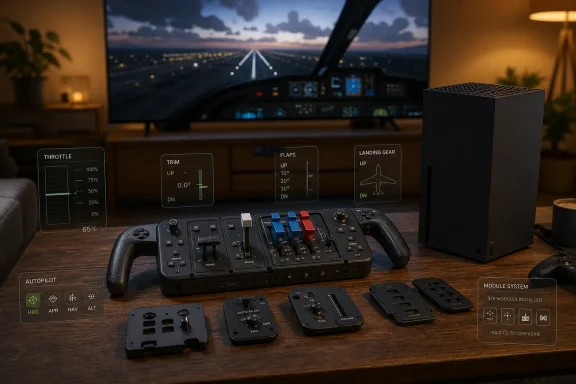
This is where Project X-Ray’s layout becomes interesting. The visible design points toward a throttle lever, flaps, landing gear, trim, lights or radio-style buttons, and dedicated autopilot controls in the space where an ordinary controller would expect more generic inputs. That is not a total cockpit, but it is a strong statement about which tasks deserve tactile permanence.
A trim wheel is a good example. You can map trim to buttons on a regular controller, but tapping a button to adjust trim feels abstract. A rotary control gives the hand a continuous relationship with the aircraft’s attitude. It does not need to be a perfect replica of a real cockpit trim wheel to be better than a button chord.
The same applies to landing gear and flaps. These are not obscure systems; they are core events in nearly every flight. Putting them on dedicated controls reduces the player’s cognitive load at precisely the moments when workload tends to rise. The value is not just immersion. It is fewer missed inputs when the runway is getting bigger in the windshield.
Autopilot controls are even more revealing. Replacing or repurposing the D-pad area for flight management acknowledges that Microsoft Flight Simulator players spend a lot of time wrestling with automation. Altitude, heading, vertical speed, navigation mode, and approach behavior are where many newcomers first discover that flying is less about pointing at the sky and more about managing intent.
If PowerA and Meridian GMT get the ergonomics right, Project X-Ray could make those interactions feel less like operating a menu from a sofa and more like commanding an aircraft through muscle memory. That is the promise. The risk is that too many miniature controls become a different kind of clutter.
That makes native console support more than a feature. It is the doorway into the market PowerA is built to serve. Microsoft Flight Simulator’s presence on Xbox transformed the franchise from a PC institution into a living-room showcase, but living-room simming has always been constrained by input devices.
A standard controller is convenient, but it flattens the aircraft. A full HOTAS or yoke setup is better, but it can be expensive, bulky, and aesthetically unwelcome in a shared space. A handheld flight controller says: you can have more control without rearranging the room.
This is particularly relevant for Game Pass-era discovery. Many players do not enter Microsoft Flight Simulator with a purchase plan for pedals and a throttle quadrant. They try the sim because it is there, because the world looks spectacular, or because a specific aircraft, mission, or challenge caught their attention. A mid-tier specialist controller gives those players a next step that does not require them to become hardware hobbyists overnight.
It also gives Xbox a better answer to the peripheral gap. Flight simulation on console should not mean pretending a general-purpose gamepad is enough forever. If Microsoft wants the platform to support serious-but-approachable simulation, hardware partners need to fill the middle of the ladder.
That matters because category creation is rarely a one-product event. The first device invites skepticism: is this brilliant, silly, or both? The second credible entrant changes the conversation. Suddenly the question is not whether handheld flight decks should exist, but how they should differ, who they should serve, and what price points make sense.
Competition should also discipline the designs. Honeycomb’s approach leans heavily into dense physical control. Meridian GMT’s public language around Project X-Ray suggests modularity as a central idea. If that survives to shipping hardware, the fight may not simply be about who can fit more controls on the shell, but who can make the controls feel coherent across aircraft types.
The modular claim is especially intriguing in Microsoft Flight Simulator 2024 because the game broadens the fantasy beyond point-to-point aviation. Helicopters, rescue work, aerial firefighting, cargo operations, and career activities all benefit from controls that are not just “general aviation plane, but smaller.” A swappable or reconfigurable surface could make more sense than a fixed mini-cockpit.
Still, the category is young, and early devices often expose the hard edges. Profiles can be awkward, firmware can lag, console support can be narrower than buyers expect, and tiny levers can feel better in renders than in hand. PowerA’s scale helps, but scale does not automatically solve sim ergonomics.
A specialist controller that preserves that foundation lowers the intimidation barrier. It tells newcomers that they are not entering an entirely different hardware culture. They are holding something recognizable, only with controls that better reflect the aircraft they are trying to fly.
That familiarity also matters for storage. A yoke setup occupies a physical and psychological space in a home. It has to be set up, broken down, or permanently accommodated. A handheld flight controller can live on a shelf, charge like a gamepad, and appear when the user wants to fly.
For WindowsForum readers, this may sound suspiciously like compromise dressed up as innovation. And yes, it is a compromise. But consumer technology advances by finding tolerable compromises, not by forcing every user to adopt the expert’s ideal setup.
The question is whether the compromise lands in the right place. If Project X-Ray feels like a cramped cockpit toy, serious users will dismiss it and casual users will be confused. If it feels like an Xbox controller that finally understands aircraft, it could become the sort of device that makes a simmer out of someone who never planned to become one.
PowerA already sells licensed Xbox wireless controllers, so the company is not entering this problem cold. But a flight controller has different failure modes from a shooter pad. A dropped input during a menu is annoying. A flaky throttle axis on final approach is infuriating.
Battery life will matter, too. Flight sim sessions can stretch longer than conventional game sessions, and the genre encourages long cruises, multi-leg flights, and slow procedures. If the controller is meant to replace both a gamepad and a slice of cockpit hardware, it needs endurance that respects the way simmers actually play.
Wireless also sharpens the question of PC compatibility. The announcement names PC and Xbox Series X|S, which sounds straightforward, but PC users will want to know how the device enumerates, how deeply it can be remapped, whether it supports standard input APIs cleanly, and whether advanced controls require PowerA software. The more specialized the hardware becomes, the more painful mediocre software support can be.
That is the unglamorous side of the story. The render sells the dream; the driver stack, profiles, firmware, and calibration tools will decide whether the dream survives first contact with a Windows desktop.
A sightseeing sim can survive with simple controls. A procedural sim asks for better controls. A mission-driven aviation platform asks for controls that are flexible enough to support different kinds of flying without making the player rebuild a rig every time.
That is where the old peripheral ladder starts to look dated. The traditional upgrade path went from gamepad or keyboard to joystick, then perhaps to HOTAS, yoke, pedals, panels, and dedicated avionics hardware. It assumed a PC desk and a user willing to expand horizontally.
The Xbox audience, and a growing number of PC handheld and couch-PC users, do not fit that assumption. They need a vertical upgrade: more capability in roughly the same physical footprint. Project X-Ray is a response to that constraint.
There is also a cultural shift here. Flight simming used to be defined by hardware seriousness as much as software seriousness. The more gear you had, the more visibly committed you were. A new handheld category challenges that identity by suggesting that commitment can look smaller, cheaper, and more portable.
Some veteran simmers will roll their eyes. They are not wrong that a compact controller cannot replicate a full yoke, throttle quadrant, and pedals. But they may be wrong if they assume replication is the only measure of value.
The sweet spot is delicate. Too cheap, and buyers will suspect mushy controls, questionable sensors, or a gimmick shell. Too expensive, and the whole argument for compact accessibility weakens. The product needs to feel premium enough to trust, but not so premium that a newcomer starts comparing it to a desk setup.
PowerA’s brand position may help. The company often operates in the space below first-party elite controllers and boutique specialty gear, where licensed compatibility and retail availability count for a lot. That could make Project X-Ray visible to Xbox owners who would never browse sim hardware stores.
But PowerA also has to avoid making the device look like a novelty tie-in. Microsoft Flight Simulator players are unusually sensitive to input quality because the sim exposes bad axes and imprecise controls quickly. A drifting stick, coarse throttle, or plasticky trim wheel will not be forgiven just because the layout is clever.
The controller’s final name may matter less than its first reviews. In flight sim hardware, trust is earned by long sessions, calibration stability, and the boring absence of surprises.
Hardware is where that negotiation becomes tangible. A full cockpit rig implies one kind of user. A standard Xbox controller implies another. Project X-Ray tries to collapse those categories into a single object.
That will annoy purists, but it is probably healthy for the platform. Simulation genres survive when they can welcome new users without flattening the experience for veterans. Hardware like this can make that possible by giving beginners a way to grow into complexity incrementally.
There is a lesson here from racing games. The jump from controller to wheel remains meaningful, but not every racing player needs a full cockpit. A healthy ecosystem includes pads, wheels, direct-drive bases, pedals, shifters, and hybrids. Flight simulation has long had the high end covered; the middle is where the growth is.
If Project X-Ray works, it will not make yokes obsolete. It will make the path to caring about yokes shorter. A player who learns trim, flaps, gear, and throttle discipline on a handheld flight deck is more likely to understand why dedicated hardware matters later.
That is the strategic value for Microsoft, even if Microsoft is not the one announcing the device. The more players move beyond casual control schemes, the more the simulator’s depth becomes a feature rather than a wall.
That uncertainty should temper the enthusiasm. Many promising peripherals look obvious in hindsight and awkward in practice. The distance between “this should exist” and “this is good” is measured in spring tension, button spacing, axis resolution, grip comfort, and whether the device still feels pleasant after two hours.
The back of the controller is also a mystery from the public render discussed so far. That matters because rudder control, paddles, triggers, and rear buttons could decide whether Project X-Ray feels genuinely complete or merely front-loaded. Flight sim inputs are not just about quantity; they are about where the hands naturally want to perform them.
The modular design raises its own questions. Interchangeable parts are attractive, but they introduce cost, durability, storage, and support issues. If modules are sold separately, the base product may feel incomplete. If everything is included, the price may climb.
Even the name “Project X-Ray” sounds provisional. That is fine for a development announcement, but it reinforces the point: this is a signal of direction, not a buying recommendation. Enthusiasts should be interested, not committed.
That gap is not Microsoft’s failure alone. It is the inevitable result of bringing a complex simulation to a mainstream platform. The more successful the simulator becomes with ordinary players, the more visible the controller problem becomes.
PowerA and Meridian GMT are betting that enough of those players want a dedicated answer. Not a giant answer, not a purist answer, and not a cheap skin over a normal gamepad. A focused handheld device with aircraft logic built into its surface.
If that bet pays off, it could pressure other accessory makers to explore similar hybrids. We may see competing layouts for airliners, helicopters, general aviation, combat-adjacent sims, or multi-sim compatibility. We may also see Microsoft and Asobo improve default profiles and detection for this class of device because the category becomes too visible to ignore.
That would be the best outcome for users: not one perfect controller, but a healthier ecosystem where the first upgrade from a standard pad is no longer confusing.
 PowerA Is Selling a Middle Seat Between Casual and Cockpit
The easiest way to misunderstand Project X-Ray is to treat it as a novelty controller with extra knobs. Flight sim hardware has always attracted elaborate devices, and the genre’s most committed users have never lacked for ways to spend money. What is different here is the attempt to compress the language of the cockpit into the grammar of an Xbox controller.That is a subtle but important inversion. Traditional flight sim hardware asks the player to move toward the simulator: clear a desk, mount equipment, learn the physical layout, and accept that the setup is now a small installation. Project X-Ray appears to move the simulator toward the player, keeping the two-handed handheld shape while grafting flight-specific inputs onto it.
PowerA’s involvement gives that idea commercial weight. The company is not a boutique sim-rig maker trying to convince retailers that flight simmers exist. It is an established accessories brand that knows Xbox licensing, mass-market packaging, wireless expectations, and the brutal economics of putting hardware in front of ordinary console buyers.
Meridian GMT, by contrast, brings the specialist argument. Its public pitch around X-Ray emphasizes modularity, interchangeable throttles, flaps, and faceplates, and a controller that can adapt to aircraft and helicopter use. That is the language of sim people, not just gamepad people.
The result is a product that sits in the awkward but potentially lucrative space between “I fly with a standard controller because it came in the box” and “I have a home cockpit.” For Microsoft Flight Simulator 2024, that in-between audience is not a rounding error. It is arguably the audience Microsoft created when it made a serious civilian flight simulator feel at home on Xbox.
Microsoft Flight Simulator Made the Xbox Controller Work, but It Never Made It Natural
Microsoft Flight Simulator 2024 can be played with a standard Xbox controller, and that fact remains one of the franchise’s great accessibility victories. It means a console player can spawn at an airport, push the throttle forward, rotate, and experience the basic magic without buying anything else. That is not a small achievement for a simulation with decades of PC baggage.But “playable” is not the same as “comfortable.” Flight simming asks for continuous control over axes and discrete access to systems that do not map cleanly to face buttons. Throttle, trim, flaps, landing gear, camera views, autopilot, lights, brakes, rudder, mixture, propeller control, radio interactions, and cockpit manipulation all compete for limited real estate.
The gamepad solves that problem through layers: modifier buttons, radial menus, context-sensitive controls, cockpit cursor modes, and user remapping. Those are clever compromises, but they make the controller feel like a translation device rather than an instrument. The player spends too much time remembering what a button means right now.
That problem becomes more obvious as the player graduates from sightseeing to procedure. A Cessna circuit, an airliner descent, a bush trip, a helicopter mission, or a low-visibility approach all expose the same truth: flight simulation is not merely about steering. It is about managing a machine over time, and machine management benefits from physical controls that stay where they are.
This is where Project X-Ray’s layout becomes interesting. The visible design points toward a throttle lever, flaps, landing gear, trim, lights or radio-style buttons, and dedicated autopilot controls in the space where an ordinary controller would expect more generic inputs. That is not a total cockpit, but it is a strong statement about which tasks deserve tactile permanence.
The Real Innovation Is Not Realism; It Is Reducing Mode Confusion
Hardcore flight simmers often talk about realism, but for a handheld controller the more practical goal is reducing mode confusion. A full-size yoke and throttle quadrant are realistic because they resemble the aircraft. A compact flight deck controller can succeed even if it does not, provided it gives the player stable, predictable controls for the actions they perform repeatedly.A trim wheel is a good example. You can map trim to buttons on a regular controller, but tapping a button to adjust trim feels abstract. A rotary control gives the hand a continuous relationship with the aircraft’s attitude. It does not need to be a perfect replica of a real cockpit trim wheel to be better than a button chord.
The same applies to landing gear and flaps. These are not obscure systems; they are core events in nearly every flight. Putting them on dedicated controls reduces the player’s cognitive load at precisely the moments when workload tends to rise. The value is not just immersion. It is fewer missed inputs when the runway is getting bigger in the windshield.
Autopilot controls are even more revealing. Replacing or repurposing the D-pad area for flight management acknowledges that Microsoft Flight Simulator players spend a lot of time wrestling with automation. Altitude, heading, vertical speed, navigation mode, and approach behavior are where many newcomers first discover that flying is less about pointing at the sky and more about managing intent.
If PowerA and Meridian GMT get the ergonomics right, Project X-Ray could make those interactions feel less like operating a menu from a sofa and more like commanding an aircraft through muscle memory. That is the promise. The risk is that too many miniature controls become a different kind of clutter.
Xbox Support Is the Business Case, Not a Footnote
The announcement’s most important platform detail is Xbox Series X|S support. PC simmers already have a sprawling hardware ecosystem, even if compatibility and profiles remain a perennial headache. Xbox players have fewer options, stricter accessory realities, and less tolerance for hardware that only works after a night of driver archaeology.That makes native console support more than a feature. It is the doorway into the market PowerA is built to serve. Microsoft Flight Simulator’s presence on Xbox transformed the franchise from a PC institution into a living-room showcase, but living-room simming has always been constrained by input devices.
A standard controller is convenient, but it flattens the aircraft. A full HOTAS or yoke setup is better, but it can be expensive, bulky, and aesthetically unwelcome in a shared space. A handheld flight controller says: you can have more control without rearranging the room.
This is particularly relevant for Game Pass-era discovery. Many players do not enter Microsoft Flight Simulator with a purchase plan for pedals and a throttle quadrant. They try the sim because it is there, because the world looks spectacular, or because a specific aircraft, mission, or challenge caught their attention. A mid-tier specialist controller gives those players a next step that does not require them to become hardware hobbyists overnight.
It also gives Xbox a better answer to the peripheral gap. Flight simulation on console should not mean pretending a general-purpose gamepad is enough forever. If Microsoft wants the platform to support serious-but-approachable simulation, hardware partners need to fill the middle of the ladder.
The Honeycomb Echo Turned a Curiosity Into a Category
Project X-Ray does not arrive in a vacuum. Honeycomb’s Echo Aviation Controller has already made the case that flight sim controls can be reimagined inside a controller-like footprint. Its mix of pitch, roll, rudder, trim, throttle, flaps, and landing gear showed that the form factor was not inherently absurd.That matters because category creation is rarely a one-product event. The first device invites skepticism: is this brilliant, silly, or both? The second credible entrant changes the conversation. Suddenly the question is not whether handheld flight decks should exist, but how they should differ, who they should serve, and what price points make sense.
Competition should also discipline the designs. Honeycomb’s approach leans heavily into dense physical control. Meridian GMT’s public language around Project X-Ray suggests modularity as a central idea. If that survives to shipping hardware, the fight may not simply be about who can fit more controls on the shell, but who can make the controls feel coherent across aircraft types.
The modular claim is especially intriguing in Microsoft Flight Simulator 2024 because the game broadens the fantasy beyond point-to-point aviation. Helicopters, rescue work, aerial firefighting, cargo operations, and career activities all benefit from controls that are not just “general aviation plane, but smaller.” A swappable or reconfigurable surface could make more sense than a fixed mini-cockpit.
Still, the category is young, and early devices often expose the hard edges. Profiles can be awkward, firmware can lag, console support can be narrower than buyers expect, and tiny levers can feel better in renders than in hand. PowerA’s scale helps, but scale does not automatically solve sim ergonomics.
The Controller Form Factor Is Familiar for a Reason
There is a reason Project X-Ray’s apparent design discipline matters. The Xbox controller is one of the most successful ergonomic compromises in consumer electronics. It is not perfect for every genre, but millions of players already know how to hold it, where to rest their thumbs, and how to navigate its hierarchy of triggers, bumpers, sticks, and buttons.A specialist controller that preserves that foundation lowers the intimidation barrier. It tells newcomers that they are not entering an entirely different hardware culture. They are holding something recognizable, only with controls that better reflect the aircraft they are trying to fly.
That familiarity also matters for storage. A yoke setup occupies a physical and psychological space in a home. It has to be set up, broken down, or permanently accommodated. A handheld flight controller can live on a shelf, charge like a gamepad, and appear when the user wants to fly.
For WindowsForum readers, this may sound suspiciously like compromise dressed up as innovation. And yes, it is a compromise. But consumer technology advances by finding tolerable compromises, not by forcing every user to adopt the expert’s ideal setup.
The question is whether the compromise lands in the right place. If Project X-Ray feels like a cramped cockpit toy, serious users will dismiss it and casual users will be confused. If it feels like an Xbox controller that finally understands aircraft, it could become the sort of device that makes a simmer out of someone who never planned to become one.
Wireless Raises Expectations as Much as Convenience
The word “wireless” in the product name is doing real work. For a living-room Xbox player, wireless is table stakes. For a flight sim peripheral, it introduces a familiar set of trade-offs around latency, battery life, firmware updates, dongles, platform modes, and reliable reconnection.PowerA already sells licensed Xbox wireless controllers, so the company is not entering this problem cold. But a flight controller has different failure modes from a shooter pad. A dropped input during a menu is annoying. A flaky throttle axis on final approach is infuriating.
Battery life will matter, too. Flight sim sessions can stretch longer than conventional game sessions, and the genre encourages long cruises, multi-leg flights, and slow procedures. If the controller is meant to replace both a gamepad and a slice of cockpit hardware, it needs endurance that respects the way simmers actually play.
Wireless also sharpens the question of PC compatibility. The announcement names PC and Xbox Series X|S, which sounds straightforward, but PC users will want to know how the device enumerates, how deeply it can be remapped, whether it supports standard input APIs cleanly, and whether advanced controls require PowerA software. The more specialized the hardware becomes, the more painful mediocre software support can be.
That is the unglamorous side of the story. The render sells the dream; the driver stack, profiles, firmware, and calibration tools will decide whether the dream survives first contact with a Windows desktop.
Microsoft’s Simulator Has Outgrown the Standard Peripheral Ladder
The original modern Microsoft Flight Simulator release in 2020 was often described as a technological showcase: streaming scenery, cloud-scale data, photogrammetry, and a globe that made screenshots look like tourism ads. Microsoft Flight Simulator 2024 pushed the formula toward a broader activity platform, with a career structure and more varied aviation tasks. That evolution changes what hardware needs to do.A sightseeing sim can survive with simple controls. A procedural sim asks for better controls. A mission-driven aviation platform asks for controls that are flexible enough to support different kinds of flying without making the player rebuild a rig every time.
That is where the old peripheral ladder starts to look dated. The traditional upgrade path went from gamepad or keyboard to joystick, then perhaps to HOTAS, yoke, pedals, panels, and dedicated avionics hardware. It assumed a PC desk and a user willing to expand horizontally.
The Xbox audience, and a growing number of PC handheld and couch-PC users, do not fit that assumption. They need a vertical upgrade: more capability in roughly the same physical footprint. Project X-Ray is a response to that constraint.
There is also a cultural shift here. Flight simming used to be defined by hardware seriousness as much as software seriousness. The more gear you had, the more visibly committed you were. A new handheld category challenges that identity by suggesting that commitment can look smaller, cheaper, and more portable.
Some veteran simmers will roll their eyes. They are not wrong that a compact controller cannot replicate a full yoke, throttle quadrant, and pedals. But they may be wrong if they assume replication is the only measure of value.
The Price Will Decide Whether This Is an Accessory or an On-Ramp
PowerA and Meridian GMT have not announced pricing, and that silence leaves the biggest commercial question unanswered. A handheld flight deck can only function as an on-ramp if it is priced like one. If it lands too close to established flight sticks or entry-level yoke bundles, it will be judged against more physically capable hardware.The sweet spot is delicate. Too cheap, and buyers will suspect mushy controls, questionable sensors, or a gimmick shell. Too expensive, and the whole argument for compact accessibility weakens. The product needs to feel premium enough to trust, but not so premium that a newcomer starts comparing it to a desk setup.
PowerA’s brand position may help. The company often operates in the space below first-party elite controllers and boutique specialty gear, where licensed compatibility and retail availability count for a lot. That could make Project X-Ray visible to Xbox owners who would never browse sim hardware stores.
But PowerA also has to avoid making the device look like a novelty tie-in. Microsoft Flight Simulator players are unusually sensitive to input quality because the sim exposes bad axes and imprecise controls quickly. A drifting stick, coarse throttle, or plasticky trim wheel will not be forgiven just because the layout is clever.
The controller’s final name may matter less than its first reviews. In flight sim hardware, trust is earned by long sessions, calibration stability, and the boring absence of surprises.
The Bigger Fight Is Over Who Gets to Be a Simmer
There is an undercurrent to this announcement that goes beyond one controller. Microsoft Flight Simulator’s mass-market success has forced the community to renegotiate who the product is for. Is it for pilots and aviation obsessives? Is it for gamers who want spectacle? Is it for students, streamers, casual explorers, Xbox owners, PC builders, or all of the above?Hardware is where that negotiation becomes tangible. A full cockpit rig implies one kind of user. A standard Xbox controller implies another. Project X-Ray tries to collapse those categories into a single object.
That will annoy purists, but it is probably healthy for the platform. Simulation genres survive when they can welcome new users without flattening the experience for veterans. Hardware like this can make that possible by giving beginners a way to grow into complexity incrementally.
There is a lesson here from racing games. The jump from controller to wheel remains meaningful, but not every racing player needs a full cockpit. A healthy ecosystem includes pads, wheels, direct-drive bases, pedals, shifters, and hybrids. Flight simulation has long had the high end covered; the middle is where the growth is.
If Project X-Ray works, it will not make yokes obsolete. It will make the path to caring about yokes shorter. A player who learns trim, flaps, gear, and throttle discipline on a handheld flight deck is more likely to understand why dedicated hardware matters later.
That is the strategic value for Microsoft, even if Microsoft is not the one announcing the device. The more players move beyond casual control schemes, the more the simulator’s depth becomes a feature rather than a wall.
The Render Shows Promise, but the Unknowns Are the Product
The current public information is still thin. We have an announcement, a teaser, a render, partnership language, platform targets, and broad claims about modularity. We do not yet have final specifications, price, release window, battery life, sensor details, software behavior, replacement modules, Xbox licensing particulars, or hands-on impressions.That uncertainty should temper the enthusiasm. Many promising peripherals look obvious in hindsight and awkward in practice. The distance between “this should exist” and “this is good” is measured in spring tension, button spacing, axis resolution, grip comfort, and whether the device still feels pleasant after two hours.
The back of the controller is also a mystery from the public render discussed so far. That matters because rudder control, paddles, triggers, and rear buttons could decide whether Project X-Ray feels genuinely complete or merely front-loaded. Flight sim inputs are not just about quantity; they are about where the hands naturally want to perform them.
The modular design raises its own questions. Interchangeable parts are attractive, but they introduce cost, durability, storage, and support issues. If modules are sold separately, the base product may feel incomplete. If everything is included, the price may climb.
Even the name “Project X-Ray” sounds provisional. That is fine for a development announcement, but it reinforces the point: this is a signal of direction, not a buying recommendation. Enthusiasts should be interested, not committed.
The Small Controller That Exposes Microsoft Flight Simulator’s Biggest Accessibility Gap
Project X-Ray’s most useful contribution may be diagnostic. It highlights exactly where Microsoft Flight Simulator 2024’s accessibility story still has a hardware-shaped hole. The software lets an Xbox player enter the world, but the standard controller cannot make the aircraft’s systems feel as legible as the scenery.That gap is not Microsoft’s failure alone. It is the inevitable result of bringing a complex simulation to a mainstream platform. The more successful the simulator becomes with ordinary players, the more visible the controller problem becomes.
PowerA and Meridian GMT are betting that enough of those players want a dedicated answer. Not a giant answer, not a purist answer, and not a cheap skin over a normal gamepad. A focused handheld device with aircraft logic built into its surface.
If that bet pays off, it could pressure other accessory makers to explore similar hybrids. We may see competing layouts for airliners, helicopters, general aviation, combat-adjacent sims, or multi-sim compatibility. We may also see Microsoft and Asobo improve default profiles and detection for this class of device because the category becomes too visible to ignore.
That would be the best outcome for users: not one perfect controller, but a healthier ecosystem where the first upgrade from a standard pad is no longer confusing.
A Few Things Already Matter Before Anyone Can Buy It
For now, the announcement is most useful as a map of what to watch next. The hype is justified only if the fundamentals follow, because flight sim hardware has a way of punishing products that get the industrial design right and the implementation wrong.- Project X-Ray is being developed by Meridian GMT and PowerA for PC and Xbox Series X|S, with the announcement made at FlightSimExpo 2026.
- The controller is still in active development, and PowerA has not announced a final price, release date, or full specification sheet.
- The device’s core pitch is a familiar handheld controller shape with dedicated flight controls such as throttle, trim, flaps, landing gear, and autopilot-style inputs.
- Xbox support is central to the story because console flight simmers have fewer practical specialist-controller options than PC users.
- The modular design claim is promising, but its value will depend on durability, included parts, software support, and whether reconfiguration feels effortless rather than fiddly.
- The product’s success will be decided less by the teaser render than by axis precision, profile reliability, battery life, ergonomics, and long-session comfort.
References
- Primary source: Windows Central
Published: 2026-06-12T21:50:07.614280
PowerA now wants in on Microsoft Flight Simulator 2024 with a specialist new controller, and it'll work on Xbox, too | Windows Central
The collaboration with Meridian GMT looks wild, and that big ol' Xbox button makes us smile.www.windowscentral.com - Related coverage: flightsimulator.zendesk.com
Controller Settings FAQ – Microsoft Flight Simulator Support
Microsoft Flight Simulator 2024 has newly designed UI for controller settings. In this FAQ, we will help you navigate through the new UI...flightsimulator.zendesk.com - Related coverage: flyhoneycomb.com
ECHO AVIATION CONTROLLER – Honeycomb Aeronautical
The Echo Aviation Controller delivers a complete flight control system in a compact, handheld-style form. Designed for Microsoft Flight Simulator, it combines pitch, roll, yaw, throttle, flaps, trim, and landing gear into one intuitive controller - ideal for flying at home, on the couch, or on... flyhoneycomb.com
- Related coverage: manuals.plus
- Related coverage: simulationdaily.com
Echo Aviation Controller Released for Microsoft Flight Simulator and More - Simulation Daily
For those who love flight simulators but also enjoy the form factor of traditional controllers, Honeycomb released Echo Aviation Controller.simulationdaily.com - Related coverage: notebookcheck.net
Special controller for Microsoft Flight Simulator and X-Plane now available - Notebookcheck News
The Echo Aviation Controller is now being sold directly by Honeycomb. The gamepad comes with six downloadable profiles for Microsoft Flight Simulator 2024, utilizes Hall effect sensors and can be used for playing on the go. www.notebookcheck.net
- Related coverage: forums.flightsimulator.com
Honeycomb Echo Flight Controller - Tools & Utilities - Microsoft Flight Simulator Forums
Coming to PC’s in December and Consoles in 2026 forums.flightsimulator.com
- Related coverage: pcgamer.com
This $150 controller from Honeycomb Aeronautical has not one, not two, not three, but four integrated Throttle Levers for the flight sim sickos | PC Gamer
Don your aviators, you big nerd.www.pcgamer.com - Related coverage: powera.com
- Related coverage: streetinsider.com
PowerA and Meridian GMT Announce Strategic Partnership at FlightSimExpo 2026
New "Fueled by PowerA" initiative takes flight, bringing advanced flight simulation experiences to more players...www.streetinsider.com - Related coverage: inkl.com
PowerA now wants in on Microsoft Flight Simulator 2024…
PowerA has shown off a first look at a new controller in partnership with Meridian GMT. You won't be playing Call of Duty on this, but if you're into…www.inkl.com
