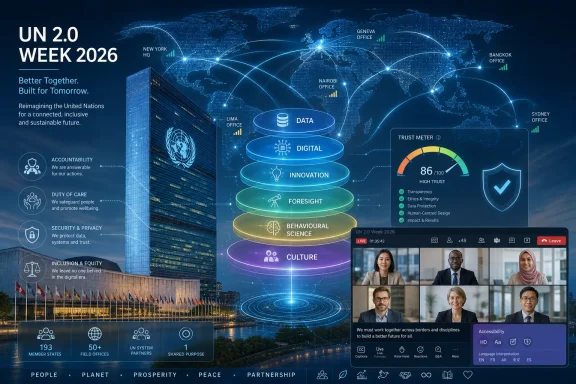
The United Nations will hold UN 2.0 Week from June 15 to June 19, 2026, as a virtual programme of Microsoft Teams sessions focused on data, digital systems, AI, innovation, foresight, behavioural science, and institutional reform across the UN system. The calendar looks like another internal conference until you read the session titles closely. This is the UN trying to answer the same question now facing every sprawling organization with legacy processes and modern expectations: can digital transformation become operating muscle rather than a permanent pilot project?
For WindowsForum readers, the Microsoft Teams join links are the least interesting technical detail and the most revealing operational one. UN 2.0 Week is not primarily about software procurement, cloud platforms, or AI demos, even though all of those hover over the agenda. It is about whether a global institution built for diplomatic deliberation can learn to behave like a networked, data-aware, digitally competent delivery organization without mistaking tools for transformation.
UN 2.0 is the Secretary-General’s modernization programme for a “future-ready” United Nations, built around what the organization calls the Quintet of Change: data, digital, innovation, foresight, and behavioural science. That phrase has the slightly frictionless quality of institutional branding, but the underlying idea is concrete. The UN wants its agencies, country teams, missions, and headquarters offices to use evidence, technology, experimentation, future planning, and human-centred design as normal methods of work.
The 2026 programme arrives at a revealing moment. The 2030 Sustainable Development Goals are not comfortably on track, and the global operating environment has become more volatile rather than less. Humanitarian crises, climate shocks, migration pressures, cyber risk, misinformation, and fiscal constraints are all pushing the UN toward faster coordination and better targeting.
That makes the Week’s “Pulse Check” opening more than ceremonial. A pulse check is a diagnostic, not a celebration. By framing the grand opening around where UN 2.0 is delivering change, where progress is uneven, and what needs to shift next, the organizers are acknowledging the central problem with public-sector modernization: success is uneven by default.
The featured opening lineup reinforces that point. Deputy Secretary-General Amina J. Mohammed brings system-wide authority, while speakers from UNECE, the Mexico Resident Coordinator’s office, the Executive Office of the Secretary-General, and the UN Mission in South Sudan represent the range from policy center to field reality. That spread matters because transformation that works in New York or Geneva can still collapse at the edge, where bandwidth, staffing, security, procurement, and political conditions are less forgiving.
That arc is the modernization playbook in miniature. First, decide whether the reform is real. Then examine the technology and the leadership model. Then confront the harder question of whether change survives beyond the pilot. Finally, reward the teams that have converted ideas into observable impact.
The Tuesday session, “Digital Solutions That Work for People,” is especially telling. It does not promise digital solutions that work for administrators, donors, dashboards, or public-relations decks. It claims the user as the test. In enterprise IT terms, that is the difference between deploying a platform and delivering a service.
The speaker list widens the aperture beyond the UN’s internal machinery. Lesotho’s technology minister, digital rights advocate Nighat Dad, Karya co-founder Safiya Husain, and Radiolab co-host Latif Nasser suggest a conversation about trust, access, data labour, storytelling, and public legitimacy. For an institution like the UN, those are not soft topics. They are the adoption layer.
Still, the use of a familiar enterprise platform is not irrelevant. For global organizations, collaboration technology has become the plumbing of institutional life. A virtual event lowers travel costs, broadens access, and gives geographically dispersed staff a common room. It also exposes the usual asymmetries: time zones, language, device access, network quality, and who feels comfortable speaking in a large digital forum.
The more important platform question is whether UN 2.0 creates trusted spaces for candid reporting. A modernization programme that only surfaces success stories will learn slowly. One that can discuss failed pilots, procurement delays, weak data governance, staff resistance, digital exclusion, and overhyped AI deployments will have a better chance of becoming real.
That is why the wording of the opening session matters. “Where progress is uneven” is bureaucratically polite, but it is also the phrase that carries the most weight. In a system as large and federated as the UN, unevenness is not a bug. It is the basic terrain.
That is the right instinct. AI can accelerate document analysis, translation workflows, emergency response triage, satellite imagery interpretation, beneficiary feedback analysis, and internal knowledge retrieval. It can also amplify bad data, obscure accountability, leak sensitive information, and introduce vendor dependencies into politically delicate work.
For the UN, AI governance is not an abstract ethics exercise. It touches refugees, peacekeeping, sanctions, health systems, food security, human rights documentation, and climate adaptation. The stakes are higher than a productivity gain in a corporate back office.
The presence of a UN AI Scientific Panel member at the awards ceremony points to a maturing conversation. The question is no longer whether AI should appear in UN innovation portfolios. The question is how the UN distinguishes responsible operational use from fashionable automation, and how it proves that AI-enabled interventions improve outcomes without compromising rights.
Making change stick means crossing the hostile middle distance between demonstration and default practice. That distance includes procurement rules, training capacity, cybersecurity review, legal sign-off, budget ownership, data-sharing agreements, help-desk support, management incentives, and staff time. None of these elements looks glamorous on a conference agenda, but each can kill reform.
The inclusion of Replit CEO Amjad Masad in this session is interesting because Replit represents a world in which software creation is becoming more accessible, collaborative, and AI-assisted. That is a provocative contrast with traditional institutional IT, where development cycles can be slow and heavily gated. The tension is obvious: how does a UN entity embrace faster building without losing control, security, accessibility, auditability, or multilingual inclusion?
Namibia’s ICT minister Emma Theofelus and EOSG strategic planning leadership bring the discussion back to public institutions. Digital change is not merely a developer workflow. It is a governance challenge, especially when the institution serves populations rather than customers.
Data capabilities can shift authority from hierarchy to insight, but only if leaders are willing to be challenged by the numbers. Digital platforms can scale services, but they can also centralize control. Innovation labs can empower local experimentation, but they can also become side rooms disconnected from core budgets.
These are political design questions disguised as management questions. A more data-driven UN may expose uncomfortable differences in performance between offices or regions. A more digital UN may require common architectures where agencies are accustomed to autonomy. A more innovative UN may demand tolerance for failure in a culture that is often punished by headlines, audits, and member-state scrutiny.
The speaker roster for the debate reflects those tensions. Senior reform leadership, regional commission leadership, and UN Women representation suggest that the discussion will not be limited to tooling. It will have to grapple with institutional architecture, equity, and the distribution of capability across the system.
The key phrase in the invitation is “measurable impact.” Innovation awards that reward novelty tend to produce novelty. Awards that reward measured improvements in delivery, inclusion, resilience, or efficiency can change incentives, especially if the winning teams become models that others can copy.
The lineup for the ceremony is heavy with senior leadership, including Secretary-General António Guterres, Guy Ryder, UNFPA leadership, UNDP’s chief digital officer, WFP’s chief data officer, resident coordinators, and UN Global Pulse. That mix points to a broader ambition: make data and digital reform visible not as a niche function but as a leadership priority.
The voting deadline of June 17 adds a participatory element, though the meaningful test will come after the ceremony. If the awards create a living catalogue of reusable approaches, they matter. If they merely produce applause for isolated teams, they become another institutional ritual.
This is where many enterprise transformations go wrong. They begin with a platform and hope behavior will follow. In reality, behavior usually bends the platform back into old habits. A document-sharing system becomes a filing cabinet. A dashboard becomes a screenshot in a PowerPoint. A collaboration platform becomes another place where decisions are not made.
Behavioural science is therefore not an odd fifth wheel in the UN 2.0 model. It is the reminder that institutional outcomes are produced by people making choices under constraints. If staff are overloaded, undertrained, risk-averse, or unconvinced, even excellent tools will underperform.
Foresight plays a similar role. It pushes the organization to prepare for discontinuity rather than merely optimize yesterday’s processes. In a period defined by climate instability, conflict, pandemics, demographic shifts, AI acceleration, and geopolitical fragmentation, foresight is not a luxury for strategy retreats. It is part of operational readiness.
That is why the Week’s external-facing tone matters. The programme is open virtually and framed around global conversations, practical learning, and collective action. This is not just internal staff development; it is a public claim about how a multilateral institution adapts under pressure.
The harder truth is that digital modernization cannot solve the political and financial constraints that surround the UN. Better data will not automatically unlock funding. AI will not create consensus among member states. Innovation labs will not erase conflict, inequality, or climate damage.
But modernization can still matter enormously. It can reduce waste, reveal need faster, improve targeting, strengthen accountability, and help field teams share what works. In a system where small delays and coordination failures can have human consequences, operational competence is not a back-office concern.
There is the problem of fragmented data. There is the challenge of moving from local heroics to common platforms. There is the need to balance autonomy with interoperability. There is the risk of buying tools faster than organizations can absorb them.
There is also the governance tension around AI. Who approves models? Where does sensitive data go? What audit trail is required? How do staff know when an AI-assisted output is good enough, and who remains accountable when it is not?
These are not merely UN questions. They are 2026 enterprise questions. The UN’s version is more politically complex, but that complexity makes it a useful mirror for everyone else.
That does not make the Week unimportant. Convenings can create shared language, surface champions, spread examples, and give leadership permission to push. They can also reveal whether a reform agenda has become performative or practical.
The sessions from June 15 to June 18 have the bones of a serious programme because they move from diagnosis to people-centred digital systems, leadership, institutionalization, debate, and recognition. That is the right sequence. The risk is that the week generates inspiration faster than implementation capacity.
A mature UN 2.0 agenda will need to be ruthless about reuse. Every successful tool, method, training module, governance pattern, and partnership model should be treated as infrastructure for the next team. Otherwise, innovation remains artisanal: impressive, local, and hard to scale.
For WindowsForum readers, the Microsoft Teams join links are the least interesting technical detail and the most revealing operational one. UN 2.0 Week is not primarily about software procurement, cloud platforms, or AI demos, even though all of those hover over the agenda. It is about whether a global institution built for diplomatic deliberation can learn to behave like a networked, data-aware, digitally competent delivery organization without mistaking tools for transformation.
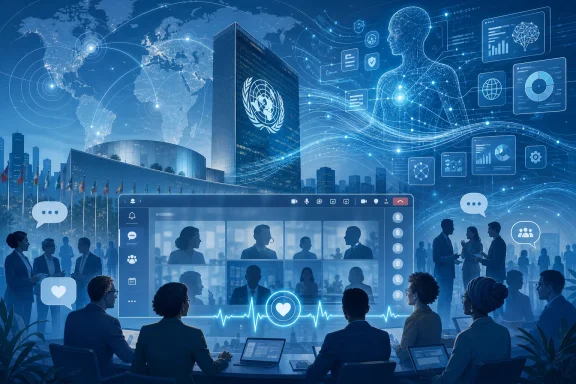 The UN Is Turning Digital Transformation Into an Institutional Fitness Test
UN 2.0 is the Secretary-General’s modernization programme for a “future-ready” United Nations, built around what the organization calls the Quintet of Change: data, digital, innovation, foresight, and behavioural science. That phrase has the slightly frictionless quality of institutional branding, but the underlying idea is concrete. The UN wants its agencies, country teams, missions, and headquarters offices to use evidence, technology, experimentation, future planning, and human-centred design as normal methods of work.The 2026 programme arrives at a revealing moment. The 2030 Sustainable Development Goals are not comfortably on track, and the global operating environment has become more volatile rather than less. Humanitarian crises, climate shocks, migration pressures, cyber risk, misinformation, and fiscal constraints are all pushing the UN toward faster coordination and better targeting.
That makes the Week’s “Pulse Check” opening more than ceremonial. A pulse check is a diagnostic, not a celebration. By framing the grand opening around where UN 2.0 is delivering change, where progress is uneven, and what needs to shift next, the organizers are acknowledging the central problem with public-sector modernization: success is uneven by default.
The featured opening lineup reinforces that point. Deputy Secretary-General Amina J. Mohammed brings system-wide authority, while speakers from UNECE, the Mexico Resident Coordinator’s office, the Executive Office of the Secretary-General, and the UN Mission in South Sudan represent the range from policy center to field reality. That spread matters because transformation that works in New York or Geneva can still collapse at the edge, where bandwidth, staffing, security, procurement, and political conditions are less forgiving.
The Calendar Tells a Story About Where the UN Thinks the Bottlenecks Are
The schedule from June 15 to June 18 is compact, but it is not random. Monday opens with diagnosis. Tuesday turns to digital systems and leadership. Wednesday moves into institutional adoption and strategic debate. Thursday ends with an awards ceremony designed to spotlight measurable innovation.That arc is the modernization playbook in miniature. First, decide whether the reform is real. Then examine the technology and the leadership model. Then confront the harder question of whether change survives beyond the pilot. Finally, reward the teams that have converted ideas into observable impact.
The Tuesday session, “Digital Solutions That Work for People,” is especially telling. It does not promise digital solutions that work for administrators, donors, dashboards, or public-relations decks. It claims the user as the test. In enterprise IT terms, that is the difference between deploying a platform and delivering a service.
The speaker list widens the aperture beyond the UN’s internal machinery. Lesotho’s technology minister, digital rights advocate Nighat Dad, Karya co-founder Safiya Husain, and Radiolab co-host Latif Nasser suggest a conversation about trust, access, data labour, storytelling, and public legitimacy. For an institution like the UN, those are not soft topics. They are the adoption layer.
Microsoft Teams Is the Venue, but the Real Platform Is Trust
It is easy for technologists to reduce a virtual programme to its collaboration stack. The sessions will be joined through Microsoft Teams, which tells us something about the default workplace tooling of large institutions but not much about whether the transformation will succeed. Teams can host the meeting; it cannot create the operating culture.Still, the use of a familiar enterprise platform is not irrelevant. For global organizations, collaboration technology has become the plumbing of institutional life. A virtual event lowers travel costs, broadens access, and gives geographically dispersed staff a common room. It also exposes the usual asymmetries: time zones, language, device access, network quality, and who feels comfortable speaking in a large digital forum.
The more important platform question is whether UN 2.0 creates trusted spaces for candid reporting. A modernization programme that only surfaces success stories will learn slowly. One that can discuss failed pilots, procurement delays, weak data governance, staff resistance, digital exclusion, and overhyped AI deployments will have a better chance of becoming real.
That is why the wording of the opening session matters. “Where progress is uneven” is bureaucratically polite, but it is also the phrase that carries the most weight. In a system as large and federated as the UN, unevenness is not a bug. It is the basic terrain.
AI Has Entered the Reform Agenda, but It Cannot Be Allowed to Own It
The programme’s references to AI are unsurprising in 2026, but the smarter reading is that AI is one strand of a broader capability agenda. The Wednesday “Big Debate” promises a discussion of innovation, AI, and transformation across the UN system. That ordering matters. AI is not being presented as a magic layer sprayed across broken processes; it is being placed inside a wider debate about institutional choices, tensions, and trade-offs.That is the right instinct. AI can accelerate document analysis, translation workflows, emergency response triage, satellite imagery interpretation, beneficiary feedback analysis, and internal knowledge retrieval. It can also amplify bad data, obscure accountability, leak sensitive information, and introduce vendor dependencies into politically delicate work.
For the UN, AI governance is not an abstract ethics exercise. It touches refugees, peacekeeping, sanctions, health systems, food security, human rights documentation, and climate adaptation. The stakes are higher than a productivity gain in a corporate back office.
The presence of a UN AI Scientific Panel member at the awards ceremony points to a maturing conversation. The question is no longer whether AI should appear in UN innovation portfolios. The question is how the UN distinguishes responsible operational use from fashionable automation, and how it proves that AI-enabled interventions improve outcomes without compromising rights.
“Making Change Stick” Is the Session Every CIO Should Watch
Wednesday’s “Making Change Stick” may be the most important session title in the programme. Every large organization has seen the pattern: a pilot launches with executive enthusiasm, a small team produces a promising prototype, a deck circulates, and then the real system absorbs the experiment without changing very much. The pilot becomes a proof of concept that proves mainly that the institution can stage a pilot.Making change stick means crossing the hostile middle distance between demonstration and default practice. That distance includes procurement rules, training capacity, cybersecurity review, legal sign-off, budget ownership, data-sharing agreements, help-desk support, management incentives, and staff time. None of these elements looks glamorous on a conference agenda, but each can kill reform.
The inclusion of Replit CEO Amjad Masad in this session is interesting because Replit represents a world in which software creation is becoming more accessible, collaborative, and AI-assisted. That is a provocative contrast with traditional institutional IT, where development cycles can be slow and heavily gated. The tension is obvious: how does a UN entity embrace faster building without losing control, security, accessibility, auditability, or multilingual inclusion?
Namibia’s ICT minister Emma Theofelus and EOSG strategic planning leadership bring the discussion back to public institutions. Digital change is not merely a developer workflow. It is a governance challenge, especially when the institution serves populations rather than customers.
The Reform Debate Is Really About Power, Not Just Process
“The Big Debate: A UN System of the Future” sounds broad, but the substance is likely to be sharper. The future UN system is not just a more digital version of the current one. If UN 2.0 succeeds, it changes who has information, who can act quickly, who sets standards, and who gets to decide what counts as evidence.Data capabilities can shift authority from hierarchy to insight, but only if leaders are willing to be challenged by the numbers. Digital platforms can scale services, but they can also centralize control. Innovation labs can empower local experimentation, but they can also become side rooms disconnected from core budgets.
These are political design questions disguised as management questions. A more data-driven UN may expose uncomfortable differences in performance between offices or regions. A more digital UN may require common architectures where agencies are accustomed to autonomy. A more innovative UN may demand tolerance for failure in a culture that is often punished by headlines, audits, and member-state scrutiny.
The speaker roster for the debate reflects those tensions. Senior reform leadership, regional commission leadership, and UN Women representation suggest that the discussion will not be limited to tooling. It will have to grapple with institutional architecture, equity, and the distribution of capability across the system.
Awards Are Symbolic, but Measurement Is the Substance
Thursday’s UN 2.0 Awards Ceremony could easily be dismissed as the celebratory endpoint of the week. That would be a mistake. In transformation programmes, awards are one of the few mechanisms leaders have for signalling what the organization actually values.The key phrase in the invitation is “measurable impact.” Innovation awards that reward novelty tend to produce novelty. Awards that reward measured improvements in delivery, inclusion, resilience, or efficiency can change incentives, especially if the winning teams become models that others can copy.
The lineup for the ceremony is heavy with senior leadership, including Secretary-General António Guterres, Guy Ryder, UNFPA leadership, UNDP’s chief digital officer, WFP’s chief data officer, resident coordinators, and UN Global Pulse. That mix points to a broader ambition: make data and digital reform visible not as a niche function but as a leadership priority.
The voting deadline of June 17 adds a participatory element, though the meaningful test will come after the ceremony. If the awards create a living catalogue of reusable approaches, they matter. If they merely produce applause for isolated teams, they become another institutional ritual.
The Most Important Word in UN 2.0 Is Not Digital
The UN 2.0 framework consistently pairs technology with culture, and that pairing is not decorative. Culture determines whether staff share data or hoard it, whether managers tolerate experimentation, whether failed pilots are studied or buried, and whether digital tools are designed around users or around reporting requirements.This is where many enterprise transformations go wrong. They begin with a platform and hope behavior will follow. In reality, behavior usually bends the platform back into old habits. A document-sharing system becomes a filing cabinet. A dashboard becomes a screenshot in a PowerPoint. A collaboration platform becomes another place where decisions are not made.
Behavioural science is therefore not an odd fifth wheel in the UN 2.0 model. It is the reminder that institutional outcomes are produced by people making choices under constraints. If staff are overloaded, undertrained, risk-averse, or unconvinced, even excellent tools will underperform.
Foresight plays a similar role. It pushes the organization to prepare for discontinuity rather than merely optimize yesterday’s processes. In a period defined by climate instability, conflict, pandemics, demographic shifts, AI acceleration, and geopolitical fragmentation, foresight is not a luxury for strategy retreats. It is part of operational readiness.
The SDG Clock Makes This More Than an Internal Reform Exercise
UN 2.0 is inseparable from the Sustainable Development Goals timeline. The 2030 deadline is close enough that incremental administrative improvement will not satisfy the rhetoric. If the UN wants to argue that modernization can accelerate results, it must show that new capabilities affect real programmes.That is why the Week’s external-facing tone matters. The programme is open virtually and framed around global conversations, practical learning, and collective action. This is not just internal staff development; it is a public claim about how a multilateral institution adapts under pressure.
The harder truth is that digital modernization cannot solve the political and financial constraints that surround the UN. Better data will not automatically unlock funding. AI will not create consensus among member states. Innovation labs will not erase conflict, inequality, or climate damage.
But modernization can still matter enormously. It can reduce waste, reveal need faster, improve targeting, strengthen accountability, and help field teams share what works. In a system where small delays and coordination failures can have human consequences, operational competence is not a back-office concern.
The Enterprise IT Lesson Is Hiding in Plain Sight
For sysadmins, CIOs, digital transformation leads, and Windows-heavy enterprise teams, UN 2.0 Week offers a familiar pattern at unusual scale. The UN is wrestling with the same modernization dilemmas that face hospitals, universities, governments, and multinational companies. The acronyms differ; the pain points rhyme.There is the problem of fragmented data. There is the challenge of moving from local heroics to common platforms. There is the need to balance autonomy with interoperability. There is the risk of buying tools faster than organizations can absorb them.
There is also the governance tension around AI. Who approves models? Where does sensitive data go? What audit trail is required? How do staff know when an AI-assisted output is good enough, and who remains accountable when it is not?
These are not merely UN questions. They are 2026 enterprise questions. The UN’s version is more politically complex, but that complexity makes it a useful mirror for everyone else.
The UN 2.0 Test Will Be Passed in Boring Places
The most decisive work will not happen on the public stage during the Week. It will happen afterward in training plans, budget memos, data governance boards, procurement reforms, field-office workflows, cybersecurity reviews, and communities of practice. Transformation becomes real when it changes the boring places.That does not make the Week unimportant. Convenings can create shared language, surface champions, spread examples, and give leadership permission to push. They can also reveal whether a reform agenda has become performative or practical.
The sessions from June 15 to June 18 have the bones of a serious programme because they move from diagnosis to people-centred digital systems, leadership, institutionalization, debate, and recognition. That is the right sequence. The risk is that the week generates inspiration faster than implementation capacity.
A mature UN 2.0 agenda will need to be ruthless about reuse. Every successful tool, method, training module, governance pattern, and partnership model should be treated as infrastructure for the next team. Otherwise, innovation remains artisanal: impressive, local, and hard to scale.
The Week’s Real Agenda Fits on One Page, Not One Platform
The immediate value of UN 2.0 Week is not that it gives participants a calendar of Teams meetings. It is that it gives the UN system a compact stress test of its modernization narrative. If the sessions are candid, practical, and grounded in evidence, they can sharpen the next phase of reform.- UN 2.0 Week runs virtually from June 15 to June 19, 2026, with main sessions scheduled from June 15 to June 18 and global side events on June 19.
- The programme is built around the UN’s broader modernization push: data, digital, innovation, foresight, behavioural science, and the organizational culture needed to make those capabilities stick.
- The strongest sessions are the ones that confront uneven progress, user trust, AI trade-offs, and the gap between pilots and durable institutional change.
- Microsoft Teams is the access layer for the sessions, but the real test is whether collaboration, data governance, and digital delivery improve across the UN system after the event ends.
- The awards ceremony will matter only if “measurable impact” becomes a reusable model for other teams rather than a one-hour celebration of isolated successes.
References
- Primary source: Welcome to the United Nations
Published: 2026-06-12T12:42:12.692011
- Related coverage: un-two-zero-week.org
UN 2.0 Week
UN 2.0 Week returns for its third edition and will bring thousands of colleagues together for a week of conversations, showcases, and community moments exploring how new capabilities are transforming the way we work and deliver impact. www.un-two-zero-week.org