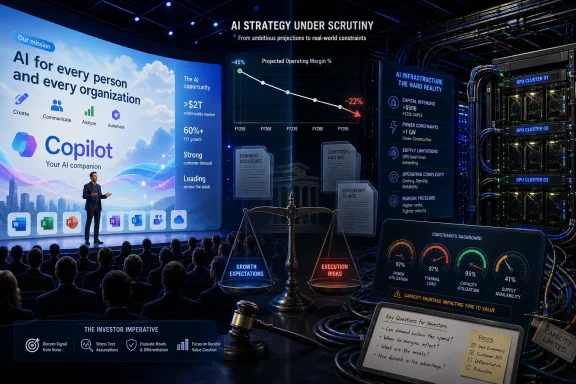
Microsoft was hit on June 12, 2026, with a securities class action alleging it misled investors about Copilot’s adoption and technical challenges while pouring capital into AI infrastructure and managing Azure capacity constraints. The case may or may not survive the procedural gauntlet that awaits nearly every securities complaint. But for Microsoft investors, the filing lands because it turns a familiar market worry into a sharper question: is AI capex being spent ahead of demand, or in defense of a product narrative that has not yet earned its valuation?
That is the real significance of the Copilot lawsuit. It does not prove that Microsoft’s AI strategy is broken, and it certainly does not erase the company’s enormous advantages in cloud, productivity software, enterprise identity, security, and developer tooling. What it does is force the bull case to become more precise. If Copilot is the visible interface for Microsoft’s AI monetization story, then adoption quality, user trust, infrastructure availability, and capital intensity are no longer separate debates. They are the same debate.
The securities complaint reportedly alleges that Microsoft and certain executives overstated or failed to adequately disclose difficulties around Copilot, including product experience, brand confusion, data silos, interoperability, and the challenge of converting AI enthusiasm into sustained enterprise usage. Those are not exotic complaints for anyone who has deployed AI tooling inside a real organization. They are the mundane frictions that separate a demo from a durable line item in the IT budget.
That distinction matters because Microsoft’s AI story has been marketed less as a speculative moonshot than as an extension of products customers already use. Copilot is not a consumer gadget sitting outside the Microsoft stack; it is being threaded through Microsoft 365, Windows, GitHub, Dynamics, Power Platform, Security, and Azure. The pitch is that AI becomes more valuable because it is embedded where work already happens.
The lawsuit challenges the confidence of that embedding story. A user who does not trust Copilot’s answer, cannot reach the relevant data, or finds the experience inconsistent is not merely a disappointed beta tester. In Microsoft’s investment narrative, that user is a missing proof point for why the company should spend tens or hundreds of billions of dollars scaling AI infrastructure.
Securities litigation is often noisy at the outset. Complaints are written to survive dismissal, and allegations are not findings of fact. Still, the timing is awkward for Microsoft because investors are already trying to answer whether AI spending is disciplined platform investment or the newest form of technology-industry overbuild.
That is why Copilot adoption is more than a product metric. It is the bridge between capital expenditure and future cash flow. Microsoft can tell investors that GPUs, data centers, networking gear, power contracts, and model-serving costs are necessary because AI demand is already arriving through Microsoft 365 seats, Azure consumption, GitHub subscriptions, and security workloads.
The problem is that the bridge has to carry real weight. Early trials, executive excitement, and large announced deployments can coexist with day-to-day user reluctance. Enterprise software has always had a gap between licenses sold and software loved, but AI makes that gap harder to ignore because the cost to serve the product is unusually high.
A traditional productivity feature can sit idle without consuming much incremental infrastructure. An AI assistant that users actually invoke at scale consumes compute every time it reasons, summarizes, searches, drafts, or automates. That makes the quality of usage crucial. Microsoft does not just need Copilot to be bought; it needs Copilot to be used in ways that justify pricing, renewals, and the hardware bill behind the curtain.
On the bearish side, capacity constraints complicate the basic investor promise that massive spending can quickly unlock massive growth. If Microsoft cannot bring capacity online fast enough, revenue is deferred. If it brings too much online too quickly, utilization and margins become the problem. If it prioritizes first-party Copilot workloads over third-party Azure customers, the internal economics become harder for outsiders to evaluate.
This is where the Copilot lawsuit intersects with capex. The central market worry is not merely that Microsoft is spending a lot. Microsoft has spent heavily before and emerged stronger. The worry is that AI infrastructure is less forgiving than past cloud expansion because the chips are expensive, depreciation schedules are unforgiving, power constraints are real, and model economics remain unsettled.
Microsoft’s management has argued that AI demand is broad and that infrastructure investment is necessary to meet it. That may be true. But the lawsuit gives skeptical investors a legal vocabulary for asking whether the company’s public optimism gave enough weight to product maturity, adoption friction, and the cost of turning AI capacity into profitable usage.
That deployment makes the opportunity tangible. Healthcare is drowning in administrative work, and the promise of AI assistance with meeting notes, document drafting, data analysis, discharge paperwork, briefings, and operational coordination is obvious. If Copilot can save meaningful time at scale, the value proposition becomes more than Silicon Valley abstraction.
But the NHS deal also illustrates the execution risk that the lawsuit is trying to spotlight. A half-million-seat rollout is not simply a procurement win; it is a governance challenge. Healthcare data is sensitive, workflows are uneven, staff training varies, and trust failures can become political failures. In that environment, Copilot has to be useful, secure, explainable enough for institutional comfort, and mundane enough to fit daily work.
This is why investors should resist the temptation to treat large deployments as clean evidence that the Copilot debate is settled. Big contracts show demand. They do not automatically show sustained usage, productivity gains, renewal willingness, or attractive margins after compute costs. In the AI era, a press release is the beginning of the story, not the end.
That breadth gives Microsoft several ways to win. If Microsoft 365 Copilot adoption is slower than hoped, Azure AI consumption may still grow. If general-purpose assistants disappoint some users, coding copilots or security copilots may deliver clearer productivity returns. If one model supplier becomes less attractive, Microsoft can route workloads across different models and optimize for cost, latency, compliance, or quality.
The breadth also creates a measurement problem. Investors want a clean AI revenue number, but Microsoft’s AI monetization is increasingly blended into cloud consumption, seat expansion, premium SKUs, and retention. That makes the story harder to falsify in the short term. It also makes disclosure discipline more important, because management commentary becomes the lens through which the market interprets a very complicated machine.
The lawsuit’s implied challenge is that Microsoft’s AI narrative may have become too smooth for the underlying complexity. Enterprise AI adoption is not a straight line from demo to deployment to productivity. It is a messy loop of data readiness, permissioning, training, prompt behavior, governance, user habit, cost control, and business-process redesign.
Microsoft’s bull case assumes the first shape. Under that version, AI becomes a premium layer across the enterprise stack. Customers pay more for Microsoft 365, consume more Azure, build more applications on Microsoft tools, and consolidate around vendors that can handle security, identity, compliance, and scale. Capex is front-loaded, but the resulting platform becomes stronger.
The bear case assumes something closer to the second shape. Enterprises experiment widely, but many users do not change habits. Competing models pressure pricing. Open-source and specialized tools reduce differentiation. AI features become table stakes rather than durable pricing power. In that scenario, Microsoft may still grow, but the return on incremental AI infrastructure is less spectacular than the stock once implied.
The Copilot lawsuit matters because it aims at the seam between those two worlds. If plaintiffs can argue that Microsoft knew Copilot faced material adoption and technical issues while presenting a more confident public narrative, then the legal case becomes a proxy for a market argument investors were already having.
Copilot could follow that path. A product that feels uneven in 2026 may be meaningfully better in 2027, especially as models improve, retrieval systems mature, and organizations clean up the data permissions that AI assistants expose. Microsoft has the patience, distribution, and cash flow to iterate through awkward early phases that would kill smaller companies.
But AI taxes the old playbook in two important ways. First, the product experience is more visible because users compare Copilot not only with older Office features but with ChatGPT, Claude, Gemini, and specialized AI tools they may use outside corporate boundaries. Second, the infrastructure cost is more immediate. A mediocre AI feature is not merely a reputational problem; it can be a margin problem.
That means Microsoft cannot rely solely on enterprise inertia. It needs genuine usefulness. It needs administrators to believe the governance model is safe. It needs finance chiefs to see measurable productivity. And it needs users to come back because the tool saves time, not because the icon is hard to avoid.
That does not mean damaging evidence exists. It means the lawsuit raises the stakes around internal metrics. Copilot seat sales, active usage, renewal rates, prompt volume, customer satisfaction, infrastructure allocation, margin profile, and support issues all become more important. The market will care less about whether Microsoft can announce another deployment and more about whether those deployments mature into profitable, sticky usage.
This is a healthy shift. The AI boom has rewarded companies for sounding capacity-constrained, partner-rich, and strategically inevitable. The next phase will reward companies that can show unit economics, repeat usage, and defensible distribution. Microsoft is better positioned than almost anyone for that phase, but it is not exempt from it.
The company’s sheer size also changes the burden of proof. A startup can sell a vision. Microsoft has to sell a vision while protecting Windows, Office, Azure, security, gaming, LinkedIn, and developer trust. Its AI story is not allowed to be merely exciting; it has to be operationally boring in the way enterprise IT prefers.
The key denominator is not total announced AI spending. It is return per dollar of AI infrastructure. Investors need to know whether new capacity produces high-value enterprise workloads, low-margin model serving, internal Copilot costs, or some mix that is difficult to separate. Each category deserves a different multiple.
Another denominator is usage per paid seat. Microsoft can sell Copilot through enterprise agreements, but long-term value depends on whether employees use it often enough for customers to renew, expand, and tolerate premium pricing. In software, shelfware is survivable when gross margins are enormous. In AI software, shelfware becomes more awkward when the vendor is simultaneously building data centers to support usage that may not arrive as quickly as forecast.
The final denominator is time. Capex happens now; depreciation, power costs, and supply commitments follow; revenue ramps later if customers adopt. That timing mismatch is tolerable when investors trust management’s visibility. A lawsuit alleging that visibility was less clear than advertised does not have to win in court to affect the multiple investors are willing to pay.
That creates practical consequences. IT departments must decide when to enable Copilot, how to govern access, how to train users, and how to measure whether the tool helps. Security teams must think about oversharing, prompt injection, retention, auditability, and the uncomfortable fact that AI assistants can make existing permission mistakes more visible and more consequential.
End users face a different issue: the creeping conversion of software from deterministic tools into probabilistic collaborators. That can be powerful. It can also be maddening when the assistant is confidently wrong, slow, too cautious, too chatty, or unable to access the one document that would make it useful.
Microsoft’s capex narrative therefore flows directly into product experience. If the company spends aggressively and delivers fast, reliable, well-integrated AI, Windows and Microsoft 365 may feel meaningfully more capable. If it spends aggressively but the user experience remains uneven, customers may see more upsell pressure than productivity.
The AI buildout resembles the cloud transition in that Microsoft is spending ahead of demand and asking investors to underwrite infrastructure before the payoff is fully visible. The company is also using a familiar enterprise adoption model: land, expand, integrate, and renew. Those parallels support the bull case.
The flaw in the analogy is that cloud computing replaced a large amount of existing enterprise infrastructure spending. Customers could move workloads from their own servers to Azure and often tell a clear story about elasticity, reliability, and operating-model change. Generative AI is different. It may create new productivity, but it also creates new consumption that did not previously exist.
That difference makes ROI harder to prove. A migrated workload has a baseline. A generated summary, drafted email, automated workflow, or AI-assisted investigation may save time, but measuring that value across thousands of employees is messy. Microsoft’s challenge is to make Copilot feel less like a clever feature and more like measurable infrastructure for work.
Microsoft is unusually resilient, but it is also unusually visible. Its statements set expectations for the broader market. If Microsoft says AI demand is outrunning supply, investors listen. If Microsoft’s flagship AI assistant is alleged to have encountered adoption and technical challenges that were not fully reflected in public messaging, investors will listen to that too.
The next few quarters should therefore be judged less by slogans and more by operating signals.
That is the real significance of the Copilot lawsuit. It does not prove that Microsoft’s AI strategy is broken, and it certainly does not erase the company’s enormous advantages in cloud, productivity software, enterprise identity, security, and developer tooling. What it does is force the bull case to become more precise. If Copilot is the visible interface for Microsoft’s AI monetization story, then adoption quality, user trust, infrastructure availability, and capital intensity are no longer separate debates. They are the same debate.
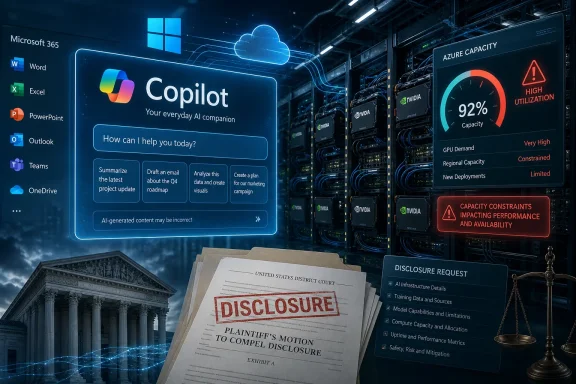 The Lawsuit Turns AI Optimism Into a Disclosure Problem
The securities complaint reportedly alleges that Microsoft and certain executives overstated or failed to adequately disclose difficulties around Copilot, including product experience, brand confusion, data silos, interoperability, and the challenge of converting AI enthusiasm into sustained enterprise usage. Those are not exotic complaints for anyone who has deployed AI tooling inside a real organization. They are the mundane frictions that separate a demo from a durable line item in the IT budget.That distinction matters because Microsoft’s AI story has been marketed less as a speculative moonshot than as an extension of products customers already use. Copilot is not a consumer gadget sitting outside the Microsoft stack; it is being threaded through Microsoft 365, Windows, GitHub, Dynamics, Power Platform, Security, and Azure. The pitch is that AI becomes more valuable because it is embedded where work already happens.
The lawsuit challenges the confidence of that embedding story. A user who does not trust Copilot’s answer, cannot reach the relevant data, or finds the experience inconsistent is not merely a disappointed beta tester. In Microsoft’s investment narrative, that user is a missing proof point for why the company should spend tens or hundreds of billions of dollars scaling AI infrastructure.
Securities litigation is often noisy at the outset. Complaints are written to survive dismissal, and allegations are not findings of fact. Still, the timing is awkward for Microsoft because investors are already trying to answer whether AI spending is disciplined platform investment or the newest form of technology-industry overbuild.
Copilot Was Supposed to Make the Capex Story Easy
Microsoft’s best AI argument has always been beautifully simple: the company owns the workplace surface area, the cloud substrate, the developer ecosystem, and the enterprise sales channel. If generative AI becomes a paid productivity layer across knowledge work, Microsoft should be one of the biggest beneficiaries. Copilot is the product name attached to that thesis.That is why Copilot adoption is more than a product metric. It is the bridge between capital expenditure and future cash flow. Microsoft can tell investors that GPUs, data centers, networking gear, power contracts, and model-serving costs are necessary because AI demand is already arriving through Microsoft 365 seats, Azure consumption, GitHub subscriptions, and security workloads.
The problem is that the bridge has to carry real weight. Early trials, executive excitement, and large announced deployments can coexist with day-to-day user reluctance. Enterprise software has always had a gap between licenses sold and software loved, but AI makes that gap harder to ignore because the cost to serve the product is unusually high.
A traditional productivity feature can sit idle without consuming much incremental infrastructure. An AI assistant that users actually invoke at scale consumes compute every time it reasons, summarizes, searches, drafts, or automates. That makes the quality of usage crucial. Microsoft does not just need Copilot to be bought; it needs Copilot to be used in ways that justify pricing, renewals, and the hardware bill behind the curtain.
Azure Capacity Constraints Cut Both Ways
Microsoft’s Azure capacity constraints have been one of the strangest signals in the AI cycle because they can be read as both bullish and bearish. On the bullish side, constrained capacity suggests demand is real enough to exceed available supply. In a world where enterprises are racing to integrate AI, running out of capacity can look like a high-class problem.On the bearish side, capacity constraints complicate the basic investor promise that massive spending can quickly unlock massive growth. If Microsoft cannot bring capacity online fast enough, revenue is deferred. If it brings too much online too quickly, utilization and margins become the problem. If it prioritizes first-party Copilot workloads over third-party Azure customers, the internal economics become harder for outsiders to evaluate.
This is where the Copilot lawsuit intersects with capex. The central market worry is not merely that Microsoft is spending a lot. Microsoft has spent heavily before and emerged stronger. The worry is that AI infrastructure is less forgiving than past cloud expansion because the chips are expensive, depreciation schedules are unforgiving, power constraints are real, and model economics remain unsettled.
Microsoft’s management has argued that AI demand is broad and that infrastructure investment is necessary to meet it. That may be true. But the lawsuit gives skeptical investors a legal vocabulary for asking whether the company’s public optimism gave enough weight to product maturity, adoption friction, and the cost of turning AI capacity into profitable usage.
NHS England Shows the Opportunity Is Not Imaginary
The most important counterweight to the bear case is that Microsoft keeps landing the kind of deployments that only a company with its enterprise reach can plausibly win. NHS England’s plan to provide Microsoft 365 Copilot access to roughly 505,000 clinicians and support staff by October 2026 is not a boutique pilot or a laboratory exercise. It is a national-scale productivity bet inside one of the world’s most complex public-sector organizations.That deployment makes the opportunity tangible. Healthcare is drowning in administrative work, and the promise of AI assistance with meeting notes, document drafting, data analysis, discharge paperwork, briefings, and operational coordination is obvious. If Copilot can save meaningful time at scale, the value proposition becomes more than Silicon Valley abstraction.
But the NHS deal also illustrates the execution risk that the lawsuit is trying to spotlight. A half-million-seat rollout is not simply a procurement win; it is a governance challenge. Healthcare data is sensitive, workflows are uneven, staff training varies, and trust failures can become political failures. In that environment, Copilot has to be useful, secure, explainable enough for institutional comfort, and mundane enough to fit daily work.
This is why investors should resist the temptation to treat large deployments as clean evidence that the Copilot debate is settled. Big contracts show demand. They do not automatically show sustained usage, productivity gains, renewal willingness, or attractive margins after compute costs. In the AI era, a press release is the beginning of the story, not the end.
The AI Footprint Is Broader Than One Assistant
Microsoft is not a one-product AI company, and that is the strongest reason the lawsuit may have limited long-term effect on the stock’s fundamental story. Copilot may be the most visible brand, but the company’s AI exposure runs through Azure OpenAI Service, GitHub Copilot, Security Copilot, Dynamics, Power Platform, healthcare partnerships, industry clouds, developer tools, and custom enterprise deployments.That breadth gives Microsoft several ways to win. If Microsoft 365 Copilot adoption is slower than hoped, Azure AI consumption may still grow. If general-purpose assistants disappoint some users, coding copilots or security copilots may deliver clearer productivity returns. If one model supplier becomes less attractive, Microsoft can route workloads across different models and optimize for cost, latency, compliance, or quality.
The breadth also creates a measurement problem. Investors want a clean AI revenue number, but Microsoft’s AI monetization is increasingly blended into cloud consumption, seat expansion, premium SKUs, and retention. That makes the story harder to falsify in the short term. It also makes disclosure discipline more important, because management commentary becomes the lens through which the market interprets a very complicated machine.
The lawsuit’s implied challenge is that Microsoft’s AI narrative may have become too smooth for the underlying complexity. Enterprise AI adoption is not a straight line from demo to deployment to productivity. It is a messy loop of data readiness, permissioning, training, prompt behavior, governance, user habit, cost control, and business-process redesign.
Investors Are Really Litigating the Shape of Demand
The capex question is often framed as a number: $100 billion, $150 billion, $190 billion, or whatever the current estimate happens to be. But the more important issue is the shape of demand. Is AI demand broad, recurring, high-margin, and embedded? Or is it bursty, experimental, compute-hungry, and vulnerable to pricing pressure?Microsoft’s bull case assumes the first shape. Under that version, AI becomes a premium layer across the enterprise stack. Customers pay more for Microsoft 365, consume more Azure, build more applications on Microsoft tools, and consolidate around vendors that can handle security, identity, compliance, and scale. Capex is front-loaded, but the resulting platform becomes stronger.
The bear case assumes something closer to the second shape. Enterprises experiment widely, but many users do not change habits. Competing models pressure pricing. Open-source and specialized tools reduce differentiation. AI features become table stakes rather than durable pricing power. In that scenario, Microsoft may still grow, but the return on incremental AI infrastructure is less spectacular than the stock once implied.
The Copilot lawsuit matters because it aims at the seam between those two worlds. If plaintiffs can argue that Microsoft knew Copilot faced material adoption and technical issues while presenting a more confident public narrative, then the legal case becomes a proxy for a market argument investors were already having.
The Old Microsoft Playbook Still Works, But AI Taxes It
Microsoft’s historic enterprise playbook is brutally effective. Bundle strategically, integrate deeply, sell through trusted channels, improve relentlessly, and let procurement gravity do the rest. Teams did not need to be beloved by every user to become entrenched. SharePoint survived decades of jokes because it solved enough institutional problems and sat inside enough enterprise agreements.Copilot could follow that path. A product that feels uneven in 2026 may be meaningfully better in 2027, especially as models improve, retrieval systems mature, and organizations clean up the data permissions that AI assistants expose. Microsoft has the patience, distribution, and cash flow to iterate through awkward early phases that would kill smaller companies.
But AI taxes the old playbook in two important ways. First, the product experience is more visible because users compare Copilot not only with older Office features but with ChatGPT, Claude, Gemini, and specialized AI tools they may use outside corporate boundaries. Second, the infrastructure cost is more immediate. A mediocre AI feature is not merely a reputational problem; it can be a margin problem.
That means Microsoft cannot rely solely on enterprise inertia. It needs genuine usefulness. It needs administrators to believe the governance model is safe. It needs finance chiefs to see measurable productivity. And it needs users to come back because the tool saves time, not because the icon is hard to avoid.
The Legal Threat Is Secondary to the Discovery Threat
For most investors, the direct financial risk of a securities class action is probably not the main issue. Microsoft is one of the world’s most profitable companies, and litigation can take years. The larger risk is informational: litigation can surface documents, testimony, and timelines that sharpen market understanding of what executives knew, when they knew it, and how they described it externally.That does not mean damaging evidence exists. It means the lawsuit raises the stakes around internal metrics. Copilot seat sales, active usage, renewal rates, prompt volume, customer satisfaction, infrastructure allocation, margin profile, and support issues all become more important. The market will care less about whether Microsoft can announce another deployment and more about whether those deployments mature into profitable, sticky usage.
This is a healthy shift. The AI boom has rewarded companies for sounding capacity-constrained, partner-rich, and strategically inevitable. The next phase will reward companies that can show unit economics, repeat usage, and defensible distribution. Microsoft is better positioned than almost anyone for that phase, but it is not exempt from it.
The company’s sheer size also changes the burden of proof. A startup can sell a vision. Microsoft has to sell a vision while protecting Windows, Office, Azure, security, gaming, LinkedIn, and developer trust. Its AI story is not allowed to be merely exciting; it has to be operationally boring in the way enterprise IT prefers.
The Stock Narrative Needs Fewer Adjectives and More Denominators
Simply Wall St’s framing captures the investor dilemma neatly: Microsoft’s existing narrative already assumes substantial revenue and earnings growth by 2029, with AI and Azure doing much of the work. Optimistic models go further, imagining even larger revenue and earnings outcomes if AI adoption scales and capex produces the expected returns. The lawsuit does not destroy those models, but it attacks the assumptions that make them comfortable.The key denominator is not total announced AI spending. It is return per dollar of AI infrastructure. Investors need to know whether new capacity produces high-value enterprise workloads, low-margin model serving, internal Copilot costs, or some mix that is difficult to separate. Each category deserves a different multiple.
Another denominator is usage per paid seat. Microsoft can sell Copilot through enterprise agreements, but long-term value depends on whether employees use it often enough for customers to renew, expand, and tolerate premium pricing. In software, shelfware is survivable when gross margins are enormous. In AI software, shelfware becomes more awkward when the vendor is simultaneously building data centers to support usage that may not arrive as quickly as forecast.
The final denominator is time. Capex happens now; depreciation, power costs, and supply commitments follow; revenue ramps later if customers adopt. That timing mismatch is tolerable when investors trust management’s visibility. A lawsuit alleging that visibility was less clear than advertised does not have to win in court to affect the multiple investors are willing to pay.
Windows Users Should Care Because AI Spending Shapes the Product
For WindowsForum readers, this is not just a Wall Street story. Microsoft’s AI spending priorities are already reshaping the products people administer, secure, troubleshoot, and use every day. Copilot is no longer a sidebar experiment; it is a design principle that influences Windows, Microsoft 365, Edge, Teams, developer tools, and security operations.That creates practical consequences. IT departments must decide when to enable Copilot, how to govern access, how to train users, and how to measure whether the tool helps. Security teams must think about oversharing, prompt injection, retention, auditability, and the uncomfortable fact that AI assistants can make existing permission mistakes more visible and more consequential.
End users face a different issue: the creeping conversion of software from deterministic tools into probabilistic collaborators. That can be powerful. It can also be maddening when the assistant is confidently wrong, slow, too cautious, too chatty, or unable to access the one document that would make it useful.
Microsoft’s capex narrative therefore flows directly into product experience. If the company spends aggressively and delivers fast, reliable, well-integrated AI, Windows and Microsoft 365 may feel meaningfully more capable. If it spends aggressively but the user experience remains uneven, customers may see more upsell pressure than productivity.
The Cloud Boom Is a Useful Analogy With One Big Flaw
Microsoft has earned investor patience before. Azure required years of investment before it became the growth engine that transformed Microsoft’s valuation. Office 365 involved a painful transition from packaged software to subscriptions. The company has repeatedly shown that it can endure margin pressure when the destination is strategically sound.The AI buildout resembles the cloud transition in that Microsoft is spending ahead of demand and asking investors to underwrite infrastructure before the payoff is fully visible. The company is also using a familiar enterprise adoption model: land, expand, integrate, and renew. Those parallels support the bull case.
The flaw in the analogy is that cloud computing replaced a large amount of existing enterprise infrastructure spending. Customers could move workloads from their own servers to Azure and often tell a clear story about elasticity, reliability, and operating-model change. Generative AI is different. It may create new productivity, but it also creates new consumption that did not previously exist.
That difference makes ROI harder to prove. A migrated workload has a baseline. A generated summary, drafted email, automated workflow, or AI-assisted investigation may save time, but measuring that value across thousands of employees is messy. Microsoft’s challenge is to make Copilot feel less like a clever feature and more like measurable infrastructure for work.
The Court Filing Is a Warning Label on the AI Supercycle
The most concrete lesson from the Copilot lawsuit is not that Microsoft is uniquely exposed. It is that the entire AI infrastructure supercycle is entering a more adversarial phase. Investors, regulators, customers, and plaintiffs’ firms are all beginning to ask whether AI claims are specific enough, whether risks are disclosed clearly enough, and whether capital spending is being justified by evidence rather than narrative momentum.Microsoft is unusually resilient, but it is also unusually visible. Its statements set expectations for the broader market. If Microsoft says AI demand is outrunning supply, investors listen. If Microsoft’s flagship AI assistant is alleged to have encountered adoption and technical challenges that were not fully reflected in public messaging, investors will listen to that too.
The next few quarters should therefore be judged less by slogans and more by operating signals.
- Microsoft needs to show that Copilot deployments are translating into recurring, active, paid usage rather than headline seat counts alone.
- Azure growth needs to demonstrate that capacity additions are relieving constraints without creating underutilized infrastructure.
- Enterprise customers need clearer evidence that Copilot produces measurable productivity gains after training, governance, and support costs are included.
- Microsoft’s AI gross margin story needs to become easier to understand as model serving, first-party workloads, and third-party Azure consumption scale together.
- Large public-sector rollouts such as NHS England’s will become proof points only if they produce credible evidence of adoption, savings, and operational trust.
References
- Primary source: simplywall.st
Published: Sat, 13 Jun 2026 17:36:21 GMT
Can Microsoft’s Copilot Lawsuit Reframe the AI Capex Narrative for MSFT Investors? - Simply Wall St News
In recent weeks Microsoft has faced a new securities class action alleging it misled investors about Copilot’s technical and adoption challenges, even as it redirected compute and billions of dollars of capital expenditure toward AI and disclosed capacity constraints in Azure. At the same time...simplywall.st - Related coverage: resultsense.com

505,000 NHS staff to get Microsoft Copilot to cut admin
NHS England will roll out Microsoft 365 Copilot to 505,000 staff after a trial saved 43 minutes a day, freeing clinicians for patient care by October 2026.www.resultsense.com
- Related coverage: theregister.com

NHS prescribes half a million Copilot licenses for its paperwork headache
After a trial claimed chatbot saved staff 43 minutes a day, NHS England has decided it's time to supersize the experimentwww.theregister.com - Related coverage: venturebeat.com

Microsoft Copilot ignored sensitivity labels twice in eight months — and no DLP stack caught either one | VentureBeat
Microsoft's CW1226324 advisory confirms Copilot bypassed sensitivity labels and DLP policies for four weeks. Combined with EchoLeak (CVE-2025-32711), it reveals a structural blind spot in enterprise security stacks — and a five-point audit framework to close it.venturebeat.com - Related coverage: fool.com

Microsoft's Capex Spending for 2026 Is 23% Higher Than What Analysts Were Expecting. The Problem Is Rising Memory Prices | The Motley Fool
Microsoft plans to spend $190 billion on capex this year.www.fool.com - Related coverage: windowsforum.com

NHS England Rolls Out Microsoft 365 Copilot: Time-Saving AI for Admin Work | Windows Forum
NHS England has announced a national rollout of Microsoft 365 Copilot to 505,000 clinicians and support staff, giving workers across English trusts access...windowsforum.com
- Related coverage: computersweden.se

Sjukvården i England rullar ut Copilot till en halv miljon vårdanställda | Computer Sweden
Enligt NHS England kan verktyget spara i genomsnitt 43 minuter per anställd och dag.computersweden.se
- Related coverage: windowscentral.com

Ex-Microsoft exec says the company blew it with AI, as it did with mobile — "Not even 3% of paying Copilot users use it even when it's pre-deployed right in their faces." | Windows Central
Microsoft might have missed the AI wave, with Copilot adoption stuck at just 3%.www.windowscentral.com - Related coverage: forbes.com.br

A Queda de 36% das Ações da Microsoft Revela um Problema Mais Profundo na IA
Empresa enfrenta ceticismo em relação aos elevados investimentos em inteligência artificial e ao baixo retorno do Copilot forbes.com.br
- Related coverage: itbusinesstoday.com

Microsoft’s AI Push Hits Trouble as Copilot Adoption Falters
Microsoft's ambitious AI strategy faces challenges as customer adoption slows and investors grow skeptical about its growth potential.itbusinesstoday.com - Related coverage: tomshardware.com

Microsoft's massive Kenya AI data center would require switching off 'half the country' to meet power requirements, government says — $1 billion project stalls over capacity disagreements and lack of infrastructure | Tom's Hardware
\u201cWe would need to switch off half the country for the data center to be powered."www.tomshardware.com - Related coverage: techradar.com

Microsoft forced to up AI spending by $25 billion to cover hardware price rises — says it 'remains confident in the return on these investments' | TechRadar
Microsoft capex is being hit by rising priceswww.techradar.com - Related coverage: nextepinvestimentos.com.br
Microsoft’s Pivotal AI Product Is Running Into Big Problems - WSJ
PDF documentnextepinvestimentos.com.br
- Official source: fpc.microsoft.com
- Related coverage: classaction.org

Class Action Alleges Artificial Intelligence Co. C3.ai Misled Investors Prior to IPO
A class action alleges enterprise artificial intelligence provider C3.ai misled investors by failing to disclose prior to its IPO that a key business partnership was www.classaction.org
- Related coverage: globenewswire.com
RR FINAL DEADLINE ALERT: Richtech Robotics (RR) Investors
Investors who lost money in RR after its stock plunged due to allegedly misleading financial statements are urged to contact Hagens Berman....www.globenewswire.com - Related coverage: ad-hoc-news.de

Microsoft Stock Caught Between Copilot Lawsuit and Xbox Speculation
Shareholder class action targets Copilot AI monetization claims; Microsoft weighs options for struggling Xbox division amid 16% stock slump.www.ad-hoc-news.de