

Google Chrome’s CVE-2026-11676 was published on June 8, 2026, as a high-severity Dawn vulnerability affecting Linux and ChromeOS before Chrome 149.0.7827.103, with NVD later adding a CPE configuration that appears narrower and messier than the plain-language advisory suggests. The uncomfortable answer is that, yes, the record probably deserves a second look. The more important answer is that this is exactly the kind of metadata wrinkle that makes browser patch compliance harder than it should be.
The bug itself is not the kind of Chrome flaw that lends itself to dramatic one-line summaries. It is an input-validation failure in Dawn, Chromium’s implementation layer for modern GPU-facing web graphics, and it matters because the stated attacker model begins after a renderer compromise. That makes CVE-2026-11676 a second-stage problem: not “visit page, own machine” by itself, but “visit page, renderer is already compromised, now try to cross the sandbox boundary.”
That distinction is not a comfort blanket. Browser security is built on layers, and sandbox escapes are the cracks between those layers. When a vulnerability sits in a component like Dawn, on platforms like Linux and ChromeOS, the practical question for defenders is not whether the CVE sounds exotic. It is whether the asset inventory, vulnerability scanner, and patch policy all agree about what “affected” means.
The description says Google Chrome on Linux and ChromeOS prior to 149.0.7827.103 is affected. The NVD change history, however, shows a CPE configuration that excludes Chrome versions up to 149.0.7827.102 and then pairs that application CPE with operating-system CPEs for ChromeOS and the Linux kernel.
That is a small line-item detail with a large operational shadow. A scanner that trusts the CPE boundary literally may treat 149.0.7827.102 differently from 149.0.7827.103. A security engineer reading the prose may conclude that anything below .103 is in scope. A desktop administrator looking at the Chrome release notes may see platform-specific stable builds and wonder whether Linux’s fixed version is .102 while the CVE prose says .103.
This is the old browser-vulnerability problem in modern clothes. Chrome versioning is cross-platform in branding but not always identical in package reality. Windows, macOS, Linux, and ChromeOS can receive nearby but distinct build numbers, and security advisories often summarize the fixed train in a way that compresses those differences. CPEs, by contrast, are supposed to be machine-readable and unforgiving.
That is why the “Are we missing a CPE?” prompt on NVD pages is more than boilerplate here. The record may not be missing a CPE so much as exposing a mismatch between human-readable vulnerability scope and machine-readable platform modeling. If an organization’s exposure management program is built on that machine-readable layer, the mismatch becomes more than clerical.
Input validation bugs in this neighborhood are uncomfortable because the data boundary is the product. A web page feeds structured commands and resources into the browser’s graphics stack. The browser has to decide what is valid, what is safe, what belongs to the current context, and what must never be passed onward. “Insufficient validation of untrusted input” is dry language for a failure at precisely that boundary.
CVE-2026-11676 is described as requiring a compromised renderer process. That puts it in the class of vulnerabilities that attackers chain. First comes a renderer bug, often in JavaScript, WebAssembly, layout, media, or another content-facing parser. Then comes the sandbox escape, the step that turns code execution inside Chrome’s constrained world into something closer to system-level consequence.
That chain is why Chrome’s sandbox has always been both a triumph and a target. The renderer compromise is the loud break-in at the front door. The sandbox escape is the stolen key to the rest of the building.
For ChromeOS users, the browser and operating system are not separate in the same way they are on a Windows desktop. Chrome is the shell, the update vehicle, and the daily computing surface. A sandbox escape on ChromeOS is therefore conceptually different from a sandbox escape in a browser that is merely one application among many. It strikes closer to the operating system’s promise.
For Linux users, the story is messier because distribution channels matter. Some users run Google’s official Chrome packages. Others run Chromium builds from distribution repositories, Flatpak, Snap, or enterprise-managed packaging systems. CPEs are not naturally good at representing that ecosystem, and NVD records frequently struggle to capture the real-world split between upstream Chromium, Google Chrome, and downstream packages.
This is where defenders should resist the false precision of a single version string. The right operational move is to verify the actual installed browser package, the channel, and the vendor fix path. If the machine is running Google Chrome on Linux, it should be on the fixed stable build or later. If it is running Chromium from a distribution, the distribution’s own security tracker becomes part of the answer.
That may explain the discrepancy, but it does not erase it. If Linux’s fixed stable package was 149.0.7827.102, then a CPE boundary excluding .102 may be defensible for that platform. If the CVE’s text says Linux and ChromeOS prior to .103, then a machine-readable entry that stops at .102 invites false negatives or at least confusion. The record is trying to describe a multi-platform release using a vocabulary that prefers a clean product-version cutoff.
Security databases have to choose between readability and precision. Too often, they achieve neither. CVE prose is meant for humans; CPE configurations are meant for tools; release notes are meant for users and administrators. When all three are slightly out of phase, the burden lands on the person trying to decide whether a fleet is patched.
This is why “are we missing a CPE?” is the wrong narrow question. The better question is whether the configuration expresses the intended vulnerable population clearly enough for automated consumers. In this case, the answer is: probably not without manual interpretation.
In practice, using
ChromeOS is also not elegantly captured by a single unversioned OS CPE. ChromeOS devices have their own milestone and platform builds, and the Chrome browser component is tightly coupled to the system update. A CPE that says ChromeOS without a version may be adequate as a platform condition, but it is not a precise expression of which ChromeOS builds were vulnerable and which were fixed.
That matters because ChromeOS fleets are managed differently from Linux workstations. Administrators may be tracking ChromeOS milestones, device channels, and auto-update expiration dates rather than a standalone browser package. If a CVE record cannot map cleanly to that model, it will either over-alert or under-alert.
The high complexity flag should not be misread as low risk. Browser exploit chains are built by specialists, traded in private markets, and deployed selectively before they are ever discussed in public. The fact that a sandbox escape needs another bug in front of it does not make it irrelevant. It makes it part of the machinery of serious exploitation.
There is no public indication from the supplied CVE record that CVE-2026-11676 itself was exploited in the wild. That is important because the same Chrome update cycle also included discussion of a separate V8 zero-day, CVE-2026-11645, for which Google acknowledged active exploitation. The two should not be conflated. One is the known-in-the-wild headline; the other is a high-severity sandbox escape candidate in the same general release neighborhood.
For administrators, however, the distinction changes threat intelligence more than patch action. You still patch Chrome. You still verify restart completion. You still assume that web-exposed client software is part of the attack surface even when the exploit notes are incomplete.
Chrome’s architecture intentionally treats renderers as dangerous. Web pages run there, and web pages are hostile by default. The sandbox exists because the browser assumes that complex content-handling code will sometimes fail. A renderer compromise should be bad, but it should not automatically become control over the broader device.
Sandbox escapes are therefore not side quests. They are the second half of the exploit story. Without them, many browser bugs remain trapped in a constrained process. With them, attackers can reach files, credentials, IPC surfaces, GPU interfaces, or system services that the renderer was not supposed to touch.
This is why graphics and GPU-related components show up so often in serious browser security discussions. They sit near performance-critical paths, cross process boundaries, and mediate complex data structures. They are also hard to lock down without breaking the web’s demand for fast, hardware-accelerated interfaces.
That ambition has consequences. Every new high-performance web capability adds an API surface that must be validated, sandboxed, fuzzed, reviewed, and patched across platforms. WebGPU was designed with security in mind, but “designed with security in mind” is not the same as “immune to implementation bugs.” CVE-2026-11676 is a reminder that the implementation details are where the risk settles.
For WindowsForum readers, the Linux and ChromeOS focus should not invite complacency on Windows. Chromium components are shared across browsers and platforms, and the security lessons rarely stay in one lane. Microsoft Edge, Brave, Vivaldi, Opera, and Electron-based applications all orbit the Chromium ecosystem, even when a specific CVE’s affected-product line names only Chrome on certain systems.
The deeper lesson is that browser security is no longer a browser-only conversation. It is graphics drivers, GPU process isolation, operating-system sandbox policy, enterprise update management, and the software supply chain of Chromium-derived applications. Dawn is just one component, but it sits in the middle of that larger bargain.
This lag is not merely bureaucratic. CPE enrichment determines whether vulnerability management platforms light up. CVSS enrichment influences prioritization queues. CWE classification affects reporting and trend analysis. A missing or imperfect platform expression can make a high-severity browser flaw look absent from an environment that is actually exposed.
NVD has the hard job of normalizing vendor advisories into a cross-industry data model. But organizations have the harder job of not pretending that normalization is ground truth. The vendor advisory, the CVE record, the NVD enrichment, and endpoint inventory are separate artifacts. They should agree, but they often do not agree at first publication.
That is why mature patch operations keep a manual review lane for browser releases. Chrome, Edge, Firefox, and Safari move too quickly, and browser vulnerabilities chain too naturally, to rely solely on overnight scanner truth. If the vendor shipped a security update and your fleet is behind it, the absence of a clean CPE match should not be treated as absolution.
A ChromeOS vulnerability tied to the browser stack must be understood through the ChromeOS update channel. Stable, beta, long-term support variants, device eligibility, staged rollout behavior, and reboot completion all affect real exposure. A CVE record that says “ChromeOS” without a precise OS build range is useful as a warning but insufficient as an audit artifact.
The most practical step is to check management console reporting for ChromeOS version compliance and pending reboots. The second is to identify devices that are no longer receiving updates. Auto-update expiration is not a theoretical procurement footnote; it is the line between a managed secure appliance and a browser endpoint stuck in time.
ChromeOS also complicates the word “Chrome.” On a Windows PC, updating Chrome is an application task. On ChromeOS, updating Chrome is closer to updating the platform. CVE-2026-11676’s CPE ambiguity is a small example of how vulnerability databases still struggle to represent that product reality.
The Linux packaging landscape makes detection uneven. Google Chrome installed from Google’s repository is one case. Chromium installed from Ubuntu, Debian, Fedora, Arch, Flathub, Snap, or a corporate mirror is another. A vulnerability scanner may flag the Google Chrome CPE but miss a downstream Chromium package, or it may flag the OS package while missing the browser channel actually used by the user.
That means defenders should treat browser inventory as its own dataset. Which browser binary is the default? Which browser binary is actually running? Which package manager owns it? Which users have unmanaged copies in home directories? Those questions sound tedious until a browser CVE becomes the initial access path into an engineering environment.
CVE-2026-11676 is not a reason to panic about Linux desktops. It is a reason to stop assuming that “Chrome updated” is a single universal state. On Linux, it is often a statement that needs a package name, repository, channel, and build number attached.
This is where CVE headlines distort risk. A single Chrome stable update can contain dozens of fixes across multiple subsystems. Some are memory safety bugs. Some are logic bugs. Some affect all platforms. Some are platform-specific. Some require a compromised renderer. Some are initial code-execution vectors. The update button looks the same for all of them.
For the user, that simplification is a feature. For defenders, it is a trap. If every Chrome CVE becomes “crafted HTML page, update now,” the meaningful differences disappear. If every non-zero-day is deprioritized because it is not known to be exploited, exploit-chain components get ignored until the first-stage bug appears.
The right reading is more layered. The known exploited V8 bug raises urgency for the whole update. The Dawn sandbox escape raises concern about post-renderer-compromise hardening on Linux and ChromeOS. The CPE discrepancy raises concern about whether tools will correctly report exposure. The combined message is not subtle: patch, verify, and do not outsource judgment to one database field.
Chrome’s release cadence is faster than many enterprise exception processes. The browser’s attack surface is too exposed to wait for a perfect CPE. And the restart requirement means “installed update” is not always the same as “running fixed code.” A user can have the update staged and still be executing the vulnerable browser until Chrome restarts.
For managed Windows estates, Chrome and Edge patching has become routine. For Linux and ChromeOS, the routines vary more widely. ChromeOS may be centrally visible but rollout-staged. Linux may be technically manageable but culturally decentralized, especially among developers. Both environments need explicit verification rather than assumption.
The fix strategy is boring because it should be. Move to the fixed stable release or later. Confirm the browser has restarted. Confirm ChromeOS devices have completed platform updates. Confirm Linux package sources are delivering the fixed build. Then watch for NVD or vendor metadata adjustments that may change scanner behavior after the operational risk has already been addressed.
A vulnerability in Dawn may affect Google Chrome on Linux and ChromeOS as reported. Related code may also exist in Chromium derivatives, but the exploitability, build flags, sandbox configuration, and platform integration can differ. CPE does not naturally express “same codebase, different productization, uncertain exploitability.” It wants a yes-or-no match.
That creates pressure in both directions. Overbroad CPEs create alert fatigue and false positives. Narrow CPEs create false negatives and missed exposure. The temptation is to demand perfect precision from the database, but the underlying software ecosystem is not precise in that way.
This is where security teams need a third category: not vulnerable, not confirmed vulnerable, but requires vendor-channel review. Chromium-derived software deserves that category more often than most platforms, because the code reuse is real while the security boundary conditions vary. CVE-2026-11676 is a small case study in why that nuance matters.
The likely source of confusion is the platform-specific Chrome build numbering around 149.0.7827.102 and 149.0.7827.103. If Linux’s fixed stable build is .102 while the CVE description uses .103 as a general cutoff, then the CPE may be attempting to represent Linux reality while the prose uses the higher cross-platform marker. If ChromeOS has a different versioning relationship, that should be made explicit rather than hidden behind an unversioned OS CPE.
The safest operational reading is not to split hairs in favor of delay. If a Linux or ChromeOS system is running a Chrome build older than the fixed release line from the June 8, 2026 advisory, it should be treated as exposed until updated. If a scanner says the system is clean solely because it does not match the current CPE, verify manually before closing the ticket.
This is also a reminder to separate Chrome from Chromium. The CVE is sourced to Chrome and names Google Chrome. Downstream Chromium packages may require distribution-specific confirmation. Security teams should not assume they are unaffected merely because the CPE says Google Chrome, nor should they assume exploitability is identical without vendor or distribution guidance.
The bug itself is not the kind of Chrome flaw that lends itself to dramatic one-line summaries. It is an input-validation failure in Dawn, Chromium’s implementation layer for modern GPU-facing web graphics, and it matters because the stated attacker model begins after a renderer compromise. That makes CVE-2026-11676 a second-stage problem: not “visit page, own machine” by itself, but “visit page, renderer is already compromised, now try to cross the sandbox boundary.”
That distinction is not a comfort blanket. Browser security is built on layers, and sandbox escapes are the cracks between those layers. When a vulnerability sits in a component like Dawn, on platforms like Linux and ChromeOS, the practical question for defenders is not whether the CVE sounds exotic. It is whether the asset inventory, vulnerability scanner, and patch policy all agree about what “affected” means.
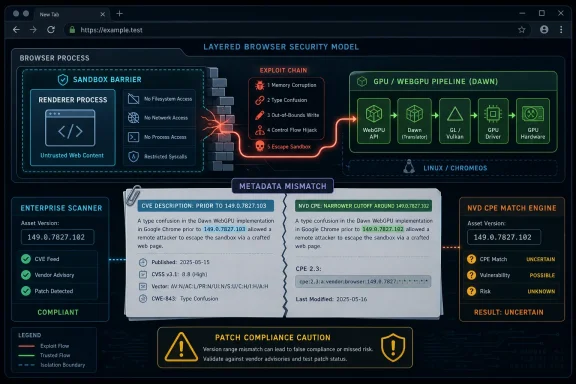 The CPE Record Tells a Different Story Than the Description
The description says Google Chrome on Linux and ChromeOS prior to 149.0.7827.103 is affected. The NVD change history, however, shows a CPE configuration that excludes Chrome versions up to 149.0.7827.102 and then pairs that application CPE with operating-system CPEs for ChromeOS and the Linux kernel.That is a small line-item detail with a large operational shadow. A scanner that trusts the CPE boundary literally may treat 149.0.7827.102 differently from 149.0.7827.103. A security engineer reading the prose may conclude that anything below .103 is in scope. A desktop administrator looking at the Chrome release notes may see platform-specific stable builds and wonder whether Linux’s fixed version is .102 while the CVE prose says .103.
This is the old browser-vulnerability problem in modern clothes. Chrome versioning is cross-platform in branding but not always identical in package reality. Windows, macOS, Linux, and ChromeOS can receive nearby but distinct build numbers, and security advisories often summarize the fixed train in a way that compresses those differences. CPEs, by contrast, are supposed to be machine-readable and unforgiving.
That is why the “Are we missing a CPE?” prompt on NVD pages is more than boilerplate here. The record may not be missing a CPE so much as exposing a mismatch between human-readable vulnerability scope and machine-readable platform modeling. If an organization’s exposure management program is built on that machine-readable layer, the mismatch becomes more than clerical.
Dawn Is the Quiet Graphics Layer With a Very Loud Threat Model
Dawn is not a household name even among people who live in Chrome settings pages. It is Chromium’s native implementation of WebGPU plumbing, the layer that helps web content talk to modern graphics capabilities without handing the web page raw control over the machine. That is a hard job, because the browser is mediating between hostile content and powerful hardware-facing APIs.Input validation bugs in this neighborhood are uncomfortable because the data boundary is the product. A web page feeds structured commands and resources into the browser’s graphics stack. The browser has to decide what is valid, what is safe, what belongs to the current context, and what must never be passed onward. “Insufficient validation of untrusted input” is dry language for a failure at precisely that boundary.
CVE-2026-11676 is described as requiring a compromised renderer process. That puts it in the class of vulnerabilities that attackers chain. First comes a renderer bug, often in JavaScript, WebAssembly, layout, media, or another content-facing parser. Then comes the sandbox escape, the step that turns code execution inside Chrome’s constrained world into something closer to system-level consequence.
That chain is why Chrome’s sandbox has always been both a triumph and a target. The renderer compromise is the loud break-in at the front door. The sandbox escape is the stolen key to the rest of the building.
Linux and ChromeOS Make This More Interesting Than a Generic Chrome Bug
The platform scope is the clue that this is not just another Chrome line item. The CVE description names Linux and ChromeOS, not Windows and macOS. That does not necessarily mean those other platforms had no related code, but it does mean the reported security impact was tied to the Linux and ChromeOS environment as described by Chrome’s CNA record.For ChromeOS users, the browser and operating system are not separate in the same way they are on a Windows desktop. Chrome is the shell, the update vehicle, and the daily computing surface. A sandbox escape on ChromeOS is therefore conceptually different from a sandbox escape in a browser that is merely one application among many. It strikes closer to the operating system’s promise.
For Linux users, the story is messier because distribution channels matter. Some users run Google’s official Chrome packages. Others run Chromium builds from distribution repositories, Flatpak, Snap, or enterprise-managed packaging systems. CPEs are not naturally good at representing that ecosystem, and NVD records frequently struggle to capture the real-world split between upstream Chromium, Google Chrome, and downstream packages.
This is where defenders should resist the false precision of a single version string. The right operational move is to verify the actual installed browser package, the channel, and the vendor fix path. If the machine is running Google Chrome on Linux, it should be on the fixed stable build or later. If it is running Chromium from a distribution, the distribution’s own security tracker becomes part of the answer.
The Version Number Dispute Is Not Pedantry
The awkward detail in CVE-2026-11676 is the boundary between 149.0.7827.102 and 149.0.7827.103. The CVE description says “prior to 149.0.7827.103.” The NVD CPE entry shown in the change history reportedly uses versions up to, but excluding, 149.0.7827.102 for the Chrome application CPE. Meanwhile, public Chrome update reporting around the same release train describes platform-specific fixed builds, with Linux commonly listed at 149.0.7827.102 and macOS at 149.0.7827.103.That may explain the discrepancy, but it does not erase it. If Linux’s fixed stable package was 149.0.7827.102, then a CPE boundary excluding .102 may be defensible for that platform. If the CVE’s text says Linux and ChromeOS prior to .103, then a machine-readable entry that stops at .102 invites false negatives or at least confusion. The record is trying to describe a multi-platform release using a vocabulary that prefers a clean product-version cutoff.
Security databases have to choose between readability and precision. Too often, they achieve neither. CVE prose is meant for humans; CPE configurations are meant for tools; release notes are meant for users and administrators. When all three are slightly out of phase, the burden lands on the person trying to decide whether a fleet is patched.
This is why “are we missing a CPE?” is the wrong narrow question. The better question is whether the configuration expresses the intended vulnerable population clearly enough for automated consumers. In this case, the answer is: probably not without manual interpretation.
The CPE Logic Looks Like an Attempt at Platform Gating
The configuration shown in the NVD change history is structured as an AND containing Chrome plus either ChromeOS or Linux kernel CPEs. That suggests NVD tried to model the vulnerability as Chrome only when running on Linux-like platforms, rather than Chrome everywhere. In theory, that is the right instinct.In practice, using
cpe:2.3:o:linux:linux_kernel:- as the platform gate is a blunt instrument. Linux distributions do not expose themselves to enterprise software inventory as “Linux kernel version dash” in a consistent way. Vulnerability scanners may or may not match that OS CPE alongside a Chrome application CPE, depending on how their asset model stores operating-system evidence. The result can be inconsistent detection across tools.ChromeOS is also not elegantly captured by a single unversioned OS CPE. ChromeOS devices have their own milestone and platform builds, and the Chrome browser component is tightly coupled to the system update. A CPE that says ChromeOS without a version may be adequate as a platform condition, but it is not a precise expression of which ChromeOS builds were vulnerable and which were fixed.
That matters because ChromeOS fleets are managed differently from Linux workstations. Administrators may be tracking ChromeOS milestones, device channels, and auto-update expiration dates rather than a standalone browser package. If a CVE record cannot map cleanly to that model, it will either over-alert or under-alert.
The Sandbox Escape Label Should Change the Patch Priority
CVE-2026-11676 carries a high severity rating from Chromium and a CISA ADP CVSS 3.1 score of 8.3. The vector includes network attack surface, no privileges required, user interaction required, high complexity, changed scope, and high impact to confidentiality, integrity, and availability. That is a mouthful, but the short version is simple: a user must be lured to content, the exploit is not trivial, and success could break out of an important security boundary.The high complexity flag should not be misread as low risk. Browser exploit chains are built by specialists, traded in private markets, and deployed selectively before they are ever discussed in public. The fact that a sandbox escape needs another bug in front of it does not make it irrelevant. It makes it part of the machinery of serious exploitation.
There is no public indication from the supplied CVE record that CVE-2026-11676 itself was exploited in the wild. That is important because the same Chrome update cycle also included discussion of a separate V8 zero-day, CVE-2026-11645, for which Google acknowledged active exploitation. The two should not be conflated. One is the known-in-the-wild headline; the other is a high-severity sandbox escape candidate in the same general release neighborhood.
For administrators, however, the distinction changes threat intelligence more than patch action. You still patch Chrome. You still verify restart completion. You still assume that web-exposed client software is part of the attack surface even when the exploit notes are incomplete.
Renderer Compromise Is the Clause Everyone Skips
The most important phrase in the CVE description is “who had compromised the renderer process.” It is also the phrase most likely to be skipped by dashboards that flatten everything into a severity score. That clause tells us the vulnerability is not expected to be the initial foothold. It is a privilege-boundary failure after the attacker has already won inside a renderer.Chrome’s architecture intentionally treats renderers as dangerous. Web pages run there, and web pages are hostile by default. The sandbox exists because the browser assumes that complex content-handling code will sometimes fail. A renderer compromise should be bad, but it should not automatically become control over the broader device.
Sandbox escapes are therefore not side quests. They are the second half of the exploit story. Without them, many browser bugs remain trapped in a constrained process. With them, attackers can reach files, credentials, IPC surfaces, GPU interfaces, or system services that the renderer was not supposed to touch.
This is why graphics and GPU-related components show up so often in serious browser security discussions. They sit near performance-critical paths, cross process boundaries, and mediate complex data structures. They are also hard to lock down without breaking the web’s demand for fast, hardware-accelerated interfaces.
WebGPU’s Rise Brings a Larger Security Accounting
Dawn’s prominence reflects a broader shift in the web platform. The browser is no longer just parsing HTML, CSS, and JavaScript. It is a high-performance application runtime with GPU computing, advanced media, local storage, device APIs, WebAssembly, and increasingly desktop-class workloads living behind tabs.That ambition has consequences. Every new high-performance web capability adds an API surface that must be validated, sandboxed, fuzzed, reviewed, and patched across platforms. WebGPU was designed with security in mind, but “designed with security in mind” is not the same as “immune to implementation bugs.” CVE-2026-11676 is a reminder that the implementation details are where the risk settles.
For WindowsForum readers, the Linux and ChromeOS focus should not invite complacency on Windows. Chromium components are shared across browsers and platforms, and the security lessons rarely stay in one lane. Microsoft Edge, Brave, Vivaldi, Opera, and Electron-based applications all orbit the Chromium ecosystem, even when a specific CVE’s affected-product line names only Chrome on certain systems.
The deeper lesson is that browser security is no longer a browser-only conversation. It is graphics drivers, GPU process isolation, operating-system sandbox policy, enterprise update management, and the software supply chain of Chromium-derived applications. Dawn is just one component, but it sits in the middle of that larger bargain.
NVD Lag Is Now Part of the Vulnerability Lifecycle
The NVD record shows no NIST CVSS score at the time of the supplied snapshot, while CISA ADP had already supplied a CVSS 3.1 vector. That division is now familiar to security teams: the CVE lands, vendor details appear, enrichment follows, CPEs are added or adjusted, and scanners digest the result at different speeds. The vulnerability is real before the metadata is polished.This lag is not merely bureaucratic. CPE enrichment determines whether vulnerability management platforms light up. CVSS enrichment influences prioritization queues. CWE classification affects reporting and trend analysis. A missing or imperfect platform expression can make a high-severity browser flaw look absent from an environment that is actually exposed.
NVD has the hard job of normalizing vendor advisories into a cross-industry data model. But organizations have the harder job of not pretending that normalization is ground truth. The vendor advisory, the CVE record, the NVD enrichment, and endpoint inventory are separate artifacts. They should agree, but they often do not agree at first publication.
That is why mature patch operations keep a manual review lane for browser releases. Chrome, Edge, Firefox, and Safari move too quickly, and browser vulnerabilities chain too naturally, to rely solely on overnight scanner truth. If the vendor shipped a security update and your fleet is behind it, the absence of a clean CPE match should not be treated as absolution.
ChromeOS Fleets Need a Different Mental Model
ChromeOS is often sold, fairly, as a platform that reduces endpoint management pain. Automatic updates, verified boot, application isolation, and a browser-first model give administrators fewer moving pieces than a traditional desktop estate. But fewer moving pieces do not mean no moving pieces.A ChromeOS vulnerability tied to the browser stack must be understood through the ChromeOS update channel. Stable, beta, long-term support variants, device eligibility, staged rollout behavior, and reboot completion all affect real exposure. A CVE record that says “ChromeOS” without a precise OS build range is useful as a warning but insufficient as an audit artifact.
The most practical step is to check management console reporting for ChromeOS version compliance and pending reboots. The second is to identify devices that are no longer receiving updates. Auto-update expiration is not a theoretical procurement footnote; it is the line between a managed secure appliance and a browser endpoint stuck in time.
ChromeOS also complicates the word “Chrome.” On a Windows PC, updating Chrome is an application task. On ChromeOS, updating Chrome is closer to updating the platform. CVE-2026-11676’s CPE ambiguity is a small example of how vulnerability databases still struggle to represent that product reality.
Linux Desktops Are Where Scanner Confidence Goes to Die
Linux desktop exposure is not large in every enterprise, but where it exists, it is often concentrated among administrators, developers, researchers, and power users. Those are precisely the users likely to have elevated access, sensitive repositories, SSH keys, cloud credentials, and unusual software stacks. A Chrome sandbox escape on a developer workstation is not a consumer nuisance.The Linux packaging landscape makes detection uneven. Google Chrome installed from Google’s repository is one case. Chromium installed from Ubuntu, Debian, Fedora, Arch, Flathub, Snap, or a corporate mirror is another. A vulnerability scanner may flag the Google Chrome CPE but miss a downstream Chromium package, or it may flag the OS package while missing the browser channel actually used by the user.
That means defenders should treat browser inventory as its own dataset. Which browser binary is the default? Which browser binary is actually running? Which package manager owns it? Which users have unmanaged copies in home directories? Those questions sound tedious until a browser CVE becomes the initial access path into an engineering environment.
CVE-2026-11676 is not a reason to panic about Linux desktops. It is a reason to stop assuming that “Chrome updated” is a single universal state. On Linux, it is often a statement that needs a package name, repository, channel, and build number attached.
The Same Update Also Shows Why CVE Headlines Can Mislead
The June 2026 Chrome update cycle drew attention for a separate actively exploited V8 vulnerability. That is the story most readers saw: update Chrome because a zero-day is being exploited. CVE-2026-11676 sits in the same broader release context but has a different role, different component, and different exploitation precondition.This is where CVE headlines distort risk. A single Chrome stable update can contain dozens of fixes across multiple subsystems. Some are memory safety bugs. Some are logic bugs. Some affect all platforms. Some are platform-specific. Some require a compromised renderer. Some are initial code-execution vectors. The update button looks the same for all of them.
For the user, that simplification is a feature. For defenders, it is a trap. If every Chrome CVE becomes “crafted HTML page, update now,” the meaningful differences disappear. If every non-zero-day is deprioritized because it is not known to be exploited, exploit-chain components get ignored until the first-stage bug appears.
The right reading is more layered. The known exploited V8 bug raises urgency for the whole update. The Dawn sandbox escape raises concern about post-renderer-compromise hardening on Linux and ChromeOS. The CPE discrepancy raises concern about whether tools will correctly report exposure. The combined message is not subtle: patch, verify, and do not outsource judgment to one database field.
Enterprise Patch Programs Should Not Wait for Perfect Metadata
A clean vulnerability-management workflow wants clean inputs. The CVE is published, NVD enriches it, scanners map it, dashboards rank it, tickets route it, and endpoint tooling remediates it. Browser security rarely respects that choreography.Chrome’s release cadence is faster than many enterprise exception processes. The browser’s attack surface is too exposed to wait for a perfect CPE. And the restart requirement means “installed update” is not always the same as “running fixed code.” A user can have the update staged and still be executing the vulnerable browser until Chrome restarts.
For managed Windows estates, Chrome and Edge patching has become routine. For Linux and ChromeOS, the routines vary more widely. ChromeOS may be centrally visible but rollout-staged. Linux may be technically manageable but culturally decentralized, especially among developers. Both environments need explicit verification rather than assumption.
The fix strategy is boring because it should be. Move to the fixed stable release or later. Confirm the browser has restarted. Confirm ChromeOS devices have completed platform updates. Confirm Linux package sources are delivering the fixed build. Then watch for NVD or vendor metadata adjustments that may change scanner behavior after the operational risk has already been addressed.
The Real Miss May Be in How We Model Browser Risk
The CPE question is useful because it points at a larger weakness. CPE was designed to name products, versions, and platforms in a standardized way. Modern browsers are not simply products. They are update channels, embedded runtimes, OS components, app frameworks, and shared engines.A vulnerability in Dawn may affect Google Chrome on Linux and ChromeOS as reported. Related code may also exist in Chromium derivatives, but the exploitability, build flags, sandbox configuration, and platform integration can differ. CPE does not naturally express “same codebase, different productization, uncertain exploitability.” It wants a yes-or-no match.
That creates pressure in both directions. Overbroad CPEs create alert fatigue and false positives. Narrow CPEs create false negatives and missed exposure. The temptation is to demand perfect precision from the database, but the underlying software ecosystem is not precise in that way.
This is where security teams need a third category: not vulnerable, not confirmed vulnerable, but requires vendor-channel review. Chromium-derived software deserves that category more often than most platforms, because the code reuse is real while the security boundary conditions vary. CVE-2026-11676 is a small case study in why that nuance matters.
The Practical Read for This Specific CVE
For the narrow question — are we missing a CPE here? — the best answer is that the current CPE expression looks incomplete or at least potentially misleading when compared with the CVE prose. It appears to be trying to encode a Linux/ChromeOS-only Chrome issue, but the version cutoff and platform modeling deserve scrutiny. A report to NVD or the relevant enrichment channel would be reasonable, especially if scanner behavior differs from the vendor’s stated affected range.The likely source of confusion is the platform-specific Chrome build numbering around 149.0.7827.102 and 149.0.7827.103. If Linux’s fixed stable build is .102 while the CVE description uses .103 as a general cutoff, then the CPE may be attempting to represent Linux reality while the prose uses the higher cross-platform marker. If ChromeOS has a different versioning relationship, that should be made explicit rather than hidden behind an unversioned OS CPE.
The safest operational reading is not to split hairs in favor of delay. If a Linux or ChromeOS system is running a Chrome build older than the fixed release line from the June 8, 2026 advisory, it should be treated as exposed until updated. If a scanner says the system is clean solely because it does not match the current CPE, verify manually before closing the ticket.
This is also a reminder to separate Chrome from Chromium. The CVE is sourced to Chrome and names Google Chrome. Downstream Chromium packages may require distribution-specific confirmation. Security teams should not assume they are unaffected merely because the CPE says Google Chrome, nor should they assume exploitability is identical without vendor or distribution guidance.
The Metadata Glitch Is the Warning Label
The useful lesson from CVE-2026-11676 is not that every administrator should become a CPE grammarian. It is that browser vulnerability records are now operational artifacts, not just reference entries. When those artifacts wobble, patch decisions wobble with them.- The CVE describes a high-severity Dawn input-validation issue that could enable a sandbox escape after a renderer compromise on Linux and ChromeOS.
- The NVD CPE configuration shown in the change history appears to use a Chrome version cutoff that does not cleanly match the “prior to 149.0.7827.103” wording in the description.
- The platform-gated CPE structure may be directionally correct, but Linux and ChromeOS are difficult to model accurately with generic operating-system CPEs.
- Administrators should verify fixed Chrome or ChromeOS builds directly rather than relying only on scanner output for this record.
- The vulnerability should not be confused with the separate actively exploited V8 zero-day from the same Chrome update cycle.
- Reporting the possible CPE mismatch is reasonable if it affects detection, compliance evidence, or fleet reporting.
References
- Primary source: NVD / Chromium
Published: 2026-06-15T19:14:36-07:00

NVD - CVE-2026-11676
 nvd.nist.gov
- Security advisory: MSRC
Published: 2026-06-15T19:14:36-07:00
Original feed URL

Security Update Guide - Microsoft Security Response Center
 msrc.microsoft.com
