

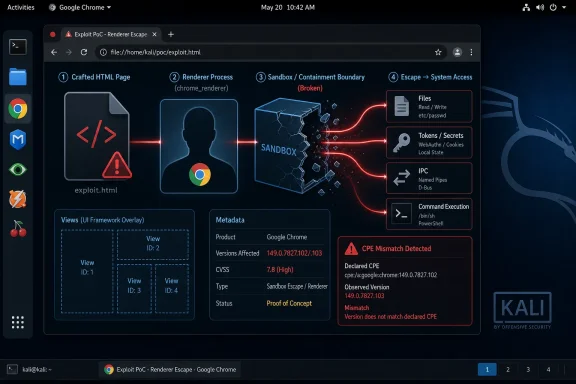
CVE-2026-11682 is a high-severity Google Chrome vulnerability disclosed on June 8, 2026, affecting Chrome on Linux before the 149.0.7827.103 line and allowing a sandbox escape after renderer compromise via a crafted HTML page. That sounds narrow, but it is the kind of narrow that matters: not a first-stage browser takeover, but the second-stage move that can turn a renderer bug into something much more consequential. The confusing part is not the exploit model; it is the metadata around the affected version, where Google’s Linux build numbering and NVD’s CPE configuration appear to tell slightly different stories. For defenders, the answer is simpler than the record: patch Chrome and Chromium-derived packages, then treat the CPE entry as a useful signal rather than a perfect asset-management contract.
Browser security is often described as if every vulnerability arrives alone. In practice, the most serious attacks are chains: one flaw gets code running in the renderer, another flaw breaks out of the sandbox, and a third may pursue persistence, credential theft, or lateral movement. CVE-2026-11682 sits in that middle role, which is why its description begins with an important condition: the attacker has already compromised the renderer process.
That prerequisite lowers the probability of exploitation compared with a clean one-click remote code execution bug. It does not make the vulnerability benign. Chrome’s renderer sandbox is a core line of defense precisely because malicious web content is expected to be hostile; the browser assumes that parsing HTML, JavaScript, images, fonts, and media will occasionally produce memory corruption or logic failures.
A sandbox escape is therefore a force multiplier. It turns a contained browser compromise into a broader system-facing event, changing the blast radius from “bad things inside a restricted process” to “bad things trying to reach the desktop session, files, tokens, IPC surfaces, and local services.” That is why a vulnerability can require a renderer compromise and still deserve high-severity treatment.
The phrase “inappropriate implementation in Views” is also more interesting than it looks. Views is Chromium’s UI framework, part of the machinery that renders and manages browser interface components. When untrusted input reaches UI plumbing in a way the browser did not anticipate, the boundary between web content and privileged browser surfaces becomes more complicated than the tidy diagrams imply.
Linux desktop users sometimes get treated as an afterthought in mainstream security coverage because Windows dominates enterprise endpoint fleets. That is a mistake here. Linux is overrepresented among developers, security researchers, cloud engineers, DevOps teams, and administrators with privileged access to production systems.
A compromised Linux desktop may not be the average consumer endpoint, but it can be a high-value workstation. SSH keys, cloud credentials, kubeconfigs, package signing material, browser sessions, Git credentials, and internal dashboards often live close together on the same machine. A browser sandbox escape on that kind of endpoint is not just a browser problem; it is potentially an infrastructure problem.
The Linux-only framing also complicates triage for organizations that rely on vulnerability scanners. A Windows-heavy shop might see the CVE, notice the Linux condition, and move on. A mixed fleet needs to ask a more careful question: which Linux machines actually run Google Chrome, Chromium, Chrome for Testing, bundled Electron apps, or downstream Chromium packages?
That distinction is not pedantic. CPEs are supposed to help machines decide whether an installed product is affected. When a vulnerability is in Chrome on Linux, using a Linux kernel CPE as a platform condition can be a practical shorthand, but it can also create ambiguity for scanners, SBOM tools, and asset inventories that read CPEs too literally.
The version boundary is where the record becomes more confusing. The CVE text says Chrome on Linux prior to 149.0.7827.103. Google’s stable-channel release information around the same update indicates patched desktop builds in the 149.0.7827.102/.103 range, with Linux called out at 149.0.7827.102 in some reporting and advisory summaries. NVD’s initial analysis reportedly added a Chrome CPE with versions up to, but excluding, 149.0.7827.102.
That creates a visible mismatch: the prose says “prior to .103,” while the CPE exclusion says “prior to .102.” It may be a versioning artifact, because Chrome often ships slightly different patch numbers across platforms and staged channels. It may also be a metadata correction waiting to happen. Either way, defenders should avoid building a policy that assumes .102 and .103 mean the same thing everywhere without checking the actual channel and platform.
The safest operational reading is this: Linux Chrome builds below the vendor-patched June 2026 stable update are exposed, and anything on the 149.0.7827.102/.103 patched line should be verified against the vendor’s release state rather than judged solely by NVD’s generated CPE. If your scanner flags the Linux kernel as part of the affected configuration, that does not mean the kernel contains the bug. It means the vulnerability applies when Chrome is present on Linux.
That is especially true in Linux environments, where Chrome may arrive through Google’s own repository, a distribution package, a managed software catalog, a container base image, or a manually installed
The CPE ecosystem was not designed for this level of release-channel nuance. It is good at saying “this product before this version is affected.” It is weaker at expressing “this product on this platform, with vendor build numbers that differ by operating system, where the public prose and the generated match criteria may not align perfectly.”
That is why security teams should treat CPE as the beginning of the conversation rather than the end. The decisive check is whether the installed browser is on the fixed stable release for its platform and channel. If it is not, patch. If it is, document the installed version, vendor channel, package source, and scanner evidence so false positives can be closed without hiding real exposure.
That is a classic modern browser-chain profile. It is not the cheap phishing macro of old, but it is also not science fiction. Browser exploit chains remain valuable because the browser is where users combine authentication, documents, internal applications, SaaS consoles, and personal browsing habits.
For WindowsForum readers, the Linux target should not make the issue feel remote. Microsoft’s own world now includes Linux everywhere: WSL on developer workstations, Linux build agents in CI/CD, Linux containers, Azure Linux hosts, and admin machines that live half in Windows and half in Unix tooling. The line between “Linux desktop issue” and “Microsoft ecosystem issue” is thinner than it used to be.
A developer running Chrome on Ubuntu under a privileged workstation profile may have access to Azure subscriptions, GitHub organizations, internal package registries, and production dashboards. A sandbox escape that helps an attacker reach local secrets on that box is not less serious because the company’s standard laptop image is Windows. It is serious because privileged users rarely fit the standard image.
Chromium’s Views framework lives in that application layer. If a compromised renderer can feed unexpected data into a UI path, the result may be a privilege boundary violation even though the vulnerable component does not sound like a traditional parser. That is why “insufficient validation of untrusted input” is such a broad and persistent class of weakness.
The browser’s security model depends on strict suspicion. Web content should not be able to smuggle assumptions into browser process logic. A title, URL, origin string, frame name, drag payload, focus event, or UI-triggered action can become dangerous if higher-privilege code trusts it too much.
This is also where Linux platform behavior matters. Desktop Linux is not one thing. X11, Wayland, portal APIs, window managers, themes, accessibility services, and distribution packaging can all influence how UI paths behave. A bug in cross-platform UI logic may become exploitable only where the surrounding desktop environment gives it the right shape.
That opacity creates a familiar gap. Security teams want exploitability details, proof-of-concept indicators, affected configurations, and detection guidance. Vendors want to avoid handing attackers a roadmap while patch adoption is still uneven. The compromise is the modern advisory style: enough to patch, not enough to fully understand.
For CVE-2026-11682, the practical signal is the combination of “High,” “sandbox escape,” “renderer compromise,” and “crafted HTML page.” That is enough to prioritize patching ahead of routine backlog work, even without public exploit code. It is not enough to claim active exploitation unless the vendor or credible reporting says so.
That last point matters because the same Chrome update cycle also included attention around another vulnerability, CVE-2026-11645, described as a V8 flaw with exploitation in the wild. It is easy for dashboards, social posts, and rushed summaries to blur the two. CVE-2026-11682 should be handled seriously, but the public record supplied here does not establish that it is the zero-day known to be exploited in the wild.
The NVD CPE record appears to be trying to express a platform-specific vulnerability: Google Chrome on Linux. But CPE matching is brittle when platform constraints are expressed through operating-system products rather than package reality. A Linux kernel CPE does not tell you which browser package is installed, which channel it follows, whether it is Google Chrome or Chromium, or whether the distribution has backported a fix.
This matters for scanners that combine CPE inference with package inventory. Some will detect the browser package and version directly. Others may infer a CPE from file paths, package names, or banners. Still others may flag a Linux host as vulnerable because the OS condition is present and Chrome appears somewhere in the inventory, even if the installed build is already fixed.
The right response is not to ignore the scanner. It is to tune the evidence. Vulnerability teams should confirm the installed Chrome or Chromium package version, identify the package source, verify whether the vendor’s fixed build is present, and then decide whether the CPE mismatch is a false positive, a true positive, or a metadata issue worth reporting upstream.
If you maintain vulnerability content, this is exactly the sort of case where a human note helps. “Affected: Google Chrome on Linux before the fixed 149.0.7827.102/.103 stable-channel update; NVD prose and CPE boundary differ” is more useful than pretending the ecosystem is cleaner than it is.
Not every Chrome vulnerability automatically affects Edge. Components differ, patches land on different schedules, features may be disabled, and platform-specific bugs may not translate. But security teams that manage Edge, Chrome, Brave, Electron applications, WebView2 runtimes, and Chromium-based internal tooling cannot treat Google’s advisory stream as somebody else’s weather.
The practical consequence is cadence. Chrome’s stable channel moves quickly, and Chromium fixes propagate through an ecosystem that includes browsers, embedded runtimes, test harnesses, kiosks, collaboration tools, and desktop apps. A Linux-only Chrome UI bug may not map directly to Windows Edge, but the operational habit it demands is the same: track upstream Chromium security movement and verify downstream patch delivery.
For Microsoft-centric environments, the most exposed Linux systems may be the least centrally managed. Developer laptops, lab machines, WSL-adjacent workflows, and build boxes often live outside the neat perimeter of Windows Update for Business, Intune compliance baselines, and standard endpoint management. That is where a Chrome-on-Linux CVE can quietly linger.
The command to “update Chrome” is therefore both correct and incomplete. Administrators need to know whether the updated binary is actually running. On desktops, that may require browser restart enforcement. On shared Linux machines, it may require checking user sessions. On VDI or persistent developer environments, it may mean rebuilding images and validating post-reboot state.
Linux also makes parallel installation easy. A user may have Google Chrome Stable, Chromium from the distro, Chrome Beta, Chrome for Testing, and an Electron-based application all present on the same workstation. A vulnerability scanner that sees only one path may miss the browser a developer actually uses.
This is why browser patching should be treated as runtime hygiene, not just package hygiene. The package manager can say the update is installed while the old process remains alive. For a sandbox escape triggered by web content, the running process is what matters.
This is the same reason defenders should not rank browser bugs solely by whether they are the first domino. A sandbox escape can be the difference between a crash and a compromise, between stolen web-session data and local credential access, between a contained exploit and an endpoint incident. Its value to attackers is not theoretical.
The changed-scope element is particularly important. Scope changes when exploitation crosses from one security authority into another. In browser terms, that usually means escaping the renderer’s confinement and affecting higher-privilege browser or system resources. That is the point of the sandbox, and that is why breaking it receives serious treatment.
Still, precision matters. High severity is not the same as panic. The public facts support rapid patching, targeted Linux inventory checks, and careful scanner interpretation. They do not support claims of mass exploitation of CVE-2026-11682 unless new evidence emerges.
That is understandable but dangerous. When every Chrome CVE in a release gets described as “the exploited zero-day,” defenders lose the ability to prioritize accurately. Conversely, when a sandbox escape is dismissed because it is not the headline zero-day, defenders underreact to a bug that attackers would love to pair with a renderer exploit.
The right lens is release-bundle triage. Patch the whole bundle because attackers do not care which CVE your change board found most interesting. Then, for reporting and risk acceptance, distinguish between known exploited flaws, high-impact chain components, and lower-risk issues.
CVE-2026-11682 belongs in the second category based on the available record: a high-impact chain component for Linux Chrome, not the publicly identified exploited V8 zero-day. That distinction should guide communication without slowing remediation.
That work lands on people who are already overloaded. A vulnerability analyst must decide whether to open tickets. A Linux admin must decide whether a package is fixed. A compliance lead must decide whether an exception is defensible. A CISO may see a dashboard count move because a generated CPE changed.
This is why accuracy in version boundaries matters. “Prior to .103” and “excluding .102” may look close enough to a casual reader, but they are not close enough for automation. If the vendor shipped Linux at .102 while the CVE prose says .103, the record should make that platform-specific versioning explicit.
Until then, organizations should preserve uncertainty rather than flatten it. A ticket that says “verify Chrome fixed build for Linux; public metadata differs between prose and CPE” is better than a ticket that asserts the wrong cutoff with false confidence.
The most concrete actions are straightforward:
 The Dangerous Bug Is the One That Comes After the First Bug
Browser security is often described as if every vulnerability arrives alone. In practice, the most serious attacks are chains: one flaw gets code running in the renderer, another flaw breaks out of the sandbox, and a third may pursue persistence, credential theft, or lateral movement. CVE-2026-11682 sits in that middle role, which is why its description begins with an important condition: the attacker has already compromised the renderer process.That prerequisite lowers the probability of exploitation compared with a clean one-click remote code execution bug. It does not make the vulnerability benign. Chrome’s renderer sandbox is a core line of defense precisely because malicious web content is expected to be hostile; the browser assumes that parsing HTML, JavaScript, images, fonts, and media will occasionally produce memory corruption or logic failures.
A sandbox escape is therefore a force multiplier. It turns a contained browser compromise into a broader system-facing event, changing the blast radius from “bad things inside a restricted process” to “bad things trying to reach the desktop session, files, tokens, IPC surfaces, and local services.” That is why a vulnerability can require a renderer compromise and still deserve high-severity treatment.
The phrase “inappropriate implementation in Views” is also more interesting than it looks. Views is Chromium’s UI framework, part of the machinery that renders and manages browser interface components. When untrusted input reaches UI plumbing in a way the browser did not anticipate, the boundary between web content and privileged browser surfaces becomes more complicated than the tidy diagrams imply.
The Linux Qualifier Is Not a Footnote
The CVE description specifically names Google Chrome on Linux. That matters because browser hardening is not identical across platforms, even when the application brand and version number are the same. Chrome on Windows, macOS, and Linux shares an enormous cross-platform codebase, but the sandbox, graphics stack, desktop integration, file dialogs, accessibility hooks, windowing behavior, and IPC details all vary by operating system.Linux desktop users sometimes get treated as an afterthought in mainstream security coverage because Windows dominates enterprise endpoint fleets. That is a mistake here. Linux is overrepresented among developers, security researchers, cloud engineers, DevOps teams, and administrators with privileged access to production systems.
A compromised Linux desktop may not be the average consumer endpoint, but it can be a high-value workstation. SSH keys, cloud credentials, kubeconfigs, package signing material, browser sessions, Git credentials, and internal dashboards often live close together on the same machine. A browser sandbox escape on that kind of endpoint is not just a browser problem; it is potentially an infrastructure problem.
The Linux-only framing also complicates triage for organizations that rely on vulnerability scanners. A Windows-heavy shop might see the CVE, notice the Linux condition, and move on. A mixed fleet needs to ask a more careful question: which Linux machines actually run Google Chrome, Chromium, Chrome for Testing, bundled Electron apps, or downstream Chromium packages?
NVD’s CPE Record Looks Messier Than the Risk
The user’s question — whether a CPE is missing — gets to the heart of the issue. Based on the information available, the NVD configuration is not obviously “missing” the idea that Linux is involved; it appears to encode the affected product as Google Chrome constrained by a Linux operating-system platform. The oddity is that the configuration reportedly uses an AND relationship with Google Chrome and the Linux kernel CPE, while the vulnerable software is Chrome, not the Linux kernel.That distinction is not pedantic. CPEs are supposed to help machines decide whether an installed product is affected. When a vulnerability is in Chrome on Linux, using a Linux kernel CPE as a platform condition can be a practical shorthand, but it can also create ambiguity for scanners, SBOM tools, and asset inventories that read CPEs too literally.
The version boundary is where the record becomes more confusing. The CVE text says Chrome on Linux prior to 149.0.7827.103. Google’s stable-channel release information around the same update indicates patched desktop builds in the 149.0.7827.102/.103 range, with Linux called out at 149.0.7827.102 in some reporting and advisory summaries. NVD’s initial analysis reportedly added a Chrome CPE with versions up to, but excluding, 149.0.7827.102.
That creates a visible mismatch: the prose says “prior to .103,” while the CPE exclusion says “prior to .102.” It may be a versioning artifact, because Chrome often ships slightly different patch numbers across platforms and staged channels. It may also be a metadata correction waiting to happen. Either way, defenders should avoid building a policy that assumes .102 and .103 mean the same thing everywhere without checking the actual channel and platform.
The safest operational reading is this: Linux Chrome builds below the vendor-patched June 2026 stable update are exposed, and anything on the 149.0.7827.102/.103 patched line should be verified against the vendor’s release state rather than judged solely by NVD’s generated CPE. If your scanner flags the Linux kernel as part of the affected configuration, that does not mean the kernel contains the bug. It means the vulnerability applies when Chrome is present on Linux.
The Version Number Is Doing Too Much Work
Chrome’s versioning has become a strange kind of security language. For administrators, “149.0.7827.102” and “149.0.7827.103” are not just build identifiers; they are compliance boundaries, help-desk scripts, detection logic, exception tickets, and vulnerability-management deadlines. When those numbers diverge by platform, a small discrepancy can trigger a large amount of enterprise noise.That is especially true in Linux environments, where Chrome may arrive through Google’s own repository, a distribution package, a managed software catalog, a container base image, or a manually installed
.deb or .rpm. Chromium packages can trail Google Chrome, carry downstream patches, or use distribution-specific version strings. In some cases, the package name a scanner sees is not the same product name the CVE record expects.The CPE ecosystem was not designed for this level of release-channel nuance. It is good at saying “this product before this version is affected.” It is weaker at expressing “this product on this platform, with vendor build numbers that differ by operating system, where the public prose and the generated match criteria may not align perfectly.”
That is why security teams should treat CPE as the beginning of the conversation rather than the end. The decisive check is whether the installed browser is on the fixed stable release for its platform and channel. If it is not, patch. If it is, document the installed version, vendor channel, package source, and scanner evidence so false positives can be closed without hiding real exposure.
A Renderer Prerequisite Does Not Save the Enterprise
The CVSS vector attributed by CISA’s enrichment tells the story in compact form: network attack vector, high attack complexity, no privileges required, user interaction required, changed scope, and high impact to confidentiality, integrity, and availability. In plainer English, the attacker needs a victim to load malicious content and must already have or achieve renderer compromise, but the consequence of success can cross a security boundary.That is a classic modern browser-chain profile. It is not the cheap phishing macro of old, but it is also not science fiction. Browser exploit chains remain valuable because the browser is where users combine authentication, documents, internal applications, SaaS consoles, and personal browsing habits.
For WindowsForum readers, the Linux target should not make the issue feel remote. Microsoft’s own world now includes Linux everywhere: WSL on developer workstations, Linux build agents in CI/CD, Linux containers, Azure Linux hosts, and admin machines that live half in Windows and half in Unix tooling. The line between “Linux desktop issue” and “Microsoft ecosystem issue” is thinner than it used to be.
A developer running Chrome on Ubuntu under a privileged workstation profile may have access to Azure subscriptions, GitHub organizations, internal package registries, and production dashboards. A sandbox escape that helps an attacker reach local secrets on that box is not less serious because the company’s standard laptop image is Windows. It is serious because privileged users rarely fit the standard image.
Views Is a Reminder That Browser UI Is Attack Surface
Most users think of web exploits as attacks on JavaScript engines, HTML parsers, image codecs, or WebAssembly. Those are still major targets, but browser UI code has repeatedly shown itself to be part of the security boundary. The browser is not just a page renderer; it is a desktop application with tabs, menus, prompts, permission bubbles, file pickers, drag-and-drop surfaces, clipboard flows, and accessibility integrations.Chromium’s Views framework lives in that application layer. If a compromised renderer can feed unexpected data into a UI path, the result may be a privilege boundary violation even though the vulnerable component does not sound like a traditional parser. That is why “insufficient validation of untrusted input” is such a broad and persistent class of weakness.
The browser’s security model depends on strict suspicion. Web content should not be able to smuggle assumptions into browser process logic. A title, URL, origin string, frame name, drag payload, focus event, or UI-triggered action can become dangerous if higher-privilege code trusts it too much.
This is also where Linux platform behavior matters. Desktop Linux is not one thing. X11, Wayland, portal APIs, window managers, themes, accessibility services, and distribution packaging can all influence how UI paths behave. A bug in cross-platform UI logic may become exploitable only where the surrounding desktop environment gives it the right shape.
Google’s Advisory Pattern Leaves Defenders Reading Between the Lines
Google’s Chrome security advisories are intentionally terse. They list CVEs, components, severities, reporters, rewards when applicable, and fixed versions. Bug details are often restricted until most users have received the update, which is a reasonable anti-exploitation practice but a frustrating one for defenders trying to determine urgency.That opacity creates a familiar gap. Security teams want exploitability details, proof-of-concept indicators, affected configurations, and detection guidance. Vendors want to avoid handing attackers a roadmap while patch adoption is still uneven. The compromise is the modern advisory style: enough to patch, not enough to fully understand.
For CVE-2026-11682, the practical signal is the combination of “High,” “sandbox escape,” “renderer compromise,” and “crafted HTML page.” That is enough to prioritize patching ahead of routine backlog work, even without public exploit code. It is not enough to claim active exploitation unless the vendor or credible reporting says so.
That last point matters because the same Chrome update cycle also included attention around another vulnerability, CVE-2026-11645, described as a V8 flaw with exploitation in the wild. It is easy for dashboards, social posts, and rushed summaries to blur the two. CVE-2026-11682 should be handled seriously, but the public record supplied here does not establish that it is the zero-day known to be exploited in the wild.
The CPE Question Exposes a Bigger Asset Problem
If you are asking whether a CPE is missing, you are probably already in the right operational mindset. The vulnerability itself is one problem; reliable matching is another. In large fleets, the difference between “Chrome before .102” and “Chrome before .103” can decide whether thousands of machines remain open tickets.The NVD CPE record appears to be trying to express a platform-specific vulnerability: Google Chrome on Linux. But CPE matching is brittle when platform constraints are expressed through operating-system products rather than package reality. A Linux kernel CPE does not tell you which browser package is installed, which channel it follows, whether it is Google Chrome or Chromium, or whether the distribution has backported a fix.
This matters for scanners that combine CPE inference with package inventory. Some will detect the browser package and version directly. Others may infer a CPE from file paths, package names, or banners. Still others may flag a Linux host as vulnerable because the OS condition is present and Chrome appears somewhere in the inventory, even if the installed build is already fixed.
The right response is not to ignore the scanner. It is to tune the evidence. Vulnerability teams should confirm the installed Chrome or Chromium package version, identify the package source, verify whether the vendor’s fixed build is present, and then decide whether the CPE mismatch is a false positive, a true positive, or a metadata issue worth reporting upstream.
If you maintain vulnerability content, this is exactly the sort of case where a human note helps. “Affected: Google Chrome on Linux before the fixed 149.0.7827.102/.103 stable-channel update; NVD prose and CPE boundary differ” is more useful than pretending the ecosystem is cleaner than it is.
Microsoft Shops Still Have a Chromium Problem
Windows administrators may be tempted to file this one under “Linux desktop” and move on. That would be too narrow. The browser monoculture problem is now a Chromium problem, not merely a Chrome problem, and Microsoft Edge sits squarely in that universe even when a particular CVE is reported against Google Chrome.Not every Chrome vulnerability automatically affects Edge. Components differ, patches land on different schedules, features may be disabled, and platform-specific bugs may not translate. But security teams that manage Edge, Chrome, Brave, Electron applications, WebView2 runtimes, and Chromium-based internal tooling cannot treat Google’s advisory stream as somebody else’s weather.
The practical consequence is cadence. Chrome’s stable channel moves quickly, and Chromium fixes propagate through an ecosystem that includes browsers, embedded runtimes, test harnesses, kiosks, collaboration tools, and desktop apps. A Linux-only Chrome UI bug may not map directly to Windows Edge, but the operational habit it demands is the same: track upstream Chromium security movement and verify downstream patch delivery.
For Microsoft-centric environments, the most exposed Linux systems may be the least centrally managed. Developer laptops, lab machines, WSL-adjacent workflows, and build boxes often live outside the neat perimeter of Windows Update for Business, Intune compliance baselines, and standard endpoint management. That is where a Chrome-on-Linux CVE can quietly linger.
Patch Management Has to Beat Browser Auto-Update Theater
Chrome’s auto-update system is one of the best consumer security mechanisms ever deployed, but enterprise reality is messier. Browsers remain open for days. Managed policies can delay updates. Linux packages depend on repository configuration. Golden images age. Containers freeze vulnerable binaries long after desktops update.The command to “update Chrome” is therefore both correct and incomplete. Administrators need to know whether the updated binary is actually running. On desktops, that may require browser restart enforcement. On shared Linux machines, it may require checking user sessions. On VDI or persistent developer environments, it may mean rebuilding images and validating post-reboot state.
Linux also makes parallel installation easy. A user may have Google Chrome Stable, Chromium from the distro, Chrome Beta, Chrome for Testing, and an Electron-based application all present on the same workstation. A vulnerability scanner that sees only one path may miss the browser a developer actually uses.
This is why browser patching should be treated as runtime hygiene, not just package hygiene. The package manager can say the update is installed while the old process remains alive. For a sandbox escape triggered by web content, the running process is what matters.
The Real Severity Is in the Chain
On its own, CVE-2026-11682 is constrained. It requires user interaction and a compromised renderer process. That is why its attack complexity is not low. But in an exploit chain, the first stage supplies the renderer compromise, and the victim’s ordinary browsing supplies the interaction.This is the same reason defenders should not rank browser bugs solely by whether they are the first domino. A sandbox escape can be the difference between a crash and a compromise, between stolen web-session data and local credential access, between a contained exploit and an endpoint incident. Its value to attackers is not theoretical.
The changed-scope element is particularly important. Scope changes when exploitation crosses from one security authority into another. In browser terms, that usually means escaping the renderer’s confinement and affecting higher-privilege browser or system resources. That is the point of the sandbox, and that is why breaking it receives serious treatment.
Still, precision matters. High severity is not the same as panic. The public facts support rapid patching, targeted Linux inventory checks, and careful scanner interpretation. They do not support claims of mass exploitation of CVE-2026-11682 unless new evidence emerges.
The June Chrome Update Was a Crowd, Not a Solo Act
Part of the confusion around CVE-2026-11682 comes from the release train around it. Google’s early June 2026 Chrome desktop updates included a large batch of security fixes, and public reporting focused heavily on CVE-2026-11645 because Google acknowledged exploitation for that separate V8 issue. In that crowded advisory environment, individual CVEs can inherit the anxiety of their neighbors.That is understandable but dangerous. When every Chrome CVE in a release gets described as “the exploited zero-day,” defenders lose the ability to prioritize accurately. Conversely, when a sandbox escape is dismissed because it is not the headline zero-day, defenders underreact to a bug that attackers would love to pair with a renderer exploit.
The right lens is release-bundle triage. Patch the whole bundle because attackers do not care which CVE your change board found most interesting. Then, for reporting and risk acceptance, distinguish between known exploited flaws, high-impact chain components, and lower-risk issues.
CVE-2026-11682 belongs in the second category based on the available record: a high-impact chain component for Linux Chrome, not the publicly identified exploited V8 zero-day. That distinction should guide communication without slowing remediation.
Security Metadata Is Infrastructure, Too
The apparent mismatch between prose and CPE is a reminder that vulnerability metadata has become production infrastructure. CVE descriptions, CPE match strings, CVSS vectors, EPSS scores, KEV listings, vendor advisories, package metadata, and scanner plugins all feed automated decisions. When one piece is ambiguous, the ambiguity becomes operational work.That work lands on people who are already overloaded. A vulnerability analyst must decide whether to open tickets. A Linux admin must decide whether a package is fixed. A compliance lead must decide whether an exception is defensible. A CISO may see a dashboard count move because a generated CPE changed.
This is why accuracy in version boundaries matters. “Prior to .103” and “excluding .102” may look close enough to a casual reader, but they are not close enough for automation. If the vendor shipped Linux at .102 while the CVE prose says .103, the record should make that platform-specific versioning explicit.
Until then, organizations should preserve uncertainty rather than flatten it. A ticket that says “verify Chrome fixed build for Linux; public metadata differs between prose and CPE” is better than a ticket that asserts the wrong cutoff with false confidence.
The Defender’s Version of the Story Is Shorter Than the CVE Record
CVE-2026-11682 does not require a dramatic new playbook. It requires disciplined execution of an old one: know where browsers run, know which ones are actually patched, and do not let metadata ambiguity become an excuse for delay. The bug’s Linux focus narrows the target set, but the kinds of users likely to run Chrome on Linux can raise the value of each affected endpoint.The most concrete actions are straightforward:
- Confirm whether Google Chrome or Chromium-based browser packages are installed on Linux desktops, developer workstations, build systems, lab machines, and administrative endpoints.
- Verify that installed Linux Chrome builds are on the vendor-fixed 149.0.7827.102/.103 update line or a downstream distribution build that explicitly includes the fix.
- Treat NVD’s Linux kernel CPE condition as a platform qualifier for Chrome on Linux, not as evidence that the Linux kernel itself contains this vulnerability.
- Do not conflate CVE-2026-11682 with CVE-2026-11645; the latter drew public attention for reported in-the-wild exploitation, while the former is a high-severity sandbox-escape issue in the same broader update cycle.
- Require browser restarts or session recycling where package updates have landed but old Chrome processes may still be running.
- Report or annotate scanner discrepancies where the CVE prose, vendor fixed versions, and CPE cutoff do not align cleanly.
References
- Primary source: NVD / Chromium
Published: 2026-06-15T19:14:44-07:00

NVD - CVE-2026-11682
 nvd.nist.gov
- Security advisory: MSRC
Published: 2026-06-15T19:14:44-07:00
Original feed URL

Security Update Guide - Microsoft Security Response Center
 msrc.microsoft.com
- Related coverage: vulnerability.circl.lu
Vulnerability-Lookup
Vulnerability-Lookup - Fast vulnerability lookup correlation from different sources.vulnerability.circl.lu - Related coverage: radar.offseq.com
CVE-2026-11682: Insufficient validation of untrusted input in Google Chrome - Live Threat Intelligence - Threat Radar | OffSeq.com
Detailed information about CVE-2026-11682: Insufficient validation of untrusted input in Google Chrome affecting Google Chrome. Get real-time updates, technicalradar.offseq.com
