

Tomb Raider: Legacy of Atlantis is scheduled to launch on February 12, 2027, for PC and current consoles, and its Steam listing now points to an Unreal Engine 5 remake with published PC requirements and Denuvo Anti-tamper attached. That means Lara Croft’s next trip through old ruins arrives with two very modern PC talking points before anyone has benchmarked a frame. The specs are not outrageous by 2026 standards, but the uncertainty around targets, upscaling, storage, and DRM overhead leaves PC players reading between the lines. For Windows users, the real story is not simply whether an RTX 3080 is enough; it is how little “official requirements” still tell us about what a premium PC release will actually feel like.
The pitch for Tomb Raider: Legacy of Atlantis is almost precision-engineered for nostalgia. Crystal Dynamics and Flying Wild Hog are rebuilding Lara Croft’s 1996 debut as a modern action-adventure game, preserving the idea of the original while replacing the grid-like discipline of early 3D platforming with contemporary movement, combat, lighting, and production values. It is the kind of project that can unite several generations of fans: those who remember tank controls, those who came in through the survivor trilogy, and those who know Lara mostly as an icon who keeps being rebooted.
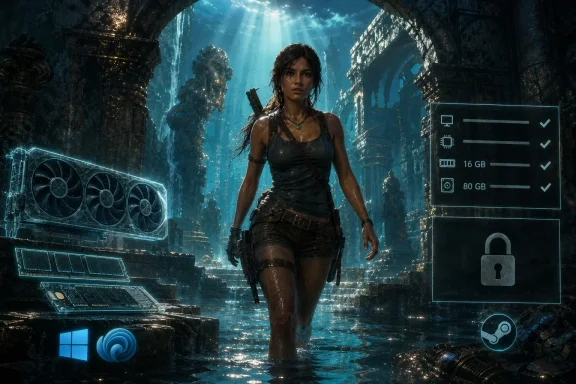
But the PC version has already found itself in the familiar triangle of expectations, hardware, and trust. The Steam page lists Windows 10 and Windows 11 64-bit support, 16 GB of RAM across both minimum and recommended tiers, and an 80 GB storage requirement. At the low end, it names an Intel Core i5-8600 or AMD Ryzen 5 3600, paired with a GTX 1070 8 GB, RTX 2060 Super, or Radeon RX 5700. The recommended line steps up to an Intel Core i7-9700K or Ryzen 5 5600X, plus an RTX 3080 or Radeon RX 6800 XT.
Those numbers are readable, but they are not self-explanatory. A GTX 1070 surviving the minimum line suggests the game may scale down reasonably well, at least on paper. An RTX 3080 at recommended, however, implies that the intended premium experience could lean heavily on the kind of lighting, geometry, and post-processing load that has made Unreal Engine 5 both a showcase and a stress test for modern Windows gaming PCs.
The missing detail is the most important one: there is no stated resolution, frame-rate target, graphics preset, ray tracing mode, or upscaling assumption. “Recommended” can mean 1080p at 60 fps, 1440p at 60 fps, 4K with aggressive reconstruction, or something else entirely. Without those targets, the specs are less a promise than a weather forecast.
That does not automatically mean Tomb Raider: Legacy of Atlantis will be poorly optimized. It may mean the developers are being realistic about Unreal Engine 5’s rendering load, particularly if the game leans into dense foliage, global illumination, high-detail ruins, complex materials, and broad outdoor vistas. Tomb Raider has always depended on place as much as character; if Atlantis, Peru, Greece, and Egypt are being rebuilt as modern spaces rather than nostalgia dioramas, the GPU bill was never going to be tiny.
Still, the RTX 3080 recommendation lands differently in a PC market still bruised by the last several years of uneven ports. Players have seen too many games where “recommended” hardware did not guarantee smooth frame pacing, shader compilation sanity, or stable performance in traversal-heavy areas. The fact that a GPU can brute-force average frame rates does not mean the experience avoids stutter, hitching, or compilation pauses.
That is why Windows players increasingly interrogate requirements like contract lawyers. They look for whether an SSD is mandatory, whether DirectStorage is mentioned, whether the page calls out ray tracing, whether DLSS or FSR is required to hit the advertised target, and whether the CPU line suggests heavy simulation or merely legacy compatibility. In this case, the requirements give us the parts list but not the performance thesis.
The CPU floor is also sensible. An Intel Core i5-8600 or Ryzen 5 3600 reflects a six-core baseline that has become common for modern PC games without cutting off too much of the enthusiast audience. The Ryzen 5 3600 in particular remains one of the great surviving CPUs of the AM4 era, still present in machines that have since been upgraded with newer GPUs.
But the absence of a performance target turns “minimum” into a slippery term. It could mean 720p at 30 fps on low settings. It could mean 1080p with upscaling and compromised shadows. It could mean a playable but visibly constrained version of a game designed around hardware several classes higher. Minimum specs are not a guarantee of dignity; they are often a guarantee that the executable will not immediately surrender.
The 16 GB RAM requirement across both tiers is also worth noting. It is no longer shocking, but it does confirm that 8 GB gaming PCs are effectively outside the intended audience. For Windows 11 machines with browsers, launchers, overlays, RGB utilities, capture software, and security tools running in the background, 16 GB is now the floor rather than the comfort zone.
That tension is especially sharp for a game built around exploration. A corridor shooter can sometimes hide loading and streaming behind doors, elevators, or slow walks. Tomb Raider is about traversal, verticality, changing sightlines, and spaces that reward the player for looking around. If the remake wants to preserve the environmental drama of the original while modernizing scale and fidelity, it needs to stream geometry, textures, lighting data, and animation without making every new chamber feel like a technical negotiation.
The Steam page’s 80 GB storage requirement is modest compared with some modern blockbusters, but it tells us little about drive expectations. The listing, as reported, does not make an SSD mandatory. That omission may be deliberate caution, or it may simply be incomplete at this stage. By 2027, however, a major Unreal Engine 5 action-adventure game that truly behaves well on a mechanical hard drive would be the exception, not the norm.
This is where WindowsForum readers should be skeptical without becoming cynical. Requirements this far from release are often placeholders refined over time. They can be updated after optimization, after console certification, after upscaler integration, and after the studio decides how much transparency it wants around presets. The hardware table is not final judgment; it is an early silhouette.
The industry position is straightforward: anti-tamper systems are meant to protect the crucial launch window, when piracy can do the most commercial damage. Publishers care intensely about those first weeks because preorders, early reviews, influencer coverage, and full-price sales all cluster there. From that point of view, adding Denuvo to a premium remake of a marquee franchise is unsurprising.
The player concern is different. Even when Denuvo is not the primary cause of poor performance, it becomes a convenient symbol of a broader imbalance. Paying customers are asked to accept additional runtime technology, online activation assumptions, and possible compatibility quirks, while pirates may eventually receive a cracked version that strips away the very layer legitimate buyers had to tolerate. That perception has been repeated often enough that it now attaches to Denuvo before any specific game ships.
For Windows users, the issue is not merely ideological. PC gaming is already a stack of launchers, overlays, kernel-level anti-cheat in some titles, cloud saves, GPU drivers, storefront APIs, telemetry, upscalers, capture tools, and background services. Another opaque layer can feel like one more thing standing between the user and the game they bought. In a hobby where troubleshooting often means disabling half the system to identify the culprit, “just one more component” is never just one more component.
That is the uncomfortable asymmetry in modern PC releases. A studio can say the right things about optimization, but players cannot verify the experience until code is in their hands. A storefront can list requirements, but the useful information often arrives later through Digital Foundry-style analysis, community benchmarks, Steam Deck reports, Proton notes, and Reddit megathreads filled with frame-time graphs. The truth of a PC launch is increasingly discovered by the audience after purchase.
There is also a preservation angle that matters more for Tomb Raider than for a disposable annualized shooter. This is a remake of one of the foundational 3D action-adventure games, not merely a seasonal content product. The original Tomb Raider is part of gaming’s architecture; it shaped how players understood 3D space, character movement, camera behavior, and environmental puzzle design. A modern reimagining tied to third-party anti-tamper technology raises predictable questions about what this version will look like ten or twenty years from now.
Publishers sometimes remove Denuvo after the launch window. When they do, it can defuse some of the criticism and make the long-term version cleaner. But unless that plan is stated upfront, players will assume nothing. In 2026, silence is not neutral; it is interpreted through the worst examples of the last decade.
But the timing is awkward. Windows 10’s mainstream consumer era is already effectively winding down, and by February 2027 many users will be navigating extended security options, unsupported installs, or hardware refresh decisions. For a game that asks for modern GPUs and 16 GB of RAM, the OS line may be less about raw compatibility than about audience politics. The studios want the widest possible PC market without having to explain why capable Windows 10 gaming machines are being left behind.
For sysadmins and security-minded users, the more interesting issue is not whether the game launches on Windows 10. It is whether the PC version behaves cleanly in managed environments, respects standard user permissions, avoids aggressive background services, and does not create support headaches through DRM activation or launcher dependencies. The consumer PC and the semi-managed home workstation have converged more than publishers sometimes acknowledge.
Windows 11 users, meanwhile, will be watching for the usual modern stack: HDR behavior, Auto HDR conflicts, fullscreen optimizations, DirectX 12 shader handling, driver scheduling, and whether the game plays nicely with variable refresh rate displays. A great PC version in 2027 is not merely one that renders pretty ruins. It is one that understands the operating system it lives on.
The more important question is drive type and asset strategy. If the final game does not require an SSD, players with older systems may see that as a win. But if the experience on HDDs involves long loads, texture pop-in, traversal hitching, or inconsistent streaming, the absence of an SSD requirement will look less like generosity and more like evasiveness.
This is a familiar PC gaming compromise. Developers want to avoid excluding users, while players want requirements that describe reality rather than the lowest technically possible boot condition. The honest version of a requirement table would distinguish between “will run,” “will run well,” and “this is how we designed the game to be played.” Most storefront pages collapse those into two columns and leave players to infer the rest.
For Tomb Raider, storage performance matters because atmosphere matters. The original game made empty spaces feel mysterious through geometry, sound, pacing, and restraint. A modern remake will likely use richer assets and more dynamic presentation to achieve a similar effect. If those assets arrive late or hitch into place, the illusion breaks.
This matters because modern games are no longer rendered in one straightforward mode. Native resolution, temporal upscaling, frame generation, dynamic resolution, ray tracing, path-traced modes, texture tiers, and console-equivalent settings can all change the meaning of a GPU recommendation. An RTX 3080 may be comfortable at 1440p native in one game and dependent on DLSS Quality in another. Both can honestly be called recommended if the publisher never defines the target.
The CPU recommendations are similarly under-explained. The i7-9700K is an eight-core, eight-thread chip from Intel’s pre-Hyper-Threading mainstream era, while the Ryzen 5 5600X is a six-core, twelve-thread Zen 3 part. That pairing suggests the game may not demand extreme CPU parallelism, but it does not tell us how it handles crowded scenes, physics, streaming, or shader compilation. It also does not tell laptop users where their mobile parts really land.
A more useful listing would say something like: minimum is 1080p low at 30 fps, recommended is 1440p high at 60 fps, and both assume SSD storage. If upscaling is assumed, say so. If HDR is supported but not required, say so. If ray tracing is optional, say so. PC players can handle complexity; what they resent is ambiguity packaged as simplicity.
Early 3D Tomb Raider was not just about Lara as a character; it was about learning the grammar of a space. Players measured jumps, lined up angles, committed to movement, and paid for mistakes. The game’s controls created friction, but that friction made the ruins legible. You did not simply move through levels; you negotiated with them.
Modern action-adventure design tends to smooth that negotiation. Ledges magnetize. Jumps correct themselves. Cameras guide the eye. Companion dialogue and objective markers prevent extended confusion. Those tools can make a remake more welcoming, but they can also flatten the sense that a tomb is a hostile architectural puzzle rather than a themed obstacle course.
This is why the PC requirements matter more than they would for a routine sequel. The remake is selling a fantasy of old danger rebuilt with modern fidelity. If it becomes visually spectacular but mechanically frictionless, nostalgia will curdle. If it preserves too much rigidity, newcomers may bounce off. The best version will understand that the original’s magic was not just dinosaurs, pistols, and polygonal cliffs; it was the feeling that the level itself was the antagonist.
The challenge is proportion. Tomb Raider has always had combat, but the best Tomb Raider games are not primarily about combat. They are about anticipation, discovery, navigation, and the unease of entering places not designed for human comfort. If the remake’s combat is too dominant, it risks importing the wrong lesson from the post-Uncharted era: that every lull must be filled with enemies and every room must justify itself through spectacle.
The reported preview impressions suggest an attempt to keep combat tied to movement, with dodges, acrobatics, and timing rather than cover-shooter heaviness. That sounds promising because it connects action to Lara’s body and spatial awareness. Combat that grows out of traversal can serve Tomb Raider; combat that interrupts traversal can smother it.
For PC players, this also affects performance expectations. A game built around combat arenas stresses different systems than one built around exploration hubs, streaming environments, and traversal animation. If Legacy of Atlantis is trying to do both, it needs not just strong average frame rates but consistent input response. Nothing exposes frame-time instability faster than a jump that fails because the game stuttered at the wrong moment.
But HDR on Windows remains a field of small traps. The difference between good HDR and bad HDR is not a checkbox; it is calibration, peak brightness handling, black levels, tone mapping, UI luminance, and whether the game respects system settings. Many Windows users have HDR-capable displays but leave the feature off because inconsistent implementations make the desktop and games feel unpredictable.
Steam achievements are less technically interesting but culturally important. They signal that the game is being integrated as a conventional PC release rather than treated as a console SKU with a PC wrapper. For a remake, achievements can also shape how players revisit classic spaces, encouraging exploration, challenge runs, collectibles, or completionist routes. That can be charming if done carefully and exhausting if overdesigned.
These features are the low-hanging fruit of PC goodwill. They will not rescue a bad port, and they will not silence DRM concerns. But if the game ships with strong HDR, stable fullscreen behavior, reliable cloud saves, remappable controls, ultrawide support, and sane graphics options, it can earn back some trust the Denuvo line spends in advance.
That is why small details matter. A Denuvo label is not just a label; it triggers a decade of accumulated discourse. A missing SSD requirement is not just an omission; it prompts speculation about streaming. A recommended RTX 3080 is not just a GPU; it becomes a proxy for optimization, target fidelity, and whether last-generation midrange cards are being left behind.
Publishers sometimes seem surprised that players treat store pages this way. They should not be. PC gaming is an enthusiast market built around comparison, modification, benchmarking, and forensic troubleshooting. If you give that audience a table, it will read the table. If the table is vague, it will read the gaps.
For WindowsForum’s audience, this is especially familiar. The same people who parse Microsoft update notes and driver changelogs are not going to accept “recommended” at face value. They want to know what changed, what is required, what is optional, and what might break. Game publishers are learning, slowly, that PC transparency is not fan service; it is support deflection.
It also raises expectations. By 2027, Unreal Engine 5 excuses will be less persuasive than they were during the engine’s awkward transition years. Players will expect shader compilation to be handled intelligently, traversal stutter to be minimized, upscalers to be implemented cleanly, and graphics menus to explain themselves. “It’s UE5” will not be an acceptable diagnosis for avoidable problems.
The release window is interesting for another reason. February has become a crowded space for major games, no longer the quiet dumping ground it once was. A big single-player adventure can thrive there, but it must arrive polished because PC players have plenty of alternatives and little patience for paying full price to become unpaid QA.
The long lead time also gives the publisher a chance to clarify the Denuvo plan. If the anti-tamper system is intended only for the launch window, saying so would materially change the conversation. If not, the studio should expect the issue to remain attached to every PC-focused update. Silence will not make it go away; it will merely let the harshest interpretation dominate.
That briefing should explain whether the game supports DLSS, FSR, XeSS, frame generation, ultrawide resolutions, unlocked frame rates, HDR calibration, DirectStorage, shader precompilation, and Steam Deck testing. It should clarify whether an SSD is recommended or effectively required for a good experience. It should state how Denuvo behaves around offline play and whether there is any plan to remove it after launch.
This is not because PC players are entitled to every internal detail. It is because ambiguity has become expensive. Every missing answer creates a vacuum filled by speculation, anger, or worst-case comparisons to other troubled launches. A clear PC briefing would not satisfy everyone, but it would separate real concerns from imagined ones.
The best PC releases now treat transparency as part of optimization. They explain what the game is doing, what hardware it needs, and where compromises exist. That honesty can buy goodwill even when requirements are high. Players are more forgiving of demanding games than evasive ones.
The better move is patience. A game shipping in February 2027 will live through multiple GPU driver generations, Windows updates, engine revisions, and likely requirement updates before release. Today’s table is useful as a warning light, not a shopping list.
For now, the most concrete takeaways are these:
 Lara’s Oldest Adventure Is Being Sold With Very New PC Anxiety
The pitch for Tomb Raider: Legacy of Atlantis is almost precision-engineered for nostalgia. Crystal Dynamics and Flying Wild Hog are rebuilding Lara Croft’s 1996 debut as a modern action-adventure game, preserving the idea of the original while replacing the grid-like discipline of early 3D platforming with contemporary movement, combat, lighting, and production values. It is the kind of project that can unite several generations of fans: those who remember tank controls, those who came in through the survivor trilogy, and those who know Lara mostly as an icon who keeps being rebooted.But the PC version has already found itself in the familiar triangle of expectations, hardware, and trust. The Steam page lists Windows 10 and Windows 11 64-bit support, 16 GB of RAM across both minimum and recommended tiers, and an 80 GB storage requirement. At the low end, it names an Intel Core i5-8600 or AMD Ryzen 5 3600, paired with a GTX 1070 8 GB, RTX 2060 Super, or Radeon RX 5700. The recommended line steps up to an Intel Core i7-9700K or Ryzen 5 5600X, plus an RTX 3080 or Radeon RX 6800 XT.
Those numbers are readable, but they are not self-explanatory. A GTX 1070 surviving the minimum line suggests the game may scale down reasonably well, at least on paper. An RTX 3080 at recommended, however, implies that the intended premium experience could lean heavily on the kind of lighting, geometry, and post-processing load that has made Unreal Engine 5 both a showcase and a stress test for modern Windows gaming PCs.
The missing detail is the most important one: there is no stated resolution, frame-rate target, graphics preset, ray tracing mode, or upscaling assumption. “Recommended” can mean 1080p at 60 fps, 1440p at 60 fps, 4K with aggressive reconstruction, or something else entirely. Without those targets, the specs are less a promise than a weather forecast.
The RTX 3080 Has Become the New Line in the Sand
The recommended GPU pairing is the most revealing part of the announcement. Nvidia’s RTX 3080 and AMD’s RX 6800 XT were once high-end cards, then comfortable enthusiast cards, and now serve as a kind of psychological midpoint for demanding games. When a 2027 release lists them as recommended, it sends a message: this is not a remake designed merely to run on yesterday’s hardware with sharper textures.That does not automatically mean Tomb Raider: Legacy of Atlantis will be poorly optimized. It may mean the developers are being realistic about Unreal Engine 5’s rendering load, particularly if the game leans into dense foliage, global illumination, high-detail ruins, complex materials, and broad outdoor vistas. Tomb Raider has always depended on place as much as character; if Atlantis, Peru, Greece, and Egypt are being rebuilt as modern spaces rather than nostalgia dioramas, the GPU bill was never going to be tiny.
Still, the RTX 3080 recommendation lands differently in a PC market still bruised by the last several years of uneven ports. Players have seen too many games where “recommended” hardware did not guarantee smooth frame pacing, shader compilation sanity, or stable performance in traversal-heavy areas. The fact that a GPU can brute-force average frame rates does not mean the experience avoids stutter, hitching, or compilation pauses.
That is why Windows players increasingly interrogate requirements like contract lawyers. They look for whether an SSD is mandatory, whether DirectStorage is mentioned, whether the page calls out ray tracing, whether DLSS or FSR is required to hit the advertised target, and whether the CPU line suggests heavy simulation or merely legacy compatibility. In this case, the requirements give us the parts list but not the performance thesis.
The Minimum Spec Is Reassuring Until You Notice What It Omits
The minimum GPU range is unexpectedly forgiving for a game that will arrive in 2027. A GTX 1070 8 GB is an old but still meaningful card, and the RTX 2060 Super and RX 5700 sit in the broad middle of older gaming rigs still attached to 1080p monitors. If those cards are truly viable, the game could have a wider PC footprint than its recommended tier implies.The CPU floor is also sensible. An Intel Core i5-8600 or Ryzen 5 3600 reflects a six-core baseline that has become common for modern PC games without cutting off too much of the enthusiast audience. The Ryzen 5 3600 in particular remains one of the great surviving CPUs of the AM4 era, still present in machines that have since been upgraded with newer GPUs.
But the absence of a performance target turns “minimum” into a slippery term. It could mean 720p at 30 fps on low settings. It could mean 1080p with upscaling and compromised shadows. It could mean a playable but visibly constrained version of a game designed around hardware several classes higher. Minimum specs are not a guarantee of dignity; they are often a guarantee that the executable will not immediately surrender.
The 16 GB RAM requirement across both tiers is also worth noting. It is no longer shocking, but it does confirm that 8 GB gaming PCs are effectively outside the intended audience. For Windows 11 machines with browsers, launchers, overlays, RGB utilities, capture software, and security tools running in the background, 16 GB is now the floor rather than the comfort zone.
Unreal Engine 5 Is the Promise and the Risk
Unreal Engine 5 is doing two jobs here. It is the marketing shorthand for “this will not look like a cleaned-up old game,” and it is the technical context that explains why PC players are wary. The engine’s modern feature set can deliver the kind of richly lit, densely detailed spaces that a Tomb Raider remake wants. It can also expose every weak link in a PC pipeline, from asset streaming to shader compilation to CPU scheduling.That tension is especially sharp for a game built around exploration. A corridor shooter can sometimes hide loading and streaming behind doors, elevators, or slow walks. Tomb Raider is about traversal, verticality, changing sightlines, and spaces that reward the player for looking around. If the remake wants to preserve the environmental drama of the original while modernizing scale and fidelity, it needs to stream geometry, textures, lighting data, and animation without making every new chamber feel like a technical negotiation.
The Steam page’s 80 GB storage requirement is modest compared with some modern blockbusters, but it tells us little about drive expectations. The listing, as reported, does not make an SSD mandatory. That omission may be deliberate caution, or it may simply be incomplete at this stage. By 2027, however, a major Unreal Engine 5 action-adventure game that truly behaves well on a mechanical hard drive would be the exception, not the norm.
This is where WindowsForum readers should be skeptical without becoming cynical. Requirements this far from release are often placeholders refined over time. They can be updated after optimization, after console certification, after upscaler integration, and after the studio decides how much transparency it wants around presets. The hardware table is not final judgment; it is an early silhouette.
Denuvo Turns a System Requirements Story Into a Trust Story
The Denuvo disclosure is the part that will dominate PC comment sections, and not because anyone is surprised. Denuvo Anti-tamper remains one of the most recognizable names in PC game DRM, and its presence on a high-profile single-player adventure almost guarantees pushback. Players who would otherwise be discussing texture quality and traversal design are now discussing launch-day performance risk, offline behavior, preservation, and whether the DRM will be removed later.The industry position is straightforward: anti-tamper systems are meant to protect the crucial launch window, when piracy can do the most commercial damage. Publishers care intensely about those first weeks because preorders, early reviews, influencer coverage, and full-price sales all cluster there. From that point of view, adding Denuvo to a premium remake of a marquee franchise is unsurprising.
The player concern is different. Even when Denuvo is not the primary cause of poor performance, it becomes a convenient symbol of a broader imbalance. Paying customers are asked to accept additional runtime technology, online activation assumptions, and possible compatibility quirks, while pirates may eventually receive a cracked version that strips away the very layer legitimate buyers had to tolerate. That perception has been repeated often enough that it now attaches to Denuvo before any specific game ships.
For Windows users, the issue is not merely ideological. PC gaming is already a stack of launchers, overlays, kernel-level anti-cheat in some titles, cloud saves, GPU drivers, storefront APIs, telemetry, upscalers, capture tools, and background services. Another opaque layer can feel like one more thing standing between the user and the game they bought. In a hobby where troubleshooting often means disabling half the system to identify the culprit, “just one more component” is never just one more component.
The DRM Debate Is Really About Who Gets the Benefit of the Doubt
Denuvo’s inclusion does not prove Tomb Raider: Legacy of Atlantis will run badly. It does not prove the game will require a constant connection. It does not prove the DRM will remain forever. But the burden of trust sits with the publisher because PC players have long memories and extensive receipts from past launches.That is the uncomfortable asymmetry in modern PC releases. A studio can say the right things about optimization, but players cannot verify the experience until code is in their hands. A storefront can list requirements, but the useful information often arrives later through Digital Foundry-style analysis, community benchmarks, Steam Deck reports, Proton notes, and Reddit megathreads filled with frame-time graphs. The truth of a PC launch is increasingly discovered by the audience after purchase.
There is also a preservation angle that matters more for Tomb Raider than for a disposable annualized shooter. This is a remake of one of the foundational 3D action-adventure games, not merely a seasonal content product. The original Tomb Raider is part of gaming’s architecture; it shaped how players understood 3D space, character movement, camera behavior, and environmental puzzle design. A modern reimagining tied to third-party anti-tamper technology raises predictable questions about what this version will look like ten or twenty years from now.
Publishers sometimes remove Denuvo after the launch window. When they do, it can defuse some of the criticism and make the long-term version cleaner. But unless that plan is stated upfront, players will assume nothing. In 2026, silence is not neutral; it is interpreted through the worst examples of the last decade.
Windows 10 Support Is Welcome, But the Clock Is Loud
The listing’s support for both Windows 10 and Windows 11 is sensible, especially for a game releasing in early 2027. Many PC gamers still have Windows 10 machines, and not every capable gaming rig meets Windows 11’s official upgrade requirements cleanly. Keeping Windows 10 in the support matrix helps avoid turning the game into a forced OS migration event.But the timing is awkward. Windows 10’s mainstream consumer era is already effectively winding down, and by February 2027 many users will be navigating extended security options, unsupported installs, or hardware refresh decisions. For a game that asks for modern GPUs and 16 GB of RAM, the OS line may be less about raw compatibility than about audience politics. The studios want the widest possible PC market without having to explain why capable Windows 10 gaming machines are being left behind.
For sysadmins and security-minded users, the more interesting issue is not whether the game launches on Windows 10. It is whether the PC version behaves cleanly in managed environments, respects standard user permissions, avoids aggressive background services, and does not create support headaches through DRM activation or launcher dependencies. The consumer PC and the semi-managed home workstation have converged more than publishers sometimes acknowledge.
Windows 11 users, meanwhile, will be watching for the usual modern stack: HDR behavior, Auto HDR conflicts, fullscreen optimizations, DirectX 12 shader handling, driver scheduling, and whether the game plays nicely with variable refresh rate displays. A great PC version in 2027 is not merely one that renders pretty ruins. It is one that understands the operating system it lives on.
The 80 GB Footprint Looks Modest, But Storage Is No Longer Just Capacity
An 80 GB storage requirement is, by current blockbuster standards, almost restrained. It is large enough to signal high-resolution assets and modern cinematics, but not so large that it creates immediate panic for users juggling a 1 TB SSD. On paper, it is one of the less alarming numbers in the table.The more important question is drive type and asset strategy. If the final game does not require an SSD, players with older systems may see that as a win. But if the experience on HDDs involves long loads, texture pop-in, traversal hitching, or inconsistent streaming, the absence of an SSD requirement will look less like generosity and more like evasiveness.
This is a familiar PC gaming compromise. Developers want to avoid excluding users, while players want requirements that describe reality rather than the lowest technically possible boot condition. The honest version of a requirement table would distinguish between “will run,” “will run well,” and “this is how we designed the game to be played.” Most storefront pages collapse those into two columns and leave players to infer the rest.
For Tomb Raider, storage performance matters because atmosphere matters. The original game made empty spaces feel mysterious through geometry, sound, pacing, and restraint. A modern remake will likely use richer assets and more dynamic presentation to achieve a similar effect. If those assets arrive late or hitch into place, the illusion breaks.
The Missing Frame-Rate Target Is the Loudest Silence
The absence of resolution and frame-rate targets is not unusual, but it is increasingly unacceptable for high-profile PC releases. A requirements table without targets is like a car spec sheet that lists engine size but not fuel economy, towing capacity, or acceleration. It tells you what the manufacturer tested, not what the buyer can expect.This matters because modern games are no longer rendered in one straightforward mode. Native resolution, temporal upscaling, frame generation, dynamic resolution, ray tracing, path-traced modes, texture tiers, and console-equivalent settings can all change the meaning of a GPU recommendation. An RTX 3080 may be comfortable at 1440p native in one game and dependent on DLSS Quality in another. Both can honestly be called recommended if the publisher never defines the target.
The CPU recommendations are similarly under-explained. The i7-9700K is an eight-core, eight-thread chip from Intel’s pre-Hyper-Threading mainstream era, while the Ryzen 5 5600X is a six-core, twelve-thread Zen 3 part. That pairing suggests the game may not demand extreme CPU parallelism, but it does not tell us how it handles crowded scenes, physics, streaming, or shader compilation. It also does not tell laptop users where their mobile parts really land.
A more useful listing would say something like: minimum is 1080p low at 30 fps, recommended is 1440p high at 60 fps, and both assume SSD storage. If upscaling is assumed, say so. If HDR is supported but not required, say so. If ray tracing is optional, say so. PC players can handle complexity; what they resent is ambiguity packaged as simplicity.
The Remake Has to Serve Two Tomb Raiders at Once
Beyond the hardware table, Legacy of Atlantis carries a design problem that no GPU can solve. It must remake a game remembered for precision, solitude, and harsh spatial rules for an audience accustomed to fluid animation, generous ledge detection, cinematic framing, and accessibility options. That is a delicate balancing act, because the original Tomb Raider’s awkwardness was also part of its identity.Early 3D Tomb Raider was not just about Lara as a character; it was about learning the grammar of a space. Players measured jumps, lined up angles, committed to movement, and paid for mistakes. The game’s controls created friction, but that friction made the ruins legible. You did not simply move through levels; you negotiated with them.
Modern action-adventure design tends to smooth that negotiation. Ledges magnetize. Jumps correct themselves. Cameras guide the eye. Companion dialogue and objective markers prevent extended confusion. Those tools can make a remake more welcoming, but they can also flatten the sense that a tomb is a hostile architectural puzzle rather than a themed obstacle course.
This is why the PC requirements matter more than they would for a routine sequel. The remake is selling a fantasy of old danger rebuilt with modern fidelity. If it becomes visually spectacular but mechanically frictionless, nostalgia will curdle. If it preserves too much rigidity, newcomers may bounce off. The best version will understand that the original’s magic was not just dinosaurs, pistols, and polygonal cliffs; it was the feeling that the level itself was the antagonist.
Flying Wild Hog Makes the Combat Question More Interesting
Flying Wild Hog’s involvement adds an intriguing wrinkle. The studio is associated with kinetic action, aggressive combat feel, and a willingness to lean into physicality. That could be valuable for a Tomb Raider remake that wants to modernize the original’s often primitive fights without turning Lara into a superhero shooter protagonist.The challenge is proportion. Tomb Raider has always had combat, but the best Tomb Raider games are not primarily about combat. They are about anticipation, discovery, navigation, and the unease of entering places not designed for human comfort. If the remake’s combat is too dominant, it risks importing the wrong lesson from the post-Uncharted era: that every lull must be filled with enemies and every room must justify itself through spectacle.
The reported preview impressions suggest an attempt to keep combat tied to movement, with dodges, acrobatics, and timing rather than cover-shooter heaviness. That sounds promising because it connects action to Lara’s body and spatial awareness. Combat that grows out of traversal can serve Tomb Raider; combat that interrupts traversal can smother it.
For PC players, this also affects performance expectations. A game built around combat arenas stresses different systems than one built around exploration hubs, streaming environments, and traversal animation. If Legacy of Atlantis is trying to do both, it needs not just strong average frame rates but consistent input response. Nothing exposes frame-time instability faster than a jump that fails because the game stuttered at the wrong moment.
HDR, Achievements, and Steam Features Are the Easy Part
The Steam listing reportedly confirms HDR support and Steam achievements, both welcome but expected in a premium PC release. HDR in particular could be meaningful for Tomb Raider, where darkness, torchlight, water, gold, stone, and ancient machinery are central to the visual identity. A well-tuned HDR implementation can make tombs feel luminous without simply raising brightness.But HDR on Windows remains a field of small traps. The difference between good HDR and bad HDR is not a checkbox; it is calibration, peak brightness handling, black levels, tone mapping, UI luminance, and whether the game respects system settings. Many Windows users have HDR-capable displays but leave the feature off because inconsistent implementations make the desktop and games feel unpredictable.
Steam achievements are less technically interesting but culturally important. They signal that the game is being integrated as a conventional PC release rather than treated as a console SKU with a PC wrapper. For a remake, achievements can also shape how players revisit classic spaces, encouraging exploration, challenge runs, collectibles, or completionist routes. That can be charming if done carefully and exhausting if overdesigned.
These features are the low-hanging fruit of PC goodwill. They will not rescue a bad port, and they will not silence DRM concerns. But if the game ships with strong HDR, stable fullscreen behavior, reliable cloud saves, remappable controls, ultrawide support, and sane graphics options, it can earn back some trust the Denuvo line spends in advance.
The Steam Page Is Now Part of the News Cycle
One of the more striking changes in PC gaming is how much analysis now begins with a storefront page. A Steam listing is no longer merely a place to wishlist or preorder; it is a living document parsed for DRM flags, AI content disclosures, language support, controller notes, family sharing exclusions, system requirements, and pricing. The page becomes the first technical interview the publisher never gave.That is why small details matter. A Denuvo label is not just a label; it triggers a decade of accumulated discourse. A missing SSD requirement is not just an omission; it prompts speculation about streaming. A recommended RTX 3080 is not just a GPU; it becomes a proxy for optimization, target fidelity, and whether last-generation midrange cards are being left behind.
Publishers sometimes seem surprised that players treat store pages this way. They should not be. PC gaming is an enthusiast market built around comparison, modification, benchmarking, and forensic troubleshooting. If you give that audience a table, it will read the table. If the table is vague, it will read the gaps.
For WindowsForum’s audience, this is especially familiar. The same people who parse Microsoft update notes and driver changelogs are not going to accept “recommended” at face value. They want to know what changed, what is required, what is optional, and what might break. Game publishers are learning, slowly, that PC transparency is not fan service; it is support deflection.
The 2027 Date Gives the Developers Time, But Also Raises Expectations
A February 2027 launch gives Legacy of Atlantis a long runway. That is good news for a remake attempting to bridge old-school Tomb Raider and modern blockbuster design. It gives the developers time to optimize, revise controls, refine streaming, test hardware, and respond to early feedback from previews and community reaction.It also raises expectations. By 2027, Unreal Engine 5 excuses will be less persuasive than they were during the engine’s awkward transition years. Players will expect shader compilation to be handled intelligently, traversal stutter to be minimized, upscalers to be implemented cleanly, and graphics menus to explain themselves. “It’s UE5” will not be an acceptable diagnosis for avoidable problems.
The release window is interesting for another reason. February has become a crowded space for major games, no longer the quiet dumping ground it once was. A big single-player adventure can thrive there, but it must arrive polished because PC players have plenty of alternatives and little patience for paying full price to become unpaid QA.
The long lead time also gives the publisher a chance to clarify the Denuvo plan. If the anti-tamper system is intended only for the launch window, saying so would materially change the conversation. If not, the studio should expect the issue to remain attached to every PC-focused update. Silence will not make it go away; it will merely let the harshest interpretation dominate.
The PC Version Needs a Real Technical Briefing Before Launch
At some point before release, Crystal Dynamics, Flying Wild Hog, or the publisher should provide a proper PC features breakdown. Not a marketing sizzle reel, not a vague “optimized for PC” paragraph, but a concrete technical post that answers the questions PC buyers actually ask. The requirements table should be expanded with targets, presets, and assumptions.That briefing should explain whether the game supports DLSS, FSR, XeSS, frame generation, ultrawide resolutions, unlocked frame rates, HDR calibration, DirectStorage, shader precompilation, and Steam Deck testing. It should clarify whether an SSD is recommended or effectively required for a good experience. It should state how Denuvo behaves around offline play and whether there is any plan to remove it after launch.
This is not because PC players are entitled to every internal detail. It is because ambiguity has become expensive. Every missing answer creates a vacuum filled by speculation, anger, or worst-case comparisons to other troubled launches. A clear PC briefing would not satisfy everyone, but it would separate real concerns from imagined ones.
The best PC releases now treat transparency as part of optimization. They explain what the game is doing, what hardware it needs, and where compromises exist. That honesty can buy goodwill even when requirements are high. Players are more forgiving of demanding games than evasive ones.
The Spec Sheet Tells Windows Players Where to Start
The practical read for Windows users is straightforward but not simple. If your machine sits near the minimum line, you should assume compromise until proven otherwise. If your machine matches the recommended line, you should still wait for target clarification before assuming 1440p or 4K comfort. If you are building or upgrading specifically for this game, it is too early to buy hardware around this table.The better move is patience. A game shipping in February 2027 will live through multiple GPU driver generations, Windows updates, engine revisions, and likely requirement updates before release. Today’s table is useful as a warning light, not a shopping list.
For now, the most concrete takeaways are these:
- Tomb Raider: Legacy of Atlantis currently lists Windows 10 and Windows 11 64-bit support, 16 GB of RAM, and 80 GB of available storage across both requirement tiers.
- The minimum GPU line reaches back to the GTX 1070 8 GB, RTX 2060 Super, and Radeon RX 5700, which suggests older 1080p-class systems have not been abandoned on paper.
- The recommended GPU line moves to the RTX 3080 or Radeon RX 6800 XT, but the listing does not define the resolution, frame rate, graphics preset, or upscaling assumptions behind that recommendation.
- Denuvo Anti-tamper is listed for the Steam version, making DRM behavior and possible performance concerns part of the PC conversation well before launch.
- The absence of an SSD requirement is notable, but it should not be read as proof that mechanical drives will deliver a good experience in a modern Unreal Engine 5 adventure.
- Anyone planning a Windows gaming upgrade for Legacy of Atlantis should wait for updated requirements, benchmarks, and a fuller PC features breakdown closer to release.
References
- Primary source: eTeknix
Published: 2026-06-15T20:20:12.144818
Tomb Raider: Legacy of Atlantis Will Have Denuvo and PC Requirements Have Been Revealed - eTeknix
Lara Croft’s return is getting closer, and PC players can now prepare their systems. Crystal Dynamics and Flying Wild Hog have shared the official PC…www.eteknix.com - Related coverage: gamesradar.com
Tomb Raider: Legacy of Atlantis is a gorgeous revival of the original's puzzle-driven spirit, but I'm glad it's been delayed | GamesRadar+
Summer Preview | Legacy of Atlantis could be something special, if the control issues during my hands-on can be fixed by launchwww.gamesradar.com - Related coverage: store.steampowered.com
Precomprar Tomb Raider: Legacy of Atlantis en Steam
Experimenta una impresionante reinterpretación de la aventura debut de Lara Croft y descubre los secretos perdidos de Atlántida con gráficos espectaculares, una jugabilidad moderna y nuevas sorpresas que honran el espíritu del juego original.store.steampowered.com
- Related coverage: gamespot.com
Tomb Raider: Legacy of Atlantis Preorders Are Live On PS5, Xbox, Switch 2, And PC - GameSpot
The remake of Lara Croft's first adventure launches for PS5, Xbox, Switch 2, and PC on February 12, 2027.www.gamespot.com - Related coverage: allthings.how
Loading…
allthings.how - Related coverage: pcgamesn.com
Tomb Raider Legacy of Atlantis system requirements
The Tomb Raider: Legacy of Atlantis system requirements are already out, well ahead of the delayed 2027 release of Lara's latest adventure.www.pcgamesn.com
- Related coverage: tweaktown.com
Tomb Raider: Legacy of Atlantis PC system requirements are out, and Denuvo DRM is confirmed ahead of its 2027 launch
The recommended tier calls for an RTX 3080 or RX 6800 XT, with no target resolution listed, suggesting the specs assume upscaling rather than native render. www.tweaktown.com
- Related coverage: gematsu.com
Loading…
www.gematsu.com - Related coverage: pcgamer.com
Tomb Raider: Legacy of Atlantis delayed into 2027, but there's a new gameplay trailer to make up for it | PC Gamer
Our first proper look at the Unreal Engine 5-powered remake of Lara Croft's original adventure dropped during today's Sony State of Play.www.pcgamer.com - Related coverage: techradar.com
'At least they're honest about it?' —Tomb Raider: Legacy of Atlantis is the latest game to come with an AI-generated content disclosure | TechRadar
Tomb Raider: Legacy of Atlantis is the latest game to feature an AI-generated content disclosure.www.techradar.com - Related coverage: embracer.com
