

Tomb Raider: Legacy of Atlantis has listed PC requirements ahead of its February 12, 2027 launch, calling for Windows 10 or 11, 16GB of RAM, 80GB of storage, and a minimum GPU tier starting at GeForce GTX 1070, GeForce RTX 2060 Super, or Radeon RX 5700. That makes Lara Croft’s return less a nostalgia trip for aging PCs than a reminder that “remake” no longer means lightweight. The surprise is not that a modern Unreal Engine 5 adventure wants modern hardware; it is that the floor has moved beyond the old Steam-survey comfort zone. For Windows gamers, the real story is the slow death of the GTX 1060 era.
The premise of Tomb Raider: Legacy of Atlantis is comfortingly familiar: Crystal Dynamics and Flying Wild Hog are revisiting Lara Croft’s first adventure, rebuilding a foundational 1996 action-adventure for a 2027 audience. The PC requirements, however, are anything but retro. This is not a remaster designed to flatter decade-old machines; it is a modern production asking for GPUs that, while no longer cutting edge, still sit above what many budget and legacy desktops contain.
The minimum GPU line is the part that matters. A GeForce GTX 1070, RTX 2060 Super, or Radeon RX 5700 is not an outrageous ask in 2026, but it is a clean break from the long-lived GTX 1060 baseline that developers have leaned on for years. That card became the symbol of “good enough” PC gaming because it survived multiple console generations, pandemic pricing, and the slow churn of 1080p hardware. Legacy of Atlantis appears to be one more game telling those users that survival is not the same as suitability.
The rest of the minimum specification is more forgiving. A Ryzen 5 3600 or Intel Core i5-8600-class CPU, 16GB of RAM, and Windows 10 or 11 64-bit are not exotic requirements for a gaming PC in 2026. The system list looks harsh because of the GPU floor, not because Crystal Dynamics is demanding a workstation.
That distinction matters for WindowsForum readers because it points to the upgrade path. This is not a game that appears to be forcing a platform migration to Windows 11, nor does it appear to be punishing anyone who built a sensible midrange system in the late 2010s and kept it maintained. It is, instead, applying pressure exactly where modern PC games usually do: graphics memory, shader throughput, and storage behavior, even when the storage line itself remains oddly vague.
Legacy of Atlantis seems to fall into the third category. A GTX 1070 is not dramatically younger than a GTX 1060, but it belongs to a higher performance tier. The RTX 2060 Super, meanwhile, brings newer architecture and features that make it a more comfortable fit for modern rendering pipelines. The Radeon RX 5700 similarly marks the game’s floor as something closer to late-2010s enthusiast hardware than old midrange hardware.
That matters because minimum specs are often misunderstood. They are not a promise of beauty, and they are rarely a guarantee of 60 frames per second. In the absence of an official performance target, the safest assumption is that the listed minimum is intended for a compromised 1080p experience, likely with low settings and a 30fps target, though Crystal Dynamics has not publicly attached a resolution or frame rate to the spec.
This ambiguity is not unique to Tomb Raider. Publishers often release system requirements before optimization is finished, before driver profiles are locked, and before the marketing team wants to discuss ray tracing, upscaling, or 4K modes. But the lack of stated expectations leaves PC players doing the same detective work they have done for years: comparing GPU tiers, guessing settings, and hoping the minimum spec is not merely the threshold for launching the executable.
There is a more generous reading. By setting the floor at GTX 1070 or RTX 2060 Super, the studio may be trying to avoid the reputational damage that comes from listing optimistic requirements and then watching older cards buckle under real gameplay. Conservative specs can annoy users up front but prevent a worse launch narrative later. PC players have learned, painfully, that a permissive spec sheet is not the same as a well-performing game.
The RTX 3080 in particular still carries psychological weight. It was once a flagship-class card, and while newer GPUs have displaced it in raw performance and efficiency, it remains a powerful 1440p-class card in many rigs. Asking for it under a recommended preset tells players that Legacy of Atlantis is not being positioned like a small remake with modest ambitions. It is being positioned like a full modern action-adventure release.
The Radeon RX 6800 XT sends the same message from the AMD side. That card has ample raster performance and a healthy memory configuration, which makes its inclusion notable when the published requirements do not state a VRAM number. If the recommended cards are doing more than serving as rough performance proxies, then memory capacity and bandwidth may matter more than the table admits.
The CPU requirements are comparatively relaxed. A Ryzen 5 5600X remains a strong gaming processor, but it is not a bleeding-edge part, and the Core i7-9700K is an older 8-core chip without the hybrid architecture complexity of newer Intel designs. That reinforces the obvious: this is likely a GPU-bound game first, and players with decent older CPUs may be fine if their graphics card is up to the job.
The lack of a stated performance expectation is still the missing piece. Recommended could mean 1080p at 60fps on High. It could mean 1440p at 60fps with upscaling. It could mean a vendor-friendly target chosen before the final optimization pass. Until Crystal Dynamics or Amazon Games clarifies that, the recommended spec is less a promise than a weather forecast.
This is sensible. The GPU floor already excludes a portion of the older PC audience, and adding a Windows 11-only requirement would narrow the audience further. For a franchise with a long memory and a fan base that includes older PC players, keeping Windows 10 on the list is as much a commercial decision as a technical one.
Still, Windows 10 support should not be confused with old-PC friendliness. A system can run Windows 10 perfectly well and still fall below the graphics requirement. In fact, many machines that stayed on Windows 10 precisely because they were older or because their owners disliked hardware-gated upgrades may be the same machines most likely to be carrying GTX 1060-era GPUs.
There is also the security-minded angle. By February 2027, Windows 10 will be deep into its post-mainstream-consumer life, with support realities depending on edition, extended programs, and organizational choices. Enthusiasts may keep it alive; enterprises may have contractual reasons to do so; home users may simply not want the disruption. But game support for Windows 10 in 2027 will increasingly feel like a courtesy rather than a guarantee of parity.
For admins managing shared gaming PCs, labs, esports spaces, or creative workstations that double as game machines, the OS line is reassuring but not decisive. The compatibility headline is good. The hardware budget line remains the constraint.
This is not only about the game itself. Windows, launchers, overlays, capture tools, browser tabs, RGB utilities, anti-cheat services, cloud sync clients, and driver software all nibble away at available memory before the game has even started loading texture pools and level data. A nominally playable 8GB machine can become a stutter machine under real use.
The RAM requirement is less painful than the GPU requirement because the upgrade path is usually cheaper, at least for DDR4 systems. Many older gaming desktops built around Ryzen 3000 or Intel 8th- and 9th-generation CPUs can be brought to 16GB or 32GB without replacing the platform. Laptops, small-form-factor systems, and OEM desktops with limited slots are a different story, but for conventional towers, memory is not the hardest part.
DDR5 pricing and platform costs can complicate new builds, but Legacy of Atlantis does not appear to demand a new platform. That is the important difference. A player with a Ryzen 5 3600, 16GB of DDR4, and a weak GPU has a straightforward problem. A player with an ancient quad-core CPU, 8GB of RAM, and a GTX 1060 has three problems pretending to be one.
The published spec therefore draws a useful line between “upgrade” and “rebuild.” For many users, the GPU is the only urgent change. For others, the requirements will reveal that the PC was already overdue for retirement.
It is possible that Legacy of Atlantis simply does not require fast random access in the way sprawling open-world games do. A more directed action-adventure structure can hide loading behind traversal, cutscenes, elevators, doors, crawlspaces, and other design tricks. The original Tomb Raider was built around rooms, routes, and authored spaces rather than modern seamless sprawl, and a remake may preserve some of that structure even with vastly richer assets.
But “not required” is not the same as “not recommended.” An HDD may launch the game, but it will almost certainly be the worst place to install it on a modern Windows PC. Load times, texture streaming, shader cache behavior, and patching all benefit from solid-state storage, and the difference between a SATA SSD and a mechanical hard drive is still enormous in day-to-day responsiveness.
The lack of an SSD line also leaves open questions about DirectStorage or similar asset-loading paths. The requirements do not indicate that such features are mandatory, and there is no stated ultra preset that would require a particular NVMe tier. That may be good news for compatibility, but it also means players should wait for more detailed technical guidance before assuming storage will be irrelevant.
The practical recommendation is simple: treat 80GB as the capacity requirement, not the performance guidance. If the game matters to you, install it on an SSD. Even a basic SATA drive is likely to provide a better experience than a spinning disk, and a midrange NVMe drive is now ordinary equipment in a gaming PC rather than a luxury.
Unreal Engine 5 has become a shorthand for both visual ambition and PC anxiety. Its most impressive features can deliver extraordinary lighting, geometry density, and environmental detail, but recent UE5 titles have also trained players to worry about shader compilation stutter, uneven traversal streaming, VRAM pressure, and settings menus that rely heavily on upscaling to hit advertised frame rates. That does not mean Legacy of Atlantis will inherit every UE5 problem. It does mean the requirements deserve to be read with caution.
The GPU tiers listed here make sense in that context. GTX 1070 and RX 5700 are not modern feature-complete cards in the same way newer RTX and Radeon generations are, but they represent enough raw performance to survive a baseline UE5 implementation if the settings are scaled appropriately. RTX 2060 Super adds Nvidia’s early ray-tracing and DLSS-era architecture, though the spec sheet does not say whether those features are required or meaningfully used.
The recommended RTX 3080 and RX 6800 XT are more comfortable fits for modern rendering. They are strong enough to handle dense environments and higher-quality effects without immediately leaning on the crutches of lowest settings. If the game uses advanced lighting, high-resolution assets, or large-scale environmental detail, those cards begin to look less extravagant and more predictable.
The risk is expectation management. Players hear “remake of a 1996 game” and imagine a familiar design made prettier. Developers hear “modern reimagining” and build something that competes visually with current releases. The system requirements are the place where those two interpretations collide.
Steam Deck compatibility often depends less on raw spec-sheet comparisons than on real-world settings, resolution, upscaling, shader behavior, and Proton compatibility. A game that looks intimidating on desktop can sometimes run acceptably at 800p with aggressive tuning. Conversely, a game with modest requirements can be unpleasant on Deck if it stutters, drains battery brutally, or trips over middleware.
Until Valve assigns a rating or the developers publish handheld-specific guidance, “likely playable” should be treated as optimism rather than fact. The Deck has a way of surprising both skeptics and optimists. But a game that lists GTX 1070-class hardware as its minimum is not an obvious handheld win.
This matters beyond Valve’s device. The handheld PC market has expanded rapidly, and devices from ASUS, Lenovo, MSI, and others have turned Windows-based portable gaming into a serious category. Those systems often have more power than the Steam Deck, but they still live under tight thermal and battery constraints. A spec sheet aimed at desktop GPUs gives those users only a rough hint.
For Windows handheld owners, the best advice is patience. Wait for tested footage, not marketing claims. Watch for frame-time consistency, not just average fps. And assume that the first week of patches may matter more than the first day of impressions.
The disclosure is carefully worded. It tries to position AI as part of preproduction or temporary support rather than as a substitute for finished creative work. That distinction may satisfy some players and irritate others. In an industry still absorbing layoffs, cost pressure, and automation anxiety, “AI-assisted” is not a neutral phrase.
For a Tomb Raider remake, the issue is especially sensitive. This is a franchise built on memory: old spaces, iconic silhouettes, familiar sounds, and the emotional attachment of players who have known Lara for decades. A remake asks fans to trust that developers understand what should change and what should remain sacred. Any hint of automation in that process invites scrutiny, even if the final assets were human-polished or replaced.
There is a parallel with PC performance. In both cases, the marketing message asks for trust before players can verify the result. The requirements tell us the game is technically ambitious, but not how well it runs. The AI disclosure tells us tools were used, but not what their practical impact was. The missing details are where community debate will live.
For WindowsForum’s audience, that debate is not culture-war decoration. It affects buying behavior, modding interest, preservation concerns, and the willingness to preorder. Enthusiasts do not only care whether a game launches. They care how it was built, how it behaves on their hardware, and whether the finished product respects the systems and communities around it.
That is awkward timing for anyone who skipped the last few GPU generations. The used market has improved from the worst days of pandemic-era pricing, but GPU shopping remains fragmented. Older cards may be affordable but inefficient; newer cards may offer better features but higher entry prices; and the value calculation changes depending on whether a player cares about ray tracing, upscaling, VRAM, power draw, or warranty.
A player sitting on a GTX 1060 faces a particularly annoying choice. Buying a used GTX 1070 just to meet the letter of the requirement would be a poor long-term move unless the price is extremely low. Moving to a newer midrange RTX or Radeon card makes more sense, but that turns a single-game upgrade into a broader platform decision.
The CPU side is less punishing. Ryzen 3000-era systems remain viable, and Intel 8th- and 9th-generation gaming desktops can still perform respectably when paired with a stronger GPU. That will soften the blow for many users. The motherboard, memory, and case may survive; the graphics card may not.
The publisher may see this as a reasonable trade. By February 2027, GTX 1070-class performance will be ancient in market terms, even if many users still own weaker hardware. Developers cannot optimize forever around the lowest common denominator without compromising scope. The tension is that PC gaming’s strength is its range, and its weakness is also its range.
This omission is increasingly common, but it is not harmless. PC players make purchasing decisions based on these tables, and vague targets encourage both overbuying and disappointment. A player with an RTX 4070-class or RX 7800 XT-class card may assume smooth high-refresh 1440p performance, only to discover that the game leans heavily on upscaling or suffers from CPU-side stutter. A player with an RTX 3080 may assume the recommended experience is comfortably above 60fps, when it may simply meet an internal “good enough” bar.
The lack of VRAM guidance is similarly frustrating. The recommended AMD card carries 16GB of VRAM, while the RTX 3080 commonly shipped with 10GB, depending on model. That mismatch makes it difficult to infer the game’s memory appetite. If 10GB is enough for High, the RX 6800 XT may simply be a raster-performance match. If the game benefits from more VRAM, Nvidia users on older high-end cards may need to watch texture settings carefully.
Upscaling is another missing variable. DLSS, FSR, XeSS, frame generation, and dynamic resolution systems can reshape performance expectations dramatically. A requirement table that does not say whether targets assume native rendering or upscaling leaves players guessing. In 2026, that is not a minor detail; it is central to how PC games are shipped and experienced.
The optimistic view is that more detailed PC guidance will arrive closer to launch. The skeptical view is that publishers prefer vague requirements because specificity creates accountability. PC players should hope for the former and plan around the latter.
Legacy of Atlantis arrives in a market where the PC is both more powerful and more complicated than ever. Windows users juggle driver branches, shader caches, overlay conflicts, VRR behavior, HDR quirks, storage tiers, and security software. The console promise is still simplicity; the PC promise is still control. System requirements are the uneasy truce between the two.
For Crystal Dynamics and Flying Wild Hog, the remake is a balancing act. Push too hard visually and the game risks becoming another “wait for patches” PC release. Scale too conservatively and the remake may fail to justify itself as a premium 2027 production. The listed specs suggest the developers are not aiming low.
For players, the message is to separate nostalgia from hardware reality. This may be Lara’s first adventure in narrative terms, but it is not a first-generation 3D game wearing a new coat of paint. It is a modern Windows game with modern dependencies, modern expectations, and modern risks.
That does not make the requirements unreasonable. It makes them revealing. The mainstream PC baseline is moving, and Tomb Raider is merely one of the more recognizable names to mark the shift.
By the time Tomb Raider: Legacy of Atlantis arrives on February 12, 2027, the most important PC question may not be whether Lara Croft can survive another ancient trap, but whether developers can give Windows players enough technical clarity before launch to make informed choices. The requirements already tell us that the old baseline is fading; the months ahead need to tell us whether this remake earns the hardware it asks for.
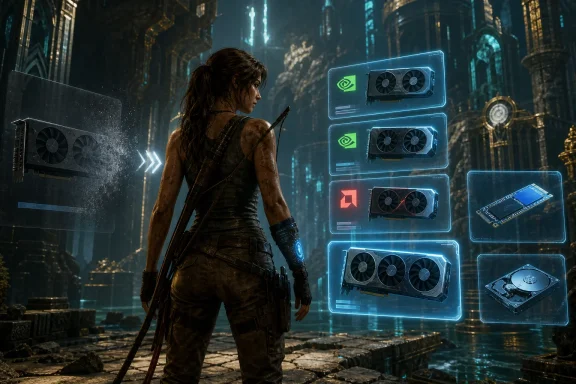 Lara Croft Returns to a PC Market That Has Aged Unevenly
The premise of Tomb Raider: Legacy of Atlantis is comfortingly familiar: Crystal Dynamics and Flying Wild Hog are revisiting Lara Croft’s first adventure, rebuilding a foundational 1996 action-adventure for a 2027 audience. The PC requirements, however, are anything but retro. This is not a remaster designed to flatter decade-old machines; it is a modern production asking for GPUs that, while no longer cutting edge, still sit above what many budget and legacy desktops contain.The minimum GPU line is the part that matters. A GeForce GTX 1070, RTX 2060 Super, or Radeon RX 5700 is not an outrageous ask in 2026, but it is a clean break from the long-lived GTX 1060 baseline that developers have leaned on for years. That card became the symbol of “good enough” PC gaming because it survived multiple console generations, pandemic pricing, and the slow churn of 1080p hardware. Legacy of Atlantis appears to be one more game telling those users that survival is not the same as suitability.
The rest of the minimum specification is more forgiving. A Ryzen 5 3600 or Intel Core i5-8600-class CPU, 16GB of RAM, and Windows 10 or 11 64-bit are not exotic requirements for a gaming PC in 2026. The system list looks harsh because of the GPU floor, not because Crystal Dynamics is demanding a workstation.
That distinction matters for WindowsForum readers because it points to the upgrade path. This is not a game that appears to be forcing a platform migration to Windows 11, nor does it appear to be punishing anyone who built a sensible midrange system in the late 2010s and kept it maintained. It is, instead, applying pressure exactly where modern PC games usually do: graphics memory, shader throughput, and storage behavior, even when the storage line itself remains oddly vague.
The Minimum Spec Is Really a Eulogy for the GTX 1060
For years, the GTX 1060 functioned as the industry’s informal treaty between developers and players. If a game could run on that card, it could plausibly claim broad PC accessibility. If it could not, it was either ambitious, poorly optimized, or making a deliberate bet that the mainstream had moved on.Legacy of Atlantis seems to fall into the third category. A GTX 1070 is not dramatically younger than a GTX 1060, but it belongs to a higher performance tier. The RTX 2060 Super, meanwhile, brings newer architecture and features that make it a more comfortable fit for modern rendering pipelines. The Radeon RX 5700 similarly marks the game’s floor as something closer to late-2010s enthusiast hardware than old midrange hardware.
That matters because minimum specs are often misunderstood. They are not a promise of beauty, and they are rarely a guarantee of 60 frames per second. In the absence of an official performance target, the safest assumption is that the listed minimum is intended for a compromised 1080p experience, likely with low settings and a 30fps target, though Crystal Dynamics has not publicly attached a resolution or frame rate to the spec.
This ambiguity is not unique to Tomb Raider. Publishers often release system requirements before optimization is finished, before driver profiles are locked, and before the marketing team wants to discuss ray tracing, upscaling, or 4K modes. But the lack of stated expectations leaves PC players doing the same detective work they have done for years: comparing GPU tiers, guessing settings, and hoping the minimum spec is not merely the threshold for launching the executable.
There is a more generous reading. By setting the floor at GTX 1070 or RTX 2060 Super, the studio may be trying to avoid the reputational damage that comes from listing optimistic requirements and then watching older cards buckle under real gameplay. Conservative specs can annoy users up front but prevent a worse launch narrative later. PC players have learned, painfully, that a permissive spec sheet is not the same as a well-performing game.
Recommended Hardware Puts the Remake in Big-Budget Territory
The recommended specification is where the game’s ambition becomes harder to ignore. Crystal Dynamics lists a Radeon RX 6800 XT or GeForce RTX 3080, along with a Ryzen 7 5600X or Core i7-9700K, 16GB of RAM, and the same 80GB storage requirement. That is a substantial jump from the minimum tier and suggests that “High” settings will not be treated as a casual checkbox for older midrange PCs.The RTX 3080 in particular still carries psychological weight. It was once a flagship-class card, and while newer GPUs have displaced it in raw performance and efficiency, it remains a powerful 1440p-class card in many rigs. Asking for it under a recommended preset tells players that Legacy of Atlantis is not being positioned like a small remake with modest ambitions. It is being positioned like a full modern action-adventure release.
The Radeon RX 6800 XT sends the same message from the AMD side. That card has ample raster performance and a healthy memory configuration, which makes its inclusion notable when the published requirements do not state a VRAM number. If the recommended cards are doing more than serving as rough performance proxies, then memory capacity and bandwidth may matter more than the table admits.
The CPU requirements are comparatively relaxed. A Ryzen 5 5600X remains a strong gaming processor, but it is not a bleeding-edge part, and the Core i7-9700K is an older 8-core chip without the hybrid architecture complexity of newer Intel designs. That reinforces the obvious: this is likely a GPU-bound game first, and players with decent older CPUs may be fine if their graphics card is up to the job.
The lack of a stated performance expectation is still the missing piece. Recommended could mean 1080p at 60fps on High. It could mean 1440p at 60fps with upscaling. It could mean a vendor-friendly target chosen before the final optimization pass. Until Crystal Dynamics or Amazon Games clarifies that, the recommended spec is less a promise than a weather forecast.
Windows 10 Support Keeps the Door Open, but Only Partway
One of the more practical details is that Legacy of Atlantis lists both Windows 10 and Windows 11 64-bit. In a year when Microsoft’s consumer Windows strategy is increasingly tilted toward Windows 11, that matters. A Windows 10 listing means players with otherwise capable gaming systems are not being asked to upgrade their operating system just to follow Lara back into the ruins.This is sensible. The GPU floor already excludes a portion of the older PC audience, and adding a Windows 11-only requirement would narrow the audience further. For a franchise with a long memory and a fan base that includes older PC players, keeping Windows 10 on the list is as much a commercial decision as a technical one.
Still, Windows 10 support should not be confused with old-PC friendliness. A system can run Windows 10 perfectly well and still fall below the graphics requirement. In fact, many machines that stayed on Windows 10 precisely because they were older or because their owners disliked hardware-gated upgrades may be the same machines most likely to be carrying GTX 1060-era GPUs.
There is also the security-minded angle. By February 2027, Windows 10 will be deep into its post-mainstream-consumer life, with support realities depending on edition, extended programs, and organizational choices. Enthusiasts may keep it alive; enterprises may have contractual reasons to do so; home users may simply not want the disruption. But game support for Windows 10 in 2027 will increasingly feel like a courtesy rather than a guarantee of parity.
For admins managing shared gaming PCs, labs, esports spaces, or creative workstations that double as game machines, the OS line is reassuring but not decisive. The compatibility headline is good. The hardware budget line remains the constraint.
The 16GB RAM Requirement Is the New Normal, Not the Scandal
Both minimum and recommended specs list 16GB of RAM. A few years ago, that would have triggered a louder reaction. Today it mostly confirms what Windows gamers already know: 8GB is no longer a serious baseline for new big-budget PC games.This is not only about the game itself. Windows, launchers, overlays, capture tools, browser tabs, RGB utilities, anti-cheat services, cloud sync clients, and driver software all nibble away at available memory before the game has even started loading texture pools and level data. A nominally playable 8GB machine can become a stutter machine under real use.
The RAM requirement is less painful than the GPU requirement because the upgrade path is usually cheaper, at least for DDR4 systems. Many older gaming desktops built around Ryzen 3000 or Intel 8th- and 9th-generation CPUs can be brought to 16GB or 32GB without replacing the platform. Laptops, small-form-factor systems, and OEM desktops with limited slots are a different story, but for conventional towers, memory is not the hardest part.
DDR5 pricing and platform costs can complicate new builds, but Legacy of Atlantis does not appear to demand a new platform. That is the important difference. A player with a Ryzen 5 3600, 16GB of DDR4, and a weak GPU has a straightforward problem. A player with an ancient quad-core CPU, 8GB of RAM, and a GTX 1060 has three problems pretending to be one.
The published spec therefore draws a useful line between “upgrade” and “rebuild.” For many users, the GPU is the only urgent change. For others, the requirements will reveal that the PC was already overdue for retirement.
The Missing SSD Requirement Is the Strangest Omission
The storage requirement is listed at 80GB, but the current spec does not explicitly require an SSD. In 2026, that omission is conspicuous. Even games that technically run from hard drives often behave better from solid-state storage, especially when streaming assets across large environments or transitioning between high-detail areas.It is possible that Legacy of Atlantis simply does not require fast random access in the way sprawling open-world games do. A more directed action-adventure structure can hide loading behind traversal, cutscenes, elevators, doors, crawlspaces, and other design tricks. The original Tomb Raider was built around rooms, routes, and authored spaces rather than modern seamless sprawl, and a remake may preserve some of that structure even with vastly richer assets.
But “not required” is not the same as “not recommended.” An HDD may launch the game, but it will almost certainly be the worst place to install it on a modern Windows PC. Load times, texture streaming, shader cache behavior, and patching all benefit from solid-state storage, and the difference between a SATA SSD and a mechanical hard drive is still enormous in day-to-day responsiveness.
The lack of an SSD line also leaves open questions about DirectStorage or similar asset-loading paths. The requirements do not indicate that such features are mandatory, and there is no stated ultra preset that would require a particular NVMe tier. That may be good news for compatibility, but it also means players should wait for more detailed technical guidance before assuming storage will be irrelevant.
The practical recommendation is simple: treat 80GB as the capacity requirement, not the performance guidance. If the game matters to you, install it on an SSD. Even a basic SATA drive is likely to provide a better experience than a spinning disk, and a midrange NVMe drive is now ordinary equipment in a gaming PC rather than a luxury.
Unreal Engine 5 Has Made “Remake” a Misleading Word
The PlayStation and publisher materials describe Legacy of Atlantis as a modern reimagining with Unreal Engine 5 visuals, modern design, and new surprises while honoring the spirit of Lara’s debut. That framing explains why the PC requirements look less like a remaster and more like a contemporary AAA release. The word “remake” can imply conservation; the technology stack implies reconstruction.Unreal Engine 5 has become a shorthand for both visual ambition and PC anxiety. Its most impressive features can deliver extraordinary lighting, geometry density, and environmental detail, but recent UE5 titles have also trained players to worry about shader compilation stutter, uneven traversal streaming, VRAM pressure, and settings menus that rely heavily on upscaling to hit advertised frame rates. That does not mean Legacy of Atlantis will inherit every UE5 problem. It does mean the requirements deserve to be read with caution.
The GPU tiers listed here make sense in that context. GTX 1070 and RX 5700 are not modern feature-complete cards in the same way newer RTX and Radeon generations are, but they represent enough raw performance to survive a baseline UE5 implementation if the settings are scaled appropriately. RTX 2060 Super adds Nvidia’s early ray-tracing and DLSS-era architecture, though the spec sheet does not say whether those features are required or meaningfully used.
The recommended RTX 3080 and RX 6800 XT are more comfortable fits for modern rendering. They are strong enough to handle dense environments and higher-quality effects without immediately leaning on the crutches of lowest settings. If the game uses advanced lighting, high-resolution assets, or large-scale environmental detail, those cards begin to look less extravagant and more predictable.
The risk is expectation management. Players hear “remake of a 1996 game” and imagine a familiar design made prettier. Developers hear “modern reimagining” and build something that competes visually with current releases. The system requirements are the place where those two interpretations collide.
Steam Deck Compatibility Is Plausible, but Not Promised
The Steam Deck question hangs over any modern PC release with a large enthusiast audience. On paper, Legacy of Atlantis may be playable if the game scales well, supports controller input cleanly, and avoids launchers or anti-cheat systems that cause compatibility headaches. But the listed minimum GPU requirement is far above the Deck’s integrated graphics capability, which makes any confident prediction premature.Steam Deck compatibility often depends less on raw spec-sheet comparisons than on real-world settings, resolution, upscaling, shader behavior, and Proton compatibility. A game that looks intimidating on desktop can sometimes run acceptably at 800p with aggressive tuning. Conversely, a game with modest requirements can be unpleasant on Deck if it stutters, drains battery brutally, or trips over middleware.
Until Valve assigns a rating or the developers publish handheld-specific guidance, “likely playable” should be treated as optimism rather than fact. The Deck has a way of surprising both skeptics and optimists. But a game that lists GTX 1070-class hardware as its minimum is not an obvious handheld win.
This matters beyond Valve’s device. The handheld PC market has expanded rapidly, and devices from ASUS, Lenovo, MSI, and others have turned Windows-based portable gaming into a serious category. Those systems often have more power than the Steam Deck, but they still live under tight thermal and battery constraints. A spec sheet aimed at desktop GPUs gives those users only a rough hint.
For Windows handheld owners, the best advice is patience. Wait for tested footage, not marketing claims. Watch for frame-time consistency, not just average fps. And assume that the first week of patches may matter more than the first day of impressions.
The AI Disclosure Adds a Second Kind of Performance Anxiety
The system requirements are not the only technical detail around Legacy of Atlantis attracting attention. The game’s Steam listing reportedly includes an AI-generated content disclosure stating that AI-assisted tools were used during development for early exploration and temporary content, with any such assets either replaced or refined by humans. That is not a hardware requirement, but it is part of the same broader story: players increasingly want to know what is inside the black box.The disclosure is carefully worded. It tries to position AI as part of preproduction or temporary support rather than as a substitute for finished creative work. That distinction may satisfy some players and irritate others. In an industry still absorbing layoffs, cost pressure, and automation anxiety, “AI-assisted” is not a neutral phrase.
For a Tomb Raider remake, the issue is especially sensitive. This is a franchise built on memory: old spaces, iconic silhouettes, familiar sounds, and the emotional attachment of players who have known Lara for decades. A remake asks fans to trust that developers understand what should change and what should remain sacred. Any hint of automation in that process invites scrutiny, even if the final assets were human-polished or replaced.
There is a parallel with PC performance. In both cases, the marketing message asks for trust before players can verify the result. The requirements tell us the game is technically ambitious, but not how well it runs. The AI disclosure tells us tools were used, but not what their practical impact was. The missing details are where community debate will live.
For WindowsForum’s audience, that debate is not culture-war decoration. It affects buying behavior, modding interest, preservation concerns, and the willingness to preorder. Enthusiasts do not only care whether a game launches. They care how it was built, how it behaves on their hardware, and whether the finished product respects the systems and communities around it.
The PC Spec Sheet Is Also a Pricing Signal
Hardware requirements are never just technical documents. They are economic signals. When a game’s minimum GPU tier starts above the GTX 1060, it tells budget players that the cost of admission may include a graphics card upgrade, not merely the game itself.That is awkward timing for anyone who skipped the last few GPU generations. The used market has improved from the worst days of pandemic-era pricing, but GPU shopping remains fragmented. Older cards may be affordable but inefficient; newer cards may offer better features but higher entry prices; and the value calculation changes depending on whether a player cares about ray tracing, upscaling, VRAM, power draw, or warranty.
A player sitting on a GTX 1060 faces a particularly annoying choice. Buying a used GTX 1070 just to meet the letter of the requirement would be a poor long-term move unless the price is extremely low. Moving to a newer midrange RTX or Radeon card makes more sense, but that turns a single-game upgrade into a broader platform decision.
The CPU side is less punishing. Ryzen 3000-era systems remain viable, and Intel 8th- and 9th-generation gaming desktops can still perform respectably when paired with a stronger GPU. That will soften the blow for many users. The motherboard, memory, and case may survive; the graphics card may not.
The publisher may see this as a reasonable trade. By February 2027, GTX 1070-class performance will be ancient in market terms, even if many users still own weaker hardware. Developers cannot optimize forever around the lowest common denominator without compromising scope. The tension is that PC gaming’s strength is its range, and its weakness is also its range.
The Absence of Ultra and 4K Targets Leaves Enthusiasts in Limbo
The current requirements list minimum and recommended settings, but no Ultra tier, no 4K guidance, and no explicit performance targets. That leaves the high-end audience with more questions than answers. If recommended is “High,” then what does Ultra require? If an RTX 3080 is recommended, does that mean 1440p without ray tracing, 1080p with heavy effects, or something else entirely?This omission is increasingly common, but it is not harmless. PC players make purchasing decisions based on these tables, and vague targets encourage both overbuying and disappointment. A player with an RTX 4070-class or RX 7800 XT-class card may assume smooth high-refresh 1440p performance, only to discover that the game leans heavily on upscaling or suffers from CPU-side stutter. A player with an RTX 3080 may assume the recommended experience is comfortably above 60fps, when it may simply meet an internal “good enough” bar.
The lack of VRAM guidance is similarly frustrating. The recommended AMD card carries 16GB of VRAM, while the RTX 3080 commonly shipped with 10GB, depending on model. That mismatch makes it difficult to infer the game’s memory appetite. If 10GB is enough for High, the RX 6800 XT may simply be a raster-performance match. If the game benefits from more VRAM, Nvidia users on older high-end cards may need to watch texture settings carefully.
Upscaling is another missing variable. DLSS, FSR, XeSS, frame generation, and dynamic resolution systems can reshape performance expectations dramatically. A requirement table that does not say whether targets assume native rendering or upscaling leaves players guessing. In 2026, that is not a minor detail; it is central to how PC games are shipped and experienced.
The optimistic view is that more detailed PC guidance will arrive closer to launch. The skeptical view is that publishers prefer vague requirements because specificity creates accountability. PC players should hope for the former and plan around the latter.
A 1996 Classic Now Carries 2027 Technical Baggage
There is a poetic irony in a remake of Tomb Raider becoming a test of modern PC readiness. The original game helped define 3D adventure design at a time when hardware acceleration was becoming a consumer obsession. Players once debated 3dfx cards, software rendering, and the thrill of seeing polygonal worlds move fluidly. Three decades later, the conversation has changed names but not character.Legacy of Atlantis arrives in a market where the PC is both more powerful and more complicated than ever. Windows users juggle driver branches, shader caches, overlay conflicts, VRR behavior, HDR quirks, storage tiers, and security software. The console promise is still simplicity; the PC promise is still control. System requirements are the uneasy truce between the two.
For Crystal Dynamics and Flying Wild Hog, the remake is a balancing act. Push too hard visually and the game risks becoming another “wait for patches” PC release. Scale too conservatively and the remake may fail to justify itself as a premium 2027 production. The listed specs suggest the developers are not aiming low.
For players, the message is to separate nostalgia from hardware reality. This may be Lara’s first adventure in narrative terms, but it is not a first-generation 3D game wearing a new coat of paint. It is a modern Windows game with modern dependencies, modern expectations, and modern risks.
That does not make the requirements unreasonable. It makes them revealing. The mainstream PC baseline is moving, and Tomb Raider is merely one of the more recognizable names to mark the shift.
Lara’s New Ruins Come With a Very Modern Checklist
The practical read is neither panic nor complacency. Legacy of Atlantis does not appear to require a luxury PC, but it does appear ready to leave a substantial slice of older midrange hardware behind. Anyone planning to play on PC should treat the published requirements as an early warning rather than a final verdict.- Players with a GTX 1060-class GPU should assume they are below the intended floor unless later testing proves otherwise.
- Players with a GTX 1070, RTX 2060 Super, or RX 5700 should expect to compromise on settings until Crystal Dynamics publishes clearer performance targets.
- Players aiming for High settings should view an RTX 3080 or RX 6800 XT as the current reference point, not as a guarantee of high-refresh or 4K performance.
- Systems with 16GB of RAM meet the listed requirement, but machines still on 8GB should be upgraded before launch.
- The absence of an SSD requirement should not be read as a recommendation to use a hard drive.
- Steam Deck and handheld PC buyers should wait for real compatibility testing rather than trusting desktop requirements.
By the time Tomb Raider: Legacy of Atlantis arrives on February 12, 2027, the most important PC question may not be whether Lara Croft can survive another ancient trap, but whether developers can give Windows players enough technical clarity before launch to make informed choices. The requirements already tell us that the old baseline is fading; the months ahead need to tell us whether this remake earns the hardware it asks for.
References
- Primary source: PCGamesN
Published: 2026-06-08T14:10:14.630958
Tomb Raider Legacy of Atlantis system requirements
The Tomb Raider: Legacy of Atlantis system requirements are already out, well ahead of the delayed 2027 release of Lara's latest adventure.www.pcgamesn.com - Related coverage: gamesradar.com
Tomb Raider: Legacy of Atlantis was made with AI, Steam page reveals, but any assets made using the controversial tech "were either replaced or refined by humans" | GamesRadar+
Lara Croft fans are less than enthusedwww.gamesradar.com - Related coverage: techradar.com
'At least they're honest about it?' —Tomb Raider: Legacy of Atlantis is the latest game to come with an AI-generated content disclosure | TechRadar
Tomb Raider: Legacy of Atlantis is the latest game to feature an AI-generated content disclosure.www.techradar.com - Related coverage: creativebloq.com
Tomb Raider and Rayman remakes vs originals | Creative Bloq
Fans are stunned by how true the upgrades remain to the original games.www.creativebloq.com - Related coverage: blog.playstation.com
Tomb Raider: Legacy of Atlantis launches Feb 12, 2027 on PS5 – PlayStation.Blog
Launch editions detailed, new gameplay info shared and a returning character revealed.blog.playstation.com - Related coverage: gamespot.com
Tomb Raider: Legacy Of Atlantis Features "AI-Assisted Assets" That Were "Refined By Humans" - GameSpot
Any AI content in Legacy of Atlantis was either replaced for the final version or "refined" by humans.www.gamespot.com
- Related coverage: pcgamer.com
The Tomb Raider: Legacy of Atlantis system requirements are here—even if the game just got further away | PC Gamer
Better than nothing, I guess.www.pcgamer.com - Related coverage: playstation.com
Tomb Raider: Legacy of Atlantis - PS5 Games | PlayStation (US)
Buy Tomb Raider: Legacy of Atlantis on PlayStation Store. A stunning reimagining of Lara Croft's genre-defining debut adventure, with enhanced graphics, modern game design and new surprises.www.playstation.com
- Related coverage: game8.co
Tomb Raider: Legacy of Atlantis|Game8
2026.06.02 Tomb Raider: Legacy of Atlantis is a 2026 remake of the original 1996 Tomb Raider game. The game reimagines Lara Croft's debut outing, where she must explore mythical locations and fight terrifying and ancient predators.game8.co - Related coverage: pcmasters.de
Tomb Raider Legacy of Atlantis: Systemanforderungen, Release-Plan, Trailer und Verkaufspreise - PC Masters
Crystal Dynamics und Amazon Game Studios haben die PC-Systemanforderungen für Tomb Raider Legacy of Atlantis veröffentlicht. Die Spezifikationen, die derzeit auf der Steam-Store-Seite aufgelistet sind, deuten auf eine hohe Hardware-Hürde für Benutzer hin, insbesondere für diejenigen, die auf...www.pcmasters.de - Related coverage: 3djuegos.com
Tomb Raider Legacy of Atlantis: Estos son los requisitos mínimos y recomendados - PC
Tomb Raider: Legacy of Atlantis, descubre los requisitos mínimos y recomendados del juego. Este es el PC que necesitas para jugar a Tomb Raider Legacy of Atlantis.www.3djuegos.com - Related coverage: tombraider.fandom.com
Tomb Raider: Legacy of Atlantis | Lara Croft Wiki | Fandom
Tomb Raider: Legacy of Atlantis is the next game in the Tomb Raider game series developed by Crystal Dynamics and Flying Wild Hog on the Unreal Engine 5.[1] It is a retelling of the original Tomb Raider (1996) video game. This game continues the Unified Timeline which was introduced in...tombraider.fandom.com
- Related coverage: gameinformer.com
Tomb Raider: Legacy of Atlantis
Information about the game "Tomb Raider: Legacy of Atlantis" from the publisher Amazon Gamesgameinformer.com - Related coverage: windowscentral.com
Crystal Dynamics announces two Tomb Raider games at the Game Awards 2025 — and the first one is coming in 2026 | Windows Central
Crystal Dynamics showed up to the Game Awards 2025 to announce two different Tomb Raider games, revisiting Lara's past and looking to her future.www.windowscentral.com - Related coverage: as.com
¿Peligran los nuevos Tomb Raider?: Crystal Dynamics anuncia su cuarta ronda de despidos en menos de un año - Meristation
Crystal Dynamics anuncia su cuarta ronda de despidos en un año, pero manda un mensaje de calma a los fans de Tomb Raider.as.com - Related coverage: storage.mfn.se
