

India’s Ministry of Electronics and Information Technology has reportedly ordered a temporary restriction on Telegram in India until June 22, 2026, covering the June 21 NEET UG 2026 re-examination and its immediate aftermath, after the National Testing Agency said the platform was being used for cheating rackets, fake paper leaks, misinformation, and student-targeted scams. The obvious follow-up is not whether Telegram deserved special punishment; it is whether the government has just articulated a platform-neutral standard it is willing to apply consistently. If the principle is exam integrity, then Slack, Microsoft Teams, WhatsApp, Discord, Google Drive, private forums, and every other digital coordination layer must be judged by conduct and evidence, not by brand category. That is where a defensible anti-fraud policy begins — and where a dangerous censorship precedent can also take root.
The Telegram restriction is being framed as a narrow, time-bound measure tied to a high-stakes national examination. On paper, that distinction matters. A short restriction covering the re-exam window is not the same as a permanent ban, and an order aimed at specific fraud patterns is not the same as a general war on private communication.
But governments do not create precedents only through laws; they create them through habits. Once an authority says a communication platform can be restricted because criminals are misusing it during an exam, the next question is unavoidable: what happens when the same criminals move elsewhere?
That is why the Slack and Microsoft Teams comparison is not absurd. Fraud networks are opportunistic. They use whatever channels offer reach, privacy, file sharing, plausible deniability, and speed. Telegram may be more culturally associated with mass channels and leak claims, but a cheating ring does not become less serious because it uses a workspace invite instead of a public channel.
The hard part is that platforms are not interchangeable in social function. Telegram is widely used for large public and semi-public groups. Slack and Teams are more commonly tied to organizations, employers, schools, and structured collaboration. A nationwide block on one will hurt a different population than a block on another. That difference does not eliminate the enforcement question, but it does raise the threshold for action.
The digital layer has changed the economics of cheating. A scammer no longer needs a physical network of touts outside coaching centers. A Telegram channel, cloud folder, payment wallet, and rotating set of aliases can simulate access to a leaked paper at national scale. Even when the “leak” is fake, the damage is real: students panic, parents pay, misinformation spreads, and the credibility of the exam collapses before the first question is answered.
This is the crucial distinction often missed in platform debates. Authorities are not only trying to stop actual leaked papers. They are also trying to stop the market for alleged leaks, because that market can distort behavior even when the underlying product is fraudulent.
A fake paper leak can be almost as destabilizing as a real one. It can trigger unfair advantage claims, provoke legal challenges, and undermine trust in results. For an agency already under scrutiny, allowing viral fraud ecosystems to flourish during a re-examination window is not a minor moderation failure.
Teams supports chats, channels, meetings, file sharing, guest access, external collaboration, recordings, and integration with Microsoft 365 storage. Slack supports private channels, file uploads, workflow automation, guest accounts, app integrations, and large communities. Both can support the same operational needs that cheating networks require: coordination, compartmentalization, document distribution, identity masking, and rapid deletion or migration.
That does not mean Slack or Teams should be blocked. It means the government’s reasoning must survive contact with the broader platform ecosystem. If the stated principle is “Telegram enables fraud,” the policy will look arbitrary. If the stated principle is “any platform knowingly or negligently hosting exam-fraud infrastructure must cooperate with narrowly tailored legal orders,” the policy becomes more coherent.
The problem is that platform-wide restrictions are blunt instruments. Blocking Telegram may disrupt some fraud networks, but it also disrupts legitimate education groups, small businesses, journalists, communities, and ordinary users. Blocking Teams would be vastly more disruptive to enterprises, universities, government vendors, hospitals, and remote workers. Blocking Slack would hit startups, developers, media teams, civil society groups, and international collaborators.
Consistency, therefore, cannot mean identical punishment. It must mean identical evidentiary standards.
The government’s best argument is urgency. A national medical entrance re-examination is time-sensitive. If officials believe fraud networks are using a platform at scale during a narrow window, they may argue there is no time for ordinary takedown-by-takedown moderation. The re-exam cannot be postponed every time a channel reappears under a new name.
The counterargument is equally serious. Once the state normalizes platform blocking as an exam-security tool, it may reach for the same mechanism in less urgent, less transparent, or more politically convenient situations. Temporary emergency measures have a way of becoming reusable templates.
That is why any defensible intervention needs four things: public clarity about scope, a defined end date, an explanation of why narrower measures failed, and post-event accountability. Without those, “time-bound” becomes a public-relations adjective rather than a restraint.
Microsoft Teams, in particular, sits inside a larger compliance universe. Organizations can retain messages, manage guest access, apply data loss prevention policies, restrict external sharing, and audit user activity depending on licensing and configuration. That does not make Teams immune to abuse, but it does mean a platform-wide public block would be harder to justify before targeted administrative remedies were exhausted.
Slack has similar enterprise controls, though the specific features depend on plan and configuration. Workspaces can be investigated, users suspended, files removed, and external connections restricted. Again, the question is not whether misuse is possible. The question is whether the platform’s governance model gives investigators a less disruptive route.
This is where Telegram differs materially. Telegram’s public channels and large groups can operate more like broadcast media than enterprise collaboration spaces. If fraud channels are rapidly appearing, gathering large audiences, and using platform affordances such as message edits or bots, authorities may view platform-level intervention as more tempting. But tempting is not the same as justified.
Message editing can be useful and harmless. It fixes typos, updates instructions, and corrects misinformation. But in a fraud investigation, it can also become a way to rewrite history. A channel can post a fake “leak,” collect payments, alter the post, delete traces, or reshape claims after an exam begins.
This is the kind of feature-level intervention that deserves more attention than the headline-grabbing platform block. If the concern is that fraudsters are using a specific affordance to mislead students or destroy evidence, a narrowly tailored feature restriction may be easier to defend than a blanket access restriction.
It also offers a model for other platforms. If Slack or Teams were used in exam fraud, authorities might seek preservation of audit logs, suspension of external sharing, disabling of anonymous guest access in implicated workspaces, or removal of specific files. The best intervention is the one that attacks the fraud pattern while leaving ordinary collaboration intact.
That is the business model. Fraudsters sell certainty in a system where students feel they have none. A private group, a countdown timer, a few screenshots, and a fabricated answer key can create enough pressure for a family to pay. By the time the material proves fake, the money is gone and the student may be afraid to report the scam.
This is why exam agencies cannot rely only on blocking orders. They need fast public communication, visible debunking, official candidate alerts, and easy reporting channels. If the official voice is slow, vague, or distrusted, the unofficial market fills the vacuum.
The burden should not fall on students to perform forensic analysis of every viral claim. In a national examination system, trust is infrastructure. When that trust breaks, fraudsters do not need to hack the exam; they only need to hack the atmosphere around it.
Platform neutrality means the government should not single out a service because it is foreign, politically inconvenient, or culturally associated with dissent. It means the same conduct should trigger scrutiny wherever it occurs. If a Microsoft Teams tenant is being used to coordinate impersonation or distribute alleged answer keys, it deserves investigation. If a Slack workspace is being used to sell fake papers, it deserves enforcement.
Platform blindness, however, would be foolish. A public Telegram channel with hundreds of thousands of subscribers is not the same enforcement problem as a private Teams chat among ten users. A Discord server with rotating invite links is not the same as a Microsoft 365 tenant tied to a registered institution. The remedy should match the architecture.
This distinction is where policy debates often collapse. Critics hear “platform-neutral” and fear every tool will be blocked. Officials hear “don’t block platforms” and accuse critics of ignoring fraud. The sensible middle is harder: demand equal seriousness, unequal remedies, and public justification.
A sudden platform restriction can disrupt identity workflows, meetings, file access, incident response, vendor coordination, and classroom operations. Even a partial restriction can create confusion if users do not know whether the problem is local networking, Microsoft service health, ISP filtering, or a government order. In heavily regulated environments, unexplained communication outages become operational risk.
There is also a compliance angle. If exam-fraud investigations reach enterprise platforms, organizations may receive preservation demands, law-enforcement requests, or internal audit instructions. IT teams will need to know what logs exist, how long they are retained, who can access them, and what external-sharing policies are actually enforced rather than merely written in a handbook.
This is not an argument for paranoia. It is an argument for treating collaboration governance as security hygiene. Guest access, file-sharing permissions, retention policies, app integrations, and audit logging are no longer just productivity settings. They are part of an organization’s exposure to misuse.
Digital enforcement works best when it combines signals. Payment trails, phone numbers, device fingerprints, repeated file hashes, reused language, admin accounts, domain registrations, and social graph patterns can reveal continuity even when the front-end platform changes. A fraud ring that migrates from Telegram to Teams is still a fraud ring.
That requires cooperation between exam bodies, cybercrime units, platforms, payment providers, telecom operators, and schools. It also requires restraint. Broad restrictions may create the appearance of action while pushing networks into more private and harder-to-monitor spaces.
The goal should be to make fraud expensive, risky, and unprofitable. Blocking one platform for six days may buy time. It does not solve the underlying incentive structure that makes students believe a leak is plausible and fraudsters believe a market is waiting.
If Telegram is blocked because fraud is happening there, but equivalent fraud on a business platform is handled quietly through back channels, the public may reasonably ask whether enforcement depends on the power of the platform’s user base. A student study group loses access; a multinational tenant gets a legal notice. Both may be rational outcomes, but only if the reasoning is transparent.
Microsoft and Slack also have more formal government-relations channels than many consumer platforms. They can respond to lawful requests, provide enterprise controls, and negotiate compliance mechanisms. Telegram’s posture toward moderation and state demands has often been more contentious in various jurisdictions, which may make it a more likely target for blunt measures.
That does not excuse overreach. It simply explains why the state may reach for different levers. The risk is that the public sees only the visible lever — the block — and concludes that enforcement is arbitrary.
Those categories matter. An actual paper leak is a breach of exam custody. A fake leak is fraud and misinformation. An answer-key scam may be consumer fraud. An impersonation network is organized criminal conduct. Each requires a different investigative response.
Treating all of them as “platform misuse” is administratively convenient but analytically lazy. It encourages broad orders against digital spaces instead of precise action against crimes. A mature doctrine would pressure platforms to cooperate while also pressuring the state to justify itself.
The exam agency’s role is just as important. The NTA must communicate faster than fraud networks, publish clear advisories, debunk viral claims, and give candidates a trusted channel for urgent updates. When official silence creates an information vacuum, even a bad Telegram channel can look authoritative to a desperate student.
Organizations should assume that collaboration tools can be used for activity that has nothing to do with the organization’s mission. That includes exam fraud, data leaks, harassment, credential trading, and scams. The right answer is not to lock everything down until productivity dies, but to make sure the obvious doors are not hanging open.
External sharing deserves special attention. Many organizations enable guest access for legitimate reasons and then forget how porous it can become. A workspace or tenant that allows unmanaged guests, anonymous links, unmonitored file sharing, and indefinite retention gaps is easier to abuse and harder to investigate.
Auditability is the quiet hero here. If an incident happens, the difference between a manageable investigation and chaos often comes down to whether logs exist, whether administrators know where to find them, and whether policies were configured before the crisis.
A platform-neutral rule would start with evidence of misuse and escalate through the least disruptive effective remedy. For Teams, that might mean tenant-level preservation, account suspension, file takedowns, and cooperation with Microsoft. For Slack, it might mean workspace investigation, admin action, and law-enforcement requests. For Telegram, if officials can show that public channels, bots, and edit features created a fast-moving fraud environment that narrower measures could not contain, a temporary restriction is at least an arguable emergency step.
But the burden should remain on the state. Emergency powers are not self-justifying because the exam is important. They require explanation, limits, and review. Otherwise, every high-stakes event becomes a reason to mute a platform.
The best policy is boring by design. It is documented, time-limited, evidence-based, technically specific, and subject to scrutiny after the fact. That is less dramatic than a nationwide block, but far better for a democracy that also needs secure exams.
The practical takeaways are sharper than the rhetoric around bans suggests.
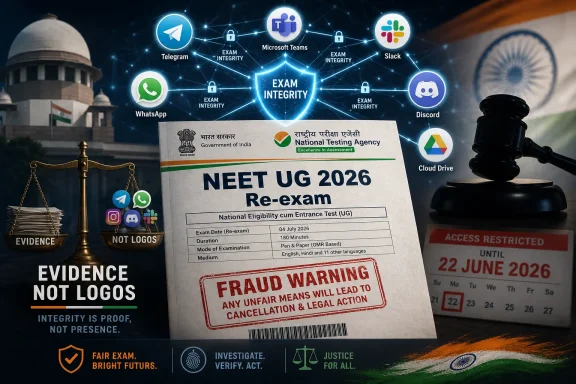 Telegram Was the Target, but the Standard Is the Story
The Telegram restriction is being framed as a narrow, time-bound measure tied to a high-stakes national examination. On paper, that distinction matters. A short restriction covering the re-exam window is not the same as a permanent ban, and an order aimed at specific fraud patterns is not the same as a general war on private communication.But governments do not create precedents only through laws; they create them through habits. Once an authority says a communication platform can be restricted because criminals are misusing it during an exam, the next question is unavoidable: what happens when the same criminals move elsewhere?
That is why the Slack and Microsoft Teams comparison is not absurd. Fraud networks are opportunistic. They use whatever channels offer reach, privacy, file sharing, plausible deniability, and speed. Telegram may be more culturally associated with mass channels and leak claims, but a cheating ring does not become less serious because it uses a workspace invite instead of a public channel.
The hard part is that platforms are not interchangeable in social function. Telegram is widely used for large public and semi-public groups. Slack and Teams are more commonly tied to organizations, employers, schools, and structured collaboration. A nationwide block on one will hurt a different population than a block on another. That difference does not eliminate the enforcement question, but it does raise the threshold for action.
Exam Fraud Has Become a Platform Problem Because Exams Became a Market
The NEET controversy sits at the intersection of two failures: exam security and platform governance. India’s entrance examinations are not merely tests; they are gateways to scarce educational and professional futures. That makes them a market, and every market attracts fraud.The digital layer has changed the economics of cheating. A scammer no longer needs a physical network of touts outside coaching centers. A Telegram channel, cloud folder, payment wallet, and rotating set of aliases can simulate access to a leaked paper at national scale. Even when the “leak” is fake, the damage is real: students panic, parents pay, misinformation spreads, and the credibility of the exam collapses before the first question is answered.
This is the crucial distinction often missed in platform debates. Authorities are not only trying to stop actual leaked papers. They are also trying to stop the market for alleged leaks, because that market can distort behavior even when the underlying product is fraudulent.
A fake paper leak can be almost as destabilizing as a real one. It can trigger unfair advantage claims, provoke legal challenges, and undermine trust in results. For an agency already under scrutiny, allowing viral fraud ecosystems to flourish during a re-examination window is not a minor moderation failure.
The “Why Not Teams?” Argument Is Stronger Than It First Sounds
The instinctive response from many IT professionals will be that Slack and Microsoft Teams are different from Telegram. That is true, but not sufficient. A platform used for work can still be misused for crime.Teams supports chats, channels, meetings, file sharing, guest access, external collaboration, recordings, and integration with Microsoft 365 storage. Slack supports private channels, file uploads, workflow automation, guest accounts, app integrations, and large communities. Both can support the same operational needs that cheating networks require: coordination, compartmentalization, document distribution, identity masking, and rapid deletion or migration.
That does not mean Slack or Teams should be blocked. It means the government’s reasoning must survive contact with the broader platform ecosystem. If the stated principle is “Telegram enables fraud,” the policy will look arbitrary. If the stated principle is “any platform knowingly or negligently hosting exam-fraud infrastructure must cooperate with narrowly tailored legal orders,” the policy becomes more coherent.
The problem is that platform-wide restrictions are blunt instruments. Blocking Telegram may disrupt some fraud networks, but it also disrupts legitimate education groups, small businesses, journalists, communities, and ordinary users. Blocking Teams would be vastly more disruptive to enterprises, universities, government vendors, hospitals, and remote workers. Blocking Slack would hit startups, developers, media teams, civil society groups, and international collaborators.
Consistency, therefore, cannot mean identical punishment. It must mean identical evidentiary standards.
Section 69A Is a Scalpel Only If the State Uses It Like One
India’s Section 69A framework gives the government power to direct blocking of online information under specified conditions. In practice, it has often been controversial because blocking orders can be opaque, difficult to challenge, and broader than users expect. When applied to a whole platform, the line between targeted enforcement and collective restriction becomes especially thin.The government’s best argument is urgency. A national medical entrance re-examination is time-sensitive. If officials believe fraud networks are using a platform at scale during a narrow window, they may argue there is no time for ordinary takedown-by-takedown moderation. The re-exam cannot be postponed every time a channel reappears under a new name.
The counterargument is equally serious. Once the state normalizes platform blocking as an exam-security tool, it may reach for the same mechanism in less urgent, less transparent, or more politically convenient situations. Temporary emergency measures have a way of becoming reusable templates.
That is why any defensible intervention needs four things: public clarity about scope, a defined end date, an explanation of why narrower measures failed, and post-event accountability. Without those, “time-bound” becomes a public-relations adjective rather than a restraint.
Microsoft and Slack Would Face a Different Kind of Pressure
If investigators found NEET-related fraud inside Microsoft Teams or Slack, the first sensible step would not be a nationwide block. It would be preservation requests, account-level action, tenant-level investigation, law-enforcement coordination, and targeted removal of illegal content. Enterprise platforms are built around administrative control, audit logs, identity systems, and contractual compliance channels. That architecture gives authorities more precise tools than they often have on open social platforms.Microsoft Teams, in particular, sits inside a larger compliance universe. Organizations can retain messages, manage guest access, apply data loss prevention policies, restrict external sharing, and audit user activity depending on licensing and configuration. That does not make Teams immune to abuse, but it does mean a platform-wide public block would be harder to justify before targeted administrative remedies were exhausted.
Slack has similar enterprise controls, though the specific features depend on plan and configuration. Workspaces can be investigated, users suspended, files removed, and external connections restricted. Again, the question is not whether misuse is possible. The question is whether the platform’s governance model gives investigators a less disruptive route.
This is where Telegram differs materially. Telegram’s public channels and large groups can operate more like broadcast media than enterprise collaboration spaces. If fraud channels are rapidly appearing, gathering large audiences, and using platform affordances such as message edits or bots, authorities may view platform-level intervention as more tempting. But tempting is not the same as justified.
The Message-Editing Issue Shows How Technical Features Become Legal Targets
One reported element of the Telegram action is especially revealing: the restriction or disabling of message editing for already posted messages in India for a longer period than the access block. That detail matters because it shows authorities are not only thinking about speech distribution; they are thinking about evidence integrity.Message editing can be useful and harmless. It fixes typos, updates instructions, and corrects misinformation. But in a fraud investigation, it can also become a way to rewrite history. A channel can post a fake “leak,” collect payments, alter the post, delete traces, or reshape claims after an exam begins.
This is the kind of feature-level intervention that deserves more attention than the headline-grabbing platform block. If the concern is that fraudsters are using a specific affordance to mislead students or destroy evidence, a narrowly tailored feature restriction may be easier to defend than a blanket access restriction.
It also offers a model for other platforms. If Slack or Teams were used in exam fraud, authorities might seek preservation of audit logs, suspension of external sharing, disabling of anonymous guest access in implicated workspaces, or removal of specific files. The best intervention is the one that attacks the fraud pattern while leaving ordinary collaboration intact.
Students Are the First Victims of the Fake-Leak Economy
The public debate tends to divide people into two groups: cheaters and honest candidates. Reality is messier. Many students caught in these networks may not be sophisticated conspirators. They may be frightened, exhausted, and vulnerable to claims that “everyone else” already has access to a leaked paper.That is the business model. Fraudsters sell certainty in a system where students feel they have none. A private group, a countdown timer, a few screenshots, and a fabricated answer key can create enough pressure for a family to pay. By the time the material proves fake, the money is gone and the student may be afraid to report the scam.
This is why exam agencies cannot rely only on blocking orders. They need fast public communication, visible debunking, official candidate alerts, and easy reporting channels. If the official voice is slow, vague, or distrusted, the unofficial market fills the vacuum.
The burden should not fall on students to perform forensic analysis of every viral claim. In a national examination system, trust is infrastructure. When that trust breaks, fraudsters do not need to hack the exam; they only need to hack the atmosphere around it.
Platform Neutrality Cannot Mean Platform Blindness
A fair enforcement policy must be platform-neutral in principle but platform-specific in execution. Telegram, Teams, Slack, WhatsApp, Discord, and cloud drives do not present identical risks. They have different architectures, user cultures, moderation systems, business models, and investigative controls.Platform neutrality means the government should not single out a service because it is foreign, politically inconvenient, or culturally associated with dissent. It means the same conduct should trigger scrutiny wherever it occurs. If a Microsoft Teams tenant is being used to coordinate impersonation or distribute alleged answer keys, it deserves investigation. If a Slack workspace is being used to sell fake papers, it deserves enforcement.
Platform blindness, however, would be foolish. A public Telegram channel with hundreds of thousands of subscribers is not the same enforcement problem as a private Teams chat among ten users. A Discord server with rotating invite links is not the same as a Microsoft 365 tenant tied to a registered institution. The remedy should match the architecture.
This distinction is where policy debates often collapse. Critics hear “platform-neutral” and fear every tool will be blocked. Officials hear “don’t block platforms” and accuse critics of ignoring fraud. The sensible middle is harder: demand equal seriousness, unequal remedies, and public justification.
Enterprise IT Should Care Because Collaboration Tools Are Now Public Infrastructure
For WindowsForum readers, the Teams angle is not theoretical. Microsoft Teams is embedded in the daily workflow of schools, government contractors, healthcare providers, IT departments, and multinational companies. If governments start treating collaboration platforms as emergency control points, sysadmins will inherit the consequences.A sudden platform restriction can disrupt identity workflows, meetings, file access, incident response, vendor coordination, and classroom operations. Even a partial restriction can create confusion if users do not know whether the problem is local networking, Microsoft service health, ISP filtering, or a government order. In heavily regulated environments, unexplained communication outages become operational risk.
There is also a compliance angle. If exam-fraud investigations reach enterprise platforms, organizations may receive preservation demands, law-enforcement requests, or internal audit instructions. IT teams will need to know what logs exist, how long they are retained, who can access them, and what external-sharing policies are actually enforced rather than merely written in a handbook.
This is not an argument for paranoia. It is an argument for treating collaboration governance as security hygiene. Guest access, file-sharing permissions, retention policies, app integrations, and audit logging are no longer just productivity settings. They are part of an organization’s exposure to misuse.
The Real Failure Would Be Chasing Apps Instead of Networks
If fraudsters can move from Telegram to Slack to Teams to WhatsApp to Signal to a private website in a single afternoon, then platform blocking alone cannot be the strategy. It can only be a disruption tactic. The real target must be the network: recruiters, payment collectors, content distributors, impersonators, coaching intermediaries, and administrators who profit from panic.Digital enforcement works best when it combines signals. Payment trails, phone numbers, device fingerprints, repeated file hashes, reused language, admin accounts, domain registrations, and social graph patterns can reveal continuity even when the front-end platform changes. A fraud ring that migrates from Telegram to Teams is still a fraud ring.
That requires cooperation between exam bodies, cybercrime units, platforms, payment providers, telecom operators, and schools. It also requires restraint. Broad restrictions may create the appearance of action while pushing networks into more private and harder-to-monitor spaces.
The goal should be to make fraud expensive, risky, and unprofitable. Blocking one platform for six days may buy time. It does not solve the underlying incentive structure that makes students believe a leak is plausible and fraudsters believe a market is waiting.
The Microsoft Question Exposes the Politics of Selective Enforcement
Asking “why not Microsoft Teams?” forces an uncomfortable comparison. Governments may be more willing to restrict consumer messaging platforms than enterprise tools used by businesses, foreign investors, and state agencies. That asymmetry may be practical, but it can also look political.If Telegram is blocked because fraud is happening there, but equivalent fraud on a business platform is handled quietly through back channels, the public may reasonably ask whether enforcement depends on the power of the platform’s user base. A student study group loses access; a multinational tenant gets a legal notice. Both may be rational outcomes, but only if the reasoning is transparent.
Microsoft and Slack also have more formal government-relations channels than many consumer platforms. They can respond to lawful requests, provide enterprise controls, and negotiate compliance mechanisms. Telegram’s posture toward moderation and state demands has often been more contentious in various jurisdictions, which may make it a more likely target for blunt measures.
That does not excuse overreach. It simply explains why the state may reach for different levers. The risk is that the public sees only the visible lever — the block — and concludes that enforcement is arbitrary.
India Needs an Exam-Security Doctrine, Not a Platform Ban Playbook
The Telegram episode should push India toward a clearer doctrine for digital exam security. That doctrine should define when platform-level action is permissible, what evidence is required, what less restrictive steps must be tried first, and how affected users can understand the scope of an order. It should also distinguish between actual leaks, fake leaks, fraud solicitations, impersonation schemes, and general misinformation.Those categories matter. An actual paper leak is a breach of exam custody. A fake leak is fraud and misinformation. An answer-key scam may be consumer fraud. An impersonation network is organized criminal conduct. Each requires a different investigative response.
Treating all of them as “platform misuse” is administratively convenient but analytically lazy. It encourages broad orders against digital spaces instead of precise action against crimes. A mature doctrine would pressure platforms to cooperate while also pressuring the state to justify itself.
The exam agency’s role is just as important. The NTA must communicate faster than fraud networks, publish clear advisories, debunk viral claims, and give candidates a trusted channel for urgent updates. When official silence creates an information vacuum, even a bad Telegram channel can look authoritative to a desperate student.
The Lesson for Schools, Employers, and Admins Is Uncomfortably Practical
The NEET-Telegram dispute may feel like a national policy story, but it has immediate operational lessons for anyone running Microsoft 365, Slack, Google Workspace, or similar tools. Misuse does not require a platform to be designed for crime. It only requires weak controls and motivated users.Organizations should assume that collaboration tools can be used for activity that has nothing to do with the organization’s mission. That includes exam fraud, data leaks, harassment, credential trading, and scams. The right answer is not to lock everything down until productivity dies, but to make sure the obvious doors are not hanging open.
External sharing deserves special attention. Many organizations enable guest access for legitimate reasons and then forget how porous it can become. A workspace or tenant that allows unmanaged guests, anonymous links, unmonitored file sharing, and indefinite retention gaps is easier to abuse and harder to investigate.
Auditability is the quiet hero here. If an incident happens, the difference between a manageable investigation and chaos often comes down to whether logs exist, whether administrators know where to find them, and whether policies were configured before the crisis.
A Fair Rule Would Follow the Fraud, Not the Logo
The cleanest answer to the Business Upturn question is this: yes, authorities should examine Slack, Microsoft Teams, and any other platform if credible evidence shows they are being used for NEET-related fraud. No, that does not mean they should be blocked merely because Telegram was blocked. Equal seriousness is not the same as equal severity.A platform-neutral rule would start with evidence of misuse and escalate through the least disruptive effective remedy. For Teams, that might mean tenant-level preservation, account suspension, file takedowns, and cooperation with Microsoft. For Slack, it might mean workspace investigation, admin action, and law-enforcement requests. For Telegram, if officials can show that public channels, bots, and edit features created a fast-moving fraud environment that narrower measures could not contain, a temporary restriction is at least an arguable emergency step.
But the burden should remain on the state. Emergency powers are not self-justifying because the exam is important. They require explanation, limits, and review. Otherwise, every high-stakes event becomes a reason to mute a platform.
The best policy is boring by design. It is documented, time-limited, evidence-based, technically specific, and subject to scrutiny after the fact. That is less dramatic than a nationwide block, but far better for a democracy that also needs secure exams.
The Exam Integrity Fight Has Moved Into the Admin Console
The Telegram restriction tells us less about Telegram alone than about the new terrain of public trust. Examinations, elections, markets, and public services now depend on private digital infrastructure that was not built to carry the legitimacy of the state. When that infrastructure is abused, governments reach for controls that can protect one public interest while threatening another.The practical takeaways are sharper than the rhetoric around bans suggests.
- Authorities should investigate Slack, Microsoft Teams, and other platforms if credible evidence shows they are being used to coordinate exam fraud or student-targeted scams.
- A nationwide platform block should remain a last-resort measure, not the default response to illegal activity on a service.
- Enterprise collaboration platforms usually offer more targeted remedies than consumer broadcast platforms, including account controls, audit logs, retention policies, and workspace-level enforcement.
- Exam agencies must communicate quickly and clearly, because fake leaks thrive when official information is slow, ambiguous, or distrusted.
- Students should treat any alleged leaked paper, answer key, or paid private group as a likely scam unless confirmed by an official examination authority.
- IT administrators should review guest access, file-sharing rules, retention settings, and audit logging because collaboration tools can become evidence systems during real-world investigations.
References
- Primary source: Business Upturn
Published: 2026-06-16T11:42:07.365220

Dear Ministry of IT, If Telegram can be restricted for NEET integrity, Why not slack and Microsoft teams too? | Business Upturn
The Indian government’s decision to temporarily suspend Telegram access during the NEET UG 2026 re-examination was justified on a simple...www.businessupturn.com - Related coverage: ummid.com

Modi govt bans Telegram ahead of NEET UG 2026 Re-Exam | ummid.com
In a major decision, Narendra Modi government in India banned social media platform Telegram ahead of NEET UG 2026 Re-Exam. The decision has been taken to curb the paper leak, according to reports.www.ummid.com - Related coverage: thetechoutlook.com
Telegram Access In India Temporarily Blocked Till June 22 Ahead Of NEET-UG 2026 Re-Examination - The Tech Outlook
Shockingly, Telegram access in India has now been temporarily blocked until June 22, 2026, ahead of the NEET-UG 2026 re-examination.www.thetechoutlook.com - Related coverage: hindustantimes.com

NEET-UG re-test: Govt places curbs on Telegram messaging app till June 22 | Education
MeitY has issued a direction restricting access to the Telegram platform in India for a defined and limited period ending June 22, 2026.  | Education Newswww.hindustantimes.com - Related coverage: theins.in

NEET(UG) Re-Exam: Centre temporarily blocks access to Telegram – The INS News
Srinagar, June 16: The Central Government has temporarily blocked access to the messaging platform Telegram across India until June 22 as a precautionary measure ahead of the NEET (UG) 2026 re-examination scheduled for June 21, the National Testing Agency (NTA) announced on Tuesday. RELATED...theins.in - Related coverage: education.indianexpress.com
- Related coverage: educationtimes.com

Telegram access to be restricted ahead of NEET UG re-exam, says NTA - EducationTimes.com
These measures were taken as a last resort after individual channel-level takedowns failed to curb organised cheating rackets and cyber-fraud gangs - EducationTimes.com www.educationtimes.com
- Related coverage: english.publictv.in
Telegram access restricted in India till June 22 to prevent NEET re-exam fraud - Public TV English
NEW DELHI: The National Testing Agency (NTA) restricted access to the Telegram platform in India for a defined and limited period ending 22 June 2026,english.publictv.in - Related coverage: newindianexpress.com

Telegram access restricted in India ahead of NEET (UG) re-examination on June 21
Ahead of the NEET (UG) 2026 re-examination scheduled for June 21, access to the messaging platform Telegram has been restricted in India until June 22.www.newindianexpress.com - Related coverage: ndtv.com
