

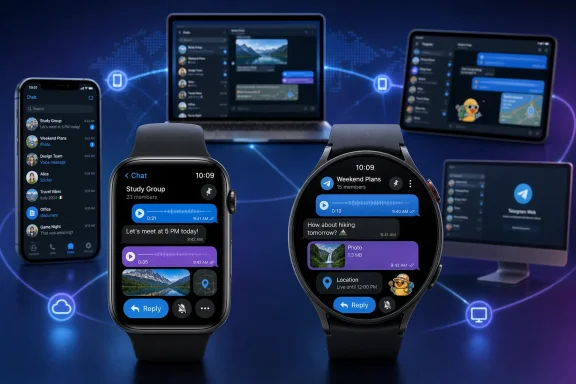
Telegram’s June 11, 2026 update brought official smartwatch apps to both Apple Watch and Wear OS, restoring watch support after years away and adding chat browsing, replies, voice messages, media playback, and conversation management from the wrist. The move is not just a convenience feature for people who hate pulling out their phones. It is Telegram making a hardware-surface argument: if messaging is infrastructure, the app has to be everywhere users might plausibly answer back. The company is returning to wearables at a moment when smartwatches have stopped being notification mirrors and started becoming small, opinionated computers.
Telegram has always been unusually aggressive about being present on every meaningful computing surface. Windows, macOS, Linux, Android, iOS, the web, tablets, and desktop clients were not treated as side projects; they were part of the product’s identity. The smartwatch gap therefore mattered more than it looked, because it was one of the few places where Telegram’s “works everywhere” story had an obvious asterisk.
That asterisk is now being erased. The new apps let users read long messages, browse chats, send text and voice messages, listen to voice messages, view media and videos, and manage conversations directly from a watch. On paper, those sound like ordinary messaging features. On a wrist-sized device, they amount to a fairly blunt claim that the watch is not merely a pager strapped to the body.
This is where Telegram’s move differs from the way many messaging services have treated wearables. For years, the dominant model has been notification triage: see who pinged you, send a canned reply, dismiss the alert, and move on. Telegram is pushing closer to continuity. It wants the watch to become a place where a conversation can keep going, not just a place where the phone nags you.
That distinction matters because messaging apps are sticky not only because of social graphs, but because of response habits. If a Telegram user learns that a voice message can be heard while walking, a reply can be dictated while carrying groceries, and a group thread can be checked without unlocking a phone, the app has gained another tiny behavioral lock-in. Nobody switches messaging platforms because of a smartwatch app alone. But people do stay with platforms that remove friction from their daily loops.
That world no longer exists. Samsung’s move to Wear OS changed the addressable market overnight, and Google’s own Pixel Watch line gave the platform a first-party identity it had long lacked. Xiaomi and other hardware makers have also made Wear OS a more visible part of the Android ecosystem. Telegram’s return is therefore not nostalgia; it is a recognition that the economics of attention on Android wearables have changed.
The Galaxy Watch point is especially important. For many users, Samsung’s watch is the default Android smartwatch, just as the Apple Watch is the default iPhone smartwatch. When Telegram last had a Wear OS app, supporting Wear OS did not necessarily mean supporting the mainstream Android watch market. In 2026, it does.
That helps explain the timing. Telegram did not simply revive a forgotten app because a few enthusiasts missed it. It returned when Wear OS had enough distribution, enough hardware quality, and enough daily usage to justify treating the wrist as a serious endpoint. The company is often described as chaotic, but this part of the move is disciplined. Telegram waited until the audience was worth the engineering cost.
At launch, the Apple Watch version supports features such as location previews and stickers that the Wear OS version lacks. The Wear OS version, meanwhile, includes muting, pinning, and deleting conversations, administrative controls that are not present in the Apple Watch app. Telegram’s own explanation was unusually candid: different teams built different things, and the missing pieces are supposed to be traded across platforms in the next update.
That is messy, but it is also very Telegram. The company has often behaved less like a conventional consumer software firm and more like a network of fast-moving product cells. Features appear quickly, sometimes with odd asymmetries, and are refined in public. The upside is speed. The downside is that users on different platforms can briefly feel like they are living in parallel universes.
For Apple Watch users, the initial emphasis is more expressive: stickers, location, media, and the social texture of chat. For Wear OS users, the early emphasis is more managerial: pinning, muting, deleting, and keeping the conversation list under control. That split is probably not a grand strategy. But accidental product choices still tell us something about assumptions. The Apple side seems to have prioritized message richness; the Android side seems to have prioritized chat handling.
The promised convergence matters because Telegram’s brand depends on cross-platform parity. Users forgive rough edges when they believe features will land everywhere eventually. They become less forgiving if “native” starts to mean “incomplete depending on which ecosystem you bought into.” Telegram’s challenge now is to turn this visibly parallel launch into a genuinely unified wearable experience before the novelty fades.
But Telegram also has one habit that makes the wrist unusually relevant: voice messaging. The platform’s users rely heavily on audio notes, and audio is far better suited to a watch than thumb typing. Listening to a voice message from the wrist is plausible. Dictating or recording a reply is plausible. Skimming a short exchange and deciding whether to answer now or later is plausible.
That is why the app’s support for voice messages may matter more than its support for full text input. The watch is a poor keyboard, but it is a decent microphone and a surprisingly good alerting device. Telegram’s wearable strategy becomes more coherent when the watch is understood as an audio-first messaging terminal rather than a miniature phone.
The same logic applies to media, though with more limits. Viewing a video on a watch is rarely ideal, but previewing enough of a clip to understand whether it matters can be useful. Reading a long message on a watch is not comfortable, but having the option changes the user’s decision tree. The point is not that every Telegram interaction should migrate to the wrist. The point is that more interactions can now begin or end there.
That is a subtle but meaningful expansion of the app’s role. Telegram does not need people to spend twenty minutes in a group thread on a Galaxy Watch. It needs them to trust that the thread is reachable, actionable, and not trapped behind a phone unlock.
This is not a cosmetic upgrade. Telegram bots have long been used for customer service, moderation, alerts, payments, search, games, automation, and dubious gray-market workflows. Giving bots document-grade formatting makes them more capable as front ends for services that would otherwise require a web page or app. A bot can now present something closer to a mini-report, dashboard, lesson, catalog, or support workflow inside the chat itself.
The character limit matters here, too. A message length of 32,768 characters, with collapsed expansion after the first 8,000, nudges Telegram closer to a publishing surface. That is not the same as replacing a website, but it reduces the need to leave the app for many structured interactions. For developers, it means Telegram can host richer experiences without forcing users into a browser at the first sign of complexity.
This is where the watch update and bot update quietly connect. Telegram is building a world in which the chat client is not just where users talk to people. It is where they read, transact, moderate, automate, and interact with services. Once that is the ambition, every device surface matters, because every missing client becomes a hole in the platform.
AI Guardians are a characteristically Telegram answer to that tension. Instead of saying Telegram itself will make more judgment calls about which communities should exist or which users should be blocked at the gate, the company is giving group administrators automated tools to screen incoming members. These bots can handle custom admission flows through mini-app interfaces, including quizzes, verification steps, or other checks before a user joins.
For large groups, this is genuinely useful. A community with tens or hundreds of thousands of members cannot rely on human moderators alone, especially when spam, scams, raids, and bot accounts are persistent problems. Automating the front door can reduce some of that burden and may improve the quality of group participation.
But it is also a form of decentralizing responsibility. Telegram can argue that it is equipping administrators with stronger safety tools while avoiding a full embrace of centralized moderation. Regulators may or may not accept that distinction. The more Telegram becomes infrastructure for large communities, the less convincing it becomes to say that platform-level design choices are neutral.
AI Guardians are therefore both a product feature and a political statement. Telegram is not saying, “Trust us to police everything.” It is saying, “Here are tools so communities can police themselves.” That approach may preserve the platform’s identity, but it will not end the argument over accountability.
These are not flashy changes, but they belong to the same strategic pattern. Telegram is increasingly designed for users who treat the app as a primary workspace. If people are reading files, opening links, interacting with bots, joining communities, following channels, and managing alerts inside Telegram, then browser behavior becomes a core part of the experience rather than a minor preference.
Markdown support is particularly telling. Markdown is not a mainstream consumer obsession; it is a format loved by developers, writers, documentation teams, note-takers, and technical communities. Supporting it inside the app suggests Telegram is still comfortable building for its power-user base, even when those features sound niche to everyone else.
The external browser controls also show Telegram trying to balance convenience and user agency. In-app browsers are useful because they reduce context switching, but they are also distrusted because they can blur boundaries between app, web, and tracking environment. Giving users more say over where links open is the sort of small control that power users notice.
This is the operating-system logic of modern super-apps, but without Telegram quite using that phrase. It does not need to own the device. It only needs to own enough of the user’s daily flow that the boundary between app and environment starts to soften.
That is why the company’s strongest use cases are situational. A commute. A workout. A kitchen. A quick walk. A moment when the phone is nearby but inconvenient, or when pulling it out would be rude, risky, or simply annoying. Telegram’s own framing about avoiding dropped phones is jokey, but the underlying point is real: the watch is useful when the phone is physically or socially inconvenient.
The risk is that Telegram overestimates how much active messaging people want from a watch. The Apple Watch succeeded largely by being glanceable, health-oriented, and tightly integrated with notifications and quick actions. Wear OS has followed a similar path. Full app experiences exist, but the best ones respect the device’s limits.
Telegram can thread that needle if it treats the watch as an escalation surface rather than a phone replacement. Let the user identify, triage, answer briefly, listen, record, mute, pin, and move on. The moment the app encourages sprawling interaction on a one-and-a-half-inch screen, it starts fighting the hardware.
The good news for Telegram is that messaging is already a micro-interaction business. Many messages are short, many replies are binary, and many decisions are really about whether something needs attention now. If Telegram optimizes for those moments, the watch app may become quietly indispensable for a subset of users.
That does not mean every platform will copy Telegram’s approach. Apple can rely on iMessage’s deep watchOS integration. WhatsApp can afford to prioritize notification workflows and phone-linked continuity. Signal, with its privacy-first posture and smaller resource base, has historically been more selective about secondary clients. Telegram’s distinctive move is to treat broad device support as part of its competitive identity.
For WindowsForum readers, the parallel is obvious. Telegram’s desktop apps have long been one of its strongest differentiators, especially for users who live across phones, PCs, and browsers all day. A good Windows client changes how a messaging app fits into work. A good watch client changes how it fits into movement. Both are about reducing the number of moments when the service feels unavailable.
There is also a developer angle. If bots become richer, groups become more automated, and clients become more universal, Telegram becomes a more attractive substrate for lightweight applications. That has consequences beyond chat. A sysadmin alert bot, a build notification bot, a community moderation bot, or a support workflow becomes more useful when the user can interact with it from a PC, phone, browser, and watch.
That is why the watch app should not be dismissed as lifestyle fluff. The wrist is not the center of computing. But in a mature platform strategy, edges matter. Telegram is filling in the edges.
The smartwatch launch captures that bargain perfectly. The apps are ambitious, useful, and overdue. They are also asymmetrical, with Apple Watch and Wear OS launching with different feature sets for reasons that sound more organizational than strategic. A more tightly managed company might have delayed one app until both matched. Telegram shipped both and promised to reconcile the gaps later.
That can be admirable or maddening depending on where a user sits. Enthusiasts appreciate speed. Administrators prefer predictability. Regulators prefer accountability. Developers prefer capability. Telegram keeps trying to serve all of these groups at once, and the result is a platform whose momentum is undeniable but whose governance remains contested.
The company’s challenge is that scale changes the meaning of rough edges. When a niche app ships unevenly, it is charming. When a billion-user communications network does it, the stakes are higher. A missing sticker feature on Wear OS is harmless. An automated admission system that fails at scale, or a bot formatting system abused for scams, is not.
This is the line Telegram now walks. The same speed that makes it interesting also magnifies its responsibility. The watch apps are the friendly face of the update. The bot and moderation tools are where the harder questions live.
 Telegram’s Wrist Comeback Is Really a Platform Claim
Telegram has always been unusually aggressive about being present on every meaningful computing surface. Windows, macOS, Linux, Android, iOS, the web, tablets, and desktop clients were not treated as side projects; they were part of the product’s identity. The smartwatch gap therefore mattered more than it looked, because it was one of the few places where Telegram’s “works everywhere” story had an obvious asterisk.That asterisk is now being erased. The new apps let users read long messages, browse chats, send text and voice messages, listen to voice messages, view media and videos, and manage conversations directly from a watch. On paper, those sound like ordinary messaging features. On a wrist-sized device, they amount to a fairly blunt claim that the watch is not merely a pager strapped to the body.
This is where Telegram’s move differs from the way many messaging services have treated wearables. For years, the dominant model has been notification triage: see who pinged you, send a canned reply, dismiss the alert, and move on. Telegram is pushing closer to continuity. It wants the watch to become a place where a conversation can keep going, not just a place where the phone nags you.
That distinction matters because messaging apps are sticky not only because of social graphs, but because of response habits. If a Telegram user learns that a voice message can be heard while walking, a reply can be dictated while carrying groceries, and a group thread can be checked without unlocking a phone, the app has gained another tiny behavioral lock-in. Nobody switches messaging platforms because of a smartwatch app alone. But people do stay with platforms that remove friction from their daily loops.
Wear OS Finally Became Worth Telegram’s Attention
Telegram’s previous exit from Wear OS in 2021 looked, at the time, like a reasonable act of product hygiene. Google’s smartwatch platform was fragmented, underpowered, and overshadowed by Samsung’s Tizen watches on the Android side. The Pixel Watch did not yet exist. Galaxy Watch buyers were not, in any meaningful sense, Wear OS users.That world no longer exists. Samsung’s move to Wear OS changed the addressable market overnight, and Google’s own Pixel Watch line gave the platform a first-party identity it had long lacked. Xiaomi and other hardware makers have also made Wear OS a more visible part of the Android ecosystem. Telegram’s return is therefore not nostalgia; it is a recognition that the economics of attention on Android wearables have changed.
The Galaxy Watch point is especially important. For many users, Samsung’s watch is the default Android smartwatch, just as the Apple Watch is the default iPhone smartwatch. When Telegram last had a Wear OS app, supporting Wear OS did not necessarily mean supporting the mainstream Android watch market. In 2026, it does.
That helps explain the timing. Telegram did not simply revive a forgotten app because a few enthusiasts missed it. It returned when Wear OS had enough distribution, enough hardware quality, and enough daily usage to justify treating the wrist as a serious endpoint. The company is often described as chaotic, but this part of the move is disciplined. Telegram waited until the audience was worth the engineering cost.
The Two Watch Apps Reveal Telegram’s Fast-and-Loose Product Culture
The most revealing detail in the launch is not that Apple Watch and Wear OS both got Telegram apps. It is that they did not get exactly the same app.At launch, the Apple Watch version supports features such as location previews and stickers that the Wear OS version lacks. The Wear OS version, meanwhile, includes muting, pinning, and deleting conversations, administrative controls that are not present in the Apple Watch app. Telegram’s own explanation was unusually candid: different teams built different things, and the missing pieces are supposed to be traded across platforms in the next update.
That is messy, but it is also very Telegram. The company has often behaved less like a conventional consumer software firm and more like a network of fast-moving product cells. Features appear quickly, sometimes with odd asymmetries, and are refined in public. The upside is speed. The downside is that users on different platforms can briefly feel like they are living in parallel universes.
For Apple Watch users, the initial emphasis is more expressive: stickers, location, media, and the social texture of chat. For Wear OS users, the early emphasis is more managerial: pinning, muting, deleting, and keeping the conversation list under control. That split is probably not a grand strategy. But accidental product choices still tell us something about assumptions. The Apple side seems to have prioritized message richness; the Android side seems to have prioritized chat handling.
The promised convergence matters because Telegram’s brand depends on cross-platform parity. Users forgive rough edges when they believe features will land everywhere eventually. They become less forgiving if “native” starts to mean “incomplete depending on which ecosystem you bought into.” Telegram’s challenge now is to turn this visibly parallel launch into a genuinely unified wearable experience before the novelty fades.
The Watch Is a Better Fit for Telegram Than It Looks
At first glance, Telegram on a smartwatch sounds faintly absurd. Telegram chats can be long, chaotic, media-heavy, multilingual, and loaded with channels, bots, forwarded posts, and group noise. A watch face is not the natural home for that kind of density.But Telegram also has one habit that makes the wrist unusually relevant: voice messaging. The platform’s users rely heavily on audio notes, and audio is far better suited to a watch than thumb typing. Listening to a voice message from the wrist is plausible. Dictating or recording a reply is plausible. Skimming a short exchange and deciding whether to answer now or later is plausible.
That is why the app’s support for voice messages may matter more than its support for full text input. The watch is a poor keyboard, but it is a decent microphone and a surprisingly good alerting device. Telegram’s wearable strategy becomes more coherent when the watch is understood as an audio-first messaging terminal rather than a miniature phone.
The same logic applies to media, though with more limits. Viewing a video on a watch is rarely ideal, but previewing enough of a clip to understand whether it matters can be useful. Reading a long message on a watch is not comfortable, but having the option changes the user’s decision tree. The point is not that every Telegram interaction should migrate to the wrist. The point is that more interactions can now begin or end there.
That is a subtle but meaningful expansion of the app’s role. Telegram does not need people to spend twenty minutes in a group thread on a Galaxy Watch. It needs them to trust that the thread is reachable, actionable, and not trapped behind a phone unlock.
Telegram’s Bigger Update Was Hiding Behind the Watch
The smartwatch apps are the consumer headline, but the same update also says something more important about Telegram’s ambitions as an application platform. The company expanded bot formatting with what it jokingly calls “filthy rich text,” allowing bot messages to include inline media, tables, headings, collapsible sections, formulas, carousels, and much longer structured messages.This is not a cosmetic upgrade. Telegram bots have long been used for customer service, moderation, alerts, payments, search, games, automation, and dubious gray-market workflows. Giving bots document-grade formatting makes them more capable as front ends for services that would otherwise require a web page or app. A bot can now present something closer to a mini-report, dashboard, lesson, catalog, or support workflow inside the chat itself.
The character limit matters here, too. A message length of 32,768 characters, with collapsed expansion after the first 8,000, nudges Telegram closer to a publishing surface. That is not the same as replacing a website, but it reduces the need to leave the app for many structured interactions. For developers, it means Telegram can host richer experiences without forcing users into a browser at the first sign of complexity.
This is where the watch update and bot update quietly connect. Telegram is building a world in which the chat client is not just where users talk to people. It is where they read, transact, moderate, automate, and interact with services. Once that is the ambition, every device surface matters, because every missing client becomes a hole in the platform.
AI Guardians Are Moderation Without Telegram Taking the Steering Wheel
The update’s AI Guardian feature fits neatly into Telegram’s post-2024 reality. After Pavel Durov’s arrest in France in August 2024 and the regulatory pressure that followed, Telegram has had to show governments that it is not indifferent to abuse on the platform. But Telegram’s culture and user promise still resist the idea of heavy central editorial control.AI Guardians are a characteristically Telegram answer to that tension. Instead of saying Telegram itself will make more judgment calls about which communities should exist or which users should be blocked at the gate, the company is giving group administrators automated tools to screen incoming members. These bots can handle custom admission flows through mini-app interfaces, including quizzes, verification steps, or other checks before a user joins.
For large groups, this is genuinely useful. A community with tens or hundreds of thousands of members cannot rely on human moderators alone, especially when spam, scams, raids, and bot accounts are persistent problems. Automating the front door can reduce some of that burden and may improve the quality of group participation.
But it is also a form of decentralizing responsibility. Telegram can argue that it is equipping administrators with stronger safety tools while avoiding a full embrace of centralized moderation. Regulators may or may not accept that distinction. The more Telegram becomes infrastructure for large communities, the less convincing it becomes to say that platform-level design choices are neutral.
AI Guardians are therefore both a product feature and a political statement. Telegram is not saying, “Trust us to police everything.” It is saying, “Here are tools so communities can police themselves.” That approach may preserve the platform’s identity, but it will not end the argument over accountability.
The In-App Browser Is Becoming Part of the Operating System
The update also adds support for opening Markdown files inside Telegram’s browser and gives users finer control over which external browser handles links. Users can long-press to choose a browser on the fly, and they can configure certain domains to always open externally. Telegram also says its in-app browser stores no browsing history.These are not flashy changes, but they belong to the same strategic pattern. Telegram is increasingly designed for users who treat the app as a primary workspace. If people are reading files, opening links, interacting with bots, joining communities, following channels, and managing alerts inside Telegram, then browser behavior becomes a core part of the experience rather than a minor preference.
Markdown support is particularly telling. Markdown is not a mainstream consumer obsession; it is a format loved by developers, writers, documentation teams, note-takers, and technical communities. Supporting it inside the app suggests Telegram is still comfortable building for its power-user base, even when those features sound niche to everyone else.
The external browser controls also show Telegram trying to balance convenience and user agency. In-app browsers are useful because they reduce context switching, but they are also distrusted because they can blur boundaries between app, web, and tracking environment. Giving users more say over where links open is the sort of small control that power users notice.
This is the operating-system logic of modern super-apps, but without Telegram quite using that phrase. It does not need to own the device. It only needs to own enough of the user’s daily flow that the boundary between app and environment starts to soften.
The Smartwatch Bet Still Has an Input Problem
For all the strategic logic, Telegram’s watch push faces a basic constraint: smartwatches are still bad places to compose complex messages. Dictation can be awkward in public, tiny keyboards are slow, canned replies are limited, and long threads can become exhausting on a small display. The fact that Telegram can run deeply on the wrist does not mean most users will want to live there.That is why the company’s strongest use cases are situational. A commute. A workout. A kitchen. A quick walk. A moment when the phone is nearby but inconvenient, or when pulling it out would be rude, risky, or simply annoying. Telegram’s own framing about avoiding dropped phones is jokey, but the underlying point is real: the watch is useful when the phone is physically or socially inconvenient.
The risk is that Telegram overestimates how much active messaging people want from a watch. The Apple Watch succeeded largely by being glanceable, health-oriented, and tightly integrated with notifications and quick actions. Wear OS has followed a similar path. Full app experiences exist, but the best ones respect the device’s limits.
Telegram can thread that needle if it treats the watch as an escalation surface rather than a phone replacement. Let the user identify, triage, answer briefly, listen, record, mute, pin, and move on. The moment the app encourages sprawling interaction on a one-and-a-half-inch screen, it starts fighting the hardware.
The good news for Telegram is that messaging is already a micro-interaction business. Many messages are short, many replies are binary, and many decisions are really about whether something needs attention now. If Telegram optimizes for those moments, the watch app may become quietly indispensable for a subset of users.
The Competitive Pressure Is About Presence, Not Novelty
Telegram’s smartwatch return also lands in a messaging market where no major platform wants to concede a surface. WhatsApp, iMessage, Signal, Discord, Teams, Slack, and Telegram all compete for attention in different ways, but they share one reality: the winning app is often the one that is easiest to answer from wherever the user already is.That does not mean every platform will copy Telegram’s approach. Apple can rely on iMessage’s deep watchOS integration. WhatsApp can afford to prioritize notification workflows and phone-linked continuity. Signal, with its privacy-first posture and smaller resource base, has historically been more selective about secondary clients. Telegram’s distinctive move is to treat broad device support as part of its competitive identity.
For WindowsForum readers, the parallel is obvious. Telegram’s desktop apps have long been one of its strongest differentiators, especially for users who live across phones, PCs, and browsers all day. A good Windows client changes how a messaging app fits into work. A good watch client changes how it fits into movement. Both are about reducing the number of moments when the service feels unavailable.
There is also a developer angle. If bots become richer, groups become more automated, and clients become more universal, Telegram becomes a more attractive substrate for lightweight applications. That has consequences beyond chat. A sysadmin alert bot, a build notification bot, a community moderation bot, or a support workflow becomes more useful when the user can interact with it from a PC, phone, browser, and watch.
That is why the watch app should not be dismissed as lifestyle fluff. The wrist is not the center of computing. But in a mature platform strategy, edges matter. Telegram is filling in the edges.
Telegram’s Rough Edges Are Part of the Bargain
Telegram’s product philosophy has always involved a trade. It ships fast, experiments broadly, and exposes users to features that sometimes feel half-governed or unevenly explained. In return, users get a platform that often moves faster than more polished rivals.The smartwatch launch captures that bargain perfectly. The apps are ambitious, useful, and overdue. They are also asymmetrical, with Apple Watch and Wear OS launching with different feature sets for reasons that sound more organizational than strategic. A more tightly managed company might have delayed one app until both matched. Telegram shipped both and promised to reconcile the gaps later.
That can be admirable or maddening depending on where a user sits. Enthusiasts appreciate speed. Administrators prefer predictability. Regulators prefer accountability. Developers prefer capability. Telegram keeps trying to serve all of these groups at once, and the result is a platform whose momentum is undeniable but whose governance remains contested.
The company’s challenge is that scale changes the meaning of rough edges. When a niche app ships unevenly, it is charming. When a billion-user communications network does it, the stakes are higher. A missing sticker feature on Wear OS is harmless. An automated admission system that fails at scale, or a bot formatting system abused for scams, is not.
This is the line Telegram now walks. The same speed that makes it interesting also magnifies its responsibility. The watch apps are the friendly face of the update. The bot and moderation tools are where the harder questions live.
The Wrist Launch Tells IT Pros Where Telegram Is Going
Telegram’s latest update is easy to summarize as a consumer convenience release, but that undersells it. The company is tying together wearable access, richer bot interfaces, automated community screening, Markdown handling, and browser controls into a broader platform story. The practical implications are concrete.- Telegram has restored official smartwatch support across both Apple Watch and Wear OS, making the service available on the two most important wearable ecosystems.
- The Wear OS return matters more in 2026 than it would have in 2021 because Galaxy Watch, Pixel Watch, and other Android watches now give Google’s wearable platform a real audience.
- The Apple Watch and Wear OS apps launched with different feature sets, and Telegram’s promise to align them will be an early test of whether this is a serious long-term client strategy.
- Voice messages are likely to be the most natural smartwatch behavior, because watches are better microphones and speakers than they are keyboards.
- Rich bot formatting and AI Guardians show Telegram pushing beyond chat into application-layer services, community infrastructure, and automated moderation.
- The update gives users and administrators more capability, but it also increases the importance of trust, abuse prevention, and predictable cross-platform behavior.
References
- Primary source: The Eastern Herald
Published: 2026-06-14T12:30:09.646916
Telegram Returns to Wear OS on Galaxy Watch and Pixel Watch After Five Years
Telegram has relaunched its Wear OS smartwatch app for Galaxy Watch and Pixel Watch, one week after Apple Watch. The two versions ship with different features — and the gap reveals how Telegram builds.easternherald.com - Related coverage: techtimes.com
Telegram Desktop 6.9: Bots Get Document-Grade Formatting, Guardian Controls, and Streaming
Telegram bot update in Desktop 6.9, released June 9, 2026, adds document-grade rich text formatting using the MessageEntity JSON system, Guardian Bots for automated group join-request processing, andwww.techtimes.com - Related coverage: gadgets360.com
- Related coverage: macrumors.com
Telegram Gets Native Apple Watch App
Messaging app Telegram now has a native Apple Watch app. The app supports viewing and responding to Telegram messages from the wrist. Features like stickers, voice messages, and location information can be shared from the Apple Watch app. Telegram had an Apple Watch app back in 2015, but it was...www.macrumors.com - Related coverage: telegram.org
Smartwatch Apps, Rich Text for Bots, AI Guardians for Groups, and Much More
Today’s update brings Telegram to Apple Watch and Android smartwatches, adds filthy rich text for bots, lets AI admins screen new group members, and introduces smarter polls, browser controls, and much more.telegram.org - Related coverage: rswebsols.com
Telegram Launches Smartwatch Apps and AI Features for Groups
Telegram unveils cutting-edge smartwatch apps and AI-powered group chat features that will transform your messaging experience like never before.www.rswebsols.com
- Official source: 9to5google.com
Telegram app for Wear OS returns after five years
Five years after killing its Wear OS app, Telegram is reviving support for Android smartwatches with its latest update. Earlier...9to5google.com - Related coverage: theunum.io
AI Guardians and watch apps: Telegram released a major update | News
Telegram released a major update on June 11, 2026, adding smart watch support to Apple Watch and Wear OS, as well as greatly expanding the capabilities of the b...theunum.io
- Related coverage: 9to5mac.com
Telegram launches fully native Apple Watch app - 9to5Mac
More than a decade after launching and later discontinuing its first native Apple Watch app, Telegram is back on the device with a fully native experience.9to5mac.com - Related coverage: fonearena.com
- Related coverage: says.com
- Related coverage: megamobilecontent.com
- Related coverage: gadgetsandwearables.com
Telegram app returns to Wear OS and Apple Watch
Telegram has brought its app back to smartwatches, with new support for Wear OS and a native Apple Watch version.gadgetsandwearables.com
