

Microsoft certification preparation can help cloud and AI professionals advance by mapping Azure skills to recognized job roles, especially through AI-102 for Azure AI engineering and AZ-305 for Azure solutions architecture, both of which emphasize practical design, implementation, security, and operations work. The career value is not in the badge alone. It is in the discipline of turning a sprawling cloud platform into a structured learning path that employers can understand. But in 2026, that path is also more complicated than the usual “study, pass, certify” marketing copy suggests.
The modern Microsoft certification track sits at an awkward intersection of ambition and evidence. On one side are learners trying to prove they can work with Azure AI services, identity systems, governance models, networks, storage, and resilient architectures. On the other side are employers who have grown skeptical of certificates that do not map to real hands-on capability.
That tension is healthy. A certification that merely rewards memorization is little more than a screening keyword. A certification that forces candidates to reason through service selection, trade-offs, deployment patterns, monitoring, and security becomes something closer to a professional rehearsal.
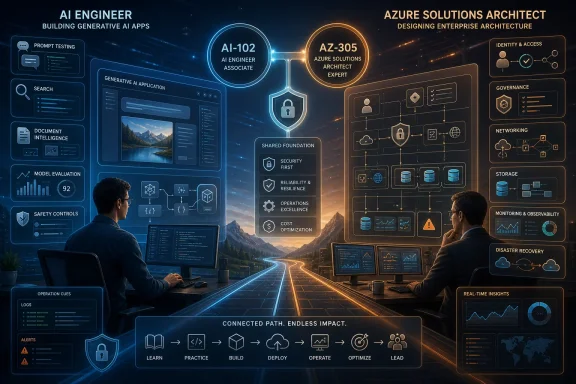
AI-102 and AZ-305 are useful examples because they target different layers of the Azure career ladder. AI-102 points toward the engineer building intelligent applications with Microsoft’s AI stack. AZ-305 points toward the architect deciding how systems should fit together before anyone starts provisioning resources.
The mistake is treating them as interchangeable trophies. They are not. One asks whether you can implement and operationalize AI capabilities. The other asks whether you can translate business requirements into cloud designs that survive cost pressure, security review, outages, and organizational politics.
The shift reflects what enterprises are actually doing. They are not simply asking developers to “add AI.” They are asking teams to integrate document intelligence, search, natural language processing, generative AI, content safety, and sometimes agentic workflows into products that must be governed and supported.
That makes AI-102 preparation less about memorizing service names and more about understanding where the responsibility boundary sits. A model may generate text, classify content, extract fields, or retrieve information, but the engineer still owns authentication, endpoint use, failure behavior, telemetry, data protection, and the quality of the user experience.
The rise of Microsoft Foundry language in the exam objectives also signals something important. Microsoft is reorganizing its AI story around a platform where model selection, orchestration, evaluation, safety, and application integration are expected to be part of the same lifecycle. Candidates who studied Azure AI only as a loose collection of cognitive services will need to update that mental model.
That sounds dry until you put it into the real world. Every architecture decision is a compromise. A storage choice affects cost and latency. A network design affects security posture and operational complexity. A disaster recovery plan affects both budget and the business’s tolerance for downtime.
The best AZ-305 candidates are not people who can recite every Azure SKU. They are people who can explain why one design fits a workload better than another. They understand that “high availability” is not a checkbox, that “secure by default” still requires deliberate identity and policy choices, and that governance is easiest to design before the environment becomes a sprawling estate of exceptions.
This is why the architect path is usually better suited to professionals who already have Azure exposure. A beginner can study the material, but the exam’s real value appears when the candidate has enough operational scar tissue to recognize why design guidance exists in the first place.
The hidden curriculum is maintenance. Can the solution be monitored? Can credentials be rotated? Can data access be audited? Can costs be forecast? Can the system recover from failure? Can the AI component be evaluated when its responses vary? Can the organization prove that sensitive data is not being casually sprayed into tools nobody governs?
AI-102 and AZ-305 both increasingly orbit these questions, even when they approach them from different angles. The AI engineer must think about responsible AI, content filtering, model behavior, data privacy, and secure integration. The solutions architect must think about identity, policy, resilience, observability, and business continuity.
This convergence is important for WindowsForum readers because many IT pros entered the Microsoft ecosystem through endpoint management, Windows Server, Active Directory, PowerShell, and Microsoft 365 administration. Azure certification is not a separate universe from that background. It is the cloud continuation of the same operational instincts: control access, document decisions, automate repeatable work, and assume something will eventually fail.
There is a legitimate reason learners seek those materials. Microsoft Learn is authoritative, but official documentation can be dense, uneven, and sprawling. A candidate trying to prepare after work may want a tighter path: objectives summarized, weak areas identified, practice questions explained, and scenarios repeated until the pattern becomes familiar.
But there is a bright line between preparation and cheating. Microsoft’s exam-security rules treat brain dumps and fraudulently obtained exam content as threats to the integrity of the credential. Candidates who rely on memorized stolen questions are not just taking an ethical risk; they are hollowing out the value of the very certification they hope will help them.
The practical advice is simple: use third-party material only as a supplement, and judge it by whether it teaches reasoning. If a resource explains why an answer is right, why the alternatives are wrong, and how the underlying Azure service behaves, it may be useful. If it promises guaranteed passing through “actual questions,” it is a liability.
Hands-on practice closes that gap. For AI-102, that means provisioning resources, calling APIs, working with SDKs, testing prompts, configuring authentication, building search indexes, experimenting with document extraction, and watching what happens when inputs are messy. For AZ-305, it means designing sample architectures, comparing service options, estimating trade-offs, and using reference architectures as starting points rather than gospel.
A small lab can teach what a page of documentation cannot. It reveals naming conventions, permissions friction, latency, quota limits, logging gaps, and the way Azure services interact when you stop imagining them as isolated boxes. It also gives candidates something meaningful to say in interviews.
That last point is underrated. Employers rarely care about exam anecdotes. They care about whether a candidate can explain a problem, a constraint, a decision, and an outcome. A lab project gives the learner a story rooted in actual work, even if the environment is small.
Beginners should build a foundation in cloud concepts before attacking advanced AI or architecture objectives. Compute, storage, networking, identity, monitoring, and security are not optional background knowledge. They are the grammar of Azure.
For someone new to Microsoft cloud, the smarter sequence is to learn fundamentals, build small projects, understand Azure portal and command-line workflows, then specialize. AI-focused learners can move toward language, vision, search, document intelligence, generative AI, and responsible AI practices. Architecture-focused learners can move toward design patterns, governance, migration planning, resilience, and cost-aware infrastructure choices.
The distinction matters because certification prep can create an illusion of progress. Completing modules feels productive. Watching videos feels productive. Reading answer explanations feels productive. But without the ability to build and troubleshoot, the learner is often collecting vocabulary rather than competence.
That evolution makes the exam more relevant but also more volatile. AI tooling changes quickly, and Microsoft’s branding and platform boundaries have shifted more than once. Candidates should treat the official study guide as a living document rather than a static syllabus printed once and trusted forever.
The practical consequence is that old study material can be actively misleading. A course that was excellent two years ago may not cover newer Foundry-oriented workflows, generative AI objectives, or agentic solution concepts. That does not make the older material worthless, but it does mean learners need to cross-check it against the current exam objectives.
This is especially important for professionals who already work in Azure. Experience helps, but experience with yesterday’s product names and patterns can become a trap. The exam is not only testing what Azure AI used to be. It is increasingly testing Microsoft’s current view of how AI applications should be built and governed.
That makes AZ-305 particularly relevant to sysadmins and infrastructure professionals moving up the stack. The exam’s architecture focus rewards people who understand that an environment is not successful merely because resources deploy. It is successful when it can be managed over time.
The architect’s job is also political. Translating business requirements into Azure design means talking to stakeholders who may not know or care about subnets, managed identities, backup vaults, or region pairs. The architect must explain why a cheaper design may increase risk, why a more secure design may change user workflows, and why resilience costs money before the outage.
This is where certification study can sharpen communication. A good exam scenario forces the candidate to weigh constraints. A good architect must do the same in meetings, design reviews, and incident retrospectives.
But a certification is not a warranty. It does not prove someone can lead a migration, secure an AI workflow, design a landing zone, or rescue a failing deployment. It says the candidate cleared a threshold under exam conditions.
The strongest candidates pair the badge with evidence. They have GitHub projects, lab notes, architecture diagrams, incident stories, migration experience, automation scripts, or thoughtful write-ups. They can describe what they built, what broke, and what they changed.
This is also why dumping every certificate into a résumé can backfire. A focused certification aligned with a credible story is stronger than a wall of badges with no practical narrative behind it. AI-102 says one thing. AZ-305 says another. The candidate should know which story they are trying to tell.
Certification preparation is useful when it exposes learners to that ambiguity. It is less useful when it pretends every problem has a neat answer hidden in a practice bank. Real Azure work usually involves incomplete information and imperfect trade-offs.
That does not mean exams are artificial in a useless way. It means candidates should use them as structured pressure, not as the whole journey. The exam objective list becomes a map. The lab becomes the terrain. The workplace becomes the weather.
This distinction matters most for AI. A model that performs well in a tutorial may fail on edge cases, sensitive inputs, domain-specific language, or poor source data. A responsible engineer must anticipate those failures and design systems that degrade safely, log appropriately, and support human review where needed.
This is good news for experienced Windows and Microsoft ecosystem professionals. Skills built in one layer remain useful in another. Active Directory experience helps with identity concepts. PowerShell habits help with automation thinking. Troubleshooting Windows services helps develop the patience required for cloud diagnostics.
It is also a warning. Narrow specialization without systems thinking is becoming less durable. The most valuable professionals are those who can go deep in one area while still understanding how their decisions affect the rest of the platform.
AI-102 and AZ-305 together illustrate that direction. One lives close to intelligent application implementation. The other lives close to enterprise design. The market increasingly rewards people who can understand both conversations, even if they specialize in only one.
 Certification Has Become a Career Sorting Mechanism, Not a Shortcut
The modern Microsoft certification track sits at an awkward intersection of ambition and evidence. On one side are learners trying to prove they can work with Azure AI services, identity systems, governance models, networks, storage, and resilient architectures. On the other side are employers who have grown skeptical of certificates that do not map to real hands-on capability.That tension is healthy. A certification that merely rewards memorization is little more than a screening keyword. A certification that forces candidates to reason through service selection, trade-offs, deployment patterns, monitoring, and security becomes something closer to a professional rehearsal.
AI-102 and AZ-305 are useful examples because they target different layers of the Azure career ladder. AI-102 points toward the engineer building intelligent applications with Microsoft’s AI stack. AZ-305 points toward the architect deciding how systems should fit together before anyone starts provisioning resources.
The mistake is treating them as interchangeable trophies. They are not. One asks whether you can implement and operationalize AI capabilities. The other asks whether you can translate business requirements into cloud designs that survive cost pressure, security review, outages, and organizational politics.
Azure AI Is No Longer a Toy Layer Bolted Onto Applications
The AI-102 path matters because Azure AI work has moved beyond demo chatbots and image classifiers. Microsoft’s current AI engineer profile expects candidates to build, deploy, monitor, and maintain AI solutions that interact with applications, data sources, APIs, and users. That is a much more operational view of AI than the early cloud certification era offered.The shift reflects what enterprises are actually doing. They are not simply asking developers to “add AI.” They are asking teams to integrate document intelligence, search, natural language processing, generative AI, content safety, and sometimes agentic workflows into products that must be governed and supported.
That makes AI-102 preparation less about memorizing service names and more about understanding where the responsibility boundary sits. A model may generate text, classify content, extract fields, or retrieve information, but the engineer still owns authentication, endpoint use, failure behavior, telemetry, data protection, and the quality of the user experience.
The rise of Microsoft Foundry language in the exam objectives also signals something important. Microsoft is reorganizing its AI story around a platform where model selection, orchestration, evaluation, safety, and application integration are expected to be part of the same lifecycle. Candidates who studied Azure AI only as a loose collection of cognitive services will need to update that mental model.
The Architect Track Rewards Judgment More Than Recall
AZ-305 occupies a different psychological space. It is not primarily a “which button do I click” exam. It is about whether a candidate can design Azure infrastructure solutions across identity, governance, monitoring, storage, networking, business continuity, and compute.That sounds dry until you put it into the real world. Every architecture decision is a compromise. A storage choice affects cost and latency. A network design affects security posture and operational complexity. A disaster recovery plan affects both budget and the business’s tolerance for downtime.
The best AZ-305 candidates are not people who can recite every Azure SKU. They are people who can explain why one design fits a workload better than another. They understand that “high availability” is not a checkbox, that “secure by default” still requires deliberate identity and policy choices, and that governance is easiest to design before the environment becomes a sprawling estate of exceptions.
This is why the architect path is usually better suited to professionals who already have Azure exposure. A beginner can study the material, but the exam’s real value appears when the candidate has enough operational scar tissue to recognize why design guidance exists in the first place.
The Hidden Curriculum Is Security, Governance, and Maintenance
The user-facing language around cloud and AI careers often emphasizes innovation. Build smarter apps. Automate workflows. Scale globally. Deliver digital transformation. Those claims are not wrong, but they understate the work that actually separates a credible cloud professional from a hobbyist.The hidden curriculum is maintenance. Can the solution be monitored? Can credentials be rotated? Can data access be audited? Can costs be forecast? Can the system recover from failure? Can the AI component be evaluated when its responses vary? Can the organization prove that sensitive data is not being casually sprayed into tools nobody governs?
AI-102 and AZ-305 both increasingly orbit these questions, even when they approach them from different angles. The AI engineer must think about responsible AI, content filtering, model behavior, data privacy, and secure integration. The solutions architect must think about identity, policy, resilience, observability, and business continuity.
This convergence is important for WindowsForum readers because many IT pros entered the Microsoft ecosystem through endpoint management, Windows Server, Active Directory, PowerShell, and Microsoft 365 administration. Azure certification is not a separate universe from that background. It is the cloud continuation of the same operational instincts: control access, document decisions, automate repeatable work, and assume something will eventually fail.
Exam Prep Sites Fill a Demand Microsoft Cannot Fully Own
The source material points readers toward third-party preparation resources, including commercial exam-prep pages. That is not unusual. The certification economy has always had a shadow market of practice questions, cram guides, flashcards, video courses, boot camps, and dubious “real exam” promises.There is a legitimate reason learners seek those materials. Microsoft Learn is authoritative, but official documentation can be dense, uneven, and sprawling. A candidate trying to prepare after work may want a tighter path: objectives summarized, weak areas identified, practice questions explained, and scenarios repeated until the pattern becomes familiar.
But there is a bright line between preparation and cheating. Microsoft’s exam-security rules treat brain dumps and fraudulently obtained exam content as threats to the integrity of the credential. Candidates who rely on memorized stolen questions are not just taking an ethical risk; they are hollowing out the value of the very certification they hope will help them.
The practical advice is simple: use third-party material only as a supplement, and judge it by whether it teaches reasoning. If a resource explains why an answer is right, why the alternatives are wrong, and how the underlying Azure service behaves, it may be useful. If it promises guaranteed passing through “actual questions,” it is a liability.
Hands-On Practice Is the Difference Between Passing and Belonging
Cloud exams have a strange failure mode: a candidate can pass and still be dangerous. That is not because the exams are meaningless. It is because multiple-choice and case-study formats cannot fully reproduce the confusion of a real tenant, a broken deployment, an unclear requirement, or a production incident.Hands-on practice closes that gap. For AI-102, that means provisioning resources, calling APIs, working with SDKs, testing prompts, configuring authentication, building search indexes, experimenting with document extraction, and watching what happens when inputs are messy. For AZ-305, it means designing sample architectures, comparing service options, estimating trade-offs, and using reference architectures as starting points rather than gospel.
A small lab can teach what a page of documentation cannot. It reveals naming conventions, permissions friction, latency, quota limits, logging gaps, and the way Azure services interact when you stop imagining them as isolated boxes. It also gives candidates something meaningful to say in interviews.
That last point is underrated. Employers rarely care about exam anecdotes. They care about whether a candidate can explain a problem, a constraint, a decision, and an outcome. A lab project gives the learner a story rooted in actual work, even if the environment is small.
Beginners Need a Ramp, Not a Leap
There is an understandable temptation to jump directly into whichever certification seems most valuable on job boards. AI engineer and solutions architect roles sound senior, visible, and future-proof. But the shortest advertised path is not always the fastest real path.Beginners should build a foundation in cloud concepts before attacking advanced AI or architecture objectives. Compute, storage, networking, identity, monitoring, and security are not optional background knowledge. They are the grammar of Azure.
For someone new to Microsoft cloud, the smarter sequence is to learn fundamentals, build small projects, understand Azure portal and command-line workflows, then specialize. AI-focused learners can move toward language, vision, search, document intelligence, generative AI, and responsible AI practices. Architecture-focused learners can move toward design patterns, governance, migration planning, resilience, and cost-aware infrastructure choices.
The distinction matters because certification prep can create an illusion of progress. Completing modules feels productive. Watching videos feels productive. Reading answer explanations feels productive. But without the ability to build and troubleshoot, the learner is often collecting vocabulary rather than competence.
AI-102 Now Reflects the Generative AI Turn
The AI-102 path has changed with the industry. Older AI certification discussions often centered on computer vision, speech, language services, and knowledge mining. Those topics still matter, but the center of gravity has moved toward generative AI, retrieval-augmented generation, model evaluation, safety controls, and application integration.That evolution makes the exam more relevant but also more volatile. AI tooling changes quickly, and Microsoft’s branding and platform boundaries have shifted more than once. Candidates should treat the official study guide as a living document rather than a static syllabus printed once and trusted forever.
The practical consequence is that old study material can be actively misleading. A course that was excellent two years ago may not cover newer Foundry-oriented workflows, generative AI objectives, or agentic solution concepts. That does not make the older material worthless, but it does mean learners need to cross-check it against the current exam objectives.
This is especially important for professionals who already work in Azure. Experience helps, but experience with yesterday’s product names and patterns can become a trap. The exam is not only testing what Azure AI used to be. It is increasingly testing Microsoft’s current view of how AI applications should be built and governed.
AZ-305 Remains the Enterprise Reality Check
If AI-102 represents the excitement of new application capability, AZ-305 represents the sober engineering needed to keep organizations from collapsing under their own cloud ambitions. It is where cost, identity, compliance, networking, availability, and operational ownership become unavoidable.That makes AZ-305 particularly relevant to sysadmins and infrastructure professionals moving up the stack. The exam’s architecture focus rewards people who understand that an environment is not successful merely because resources deploy. It is successful when it can be managed over time.
The architect’s job is also political. Translating business requirements into Azure design means talking to stakeholders who may not know or care about subnets, managed identities, backup vaults, or region pairs. The architect must explain why a cheaper design may increase risk, why a more secure design may change user workflows, and why resilience costs money before the outage.
This is where certification study can sharpen communication. A good exam scenario forces the candidate to weigh constraints. A good architect must do the same in meetings, design reviews, and incident retrospectives.
The Certification Badge Is a Signal, Not a Warranty
Employers use certifications because hiring is noisy. A Microsoft credential provides a standardized signal that a candidate has at least engaged with a defined body of knowledge. That signal is useful, especially for early-career professionals, career changers, consultants, and workers trying to move from operations into engineering or architecture.But a certification is not a warranty. It does not prove someone can lead a migration, secure an AI workflow, design a landing zone, or rescue a failing deployment. It says the candidate cleared a threshold under exam conditions.
The strongest candidates pair the badge with evidence. They have GitHub projects, lab notes, architecture diagrams, incident stories, migration experience, automation scripts, or thoughtful write-ups. They can describe what they built, what broke, and what they changed.
This is also why dumping every certificate into a résumé can backfire. A focused certification aligned with a credible story is stronger than a wall of badges with no practical narrative behind it. AI-102 says one thing. AZ-305 says another. The candidate should know which story they are trying to tell.
The Real Exam Is the First Production Constraint
Cloud and AI careers are advancing because organizations need people who can operate in ambiguity. The business wants faster delivery. Security wants tighter control. Finance wants predictable spending. Users want reliability. Developers want flexible platforms. AI adds another layer of uncertainty because model behavior, data quality, and governance expectations are still evolving.Certification preparation is useful when it exposes learners to that ambiguity. It is less useful when it pretends every problem has a neat answer hidden in a practice bank. Real Azure work usually involves incomplete information and imperfect trade-offs.
That does not mean exams are artificial in a useless way. It means candidates should use them as structured pressure, not as the whole journey. The exam objective list becomes a map. The lab becomes the terrain. The workplace becomes the weather.
This distinction matters most for AI. A model that performs well in a tutorial may fail on edge cases, sensitive inputs, domain-specific language, or poor source data. A responsible engineer must anticipate those failures and design systems that degrade safely, log appropriately, and support human review where needed.
Microsoft’s Cloud Career Ladder Is Becoming More Interdependent
The old certification ladder implied relatively clean job lanes: administrator, developer, architect, security engineer, data engineer, AI engineer. In practice, those lanes now overlap. An AI engineer must understand identity and monitoring. An architect must understand data and application patterns. A security professional must understand cloud-native controls. A developer must understand deployment and cost.This is good news for experienced Windows and Microsoft ecosystem professionals. Skills built in one layer remain useful in another. Active Directory experience helps with identity concepts. PowerShell habits help with automation thinking. Troubleshooting Windows services helps develop the patience required for cloud diagnostics.
It is also a warning. Narrow specialization without systems thinking is becoming less durable. The most valuable professionals are those who can go deep in one area while still understanding how their decisions affect the rest of the platform.
AI-102 and AZ-305 together illustrate that direction. One lives close to intelligent application implementation. The other lives close to enterprise design. The market increasingly rewards people who can understand both conversations, even if they specialize in only one.
The Sensible Route Through Microsoft’s AI-and-Architecture Maze
The most useful certification plan is the one that respects both ambition and sequence. Learners do not need to master all of Azure before beginning, but they do need enough foundation to make advanced topics meaningful. A structured path should produce judgment, not just exam readiness.- Candidates should start with the current Microsoft exam objectives because Azure services, product names, and measured skills change over time.
- AI-102 preparation should include hands-on work with Azure AI services, Foundry-oriented workflows, search, document intelligence, responsible AI controls, and application integration.
- AZ-305 preparation should emphasize scenario design, trade-off analysis, identity, governance, networking, storage, monitoring, and business continuity.
- Third-party study material should be treated as supplemental and avoided entirely if it appears to sell memorized real exam questions.
- A certification is strongest when paired with labs, architecture notes, small projects, or workplace examples that prove the candidate can apply the material.
- Beginners should build cloud fundamentals before attempting to present themselves as AI engineers or solutions architects.
References
- Primary source: THISDAYLIVE
Published: 2026-06-09T19:30:08.374308
- Official source: learn.microsoft.com
Exam AZ-305: Designing Microsoft Azure Infrastructure Solutions - Certifications | Microsoft Learn
Exam AZ-305: Designing Microsoft Azure Infrastructure Solutionslearn.microsoft.com - Official source: techcommunity.microsoft.com
Now live: Exam AZ-305: Designing Microsoft Azure Infrastructure Solutions | Microsoft Community Hub
Start or continue your journey to become a Microsoft Certified: Azure Solutions Architect Expert. We’re happy to announce that Exam AZ-305: Designing... techcommunity.microsoft.com
- Official source: microsoftpressstore.com
Exam AZ-305 Designing Microsoft Azure Infrastructure Solutions (Video) | Microsoft Press Store
8 + Hours of Video Instruction Prepare for the AZ-305 Exam with walk through examples of the key topics required to achieve the Designing Microsoft Azure Infrastructure Solutions Exam. This course is for subject matter experts, cloud architects, or experienced technicians who work with business...www.microsoftpressstore.com - Related coverage: certcompanion.com
AZ-305 Microsoft Practice Test | CertCompanion
Measures your ability to design cloud and hybrid solutions on Azure, including identity, governance, monitoring, data storage, business continuity, and infra...certcompanion.com - Related coverage: arch-center.azureedge.net
AI-102 Exam Study Guide
Exam AI-102: Designing and Implementing a Microsoft Azure AI Solutionarch-center.azureedge.net

- Related coverage: itiq.tech
