

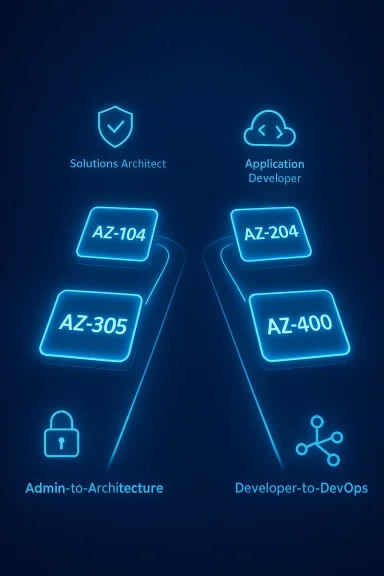
The latest wave of Microsoft Azure certification coverage is less about exam trivia and more about a bigger strategic message: the cloud career ladder is now built around role-based proof, not broad IT familiarity. Across the two Nordest24 pieces, the through-line is clear: AZ-104 and AZ-305 represent the administration-to-architecture path, while AZ-204 and AZ-400 map to development and DevOps progression. The articles frame those certifications as practical career accelerators, but the deeper story is that Microsoft’s certification ecosystem has become a shorthand for enterprise readiness in cloud, security, and automation. That is especially relevant in 2026, when employers want candidates who can demonstrate not just knowledge, but operational judgment.
The pair of articles reflects a market that has moved past the old idea of “getting certified” as a neat résumé booster. Instead, they present Azure certification as a structured path through increasingly specialized job roles, with each exam serving a distinct purpose in a professional growth sequence. That is a significant shift, because it aligns with how cloud teams actually work: administrators, architects, developers, and DevOps engineers all solve different problems, even when they work inside the same Microsoft ecosystem.
The first article, focused on AZ-104 and AZ-305, is really about the progression from operational administration to higher-level architectural decision-making. The second, centered on AZ-204 and AZ-400, turns the lens toward application development and delivery automation. Together, they tell a coherent story about how Microsoft wants professionals to move through the cloud stack: first build competence, then prove specialization, then connect those skills to real business outcomes.
That structure matters because Azure remains one of Microsoft’s most important enterprise platforms, and certification has become a way for candidates to signal that they can work in real-world hybrid environments. Microsoft’s role-based model is designed to validate practical capability, not just recall definitions. The articles’ emphasis on labs, study guides, and hands-on practice mirrors Microsoft’s own guidance that preparation should begin with the skills measured and be reinforced through actual platform work.
There is also a subtle labor-market message embedded in both pieces. Employers do not just want cloud enthusiasts; they want people who can administer subscriptions, design secure workloads, build applications, and automate delivery without creating outages. In that sense, these certifications are not simply educational milestones. They are hiring signals, internal promotion markers, and evidence that a professional can operate under the constraints of modern enterprise IT.
A few implications stand out from that ladder model:
AZ-104’s value lies in its grounding effect. It forces candidates to understand identity, storage, networking, monitoring, and compute in a practical way. That matters because a cloud administrator who only knows concepts but cannot operate within a live tenant is not yet useful in an enterprise environment. The article’s framing of the certification as a gateway to real career mobility is therefore well aligned with Microsoft’s role-based philosophy.
AZ-305 adds a different kind of value. Architecture is less about toggling settings and more about making tradeoffs under constraint. A solutions architect has to think about reliability, governance, hybrid integration, and the implications of design decisions over time. That is why this certification carries more senior signaling power: it suggests not just execution, but judgment.
The hiring takeaway is straightforward:
AZ-204 matters because cloud development is no longer just about building code that runs. Developers now need to understand how applications interact with identity, APIs, storage, eventing, and deployment environments. The article’s emphasis on career growth is meaningful here because Azure development skills are most valuable when they are paired with real platform awareness, not when they exist as isolated coding ability.
AZ-400 takes that one step further. Microsoft positions DevOps as a cross-functional discipline, and the exam reflects that reality by emphasizing continuous delivery, collaboration, and automation. In practical terms, that means the certification is not only about tools like pipelines or GitHub workflows. It is about learning how delivery systems behave when they meet security requirements, release pressure, and production expectations.
The practical implications are easy to see:
That distinction matters in the labor market. Employers are not buying a diploma; they are trying to reduce hiring risk. A certification that tracks real work is therefore valuable because it suggests the candidate can contribute faster and with less hand-holding.
A structured prep stack usually looks like this:
The most useful tools for this kind of work include:
For internal mobility, the upside is just as important. Certifications can help managers design training pathways, promotion ladders, and team coverage strategies. They provide a shared reference point for what “ready” looks like, which can be especially helpful when organizations are trying to upskill support staff into cloud-facing roles.
The big enterprise advantage is consistency. A certification program does not guarantee competence, but it gives organizations a baseline for conversation. That baseline becomes more useful when it is paired with internal projects, mentoring, and real operational context.
Candidates should also treat practice tests carefully. The articles repeatedly suggest that practice exams are most useful when they reveal gaps, not when they are used as a crutch. That is a critical distinction because false confidence is one of the quickest ways to waste both time and money.
Some practical habits help more than others:
The architecture path and the development path also complement each other well. That matters because modern teams increasingly want people who can work across boundaries without losing focus. A strong cloud professional may need to understand both the application lifecycle and the underlying infrastructure. Microsoft’s certification layout reflects that convergence very effectively.
There is a broader market truth here too: employers are tired of vague claims. Certifications that map to actual duties help them identify practical talent faster. That is one reason the Microsoft model continues to resonate even as training options proliferate.
For the market, the direction is equally clear. Cloud roles will continue to split into more precise specialties, and the most valuable candidates will be those who can move between them. The professionals who combine administration, architecture, development, and DevOps thinking will have the strongest positioning because they understand both the technology and the operating model behind it.
What to watch next:
Source: nordest24.it The Ultimate Roadmap to Mastering Azure Certifications: AZ-104 and AZ-305 Introduction to Azure Certifications and Career Growth
Source: nordest24.it Advancing Your Cloud Development Career with Microsoft Azure Certifications
 Overview
The pair of articles reflects a market that has moved past the old idea of “getting certified” as a neat résumé booster. Instead, they present Azure certification as a structured path through increasingly specialized job roles, with each exam serving a distinct purpose in a professional growth sequence. That is a significant shift, because it aligns with how cloud teams actually work: administrators, architects, developers, and DevOps engineers all solve different problems, even when they work inside the same Microsoft ecosystem.The first article, focused on AZ-104 and AZ-305, is really about the progression from operational administration to higher-level architectural decision-making. The second, centered on AZ-204 and AZ-400, turns the lens toward application development and delivery automation. Together, they tell a coherent story about how Microsoft wants professionals to move through the cloud stack: first build competence, then prove specialization, then connect those skills to real business outcomes.
That structure matters because Azure remains one of Microsoft’s most important enterprise platforms, and certification has become a way for candidates to signal that they can work in real-world hybrid environments. Microsoft’s role-based model is designed to validate practical capability, not just recall definitions. The articles’ emphasis on labs, study guides, and hands-on practice mirrors Microsoft’s own guidance that preparation should begin with the skills measured and be reinforced through actual platform work.
There is also a subtle labor-market message embedded in both pieces. Employers do not just want cloud enthusiasts; they want people who can administer subscriptions, design secure workloads, build applications, and automate delivery without creating outages. In that sense, these certifications are not simply educational milestones. They are hiring signals, internal promotion markers, and evidence that a professional can operate under the constraints of modern enterprise IT.
Why Azure Certification Still Matters
Azure certification remains valuable because Microsoft has tied it closely to how its platform is actually used in business settings. The articles correctly present Azure as a living platform where identity, networking, governance, monitoring, and automation all intersect. That makes the certification path more than a learning checklist; it becomes a map of the operating realities that cloud teams face every day.The Career-Ladder Effect
One of the most important ideas in the articles is that Azure certification works best as a ladder. A candidate may begin with fundamentals, move into administrator or developer roles, and later specialize in architecture or DevOps. That progression is important because it helps learners avoid the common trap of studying in a vacuum, where they collect concepts but never turn them into job-ready skill.A few implications stand out from that ladder model:
- AZ-104 builds core cloud administration credibility.
- AZ-305 expands that into design and architecture thinking.
- AZ-204 supports application development on Azure.
- AZ-400 validates DevOps and release engineering capability.
- The sequence works best when paired with hands-on labs rather than passive reading.
AZ-104 and AZ-305: From Admin to Architect
The AZ-104 and AZ-305 pairing is compelling because it captures two ends of the Azure operations spectrum. AZ-104 is about the day-to-day mechanics of administering the cloud, while AZ-305 moves into broader design decisions that influence resilience, cost, security, and scalability. That progression reflects how many professionals actually grow: first you learn to manage the platform, then you learn to shape it.AZ-104’s value lies in its grounding effect. It forces candidates to understand identity, storage, networking, monitoring, and compute in a practical way. That matters because a cloud administrator who only knows concepts but cannot operate within a live tenant is not yet useful in an enterprise environment. The article’s framing of the certification as a gateway to real career mobility is therefore well aligned with Microsoft’s role-based philosophy.
AZ-305 adds a different kind of value. Architecture is less about toggling settings and more about making tradeoffs under constraint. A solutions architect has to think about reliability, governance, hybrid integration, and the implications of design decisions over time. That is why this certification carries more senior signaling power: it suggests not just execution, but judgment.
What the Pair Signals to Employers
Employers tend to interpret this combination as evidence of maturity. A person with AZ-104 and AZ-305 is not just learning Azure; they are learning to think in terms of environment design, operational continuity, and business risk. That is a stronger signal than isolated product knowledge because it maps to how organizations structure cloud teams.The hiring takeaway is straightforward:
- AZ-104 suggests you can manage and support real cloud operations.
- AZ-305 suggests you can design systems that survive scale and change.
- Together they imply broader cloud fluency than either one alone.
- The combination helps candidates tell a cleaner promotion story.
- The path is especially useful in Microsoft-heavy enterprises.
AZ-204 and AZ-400: The Developer-to-DevOps Path
The AZ-204 and AZ-400 pairing is the most obviously modern part of the coverage because it reflects where a lot of cloud value is being created now: application delivery. AZ-204 focuses on Azure development skills, while AZ-400 pushes candidates into continuous delivery, source control, automation, and monitoring. That combination is powerful because it turns application knowledge into operational discipline.AZ-204 matters because cloud development is no longer just about building code that runs. Developers now need to understand how applications interact with identity, APIs, storage, eventing, and deployment environments. The article’s emphasis on career growth is meaningful here because Azure development skills are most valuable when they are paired with real platform awareness, not when they exist as isolated coding ability.
AZ-400 takes that one step further. Microsoft positions DevOps as a cross-functional discipline, and the exam reflects that reality by emphasizing continuous delivery, collaboration, and automation. In practical terms, that means the certification is not only about tools like pipelines or GitHub workflows. It is about learning how delivery systems behave when they meet security requirements, release pressure, and production expectations.
Why the DevOps Layer Matters
DevOps has become one of the most valuable skills in cloud IT because it bridges the old divide between development and operations. The articles understand this well: they treat AZ-400 not as a badge for enthusiasts, but as a proof point for people who want to build reliable software delivery systems. That framing is important because employers increasingly want engineers who can reduce friction rather than create new silos.The practical implications are easy to see:
- AZ-204 supports cloud application engineering.
- AZ-400 supports automation, release engineering, and delivery governance.
- Both exams benefit from lab work and repeated implementation.
- Both are stronger when paired with portfolio evidence.
- Both reward scenario thinking more than trivia recall.
Microsoft’s Role-Based Model and Why It Works
Microsoft’s certification ecosystem has matured into a role-based model for a reason: modern IT jobs are role-based. A cloud administrator, a solutions architect, a developer, and a DevOps engineer all need overlapping knowledge, but they do not need the same depth in every area. The articles reflect that reality by organizing career paths around job function rather than generic product mastery.Validation, Not Just Education
The strongest theme in the source material is that certification should validate competence. Microsoft’s own prep philosophy, as reflected in the articles, emphasizes skills measured, practice assessments, and hands-on experience. That is a healthier model than the old “read the book and hope for the best” approach because it forces learners to connect knowledge with execution.That distinction matters in the labor market. Employers are not buying a diploma; they are trying to reduce hiring risk. A certification that tracks real work is therefore valuable because it suggests the candidate can contribute faster and with less hand-holding.
The Hidden Strength of Microsoft Learn
The articles also implicitly praise Microsoft Learn’s ecosystem, and that is not accidental. Official documentation, study guides, and practice assessments are more reliable than stale third-party material because they track the live blueprint. In a rapidly changing platform like Azure, that freshness is not optional; it is the difference between studying the right thing and studying the wrong thing.A structured prep stack usually looks like this:
- Read the official skills outline.
- Map each objective to a lab exercise.
- Study Microsoft Learn material for weak spots.
- Use practice assessments diagnostically.
- Rebuild the scenario from memory to confirm retention.
Hands-On Practice Is the Real Differentiator
The articles are at their best when they emphasize hands-on learning. Azure certification is not won by abstract familiarity; it is won by repeated exposure to real platform behavior. That includes subscriptions, access controls, pipelines, deployment flows, and architecture decisions under realistic constraints.Labs, Projects, and Muscle Memory
Candidates often underestimate how much certification readiness depends on muscle memory. It is one thing to know that a service exists. It is another to configure it, troubleshoot it, and understand how it behaves when multiple requirements collide. That is why labs and projects are central to the strongest prep strategies.The most useful tools for this kind of work include:
- Azure resource creation and subscription management
- Identity and access controls
- Deployment pipelines and release steps
- Monitoring and logging
- Security and governance checks
- Rebuild-from-memory exercises after each study cycle
Enterprise Impact: Why Employers Care
For employers, the value of these certifications is not the badge itself. It is the signal that the person behind the badge can help stabilize operations, reduce onboarding time, and speak the same language as platform teams. That is especially valuable in environments where cloud adoption is moving faster than internal training can keep up.Hiring, Mobility, and Baseline Trust
Microsoft certification gives hiring managers a shorthand. It does not replace interviews, references, or project evidence, but it does reduce ambiguity. If a candidate holds AZ-104, AZ-305, AZ-204, or AZ-400, there is at least a reasonable expectation that they understand the role they are applying for. That is useful in a market where job descriptions can be vague and resume screening is brutally compressed.For internal mobility, the upside is just as important. Certifications can help managers design training pathways, promotion ladders, and team coverage strategies. They provide a shared reference point for what “ready” looks like, which can be especially helpful when organizations are trying to upskill support staff into cloud-facing roles.
The big enterprise advantage is consistency. A certification program does not guarantee competence, but it gives organizations a baseline for conversation. That baseline becomes more useful when it is paired with internal projects, mentoring, and real operational context.
Consumer Impact: What Candidates Should Take Away
For individual candidates, the message is both encouraging and cautionary. Azure certifications can absolutely help open doors, but they are not magic shortcuts. The articles do a good job of framing them as investments that require time, discipline, and a willingness to go beyond passive study.Time, Money, and Real Return
Certification prep costs money in obvious and hidden ways. Exam fees, lab time, study time, and practice materials all add up. That means candidates need to think about return on effort, not just the prestige of passing. A smart plan is one that builds usable skill while improving job prospects, not one that chases the fastest possible pass.Candidates should also treat practice tests carefully. The articles repeatedly suggest that practice exams are most useful when they reveal gaps, not when they are used as a crutch. That is a critical distinction because false confidence is one of the quickest ways to waste both time and money.
Some practical habits help more than others:
- Study in structured blocks instead of cramming.
- Track weak areas against the official outline.
- Use labs to convert theory into behavior.
- Retake practice assessments only after remediation.
- Treat certification as a career asset, not a one-week sprint.
The Competitive Landscape for Microsoft Skills
The competitive implication of these articles is that Microsoft is trying to own the intersection of cloud, development, and operational discipline. Azure is not just a product; it is the center of a broader career ecosystem that spans administration, architecture, coding, and DevOps. That breadth makes Microsoft’s certification ladder particularly sticky.Why the Stack Is Hard to Ignore
Azure remains compelling because it sits inside Microsoft-centric enterprises where identity, device management, collaboration, and cloud workloads often overlap. That gives Azure certification a practical advantage over more abstract cloud branding. Candidates are not just learning a platform; they are learning the operating environment many companies already use.The architecture path and the development path also complement each other well. That matters because modern teams increasingly want people who can work across boundaries without losing focus. A strong cloud professional may need to understand both the application lifecycle and the underlying infrastructure. Microsoft’s certification layout reflects that convergence very effectively.
There is a broader market truth here too: employers are tired of vague claims. Certifications that map to actual duties help them identify practical talent faster. That is one reason the Microsoft model continues to resonate even as training options proliferate.
Strengths and Opportunities
The strongest feature of the certification paths described in the articles is that they are tightly aligned with real enterprise work. They are not academic trophies; they are role signals that can help candidates move into cloud operations, architecture, development, or DevOps with more confidence. They also give organizations a cleaner way to identify people who can contribute quickly.- Role-based clarity for employers and candidates
- Strong alignment with real cloud job functions
- Useful progression from entry-level to advanced roles
- Better interview signaling than generic IT claims
- Good fit for Microsoft-heavy enterprise environments
- Strong support from Microsoft Learn and official study guides
- Clear value when paired with hands-on projects
- Durable relevance in a fast-changing cloud market
Risks and Concerns
The biggest risk in any certification journey is mistaking familiarity for readiness. Azure services can look straightforward when you read about them, but scenario-based exams expose shallow understanding very quickly. That is why shortcut culture, dump-style prep, and stale material are so dangerous: they can create the illusion of competence without the substance.- Outdated study material may not match current skills measured
- Shortcut-driven prep encourages memorization over understanding
- Limited lab exposure leaves candidates weak on scenario questions
- Practice tests can create false confidence if misused
- Certification can be overrated if employers treat it as a full substitute for experience
- Renewal and blueprint updates make stale prep especially risky
- Overfocusing on one tool can leave major gaps elsewhere
- Passing is not the same as performing
Looking Ahead
The most likely next phase for Azure certification is even tighter alignment between exams and live platform behavior. That is already visible in Microsoft’s emphasis on updated blueprints, official prep resources, and renewal-driven relevance. For candidates, that means the days of stale, one-size-fits-all preparation are fading fast.For the market, the direction is equally clear. Cloud roles will continue to split into more precise specialties, and the most valuable candidates will be those who can move between them. The professionals who combine administration, architecture, development, and DevOps thinking will have the strongest positioning because they understand both the technology and the operating model behind it.
What to watch next:
- Updates to AZ-400 and other role-based exam blueprints
- Continued emphasis on labs and official Microsoft Learn content
- Stronger employer preference for portfolio-backed certification
- More demand for candidates who bridge cloud, security, and automation
- Rising value of architecture skills alongside core administration
- Ongoing pressure to keep certifications current rather than static
Source: nordest24.it The Ultimate Roadmap to Mastering Azure Certifications: AZ-104 and AZ-305 Introduction to Azure Certifications and Career Growth
Source: nordest24.it Advancing Your Cloud Development Career with Microsoft Azure Certifications
