

Microsoft Azure certifications remain one of the clearest ways for IT professionals to prove current cloud skills, but the real story in 2026 is that the path has become more role-specific, more practical, and more time-sensitive than many candidates realize. AZ-104 and AZ-204 sit at the center of that shift: one validates the hands-on work of an Azure administrator, while the other measures the ability to build and maintain cloud applications as a developer. Both are still highly relevant, but they now demand a preparation strategy that goes well beyond memorizing exam objectives and buying a dump-style shortcut. Microsoft’s own guidance makes that clear by emphasizing role-based skills, hands-on experience, and renewal awareness for these credentials.
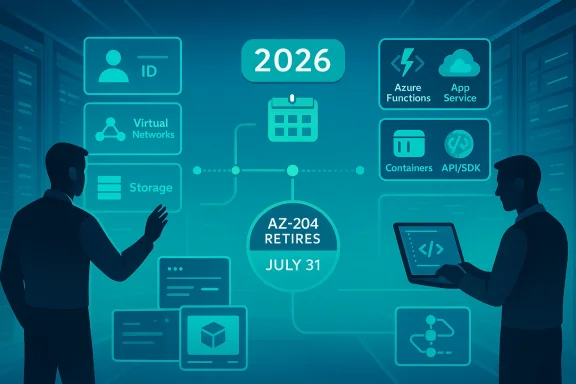
The pairing of AZ-104 and AZ-204 makes sense because they represent two sides of the same cloud platform. AZ-104 is the operational track: identity, storage, compute, networking, governance, and monitoring. AZ-204 is the build track: Azure Functions, App Service, containers, storage integration, security, diagnostics, and service consumption. Microsoft frames both as intermediate-level credentials, which means they are not beginner exams in practice even if many candidates treat them that way.
That distinction matters because the Azure ecosystem has matured. It is no longer enough to know what a resource group is or how a Function App is created. Employers expect people who can connect Azure services to real workloads, troubleshoot issues, and understand how cloud design affects cost, security, and maintainability. Microsoft’s AZ-104 page explicitly highlights implementing, managing, and monitoring an Azure environment across virtual networks, storage, compute, identity, security, and governance, while also calling out coordination with networking, DevOps, and application-development roles.
AZ-204 is similarly broad, but from the developer’s side of the house. Microsoft says candidates should be able to participate in every phase of development, including requirements, design, deployment, maintenance, tuning, and monitoring. The exam also expects proficiency with SDKs, data storage options, data connections, APIs, authentication, debugging, and container deployment, which is why developers with limited Azure exposure often find the exam more demanding than they expected.
For candidates building a career strategy, the two certifications create a useful map. AZ-104 is often the better entry point for system administrators, support engineers, cloud operators, and infrastructure-minded professionals. AZ-204 is the more natural path for software engineers, backend developers, application developers, and DevOps-adjacent practitioners who want to prove they can ship on Azure. In other words, these are not just exams; they are identity markers for how you want to work in cloud environments.
That renewal model is not a bureaucratic annoyance; it is a signal about how Microsoft views cloud skills. The platform changes often enough that a credential must stay aligned with current Azure behavior to remain valuable. In practice, that makes continuous learning part of the certification itself rather than an optional extra. It also means candidates should study with official documentation and current Microsoft Learn materials instead of leaning on stale courses or outdated exam dumps.
AZ-204 carries a different kind of weight because it proves developers can use Azure as a runtime and application platform. Microsoft’s exam guide highlights compute, storage, security, monitoring, and service integration, which are the parts of cloud development that tend to break in real life. A developer who understands Azure SDKs, bindings, auth, and service connections is usually more productive than one who only knows how to deploy code.
The certifications also fit the current market reality. Enterprises are not choosing between infrastructure and applications anymore; they need both to work together. That is why many teams value engineers who understand administration and development, or at least can speak across both domains without friction. This is one reason the AZ-104 and AZ-204 pairing remains strategically useful.
That structure benefits employers as much as candidates. A manager reading a current Azure credential can infer that the holder has at least interacted with the platform’s recent changes. It does not guarantee perfect performance, but it does reduce uncertainty. In a cloud market where stale knowledge can become expensive quickly, that matters.
That means AZ-104 is not just a “portal clicking” exam. It tests whether you can reason about cloud infrastructure the way an operator does: what breaks, how it is secured, how it is monitored, and how it scales. This is why candidates coming from on-prem systems administration often do well if they already understand troubleshooting, change control, and service dependencies.
The exam rewards people who can connect the dots. For example, a storage issue might actually be an identity or networking problem. A compute outage might trace back to a governance mistake or a misconfigured resource policy. The exam environment mirrors real administration, where no problem sits neatly inside a single service silo. That is why hands-on practice is critical, not optional.
Microsoft also offers a sandbox, practice assessment, and prep videos for AZ-104, which is useful because it helps candidates get comfortable with the exam format and question style. The sandbox is especially valuable for people who have not yet taken a proctored role-based exam. It lets you see the test interface before you are under time pressure.
A good order of attack usually looks like this:
It also gives hiring managers a cleaner signal than a vague résumé claim. A candidate who has earned AZ-104 has demonstrated enough structure to understand Azure’s operational model. That does not replace experience, but it does create a useful floor under technical conversation.
The exam expects familiarity with Azure SDKs, storage options, data connections, APIs, app authentication and authorization, compute and container deployment, and debugging. Microsoft’s current exam guide also shows emphasis on developing compute solutions, storage, security, monitoring, and consumption of Azure and third-party services. That is a broad and current developer skill set, not a narrow certification in one language or one framework.
The exam also expects a certain amount of platform fluency. If you are not comfortable with Azure CLI, PowerShell, authentication flows, monitoring tools, and resource configuration, the questions can feel much more complex than the underlying code suggests. This is why developers who have deployed into production usually outperform those who have only built local projects.
A second reason is breadth. AZ-204 covers functions, web apps, containers, storage, security, troubleshooting, and external service integration. That is enough surface area to punish shallow preparation. The good news is that Microsoft provides a study guide and exam-readiness content for each major domain, which is a strong starting point if you use it properly.
It also helps developers speak more effectively with infrastructure teams. That is not a small advantage. The people who can understand deployment slots, containers, Cosmos DB, security, and messaging are often the ones who avoid the classic “it worked on my machine” failure mode. AZ-204 is a developer credential, but it teaches production thinking.
For readers planning a preparation schedule in 2026, that is not a trivial detail. If AZ-204 is part of your career plan, you need to align study time with the retirement window. It also means Microsoft’s documentation is more important than ever, because exam coverage and recertification rules can change quickly.
A study plan should also reflect your background. If you come from administration, AZ-104 will feel closer to your day job, but you still need to practice the Azure-specific twists. If you come from development, AZ-204 may feel familiar in code terms, but you may need to invest extra time in Azure governance, services, and operational monitoring. Self-awareness is a huge advantage here.
A practical framework looks like this:
Labs also reduce anxiety. Once you have repeated a process enough times in a real environment, you are less likely to panic when the exam presents a scenario. That is particularly important for AZ-204, where you may need to think through how services interact rather than remember a single obvious answer. Practice builds pattern recognition, and pattern recognition saves time.
For AZ-104 and AZ-204, practice tests should reveal two things: where you do not know the answer, and where you know the answer but cannot get there fast enough. Both matter. Time pressure is real, and the pacing problem is often as important as the knowledge problem.
A good review process is:
This matters even more for people who have not taken a modern proctored certification exam recently. The testing experience can feel different from old-style multiple-choice exams, especially when interactive elements are involved. Familiarity reduces cognitive load, and reduced cognitive load usually improves performance.
A second mistake is using outdated study material. Azure changes, Microsoft updates skills guides, and certification renewal policies evolve. If your material is stale, your preparation can drift away from what the exam actually measures. That is particularly dangerous when the exam is close to retirement, as AZ-204 currently is.
Another issue is narrow study. Some people overfocus on one domain they already like, such as storage or App Service, and skip the awkward areas like governance, identity, or monitoring. That is risky because Azure exams often reward balanced competency. The weak domain is usually the one that costs you the pass.
That is one reason candidates should check the official pages regularly rather than relying on generic blog advice. Microsoft’s certification pages, study guides, and renewal policy pages are the current source of truth. In a fast-moving ecosystem, that discipline is part of professional maturity.
For candidates, the practical lesson is simple: prepare with current Microsoft Learn material, build labs, take practice assessments, and keep an eye on expiration or retirement dates. If you are working toward AZ-104 or AZ-204, the smartest plan is to treat the certification as a milestone in a larger learning path, not the final destination. In cloud work, continuous competence matters more than a one-time win.
Source: Breaking The Lines Complete Guide to Azure AZ-104 and AZ-204 Certification Preparation - Breaking The Lines
 Overview
The pairing of AZ-104 and AZ-204 makes sense because they represent two sides of the same cloud platform. AZ-104 is the operational track: identity, storage, compute, networking, governance, and monitoring. AZ-204 is the build track: Azure Functions, App Service, containers, storage integration, security, diagnostics, and service consumption. Microsoft frames both as intermediate-level credentials, which means they are not beginner exams in practice even if many candidates treat them that way.That distinction matters because the Azure ecosystem has matured. It is no longer enough to know what a resource group is or how a Function App is created. Employers expect people who can connect Azure services to real workloads, troubleshoot issues, and understand how cloud design affects cost, security, and maintainability. Microsoft’s AZ-104 page explicitly highlights implementing, managing, and monitoring an Azure environment across virtual networks, storage, compute, identity, security, and governance, while also calling out coordination with networking, DevOps, and application-development roles.
AZ-204 is similarly broad, but from the developer’s side of the house. Microsoft says candidates should be able to participate in every phase of development, including requirements, design, deployment, maintenance, tuning, and monitoring. The exam also expects proficiency with SDKs, data storage options, data connections, APIs, authentication, debugging, and container deployment, which is why developers with limited Azure exposure often find the exam more demanding than they expected.
For candidates building a career strategy, the two certifications create a useful map. AZ-104 is often the better entry point for system administrators, support engineers, cloud operators, and infrastructure-minded professionals. AZ-204 is the more natural path for software engineers, backend developers, application developers, and DevOps-adjacent practitioners who want to prove they can ship on Azure. In other words, these are not just exams; they are identity markers for how you want to work in cloud environments.
What Azure Certifications Mean in 2026
Microsoft’s certification model has become more dynamic over the last few years, and that has changed the prep game. Role-based certifications now have a shorter life cycle, which means candidates cannot assume that passing once gives them permanent coverage. Microsoft states that associate, expert, and specialty certifications expire after one year and can be renewed through free online assessments, while fundamentals certifications do not expire.That renewal model is not a bureaucratic annoyance; it is a signal about how Microsoft views cloud skills. The platform changes often enough that a credential must stay aligned with current Azure behavior to remain valuable. In practice, that makes continuous learning part of the certification itself rather than an optional extra. It also means candidates should study with official documentation and current Microsoft Learn materials instead of leaning on stale courses or outdated exam dumps.
Why AZ-104 and AZ-204 still carry weight
The value of AZ-104 is that it proves you can operate the platform, not just talk about it. Microsoft’s exam scope emphasizes identity and governance, storage, compute, networking, monitoring, and security, all of which are core responsibilities in hybrid enterprise environments. That makes the certification useful for employers who need administrators who can keep systems stable and compliant.AZ-204 carries a different kind of weight because it proves developers can use Azure as a runtime and application platform. Microsoft’s exam guide highlights compute, storage, security, monitoring, and service integration, which are the parts of cloud development that tend to break in real life. A developer who understands Azure SDKs, bindings, auth, and service connections is usually more productive than one who only knows how to deploy code.
The certifications also fit the current market reality. Enterprises are not choosing between infrastructure and applications anymore; they need both to work together. That is why many teams value engineers who understand administration and development, or at least can speak across both domains without friction. This is one reason the AZ-104 and AZ-204 pairing remains strategically useful.
- AZ-104 is about keeping Azure environments reliable.
- AZ-204 is about building solutions that actually fit Azure’s architecture.
- Both reward practical work more than passive study.
- Both are better treated as career investments than exam milestones.
- Both are strongest when paired with real projects.
The significance of renewal and recertification
Microsoft’s annual renewal cycle changes how candidates should plan their careers. It is no longer enough to pass and forget; the credential is designed to stay current, and that means your knowledge must stay fresh too. Microsoft’s renewal flow is free, online, and unproctored, with a six-month renewal window before expiration.That structure benefits employers as much as candidates. A manager reading a current Azure credential can infer that the holder has at least interacted with the platform’s recent changes. It does not guarantee perfect performance, but it does reduce uncertainty. In a cloud market where stale knowledge can become expensive quickly, that matters.
AZ-104: The Administrator Mindset
AZ-104 is the exam for people who want to manage Azure environments, not merely consume Azure services. Microsoft’s official overview is clear that this certification is for those implementing, managing, and monitoring an organization’s Azure environment, including virtual networks, storage, compute, identity, security, and governance. It also expects familiarity with operating systems, networking, servers, virtualization, PowerShell, Azure CLI, the portal, Resource Manager templates, and Microsoft Entra ID.That means AZ-104 is not just a “portal clicking” exam. It tests whether you can reason about cloud infrastructure the way an operator does: what breaks, how it is secured, how it is monitored, and how it scales. This is why candidates coming from on-prem systems administration often do well if they already understand troubleshooting, change control, and service dependencies.
What the exam is really testing
The skills measured by AZ-104 are practical and interdependent. You are expected to manage Azure identities and governance, implement and manage storage, deploy and manage compute, implement and manage virtual networking, and monitor and maintain Azure resources. That is a broad set of tasks, and the breadth is part of the challenge.The exam rewards people who can connect the dots. For example, a storage issue might actually be an identity or networking problem. A compute outage might trace back to a governance mistake or a misconfigured resource policy. The exam environment mirrors real administration, where no problem sits neatly inside a single service silo. That is why hands-on practice is critical, not optional.
Microsoft also offers a sandbox, practice assessment, and prep videos for AZ-104, which is useful because it helps candidates get comfortable with the exam format and question style. The sandbox is especially valuable for people who have not yet taken a proctored role-based exam. It lets you see the test interface before you are under time pressure.
Core study priorities for AZ-104
A strong AZ-104 prep plan should start with the official study guide and break the exam into functional blocks. The current study guide is explicitly the right place to focus preparation, because Microsoft updates the guide when the exam changes. That alone makes it more reliable than generic third-party content.A good order of attack usually looks like this:
- Read the AZ-104 skills outline carefully.
- Build a small Azure lab or sandbox.
- Practice identity, storage, and networking tasks.
- Take a practice assessment early.
- Review weak areas and repeat with timed study sessions.
AZ-104 strengths in the job market
AZ-104 is often the more immediately useful credential for enterprise support and cloud operations roles. Microsoft positions the certification around coordination with broader infrastructure, networking, security, database, application, and DevOps teams, which is exactly how modern operations works in large organizations. That makes the badge useful for people who want to move from general IT into cloud administration.It also gives hiring managers a cleaner signal than a vague résumé claim. A candidate who has earned AZ-104 has demonstrated enough structure to understand Azure’s operational model. That does not replace experience, but it does create a useful floor under technical conversation.
- Strong fit for administrators and support engineers
- Useful for hybrid cloud environments
- Good foundation for security and governance work
- Helps validate Azure CLI and PowerShell familiarity
- Often a bridge into more advanced cloud roles
AZ-204: The Developer Mindset
AZ-204 is the certification for people who build on Azure rather than administer it. Microsoft describes the role as participating in all phases of development, including requirements gathering, design, development, deployment, security, maintenance, performance tuning, and monitoring. That is a very different operating model from AZ-104, and candidates who underestimate that difference often struggle.The exam expects familiarity with Azure SDKs, storage options, data connections, APIs, app authentication and authorization, compute and container deployment, and debugging. Microsoft’s current exam guide also shows emphasis on developing compute solutions, storage, security, monitoring, and consumption of Azure and third-party services. That is a broad and current developer skill set, not a narrow certification in one language or one framework.
Why developers find AZ-204 harder than expected
Many developers assume AZ-204 will be mostly about writing code. In reality, it asks how code behaves inside Azure’s ecosystem, which means you must understand service integration, security boundaries, and operational constraints. That makes the exam more architecture-aware than many dev certifications.The exam also expects a certain amount of platform fluency. If you are not comfortable with Azure CLI, PowerShell, authentication flows, monitoring tools, and resource configuration, the questions can feel much more complex than the underlying code suggests. This is why developers who have deployed into production usually outperform those who have only built local projects.
A second reason is breadth. AZ-204 covers functions, web apps, containers, storage, security, troubleshooting, and external service integration. That is enough surface area to punish shallow preparation. The good news is that Microsoft provides a study guide and exam-readiness content for each major domain, which is a strong starting point if you use it properly.
Where AZ-204 fits in a developer career
AZ-204 is especially valuable for backend developers, cloud application engineers, and teams building services in Microsoft-heavy environments. Microsoft positions the certification around end-to-end solution building in Azure, which means it is less about one framework and more about cloud-native delivery. That makes it a compelling credential for developers who want to move beyond purely local application work.It also helps developers speak more effectively with infrastructure teams. That is not a small advantage. The people who can understand deployment slots, containers, Cosmos DB, security, and messaging are often the ones who avoid the classic “it worked on my machine” failure mode. AZ-204 is a developer credential, but it teaches production thinking.
- Strong fit for application developers
- Valuable for cloud-native backend roles
- Useful for DevOps-adjacent engineers
- Helps bridge development and operations
- Good choice for people already using Azure SDKs or APIs
The retire date changes how you should think
One important development in the current Microsoft certification landscape is that the AZ-204 certification and exam are scheduled to retire on July 31, 2026. Microsoft says the associated certification, exam, and renewal assessments will retire on that date, after which candidates can no longer earn or renew it. That makes timing important for anyone currently planning to sit the exam.For readers planning a preparation schedule in 2026, that is not a trivial detail. If AZ-204 is part of your career plan, you need to align study time with the retirement window. It also means Microsoft’s documentation is more important than ever, because exam coverage and recertification rules can change quickly.
How to Build an Effective Study Plan
The most effective Azure study plans are structured, repeatable, and hands-on. Microsoft repeatedly recommends training, documentation, practice assessments, and sandbox exposure, which is a strong hint that passive reading alone is not enough. Candidates should treat the exam guide as a checklist for actual practice, not merely as a reading list.A study plan should also reflect your background. If you come from administration, AZ-104 will feel closer to your day job, but you still need to practice the Azure-specific twists. If you come from development, AZ-204 may feel familiar in code terms, but you may need to invest extra time in Azure governance, services, and operational monitoring. Self-awareness is a huge advantage here.
A realistic prep framework
The strongest prep framework usually combines content review with active implementation. Reading documentation, watching a course, and taking notes are useful, but they only become meaningful when paired with actual Azure work. Microsoft’s own exam pages emphasize practice assessments, sandbox use, and training resources for that reason.A practical framework looks like this:
- Read the current exam guide first.
- Build a simple Azure sandbox subscription.
- Spend time on the services most heavily weighted by the exam.
- Use practice assessments to find weak spots.
- Revisit official docs after each practice round.
Why hands-on labs matter so much
Hands-on work is the single biggest separator between people who understand Azure and people who pass Azure exams. Azure services are deeply connected, and the exam often asks you to reason through dependencies rather than recite definitions. If you have actually configured storage, deployed a web app, created identities, and monitored resources, the exam feels more natural.Labs also reduce anxiety. Once you have repeated a process enough times in a real environment, you are less likely to panic when the exam presents a scenario. That is particularly important for AZ-204, where you may need to think through how services interact rather than remember a single obvious answer. Practice builds pattern recognition, and pattern recognition saves time.
Practice Tests, Mock Exams, and Timing
Practice tests are useful, but only if you use them honestly. Microsoft’s practice assessments exist to show exam style, wording, and difficulty, and the company says they are designed to help you assess readiness and fill knowledge gaps. That means they are diagnostic tools, not magic tickets.For AZ-104 and AZ-204, practice tests should reveal two things: where you do not know the answer, and where you know the answer but cannot get there fast enough. Both matter. Time pressure is real, and the pacing problem is often as important as the knowledge problem.
How to use practice tests correctly
The best method is to take an early diagnostic test, then treat the results as a roadmap. Do not focus only on your score. Focus on the service areas, question patterns, and whether you missed concepts, commands, or scenario logic. That kind of review turns a practice test into a study engine.A good review process is:
- Take the test under timed conditions.
- Identify every missed topic.
- Re-read the relevant Microsoft documentation.
- Rebuild the workflow in a lab if possible.
- Retest after a short gap.
Why exam format familiarity matters
Microsoft lets candidates try the exam sandbox so they can experience the user interface before test day. That may sound minor, but it is actually valuable because unfamiliar question mechanics can cost time and confidence. If you know what the environment looks like ahead of time, you can spend more mental energy on the content itself.This matters even more for people who have not taken a modern proctored certification exam recently. The testing experience can feel different from old-style multiple-choice exams, especially when interactive elements are involved. Familiarity reduces cognitive load, and reduced cognitive load usually improves performance.
- Use timed sessions from the beginning
- Review wrong answers in detail
- Recreate scenario questions in a lab
- Build speed without sacrificing accuracy
- Treat practice tests as feedback, not as a guarantee
Common Pitfalls Candidates Should Avoid
The biggest mistake candidates make is assuming that reading or watching content equals readiness. It does not. Azure exams reward applied competence, and that difference shows up quickly when questions involve dependencies, troubleshooting, or tradeoffs. Microsoft’s own pages repeatedly push hands-on preparation because it matters so much.A second mistake is using outdated study material. Azure changes, Microsoft updates skills guides, and certification renewal policies evolve. If your material is stale, your preparation can drift away from what the exam actually measures. That is particularly dangerous when the exam is close to retirement, as AZ-204 currently is.
Avoid the shortcuts that hurt real learning
Many candidates are tempted by dumps, overhyped cheat sheets, or poorly maintained exam collections. Those shortcuts can create false confidence because they train you to recognize wording instead of understand systems. If the exam wording changes, the shortcut fails. If the job changes, the shortcut fails even harder.Another issue is narrow study. Some people overfocus on one domain they already like, such as storage or App Service, and skip the awkward areas like governance, identity, or monitoring. That is risky because Azure exams often reward balanced competency. The weak domain is usually the one that costs you the pass.
The danger of ignoring renewal and retirement windows
Microsoft’s current model means the credential can expire unless renewed, and AZ-204 has a specific retirement deadline. Those timelines are not background noise; they should influence your study calendar. If you plan your exam too late, you can end up chasing a credential that is no longer available to earn or renew.That is one reason candidates should check the official pages regularly rather than relying on generic blog advice. Microsoft’s certification pages, study guides, and renewal policy pages are the current source of truth. In a fast-moving ecosystem, that discipline is part of professional maturity.
Strengths and Opportunities
The Azure certification path is still compelling because it is tied directly to real job functions, not abstract theory. AZ-104 and AZ-204 each validate a different but complementary set of cloud skills, which makes them useful for both career starters and experienced practitioners looking to sharpen their specialization. The biggest opportunity is that these exams can help you move from general IT work into a more defined cloud role with clearer market value.- AZ-104 maps cleanly to cloud administration roles.
- AZ-204 maps cleanly to cloud application development.
- Microsoft’s renewal model keeps skills current.
- Official study guides reduce guesswork.
- Hands-on labs translate directly into job readiness.
- Practice assessments help identify weak areas early.
- The certification pair supports hybrid cloud careers.
Risks and Concerns
The main risk is assuming the badge is enough. In practice, employers still care about experience, troubleshooting ability, and the quality of your actual work. A certification helps you get in the door, but it does not do your job for you. That is true for both AZ-104 and AZ-204, and it is especially true in enterprise environments where mistakes can be expensive.- Overreliance on dumps creates shallow knowledge.
- Outdated materials can mislead candidates.
- Weak hands-on practice hurts on exam day and at work.
- Poor time management can sabotage strong technical candidates.
- Renewal deadlines can catch people off guard.
- AZ-204’s 2026 retirement creates scheduling pressure.
- Vendor lock-in can narrow long-term flexibility.
Looking Ahead
The next phase of Azure certification will almost certainly be even more role-specific, more integrated with hands-on assessment, and more closely tied to evolving cloud operations. Microsoft’s current renewal system and the retirement of AZ-204 are both signs that the company wants credentials to mirror live platform change rather than sit still. That is inconvenient for candidates, but it is also more honest about how cloud careers actually work.For candidates, the practical lesson is simple: prepare with current Microsoft Learn material, build labs, take practice assessments, and keep an eye on expiration or retirement dates. If you are working toward AZ-104 or AZ-204, the smartest plan is to treat the certification as a milestone in a larger learning path, not the final destination. In cloud work, continuous competence matters more than a one-time win.
- Watch Microsoft Learn updates for exam changes.
- Use labs to reinforce every study block.
- Track renewal eligibility well before expiration.
- Move quickly if AZ-204 is part of your plan.
- Build real projects that show cloud fluency.
Source: Breaking The Lines Complete Guide to Azure AZ-104 and AZ-204 Certification Preparation - Breaking The Lines
Last edited:
