

Microsoft published CVE-2026-50656 on June 16, 2026, describing an Important elevation-of-privilege vulnerability in the Microsoft Malware Protection Engine used by Defender, publicly known as “RoguePlanet,” with functional exploit code assessed as available but no confirmed exploitation yet. The uncomfortable part is not merely that Defender has another local privilege bug; it is that Microsoft has acknowledged the flaw before shipping a fix. That turns an ordinary Patch Tuesday-style advisory into a live risk-management exercise. For Windows users and administrators, the message is simple: Defender’s automatic update model is useful, but it is not magic.
The most important word in Microsoft’s advisory is not “Important,” “local,” or even “Defender.” It is “confirmed.” In CVSS terms, Microsoft rates the report confidence for CVE-2026-50656 as confirmed, meaning the vendor accepts that the vulnerability exists and that the technical basis is credible enough to publish.
That matters because many CVEs begin life as thin public records: a product name, an impact category, perhaps a score, and not much else. This one is different. Microsoft says the issue is an elevation of privilege in the Microsoft Malware Protection Engine, the component at the center of Defender’s scanning and detection stack, and says it is working on a “high quality security update” that will be documented when available.
The absence of a patch is the defining feature of the moment. There is no KB article, no fixed build number, and no download entry listed for the affected product row. The advisory is effectively a public marker: the vulnerability is real, the vendor knows it, attackers may have enough information to work with, and customers are waiting for the engine update that closes the loop.
That is a strange place for Microsoft to be with Defender. The product is both a security control and a sprawling privileged service on hundreds of millions of Windows systems. When the guard dog has a privilege-escalation flaw, the conversation is no longer about whether antivirus software is useful; it is about how much trust the platform places in code that must inspect everything.
The vector explains the tradeoff. The attack is local, requires low privileges, has low complexity, and needs no user interaction. In plain English, that means an attacker who can already run code as a normal user may be able to push higher without needing the victim to click through a second prompt or open a special file.
That is exactly the kind of vulnerability that enterprise defenders dislike because it completes the second half of an intrusion. Phishing, drive-by malware, stolen credentials, malicious scripts, and abused remote management tools often begin with limited privileges. A reliable elevation-of-privilege bug is what turns that beachhead into a full compromise.
The advisory’s impact ratings are also stark. Microsoft scores confidentiality, integrity, and availability as high. That does not automatically mean every vulnerable machine is one exploit away from total domain compromise, but it does mean the security model being described is not a harmless nuisance. A successful exploit could allow an attacker to cross a privilege boundary in a way that meaningfully undermines the system.
CVE-2026-50656 is categorized under CWE-59, improper link resolution before file access, commonly known as link following. This class of bug often involves software trusting a path, shortcut, junction, symbolic link, or other file-system redirection in a way that lets an attacker steer a privileged process toward the wrong target. The broad pattern is old, but it remains dangerous because Windows has a rich file-system namespace and many privileged services perform automated file operations.
For Defender, the risk is conceptually easy to understand even without exploit details. If a privileged scanning or remediation component can be tricked into touching attacker-controlled paths incorrectly, the attacker may be able to convert routine security activity into privilege escalation. That is why local privilege bugs in antimalware engines deserve more attention than their “local” label often suggests.
There is a second irony here. Defender is supposed to reduce the blast radius of untrusted files and suspicious behaviors. A link-following vulnerability turns that relationship inside out: the attacker may be able to make the security product’s own file access become part of the exploit chain. That does not make Defender uniquely bad. It makes Defender a reminder that every powerful security agent is also part of the attack surface.
The CVSS temporal metrics sharpen the point. Exploit code maturity is listed as functional. Remediation level is unavailable. Report confidence is confirmed. Those three fields together describe a vulnerability that is known, reproducible enough to be taken seriously, not yet fixed, and more useful to attackers than defenders would prefer.
This is where vulnerability management teams should resist the temptation to sort by severity alone. A 7.8 Important issue with functional exploit code and no fix can outrank a higher-scored issue that is hard to exploit, privately reported, and already patched. The old “Critical first, Important later” queue is too blunt for a world where public exploitability often matters more than the adjective in the vendor bulletin.
Microsoft’s “not exploited” field is useful, but it should not be overread. It means Microsoft was not reporting known in-the-wild exploitation at publication time. It does not mean exploitation is impossible, absent from every environment, or unlikely to be attempted after publication. The public advisory itself changes the attacker calculus.
But CVE-2026-50656 is not yet in that comfortable phase. Microsoft’s advisory lists the Microsoft Malware Protection Engine as the affected product, but the security update table has no fixed build number. The executive summary says Microsoft is still working on the update.
That means administrators cannot yet verify compliance by checking for a specific fixed engine version. They can check whether Defender updates are flowing, whether devices are cloud-connected where appropriate, whether update channels are not pinned or broken, and whether security tooling can report engine versions. But they cannot mark the vulnerability remediated until Microsoft publishes the version that contains the fix.
This is particularly awkward for regulated environments. Auditors like binary states: vulnerable or patched, compliant or non-compliant. RoguePlanet currently sits in the messier middle, where the correct answer is active monitoring, exposure reduction, and rapid deployment readiness.
That is why defenders sometimes underestimate this class of bug. If the attacker already has a foothold, the thinking goes, the organization has bigger problems. But modern endpoint security is built around the assumption that initial compromise happens and must be contained. Least privilege, application control, EDR telemetry, credential isolation, and tamper protection all exist because the first foothold should not automatically become total control.
A reliable EoP bug attacks that containment layer. It can help malware disable protections, access secrets, tamper with logs, install persistence, dump credentials, or move from a user context into SYSTEM. The difference between “the user ran something bad” and “the machine is owned” is often a local privilege boundary.
RoguePlanet is therefore not just a Defender bug. It is a test of whether organizations have treated Defender as part of a layered defensive system or as a silver bullet. If your endpoint strategy assumes Defender will always be both present and trustworthy under attack, a Defender EoP is a particularly sharp reminder that security controls need their own guardrails.
Public disclosure compresses the time between advisory and adversary testing. Once a flaw has a name, a CVE, a weakness class, an affected component, and an exploitability signal, defenders are not the only people reading. Offensive researchers, ransomware crews, initial-access brokers, and opportunistic script collectors all parse the same advisories.
This does not mean every Windows PC will be targeted tomorrow. Local privilege escalation bugs generally need pairing with another access method, and attackers must still account for version differences, mitigations, endpoint policies, and telemetry. But it does mean that waiting passively for a patch is not enough for high-value systems.
The sensible response is preparation, not panic. Organizations should make sure Defender engine updates are not blocked by proxy rules, disconnected WSUS assumptions, stale gold images, or overzealous change-control freezes. When Microsoft publishes the fixed build, the update path should already be clear.
For sysadmins, the work is more specific. Inventory matters. If your endpoint management system cannot tell you which Malware Protection Engine versions are deployed, it is already underperforming. A vulnerability like this turns engine version visibility from a nice-to-have into a basic operational requirement.
Disconnected and semi-disconnected environments deserve special scrutiny. Industrial networks, lab systems, classified enclaves, and tightly controlled server fleets often do not update Defender the same way laptops do. Those are exactly the environments where an automatic security engine update may be delayed by design, and where administrators need a plan to ingest the fixed package once it exists.
There is also a policy question. If Defender tamper protection, attack surface reduction rules, controlled folder access, or EDR onboarding have been weakened to satisfy a legacy workflow, RoguePlanet is a prompt to revisit those exceptions. A local privilege escalation flaw is easier to operationalize when the endpoint is already full of carve-outs.
The problem is that Microsoft’s Security Update Guide still speaks in a format designed for machines and vulnerability managers more than humans. The most important operational facts are scattered across CVSS fields, executive summary text, exploitability tables, and an empty security update row. Experienced admins can read between the lines. Everyone else sees a familiar Defender CVE page and may not notice that remediation is unavailable.
That gap matters because Microsoft Defender is now part of the default Windows security baseline. It is not an optional enterprise add-on used only by specialists. When a Defender engine vulnerability is confirmed, publicly disclosed, and not yet fixed, the vendor’s communication must make the practical state unmissable.
The phrase “working to provide a high quality security update” is doing diplomatic work here. It signals caution: Microsoft does not want to rush an engine patch that breaks scanning, false-positives half the fleet, or introduces a worse defect. But for customers, the phrase also means exposure remains open until further notice.
The recurring lesson from antimalware vulnerabilities is that inspection is dangerous work. Engines parse hostile input by design. They traverse untrusted directories, unpack archives designed to confuse parsers, chase metadata, inspect scripts, and operate across user-controlled file systems. Every one of those actions must be done as if the attacker is trying to manipulate the inspector.
CWE-59 fits neatly into that story. File paths are not just strings. On Windows, they can represent junctions, symbolic links, reparse points, device paths, hard links, mount points, and redirections that behave differently depending on timing and privilege. A service that assumes “this path still points where I checked a moment ago” may be making an attacker’s favorite mistake.
The industry has spent years telling users not to run as administrator. That remains good advice. But RoguePlanet shows the other side of the bargain: privileged services must not turn low-privilege file-system tricks into high-privilege outcomes.
The right posture is to assume the fix will arrive through Defender’s normal update channels, then verify that those channels are functioning everywhere. Devices that have not checked in, cannot reach update sources, or have stale engine versions should be treated as operational debt. If they are high-value machines, they deserve priority attention before the fixed build drops.
Security teams should also look for signs that attackers are pairing local privilege escalation attempts with commodity access methods. Suspicious low-privilege process behavior, Defender service tampering, unexpected file-system link activity in sensitive paths, abnormal engine crashes, and sudden changes to security configuration all deserve scrutiny. None of these are proof of RoguePlanet exploitation by themselves, but the advisory changes their investigative context.
For smaller organizations, the guidance is less glamorous but just as important. Do not disable Defender because Defender has a bug. Do not go hunting for unofficial exploit details on production machines. Do not assume a third-party antivirus automatically removes the affected Microsoft component from the system. Verify, update, and keep the platform boring.
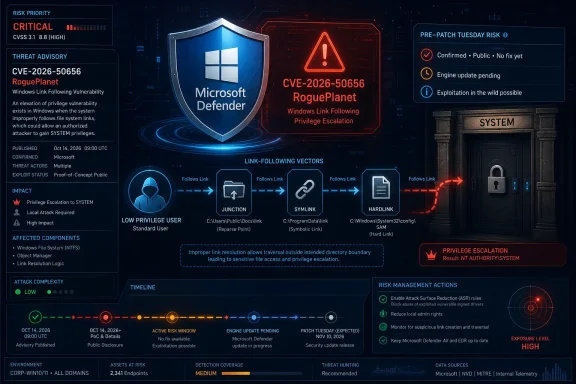 Microsoft Has Confirmed the Bug Before It Has Closed the Door
The most important word in Microsoft’s advisory is not “Important,” “local,” or even “Defender.” It is “confirmed.” In CVSS terms, Microsoft rates the report confidence for CVE-2026-50656 as confirmed, meaning the vendor accepts that the vulnerability exists and that the technical basis is credible enough to publish.That matters because many CVEs begin life as thin public records: a product name, an impact category, perhaps a score, and not much else. This one is different. Microsoft says the issue is an elevation of privilege in the Microsoft Malware Protection Engine, the component at the center of Defender’s scanning and detection stack, and says it is working on a “high quality security update” that will be documented when available.
The absence of a patch is the defining feature of the moment. There is no KB article, no fixed build number, and no download entry listed for the affected product row. The advisory is effectively a public marker: the vulnerability is real, the vendor knows it, attackers may have enough information to work with, and customers are waiting for the engine update that closes the loop.
That is a strange place for Microsoft to be with Defender. The product is both a security control and a sprawling privileged service on hundreds of millions of Windows systems. When the guard dog has a privilege-escalation flaw, the conversation is no longer about whether antivirus software is useful; it is about how much trust the platform places in code that must inspect everything.
“Important” Does Not Mean Comfortable
Microsoft assigns CVE-2026-50656 a maximum severity of Important, with a CVSS 3.1 base score of 7.8 and a temporal score of 7.6. Those numbers put it in familiar Windows local privilege escalation territory: serious, not wormable, and generally dependent on an attacker already having some foothold on the machine.The vector explains the tradeoff. The attack is local, requires low privileges, has low complexity, and needs no user interaction. In plain English, that means an attacker who can already run code as a normal user may be able to push higher without needing the victim to click through a second prompt or open a special file.
That is exactly the kind of vulnerability that enterprise defenders dislike because it completes the second half of an intrusion. Phishing, drive-by malware, stolen credentials, malicious scripts, and abused remote management tools often begin with limited privileges. A reliable elevation-of-privilege bug is what turns that beachhead into a full compromise.
The advisory’s impact ratings are also stark. Microsoft scores confidentiality, integrity, and availability as high. That does not automatically mean every vulnerable machine is one exploit away from total domain compromise, but it does mean the security model being described is not a harmless nuisance. A successful exploit could allow an attacker to cross a privilege boundary in a way that meaningfully undermines the system.
RoguePlanet Lands in a Product That Runs Close to the Kernel of Trust
Defender is not just another Windows app. The Microsoft Malware Protection Engine operates with deep access because it has to inspect files, processes, scripts, archives, memory patterns, and behaviors that ordinary software should not be able to see. That privileged position is why security software is useful, and also why bugs in security software are especially sensitive.CVE-2026-50656 is categorized under CWE-59, improper link resolution before file access, commonly known as link following. This class of bug often involves software trusting a path, shortcut, junction, symbolic link, or other file-system redirection in a way that lets an attacker steer a privileged process toward the wrong target. The broad pattern is old, but it remains dangerous because Windows has a rich file-system namespace and many privileged services perform automated file operations.
For Defender, the risk is conceptually easy to understand even without exploit details. If a privileged scanning or remediation component can be tricked into touching attacker-controlled paths incorrectly, the attacker may be able to convert routine security activity into privilege escalation. That is why local privilege bugs in antimalware engines deserve more attention than their “local” label often suggests.
There is a second irony here. Defender is supposed to reduce the blast radius of untrusted files and suspicious behaviors. A link-following vulnerability turns that relationship inside out: the attacker may be able to make the security product’s own file access become part of the exploit chain. That does not make Defender uniquely bad. It makes Defender a reminder that every powerful security agent is also part of the attack surface.
The Temporal Score Is Doing More Work Than the Severity Label
The advisory says CVE-2026-50656 was publicly disclosed, has not been observed exploited, and is assessed as “Exploitation More Likely.” That combination is the practical heart of the alert. Microsoft is not saying the sky is falling, but it is also not treating RoguePlanet as a theoretical bug that can wait for the next quiet maintenance window.The CVSS temporal metrics sharpen the point. Exploit code maturity is listed as functional. Remediation level is unavailable. Report confidence is confirmed. Those three fields together describe a vulnerability that is known, reproducible enough to be taken seriously, not yet fixed, and more useful to attackers than defenders would prefer.
This is where vulnerability management teams should resist the temptation to sort by severity alone. A 7.8 Important issue with functional exploit code and no fix can outrank a higher-scored issue that is hard to exploit, privately reported, and already patched. The old “Critical first, Important later” queue is too blunt for a world where public exploitability often matters more than the adjective in the vendor bulletin.
Microsoft’s “not exploited” field is useful, but it should not be overread. It means Microsoft was not reporting known in-the-wild exploitation at publication time. It does not mean exploitation is impossible, absent from every environment, or unlikely to be attempted after publication. The public advisory itself changes the attacker calculus.
The Missing Fixed Build Number Is the Operational Problem
Defender is usually one of Microsoft’s easier security products to patch because engine and intelligence updates arrive automatically in standard configurations. Administrators do not usually need to wait for a monthly cumulative update to get Malware Protection Engine fixes. That automatic update channel has saved customers repeatedly, especially when engine-level vulnerabilities could otherwise linger across fleets.But CVE-2026-50656 is not yet in that comfortable phase. Microsoft’s advisory lists the Microsoft Malware Protection Engine as the affected product, but the security update table has no fixed build number. The executive summary says Microsoft is still working on the update.
That means administrators cannot yet verify compliance by checking for a specific fixed engine version. They can check whether Defender updates are flowing, whether devices are cloud-connected where appropriate, whether update channels are not pinned or broken, and whether security tooling can report engine versions. But they cannot mark the vulnerability remediated until Microsoft publishes the version that contains the fix.
This is particularly awkward for regulated environments. Auditors like binary states: vulnerable or patched, compliant or non-compliant. RoguePlanet currently sits in the messier middle, where the correct answer is active monitoring, exposure reduction, and rapid deployment readiness.
Local Privilege Escalation Is the Attack Chain’s Accelerator
A local privilege escalation vulnerability is rarely the opening scene of an incident. It is the second act. The attacker already has code execution somewhere, perhaps through a malicious document, stolen VPN credentials, a compromised developer workstation, an abused help-desk tool, or a browser exploit that landed in a restricted context.That is why defenders sometimes underestimate this class of bug. If the attacker already has a foothold, the thinking goes, the organization has bigger problems. But modern endpoint security is built around the assumption that initial compromise happens and must be contained. Least privilege, application control, EDR telemetry, credential isolation, and tamper protection all exist because the first foothold should not automatically become total control.
A reliable EoP bug attacks that containment layer. It can help malware disable protections, access secrets, tamper with logs, install persistence, dump credentials, or move from a user context into SYSTEM. The difference between “the user ran something bad” and “the machine is owned” is often a local privilege boundary.
RoguePlanet is therefore not just a Defender bug. It is a test of whether organizations have treated Defender as part of a layered defensive system or as a silver bullet. If your endpoint strategy assumes Defender will always be both present and trustworthy under attack, a Defender EoP is a particularly sharp reminder that security controls need their own guardrails.
Public Disclosure Has Shifted the Clock
Microsoft says CVE-2026-50656 is publicly disclosed. That does not automatically mean a polished exploit is circulating in every malware forum, but the CVSS temporal assessment says functional exploit code is available. That is enough to change the urgency for administrators.Public disclosure compresses the time between advisory and adversary testing. Once a flaw has a name, a CVE, a weakness class, an affected component, and an exploitability signal, defenders are not the only people reading. Offensive researchers, ransomware crews, initial-access brokers, and opportunistic script collectors all parse the same advisories.
This does not mean every Windows PC will be targeted tomorrow. Local privilege escalation bugs generally need pairing with another access method, and attackers must still account for version differences, mitigations, endpoint policies, and telemetry. But it does mean that waiting passively for a patch is not enough for high-value systems.
The sensible response is preparation, not panic. Organizations should make sure Defender engine updates are not blocked by proxy rules, disconnected WSUS assumptions, stale gold images, or overzealous change-control freezes. When Microsoft publishes the fixed build, the update path should already be clear.
Where Home Users and Sysadmins Should Actually Look
For home users, the most important practical step is almost boring: keep Windows Security and Defender updates enabled. Most consumer systems receive Malware Protection Engine updates automatically, and that delivery mechanism will likely be the path that matters once Microsoft ships the fix. Disabling Defender, pausing updates indefinitely, or replacing it with an unsupported security stack is not a clever workaround.For sysadmins, the work is more specific. Inventory matters. If your endpoint management system cannot tell you which Malware Protection Engine versions are deployed, it is already underperforming. A vulnerability like this turns engine version visibility from a nice-to-have into a basic operational requirement.
Disconnected and semi-disconnected environments deserve special scrutiny. Industrial networks, lab systems, classified enclaves, and tightly controlled server fleets often do not update Defender the same way laptops do. Those are exactly the environments where an automatic security engine update may be delayed by design, and where administrators need a plan to ingest the fixed package once it exists.
There is also a policy question. If Defender tamper protection, attack surface reduction rules, controlled folder access, or EDR onboarding have been weakened to satisfy a legacy workflow, RoguePlanet is a prompt to revisit those exceptions. A local privilege escalation flaw is easier to operationalize when the endpoint is already full of carve-outs.
The Vulnerability Also Exposes Microsoft’s Communication Problem
To Microsoft’s credit, publishing an advisory before a fix gives defenders a chance to prepare. It is better to acknowledge a confirmed, publicly disclosed vulnerability than to let customers discover the situation through rumor, exploit chatter, or third-party panic. Transparency is not the problem.The problem is that Microsoft’s Security Update Guide still speaks in a format designed for machines and vulnerability managers more than humans. The most important operational facts are scattered across CVSS fields, executive summary text, exploitability tables, and an empty security update row. Experienced admins can read between the lines. Everyone else sees a familiar Defender CVE page and may not notice that remediation is unavailable.
That gap matters because Microsoft Defender is now part of the default Windows security baseline. It is not an optional enterprise add-on used only by specialists. When a Defender engine vulnerability is confirmed, publicly disclosed, and not yet fixed, the vendor’s communication must make the practical state unmissable.
The phrase “working to provide a high quality security update” is doing diplomatic work here. It signals caution: Microsoft does not want to rush an engine patch that breaks scanning, false-positives half the fleet, or introduces a worse defect. But for customers, the phrase also means exposure remains open until further notice.
RoguePlanet Is a Reminder That Security Agents Need Least Privilege Too
Security products have historically asked for broad trust and received it. They hook, scan, monitor, quarantine, unpack, emulate, and sometimes intercept behaviors that the operating system itself treats as sensitive. That model works only if the security product is engineered with the same suspicion it applies to everything else.The recurring lesson from antimalware vulnerabilities is that inspection is dangerous work. Engines parse hostile input by design. They traverse untrusted directories, unpack archives designed to confuse parsers, chase metadata, inspect scripts, and operate across user-controlled file systems. Every one of those actions must be done as if the attacker is trying to manipulate the inspector.
CWE-59 fits neatly into that story. File paths are not just strings. On Windows, they can represent junctions, symbolic links, reparse points, device paths, hard links, mount points, and redirections that behave differently depending on timing and privilege. A service that assumes “this path still points where I checked a moment ago” may be making an attacker’s favorite mistake.
The industry has spent years telling users not to run as administrator. That remains good advice. But RoguePlanet shows the other side of the bargain: privileged services must not turn low-privilege file-system tricks into high-privilege outcomes.
Patch Readiness Is the Only Sensible Posture
Until Microsoft publishes a fixed Malware Protection Engine build, remediation is necessarily incomplete. That does not make administrators powerless. It does mean the work shifts from installing a patch to shortening the time between patch availability and fleet coverage.The right posture is to assume the fix will arrive through Defender’s normal update channels, then verify that those channels are functioning everywhere. Devices that have not checked in, cannot reach update sources, or have stale engine versions should be treated as operational debt. If they are high-value machines, they deserve priority attention before the fixed build drops.
Security teams should also look for signs that attackers are pairing local privilege escalation attempts with commodity access methods. Suspicious low-privilege process behavior, Defender service tampering, unexpected file-system link activity in sensitive paths, abnormal engine crashes, and sudden changes to security configuration all deserve scrutiny. None of these are proof of RoguePlanet exploitation by themselves, but the advisory changes their investigative context.
For smaller organizations, the guidance is less glamorous but just as important. Do not disable Defender because Defender has a bug. Do not go hunting for unofficial exploit details on production machines. Do not assume a third-party antivirus automatically removes the affected Microsoft component from the system. Verify, update, and keep the platform boring.
The RoguePlanet Checklist Starts Before the Fix Arrives
The useful takeaway from CVE-2026-50656 is not that every Defender deployment is doomed. It is that the remediation clock has started before the patch clock has finished, and administrators should use that gap well.- Microsoft has confirmed CVE-2026-50656 as an Important elevation-of-privilege vulnerability in the Microsoft Malware Protection Engine used by Defender.
- The vulnerability is publicly disclosed, has functional exploit code assessed as available, and is considered more likely to be exploited, although Microsoft has not reported active exploitation.
- No fixed build number or security update was listed at publication, so organizations cannot yet close the issue through normal patch verification.
- The CVSS vector indicates local exploitation with low privileges, low complexity, and no user interaction, making it most relevant as part of a broader attack chain.
- Administrators should verify Defender update health, engine-version visibility, endpoint telemetry, and update paths now so the eventual fix can be deployed quickly.
- Home users should leave Defender and Windows updates enabled rather than attempting unsupported workarounds or disabling built-in protection.
References
- Primary source: MSRC
Published: 2026-06-16T07:00:00-07:00

Security Update Guide - Microsoft Security Response Center
 msrc.microsoft.com
