

AMD and Principled Technologies said on June 16, 2026, that a Windows Server 2025 database server using an AMD EPYC 4545P processor delivered up to three times the OLTP throughput of an older Intel Xeon E-2400 system and outperformed a newer Xeon 6300-class comparison system. The headline number is easy to market, but the more interesting story is what AMD is really selling: a small-business server refresh argument wrapped around Windows Server licensing, database latency, and the awkward economics of entry-level Xeon. For Windows shops that still treat the back-office database box as furniture, this is a reminder that the “boring” server can become the bottleneck long before anyone budgets for a formal modernization project.
The EPYC brand usually evokes dense racks, cloud instances, virtualization farms, and the kind of procurement language that makes sense only after the third spreadsheet tab. The EPYC 4005 series is different. It is aimed at the small server that runs a retailer’s point-of-sale database, a clinic’s scheduling system, or the inventory application that everyone complains about but nobody owns.
That positioning matters because small-business infrastructure is often upgraded only when it becomes visibly painful. The server does not need to fail outright to become expensive. It only needs to make employees wait, reports crawl, backups collide with business hours, or customer-facing systems stutter during peak traffic.
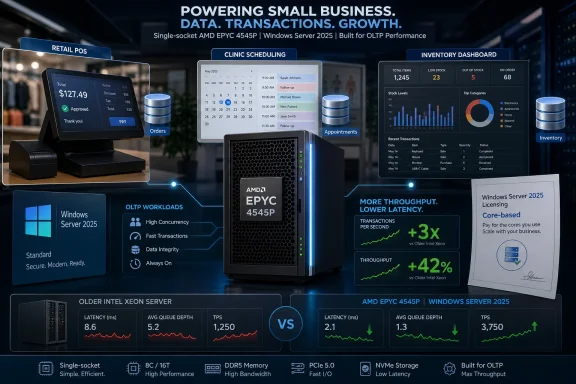
The Principled Technologies test gives AMD a clean story to tell: one single-socket EPYC 4545P system, running a Windows Server 2025 database workload, beat both an older Intel Xeon E-2400-based system and a newer Xeon 6300-series-based comparison platform. In the legacy comparison, AMD says the EPYC system approached three times the transactions and new orders per minute. Against the newer Intel platform, the claimed advantage was smaller but still material, at roughly 42 percent more transactions per minute and 41 percent more new orders per minute.
Those numbers should not be treated as universal truth for every SQL workload, every storage layout, or every application stack. Benchmarks are structured arguments, not neutral weather reports. But they are useful when they expose a product strategy, and this one does: AMD wants small businesses and their IT providers to stop buying entry-level servers as if eight cores are the natural ceiling.
That is why transactions per minute and new orders per minute are persuasive metrics for this class of test. They are not perfect proxies for user experience, but they map more closely to daily pain than a synthetic CPU score. A database server that clears more work in the same interval gives applications more headroom before queues form and delays become visible.
The small-business angle is also important because these environments frequently combine underpowered hardware with overextended software. The database server may also host line-of-business applications, file shares, management agents, backup software, endpoint tooling, and monitoring services. Even if the database workload is nominally modest, the server can become resource-constrained because reality does not respect neat architecture diagrams.
In that context, AMD’s pitch is not merely “our chip is faster.” It is “your existing server may be hiding a productivity tax.” That is a sharper argument because it reframes performance as operational friction rather than enthusiast bragging rights.
This does not mean every small business should buy the highest-core processor that fits the socket. SQL Server licensing, application licensing, virtualization rights, CALs, support contracts, and OEM bundles can all change the math. But AMD is exploiting a real discomfort in the market: many entry servers are sold into a software ecosystem where the minimum license unit is larger than the processor’s useful compute footprint.
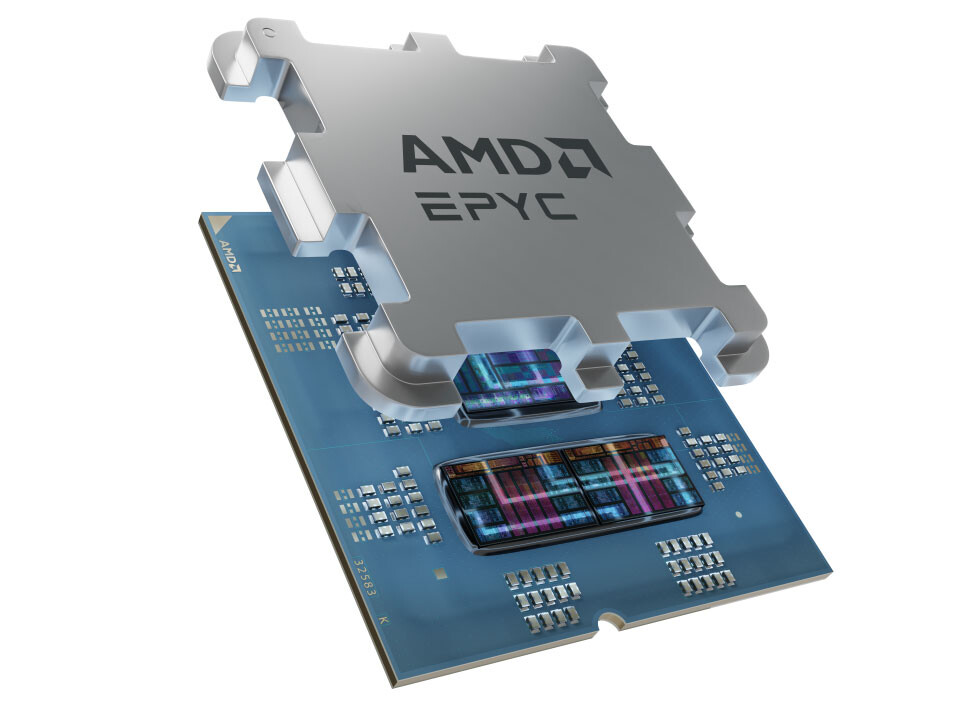
That is why the EPYC 4545P is an interesting part for this comparison. It is a 16-core, 32-thread processor with a 65-watt TDP and boost clocks listed up to 5.4GHz. It is not the biggest EPYC 4005 part, but it represents the exact middle ground AMD wants to defend: enough cores to make Windows Server licensing feel less wasteful, enough frequency to help transactional workloads, and a power envelope that does not scream datacenter overkill.
Intel’s Xeon E and Xeon 6300P-class parts remain familiar territory for SMB servers, and familiarity counts for a lot in the channel. But AMD is trying to make that familiarity look like inertia. If a small business is paying for a 16-core Windows Server base anyway, AMD wants the reseller conversation to start with a pointed question: why deploy an eight-core CPU into that licensing envelope?
That does not make the result meaningless. It makes it a refresh story. If a company is still running a database on older entry-server hardware, the practical question is not whether AMD’s benchmark maps one-to-one to its production environment. The practical question is whether the current server is already constraining workflows and whether a modern replacement would remove enough friction to justify the spend.
The more revealing comparison may be the smaller one: the EPYC system’s claimed 42 percent advantage over a current Intel Xeon 6300-series system. A 40-plus percent edge in OLTP throughput is not a rounding error, especially for a workload that can become customer-visible. But it is also a benchmark result under controlled conditions, not a blanket guarantee that every Windows Server database will see the same improvement.
For IT pros, the right reading is cautious but not dismissive. A vendor-sponsored performance study should not be the only basis for procurement. It should be a prompt to test a representative workload, demand full configuration details, and ask whether the proposed server is sized for the next five years rather than the last five.
That leaves a large gray zone. The server is no longer glamorous, but it is still critical. It may not host Exchange anymore, but it may still decide whether the front desk can check in patients, whether the warehouse can see inventory, or whether the restaurant can reconcile sales before closing.
AMD’s EPYC 4005 push recognizes that this gray zone is not going away overnight. Instead of chasing only hyperscale narratives, AMD is treating the single-socket SMB server as a place where modern cores, memory bandwidth, and platform economics can still matter. That is a practical move, because smaller organizations often modernize infrastructure through hardware refreshes rather than architectural redesigns.
Windows Server 2025 gives that refresh cycle a sharper edge. If an organization is already planning an OS upgrade, a support lifecycle review, or a security baseline update, the hardware discussion becomes harder to postpone. A server that looked “good enough” under an older OS may look less defensible when the business is already touching the platform.
The more subtle issue is that Intel’s entry server stack has become vulnerable to a value argument. If the competing part has fewer cores in a licensing environment that already assumes a 16-core floor, AMD can turn processor selection into a procurement efficiency story. That is more dangerous than a benchmark chart because it gives resellers and customers a simple way to discuss total value without becoming CPU architects.
Intel can counter with platform stability, power behavior, OEM availability, remote management, memory support details, and workload-specific performance. Those things matter. A small business server is bought as a system, not as a bare processor, and the surrounding platform can decide whether the box is easy to deploy and support.
But AMD does not need to win every argument. It needs to make the default Intel quote look less automatic. If EPYC 4005 systems become readily available from trusted vendors at competitive prices, the SMB server conversation becomes a choice again rather than a reflex.
That matters because small environments often lack the clean separation found in larger shops. The reporting workload that should run on a replica hits production. The backup job starts before the day is truly over. The vendor’s application update adds a new service. The endpoint agent gets heavier. Over time, the server becomes the place where every “small” additional burden accumulates.
A modern 16-core processor does not fix bad schema design, insufficient memory, slow storage, or an application that serializes work unnecessarily. It will not turn a neglected database into a well-governed platform. But it can reduce the amount of time users spend trapped behind hardware limits, especially when the current server was sized for a business that no longer exists.
The best administrators will treat this kind of benchmark as a diagnostic invitation. If the current database server is slow, measure where the waits occur. If CPU is routinely saturated, the AMD result becomes more relevant. If storage latency, locking, memory pressure, or application design is the real culprit, a processor swap may produce a smaller improvement than the marketing suggests.
That means AMD has to win at the proposal level. A benchmark gives partners a short, concrete proof point: this EPYC-based configuration handled more OLTP work than these Intel-based alternatives in a third-party test. For a reseller, that can be the difference between recommending what is familiar and recommending what appears more efficient.
The Windows Server licensing angle also gives the channel a clean story to tell without requiring a deep dive into microarchitecture. If the customer is paying around a 16-core server baseline, a 16-core CPU looks rational. If the same customer buys an eight-core platform, the conversation shifts to why half the potential compute envelope is absent.
But the channel will also be where the claim is tested. Availability, warranty terms, BIOS maturity, remote management features, storage options, memory validation, and vendor support can outweigh CPU benchmark wins. AMD’s best-case argument depends on EPYC 4005 systems being easy to buy, easy to service, and boring in production.
That does not mean readers should discard it. Vendor-sponsored benchmarks often surface useful configuration details and competitive pressure that independent reviews may not cover, especially in less glamorous market segments. The right response is to separate the measured result from the implied universal conclusion.
In this case, the measured result is that a specific AMD EPYC 4545P Windows Server 2025 database system outperformed two specified Intel-based systems in an OLTP test. The implied conclusion is broader: many small businesses would benefit from refreshing aging database servers with current-generation EPYC hardware. The first claim is testable inside the report’s boundaries. The second depends on workload, budget, support model, licensing, and the actual cause of slowness.
That distinction is where good IT buying decisions live. A benchmark can justify a pilot. It should not replace one.
Those increments are easy to ignore because they are distributed. A cashier waits two extra seconds. A nurse refreshes a schedule. A warehouse employee checks stock manually because the system lags. A manager runs a report after hours because it slows the application during the day.
A faster database server cannot redesign business processes, but it can remove a layer of resistance from them. That is why the strongest version of AMD’s argument is operational rather than theatrical. The promise is not that EPYC 4005 will transform a small business. The promise is that it may stop the database server from being the silent reason ordinary tasks feel harder than they should.
For WindowsForum readers, this is also a reminder to look beyond the desktop when diagnosing user complaints. The “slow PC” ticket is often a slow application ticket. The slow application is often waiting on a database. The database is often waiting on a server nobody has benchmarked since installation day.
That is a sensible strategy because SMBs often buy servers at transition points. They do not refresh because a processor generation exists. They refresh because support is ending, a vendor raises requirements, cyber insurance asks harder questions, or a business application upgrade refuses to run well on the old box.
In that sense, the EPYC 4545P benchmark is ammunition for a broader modernization case. It gives IT staff and MSPs a way to argue that a Windows Server 2025 move should not simply recreate the old environment on the cheapest familiar hardware. If the server is going to be touched anyway, performance headroom should be part of the design.
The risk is that “up to 3x” becomes a slogan detached from sizing work. Small businesses do not need benchmark worship. They need appropriately configured systems, tested backups, documented recovery paths, patched firmware, monitored storage health, and a database maintenance plan that does not depend on luck.
 AMD Aims EPYC at the Server Under the Counter
The EPYC brand usually evokes dense racks, cloud instances, virtualization farms, and the kind of procurement language that makes sense only after the third spreadsheet tab. The EPYC 4005 series is different. It is aimed at the small server that runs a retailer’s point-of-sale database, a clinic’s scheduling system, or the inventory application that everyone complains about but nobody owns.That positioning matters because small-business infrastructure is often upgraded only when it becomes visibly painful. The server does not need to fail outright to become expensive. It only needs to make employees wait, reports crawl, backups collide with business hours, or customer-facing systems stutter during peak traffic.
The Principled Technologies test gives AMD a clean story to tell: one single-socket EPYC 4545P system, running a Windows Server 2025 database workload, beat both an older Intel Xeon E-2400-based system and a newer Xeon 6300-series-based comparison platform. In the legacy comparison, AMD says the EPYC system approached three times the transactions and new orders per minute. Against the newer Intel platform, the claimed advantage was smaller but still material, at roughly 42 percent more transactions per minute and 41 percent more new orders per minute.
Those numbers should not be treated as universal truth for every SQL workload, every storage layout, or every application stack. Benchmarks are structured arguments, not neutral weather reports. But they are useful when they expose a product strategy, and this one does: AMD wants small businesses and their IT providers to stop buying entry-level servers as if eight cores are the natural ceiling.
The Benchmark Is Less About Databases Than Waiting
Online transaction processing, or OLTP, is one of those phrases that sounds abstract until it shows up as a line at a cash register. A transaction can be a price lookup, a stock decrement, a schedule change, an order write, or a record update. Multiply those little events across employees, customers, and business hours, and the database becomes the nervous system of the company.That is why transactions per minute and new orders per minute are persuasive metrics for this class of test. They are not perfect proxies for user experience, but they map more closely to daily pain than a synthetic CPU score. A database server that clears more work in the same interval gives applications more headroom before queues form and delays become visible.
The small-business angle is also important because these environments frequently combine underpowered hardware with overextended software. The database server may also host line-of-business applications, file shares, management agents, backup software, endpoint tooling, and monitoring services. Even if the database workload is nominally modest, the server can become resource-constrained because reality does not respect neat architecture diagrams.
In that context, AMD’s pitch is not merely “our chip is faster.” It is “your existing server may be hiding a productivity tax.” That is a sharper argument because it reframes performance as operational friction rather than enthusiast bragging rights.
Windows Server 2025 Makes Core Counts a Business Argument
The Windows Server angle is where AMD’s EPYC 4005 positioning becomes more than a silicon comparison. Windows Server Standard and Datacenter licensing still revolve around physical cores, with minimums that make the low-end server market unusually sensitive to processor configuration. A 16-core single-socket system can align neatly with the baseline licensing floor, while an eight-core system can leave performance on the table without necessarily delivering a proportional software-cost advantage.This does not mean every small business should buy the highest-core processor that fits the socket. SQL Server licensing, application licensing, virtualization rights, CALs, support contracts, and OEM bundles can all change the math. But AMD is exploiting a real discomfort in the market: many entry servers are sold into a software ecosystem where the minimum license unit is larger than the processor’s useful compute footprint.
That is why the EPYC 4545P is an interesting part for this comparison. It is a 16-core, 32-thread processor with a 65-watt TDP and boost clocks listed up to 5.4GHz. It is not the biggest EPYC 4005 part, but it represents the exact middle ground AMD wants to defend: enough cores to make Windows Server licensing feel less wasteful, enough frequency to help transactional workloads, and a power envelope that does not scream datacenter overkill.
Intel’s Xeon E and Xeon 6300P-class parts remain familiar territory for SMB servers, and familiarity counts for a lot in the channel. But AMD is trying to make that familiarity look like inertia. If a small business is paying for a 16-core Windows Server base anyway, AMD wants the reseller conversation to start with a pointed question: why deploy an eight-core CPU into that licensing envelope?
The 3x Claim Is a Refresh Argument, Not a Miracle
The “up to 3x” figure is the number that will travel furthest, and it is also the one that needs the most context. AMD and Principled Technologies are comparing the EPYC 4545P system to a legacy Intel Xeon E-2400-series-based server for that larger result. Legacy comparisons often produce dramatic deltas because they capture more than one generation of improvement at once: core count, memory speed, platform behavior, firmware maturity, storage configuration, and database tuning can all contribute.That does not make the result meaningless. It makes it a refresh story. If a company is still running a database on older entry-server hardware, the practical question is not whether AMD’s benchmark maps one-to-one to its production environment. The practical question is whether the current server is already constraining workflows and whether a modern replacement would remove enough friction to justify the spend.
The more revealing comparison may be the smaller one: the EPYC system’s claimed 42 percent advantage over a current Intel Xeon 6300-series system. A 40-plus percent edge in OLTP throughput is not a rounding error, especially for a workload that can become customer-visible. But it is also a benchmark result under controlled conditions, not a blanket guarantee that every Windows Server database will see the same improvement.
For IT pros, the right reading is cautious but not dismissive. A vendor-sponsored performance study should not be the only basis for procurement. It should be a prompt to test a representative workload, demand full configuration details, and ask whether the proposed server is sized for the next five years rather than the last five.
The Small-Business Server Is Becoming a Platform Decision Again
For much of the cloud era, the local SMB server was treated as a shrinking category. Email moved to Microsoft 365, file collaboration moved to cloud storage, backup became hybrid, and many line-of-business apps became SaaS subscriptions. Yet plenty of businesses still depend on local databases because of latency, customization, peripheral integration, compliance preference, unreliable connectivity, or plain old sunk cost.That leaves a large gray zone. The server is no longer glamorous, but it is still critical. It may not host Exchange anymore, but it may still decide whether the front desk can check in patients, whether the warehouse can see inventory, or whether the restaurant can reconcile sales before closing.
AMD’s EPYC 4005 push recognizes that this gray zone is not going away overnight. Instead of chasing only hyperscale narratives, AMD is treating the single-socket SMB server as a place where modern cores, memory bandwidth, and platform economics can still matter. That is a practical move, because smaller organizations often modernize infrastructure through hardware refreshes rather than architectural redesigns.
Windows Server 2025 gives that refresh cycle a sharper edge. If an organization is already planning an OS upgrade, a support lifecycle review, or a security baseline update, the hardware discussion becomes harder to postpone. A server that looked “good enough” under an older OS may look less defensible when the business is already touching the platform.
Intel’s Problem Is Not That Xeon Is Slow
It would be too simple to frame this as AMD fast, Intel slow. Intel still has a huge installed base, deep OEM relationships, mature manageability ecosystems, and broad validation across SMB server platforms. Many businesses will continue buying Xeon-based systems because their reseller recommends them, their application vendor certifies them, or their standard images and support processes already assume them.The more subtle issue is that Intel’s entry server stack has become vulnerable to a value argument. If the competing part has fewer cores in a licensing environment that already assumes a 16-core floor, AMD can turn processor selection into a procurement efficiency story. That is more dangerous than a benchmark chart because it gives resellers and customers a simple way to discuss total value without becoming CPU architects.
Intel can counter with platform stability, power behavior, OEM availability, remote management, memory support details, and workload-specific performance. Those things matter. A small business server is bought as a system, not as a bare processor, and the surrounding platform can decide whether the box is easy to deploy and support.
But AMD does not need to win every argument. It needs to make the default Intel quote look less automatic. If EPYC 4005 systems become readily available from trusted vendors at competitive prices, the SMB server conversation becomes a choice again rather than a reflex.
Windows Admins Should Care About the Boring Metrics
The performance claims in this report are framed around transactions and new orders per minute, but administrators should immediately translate them into queue depth, response time, maintenance windows, and growth margin. A faster OLTP server is not just about peak throughput. It can also give a business more room to run reports, handle batch jobs, absorb seasonal spikes, and keep users productive while background tasks run.That matters because small environments often lack the clean separation found in larger shops. The reporting workload that should run on a replica hits production. The backup job starts before the day is truly over. The vendor’s application update adds a new service. The endpoint agent gets heavier. Over time, the server becomes the place where every “small” additional burden accumulates.
A modern 16-core processor does not fix bad schema design, insufficient memory, slow storage, or an application that serializes work unnecessarily. It will not turn a neglected database into a well-governed platform. But it can reduce the amount of time users spend trapped behind hardware limits, especially when the current server was sized for a business that no longer exists.
The best administrators will treat this kind of benchmark as a diagnostic invitation. If the current database server is slow, measure where the waits occur. If CPU is routinely saturated, the AMD result becomes more relevant. If storage latency, locking, memory pressure, or application design is the real culprit, a processor swap may produce a smaller improvement than the marketing suggests.
The Channel Is the Real Battlefield
AMD’s press release is aimed at end users, but the real audience is the channel: VARs, MSPs, regional integrators, and OEM partners that turn a business complaint into a quote. Small businesses rarely shop processors in isolation. They ask for a new server, a faster POS system, a Windows Server 2025 upgrade, or relief from an application that “gets slow in the afternoon.”That means AMD has to win at the proposal level. A benchmark gives partners a short, concrete proof point: this EPYC-based configuration handled more OLTP work than these Intel-based alternatives in a third-party test. For a reseller, that can be the difference between recommending what is familiar and recommending what appears more efficient.
The Windows Server licensing angle also gives the channel a clean story to tell without requiring a deep dive into microarchitecture. If the customer is paying around a 16-core server baseline, a 16-core CPU looks rational. If the same customer buys an eight-core platform, the conversation shifts to why half the potential compute envelope is absent.
But the channel will also be where the claim is tested. Availability, warranty terms, BIOS maturity, remote management features, storage options, memory validation, and vendor support can outweigh CPU benchmark wins. AMD’s best-case argument depends on EPYC 4005 systems being easy to buy, easy to service, and boring in production.
Vendor Benchmarks Need Skepticism, Not Cynicism
Principled Technologies is a familiar name in vendor-commissioned testing, and that genre deserves a specific kind of skepticism. The configurations, workload parameters, tuning choices, and selected comparisons define the outcome space. Even when the testing is hands-on and accurately reported, it is still built to answer the sponsor’s question.That does not mean readers should discard it. Vendor-sponsored benchmarks often surface useful configuration details and competitive pressure that independent reviews may not cover, especially in less glamorous market segments. The right response is to separate the measured result from the implied universal conclusion.
In this case, the measured result is that a specific AMD EPYC 4545P Windows Server 2025 database system outperformed two specified Intel-based systems in an OLTP test. The implied conclusion is broader: many small businesses would benefit from refreshing aging database servers with current-generation EPYC hardware. The first claim is testable inside the report’s boundaries. The second depends on workload, budget, support model, licensing, and the actual cause of slowness.
That distinction is where good IT buying decisions live. A benchmark can justify a pilot. It should not replace one.
The Practical Win Is Fewer Excuses for Aging Hardware
The most useful part of AMD’s message is not the competitive jab at Intel. It is the reminder that many small-business databases are running on hardware that has quietly fallen behind the business. The application may still launch, the server may still boot, and the nightly backup may still complete, but the organization pays for delay in tiny increments every day.Those increments are easy to ignore because they are distributed. A cashier waits two extra seconds. A nurse refreshes a schedule. A warehouse employee checks stock manually because the system lags. A manager runs a report after hours because it slows the application during the day.
A faster database server cannot redesign business processes, but it can remove a layer of resistance from them. That is why the strongest version of AMD’s argument is operational rather than theatrical. The promise is not that EPYC 4005 will transform a small business. The promise is that it may stop the database server from being the silent reason ordinary tasks feel harder than they should.
For WindowsForum readers, this is also a reminder to look beyond the desktop when diagnosing user complaints. The “slow PC” ticket is often a slow application ticket. The slow application is often waiting on a database. The database is often waiting on a server nobody has benchmarked since installation day.
The EPYC 4005 Pitch Lands Where Windows Server Budgets Are Already Moving
The timing is not accidental. Windows Server 2025 is now part of real planning cycles, and refresh discussions tend to bundle operating system support, security posture, hardware warranties, and application compatibility into one uncomfortable meeting. AMD wants EPYC 4005 in that meeting before the default Intel quote arrives.That is a sensible strategy because SMBs often buy servers at transition points. They do not refresh because a processor generation exists. They refresh because support is ending, a vendor raises requirements, cyber insurance asks harder questions, or a business application upgrade refuses to run well on the old box.
In that sense, the EPYC 4545P benchmark is ammunition for a broader modernization case. It gives IT staff and MSPs a way to argue that a Windows Server 2025 move should not simply recreate the old environment on the cheapest familiar hardware. If the server is going to be touched anyway, performance headroom should be part of the design.
The risk is that “up to 3x” becomes a slogan detached from sizing work. Small businesses do not need benchmark worship. They need appropriately configured systems, tested backups, documented recovery paths, patched firmware, monitored storage health, and a database maintenance plan that does not depend on luck.
The Numbers That Should Survive the Sales Deck
The useful lesson from this release is not that every shop should rush to replace Xeon with EPYC. It is that the old assumptions around entry-level Windows database servers deserve another look. The claimed performance gap is large enough to justify evaluation, and the licensing context makes core count harder to dismiss as an enthusiast metric.- The EPYC 4545P system in Principled Technologies’ testing delivered nearly three times the OLTP throughput of the older Intel Xeon E-2400-based comparison system.
- The same AMD-based system reportedly delivered about 42 percent more transactions per minute than a newer Intel Xeon 6300-series-based comparison system.
- The EPYC 4545P’s 16-core, 32-thread configuration fits neatly into the Windows Server 2025 licensing conversation because Standard and Datacenter licensing use core-based minimums.
- Small-business database workloads are often more visible to users than administrators realize, because POS, scheduling, inventory, and reporting systems all turn database latency into employee waiting time.
- The benchmark should be treated as a reason to test representative workloads, not as a guarantee that every database application will see the same uplift.
- The strongest procurement case is not raw speed alone, but the combination of performance headroom, licensing fit, platform availability, and supportability.
References
- Primary source: The National Law Review
Published: 2026-06-16T20:01:07.902354
- Related coverage: amd.com

AMD EPYC™ 4545P
AMD EPYC 4005 processors power affordable, turn-key, easy-to-use, and manageable server solutions, propelling business growth and success in the AI era.www.amd.com - Related coverage: ir.amd.com

AMD Unveils EPYC 4005 Series Processors, Delivering Workload-Optimized Solutions for Entry-Level Enterprise :: Advanced Micro Devices, Inc. (AMD)
— AMD EPYC 4005 Processors provide a compelling balance of performance, dependability and efficiency in an affordable, easy-to-deploy platform…...ir.amd.com - Related coverage: tomshardware.com

Zen 5 comes to small businesses: AMD unveils EPYC 4005-series processors | Tom's Hardware
Zen 5 family expands to new markets.www.tomshardware.com - Related coverage: supermicro.com
CPU Information: AMD EPYC™ 4005 Series Processors | Supermicro
www.supermicro.com
- Related coverage: techpowerup.com
AMD Announces EPYC 4005 "Grado" Zen 5 Server Processors for Socket AM5 | TechPowerUp
AMD today announced the EPYC 4005 series server processors in the Socket AM5 package, codenamed "Grado." These chips come with core-counts of up to 16-core/32-thread, letting enterprise users optimally utilize their Windows Server 2005 Datacenter Edition 16-core license in dedicated server...www.techpowerup.com
- Related coverage: crn.com

AMD: ‘Big’ Channel Push For New EPYC 4005 CPUs Includes Windows Server Blitz Against Intel
AMD said it plans to make a “big push” in the channel to win SMB deals with its new EPYC 4005 CPUs, particularly when it comes to customers using Windows Server, where the company said it can offer better utilization, performance and pricing.www.crn.com - Official source: learn.microsoft.com

Clarification Needed: Core-Based Licensing Requirements for a 48-Core Server - Microsoft Q&A
Hello, I would like confirmation and clarification regarding core-based licensing requirements for Windows Server Standard (2025) on my server, which has: 2 × Intel Xeon Gold processors = 48 physical cores According to Microsoft's core licensing…learn.microsoft.com - Official source: microsoft.com
