

iWebFusion has refreshed its dedicated server clearance program in June 2026 with a wider catalog of bare-metal configurations spanning low-cost Xeon E3 machines, dual-socket Intel platforms, newer Gold and Platinum Xeon systems, Ryzen 9 servers, and high-core-count AMD EPYC options across multiple United States data center locations. The announcement is not just another hosting price sheet; it is a small but telling example of how the infrastructure market is sorting itself after a decade of cloud-first orthodoxy. For businesses that know their workloads, dedicated servers are being pitched again as predictable, controllable, and economically legible. That pitch lands because cloud abstraction solved many problems while quietly creating a new one: too many teams no longer know what their compute actually costs.
The dedicated server never disappeared, but it did spend years being treated as the unfashionable cousin of cloud infrastructure. Public cloud won the imagination of startups, procurement teams, and enterprise architects because it turned hardware into an API and capacity into an operating expense. That model remains powerful, especially for elastic workloads and organizations that need global services more than they need fixed machines.
But there has always been a counterargument, and iWebFusion’s refreshed clearance lineup leans squarely into it. If a workload is steady, geographically bounded, and resource-hungry, renting whole machines can be simpler than renting slices of an enormous cloud platform. A physical server with known CPU, memory, storage, bandwidth, and IP allocation can be dull in exactly the way production infrastructure is supposed to be dull.
That is the heart of this announcement. iWebFusion is not trying to out-hyperscale the hyperscalers. It is selling fixed infrastructure to customers who have already discovered that predictable workloads do not always benefit from infinitely variable billing.
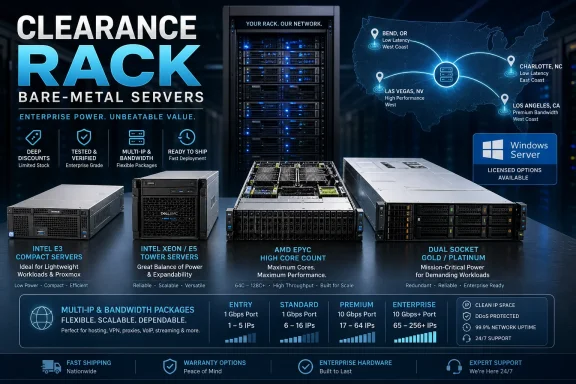
The company’s refreshed program includes traditional entry machines built around Intel E3-1230-class processors, mid-range Xeon E5 and Core i7 configurations, larger dual Gold and dual Platinum Xeon servers, and AMD Ryzen 9 and EPYC systems reaching up to 128 cores. The spread matters because “dedicated server” has become a very broad category. It can mean a bargain web-hosting box with 16GB of RAM, or it can mean a private cloud node with hundreds of gigabytes of memory and NVMe storage intended to host virtual machines, databases, or application clusters.
That distinction is important. A dual Xeon E5 platform is not the right answer for every modern workload, especially where power efficiency, single-threaded performance, or current-generation platform features matter. But it can be a very rational answer for file services, legacy applications, backup targets, development environments, low-margin hosting, lab clusters, or workloads where the bottleneck is not the newest instruction set.
iWebFusion’s updated list appears designed to make that inventory legible rather than mysterious. The company is publishing CPU class, core count, RAM, storage, RAID style, traffic allocation, IP bundle, and upgrade paths. That transparency is the entire value proposition for buyers who are tired of calculator-driven infrastructure planning.
The interesting part is not simply that a low-end server starts in the budget range. It is that the catalog stretches from small boxes with 10TB of monthly traffic to larger machines with 30TB or 50TB packages and options for 10GE uplinks, SAN storage, control panels, operating system licenses, and managed services. That mix signals a provider trying to capture both hobbyist-adjacent workloads and serious business deployments without pretending they are the same customer.
That geography is more than a map graphic. For hosting operators, game communities, regional SaaS providers, media sites, and small businesses, latency is often local before it is global. A server in Los Angeles may be a better fit for West Coast users and Pacific routes; Charlotte may serve East Coast or Southeast audiences more comfortably; an Iowa deployment may appeal to customers looking for central US placement.
This is where dedicated hosting can still feel refreshingly concrete. Instead of choosing from an abstract region name and hoping the network path behaves, customers can test specific locations and buy a specific machine in a specific facility. That does not make the provider automatically better than a cloud region, but it changes the kind of decision being made.
For WindowsForum’s audience, this is especially relevant. Sysadmins do not evaluate infrastructure only by brand prestige. They care about routes, remote hands, ticket response, IP reputation, restore procedures, control panel compatibility, and what happens at 2 a.m. when a disk starts failing.
For those customers, a dedicated server can be less about raw performance and more about administrative control. A Windows Server instance on physical hardware gives teams a familiar patching model, predictable resource access, and fewer surprises around noisy neighbors. It can also be a useful stepping stone for organizations modernizing in place rather than leaping directly to a platform-as-a-service model.
The availability of Windows Server 2019, 2022, and 2025 licensing options also highlights a reality that infrastructure marketing often avoids. Many organizations run mixed estates. They may deploy Linux for web services, Windows for application compatibility, Proxmox or VMware for virtualization, and CloudLinux or control panels for managed hosting.
iWebFusion’s menu reflects that messiness. The company is not selling a pristine ideology of infrastructure. It is selling the parts bin that real sysadmins recognize: operating system choices, RAID options, IP addresses, control panels, uplink upgrades, private cloud setup, and management add-ons.
There are legitimate reasons to need multiple IPv4 addresses. Hosting providers need them for customer separation, SSL edge cases, mail infrastructure, DNS services, virtualization platforms, and application isolation. Some legacy software still assumes distinct addresses where modern architectures would use name-based routing or containers.
At the same time, IPv4 is scarce, expensive, and frequently abused. Large IP allocations can attract customers whose use cases involve spam, reputation games, or brittle SEO folklore. Any provider that advertises generous IPv4 options has to manage not only routing and allocation but also abuse handling and reputation protection.
The better reading of iWebFusion’s refreshed program is that IP flexibility is part of its appeal to hosting operators and infrastructure resellers. But buyers should treat IP volume as one input, not the headline. Network quality, abuse policy, rDNS handling, support responsiveness, and long-term allocation stability matter more than the raw number of addresses in an order form.
For customers building private clouds, CI runners, virtualization nodes, database servers, or container hosts, EPYC configurations are qualitatively different from older E3 or E5 boxes. A 24-core server is not just a bigger web-hosting machine. A 64-core or 128-core platform can become a consolidation target, replacing a rack of older systems or absorbing workloads that would be expensive to run as many individual cloud instances.
That is why the upper end of iWebFusion’s lineup matters. A provider with only bargain hardware is competing on price alone. A provider with both budget machines and high-core-count EPYC nodes can make a more coherent pitch: start small, scale within the same vendor relationship, and choose hardware based on workload rather than platform fashion.
There is still a caveat. Not all EPYC systems are equal. Generation, memory speed, storage layout, PCIe version, NUMA behavior, and network uplink all affect real-world performance. Customers buying serious EPYC capacity should ask for exact CPU models, disk details, and network constraints before assuming that core count alone tells the story.
Dedicated servers invert that model. The machine is the bill. Bandwidth is usually stated up front. IPs, uplinks, storage, control panels, and management add-ons are visible before deployment. That makes dedicated infrastructure attractive to businesses whose margins do not allow surprise.
iWebFusion’s quarterly, semi-annual, and annual billing discounts fit that broader argument. A customer willing to commit for longer can trade optionality for cost certainty. That is not exciting in the venture-capital sense, but it is exactly how many small hosting businesses, content sites, and internal IT teams operate.
The risk, of course, is that fixed infrastructure also fixes responsibility. If you buy too little server, you must migrate. If you buy too much, you waste capacity. If a workload suddenly needs global scaling, a single dedicated box does not magically become a distributed platform. Predictability is powerful, but it is not the same as elasticity.
iWebFusion and H4Y emphasize owned equipment, in-house staff, self-operated infrastructure, and an autonomous network with BGP routing. Those are not decorative claims. In a market crowded with resellers and thin-margin virtual storefronts, ownership can matter because it affects escalation paths. If the provider controls the hardware, network, and staff, there are fewer layers between the customer and the fix.
But customers should not romanticize ownership either. A company can own its gear and still have slow support. A reseller can sometimes deliver excellent service if its upstream relationships are strong. The practical question is not “owned or leased?” but “who can replace the drive, trace the packet loss, null-route the attack, rebuild the OS, explain the maintenance window, and answer the ticket?”
That is why the refreshed clearance program should be evaluated with operational questions, not just shopping-cart enthusiasm. What is the hardware replacement SLA? How are DDoS incidents handled? Are reboots automated or ticket-based? Are backups included, optional, or entirely the customer’s problem? Can customers get remote console access? Those answers determine whether an inexpensive server is a bargain or a liability.
A company might use Microsoft 365, Azure Active Directory, a SaaS CRM, a cloud backup platform, a bare-metal database server, a colocation firewall, and a VPS fleet all at once. The debate is not cloud versus dedicated. The debate is where abstraction helps and where it simply taxes a predictable workload.
Dedicated servers fit workloads with stable demand, high sustained utilization, data transfer sensitivity, licensing quirks, or administrative requirements that do not map cleanly to managed services. Cloud fits workloads with variable demand, global failover requirements, event-driven architectures, managed platform dependencies, or teams that would rather rent operational expertise than own it.
iWebFusion’s refreshed program is best understood as part of that more mature infrastructure conversation. It does not claim that every customer should leave the cloud. It suggests that some customers have been paying cloud premiums for workloads that look suspiciously like servers.
Power efficiency is one of them. A provider absorbs the facility power bill, but platform efficiency still influences pricing, thermal headroom, and long-term availability. Older CPUs may also lack modern security and virtualization features that some workloads increasingly expect. Firmware, RAID controllers, drive age, and replacement part availability can turn into operational concerns over time.
Storage is another place where buyers need precision. A server with “SSD” or “NVMe” in the row may still vary widely in endurance, redundancy, and performance consistency. RAID with a battery backup unit is reassuring where available, but it is not a backup strategy. SAN add-ons can solve some problems while introducing new dependencies.
The smart buyer treats clearance infrastructure as a negotiation between price and specificity. If the application is disposable, test-oriented, or horizontally redundant, a bargain configuration may be perfect. If the server is going to host the accounting system, a revenue-generating database, or customer production workloads, the conversation should move quickly from price to recovery, monitoring, support, and replacement procedures.
The presence of control panel options such as DirectAdmin, cPanel, Plesk, Softaculous, and WHMCS reinforces that audience. These are not accessories for a single internal application server. They are the tools of hosting businesses and managed service providers that package infrastructure for end users.
Virtualization setup options point in the same direction. A customer can use a large dedicated machine as the base for KVM virtualization, Proxmox, VirtFusion, SolusVM, Virtualizor, or other private cloud arrangements. That turns one server purchase into a platform decision.
For Windows-oriented operators, the same logic applies to Remote Desktop farms, Windows-based application hosting, or mixed hypervisor environments. The key is density. Once a server can support multiple paying workloads or departments, the dedicated model becomes a margin exercise rather than a nostalgia play.
The refreshed iWebFusion program includes managed service options, which may be useful for customers without 24/7 operational staff. But managed hosting is not a magic word. Customers should clarify whether management includes OS updates, malware response, firewall rules, control panel support, backup configuration, application troubleshooting, or only basic infrastructure intervention.
Security-minded buyers should also ask about reinstall procedures, remote console access, two-factor authentication in the customer portal, abuse notification handling, DDoS posture, and network segmentation. A dedicated server with excellent specs but weak account security is not an enterprise-grade deployment. It is a large attack surface with a monthly invoice.
The practical advantage of dedicated hosting is that boundaries can be clearer. The customer knows which machine is theirs, which addresses route to it, and which services are exposed. That clarity can support better security practices, but only if the team uses it.
That advantage is especially visible in custom requests. Need a specific storage layout, extra IPv4 addresses, a 10GE uplink, a particular control panel, a private virtualization host, or a server in a specific US city? A smaller provider may be able to quote and deploy that directly. In a hyperscale cloud, the answer may exist, but it often requires stitching together more services and accepting the billing complexity that comes with them.
The disadvantage is platform depth. Hyperscalers offer managed databases, identity integrations, object storage, serverless runtimes, global load balancers, compliance programs, security tooling, and ecosystem gravity that smaller providers cannot replicate. For some organizations, those managed services are worth far more than the raw server cost.
That is why iWebFusion’s best market is not the customer looking for a cloud replacement in the abstract. It is the customer with a concrete workload, a known budget, and enough technical confidence to value control over managed abstraction.
Bandwidth language deserves particular attention. Monthly traffic allocations are useful, but customers should understand port speed, burst behavior, overage policy, inbound versus outbound accounting, and whether 10GE upgrades change the traffic allowance or only the link speed. A fast port with a modest traffic cap can be ideal for bursty workloads and poor for sustained transfer.
RAID language also needs care. Software RAID, BIOS RAID, and hardware RAID with battery backup represent different operational models. None replace off-server backups. A single dedicated server can be robust and still represent a single point of failure if the application has no replication or recovery plan.
For businesses buying annually to capture discounts, this diligence becomes more important. A cheaper long-term commitment is only a discount if the server, support, and network remain suitable for the full term.
The concrete takeaways are straightforward:
 Bare Metal Gets Its Budget Argument Back
The dedicated server never disappeared, but it did spend years being treated as the unfashionable cousin of cloud infrastructure. Public cloud won the imagination of startups, procurement teams, and enterprise architects because it turned hardware into an API and capacity into an operating expense. That model remains powerful, especially for elastic workloads and organizations that need global services more than they need fixed machines.But there has always been a counterargument, and iWebFusion’s refreshed clearance lineup leans squarely into it. If a workload is steady, geographically bounded, and resource-hungry, renting whole machines can be simpler than renting slices of an enormous cloud platform. A physical server with known CPU, memory, storage, bandwidth, and IP allocation can be dull in exactly the way production infrastructure is supposed to be dull.
That is the heart of this announcement. iWebFusion is not trying to out-hyperscale the hyperscalers. It is selling fixed infrastructure to customers who have already discovered that predictable workloads do not always benefit from infinitely variable billing.
The company’s refreshed program includes traditional entry machines built around Intel E3-1230-class processors, mid-range Xeon E5 and Core i7 configurations, larger dual Gold and dual Platinum Xeon servers, and AMD Ryzen 9 and EPYC systems reaching up to 128 cores. The spread matters because “dedicated server” has become a very broad category. It can mean a bargain web-hosting box with 16GB of RAM, or it can mean a private cloud node with hundreds of gigabytes of memory and NVMe storage intended to host virtual machines, databases, or application clusters.
Clearance Pricing Is Also Inventory Strategy
The word clearance carries baggage. In consumer technology, it can imply obsolete gear and “while supplies last” liquidation. In infrastructure, it often means something more nuanced: a provider has usable, depreciated, or bulk-acquired hardware that can still serve real production needs at prices that newer cloud-native platforms do not usually touch.That distinction is important. A dual Xeon E5 platform is not the right answer for every modern workload, especially where power efficiency, single-threaded performance, or current-generation platform features matter. But it can be a very rational answer for file services, legacy applications, backup targets, development environments, low-margin hosting, lab clusters, or workloads where the bottleneck is not the newest instruction set.
iWebFusion’s updated list appears designed to make that inventory legible rather than mysterious. The company is publishing CPU class, core count, RAM, storage, RAID style, traffic allocation, IP bundle, and upgrade paths. That transparency is the entire value proposition for buyers who are tired of calculator-driven infrastructure planning.
The interesting part is not simply that a low-end server starts in the budget range. It is that the catalog stretches from small boxes with 10TB of monthly traffic to larger machines with 30TB or 50TB packages and options for 10GE uplinks, SAN storage, control panels, operating system licenses, and managed services. That mix signals a provider trying to capture both hobbyist-adjacent workloads and serious business deployments without pretending they are the same customer.
Geography Still Matters When Latency Has a Budget
Cloud marketing taught an entire generation of buyers to think in regions and availability zones. Smaller hosting providers speak a different language: city names, carrier hotels, looking glass pages, and network tests. iWebFusion’s program sits firmly in that second tradition, with available deployment locations including Bend, Charlotte, Los Angeles, Monticello, Las Vegas, and multiple Los Angeles facility options.That geography is more than a map graphic. For hosting operators, game communities, regional SaaS providers, media sites, and small businesses, latency is often local before it is global. A server in Los Angeles may be a better fit for West Coast users and Pacific routes; Charlotte may serve East Coast or Southeast audiences more comfortably; an Iowa deployment may appeal to customers looking for central US placement.
This is where dedicated hosting can still feel refreshingly concrete. Instead of choosing from an abstract region name and hoping the network path behaves, customers can test specific locations and buy a specific machine in a specific facility. That does not make the provider automatically better than a cloud region, but it changes the kind of decision being made.
For WindowsForum’s audience, this is especially relevant. Sysadmins do not evaluate infrastructure only by brand prestige. They care about routes, remote hands, ticket response, IP reputation, restore procedures, control panel compatibility, and what happens at 2 a.m. when a disk starts failing.
The Windows Server Angle Is Not a Footnote
The inclusion of licensed Windows Server options is one of the more practical details in the updated offering. Linux dominates much of the hosting world, but Windows Server remains deeply embedded in line-of-business applications, Remote Desktop deployments, SQL Server workloads, Active Directory-adjacent services, and legacy software stacks that businesses are not ready to rewrite.For those customers, a dedicated server can be less about raw performance and more about administrative control. A Windows Server instance on physical hardware gives teams a familiar patching model, predictable resource access, and fewer surprises around noisy neighbors. It can also be a useful stepping stone for organizations modernizing in place rather than leaping directly to a platform-as-a-service model.
The availability of Windows Server 2019, 2022, and 2025 licensing options also highlights a reality that infrastructure marketing often avoids. Many organizations run mixed estates. They may deploy Linux for web services, Windows for application compatibility, Proxmox or VMware for virtualization, and CloudLinux or control panels for managed hosting.
iWebFusion’s menu reflects that messiness. The company is not selling a pristine ideology of infrastructure. It is selling the parts bin that real sysadmins recognize: operating system choices, RAID options, IP addresses, control panels, uplink upgrades, private cloud setup, and management add-ons.
The IP Address Pitch Is Both Useful and Controversial
One of iWebFusion’s established niches is multi-IP hosting, including offerings aimed at customers who need larger IPv4 allocations. The press material emphasizes dedicated IP availability, IPv6 support, and historically even SEO-oriented multi-IP use cases. That is an area where technical utility and industry skepticism coexist.There are legitimate reasons to need multiple IPv4 addresses. Hosting providers need them for customer separation, SSL edge cases, mail infrastructure, DNS services, virtualization platforms, and application isolation. Some legacy software still assumes distinct addresses where modern architectures would use name-based routing or containers.
At the same time, IPv4 is scarce, expensive, and frequently abused. Large IP allocations can attract customers whose use cases involve spam, reputation games, or brittle SEO folklore. Any provider that advertises generous IPv4 options has to manage not only routing and allocation but also abuse handling and reputation protection.
The better reading of iWebFusion’s refreshed program is that IP flexibility is part of its appeal to hosting operators and infrastructure resellers. But buyers should treat IP volume as one input, not the headline. Network quality, abuse policy, rDNS handling, support responsiveness, and long-term allocation stability matter more than the raw number of addresses in an order form.
AMD EPYC Moves the Ceiling for Smaller Providers
The presence of AMD EPYC systems in the refreshed catalog is the clearest sign that “clearance” does not necessarily mean low-end. EPYC changed the economics of dense dedicated hosting by bringing high core counts, large memory capacity, and strong virtualization characteristics into platforms that smaller providers could deploy competitively.For customers building private clouds, CI runners, virtualization nodes, database servers, or container hosts, EPYC configurations are qualitatively different from older E3 or E5 boxes. A 24-core server is not just a bigger web-hosting machine. A 64-core or 128-core platform can become a consolidation target, replacing a rack of older systems or absorbing workloads that would be expensive to run as many individual cloud instances.
That is why the upper end of iWebFusion’s lineup matters. A provider with only bargain hardware is competing on price alone. A provider with both budget machines and high-core-count EPYC nodes can make a more coherent pitch: start small, scale within the same vendor relationship, and choose hardware based on workload rather than platform fashion.
There is still a caveat. Not all EPYC systems are equal. Generation, memory speed, storage layout, PCIe version, NUMA behavior, and network uplink all affect real-world performance. Customers buying serious EPYC capacity should ask for exact CPU models, disk details, and network constraints before assuming that core count alone tells the story.
Predictable Pricing Is the Product
Cloud bills are legible at small scale and notoriously weird at medium scale. Compute, storage, egress, snapshots, managed databases, observability, support tiers, and data transfer can turn a clean architecture diagram into a monthly archaeology project. This is not a failure of cloud so much as a feature of its flexibility: every knob can become a line item.Dedicated servers invert that model. The machine is the bill. Bandwidth is usually stated up front. IPs, uplinks, storage, control panels, and management add-ons are visible before deployment. That makes dedicated infrastructure attractive to businesses whose margins do not allow surprise.
iWebFusion’s quarterly, semi-annual, and annual billing discounts fit that broader argument. A customer willing to commit for longer can trade optionality for cost certainty. That is not exciting in the venture-capital sense, but it is exactly how many small hosting businesses, content sites, and internal IT teams operate.
The risk, of course, is that fixed infrastructure also fixes responsibility. If you buy too little server, you must migrate. If you buy too much, you waste capacity. If a workload suddenly needs global scaling, a single dedicated box does not magically become a distributed platform. Predictability is powerful, but it is not the same as elasticity.
The Support Claim Is Where Providers Win or Lose
Every infrastructure provider promises reliability. Most publish uptime numbers, support availability, or operational language that suggests calm competence. The meaningful difference emerges when something breaks.iWebFusion and H4Y emphasize owned equipment, in-house staff, self-operated infrastructure, and an autonomous network with BGP routing. Those are not decorative claims. In a market crowded with resellers and thin-margin virtual storefronts, ownership can matter because it affects escalation paths. If the provider controls the hardware, network, and staff, there are fewer layers between the customer and the fix.
But customers should not romanticize ownership either. A company can own its gear and still have slow support. A reseller can sometimes deliver excellent service if its upstream relationships are strong. The practical question is not “owned or leased?” but “who can replace the drive, trace the packet loss, null-route the attack, rebuild the OS, explain the maintenance window, and answer the ticket?”
That is why the refreshed clearance program should be evaluated with operational questions, not just shopping-cart enthusiasm. What is the hardware replacement SLA? How are DDoS incidents handled? Are reboots automated or ticket-based? Are backups included, optional, or entirely the customer’s problem? Can customers get remote console access? Those answers determine whether an inexpensive server is a bargain or a liability.
Dedicated Servers Are Not Cloud Rebellion, They Are Cloud Discipline
It is tempting to frame every bare-metal announcement as part of a backlash against the cloud. That makes for tidy headlines, but it overstates the case. Most serious infrastructure strategies are hybrid because most real businesses are hybrid by accident long before they are hybrid by design.A company might use Microsoft 365, Azure Active Directory, a SaaS CRM, a cloud backup platform, a bare-metal database server, a colocation firewall, and a VPS fleet all at once. The debate is not cloud versus dedicated. The debate is where abstraction helps and where it simply taxes a predictable workload.
Dedicated servers fit workloads with stable demand, high sustained utilization, data transfer sensitivity, licensing quirks, or administrative requirements that do not map cleanly to managed services. Cloud fits workloads with variable demand, global failover requirements, event-driven architectures, managed platform dependencies, or teams that would rather rent operational expertise than own it.
iWebFusion’s refreshed program is best understood as part of that more mature infrastructure conversation. It does not claim that every customer should leave the cloud. It suggests that some customers have been paying cloud premiums for workloads that look suspiciously like servers.
The Clearance Rack Has Real Trade-Offs
The strongest version of iWebFusion’s pitch is cost control. The weakest version is the assumption that every discounted server is a production-ready answer. Older platforms can be entirely serviceable, but they have limitations that matter.Power efficiency is one of them. A provider absorbs the facility power bill, but platform efficiency still influences pricing, thermal headroom, and long-term availability. Older CPUs may also lack modern security and virtualization features that some workloads increasingly expect. Firmware, RAID controllers, drive age, and replacement part availability can turn into operational concerns over time.
Storage is another place where buyers need precision. A server with “SSD” or “NVMe” in the row may still vary widely in endurance, redundancy, and performance consistency. RAID with a battery backup unit is reassuring where available, but it is not a backup strategy. SAN add-ons can solve some problems while introducing new dependencies.
The smart buyer treats clearance infrastructure as a negotiation between price and specificity. If the application is disposable, test-oriented, or horizontally redundant, a bargain configuration may be perfect. If the server is going to host the accounting system, a revenue-generating database, or customer production workloads, the conversation should move quickly from price to recovery, monitoring, support, and replacement procedures.
The Reseller and Hosting Operator Use Case Is Obvious
The updated catalog looks particularly relevant for smaller hosting operators. Shared hosting, VPS resale, game servers, niche SaaS platforms, and agency-managed client environments all depend on buying infrastructure below the price at which it can be resold or productized. A predictable dedicated server bill is easier to build a margin around than a cloud bill that expands unpredictably with transfer, logging, and managed services.The presence of control panel options such as DirectAdmin, cPanel, Plesk, Softaculous, and WHMCS reinforces that audience. These are not accessories for a single internal application server. They are the tools of hosting businesses and managed service providers that package infrastructure for end users.
Virtualization setup options point in the same direction. A customer can use a large dedicated machine as the base for KVM virtualization, Proxmox, VirtFusion, SolusVM, Virtualizor, or other private cloud arrangements. That turns one server purchase into a platform decision.
For Windows-oriented operators, the same logic applies to Remote Desktop farms, Windows-based application hosting, or mixed hypervisor environments. The key is density. Once a server can support multiple paying workloads or departments, the dedicated model becomes a margin exercise rather than a nostalgia play.
Security Depends Less on the Box Than the Boundary
Dedicated hardware provides isolation, but it does not provide security by itself. A bare-metal customer receives more control and fewer shared-resource concerns, but also inherits more responsibility for patching, access control, backups, firewalling, monitoring, and incident response. That trade is familiar to Windows admins who have lived through decades of “you own the server, so you own the problem.”The refreshed iWebFusion program includes managed service options, which may be useful for customers without 24/7 operational staff. But managed hosting is not a magic word. Customers should clarify whether management includes OS updates, malware response, firewall rules, control panel support, backup configuration, application troubleshooting, or only basic infrastructure intervention.
Security-minded buyers should also ask about reinstall procedures, remote console access, two-factor authentication in the customer portal, abuse notification handling, DDoS posture, and network segmentation. A dedicated server with excellent specs but weak account security is not an enterprise-grade deployment. It is a large attack surface with a monthly invoice.
The practical advantage of dedicated hosting is that boundaries can be clearer. The customer knows which machine is theirs, which addresses route to it, and which services are exposed. That clarity can support better security practices, but only if the team uses it.
The Smaller Provider Advantage Is Attention, Not Scale
iWebFusion cannot compete with Microsoft, Amazon, or Google on global platform breadth. It does not need to. Smaller infrastructure providers compete on combinations of price, specificity, flexibility, and human support that hyperscalers often struggle to provide at the low and middle end of the market.That advantage is especially visible in custom requests. Need a specific storage layout, extra IPv4 addresses, a 10GE uplink, a particular control panel, a private virtualization host, or a server in a specific US city? A smaller provider may be able to quote and deploy that directly. In a hyperscale cloud, the answer may exist, but it often requires stitching together more services and accepting the billing complexity that comes with them.
The disadvantage is platform depth. Hyperscalers offer managed databases, identity integrations, object storage, serverless runtimes, global load balancers, compliance programs, security tooling, and ecosystem gravity that smaller providers cannot replicate. For some organizations, those managed services are worth far more than the raw server cost.
That is why iWebFusion’s best market is not the customer looking for a cloud replacement in the abstract. It is the customer with a concrete workload, a known budget, and enough technical confidence to value control over managed abstraction.
The Fine Print Belongs in the Buying Decision
The announcement emphasizes transparent specifications, flexible upgrades, and multiple US facilities. Those are good signs, but the buying decision still lives in the fine print. Hosting contracts, acceptable use policies, backup responsibilities, cancellation terms, migration fees, IP justification requirements, and support boundaries can matter as much as CPU selection.Bandwidth language deserves particular attention. Monthly traffic allocations are useful, but customers should understand port speed, burst behavior, overage policy, inbound versus outbound accounting, and whether 10GE upgrades change the traffic allowance or only the link speed. A fast port with a modest traffic cap can be ideal for bursty workloads and poor for sustained transfer.
RAID language also needs care. Software RAID, BIOS RAID, and hardware RAID with battery backup represent different operational models. None replace off-server backups. A single dedicated server can be robust and still represent a single point of failure if the application has no replication or recovery plan.
For businesses buying annually to capture discounts, this diligence becomes more important. A cheaper long-term commitment is only a discount if the server, support, and network remain suitable for the full term.
A Practical Reading of iWebFusion’s Refreshed Rack
The updated clearance program is best read as a menu for buyers who already know their infrastructure profile. It is less compelling for teams that need fully managed cloud-native services, global autoscaling, or deep compliance integrations. It is more compelling for operators who can turn fixed hardware into stable service delivery.The concrete takeaways are straightforward:
- iWebFusion is expanding its dedicated server clearance catalog across entry-level Intel systems, mid-range Xeon configurations, high-end dual Xeon platforms, Ryzen 9 machines, and AMD EPYC servers with high core counts.
- The offering is aimed at buyers who value predictable monthly infrastructure costs, published hardware specifications, and direct control over server resources.
- The company’s multiple US deployment locations make the program more useful for latency-sensitive hosting, regional applications, and operators who want network choice rather than a generic cloud region.
- Windows Server licensing, control panel options, virtualization setup, extra IPv4 addresses, SAN storage, and managed services turn the program into a platform for hosting operators as much as individual server buyers.
- Customers should evaluate support boundaries, backup strategy, RAID details, bandwidth policies, hardware replacement expectations, and security responsibilities before treating any clearance server as production-ready.
- The announcement reinforces a broader market shift in which bare metal is no longer a rejection of cloud computing but a cost-discipline tool for workloads that do not need cloud elasticity.
References
- Primary source: openpr.com
Published: 2026-06-03T08:26:33.340971
iWebFusion Launches Updated Dedicated Server with Expanded
Press release - iWebFusion.Net - iWebFusion Launches Updated Dedicated Server with Expanded Enterprise-Grade Configurations - published on openPR.comwww.openpr.com - Related coverage: iwebfusion.net
Dedicated Bare Metal Servers - Affordable and Reliable : iWebFusion / H4Y Technologies LLC
iWebFusion / H4Y Technologies LLC is the worldwide leader in quality hosting. We provide Shared, VPS, Reseller, colocation, and Dedicated hosting with premium 24/7/365 in-house support.www.iwebfusion.net - Related coverage: my.iwebfusion.net
Portal Home - iWebFusion
 my.iwebfusion.net
- Related coverage: scam-detector.com
iwebfusion.net Reviews: Is this site a scam or legit? – Scam Detector
Is iwebfusion.net legit? Is it secure or a scam? In this comprehensive review, we dissect its pros and cons and see if it’s a reputable source.www.scam-detector.com - Related coverage: issuewire.com
- Related coverage: flexential.com
Flexential_logo-Navy_Blue_RGB_001
laptop isolate blank screen display mockup, mockup display , computer, monitor isolate white background, Mock up of realistic Laptop, clipping pathwww.flexential.com
- Related coverage: res.cloudinary.com
- Related coverage: xfusion.com

