
Valve’s upcoming Steam Machine reportedly surfaced in fresh Geekbench 6 results on June 16, 2026, showing a custom six-core AMD 1772 CPU running Linux and scoring behind several current premium gaming handheld processors. That sounds like bad news only if the Steam Machine is judged as a handheld with no screen, no battery, and no reason to exist. It is not. Valve’s bet is that the living-room PC is won by balance, software, thermals, and price discipline — not by winning a CPU leaderboard designed to isolate one part of the machine from the rest of the experience.
The new numbers are not flattering in the narrowest possible reading. The Steam Machine’s reported Linux Geekbench 6 scores land around 2,334 single-core and 7,392 multi-core, while newer handheld chips such as AMD’s Ryzen AI Z2 Extreme can post substantially higher multi-core results in tested devices. That gap is real, and pretending otherwise would be the usual prelaunch fan-service mistake.
But it is also the least surprising thing about the product. Valve’s chip is reportedly a six-core, twelve-thread custom AMD part, while the fastest handheld silicon in the comparison set generally uses eight CPU cores, higher boost behavior, aggressive power envelopes, or a newer mobile platform tuned to win exactly this kind of synthetic test. Geekbench is a useful smoke alarm; it is not a floor plan.
The more interesting detail is that these newer results appear to come from Linux, presumably a SteamOS-derived environment, whereas earlier leaked scores were associated with Windows. That matters because Valve is not merely launching a small PC. It is trying to ship a console-shaped argument that the PC can be civilized from the operating system up.
If the benchmark leak is accurate, the Steam Machine’s CPU is not a monster. It is a competent midrange part attached to a product that will live or die elsewhere.
A handheld gaming PC is an exercise in compromise stacked on compromise. The CPU, GPU, memory, display, cooling, speakers, battery, and controller all fight for the same space, thermal headroom, and bill of materials. Its processor performance is not merely about how fast the chip can run; it is about how long the device can keep running without becoming loud, hot, short-lived, or uncomfortable.
The Steam Machine has a different job. It does not need to power a display. It does not need to fit behind your thumbs. It does not need to preserve a battery while rendering a game at a fixed portable resolution. It can use wall power, larger cooling, and a GPU arrangement that is closer to a compact desktop than to the integrated graphics designs that dominate handhelds.
That changes the meaning of a middling CPU score. In a handheld, the CPU and GPU often share thermal and memory constraints so tightly that any weakness in one part can drag down the whole device. In a living-room box, a modest CPU can still make sense if the GPU has dedicated memory, the cooling system is sane, and Valve’s target is console-style play rather than desktop benchmark supremacy.
Reports and spec discussion have pointed toward a custom RDNA 3-class graphics solution with 8GB of dedicated VRAM. If that is the shape of the final hardware, the Steam Machine will be playing a very different game from handhelds that rely on integrated graphics sharing system memory. The CPU may trail, but the graphics subsystem could more than compensate in the workloads most buyers actually care about.
That is why the benchmark panic feels premature. A living-room gaming box is judged by frame rates, frame pacing, image quality, noise, resume behavior, controller integration, storefront convenience, and whether the game launches without turning the couch into a help desk. Geekbench tests none of that.
The real risk is not that the CPU loses to a Ryzen Z2 Extreme in a synthetic run. The risk is that the CPU is just weak enough to become the bottleneck in modern open-world games, simulation-heavy titles, high-refresh competitive play, or PC ports that already struggle with shader compilation and asset streaming. That is a narrower but more important concern than the leaderboard suggests.
If Valve has balanced the GPU, memory bandwidth, storage, and thermals properly, most living-room play will be GPU-limited first. If it has not, the Steam Machine will become another lesson in why small gaming PCs are easy to admire and hard to recommend.
Valve learned this with the Steam Deck. The Deck did not win because it obliterated every Windows handheld on raw specifications. It won because it made PC gaming feel coherent in a form factor where Windows often felt like a desktop OS forced to cosplay as firmware. Suspend and resume, controller-first navigation, shader pre-caching, verified compatibility labels, Proton, and a store that understood the hardware all mattered as much as the APU.
The Steam Machine is an attempt to apply that lesson to the television. That is a harder sell than the Deck because living-room gaming already has mature incumbents. Xbox, PlayStation, and Nintendo do not need to explain why they belong under a TV. A PC does.
SteamOS is Valve’s answer to that problem. A Windows mini-PC can run more software, more launchers, more anti-cheat systems, and more oddball peripherals. It can also make the user reach for a keyboard at exactly the wrong moment. Valve’s proposition is that enough players will trade some edge-case compatibility for a machine that behaves more like an appliance.
That is why the Linux benchmark is symbolically important even if the score is ordinary. It suggests the hardware is being tested where it is meant to live. Valve does not need to prove that the Steam Machine is the fastest compact PC. It needs to prove that the fastest compact PC is not necessarily the one people want in the living room.
The new Steam Machine appears to be Valve correcting that mistake by collapsing the strategy into a single first-party device. That matters enormously. A console-adjacent PC cannot be a vibes-based ecosystem proposal. It needs one hardware target, one expected user experience, one compatibility story, one controller story, and one price that makes sense without a spreadsheet.
The Steam Deck proved Valve could do that. It also proved that a fixed target can attract developer attention in a way generic Linux PCs rarely do. Developers did not optimize for “handheld PCs”; they optimized, implicitly or explicitly, for Steam Deck behavior because there was a large and legible install base.
A living-room Steam Machine could repeat that effect if Valve ships enough units and prices it aggressively enough. The CPU benchmark does not answer that question. The launch price will.
A console-like PC occupies a dangerous middle ground. Price it near a PlayStation or Xbox, and buyers will forgive a lot because they get their Steam library, mod potential, PC flexibility, and a living-room interface. Price it like a boutique mini-PC, and every benchmark becomes a weapon against it.
That is where the leaked CPU score becomes commercially relevant. A modest CPU is acceptable in a value-optimized living-room machine. It is much harder to defend in a premium one. If the Steam Machine lands at a price that invites comparison with discounted gaming laptops, compact desktops, or do-it-yourself builds, the “but the GPU is stronger than a handheld” argument will not carry the day.
Valve’s problem is that it has trained customers to expect unusually sharp hardware pricing. The Steam Deck felt disruptive because it made the PC handheld market look inflated. If the Steam Machine cannot do the same for living-room PCs, it will be judged as another niche enthusiast box, not a console challenger.
Valve is arguing that Windows is not always the best appliance layer for gaming. That is a narrower claim, and a stronger one. The living room punishes friction more harshly than the desk. A login prompt, driver pop-up, launcher update, focus-stealing window, or controller mapping failure feels more tolerable when you are sitting at a monitor with a mouse and keyboard. On a couch, it feels like the device broke the social contract.
Microsoft knows this, which is why the Windows handheld experience has become such a visible area of pressure. The more SteamOS spreads beyond Valve’s own hardware, the more Windows has to justify itself not only as the compatibility king but as a couch-and-controller environment. That is not a fight Microsoft can win with raw DirectX history alone.
The irony is that the Steam Machine may end up helping Windows gaming indirectly. Competition from SteamOS forces clearer thinking about what gaming mode, controller-first UI, resume behavior, shader handling, and update discipline should look like on Windows devices. Valve does not need to dethrone Windows to make Microsoft uncomfortable. It only needs to make enough users ask why their gaming PC cannot feel as simple.
The question is how often that weakness appears at the settings and frame rates Valve expects buyers to use. A Steam Machine designed around 60 frames per second on a television has a different CPU requirement than a desktop targeting 144Hz or 240Hz play. If Valve’s pitch is 4K output through upscaling, balanced presets, and console-like frame targets, then CPU limitations may appear mostly in outliers.
Frame pacing will matter more than average frame rate. A machine that posts respectable averages but stutters during traversal, compilation, or heavy scene changes will feel worse than its charts suggest. This is where Valve’s software stack could help, particularly if shader caching and compatibility profiling are mature at launch.
But no amount of platform polish can repeal bad PC ports. The Steam Machine will inherit the strengths of the PC ecosystem and its messes. Some games will run beautifully. Some will need updates. Some will expose exactly why consoles still benefit from fixed hardware targets and certification processes.
A console buyer expects a stable performance class, predictable pricing, physical retail presence, first-party marketing, and a library curated around the platform’s assumptions. A PC buyer expects openness, modding, multiple storefronts, configurable settings, and the freedom to break things. The Steam Machine is trying to borrow enough from both worlds without inheriting the worst of each.
That hybrid identity gives Valve a chance to reach players who already own Steam libraries but no longer want to game at a desk. It also gives it a shot at households where a traditional console feels too locked down but a Windows PC feels too fussy. The product is not really competing with a handheld. It is competing with inertia.
The danger is that the console comparison raises expectations Valve may not want. If buyers hear “Steam console,” they will expect console reliability. If reviewers hear “PC,” they will benchmark it like one. The leaked CPU results are an early example of that tension: a console-style product being judged by desktop-style component isolation before the actual gaming experience is visible.
Valve can survive that, but only if the final experience is coherent enough that the spec debate fades into the background. The Steam Deck managed that trick. The Steam Machine has to do it in a less forgiving room.
That chart is useful, but it can flatten product intent. A handheld with an expensive APU may need strong CPU scores because its integrated GPU, shared memory, and battery envelope leave less room for brute-force graphics performance. A plugged-in living-room box with discrete-class graphics resources has a different balance sheet.
This is why “middle of the pack” can mean two different things. In a handheld roundup, middle of the pack may imply a device is already behind the curve. In a living-room PC, it may simply mean the CPU was not where the budget was spent. The latter is not automatically bad engineering.
The market will not care about that nuance if the Steam Machine is expensive. But if Valve prices it like a sharply optimized platform rather than a premium mini-PC, the CPU score becomes a footnote. Consumers forgive balanced compromises. They punish mismatched ones.
That creates a feedback loop competitors struggle to match. Valve can see what people play, where games fail, which titles need compatibility work, and what settings profiles make sense. It can use the Deck, Steam Machine, and Steam Frame as a family of targets rather than isolated experiments.
The expanded verification language around Valve’s newer hardware points in that direction. If developers and users begin seeing compatibility not as “does this run on Linux?” but as “does this run well on Valve’s gaming hardware family?” the platform becomes more legible. That is how you build confidence.
This is also why a prelaunch Geekbench result is such a partial artifact. It captures a CPU run at a moment in time. It does not capture firmware maturity, scheduler tuning, thermal profiles, game-specific settings, Proton improvements, or driver changes. Those are not excuses for weak hardware; they are reasons not to confuse an early component benchmark with a verdict.
This is where Windows retains a blunt advantage. If your gaming life revolves around titles that refuse to support SteamOS, the Steam Machine may be an elegant device that fails at the one job you need. Valve can improve tooling and court publishers, but it cannot unilaterally force every multiplayer ecosystem to support Proton.
That limitation should shape expectations. The Steam Machine is likely to be strongest for Steam-native libraries, verified single-player games, indies, emulation-adjacent use cases where legal, couch co-op, and PC titles that already behave well on the Deck. It will be weaker for users whose libraries are fragmented across launchers or tied to kernel-level anti-cheat assumptions.
This does not make the product doomed. It makes the audience more specific than the word “console” implies. Valve’s task is to make that specificity feel like curation rather than compromise.
Boot time will matter. Resume reliability will matter. Fan noise from ten feet away will matter. The number of times a user has to grab a keyboard will matter. Whether family members can switch profiles without summoning desktop Linux will matter. Whether 8GB of VRAM is enough for the next several years of texture settings will matter.
So will storage behavior. Modern PC games are enormous, and storage prices have been part of the broader anxiety around Valve’s launch planning. If the base model feels cramped or upgrades are awkward, users will notice quickly. A living-room PC that constantly asks its owner to manage installed games like a budget phone is not going to feel premium.
The final reviews should therefore focus less on whether the CPU outruns handheld chips and more on whether the total platform has a convincing floor. A console-like PC cannot merely be fast in the best cases. It has to be hard to make miserable.
Valve tends to win hardware arguments when it attacks friction rather than spec ceilings. The Deck was not the fastest handheld possible. It was the handheld that made the most sense at the right moment, with the right software, at the right price. The Steam Machine needs the same alignment.
The CPU leak usefully narrows the fantasy. This is probably not a device for people who want a tiny enthusiast desktop, a benchmark trophy, or a no-compromise 4K ultra machine. It is more likely a Steam library appliance with enough PC DNA to stay flexible and enough console DNA to stay approachable.
That is still a compelling idea. It is just not the same idea as “fastest small gaming PC.”
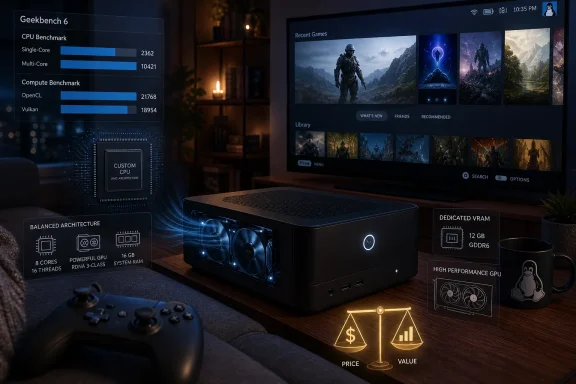 The Benchmark Leak Says Less Than the Panic Does
The new numbers are not flattering in the narrowest possible reading. The Steam Machine’s reported Linux Geekbench 6 scores land around 2,334 single-core and 7,392 multi-core, while newer handheld chips such as AMD’s Ryzen AI Z2 Extreme can post substantially higher multi-core results in tested devices. That gap is real, and pretending otherwise would be the usual prelaunch fan-service mistake.But it is also the least surprising thing about the product. Valve’s chip is reportedly a six-core, twelve-thread custom AMD part, while the fastest handheld silicon in the comparison set generally uses eight CPU cores, higher boost behavior, aggressive power envelopes, or a newer mobile platform tuned to win exactly this kind of synthetic test. Geekbench is a useful smoke alarm; it is not a floor plan.
The more interesting detail is that these newer results appear to come from Linux, presumably a SteamOS-derived environment, whereas earlier leaked scores were associated with Windows. That matters because Valve is not merely launching a small PC. It is trying to ship a console-shaped argument that the PC can be civilized from the operating system up.
If the benchmark leak is accurate, the Steam Machine’s CPU is not a monster. It is a competent midrange part attached to a product that will live or die elsewhere.
Valve Is Not Building a Handheld Without a Battery
The easiest mistake is to compare the Steam Machine to the handhelds currently defining the Windows gaming-PC conversation. That is understandable because the handheld market has become the benchmark theater for mobile AMD and Intel silicon. It is also a category error.A handheld gaming PC is an exercise in compromise stacked on compromise. The CPU, GPU, memory, display, cooling, speakers, battery, and controller all fight for the same space, thermal headroom, and bill of materials. Its processor performance is not merely about how fast the chip can run; it is about how long the device can keep running without becoming loud, hot, short-lived, or uncomfortable.
The Steam Machine has a different job. It does not need to power a display. It does not need to fit behind your thumbs. It does not need to preserve a battery while rendering a game at a fixed portable resolution. It can use wall power, larger cooling, and a GPU arrangement that is closer to a compact desktop than to the integrated graphics designs that dominate handhelds.
That changes the meaning of a middling CPU score. In a handheld, the CPU and GPU often share thermal and memory constraints so tightly that any weakness in one part can drag down the whole device. In a living-room box, a modest CPU can still make sense if the GPU has dedicated memory, the cooling system is sane, and Valve’s target is console-style play rather than desktop benchmark supremacy.
The GPU Is the Missing Half of the Story
The CPU leak has generated attention because it is measurable. The GPU remains the much more important unknown because it is likely to determine whether the Steam Machine feels like a serious living-room device or a clever curiosity.Reports and spec discussion have pointed toward a custom RDNA 3-class graphics solution with 8GB of dedicated VRAM. If that is the shape of the final hardware, the Steam Machine will be playing a very different game from handhelds that rely on integrated graphics sharing system memory. The CPU may trail, but the graphics subsystem could more than compensate in the workloads most buyers actually care about.
That is why the benchmark panic feels premature. A living-room gaming box is judged by frame rates, frame pacing, image quality, noise, resume behavior, controller integration, storefront convenience, and whether the game launches without turning the couch into a help desk. Geekbench tests none of that.
The real risk is not that the CPU loses to a Ryzen Z2 Extreme in a synthetic run. The risk is that the CPU is just weak enough to become the bottleneck in modern open-world games, simulation-heavy titles, high-refresh competitive play, or PC ports that already struggle with shader compilation and asset streaming. That is a narrower but more important concern than the leaderboard suggests.
If Valve has balanced the GPU, memory bandwidth, storage, and thermals properly, most living-room play will be GPU-limited first. If it has not, the Steam Machine will become another lesson in why small gaming PCs are easy to admire and hard to recommend.
SteamOS Is the Product, Not the Wallpaper
The Steam Machine’s most important component may not be the AMD CPU at all. It may be the operating system.Valve learned this with the Steam Deck. The Deck did not win because it obliterated every Windows handheld on raw specifications. It won because it made PC gaming feel coherent in a form factor where Windows often felt like a desktop OS forced to cosplay as firmware. Suspend and resume, controller-first navigation, shader pre-caching, verified compatibility labels, Proton, and a store that understood the hardware all mattered as much as the APU.
The Steam Machine is an attempt to apply that lesson to the television. That is a harder sell than the Deck because living-room gaming already has mature incumbents. Xbox, PlayStation, and Nintendo do not need to explain why they belong under a TV. A PC does.
SteamOS is Valve’s answer to that problem. A Windows mini-PC can run more software, more launchers, more anti-cheat systems, and more oddball peripherals. It can also make the user reach for a keyboard at exactly the wrong moment. Valve’s proposition is that enough players will trade some edge-case compatibility for a machine that behaves more like an appliance.
That is why the Linux benchmark is symbolically important even if the score is ordinary. It suggests the hardware is being tested where it is meant to live. Valve does not need to prove that the Steam Machine is the fastest compact PC. It needs to prove that the fastest compact PC is not necessarily the one people want in the living room.
The Old Steam Machine Failed Because the Strategy Was Backwards
The phrase “Steam Machine” carries baggage because Valve has used it before, and not successfully. The first wave of Steam Machines in the mid-2010s was less a product than a hope that OEMs would collectively make living-room PCs happen. The result was a fragmented lineup of expensive boxes, uneven hardware, limited software maturity, and unclear reasons to choose one over a console or a self-built PC.The new Steam Machine appears to be Valve correcting that mistake by collapsing the strategy into a single first-party device. That matters enormously. A console-adjacent PC cannot be a vibes-based ecosystem proposal. It needs one hardware target, one expected user experience, one compatibility story, one controller story, and one price that makes sense without a spreadsheet.
The Steam Deck proved Valve could do that. It also proved that a fixed target can attract developer attention in a way generic Linux PCs rarely do. Developers did not optimize for “handheld PCs”; they optimized, implicitly or explicitly, for Steam Deck behavior because there was a large and legible install base.
A living-room Steam Machine could repeat that effect if Valve ships enough units and prices it aggressively enough. The CPU benchmark does not answer that question. The launch price will.
Pricing Is the Real Benchmark Valve Has Not Run Yet
The uncomfortable truth is that the Steam Machine’s success may depend less on whether its CPU is “too slow” and more on whether its price is too high. Valve has already had to navigate rising memory and storage costs, and reporting around the hardware has repeatedly noted that pricing remains unresolved or at least undisclosed. That silence is not incidental.A console-like PC occupies a dangerous middle ground. Price it near a PlayStation or Xbox, and buyers will forgive a lot because they get their Steam library, mod potential, PC flexibility, and a living-room interface. Price it like a boutique mini-PC, and every benchmark becomes a weapon against it.
That is where the leaked CPU score becomes commercially relevant. A modest CPU is acceptable in a value-optimized living-room machine. It is much harder to defend in a premium one. If the Steam Machine lands at a price that invites comparison with discounted gaming laptops, compact desktops, or do-it-yourself builds, the “but the GPU is stronger than a handheld” argument will not carry the day.
Valve’s problem is that it has trained customers to expect unusually sharp hardware pricing. The Steam Deck felt disruptive because it made the PC handheld market look inflated. If the Steam Machine cannot do the same for living-room PCs, it will be judged as another niche enthusiast box, not a console challenger.
The Windows Angle Is More Complicated Than It Looks
For WindowsForum readers, the Steam Machine is especially interesting because it is both a PC and a rebuke to the default assumption that a gaming PC should run Windows. Valve is not arguing that Windows cannot game. Windows remains the broadest compatibility layer in PC gaming, especially for anti-cheat-heavy multiplayer titles, third-party launchers, productivity software, and the messy long tail of PC utilities.Valve is arguing that Windows is not always the best appliance layer for gaming. That is a narrower claim, and a stronger one. The living room punishes friction more harshly than the desk. A login prompt, driver pop-up, launcher update, focus-stealing window, or controller mapping failure feels more tolerable when you are sitting at a monitor with a mouse and keyboard. On a couch, it feels like the device broke the social contract.
Microsoft knows this, which is why the Windows handheld experience has become such a visible area of pressure. The more SteamOS spreads beyond Valve’s own hardware, the more Windows has to justify itself not only as the compatibility king but as a couch-and-controller environment. That is not a fight Microsoft can win with raw DirectX history alone.
The irony is that the Steam Machine may end up helping Windows gaming indirectly. Competition from SteamOS forces clearer thinking about what gaming mode, controller-first UI, resume behavior, shader handling, and update discipline should look like on Windows devices. Valve does not need to dethrone Windows to make Microsoft uncomfortable. It only needs to make enough users ask why their gaming PC cannot feel as simple.
CPU-Bound Games Are the Place to Watch
There are cases where the CPU gap could matter, and they should not be waved away. Large open-world games, dense simulation titles, strategy games, multiplayer sandboxes, heavy emulation workloads, and high-frame-rate esports can stress CPU performance in ways a living-room GPU cannot hide. The more ambitious PC games become, the more a six-core CPU can look like a budget decision exposed by time.The question is how often that weakness appears at the settings and frame rates Valve expects buyers to use. A Steam Machine designed around 60 frames per second on a television has a different CPU requirement than a desktop targeting 144Hz or 240Hz play. If Valve’s pitch is 4K output through upscaling, balanced presets, and console-like frame targets, then CPU limitations may appear mostly in outliers.
Frame pacing will matter more than average frame rate. A machine that posts respectable averages but stutters during traversal, compilation, or heavy scene changes will feel worse than its charts suggest. This is where Valve’s software stack could help, particularly if shader caching and compatibility profiling are mature at launch.
But no amount of platform polish can repeal bad PC ports. The Steam Machine will inherit the strengths of the PC ecosystem and its messes. Some games will run beautifully. Some will need updates. Some will expose exactly why consoles still benefit from fixed hardware targets and certification processes.
The Console Comparison Is Tempting but Treacherous
Valve wants the Steam Machine near the console conversation, but it cannot become a console in the traditional sense. That is both its advantage and its burden.A console buyer expects a stable performance class, predictable pricing, physical retail presence, first-party marketing, and a library curated around the platform’s assumptions. A PC buyer expects openness, modding, multiple storefronts, configurable settings, and the freedom to break things. The Steam Machine is trying to borrow enough from both worlds without inheriting the worst of each.
That hybrid identity gives Valve a chance to reach players who already own Steam libraries but no longer want to game at a desk. It also gives it a shot at households where a traditional console feels too locked down but a Windows PC feels too fussy. The product is not really competing with a handheld. It is competing with inertia.
The danger is that the console comparison raises expectations Valve may not want. If buyers hear “Steam console,” they will expect console reliability. If reviewers hear “PC,” they will benchmark it like one. The leaked CPU results are an early example of that tension: a console-style product being judged by desktop-style component isolation before the actual gaming experience is visible.
Valve can survive that, but only if the final experience is coherent enough that the spec debate fades into the background. The Steam Deck managed that trick. The Steam Machine has to do it in a less forgiving room.
The Handheld Boom Has Distorted the Yardstick
The current handheld market has made CPU comparisons unusually noisy. Devices like the ROG Ally line, Lenovo Legion Go family, MSI Claw systems, and newer Xbox-branded handheld PCs have turned mobile silicon into a spectator sport. Reviewers now expect every new gaming device to enter a chart full of Z1, Z2, Core Ultra, and custom AMD parts.That chart is useful, but it can flatten product intent. A handheld with an expensive APU may need strong CPU scores because its integrated GPU, shared memory, and battery envelope leave less room for brute-force graphics performance. A plugged-in living-room box with discrete-class graphics resources has a different balance sheet.
This is why “middle of the pack” can mean two different things. In a handheld roundup, middle of the pack may imply a device is already behind the curve. In a living-room PC, it may simply mean the CPU was not where the budget was spent. The latter is not automatically bad engineering.
The market will not care about that nuance if the Steam Machine is expensive. But if Valve prices it like a sharply optimized platform rather than a premium mini-PC, the CPU score becomes a footnote. Consumers forgive balanced compromises. They punish mismatched ones.
Valve’s Real Edge Is the Feedback Loop
Valve’s greatest hardware advantage is not that it can outspend Sony, Microsoft, Asus, Lenovo, or MSI on silicon. It is that it controls Steam, SteamOS, Proton, the Deck compatibility program, shader distribution, and a direct relationship with the players most likely to buy this device.That creates a feedback loop competitors struggle to match. Valve can see what people play, where games fail, which titles need compatibility work, and what settings profiles make sense. It can use the Deck, Steam Machine, and Steam Frame as a family of targets rather than isolated experiments.
The expanded verification language around Valve’s newer hardware points in that direction. If developers and users begin seeing compatibility not as “does this run on Linux?” but as “does this run well on Valve’s gaming hardware family?” the platform becomes more legible. That is how you build confidence.
This is also why a prelaunch Geekbench result is such a partial artifact. It captures a CPU run at a moment in time. It does not capture firmware maturity, scheduler tuning, thermal profiles, game-specific settings, Proton improvements, or driver changes. Those are not excuses for weak hardware; they are reasons not to confuse an early component benchmark with a verdict.
The Anti-Cheat Problem Still Lurks
The biggest software caveat for SteamOS remains multiplayer compatibility. Some anti-cheat systems and publisher policies still do not play nicely with Linux-based gaming environments, and that matters because the living room is not just for single-player RPGs and indie games. It is also where people want sports games, shooters, racing titles, and the annual franchises that dominate mainstream play.This is where Windows retains a blunt advantage. If your gaming life revolves around titles that refuse to support SteamOS, the Steam Machine may be an elegant device that fails at the one job you need. Valve can improve tooling and court publishers, but it cannot unilaterally force every multiplayer ecosystem to support Proton.
That limitation should shape expectations. The Steam Machine is likely to be strongest for Steam-native libraries, verified single-player games, indies, emulation-adjacent use cases where legal, couch co-op, and PC titles that already behave well on the Deck. It will be weaker for users whose libraries are fragmented across launchers or tied to kernel-level anti-cheat assumptions.
This does not make the product doomed. It makes the audience more specific than the word “console” implies. Valve’s task is to make that specificity feel like curation rather than compromise.
The Numbers That Matter Will Be Boring
The most important Steam Machine benchmarks will not be the ones that produce the most dramatic charts. They will be the boring measurements that determine whether the box disappears into the living room.Boot time will matter. Resume reliability will matter. Fan noise from ten feet away will matter. The number of times a user has to grab a keyboard will matter. Whether family members can switch profiles without summoning desktop Linux will matter. Whether 8GB of VRAM is enough for the next several years of texture settings will matter.
So will storage behavior. Modern PC games are enormous, and storage prices have been part of the broader anxiety around Valve’s launch planning. If the base model feels cramped or upgrades are awkward, users will notice quickly. A living-room PC that constantly asks its owner to manage installed games like a budget phone is not going to feel premium.
The final reviews should therefore focus less on whether the CPU outruns handheld chips and more on whether the total platform has a convincing floor. A console-like PC cannot merely be fast in the best cases. It has to be hard to make miserable.
The Leak Should Temper Expectations, Not Kill Interest
The Steam Machine now looks less like a hidden performance monster and more like a deliberately balanced box. That may disappoint anyone hoping Valve would ship a cheap living-room PC that embarrasses both consoles and premium handhelds. It should not disappoint anyone who understood the Steam Deck playbook.Valve tends to win hardware arguments when it attacks friction rather than spec ceilings. The Deck was not the fastest handheld possible. It was the handheld that made the most sense at the right moment, with the right software, at the right price. The Steam Machine needs the same alignment.
The CPU leak usefully narrows the fantasy. This is probably not a device for people who want a tiny enthusiast desktop, a benchmark trophy, or a no-compromise 4K ultra machine. It is more likely a Steam library appliance with enough PC DNA to stay flexible and enough console DNA to stay approachable.
That is still a compelling idea. It is just not the same idea as “fastest small gaming PC.”
The Steam Machine’s Report Card Will Be Written on the Couch
The most concrete read on the leak is that Valve appears to be optimizing for a platform target rather than a spec-sheet knockout. That makes the coming launch more interesting, not less, because it puts the burden on execution.- The leaked Geekbench 6 CPU results suggest the Steam Machine’s custom AMD 1772 processor trails the fastest current handheld chips in synthetic CPU performance.
- The comparison is incomplete because handheld processors often rely on integrated graphics and shared memory, while the Steam Machine is expected to lean on a stronger RDNA 3-class GPU with dedicated VRAM.
- The CPU could still matter in open-world games, simulation-heavy workloads, high-refresh play, and poorly optimized PC ports.
- SteamOS may be the decisive feature if Valve can make the device feel more like a console than a Windows mini-PC attached to a television.
- Pricing remains the unresolved variable that will decide whether the hardware balance feels smart or underpowered.
- Windows still has the compatibility advantage, especially for anti-cheat-heavy multiplayer games and non-Steam libraries.
References
- Primary source: Windows Central
Published: 2026-06-16T15:20:18.817229
"Context matters a lot": New Steam Machine CPU benchmark numbers are underwhelming, but they're far from the full picture | Windows Central
Gaming handhelds we tested have more CPU power than the Steam Machine, but that doesn't mean it's time to panic.www.windowscentral.com - Related coverage: gamesradar.com
SteamOS now plays nice with Intel handhelds, and that could help a shunned portable become a solid Steam Deck alternative | GamesRadar+
Now that SteamOS is working and improving on Intel handheld gaming PCs, it could help the OG MSI Claw shine as a makeshift Steam Deck.www.gamesradar.com - Related coverage: pcgamer.com
The Steam Frame is arriving in the US, suggesting the VR headset's launch isn't far off | PC Gamer
Release may be soon, but pricing still remains a mystery.www.pcgamer.com - Related coverage: club386.com
Valve Steam Machine CPU appears in Geekbench, with six cores at 4.86GHz | Club386
A SteamOS-powered rig appears on Geekbench, revealing the CPU clock speeds and giving us an indication of performance. www.club386.com
- Related coverage: uploadvr.com
Steam Frame Shipping "This Summer", Valve Confirms, As Pallets Arrive In US
Valve confirmed that Steam Frame is shipping "this summer", and import logs show pallets of the headset arriving at the company's US warehouses. www.uploadvr.com
- Related coverage: tomshardware.com
Best Handheld Gaming PCs 2026: Windows and Steam Decks tested | Tom's Hardware
Here are our favorite handheld gaming PCs, based on our testing and reviews.www.tomshardware.com
- Related coverage: hothardware.com
Steam Machine Hits Geekbench With SteamOS Hinting At Imminent Launch | HotHardware
Geekbench results for the Steam Machine have leaked online, which could mean the system is out in the wild.hothardware.com
- Related coverage: tweaktown.com
Steam Machine benchmarks spotted on Geekbench, as early reviews might be underway
New Steam Machine benchmarks have been spotted on Geekbench under the 'Fremont' codename, suggesting the launch may finally be close. www.tweaktown.com
- Related coverage: gamingonlinux.com
Steam Machine release closing in with an appearance on the Vulkan conformant product list | GamingOnLinux
The official Vulkan API Conformant Products list from The Khronos Group recently had Valve's Steam Machine appear on it - so a release is likely quite soon.www.gamingonlinux.com
- Related coverage: pcgameshardware.de
- Related coverage: allthings.how
Steam Machine specs: CPU, GPU, I/O, upgrades (2026)
A concise overview of Valve’s mini PC: hardware, performance targets, ports, upgrades, and release timing.allthings.how - Related coverage: notebookcheck-cn.com
随着两条新的Geekbench测试记录浮出水面,Steam Machine的评测可能已经展开 - Notebookcheck-cn.com News
Valve的Steam Machine再次现身Geekbench,且有两条独立的记录,这表明评测工作可能已经展开。 www.notebookcheck-cn.com
- Related coverage: steamhardware.io
Steam Machine Specs | Steam Hardware Hub
Why Steam Machine may perform better than its raw specs suggest, with Steam Deck lessons, SteamOS, Proton, FSR, VRAM caveats, and benchmark questions.steamhardware.io - Related coverage: vice.com
Steam Machine Benchmarks Reportedly Leak and Spark Concern Over Performance
Steam Machine benchmarks have reportedly leaked, sparking debate over the Valve console's performance ahead of its reviews.www.vice.com - Related coverage: techradar.com
After spending all week gawking at the new MSI Claw 8 EX AI+, I think I’m finally ready to bid adieu to my beloved Steam Deck | TechRadar
Time to start saving… a lotwww.techradar.com
