
BrightWork announced on June 17, 2026, from Boston, Massachusetts, that its latest BrightWork 365 release is aimed at PMO teams preparing for Microsoft Project Online’s scheduled retirement on September 30, 2026. The pitch is not merely that BrightWork has another project-management product to sell. It is that the end of Project Online is becoming a forcing function for organizations that have postponed harder decisions about governance, reporting, and portfolio visibility. For Microsoft 365 shops, the fight over Project Online’s replacement is really a fight over where project management should live.
Microsoft Project Online was never just a task board. For many organizations, it became the place where project schedules, portfolio reporting, resourcing habits, and PMO processes accumulated over years of practical compromise. That history is exactly why its retirement matters: the service may be old, but the workflows built around it are often deeply embedded.
Microsoft’s September 30, 2026 retirement date gives customers a clear endpoint, but not a simple migration path. Project Online’s architecture belongs to an earlier Microsoft cloud era, while the company’s modern work-management direction now runs through Planner, Teams, Power Platform, Microsoft 365 Copilot, and newer portfolio experiences. That may be strategically coherent for Microsoft, but it leaves PMOs with a familiar enterprise problem: the vendor roadmap and the customer operating model are not the same thing.
BrightWork is stepping into that gap with BrightWork 365, a project and portfolio management platform built inside Microsoft 365 and the Power Platform. Its announcement is timed well because the retirement clock has moved from abstract future concern to 2026 operational risk. PMO leaders who wait until the final quarter will not be choosing software; they will be triaging process debt.
The Manila Times-distributed release frames BrightWork 365 as an alternative for organizations that want to stay within Microsoft 365 rather than move project and portfolio management into a separate SaaS ecosystem. That is the important distinction. BrightWork is not arguing that PMOs need less structure after Project Online. It is arguing that they need structure that sits closer to the collaboration and reporting tools employees already use.
That is a smart wedge. Many organizations already have Microsoft 365 licensing, identity, compliance, and collaboration practices in place. If a PMO can build its replacement environment around those foundations, the migration conversation changes from “buy and adopt a new system” to “extend the environment users already inhabit.” That framing is especially attractive to IT departments wary of yet another external platform with its own security model, user directory, data export process, and integration backlog.
But the same argument also raises the bar. A Microsoft 365-based PMO product cannot win merely by being adjacent to Teams and SharePoint. It has to make the sprawl manageable. If every business unit already has its own SharePoint sites, Teams channels, Planner boards, Excel trackers, Power BI dashboards, and approval flows, then the PMO does not need another surface area. It needs a governing layer.
BrightWork’s release emphasizes configurable templates, project request management, approval workflows, program and portfolio dashboards, executive visibility, and Power BI reporting. Those are not glamorous features, but they are the features that separate an enterprise PMO system from a prettier task list. The value proposition is not “make work visible” in the generic collaboration-software sense. It is “make work comparable, governable, and reportable across the organization.”
Yet that strategy does not automatically satisfy mature PMOs. Enterprise project and portfolio management is often less about individual productivity than organizational control. It involves intake governance, prioritization, resource visibility, risk reporting, steering committees, executive dashboards, auditability, and the uncomfortable process of saying no to work the business wants but cannot realistically fund or staff.
The gap between “modern collaborative work management” and “portfolio governance” is where products like BrightWork 365 can make their case. Microsoft may provide the substrate, but many organizations still need opinionated templates, deployment guidance, and PMO-specific configuration. That is especially true for companies that used Project Online not just for schedules, but as the center of a portfolio operating model.
The risk for BrightWork is that Microsoft’s own tools will keep improving. Planner Premium, Power Platform, and Copilot-enabled work experiences will inevitably absorb more functions that once required specialist add-ons. The opportunity for BrightWork is that most enterprises do not buy transformation as a bag of platform primitives. They buy something that looks like a working operating model.
Project Online’s retirement exposes process debt because old systems often hide inconsistency. One team may use schedules rigorously, another may treat them as theater, and a third may update status only before executive reviews. A migration forces those differences into the open. Fields must be mapped, workflows must be recreated, reports must be rebuilt, and stakeholders must agree which practices are worth preserving.
That is why BrightWork’s emphasis on requests, approvals, templates, dashboards, and governance matters more than its product branding. PMOs preparing for the deadline need to ask whether their current environment actually reflects how projects should run, or merely how Project Online happened to be configured years ago. A retirement event is a rare excuse to fix the operating model instead of photocopying it.
There is also a people problem. Project Online users range from professional project managers to occasional contributors who only touch the system when forced. A replacement that is theoretically powerful but alien to everyday users will recreate the adoption problem under a new logo. BrightWork’s Microsoft 365-native positioning is an attempt to reduce that friction by keeping collaboration in Teams and documents in SharePoint, where many employees already spend their day.
That familiarity is not a small advantage. In enterprise software, the best feature is often not a feature at all; it is the absence of a new login, a new data silo, or a new compliance exception. If BrightWork 365 can help PMOs move from Project Online while preserving Microsoft 365 identity, security, and collaboration patterns, it will appeal to organizations that view standalone project platforms as another governance headache.
But familiarity can also conceal complexity. Power Platform-based systems are only as clean as their data model, permissions design, environment strategy, and lifecycle management. SharePoint-based document practices can become chaotic without standards. Teams collaboration can fragment quickly if project spaces are created inconsistently. Power BI dashboards can mislead if project health definitions vary across the portfolio.
That is why BrightWork’s mention of expert-led implementation services is more than a sales add-on. For a PMO migration, deployment support may be the difference between a controlled transition and a sprawling rebuild. The product can provide templates and dashboards, but the customer still has to make decisions about governance, roles, terminology, reporting cadence, and adoption.
Migration planning is not just about moving records. It involves deciding which data matters, which reports must survive, which workflows are still relevant, and which user groups need training. It also requires parallel operation or at least a controlled cutover period, because project governance cannot simply pause while IT rebuilds the plane.
The hard deadline also changes vendor dynamics. As retirement approaches, every Project Online replacement vendor has an incentive to sharpen its migration messaging. Customers should expect confident claims, quick-start packages, and comparison content. Some of that will be useful; some of it will blur the distinction between replacing screens and replacing capabilities.
BrightWork’s release arrives in that context. It is both a product announcement and a market-positioning move. The company is telling PMO leaders that the deadline should not push them into the nearest task-management tool, but into a broader reconsideration of project intake, standardization, and portfolio reporting.
That difference in audience is crucial. Project Online often served multiple constituencies at once: project managers, resource managers, PMO analysts, executives, and sometimes finance or operations stakeholders. Any replacement must survive that same multi-audience test. A tool that delights project teams but weakens executive reporting is not a replacement. A governance platform that satisfies leadership but burdens contributors will fail by neglect.
BrightWork 365 appears aimed at the middle ground: structured enough for PMO oversight, familiar enough for Microsoft 365 users, and configurable enough to evolve. Its success will depend on how well those promises hold under messy customer reality. Every PMO says it wants standardization until standardization collides with departmental autonomy.
The stronger argument for BrightWork is that PMOs need a configurable framework, not a blank canvas. Pure flexibility can become abdication. If every workflow is custom, every report becomes a negotiation. If every project type is unique, portfolio visibility becomes an illusion. Templates and governance patterns matter because they force the organization to decide what consistency means.
That is where BrightWork’s architecture needs to prove itself. If it gives PMOs a coherent operating layer over Microsoft 365, it has a practical story. If it merely assembles familiar Microsoft components and leaves customers to sort out the governance themselves, the advantage weakens. The difference matters because Microsoft 365 tenants are already crowded places.
There is also a strategic consideration for IT. Keeping PMO data inside Microsoft 365 may simplify security and compliance, but it may also deepen dependence on Microsoft’s ecosystem. Some organizations will welcome that consolidation. Others may prefer a best-of-breed PPM platform with broader cross-suite neutrality. The “right” answer depends less on product ideology than on the organization’s actual collaboration patterns and regulatory posture.
For WindowsForum.com readers, the lesson is familiar from many Microsoft transitions: the platform shift is rarely just a platform shift. It changes administration, licensing conversations, data governance, support models, and the way business teams expect IT to enable work. Project Online’s retirement is one more example of Microsoft pulling customers toward a newer cloud architecture and leaving partners to package the last mile.
If the PMO mainly needs lightweight planning and team coordination, Microsoft’s newer Planner-centered direction may be enough. If the organization needs portfolio governance, executive reporting, structured intake, and standardized delivery templates, it will likely need more than a task interface. If the company has already standardized on Microsoft 365 and Power Platform, a product like BrightWork 365 becomes a more natural candidate.
BrightWork’s challenge is to make its value legible to both PMO leaders and IT. PMO leaders need assurance that governance and reporting will not be sacrificed. IT needs assurance that the solution will not create unmanaged complexity inside the tenant. Executives need assurance that the migration will not become an expensive relabeling exercise.
The company’s announcement leans into those concerns by emphasizing out-of-the-box templates, configurable processes, Power BI reporting, Teams and SharePoint collaboration, and implementation services. That is the right message for the moment. The decisive factor will be whether customers experience BrightWork 365 as a disciplined PMO system or as another layer of Microsoft 365 configuration work.
A replacement project should be ruthless about those artifacts. It should identify the minimum viable governance model the organization actually needs, then build from there. BrightWork’s configurable approach could help with that, provided customers use configuration to standardize rather than to preserve every historical quirk.
The PMO also has to decide where it wants collaboration to happen. If status discussions happen in Teams, documents live in SharePoint, dashboards appear in Power BI, and approvals run through Power Automate, then the project-management layer must orchestrate those experiences rather than compete with them. That is the promise of Microsoft 365-based PPM. It is also the implementation burden.
The most dangerous migration is the one that treats the deadline as an IT substitution exercise. Export data, import data, train users, declare success. That may keep the lights on for a few months. It will not answer whether the organization has improved visibility, accountability, or portfolio discipline.
The company’s message is strongest when it avoids sounding like a simple replacement pitch. “Alternative to Project Online” is useful shorthand, but the deeper proposition is “use this disruption to modernize the PMO inside Microsoft 365.” That is more ambitious, and more credible, than promising a one-for-one swap.
For Microsoft, partner solutions like BrightWork 365 help soften the landing. They give customers paths that remain aligned with Microsoft 365 while addressing scenarios Microsoft’s own general-purpose work-management tools may not fully cover. For customers, that ecosystem is both a blessing and a burden. There are choices, but the choices require clarity about governance, not just feature comparison.
The timing also matters commercially. By June 2026, late-moving organizations are entering the zone where migration decisions become constrained by calendar reality. Vendors that can offer structure, deployment assistance, and a credible Microsoft 365 story will have an advantage over products that require customers to invent their own transition plan.
PMO teams evaluating BrightWork 365 or any competing platform should keep the discussion concrete. The retirement deadline is real, but urgency should not become panic. The goal is not to buy the first product that checks the most boxes. The goal is to preserve what Project Online did well, discard what it merely accumulated, and build a project operating model that fits the Microsoft 365 era.
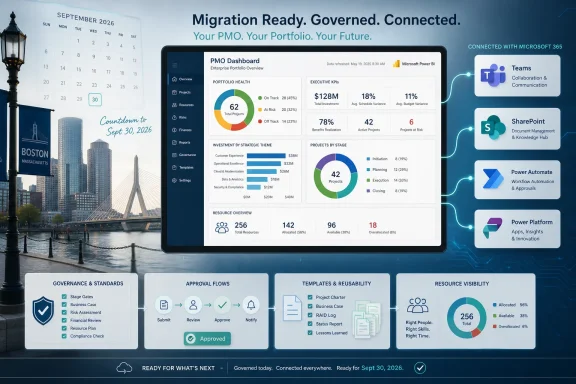 Project Online’s Exit Turns a Tool Migration Into a Governance Deadline
Microsoft Project Online was never just a task board. For many organizations, it became the place where project schedules, portfolio reporting, resourcing habits, and PMO processes accumulated over years of practical compromise. That history is exactly why its retirement matters: the service may be old, but the workflows built around it are often deeply embedded.Microsoft’s September 30, 2026 retirement date gives customers a clear endpoint, but not a simple migration path. Project Online’s architecture belongs to an earlier Microsoft cloud era, while the company’s modern work-management direction now runs through Planner, Teams, Power Platform, Microsoft 365 Copilot, and newer portfolio experiences. That may be strategically coherent for Microsoft, but it leaves PMOs with a familiar enterprise problem: the vendor roadmap and the customer operating model are not the same thing.
BrightWork is stepping into that gap with BrightWork 365, a project and portfolio management platform built inside Microsoft 365 and the Power Platform. Its announcement is timed well because the retirement clock has moved from abstract future concern to 2026 operational risk. PMO leaders who wait until the final quarter will not be choosing software; they will be triaging process debt.
The Manila Times-distributed release frames BrightWork 365 as an alternative for organizations that want to stay within Microsoft 365 rather than move project and portfolio management into a separate SaaS ecosystem. That is the important distinction. BrightWork is not arguing that PMOs need less structure after Project Online. It is arguing that they need structure that sits closer to the collaboration and reporting tools employees already use.
BrightWork’s Bet Is That Microsoft 365 Is the New PMO Substrate
The core BrightWork 365 proposition is straightforward: keep project requests, templates, approvals, collaboration, documents, dashboards, and portfolio reporting inside the Microsoft stack. The product leans on Teams, SharePoint Online, Power BI, Power Apps, Power Automate, Dataverse, and Microsoft 365 permissions. In other words, BrightWork is not trying to persuade enterprises to abandon Microsoft. It is trying to persuade them that Microsoft’s platform is not, by itself, a finished PMO system.That is a smart wedge. Many organizations already have Microsoft 365 licensing, identity, compliance, and collaboration practices in place. If a PMO can build its replacement environment around those foundations, the migration conversation changes from “buy and adopt a new system” to “extend the environment users already inhabit.” That framing is especially attractive to IT departments wary of yet another external platform with its own security model, user directory, data export process, and integration backlog.
But the same argument also raises the bar. A Microsoft 365-based PMO product cannot win merely by being adjacent to Teams and SharePoint. It has to make the sprawl manageable. If every business unit already has its own SharePoint sites, Teams channels, Planner boards, Excel trackers, Power BI dashboards, and approval flows, then the PMO does not need another surface area. It needs a governing layer.
BrightWork’s release emphasizes configurable templates, project request management, approval workflows, program and portfolio dashboards, executive visibility, and Power BI reporting. Those are not glamorous features, but they are the features that separate an enterprise PMO system from a prettier task list. The value proposition is not “make work visible” in the generic collaboration-software sense. It is “make work comparable, governable, and reportable across the organization.”
Microsoft’s Own Direction Leaves Room for Partners
Microsoft’s retirement of Project Online does not mean Microsoft is exiting project management. Quite the opposite: the company has been consolidating work management under the broader Planner brand while pushing more intelligence into Microsoft 365 through Copilot and agentic workflows. That direction makes sense from Redmond’s perspective. Microsoft wants work management to feel native to Teams, Outlook, Loop, Planner, and the wider productivity graph.Yet that strategy does not automatically satisfy mature PMOs. Enterprise project and portfolio management is often less about individual productivity than organizational control. It involves intake governance, prioritization, resource visibility, risk reporting, steering committees, executive dashboards, auditability, and the uncomfortable process of saying no to work the business wants but cannot realistically fund or staff.
The gap between “modern collaborative work management” and “portfolio governance” is where products like BrightWork 365 can make their case. Microsoft may provide the substrate, but many organizations still need opinionated templates, deployment guidance, and PMO-specific configuration. That is especially true for companies that used Project Online not just for schedules, but as the center of a portfolio operating model.
The risk for BrightWork is that Microsoft’s own tools will keep improving. Planner Premium, Power Platform, and Copilot-enabled work experiences will inevitably absorb more functions that once required specialist add-ons. The opportunity for BrightWork is that most enterprises do not buy transformation as a bag of platform primitives. They buy something that looks like a working operating model.
The Replacement Decision Is Really About Process Debt
The most useful line in BrightWork’s announcement is the insistence that PMO teams should “look beyond simple task management.” That is vendor messaging, but it is also true. Replacing Project Online with a task tool may satisfy users who only care about assignments and due dates. It will not satisfy a PMO that must explain to leadership why the portfolio is overcommitted, why strategic initiatives are slipping, or why every department reports project health differently.Project Online’s retirement exposes process debt because old systems often hide inconsistency. One team may use schedules rigorously, another may treat them as theater, and a third may update status only before executive reviews. A migration forces those differences into the open. Fields must be mapped, workflows must be recreated, reports must be rebuilt, and stakeholders must agree which practices are worth preserving.
That is why BrightWork’s emphasis on requests, approvals, templates, dashboards, and governance matters more than its product branding. PMOs preparing for the deadline need to ask whether their current environment actually reflects how projects should run, or merely how Project Online happened to be configured years ago. A retirement event is a rare excuse to fix the operating model instead of photocopying it.
There is also a people problem. Project Online users range from professional project managers to occasional contributors who only touch the system when forced. A replacement that is theoretically powerful but alien to everyday users will recreate the adoption problem under a new logo. BrightWork’s Microsoft 365-native positioning is an attempt to reduce that friction by keeping collaboration in Teams and documents in SharePoint, where many employees already spend their day.
BrightWork 365 Sells Familiarity, but Familiarity Can Cut Both Ways
Building on Microsoft 365 gives BrightWork an obvious adoption story. Users know Teams. They know SharePoint, or at least know where the documents are supposed to live. Executives recognize Power BI dashboards. IT understands Entra ID, permissions, retention, and the broader governance apparatus around Microsoft 365.That familiarity is not a small advantage. In enterprise software, the best feature is often not a feature at all; it is the absence of a new login, a new data silo, or a new compliance exception. If BrightWork 365 can help PMOs move from Project Online while preserving Microsoft 365 identity, security, and collaboration patterns, it will appeal to organizations that view standalone project platforms as another governance headache.
But familiarity can also conceal complexity. Power Platform-based systems are only as clean as their data model, permissions design, environment strategy, and lifecycle management. SharePoint-based document practices can become chaotic without standards. Teams collaboration can fragment quickly if project spaces are created inconsistently. Power BI dashboards can mislead if project health definitions vary across the portfolio.
That is why BrightWork’s mention of expert-led implementation services is more than a sales add-on. For a PMO migration, deployment support may be the difference between a controlled transition and a sprawling rebuild. The product can provide templates and dashboards, but the customer still has to make decisions about governance, roles, terminology, reporting cadence, and adoption.
The Clock Is Shorter Than It Looks
September 30, 2026 may sound comfortably distant to teams that have been living with Project Online for a decade. It is not. By mid-June 2026, organizations have just over three months before the retirement date. For a small team with limited historical data, that may be enough time to export, reconfigure, and retrain. For an enterprise PMO with multiple departments, custom fields, reporting dependencies, integrations, and executive routines, it is an alarm bell.Migration planning is not just about moving records. It involves deciding which data matters, which reports must survive, which workflows are still relevant, and which user groups need training. It also requires parallel operation or at least a controlled cutover period, because project governance cannot simply pause while IT rebuilds the plane.
The hard deadline also changes vendor dynamics. As retirement approaches, every Project Online replacement vendor has an incentive to sharpen its migration messaging. Customers should expect confident claims, quick-start packages, and comparison content. Some of that will be useful; some of it will blur the distinction between replacing screens and replacing capabilities.
BrightWork’s release arrives in that context. It is both a product announcement and a market-positioning move. The company is telling PMO leaders that the deadline should not push them into the nearest task-management tool, but into a broader reconsideration of project intake, standardization, and portfolio reporting.
The PMO’s Next Platform Will Be Judged by Executives, Not Project Managers Alone
A project manager may care whether a replacement handles schedules elegantly. A PMO director cares whether the organization can see, compare, and control the portfolio. An executive cares whether the information presented in steering meetings is timely enough to influence decisions rather than merely explain failures after the fact.That difference in audience is crucial. Project Online often served multiple constituencies at once: project managers, resource managers, PMO analysts, executives, and sometimes finance or operations stakeholders. Any replacement must survive that same multi-audience test. A tool that delights project teams but weakens executive reporting is not a replacement. A governance platform that satisfies leadership but burdens contributors will fail by neglect.
BrightWork 365 appears aimed at the middle ground: structured enough for PMO oversight, familiar enough for Microsoft 365 users, and configurable enough to evolve. Its success will depend on how well those promises hold under messy customer reality. Every PMO says it wants standardization until standardization collides with departmental autonomy.
The stronger argument for BrightWork is that PMOs need a configurable framework, not a blank canvas. Pure flexibility can become abdication. If every workflow is custom, every report becomes a negotiation. If every project type is unique, portfolio visibility becomes an illusion. Templates and governance patterns matter because they force the organization to decide what consistency means.
Microsoft 365 Integration Is Now Table Stakes, Not a Differentiator
A decade ago, being “integrated with Microsoft” could carry a product pitch. In 2026, that is the floor. Enterprise buyers expect identity integration, Teams awareness, SharePoint document handling, Power BI reporting, and some level of automation. The question is no longer whether a project-management platform can connect to Microsoft 365. The question is whether it can use Microsoft 365 without making the tenant harder to govern.That is where BrightWork’s architecture needs to prove itself. If it gives PMOs a coherent operating layer over Microsoft 365, it has a practical story. If it merely assembles familiar Microsoft components and leaves customers to sort out the governance themselves, the advantage weakens. The difference matters because Microsoft 365 tenants are already crowded places.
There is also a strategic consideration for IT. Keeping PMO data inside Microsoft 365 may simplify security and compliance, but it may also deepen dependence on Microsoft’s ecosystem. Some organizations will welcome that consolidation. Others may prefer a best-of-breed PPM platform with broader cross-suite neutrality. The “right” answer depends less on product ideology than on the organization’s actual collaboration patterns and regulatory posture.
For WindowsForum.com readers, the lesson is familiar from many Microsoft transitions: the platform shift is rarely just a platform shift. It changes administration, licensing conversations, data governance, support models, and the way business teams expect IT to enable work. Project Online’s retirement is one more example of Microsoft pulling customers toward a newer cloud architecture and leaving partners to package the last mile.
The Migration Market Will Reward Products That Reduce Ambiguity
The next few months will be noisy. PMO teams will hear from Microsoft partners, PPM vendors, consultants, and internal platform teams, each with a different answer to the same question: what replaces Project Online? The better question is what the organization expects its PMO to do after Project Online is gone.If the PMO mainly needs lightweight planning and team coordination, Microsoft’s newer Planner-centered direction may be enough. If the organization needs portfolio governance, executive reporting, structured intake, and standardized delivery templates, it will likely need more than a task interface. If the company has already standardized on Microsoft 365 and Power Platform, a product like BrightWork 365 becomes a more natural candidate.
BrightWork’s challenge is to make its value legible to both PMO leaders and IT. PMO leaders need assurance that governance and reporting will not be sacrificed. IT needs assurance that the solution will not create unmanaged complexity inside the tenant. Executives need assurance that the migration will not become an expensive relabeling exercise.
The company’s announcement leans into those concerns by emphasizing out-of-the-box templates, configurable processes, Power BI reporting, Teams and SharePoint collaboration, and implementation services. That is the right message for the moment. The decisive factor will be whether customers experience BrightWork 365 as a disciplined PMO system or as another layer of Microsoft 365 configuration work.
The Real Test Before September Is Whether the PMO Can Say No
The organizations that handle Project Online’s retirement well will be the ones that resist the temptation to recreate everything. Some legacy fields exist because someone requested them in 2017 and no one dared remove them. Some reports survive because executives once asked for them and then stopped reading them. Some workflows are elaborate not because governance requires them, but because the old system made exceptions permanent.A replacement project should be ruthless about those artifacts. It should identify the minimum viable governance model the organization actually needs, then build from there. BrightWork’s configurable approach could help with that, provided customers use configuration to standardize rather than to preserve every historical quirk.
The PMO also has to decide where it wants collaboration to happen. If status discussions happen in Teams, documents live in SharePoint, dashboards appear in Power BI, and approvals run through Power Automate, then the project-management layer must orchestrate those experiences rather than compete with them. That is the promise of Microsoft 365-based PPM. It is also the implementation burden.
The most dangerous migration is the one that treats the deadline as an IT substitution exercise. Export data, import data, train users, declare success. That may keep the lights on for a few months. It will not answer whether the organization has improved visibility, accountability, or portfolio discipline.
BrightWork’s Announcement Lands Because the Old PMO Compromise Is Ending
BrightWork is not the only company targeting Project Online customers, and its announcement should be read as part of a broader vendor race around a Microsoft-imposed deadline. But it lands because the market pain is real. Project Online customers are not merely shopping; they are being forced to confront a retirement date attached to a service that, in many organizations, became part of the PMO’s nervous system.The company’s message is strongest when it avoids sounding like a simple replacement pitch. “Alternative to Project Online” is useful shorthand, but the deeper proposition is “use this disruption to modernize the PMO inside Microsoft 365.” That is more ambitious, and more credible, than promising a one-for-one swap.
For Microsoft, partner solutions like BrightWork 365 help soften the landing. They give customers paths that remain aligned with Microsoft 365 while addressing scenarios Microsoft’s own general-purpose work-management tools may not fully cover. For customers, that ecosystem is both a blessing and a burden. There are choices, but the choices require clarity about governance, not just feature comparison.
The timing also matters commercially. By June 2026, late-moving organizations are entering the zone where migration decisions become constrained by calendar reality. Vendors that can offer structure, deployment assistance, and a credible Microsoft 365 story will have an advantage over products that require customers to invent their own transition plan.
The September Deadline Gives PMOs One Last Chance to Simplify
BrightWork’s latest release should be understood less as a standalone product milestone than as a signal of where the Project Online replacement market is heading. The winners will be tools that combine governance with adoption, reporting with collaboration, and configuration with discipline. The losers will be tools that mistake task management for portfolio management.PMO teams evaluating BrightWork 365 or any competing platform should keep the discussion concrete. The retirement deadline is real, but urgency should not become panic. The goal is not to buy the first product that checks the most boxes. The goal is to preserve what Project Online did well, discard what it merely accumulated, and build a project operating model that fits the Microsoft 365 era.
- Organizations using Project Online need to plan around the September 30, 2026 retirement date rather than treating it as a distant lifecycle footnote.
- BrightWork 365 is positioning itself as a Microsoft 365-native PMO platform rather than a standalone task-management replacement.
- The most important migration questions involve project intake, governance, reporting, templates, approvals, and executive visibility.
- Staying inside Microsoft 365 may simplify adoption and security, but it still requires careful tenant, data, and process governance.
- PMOs should use the retirement as an opportunity to simplify legacy workflows instead of rebuilding every historical customization.
- The strongest replacement strategy will be the one that aligns project teams, IT administrators, and executives around a shared operating model.
References
- Primary source: The Manila Times
Published: Wed, 17 Jun 2026 19:45:27 GMT
BrightWork Announces Latest BrightWork 365 Release to Support PMO Teams Preparing for Project Online Retirement | The Manila Times
The Microsoft 365-based project and portfolio management solution helps organizations improve project governance, reporting, collaboration, and portfolio visibility as they assess alternatives to Microsoft Project Online. www.manilatimes.net
- Official source: learn.microsoft.com
Project Online - Microsoft Lifecycle | Microsoft Learn
Project Online follows the Modern-Online Policy.learn.microsoft.com - Official source: techcommunity.microsoft.com
Microsoft Project Online is retiring: What you need to know | Microsoft Community Hub
After more than a decade of supporting project managers and teams around the world, Project Online will officially retire on September 30, 2026. We know... techcommunity.microsoft.com
- Related coverage: onplana.com
Project Online Migration: Complete Guide [2026] | Onplana
Project Online retires September 30, 2026. Step-by-step migration guide covering timeline, options, costs, pitfalls, and validation. Honest, vendor-neutral. www.onplana.com
- Related coverage: proha.com
Microsoft Project Online expires 30.9.2026 - Proha Oy
Microsoft announced on 5 September 2025 that Microsoft Project Online will be retired on 30 September 2026, confirming that Microsoft’s solutions based on ageing technologies, such as Project Online and Project Server, will be the first products to be retired, with Project Online now being...proha.com - Related coverage: tempo.io
Microsoft Project Online in Retirement: Alternatives & Guide | Tempo
Microsoft Project Online is retiring in 2026. Explore the transition timeline, risks of staying, and enterprise-grade migration options for PMOs.www.tempo.io
- Official source: directionsonmicrosoft.com
Project Online to Shut Down Sept. 30, 2026 - Directions on Microsoft
The Project Online service will shut down in Sept. 2026 and remove access to all customer data in the service. Customers should immediately start migrating to an alternative. Consider both stability and licensing when choosing an alternative. Seek any migration help as soon as possible...www.directionsonmicrosoft.com - Related coverage: o365cloudexperts.com
Microsoft Project Online Retirement: What It Means and What Comes Next
Microsoft has officially announced that Project Online will retire on September 30, 2026. In addition, the sale of new Project Online-only plans will end on October 1, 2025. This marks a significant shift for organizations that depend on Microsoft project management tools. While Microsoft...www.o365cloudexperts.com - Related coverage: integent.com
Project Online Retirement Migration Options Explained - Integent
Explore Project Online retirement migration options before the deadline to ensure continuity and minimize operational risks. integent.com
- Related coverage: avepoint.com
Microsoft Project Online Retirement 2026: AvePoint Cloud Backup Impact | AvePoint
Learn how Microsoft Project Online retirement affects AvePoint Cloud Backup customers, including backup changes, restore limitations, and export guidance.www.avepoint.com - Related coverage: easi.its.utoronto.ca
Project Online retiring September 30, 2026 | EASI
 easi.its.utoronto.ca
- Related coverage: projectinsight.com
- Related coverage: ppmworks.com
