
Microsoft has listed CVE-2026-42015 in its Security Update Guide as a GnuTLS memory-corruption flaw, disclosed in spring 2026, involving an off-by-one error in PKCS#12 bag handling that can let a remote unauthenticated attacker trigger a limited denial-of-service condition. The bug is not a Windows kernel emergency, and it is not being described as a credential-theft or remote-code-execution break-glass event. But it is exactly the kind of open-source plumbing flaw that matters in modern Windows estates because “Windows” increasingly means WSL images, containers, Linux-based appliances, Azure workloads, developer toolchains, and third-party packages sitting beside Microsoft’s own code. The lesson is not panic; it is inventory.
The most interesting thing about CVE-2026-42015 is not that an off-by-one error exists in a security library. That happens with depressing regularity. The more revealing detail is that Microsoft’s vulnerability machinery is surfacing a GnuTLS issue in a way that Windows administrators can no longer dismiss as someone else’s Linux problem.
GnuTLS is a widely used TLS library in the Unix and Linux world. It is not the default cryptographic stack of the Windows desktop in the way SChannel is, but that distinction matters less than it used to. A Windows shop may not knowingly deploy GnuTLS on a domain controller, but it may still run workloads that depend on it in WSL, containers, GitLab runners, cross-platform agents, package scanners, mail gateways, VPN components, or Linux virtual machines managed by the same security team.
That is why this CVE belongs on WindowsForum. The old boundary between “Windows vulnerability” and “not our problem” has been eroding for years. Microsoft’s security ecosystem now tracks the full software supply chain around Windows as much as Windows itself, and CVE-2026-42015 is a small but useful example of that shift.
The reported impact is availability, not confidentiality or integrity. In plain English, the attacker’s likely win is crashing or disrupting a process that parses a malicious PKCS#12 structure, not stealing secrets outright or gaining administrator privileges. That puts the bug in the “patch in normal maintenance, accelerate where exposed” category rather than the “wake everyone up” category.
Still, availability bugs in cryptographic libraries deserve more respect than their CVSS labels often receive. A TLS component is rarely decorative. If it fails in the wrong service, the symptom is not “one library crashed”; it is failed authentication, broken certificate import, interrupted mail flow, failed package retrieval, or an outage that looks unrelated until someone finally reads the backtrace.
That is the kind of sentence that sounds minor until you remember that memory safety bugs do not care about human adjectives. One write past the end of an array can corrupt adjacent state, crash the process, or in some cases become a stepping stone toward a more severe exploit. The published assessment here is limited: denial of service or unspecified impact, with low availability impact and no confirmed confidentiality or integrity loss.
PKCS#12 itself is not exotic. It is a common format for bundling private keys, certificates, and related material, often seen in files with extensions such as .p12 or .pfx. Windows administrators know the format even if they never say “PKCS#12” aloud, because certificate export and import workflows have long used it.
That familiarity is what makes the bug operationally interesting. Certificate bundles move through deployment systems, browsers, VPN clients, mail systems, web servers, mobile-device management platforms, and developer environments. A malformed certificate bundle is not some theoretical packet from deep space; it is the sort of artifact an administrator might import, automate, sync, or receive from another team.
The current public scoring suggests network attackability with low complexity, no required privileges, and no user interaction. That combination is worth attention even when the direct impact is only partial availability. A bug that can be triggered without credentials and without a click is easier to fold into scanning, nuisance attacks, or service-specific disruption than one that needs a chain of social engineering and local access.
But real operations do not always map neatly onto scoring language. A crash in a redundant service can be a blip. A crash in a single certificate-processing worker can become a stuck queue. A crash in a small edge appliance can mean the only person who understands the fix is on vacation.
This is why availability bugs are so often underrated in patch planning. Security teams chase remote code execution because it is dramatic and measurable. Operations teams remember the incident where a “medium” bug took down authentication for a subset of users during a certificate rotation window.
For Windows-heavy organizations, the practical question is not whether Windows 11 itself is vulnerable in its default TLS stack. The better question is where GnuTLS is hiding in the estate. If your answer is “nowhere,” that should be a result from asset inventory, not a guess based on branding.
Linux servers in Azure may carry it. Developer workstations running WSL distributions may carry it. Containers based on Ubuntu, Debian, Alpine, SUSE, or Red Hat may carry it. Third-party appliances may include it and expose only a vendor update feed to the administrator. The vulnerability’s blast radius is therefore less about the word “GnuTLS” and more about the completeness of your software bill of materials.
CVE-2026-42015 sits squarely in that new reality. A Windows admin may see the MSRC entry and wonder why a Linux TLS library is appearing in a Microsoft security workflow. The answer is that Microsoft’s customers do not run tidy monocultures. They run Windows endpoints, Linux containers, Azure images, Kubernetes clusters, open-source developer stacks, and commercial software that quietly embeds components from all over the ecosystem.
This is especially true in security and identity workflows. Certificate files cross platforms constantly. A certificate generated on a Linux host may be imported into a Windows service. A .pfx exported from a Windows certificate store may be processed by a Linux automation script. A CI pipeline may convert, inspect, or bundle certificates using tools the endpoint team never approved because the build team owns that environment.
The attacker does not need to care whether your org chart says “Windows,” “Linux,” or “cloud.” The attacker cares whether a reachable parser mishandles a crafted object. That is the uncomfortable continuity between old-school memory bugs and modern hybrid infrastructure.
There is also a subtler point for Windows users who have embraced WSL as a convenience layer. WSL distributions are not patched by Windows Update in the same way the host operating system is. Updating Windows does not automatically mean every package inside every Linux distribution on a developer workstation is current. If GnuTLS is present inside that environment, it follows the package lifecycle of the distribution, not the cadence of the host OS.
PKCS#12 bundles are often treated as administrative objects rather than hostile input. That assumption is dangerous in automated environments. If a service accepts uploaded certificate bundles, if a tool imports them from external parties, or if a pipeline processes them as part of onboarding, then PKCS#12 is input validation territory.
The vulnerability description points to a specific edge case: a bag with 32 elements and an append operation that can go one past the internal array. That specificity is useful for developers and maintainers, but administrators should not overfit their thinking to the number. The operational lesson is broader: certificate-parsing paths are attack surfaces.
In many organizations, certificate workflows are also poorly documented. The person who built the renewal automation left three years ago. The appliance UI exposes only “upload certificate.” The Linux utility running inside the pipeline is installed because it was present in a base image. Nobody thinks of that as exposed infrastructure until a malformed object turns it into one.
This is where the “medium” severity label can mislead. Medium does not mean irrelevant. It means the likely impact is bounded. In a well-designed environment with patched packages, process isolation, and redundancy, bounded impact stays bounded. In a brittle environment, bounded impact can still produce a visible outage.
That is not evidence of chaos. It is how open-source vulnerability response works across distributions. Upstream fixes land, vendors backport, package versions differ, and the same underlying fix may appear under different version numbers depending on the platform.
For administrators, this means the question “Are we fixed?” cannot be answered by searching for one universal GnuTLS version. The correct answer depends on the distribution, package name, vendor backport policy, and support channel. On Ubuntu the relevant package is commonly gnutls28; on Red Hat-family systems it may appear simply as gnutls, with Red Hat advisory identifiers carrying the remediation detail.
This is also where vulnerability scanners can produce noisy results. A scanner that understands vendor backports may correctly mark a package as fixed even if the upstream version number looks old. A scanner that does not understand backports may flag false positives. Conversely, a container image built weeks ago may remain vulnerable even after the host is patched.
Windows administrators who are used to a more centralized patch identity model can find this frustrating. A KB number has its own complexities, but it gives the enterprise a recognizable artifact. Linux package remediation is more distributed. It rewards teams that know their base images, repositories, and rebuild pipelines, and it punishes teams that rely on “latest” tags and hope.
The vulnerable component may not be exposed directly to the network in every container. That matters. A dormant library inside an image is not the same as a reachable parser inside a service. But dormant libraries have a way of becoming active when an application adds certificate import, client authentication, S/MIME support, LDAP integration, package retrieval, or outbound TLS features.
The remediation path for containers is not “apt upgrade on the host.” It is rebuild, retest, redeploy. If the vulnerable library is in a base image, the base image needs updating and everything derived from it needs to move forward. If the library is installed during a Dockerfile build, the build cache may preserve an old package unless the pipeline is designed to refresh dependencies.
This distinction matters because many outage-prone security programs still confuse host patching with workload patching. Windows Update can make a server healthier while the containers running on it remain frozen in time. The same is true in Kubernetes clusters, CI runners, and developer environments where images are treated as artifacts rather than living systems.
For this CVE, that does not imply emergency rebuilds across every workload. It does imply that teams should be able to answer where GnuTLS appears, which images include affected packages, and whether any application path processes untrusted PKCS#12 data. If those questions take days, the vulnerability has already found a weakness in the organization’s process.
An off-by-one bounds check is not a glamorous vulnerability class. It is one of the oldest software mistakes in the book. But old classes persist because old code persists, formats persist, and compatibility demands persist. Cryptographic libraries in particular live under the burden of supporting decades of protocols, encodings, certificate formats, and application expectations.
The fact that this bug appears in PKCS#12 handling is almost poetic. Certificate and key formats are full of nested structures, optional fields, legacy compatibility requirements, and parsing code that must accept messy real-world input. That is exactly the terrain where small boundary mistakes survive.
The security community often frames memory corruption in terms of exploitability. Can it become remote code execution? Is there a proof of concept? Is exploitation in the wild? Those are the right questions for triage, but they are not the only questions for engineering. The other question is why so many critical trust paths still depend on code where one boundary check can destabilize a process.
For WindowsForum readers, this intersects with Microsoft’s own long march toward memory safety in selected components and its broader support for safer languages in the ecosystem. But no vendor can memory-safe its way out of every third-party dependency overnight. The transition will be slow, uneven, and full of medium-severity bugs that look individually manageable but collectively expensive.
A public-facing service that accepts PKCS#12 uploads deserves faster attention than an offline utility used only by a trusted administrator. A container image with GnuTLS installed but no code path to parse PKCS#12 files deserves tracking and normal rebuild hygiene. A developer laptop running an affected WSL distribution may be lower priority, unless that laptop participates in certificate automation or test harnesses processing untrusted artifacts.
This is the difference between vulnerability severity and environmental risk. Severity describes the bug in the abstract. Risk describes the bug inside your architecture. Security programs fail when they treat those as identical.
The user-supplied impact language emphasizes that repeated exploitation should not completely deny service to legitimate users. That matters because it discourages exaggeration. There is no public basis here for claiming a total service-killer across all GnuTLS deployments.
But the same language leaves room for repeated disruption, degraded performance, and intermittent availability. In operational terms, intermittent failures are often harder to diagnose than clean outages. A service that crashes only when a certain certificate bundle is processed can look like a flaky dependency, a bad deployment, or a storage issue until the security root cause is identified.
The more useful response is to map dependency ownership. Who owns Linux packages inside WSL images? Who owns base container images? Who owns third-party appliances that bundle open-source TLS libraries? Who owns certificate-processing workflows? If the answer is “different teams, none of them talking,” then the vulnerability is exposing a governance problem as much as a code flaw.
This is where Microsoft’s broader security ecosystem can be both helpful and misleading. Helpful, because central visibility pulls non-Windows dependencies into the same conversation as Windows updates. Misleading, because the presence of an MSRC entry can make teams assume the remediation will arrive through familiar Microsoft channels. In many cases, it will not.
The fix may come from Canonical, Red Hat, SUSE, Alpine, Debian, a container base-image maintainer, an appliance vendor, or an application vendor that statically links or bundles a library. The administrator’s job is to follow the dependency to the place where it is actually updated.
That is not glamorous work. It is package inventory, image rebuilds, vendor tickets, maintenance windows, and scanner tuning. But it is exactly the work that prevents medium-severity vulnerabilities from becoming surprise outages.
CVE-2026-42015 will probably not be remembered as one of 2026’s defining vulnerabilities. It is too bounded, too specific, and too ordinary for that. But ordinary vulnerabilities are the ones that test whether an organization’s security program actually understands its estate, and this one asks a pointed question of Windows-centric teams living in a hybrid world: when Microsoft flags a Linux library flaw, do you know whether it is yours to fix?
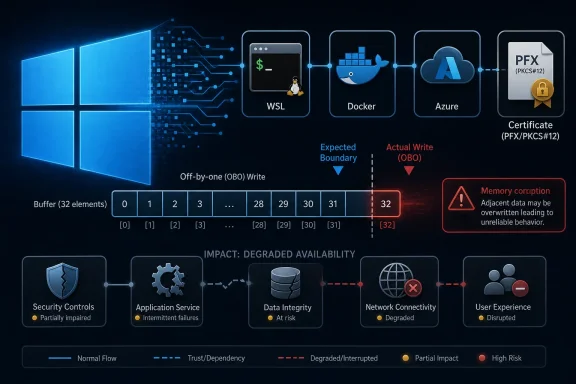 Microsoft’s Vulnerability Ledger Now Extends Well Beyond Windows
The most interesting thing about CVE-2026-42015 is not that an off-by-one error exists in a security library. That happens with depressing regularity. The more revealing detail is that Microsoft’s vulnerability machinery is surfacing a GnuTLS issue in a way that Windows administrators can no longer dismiss as someone else’s Linux problem.GnuTLS is a widely used TLS library in the Unix and Linux world. It is not the default cryptographic stack of the Windows desktop in the way SChannel is, but that distinction matters less than it used to. A Windows shop may not knowingly deploy GnuTLS on a domain controller, but it may still run workloads that depend on it in WSL, containers, GitLab runners, cross-platform agents, package scanners, mail gateways, VPN components, or Linux virtual machines managed by the same security team.
That is why this CVE belongs on WindowsForum. The old boundary between “Windows vulnerability” and “not our problem” has been eroding for years. Microsoft’s security ecosystem now tracks the full software supply chain around Windows as much as Windows itself, and CVE-2026-42015 is a small but useful example of that shift.
The reported impact is availability, not confidentiality or integrity. In plain English, the attacker’s likely win is crashing or disrupting a process that parses a malicious PKCS#12 structure, not stealing secrets outright or gaining administrator privileges. That puts the bug in the “patch in normal maintenance, accelerate where exposed” category rather than the “wake everyone up” category.
Still, availability bugs in cryptographic libraries deserve more respect than their CVSS labels often receive. A TLS component is rarely decorative. If it fails in the wrong service, the symptom is not “one library crashed”; it is failed authentication, broken certificate import, interrupted mail flow, failed package retrieval, or an outage that looks unrelated until someone finally reads the backtrace.
The Off-by-One Bug Is Small; the Trust Boundary Is Not
The technical description is almost comically modest: an off-by-one error in the PKCS#12 bag element bounds check. That means code responsible for handling a collection inside a PKCS#12 structure misjudged the edge of an internal array. Specifically, the public descriptions say appending to a bag that already contains 32 elements can write past that bag’s internal array.That is the kind of sentence that sounds minor until you remember that memory safety bugs do not care about human adjectives. One write past the end of an array can corrupt adjacent state, crash the process, or in some cases become a stepping stone toward a more severe exploit. The published assessment here is limited: denial of service or unspecified impact, with low availability impact and no confirmed confidentiality or integrity loss.
PKCS#12 itself is not exotic. It is a common format for bundling private keys, certificates, and related material, often seen in files with extensions such as .p12 or .pfx. Windows administrators know the format even if they never say “PKCS#12” aloud, because certificate export and import workflows have long used it.
That familiarity is what makes the bug operationally interesting. Certificate bundles move through deployment systems, browsers, VPN clients, mail systems, web servers, mobile-device management platforms, and developer environments. A malformed certificate bundle is not some theoretical packet from deep space; it is the sort of artifact an administrator might import, automate, sync, or receive from another team.
The current public scoring suggests network attackability with low complexity, no required privileges, and no user interaction. That combination is worth attention even when the direct impact is only partial availability. A bug that can be triggered without credentials and without a click is easier to fold into scanning, nuisance attacks, or service-specific disruption than one that needs a chain of social engineering and local access.
“Low Availability Impact” Still Means Someone’s Service Can Fall Over
The phrasing around CVE-2026-42015 is careful: performance may be reduced, resource availability may be interrupted, and even repeated exploitation should not completely deny service to legitimate users. That is vulnerability taxonomy doing its job. It distinguishes a partial disruption from a catastrophic outage.But real operations do not always map neatly onto scoring language. A crash in a redundant service can be a blip. A crash in a single certificate-processing worker can become a stuck queue. A crash in a small edge appliance can mean the only person who understands the fix is on vacation.
This is why availability bugs are so often underrated in patch planning. Security teams chase remote code execution because it is dramatic and measurable. Operations teams remember the incident where a “medium” bug took down authentication for a subset of users during a certificate rotation window.
For Windows-heavy organizations, the practical question is not whether Windows 11 itself is vulnerable in its default TLS stack. The better question is where GnuTLS is hiding in the estate. If your answer is “nowhere,” that should be a result from asset inventory, not a guess based on branding.
Linux servers in Azure may carry it. Developer workstations running WSL distributions may carry it. Containers based on Ubuntu, Debian, Alpine, SUSE, or Red Hat may carry it. Third-party appliances may include it and expose only a vendor update feed to the administrator. The vulnerability’s blast radius is therefore less about the word “GnuTLS” and more about the completeness of your software bill of materials.
The Windows Angle Is the Hybrid Estate Microsoft Helped Create
Microsoft spent the last decade making Windows a better citizen in Linux-heavy infrastructure. WSL became normal. Azure made mixed estates routine. DevOps pipelines blurred desktop, server, cloud, and container boundaries. The result is more flexible and often more productive, but it also means vulnerability management has to follow dependencies instead of operating-system tribal lines.CVE-2026-42015 sits squarely in that new reality. A Windows admin may see the MSRC entry and wonder why a Linux TLS library is appearing in a Microsoft security workflow. The answer is that Microsoft’s customers do not run tidy monocultures. They run Windows endpoints, Linux containers, Azure images, Kubernetes clusters, open-source developer stacks, and commercial software that quietly embeds components from all over the ecosystem.
This is especially true in security and identity workflows. Certificate files cross platforms constantly. A certificate generated on a Linux host may be imported into a Windows service. A .pfx exported from a Windows certificate store may be processed by a Linux automation script. A CI pipeline may convert, inspect, or bundle certificates using tools the endpoint team never approved because the build team owns that environment.
The attacker does not need to care whether your org chart says “Windows,” “Linux,” or “cloud.” The attacker cares whether a reachable parser mishandles a crafted object. That is the uncomfortable continuity between old-school memory bugs and modern hybrid infrastructure.
There is also a subtler point for Windows users who have embraced WSL as a convenience layer. WSL distributions are not patched by Windows Update in the same way the host operating system is. Updating Windows does not automatically mean every package inside every Linux distribution on a developer workstation is current. If GnuTLS is present inside that environment, it follows the package lifecycle of the distribution, not the cadence of the host OS.
PKCS#12 Is Boring Until Certificate Automation Touches It
Certificate handling is one of those corners of IT where boring is a virtue. Most administrators want certificate import, renewal, export, and deployment to be predictable, dull, and invisible. CVE-2026-42015 is a reminder that parsers for “boring” formats still sit on trust boundaries.PKCS#12 bundles are often treated as administrative objects rather than hostile input. That assumption is dangerous in automated environments. If a service accepts uploaded certificate bundles, if a tool imports them from external parties, or if a pipeline processes them as part of onboarding, then PKCS#12 is input validation territory.
The vulnerability description points to a specific edge case: a bag with 32 elements and an append operation that can go one past the internal array. That specificity is useful for developers and maintainers, but administrators should not overfit their thinking to the number. The operational lesson is broader: certificate-parsing paths are attack surfaces.
In many organizations, certificate workflows are also poorly documented. The person who built the renewal automation left three years ago. The appliance UI exposes only “upload certificate.” The Linux utility running inside the pipeline is installed because it was present in a base image. Nobody thinks of that as exposed infrastructure until a malformed object turns it into one.
This is where the “medium” severity label can mislead. Medium does not mean irrelevant. It means the likely impact is bounded. In a well-designed environment with patched packages, process isolation, and redundancy, bounded impact stays bounded. In a brittle environment, bounded impact can still produce a visible outage.
The Patch Story Is Already Fragmented by Design
Public distribution advisories show the expected pattern: fixed versions appear at different times for different Linux releases and vendors. Ubuntu lists fixes for supported releases such as 26.04 LTS, 25.10, 24.04 LTS, and 22.04 LTS, while older extended or unmaintained lines may require separate evaluation. Red Hat’s tracking shows advisories across Enterprise Linux versions, including RHEL 8, 9, 10, and an Extended Update Support stream.That is not evidence of chaos. It is how open-source vulnerability response works across distributions. Upstream fixes land, vendors backport, package versions differ, and the same underlying fix may appear under different version numbers depending on the platform.
For administrators, this means the question “Are we fixed?” cannot be answered by searching for one universal GnuTLS version. The correct answer depends on the distribution, package name, vendor backport policy, and support channel. On Ubuntu the relevant package is commonly gnutls28; on Red Hat-family systems it may appear simply as gnutls, with Red Hat advisory identifiers carrying the remediation detail.
This is also where vulnerability scanners can produce noisy results. A scanner that understands vendor backports may correctly mark a package as fixed even if the upstream version number looks old. A scanner that does not understand backports may flag false positives. Conversely, a container image built weeks ago may remain vulnerable even after the host is patched.
Windows administrators who are used to a more centralized patch identity model can find this frustrating. A KB number has its own complexities, but it gives the enterprise a recognizable artifact. Linux package remediation is more distributed. It rewards teams that know their base images, repositories, and rebuild pipelines, and it punishes teams that rely on “latest” tags and hope.
Containers Turn Medium Bugs Into Inventory Tests
If CVE-2026-42015 has a natural habitat in Windows-adjacent environments, it is the container image. Containers are where many organizations have accumulated Linux userlands without building Linux patch discipline to match. A Windows shop may have excellent endpoint management and still be running stale Ubuntu or Alpine layers in a build system.The vulnerable component may not be exposed directly to the network in every container. That matters. A dormant library inside an image is not the same as a reachable parser inside a service. But dormant libraries have a way of becoming active when an application adds certificate import, client authentication, S/MIME support, LDAP integration, package retrieval, or outbound TLS features.
The remediation path for containers is not “apt upgrade on the host.” It is rebuild, retest, redeploy. If the vulnerable library is in a base image, the base image needs updating and everything derived from it needs to move forward. If the library is installed during a Dockerfile build, the build cache may preserve an old package unless the pipeline is designed to refresh dependencies.
This distinction matters because many outage-prone security programs still confuse host patching with workload patching. Windows Update can make a server healthier while the containers running on it remain frozen in time. The same is true in Kubernetes clusters, CI runners, and developer environments where images are treated as artifacts rather than living systems.
For this CVE, that does not imply emergency rebuilds across every workload. It does imply that teams should be able to answer where GnuTLS appears, which images include affected packages, and whether any application path processes untrusted PKCS#12 data. If those questions take days, the vulnerability has already found a weakness in the organization’s process.
Memory Corruption Keeps Finding the Old Corners of New Infrastructure
The industry has spent years talking about memory safety, and for good reason. Rust, hardened allocators, fuzzing, sanitizers, and safer APIs have improved the state of the art. Yet CVE-2026-42015 is a reminder that enormous amounts of critical infrastructure still run through C code that was written for performance, portability, and long-term compatibility.An off-by-one bounds check is not a glamorous vulnerability class. It is one of the oldest software mistakes in the book. But old classes persist because old code persists, formats persist, and compatibility demands persist. Cryptographic libraries in particular live under the burden of supporting decades of protocols, encodings, certificate formats, and application expectations.
The fact that this bug appears in PKCS#12 handling is almost poetic. Certificate and key formats are full of nested structures, optional fields, legacy compatibility requirements, and parsing code that must accept messy real-world input. That is exactly the terrain where small boundary mistakes survive.
The security community often frames memory corruption in terms of exploitability. Can it become remote code execution? Is there a proof of concept? Is exploitation in the wild? Those are the right questions for triage, but they are not the only questions for engineering. The other question is why so many critical trust paths still depend on code where one boundary check can destabilize a process.
For WindowsForum readers, this intersects with Microsoft’s own long march toward memory safety in selected components and its broader support for safer languages in the ecosystem. But no vendor can memory-safe its way out of every third-party dependency overnight. The transition will be slow, uneven, and full of medium-severity bugs that look individually manageable but collectively expensive.
The CVSS Score Is a Floor, Not a Patch Plan
CVE-2026-42015 has been presented with a medium CVSS 3.1 score of 5.3 in public advisories, with network attack vector, low attack complexity, no privileges required, no user interaction, unchanged scope, no confidentiality impact, no integrity impact, and low availability impact. That score is useful. It is not a deployment calendar.A public-facing service that accepts PKCS#12 uploads deserves faster attention than an offline utility used only by a trusted administrator. A container image with GnuTLS installed but no code path to parse PKCS#12 files deserves tracking and normal rebuild hygiene. A developer laptop running an affected WSL distribution may be lower priority, unless that laptop participates in certificate automation or test harnesses processing untrusted artifacts.
This is the difference between vulnerability severity and environmental risk. Severity describes the bug in the abstract. Risk describes the bug inside your architecture. Security programs fail when they treat those as identical.
The user-supplied impact language emphasizes that repeated exploitation should not completely deny service to legitimate users. That matters because it discourages exaggeration. There is no public basis here for claiming a total service-killer across all GnuTLS deployments.
But the same language leaves room for repeated disruption, degraded performance, and intermittent availability. In operational terms, intermittent failures are often harder to diagnose than clean outages. A service that crashes only when a certain certificate bundle is processed can look like a flaky dependency, a bad deployment, or a storage issue until the security root cause is identified.
The Microsoft Listing Should Prompt Better Dependency Hygiene, Not Windows Panic
There is a familiar cycle around vulnerability listings. A CVE appears in a Microsoft guide, scanners light up, dashboards turn red, and teams ask whether Windows is “affected.” That question is understandable, but for CVE-2026-42015 it is too narrow.The more useful response is to map dependency ownership. Who owns Linux packages inside WSL images? Who owns base container images? Who owns third-party appliances that bundle open-source TLS libraries? Who owns certificate-processing workflows? If the answer is “different teams, none of them talking,” then the vulnerability is exposing a governance problem as much as a code flaw.
This is where Microsoft’s broader security ecosystem can be both helpful and misleading. Helpful, because central visibility pulls non-Windows dependencies into the same conversation as Windows updates. Misleading, because the presence of an MSRC entry can make teams assume the remediation will arrive through familiar Microsoft channels. In many cases, it will not.
The fix may come from Canonical, Red Hat, SUSE, Alpine, Debian, a container base-image maintainer, an appliance vendor, or an application vendor that statically links or bundles a library. The administrator’s job is to follow the dependency to the place where it is actually updated.
That is not glamorous work. It is package inventory, image rebuilds, vendor tickets, maintenance windows, and scanner tuning. But it is exactly the work that prevents medium-severity vulnerabilities from becoming surprise outages.
The Practical Read Is Written in the Certificate Path
For most WindowsForum readers, the right response is measured and specific: identify where GnuTLS exists, prioritize systems that process untrusted PKCS#12 data, and patch through the relevant vendor channel. This is not a reason to shut down certificate workflows or treat every .pfx file as radioactive. It is a reason to stop assuming certificate parsers are harmless because they sit behind administrative interfaces.- Organizations should check Linux distributions, WSL environments, containers, and appliances for affected GnuTLS packages rather than limiting the review to traditional Windows hosts.
- Systems that accept, import, transform, or validate PKCS#12 certificate bundles from untrusted or semi-trusted sources should move higher in the remediation queue.
- Containerized workloads should be rebuilt from patched base images, because host patching alone will not update frozen userland libraries inside existing images.
- Vulnerability scanner results should be interpreted against distribution backport policies, since a fixed vendor package may not carry the newest upstream version number.
- The absence of confirmed confidentiality or integrity impact should lower panic, not eliminate action, because partial availability failures can still break real services.
CVE-2026-42015 will probably not be remembered as one of 2026’s defining vulnerabilities. It is too bounded, too specific, and too ordinary for that. But ordinary vulnerabilities are the ones that test whether an organization’s security program actually understands its estate, and this one asks a pointed question of Windows-centric teams living in a hybrid world: when Microsoft flags a Linux library flaw, do you know whether it is yours to fix?
References
- Primary source: MSRC
Published: 2026-06-11T01:43:44-07:00
Security Update Guide - Microsoft Security Response Center
 msrc.microsoft.com
- Related coverage: vulnerability.circl.lu
Vulnerability-Lookup
Vulnerability-Lookup - Fast vulnerability lookup correlation from different sources.vulnerability.circl.lu - Related coverage: security.snyk.io
- Related coverage: osv.dev

OSV - Open Source Vulnerabilities
Comprehensive vulnerability database for your open source projects and dependencies.
osv.dev
- Related coverage: radar.offseq.com
CVE-2026-42015: Off-by-one Error in Red Hat Red Hat Enterprise Linux 10 - Live Threat Intelligence - Threat Radar | OffSeq.com
Detailed information about CVE-2026-42015: Off-by-one Error in Red Hat Red Hat Enterprise Linux 10 affecting Red Hat Red Hat Enterprise Linux 10. Get real-timeradar.offseq.com
