

A Linux TLS Bug Lands in the Microsoft Inbox
The interesting part of CVE-2026-42013 is not that GnuTLS had another certificate-validation bug. The interesting part is that Microsoft’s vulnerability machinery now routinely surfaces flaws in components that many Windows shops still mentally file under “someone else’s stack.” That split between ownership and exposure is where a lot of modern enterprise risk lives.
GnuTLS is an open-source TLS library used across Linux distributions and network-facing software. It is not the TLS stack Windows uses for Schannel, Edge, or most native Microsoft desktop plumbing. But that distinction is less comforting than it sounds, because Windows networks are full of non-Windows dependencies: WSL images, Linux containers on developer workstations, Kubernetes nodes, security appliances, Git tooling, backup agents, CI runners, cross-platform apps, and server-side workloads that authenticate to Microsoft services.
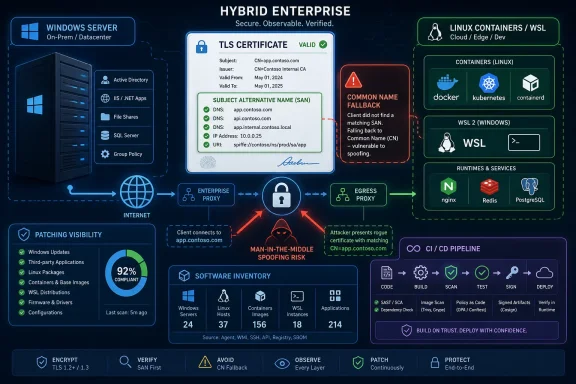
CVE-2026-42013 sits in the certificate-name validation path. When a certificate includes an oversized Subject Alternative Name, the vulnerable behavior can cause the library to fall back to matching a DNS hostname against the older Common Name field. That matters because the web PKI has spent years moving away from Common Name fallback precisely because it is ambiguous, legacy-friendly, and easier to misuse.
The bug therefore reads like a small parser edge case, but its security consequence is conceptual: a certificate that should be rejected may be treated as acceptable. In the TLS world, that is the difference between “this server is who it claims to be” and “this connection merely looks encrypted.”
The Common Name Should Have Stayed Buried
For years, the Common Name field was the place people put the hostname a certificate was meant to identify. Then the Subject Alternative Name extension became the proper home for that identity, and modern certificate validation shifted accordingly. The reason was not stylistic. SANs allow explicit, structured names, while Common Name fallback creates compatibility behavior that attackers can try to bend.
CVE-2026-42013 is a reminder that legacy behavior does not always disappear when standards move on. Sometimes it remains as a fallback path, a compatibility courtesy, or a “just in case” branch buried inside validation logic. Those branches are dangerous because they are usually exercised only under weird conditions, exactly the territory where fuzzers, researchers, and attackers find daylight.
The reported GnuTLS issue involves an oversized SAN. In plain English, the certificate presents a name extension large enough to disrupt the expected validation path. Instead of simply failing the certificate as unsuitable, the vulnerable path may consult the Common Name and allow a match there.
That is not the same as stealing a private key or breaking encryption math. It is subtler and, in some environments, more operationally awkward. The attacker still needs a scenario where they can present a crafted certificate and benefit from a victim accepting it. But if they can do that, the entire promise of hostname validation becomes negotiable.
“Encrypted” Was Never the Same as “Authenticated”
Users and even some administrators still talk about TLS as if encryption is the whole product. It is not. TLS has two jobs: protect the session from eavesdropping and prove that the remote endpoint is the one the client intended to reach. CVE-2026-42013 attacks the second job.
A successful man-in-the-middle attack does not need to defeat AES or invent a quantum computer. It needs the client to accept the wrong certificate for the right name. Once that happens, the padlock is still there, packets are still encrypted, and logs may still show a TLS connection. The trust decision underneath has already gone bad.
That is why certificate-validation bugs tend to feel disproportionate. They often lack the fireworks of remote code execution, yet they undermine the foundation on which secure update checks, API calls, package downloads, webhook delivery, SSO handshakes, and internal service-to-service traffic depend. If the wrong certificate is accepted, all the layers above TLS inherit a false premise.
For Windows-heavy organizations, this is especially uncomfortable because the vulnerable library may not be where the Windows patching team usually looks. A developer’s Ubuntu container, a GitLab runner, a Linux-based network scanner, or a storage appliance may be the component doing the TLS verification. The attack surface is not defined by the logo on the laptop; it is defined by the software that makes outbound and inbound trust decisions.
The Severity Score Tells Only Part of the Story
Public vulnerability databases have described CVE-2026-42013 as a high-scoring issue under CVSS, while GnuTLS’s own advisory classifies it as a medium-severity certificate misuse bug and recommends upgrading to GnuTLS 3.8.13 or later. That gap is not necessarily a contradiction. It reflects the old problem with security scoring: generic impact models and maintainer context do not always speak the same operational language.
From a maintainer’s perspective, this is not a universal instant-compromise bug. It requires a crafted certificate, a validation path that hits the vulnerable behavior, and an attacker position where spoofing or interception matters. That makes it less dramatic than a wormable memory corruption flaw.
From a defender’s perspective, however, certificate-validation bypasses are hard to wave away. They sit in code that applications call precisely when they are trying to decide whether to trust something. A bug there can affect many programs without each program’s maintainer making an obvious mistake.
The right reading is not “panic” or “ignore.” It is inventory first, patch second, test assumptions third. If vulnerable GnuTLS is present only in a dormant package on a lab VM, this is not your top incident-response item. If it is inside an outbound proxy, mail gateway, package-fetching pipeline, identity connector, or production service that validates external endpoints, the risk calculation changes quickly.
This is also why administrators should be careful with vendor dashboards that flatten everything into one severity color. CVE-2026-42013 is a certificate bug, and certificate bugs are context multipliers. They become more or less serious depending on where the library is used, what it connects to, whether attackers can influence network paths, and whether internal tooling treats TLS success as authorization-adjacent proof.
Microsoft’s Role Is Signal, Not Ownership
The Microsoft Security Update Guide entry may tempt some readers to ask when Windows Update will fix this. For most ordinary Windows clients, that is the wrong question. CVE-2026-42013 is a GnuTLS issue, and the fix is generally delivered through the operating system or product that ships vulnerable GnuTLS packages.
Microsoft’s role here is better understood as ecosystem signaling. The company maintains a massive vulnerability index because its customers operate in heterogeneous environments. Azure workloads, Linux virtual machines, containers, Dev Boxes, Windows Subsystem for Linux distributions, enterprise software dependencies, and third-party appliances all coexist in the same administrative reality.
That is the practical reason Microsoft surfaces issues like this. A Windows administrator may not maintain GnuTLS directly, but they may own the risk that results when a Linux-based tool inside the Windows estate trusts the wrong certificate. In 2026, “Microsoft environment” often means Entra ID, Windows endpoints, Azure compute, Linux containers, SaaS connectors, and open-source packages in the same blast radius.
The advisory also reflects a broader truth about modern patch management. The old monthly rhythm of Patch Tuesday is no longer enough. Some of the most important fixes in a Microsoft-centered organization arrive through apt, dnf, zypper, container rebuilds, base-image refreshes, firmware updates, and application vendor hotfixes. The security team that watches only Windows Update is watching only part of the board.
The Real Exposure Is Hidden in Build Pipelines
The easiest place to understand CVE-2026-42013 is a browser connecting to a website, but that may not be the most important place to look. The more interesting exposure is in automated systems that fetch, verify, synchronize, or publish data without a human watching the certificate prompt. Build pipelines are particularly fertile ground.
A CI runner that uses a vulnerable GnuTLS-linked tool may download dependencies from package repositories, internal artifact stores, or vendor endpoints. A man-in-the-middle opportunity against that traffic could become more than a spoofed webpage. It could become a supply-chain problem if the surrounding controls also fail.
The same logic applies to backup systems, monitoring agents, SSO helpers, API clients, and container image tooling. Many of these systems run headless and privilege-rich. They may also sit in network segments where administrators assume outbound TLS is sufficient protection against tampering.
That assumption deserves scrutiny. TLS is only as reliable as certificate validation, and certificate validation is implemented by libraries with real code, real edge cases, and real legacy behavior. CVE-2026-42013 is another entry in a long ledger showing that trust plumbing needs patching as much as kernels and browsers do.
For Windows shops, the challenge is cultural as much as technical. The machines with the most visible risk may not be Windows desktops. They may be the Linux hosts that Windows teams inherited because a backup appliance, SIEM connector, container platform, or developer workflow required them. If those systems are outside the normal patch cadence, a Microsoft advisory becomes less a fix notice than a map of forgotten responsibility.
Containers Make Old Libraries Look New
Containers complicate the story because they blur the difference between “the host is patched” and “the workload is patched.” A Linux host may have a fixed GnuTLS package, while container images built weeks earlier still carry the vulnerable library. Conversely, a Windows developer workstation may be fully current while WSL distributions or local container images lag behind.
This is the problem with dependency risk in 2026: software does not live in one place. It is copied into base images, cached in build layers, embedded in appliances, and vendored into applications. Patching the package manager’s current view of the world is necessary, but it may not touch the image actually running in production.
CVE-2026-42013 should therefore trigger a rebuild conversation, not merely an update conversation. Administrators need to ask which images include GnuTLS, when those images were last rebuilt, and whether production deployments are pinned to old digests. If the answer is “we patch hosts but rarely rebuild base images,” the organization has a visibility gap.
The same applies to developer workstations. WSL has made Linux tooling feel native to Windows, which is wonderful for productivity and occasionally miserable for patch governance. A developer may have Windows fully updated and still run stale Linux userspace packages inside a distro that no one in central IT inventories.
Appliances Are the Patch-Management Blind Spot
Network and security appliances deserve their own suspicion. Many of them are Linux-based, many use open-source TLS libraries, and many expose a vendor-branded management plane that hides the underlying package inventory. The customer often cannot simply upgrade GnuTLS directly; they must wait for the vendor to ship an appliance firmware or software update.
That does not make CVE-2026-42013 immediately exploitable against every appliance. It does mean the remediation path may be slower than the CVE entry implies. “Upgrade to GnuTLS 3.8.13 or later” is straightforward on a supported Linux distribution. It is much less straightforward when the vulnerable library is bundled inside a product image.
Administrators should press vendors for clarity. Does the product use GnuTLS? Is certificate hostname validation performed through the affected code path? Is the product a TLS client, a TLS server, or both in relevant scenarios? Has the vendor rebuilt against a fixed library, backported a patch, or determined the product is not affected?
The worst answer is silence disguised as assurance. A vendor statement that says “we are investigating” is acceptable for a short period. A vendor statement that says nothing while the product performs privileged TLS connections into the enterprise should not satisfy anyone.
Not Every Windows User Needs to Care Equally
For a home Windows user, CVE-2026-42013 is unlikely to be a direct call to action unless they run Linux tools, WSL distributions, self-hosted services, or third-party applications that bundle GnuTLS. Windows Update remains important, but it is not the main remediation channel for this particular flaw.
For enthusiasts, the story is more relevant. If you run a homelab with Debian, Ubuntu, Fedora, openSUSE, containers, reverse proxies, Git servers, or package mirrors, this is the sort of bug that should push you to refresh systems and images. It is exactly the kind of vulnerability that hides behind “it’s just my lab” until the lab has VPN access, saved credentials, and automation keys.
For enterprise administrators, the priority is mapping use, not memorizing the CVE text. Systems that validate certificates while connecting to untrusted or semi-trusted endpoints deserve the first look. Internal services are not automatically safe either, especially in flat networks where DNS spoofing, proxy compromise, rogue Wi-Fi, or compromised developer machines can create interception opportunities.
Security teams should also resist the urge to treat “medium” as a synonym for “later.” Certificate validation flaws are rarely the noisiest vulnerabilities in a scanner report, but they can be unusually consequential when they sit inside trust-sensitive workflows. The better question is not “what is the score?” but “what trust decision could this library make wrong?”
The Fix Is Simple Until the Inventory Is Not
The upstream recommendation is clean: move to a fixed GnuTLS release, with GnuTLS 3.8.13 or later identified by the project as containing the fix. Linux distributions may backport the patch into older version numbers, so administrators should not rely solely on upstream version comparisons. Distribution security notices and package changelogs matter.
That nuance trips up many Windows-first teams. On enterprise Linux, a package version may look old while carrying a security backport. A scanner that flags only the upstream version string can create false positives; a team that dismisses all old-looking versions can create false negatives. The answer is to correlate package status with the distribution’s security advisory, not to eyeball a version number in isolation.
The practical remediation sequence is familiar. Update supported distributions through their normal package channels. Rebuild containers and redeploy them rather than assuming the host update fixed image contents. Ask vendors about bundled libraries. Remove unsupported systems from trust-sensitive roles if they cannot receive a fixed package.
The harder part is proving coverage. If an organization cannot answer where GnuTLS exists in its fleet, CVE-2026-42013 becomes a small audit of software composition maturity. That is not a glamorous exercise, but it is precisely where modern security programs either work or reveal they are mostly ticket queues attached to scanner output.
A Certificate Bug Exposes the Shape of the Modern Windows Estate
The lesson from CVE-2026-42013 is not that GnuTLS is uniquely fragile. Every major TLS stack has carried validation bugs, parser bugs, timing bugs, or compatibility traps over the years. The lesson is that trust code is part of the shared infrastructure of computing, and it travels farther than most asset inventories admit.
WindowsForum readers live at the intersection of Windows and everything Windows now touches. That means Microsoft advisories about non-Windows components are not noise. They are evidence of the hybrid estate becoming normal enough that Microsoft’s security guidance has to follow the dependency graph rather than the product logo.
There is a strategic point here for administrators. The future of Windows security is not just hardening Windows. It is understanding the Windows-adjacent ecosystem: Linux guests, open-source libraries, container bases, browser runtimes, identity SDKs, cloud agents, and third-party management tools. Attackers do not care which team owns the component that fails.
CVE-2026-42013 is an example of a vulnerability whose practical effect depends on the environment around it. In a narrow, patched desktop context, it may be uninteresting. In a sprawling automation-heavy enterprise, it may sit inside a path that fetches code, validates services, or connects privileged systems. The same CVE can be boring in one place and important in another.
The Patch Note Is Small; the Trust Boundary Is Not
This is the kind of vulnerability that rewards disciplined housekeeping rather than heroic incident response. The fix path is known, there is no need to invent exotic mitigations, and panic would be misplaced. But ignoring it because it says GnuTLS instead of Windows would miss the larger operational message.
- Organizations should identify where GnuTLS is installed, bundled, or embedded before deciding that CVE-2026-42013 is irrelevant.
- Linux distributions may provide fixed packages with backported patches, so the distribution’s security status matters more than a simple upstream version comparison.
- Container images, WSL distributions, CI runners, and appliances can remain vulnerable even after host operating systems are patched.
- Systems that perform automated TLS connections to repositories, APIs, identity services, or vendor endpoints deserve higher priority than dormant packages on isolated machines.
- Vendor-managed products should be checked for exposure because customers may not be able to upgrade bundled GnuTLS libraries directly.
- The vulnerability is best treated as a test of certificate-validation dependency visibility, not merely as another scanner item to close.
The forward-looking lesson is blunt: Windows security teams can no longer define their patch perimeter by Windows alone. CVE-2026-42013 is a medium-sized bug in a non-Microsoft TLS library, but it points at a much larger reality: the systems that protect Windows estates increasingly depend on open-source components, Linux userlands, and automated trust decisions outside the traditional Windows Update lane. The defenders who adapt fastest will be the ones who treat those dependencies as first-class assets before the next certificate edge case becomes the breach path.
References
- CVE-2026-42013 Gnutls: gnutls: certificate validation bypass due to oversized subject alternative name MSRC · 2026-06-11T01:43:37-07:00