

The Small Print Is the Story This Time
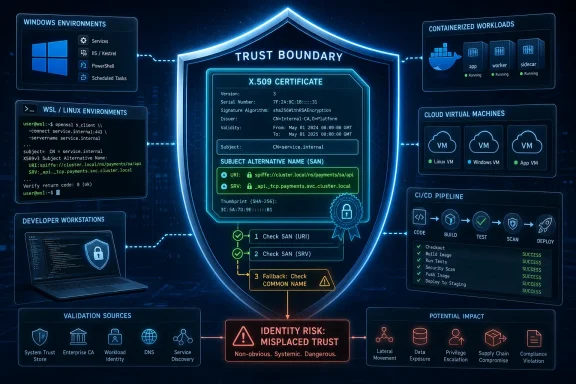
The Microsoft Knowledge Base disclaimer attached to this CVE is boilerplate, but the vulnerability itself is not. CVE-2026-42012 is about what happens when a certificate contains URI or SRV Subject Alternative Names, and GnuTLS falls back to checking DNS hostnames against the certificate’s Common Name. In practical terms, that can let a certificate issued for one intended purpose be accepted in a context where it should not be trusted.
That sounds painfully narrow until you remember what certificates do. They are the machine-readable answer to “am I really talking to the service I think I am talking to?” When certificate validation becomes too permissive, the failure mode is not a crash or an obvious broken login screen. The failure mode is misplaced confidence.
GnuTLS upstream categorized the issue as certificate misuse and recommended upgrading to GnuTLS 3.8.13 or later. Debian tracked fixed packages across its supported branches, while vulnerability databases described a remote attacker presenting a specially crafted certificate with URI or SRV SANs to trigger the faulty validation behavior. Microsoft’s appearance in the story is therefore less about Windows Update pushing a patch to every desktop and more about MSRC acting as a visibility layer for a component that may exist in Microsoft-connected ecosystems.
The modern Windows estate is no longer only Windows. It is Windows Server hosting Linux containers, developer laptops running WSL, Azure images, Git tooling, package managers, backup appliances, security scanners, proxies, and line-of-business software that quietly bundles open-source libraries. A certificate bug in GnuTLS is a reminder that trust boundaries now run through dependencies most administrators never selected directly.
Certificate Validation Bugs Rarely Look Dangerous Until They Are
The phrase certificate validation bypass carries a strange ambiguity. It can describe catastrophic authentication failure, or it can describe a tightly scoped standards-compliance mistake with limited exploitability. CVE-2026-42012 appears closer to the second category than the first, but that should not make administrators shrug.
The danger is contextual. An attacker generally needs a position where presenting a crafted certificate matters: a man-in-the-middle position, control over a malicious endpoint, a compromised internal service, or influence over a client’s connection path. That is not the same as “anyone on the internet owns your server.” It is, however, exactly the kind of condition that exists during Wi-Fi interception, DNS manipulation, proxy abuse, captive portals, compromised routers, or hostile network segments.
The technical detail that matters is the fallback. Modern certificate matching is supposed to rely on the Subject Alternative Name extension, not casual interpretation of the Common Name field. SANs exist because the old Common Name model was too loose for the way the internet and enterprise PKI evolved. If validation logic sees SANs of certain types and then falls back to Common Name matching in a way it should not, the certificate’s intended identity can be stretched.
That stretching is the bug. A certificate that contains URI or SRV SANs may be meaningful for one service identity model, but DNS hostname validation is a different question. If software treats the certificate as acceptable for a hostname because it fell through to a Common Name comparison, the attacker has found a seam between standards and implementation.
This is why certificate bugs are so irritating for defenders. They often do not announce themselves in logs as “attack detected.” The TLS session may complete. The application may behave normally. The user may see no warning. The entire compromise is that the system believed the wrong thing with perfect confidence.
GnuTLS Is Not OpenSSL’s Famous Cousin; It Is Infrastructure
OpenSSL gets the cultural attention, partly because of Heartbleed and partly because it is everywhere. GnuTLS has a quieter profile, but it is still widely used across Linux distributions and networked software. It provides TLS, X.509 certificate handling, cryptographic primitives, and the plumbing that lets applications outsource one of the hardest parts of secure communications.
That outsourcing is both necessary and dangerous. No sane application developer wants to implement full certificate path validation from scratch, and no sane administrator wants every vendor inventing its own TLS stack. But centralized libraries create centralized classes of failure. When the library gets hostname validation subtly wrong, every application depending on the vulnerable path inherits the mistake.
The Windows relevance is indirect but real. Many Windows shops run Linux servers. Many Windows developers use Linux containers locally. Many enterprise products ship as virtual appliances with a Linux base. Many security, monitoring, and DevOps tools are written for cross-platform deployment and may link against different TLS libraries depending on platform, build flags, or distribution packaging.
That means the useful question is not “does Windows itself use GnuTLS for Schannel?” It generally does not; Windows has its own TLS stack. The useful question is “where in my Windows-managed environment do I have software that brings GnuTLS along for the ride?” That answer can be surprisingly long.
WSL is an obvious example. A developer running Debian, Ubuntu, or another distribution inside WSL may have GnuTLS installed through package dependencies. If that environment is used for internal tooling, package downloads, service calls, or test automation, certificate validation behavior still matters. The trust decision happens inside the Linux userland, even though the laptop has a Windows logo on the lid.
The SAN Detail Shows How Security Regressions Hide in Standards
Subject Alternative Names were designed to make certificate identity more explicit. DNS names, IP addresses, email addresses, URIs, and other identity forms can all be represented as SAN entries. That flexibility is useful, but it also creates a parsing and policy challenge: not every name type is valid for every verification purpose.
A TLS client connecting to example.com should verify that the certificate is valid for that DNS name. A service identity expressed as a URI or SRV name is a different kind of assertion. The certificate may still be legitimate, signed, and unexpired, but legitimacy is not enough. The question is whether it is legitimate for this use.
The Common Name fallback is the historical trapdoor. For years, clients relied on CN matching when SANs were absent. Over time, the industry moved away from that behavior because it produced ambiguity and inconsistent validation. The safest interpretation is simple: if the certificate has SANs relevant to the identity being checked, the validation logic should not rummage around in the Common Name looking for a second chance.
CVE-2026-42012 is interesting because it lives in the gap between “has SANs” and “has the SAN type I expected.” If a certificate has URI or SRV SANs, but not the right DNS SAN, a permissive fallback can turn a certificate meant for one namespace into a certificate accepted for another. That is not merely a parser bug. It is a policy bug.
Policy bugs are harder to explain than buffer overflows, but they are often more revealing. They show where code preserves legacy compatibility at the expense of modern assumptions. They also show why security standards are not self-enforcing. A library can support X.509 and TLS and still make the wrong choice at the precise branch where trust is decided.
The Patch Is Easy; Finding the Blast Radius Is Not
The upstream answer is straightforward: upgrade to GnuTLS 3.8.13 or a distribution-patched equivalent. Debian’s tracker shows fixed package versions for multiple releases, and other vendors have issued or tracked their own updates. For administrators, though, “upgrade GnuTLS” is not a single action unless they own every image, appliance, container, and embedded runtime in the estate.
Linux distributions usually make this manageable. If the vulnerable library comes from the OS package manager, the fix should arrive through normal security updates. The more difficult cases are statically linked binaries, vendor appliances, old containers, language-specific package ecosystems, and products that bundle their own crypto stack. Those cases can remain vulnerable long after the base operating system is patched.
Containers deserve particular attention. A Windows shop that has embraced containers may assume vulnerability management is covered because the host is patched. That assumption is wrong. If an image contains an affected GnuTLS package and the image is not rebuilt from a fixed base, the vulnerable library can persist indefinitely.
The same is true for golden images and build agents. CI/CD workers often perform sensitive network operations: pulling dependencies, contacting artifact repositories, signing or verifying packages, talking to cloud APIs, and deploying into production. A certificate validation bypass in a build environment is not automatically exploitable, but it is exactly the sort of weakness attackers look for after gaining a foothold in network infrastructure.
This is where vulnerability management becomes less about severity scores and more about asset literacy. The organizations that can answer “where do we run GnuTLS?” will patch quickly. The organizations that cannot will wait for scanners, vendor bulletins, and luck.
Microsoft’s Role Is Visibility, Not Ownership
The MSRC entry may confuse some readers because the vulnerable component is GnuTLS, not a native Microsoft TLS library. That is a feature of modern security reporting, not necessarily a sign that Windows itself is directly affected. Microsoft’s Security Update Guide increasingly surfaces issues that matter to Microsoft products, services, dependencies, or customer environments, even when the root component is open source.
That distinction matters because Microsoft’s KB-style disclaimer is legal framing, not technical triage. It does not mean the issue is theoretical, and it does not mean Microsoft is the upstream maintainer of the affected library. It means the information is being published through Microsoft’s vulnerability-information machinery, with the usual caveat that customers must evaluate applicability in their own environments.
For Windows administrators, the practical reading is: do not wait for a Windows cumulative update if the affected software lives elsewhere. Patch the Linux distribution, appliance firmware, container base image, or application package that actually ships GnuTLS. If a Microsoft product or Azure image includes an affected package, follow the vendor’s update path for that product. The trust chain is operational, not brand-based.
This is also a useful moment to separate vendor ecosystems from security boundaries. A Windows domain can authenticate users while Linux services terminate TLS. Azure can host a VM image maintained by a third party. A Windows developer can run a Linux package manager inside WSL. None of those boundaries make certificate validation bugs disappear.
The industry still talks about vulnerabilities as if they belong cleanly to products. CVE-2026-42012 belongs more accurately to a dependency graph. That graph crosses operating systems, packaging formats, cloud images, and procurement lines.
The Real Risk Is Service Spoofing, Not Instant Catastrophe
A sober reading of CVE-2026-42012 should avoid both panic and dismissal. This is not a wormable Windows flaw, and there is no public indication from the core advisories that every GnuTLS-using application is trivially exploitable. The attacker has to make the target validate a crafted certificate in a vulnerable way and in a context where spoofing matters.
But spoofing matters often. Package repositories, internal APIs, service discovery, mail infrastructure, directory services, Git remotes, monitoring endpoints, and management consoles all depend on clients correctly deciding which server they are talking to. If that decision can be bent, attackers can intercept credentials, serve malicious content, or quietly proxy traffic.
The SRV angle is particularly relevant in enterprise environments because SRV records are used for service discovery. The URI angle matters because modern systems often express identities and endpoints as structured resource identifiers rather than simple hostnames. These are not exotic certificate features reserved for academic PKI labs. They are part of the machinery that lets distributed services find and trust each other.
The word “potentially” does a lot of work in vulnerability descriptions, and rightly so. Exploitability depends on application behavior, certificate issuance conditions, trust anchors, network position, and whether the vulnerable code path is reached. Still, defenders should not confuse conditional exploitability with irrelevance. Many real intrusions are chains of conditional steps.
A certificate validation bypass is often a force multiplier. It may not be the first vulnerability in an attack. It may be the thing that turns DNS manipulation into credential capture, or a compromised proxy into a convincing endpoint, or an internal foothold into a supply-chain compromise.
Compatibility Debt Keeps Reappearing as Security Debt
The Common Name fallback exists because the internet is old, messy, and addicted to backward compatibility. There are always legacy certificates, older applications, and deployed systems that expect yesterday’s behavior. Library maintainers live under pressure not to break working software, even when “working” means “depending on semantics that should have died years ago.”
That tension is not unique to GnuTLS. It is the central conflict of platform security. Tighten validation too aggressively and customers complain that upgrades broke production. Leave compatibility paths open too long and attackers exploit the ambiguity. Every TLS library, browser, operating system, and enterprise middleware stack has had to navigate that trade-off.
The lesson is not that maintainers should be blamed for every edge-case bug in X.509 processing. Certificate validation is notoriously complex, and the surrounding standards have accumulated decades of exceptions. The lesson is that old compatibility behavior must be treated like hazardous material. It may be necessary in small quantities, but it should be isolated, documented, tested, and eventually removed.
CVE-2026-42012 fits into a broader pattern of certificate-name handling issues disclosed around the same GnuTLS update cycle. Upstream advisories around late April 2026 included multiple certificate-related problems, including name constraint handling and SAN-related validation behavior. That clustering suggests not a single catastrophic collapse, but a renewed hardening pass through code paths where identity rules meet messy real-world certificates.
For defenders, clusters like this are useful signals. When several related issues land at once, patch priority should rise even if each individual CVE receives a medium severity label. Attackers do not care whether a weakness is elegant enough to deserve a high score. They care whether it helps them cross a trust boundary.
Windows Shops Need a Dependency Inventory That Includes Linux
The practical work begins with inventory. Traditional Windows patch management is good at counting Windows builds, cumulative updates, Office versions, Defender status, and sometimes browser patch levels. It is often much worse at identifying open-source libraries inside Linux containers, appliances, developer toolchains, and third-party software deployed adjacent to Windows systems.
That gap is no longer acceptable. A Microsoft-centric enterprise may still run Kubernetes nodes, Ubuntu build agents, Debian-based appliances, Red Hat servers, Git clients, package mirrors, and scanner engines. The security posture of that environment depends on Linux package hygiene even if every human user signs in through Entra ID and every endpoint is managed by Intune.
Software bills of materials can help, but only if they are current and operationally connected to patching. SBOMs that sit in procurement folders do not rebuild vulnerable containers. Vulnerability scanners help, but they can miss statically linked libraries or vendor-customized builds. Endpoint management helps, but it may not see inside ephemeral workloads.
The best response is layered. Update distribution packages where possible. Rebuild containers from patched bases. Ask vendors whether they bundle GnuTLS and which version they ship. Check WSL distributions on developer machines if those environments touch sensitive internal services. Treat build infrastructure as production infrastructure, because attackers increasingly do.
This is not glamorous work. It is also the difference between a vulnerability advisory that becomes a ticket and one that becomes an incident report.
The Certificate Bug That Teaches a Windows Lesson
CVE-2026-42012 is a good test of whether an organization’s security process understands the systems it actually runs. The remediation is not conceptually hard, but it cuts across packaging, ownership, and assumptions about where risk lives.
- Organizations should update GnuTLS to 3.8.13 or a vendor-patched equivalent wherever the affected library is present.
- Administrators should look beyond Windows Update and check Linux distributions, WSL instances, containers, appliances, and third-party tools that may include GnuTLS.
- Security teams should treat certificate validation bypasses as trust-boundary issues, even when the severity label is not critical.
- Container images and build agents should be rebuilt or refreshed, not merely scanned on the host.
- Vendor-managed products should be checked through their own advisories, because bundled libraries may not track the host operating system’s package state.
The broader lesson is that TLS trust is only as strong as the least visible validator in the path. Windows administrators have spent years learning to patch the operating system quickly. The next maturity jump is learning to patch the dependency graph with the same urgency.
CVE-2026-42012 will probably not be remembered as one of the defining vulnerabilities of 2026, and that is precisely why it is worth paying attention to now. The future of enterprise Windows security will be shaped less by clean platform boundaries and more by mixed estates where open-source libraries, cloud images, containers, and developer runtimes make trust decisions on Microsoft-managed networks every second. The organizations that adapt to that reality will treat this GnuTLS flaw not as someone else’s Linux advisory, but as another warning that identity, once delegated to code you barely know you run, must still be patched like the crown jewels.