

The Smallest Character in the Room Gets the Biggest Vote
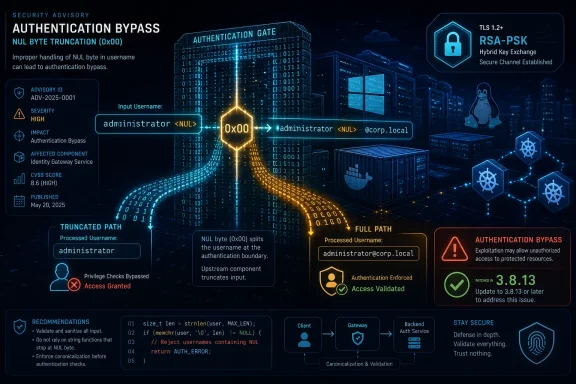
The vulnerability turns on an old programming trap: the NUL character. In C-derived software, a NUL byte often marks the end of a string, even when a higher-level protocol thinks it is carrying a longer identity value. If one layer sees admin and another layer sees admin\0anything, security decisions can quietly split in two.
GnuTLS says the affected condition involves servers configured with RSA-PSK, or RSA pre-shared key authentication. In that mode, usernames are not decorative metadata; they are part of the machinery that selects or validates a shared secret. If the server compares the wrong length, a crafted identity can be matched as though it were the truncated, legitimate username.
That is the kind of bug security teams hate because the exploit story is conceptually simple while the exposure story is not. Few administrators can instantly answer which services in their environment use GnuTLS, fewer still can say which of those use RSA-PSK, and almost nobody has that inventory already filtered by library version, container base image, and appliance firmware.
Microsoft’s Listing Is a Supply-Chain Signal, Not a Windows Panic Button
The appearance of CVE-2026-42010 in Microsoft’s Security Update Guide will naturally catch the eye of Windows administrators. Microsoft’s vulnerability portal has become a clearinghouse for risks that may matter to Microsoft customers even when the root project is not authored in Redmond. That distinction matters.
This is not the same thing as saying every Windows desktop is exposed. GnuTLS is a widely used TLS library in the Linux and open-source ecosystem, and the practical blast radius depends on whether a product, service, container, or appliance uses a vulnerable GnuTLS build in the vulnerable RSA-PSK server configuration. For many Windows-only endpoints, the answer may be “not directly.” For a mixed Microsoft estate, especially one with WSL, Linux containers, Azure-hosted workloads, Kubernetes clusters, security appliances, and third-party agents, the answer deserves inspection rather than assumption.
That is where the Microsoft angle becomes more interesting than a simple vendor tag. The modern Microsoft customer is often running Windows Server, Entra-integrated Linux workloads, Azure Kubernetes Service nodes, OpenShift, DevOps runners, observability collectors, VPN gateways, and embedded management tools in one administrative reality. A GnuTLS bug can therefore become a WindowsForum story not because it attacks ntoskrnl.exe, but because Windows shops now operate heterogeneous infrastructure whether they planned to or not.
Authentication Bypass Is the Phrase That Should Slow Every Reader Down
Security teams are used to triaging memory corruption bugs, denial-of-service issues, and certificate-validation edge cases. Authentication bypass belongs in a different psychological category. It attacks the gate rather than the wall.
CVE-2026-42010’s narrowness is real. The vulnerable server must be using RSA-PSK, and the attack depends on the way the server processes a crafted username containing a NUL byte. This is not a universal TLS break, not a blanket compromise of all GnuTLS deployments, and not evidence that ordinary certificate-based HTTPS is suddenly untrustworthy.
But narrow does not mean harmless. In industrial control systems, embedded services, broker-style middleware, private APIs, VPN-adjacent services, and internal machine-to-machine authentication, PSK modes still appear precisely because they are operationally convenient. When pre-shared key systems fail, they often fail in places where administrators assumed the network was already “trusted enough.”
The impact also depends on what identity the attacker can collide with. A bypass that maps a malicious username to a low-privilege service account is bad. A bypass that maps it to a high-trust automation identity is much worse. The CVSS debate around this bug reflects that ambiguity: scoring systems can describe attack vectors and privileges, but they cannot know which forgotten service account sits behind your production gateway.
The Patch Is Straightforward; Finding the Patch Target Is Not
GnuTLS addressed the issue in version 3.8.13, part of a broader security release on April 29, 2026. The fix described by the project is conceptually modest: compare usernames using the full supplied length rather than stopping at the NUL character. That is exactly the kind of repair that sounds obvious after the incident and remains easy to miss before it.
The harder part is dependency discovery. GnuTLS can arrive through operating system packages, application bundles, statically linked binaries, vendor firmware, container images, development toolchains, and security products. A single organization may have patched its Linux servers while still running vulnerable copies inside containers built months earlier.
For Windows administrators, this is where old patch habits become inadequate. Windows Update will not necessarily remediate a vulnerable Linux container image. A cumulative update for a host will not necessarily patch a bundled GnuTLS library inside a third-party appliance. A vendor agent installed on Windows may include open-source components whose patch cadence follows the vendor, not Microsoft.
The immediate operational question is therefore not “Did we install the latest Microsoft update?” It is “Where do we run GnuTLS, and where is RSA-PSK enabled?” That second clause is critical. If RSA-PSK is not used, this specific bypass should not be reachable, though the same GnuTLS release also fixed other issues that may matter independently.
The NUL Byte Is an Ancient Bug With Modern Consequences
The NUL-character class of bugs has an old pedigree. Developers have spent decades learning that strings are not always strings in the same way across APIs, languages, encodings, and protocols. Web stacks, certificate parsers, file APIs, LDAP integrations, and authentication systems have all suffered from variations of “one component stops reading before another component does.”
What makes CVE-2026-42010 modern is not the primitive. It is the deployment environment. Today’s infrastructure is a matryoshka doll of components: Windows hosts running Linux guests, Linux hosts running Windows containers, Kubernetes clusters pulling base images from registries, and cloud services stitching identity across layers. A byte-handling mismatch in a TLS library can sit several layers below the dashboard an administrator actually sees.
That distance creates a false sense of safety. If a service presents a polished web console and logs to a SIEM, it feels like a contemporary product. Underneath, it may still depend on C string handling, legacy authentication modes, and distribution packages that require disciplined tracking.
The lesson is not that C is doomed or that TLS libraries are uniquely careless. The lesson is that security boundaries are often enforced by the least glamorous code in the stack. A username comparison routine has none of the drama of ransomware or nation-state implants, but if it decides who is authenticated, it is part of the perimeter.
Enterprise Exposure Lives in the Exceptions
Most organizations will not find CVE-2026-42010 on every asset. They will find it in exceptions: an old integration server, a vendor appliance, a container image nobody has rebuilt, a lab environment that became production, a broker that still uses PSK because certificates were “too much work” at the time.
Those exceptions are where attackers often live. Internal services are commonly granted excessive trust because they are assumed to be reachable only from “inside.” Once an attacker lands on a network segment, a machine-to-machine authentication bypass becomes more interesting than an internet-facing exploit that defenders have already patched.
The Windows administrator’s role is also changing here. In the past, a Windows team could plausibly draw a boundary around Active Directory, Group Policy, WSUS, SCCM, and endpoint protection. In 2026, the same team may own the identity plane while application teams ship containers and cloud teams manage Linux nodes. A GnuTLS bug becomes everyone’s problem because no one team owns the whole path from package to production.
Asset inventory tools can help, but only if they understand software composition. Host-level package scans are useful for native packages, but they miss statically linked libraries and stale images. Container scanners help with image contents, but they do not prove whether RSA-PSK is actually configured. Runtime telemetry can show exposed services, but it rarely tells you which TLS authentication mode is negotiated unless logging is unusually rich.
Scoring the Bug Is Easier Than Scoring Your Risk
Public vulnerability databases have treated CVE-2026-42010 as serious, with high or critical-style scoring depending on assumptions about privileges and impact. That spread is not unusual. CVSS is a useful common language, but it is a blunt instrument for configuration-dependent library flaws.
If a vulnerable service is internet-facing and accepts RSA-PSK identities from untrusted clients, the risk profile is severe. If the only vulnerable binary sits unused in a package directory, the practical risk is near zero. Between those poles lies the messy reality of enterprise computing.
Administrators should resist both reflexes: panic and dismissal. Panic wastes time on assets that cannot be exploited. Dismissal leaves precisely the oddball service untouched. The disciplined response is to treat the CVE as a query: find GnuTLS, identify versions, determine whether RSA-PSK server mode is enabled, patch or mitigate, and then verify that the service actually restarted on the fixed library.
There is a subtle operational trap in that last step. Updating a package does not always update a running process. Containers may need to be rebuilt and redeployed. Long-lived daemons may need restarts. Appliances may require vendor firmware. Security teams that stop at “package installed” can leave vulnerable code resident in memory.
Microsoft Shops Need a Linux Patch Muscle
The Windows ecosystem has spent years absorbing Linux rather than replacing it. WSL put Linux environments on developer desktops. Azure made Linux first-class. Containers made Linux userlands routine even in shops whose endpoint fleet is overwhelmingly Windows. Security tooling, backup agents, monitoring collectors, and DevOps pipelines now routinely ship with open-source dependencies.
That makes CVE-2026-42010 a useful test of organizational maturity. Can the team that watches MSRC alerts hand off a GnuTLS issue to the people who maintain container images? Can the SOC correlate a Microsoft vulnerability listing with Linux package advisories? Can procurement force a vendor to answer whether its appliance uses RSA-PSK with GnuTLS?
The old division between “Windows patching” and “Linux patching” is no longer aligned with business risk. A Windows administrator may not personally update GnuTLS, but the Windows environment may depend on a service that does. Conversely, a Linux team may patch its servers while overlooking Windows-hosted developer tools that bundle older open-source libraries.
This is why vulnerability management has become less about operating systems and more about dependency ownership. The relevant unit is not the machine. It is the service, its libraries, its authentication modes, and its route from the network.
The Fix Should Push Teams Away From Casual PSK Designs
RSA-PSK exists for reasons, but pre-shared key designs carry administrative baggage. Secrets must be generated, distributed, rotated, scoped, and revoked. Usernames or identities tied to those secrets must be parsed consistently. When shortcuts accumulate, the authentication layer becomes brittle.
CVE-2026-42010 does not prove that all PSK deployments are broken. It does suggest that organizations should re-evaluate where they still rely on them. Certificate-based mutual TLS, hardware-backed keys, short-lived credentials, and managed identity systems are not magic, but they often provide better rotation and auditing primitives than hand-managed shared secrets.
The migration case is strongest for services exposed beyond a tightly controlled management network. If a PSK-authenticated service is reachable from broad internal networks, partner links, or the public internet, administrators should ask why. If the answer is “because that was easiest,” the vulnerability has already done its job as a warning.
There will be environments where PSK remains practical or necessary. In those cases, teams should narrow exposure, rotate affected secrets after patching where warranted, monitor for anomalous authentication attempts, and ensure application logs preserve the full identity string rather than silently truncating it. Visibility into failed and unusual authentication attempts is especially important when the exploit primitive is a malformed username.
The Practical Response Starts With Boring Inventory
The most useful response to CVE-2026-42010 is not theatrical. It is a short, methodical campaign.
First, identify systems and images carrying GnuTLS versions older than 3.8.13 or vendor-patched equivalents. Distribution backports complicate simple version checks, so administrators should rely on vendor advisories and package changelogs rather than assuming upstream version numbers tell the whole story.
Second, look for RSA-PSK usage. That may require reviewing service configuration, application code, TLS library settings, or vendor documentation. The vulnerability condition is specific enough that configuration awareness materially changes risk.
Third, patch and restart. For servers, that means applying the relevant OS or vendor update. For containers, it means rebuilding images from updated bases and redeploying workloads. For appliances and third-party software, it means pressing vendors for fixed builds and compensating controls if patches are not yet available.
Finally, check exposure. A vulnerable internal-only service behind strict segmentation is not the same emergency as a reachable authentication endpoint. But “internal-only” should be proven, not assumed.
This Is the Work the CVE Name Hides
CVE identifiers flatten the world. They make a vulnerability look like a single object when it is really a chain of product choices, package decisions, configuration defaults, and operational habits. CVE-2026-42010 is a perfect example: a small comparison bug in a TLS library becomes a different risk in every estate that carries it.
The concrete lessons are not complicated, but they are easy to skip under patch pressure.
- Administrators should treat CVE-2026-42010 as relevant only where GnuTLS is present and RSA-PSK server authentication is enabled or plausibly enabled.
- Teams should update to GnuTLS 3.8.13 or a vendor-supported backport that includes the fix.
- Container images, appliances, and bundled third-party agents need separate attention because host patching may not update their embedded libraries.
- Services that rely on pre-shared key authentication should be reviewed for exposure, credential rotation practices, and logging quality.
- Microsoft-focused teams should use the MSRC listing as a prompt to inspect cross-platform dependencies, not as evidence that ordinary Windows clients are broadly vulnerable.
That is the real story behind this bug. The NUL byte is old, RSA-PSK is specialized, and GnuTLS is not a household name among Windows desktop users, but the operational pattern is thoroughly modern. Windows environments now inherit risk through the open-source components and Linux-based services they depend on, and the organizations that handle CVE-2026-42010 well will be the ones that have already stopped pretending that platform boundaries are security boundaries.
References
- CVE-2026-42010 Gnutls: gnutls: authentication bypass via nul character in username MSRC · 2026-06-03T01:41:01-07:00