CVE-2026-3832 is a low-severity GnuTLS revocation-checking flaw disclosed publicly on April 30, 2026, in which a crafted multi-entry OCSP response can cause clients with OCSP verification enabled to accept a revoked server certificate during a TLS handshake. That sounds narrow, and it is. But it also lands in one of the most brittle corners of Internet security: the machinery that decides whether a once-trusted certificate should no longer be trusted. For WindowsForum readers, the story is less “panic over GnuTLS” than “notice how many modern systems quietly depend on Linux libraries, container images, WSL workloads, appliances, and cross-platform tooling that Windows admins still have to own.”
Security scoring systems are useful until they become a substitute for thinking. CVE-2026-3832 carries a CVSS 3.1 base score of 3.7, with network attack vector, high attack complexity, no privileges required, no user interaction, unchanged scope, low confidentiality impact, and no rated integrity or availability impact. In the spreadsheet view of vulnerability management, that pushes it below the kind of remote code execution bugs that dominate emergency patch calls.
The problem is that this particular “low” vulnerability lives in certificate validation, where the failure mode is not a crash, a shell, or a blue screen. It is a quiet decision: this certificate is acceptable. If the certificate has actually been revoked, the client is supposed to reject it, and a logic error that flips that answer can undermine the exact safeguard revocation was designed to provide.
The flaw is in GnuTLS, the widely used Transport Layer Security library found across Linux distributions and embedded or packaged software stacks. The issue is not that every TLS connection using GnuTLS is automatically broken. The vulnerable path involves OCSP verification and a multi-entry OCSP response, where GnuTLS reportedly checked the revocation status for the first response entry rather than the entry matching the certificate being validated.
That is a subtle bug, but subtlety is not the same as irrelevance. Certificate validation code is full of these edge cases: chain building, name constraints, stapled responses, intermediate certificates, expiration, revocation, and application-specific policy knobs. Attackers do not need the whole model to collapse; they need one path where the client and the library disagree about what has been proven.
In practice, revocation has long been one of the messiest parts of public key infrastructure. Browsers, operating systems, libraries, and applications do not all treat revocation failures the same way. Some environments fail closed, some fail open, some cache, some staple, some use vendor-maintained revocation sets, and many enterprise applications expose toggles that admins only discover during an outage.
CVE-2026-3832 is a reminder that getting an OCSP response is not the same thing as binding the right OCSP status to the right certificate. A multi-entry response is not just a bigger version of a single response; it creates indexing and matching requirements. If the library validates the wrong entry, the rest of the cryptographic ceremony can look polished while the security conclusion is wrong.
That is why this bug matters beyond its severity label. Revocation is already an area where operational pressure pushes teams toward permissive behavior. A library bug that makes a revoked certificate appear acceptable does not need to be easy to exploit to be worth fixing; it needs only to exist in a trust path that an attacker can plausibly influence.
This is not a drive-by web exploit. The attacker needs a revoked server certificate that is still useful in some way, a victim using a vulnerable GnuTLS path with OCSP verification enabled, and the ability to present or influence a crafted OCSP response during the TLS handshake. In many consumer scenarios, those preconditions will be hard to satisfy.
But enterprise networks have a habit of creating exactly the strange middle grounds vulnerability scoring tries to abstract away. TLS interception boxes, private PKI, service meshes, internal package repositories, appliance update channels, container registries, and developer tooling can all introduce unusual certificate and OCSP behaviors. When administrators say “this does not affect Windows,” they are often thinking of the Windows desktop certificate stack, not the Linux-based systems that sit beside it.
The man-in-the-middle condition is also not science fiction. Corporate proxies, captive portals, compromised routers, malicious Wi-Fi, rogue internal hosts, poisoned DNS, and BGP-level incidents all represent different flavors of traffic positioning. Most are not easy. None are impossible enough to ignore in risk models for sensitive environments.
That is the new normal for patch management. A Windows shop may run Ubuntu in WSL, Linux containers on developer laptops, Red Hat or Ubuntu nodes in Azure, Linux-based security appliances, GitHub Actions runners, or applications bundled with their own TLS library. If GnuTLS is buried in one of those layers, the risk is still operationally yours, even if the vulnerable code is not part of schannel.dll.
For IT pros, the practical question is not whether the CVE has a Microsoft page. It is where GnuTLS exists in the estate and whether that copy is managed by the operating system, a container base image, an application vendor, or a developer who copied a binary into a build years ago. That inventory question is usually harder than the patch itself.
This is why open-source library advisories increasingly feel like Windows news. The enterprise Windows environment has become a hybrid estate whether or not the Active Directory diagram says so. The attack surface includes whatever code your workloads actually execute, not whatever platform your procurement spreadsheet says you standardized on.
That matters because administrators rarely patch a single vulnerability in isolation. Distribution vendors consume upstream fixes, backport them into supported package versions, and publish advisories with their own severity ratings and package names. Ubuntu, for example, marked the issue as medium priority while retaining the CVSS low score, and listed fixed gnutls28 packages for supported releases including Ubuntu 26.04 LTS, 25.10, 24.04 LTS, and 22.04 LTS.
Red Hat’s ecosystem likewise moved updated GnuTLS packages into hardened image channels, with version 3.8.13 appearing in the listed RPM set. The exact affected status varies by product and packaging stream, which is precisely why “we have GnuTLS somewhere” is not a sufficient vulnerability-management answer. You need to know which distribution built it, which package revision is installed, and whether the consuming application actually links against the fixed library.
The backporting wrinkle is worth stressing. A fixed package on an enterprise distribution may not show the same upstream version number a scanner expects. Conversely, a container image may continue shipping an old vulnerable package long after the host has been patched. GnuTLS is the kind of library that exposes the gap between host patching and workload patching.
When revocation fails, the old credential may still carry enough cryptographic legitimacy to fool clients. The certificate can be expired or mismatched and still fail for other reasons, but a not-yet-expired revoked certificate is especially tricky because the signature chain may remain valid. Revocation is the mechanism that says, “The chain may look good, but trust has been withdrawn.”
CVE-2026-3832 attacks that distinction. If a client accepts a revoked certificate because the OCSP response is misprocessed, the attacker does not necessarily gain code execution or persistence. But they may gain the ability to impersonate a service long enough to observe data, redirect a workflow, or degrade trust in a connection the application treats as secure.
That explains the confidentiality-only impact rating. The canonical concern is that a victim connects to what appears to be a legitimate server, accepts a certificate it should have rejected, and leaks information across that channel. Integrity and availability are not rated as impacted in the CVSS vector, but real-world consequences depend heavily on what the TLS-protected application does next.
WSL is the obvious example. Developers using Ubuntu or other Linux distributions under WSL can have GnuTLS installed for command-line tools, package managers, language runtimes, or test services. If those environments reach internal services, pull dependencies, or authenticate against development infrastructure, they are part of the organization’s trust boundary.
Containers make the problem bigger. A Windows laptop or server can build, test, scan, and ship Linux containers without anyone thinking of it as a “Linux system” in the traditional inventory sense. The vulnerable library can live inside a base image, and the fix may require rebuilding images rather than patching the host.
Then there are third-party applications. Backup tools, security products, observability agents, VPN clients, remote management software, and cross-platform enterprise apps may bundle TLS libraries rather than rely on the host. Software bills of materials help here, but only if teams actually ingest them into vulnerability workflows and map them to deployed binaries.
Reachability is the difference between vulnerability management and asset accounting. A dormant library in a build image is not the same as a library used by an outbound client that talks to production systems. A developer test container is not the same as an internet-facing service, but the latter may depend on the former’s base image if your CI/CD process promotes images carelessly.
The attack condition also means that compensating controls matter. Network egress restrictions, certificate pinning in some applications, strict internal PKI controls, short-lived certificates, service identity rotation, and traffic monitoring all affect practical risk. None of them replace patching, but they shape the order in which teams should move.
Still, the worst response is to dismiss the finding because the CVSS score is low. The second-worst response is to treat every instance as equally urgent. The right response is to sort by exposure, role, and update path: production clients before build artifacts, internet-connected workloads before isolated labs, bundled applications before centrally managed distro packages that already have updates available.
This is especially relevant in enterprise software, where defaults often drift from security ideals. Developers may disable strict revocation checking after a customer reports connection failures. Administrators may turn off OCSP because an internal responder is unreliable. A vendor may document a flag as “recommended for compatibility” without explaining the security tradeoff.
CVE-2026-3832 is almost the mirror image of those fail-open behaviors. Here, the client may believe it performed the revocation check, and the application may record success. The failure is not a timeout, an unavailable responder, or a policy exception. It is the wrong association between the certificate and the status entry.
That makes logging and forensic confidence harder. If a client silently accepted a revoked certificate during the vulnerable window, there may be no obvious error trail. Teams investigating sensitive connections should not assume absence of revocation errors proves revocation was correctly enforced.
The reported GnuTLS behavior fits this pattern. If status was checked against the first entry rather than the entry corresponding to the target certificate, a crafted response could place a benign-looking entry first and the revoked certificate’s entry elsewhere. The cryptographic signatures around the response may still validate; the error is in which signed assertion the client uses for its decision.
This is why “cryptographic bug” often means “state-machine bug” or “binding bug,” not broken math. TLS and PKI are full of places where the program must bind one identity, one key, one hostname, one certificate, and one status to one security decision. If any of those bindings are loose, an attacker may not need to forge anything.
Administrators do not need to become OCSP protocol experts to understand the lesson. When a patch note says certificate validation logic was wrong, treat it as more than a cosmetic fix. Certificate validation bugs sit at the border between authentication and encryption; mistakes there can make a secure tunnel secure to the wrong party.
Modern container workflows encourage immutability, but immutability cuts both ways. A frozen image is reproducible, which is good. It is also frozen in time, which means patched packages do not appear until someone rebuilds the image from an updated base or explicitly updates the package inside it.
For Windows-centric teams, this is a cultural adjustment. Traditional patch management taught administrators to think in terms of machines: patch the server, reboot the server, verify the server. Container patching teaches a different rhythm: rebuild, rescan, redeploy, retire old images, and ensure orchestration actually stops running vulnerable layers.
CVE-2026-3832 is a good test of whether that machinery works. If the organization cannot quickly answer which images contain GnuTLS, which of those images are running, and which external or internal services they connect to as clients, the vulnerability has already done its job as an audit finding.
Enterprise PKI is different. Internal certificate authorities, private OCSP responders, TLS inspection devices, and custom trust stores are common in large organizations. Some environments also keep certificates alive longer than public web norms, rely on manual revocation workflows, or maintain legacy services with brittle TLS stacks.
In those networks, a revoked internal certificate may still be valuable. It could identify a decommissioned service, a former appliance, a compromised test endpoint, or a certificate whose private key was exposed. If a client can be steered toward accepting it, the attacker may gain access to secrets, tokens, configuration data, or service traffic that was never meant to leave the internal network.
This is where the “conditions beyond the attacker’s control” language becomes a risk-management fork. A random attacker on the Internet may not control those conditions. A malicious insider, compromised host, or attacker already inside the network may be much closer to them.
Start with outbound clients, not just servers. Package retrieval, artifact downloads, API calls, webhooks, telemetry uploaders, update agents, monitoring probes, and internal service clients can all validate server certificates. If any of them use GnuTLS and OCSP verification, they belong in scope.
Next, look at environments where an attacker could realistically influence traffic. Developer workstations on untrusted networks, CI runners that fetch dependencies, branch offices, cloud workloads with broad egress, and segmented internal networks with weak east-west controls are more interesting than isolated systems with no meaningful outbound TLS exposure.
Finally, separate update responsibility. Distribution packages can usually be handled through normal security updates. Containers require rebuilds. Bundled libraries require vendor fixes. Appliances require firmware. Static binaries may require replacement even if the host package manager says everything is current.
This is the dull part of the work, and it is also the part that prevents a low-scoring CVE from reappearing in scan reports for the next two years.
That is why a low base score can still deserve prompt attention in selected environments. A GnuTLS-powered tool that retrieves sensitive data over TLS from an internal service has a different risk profile than a dormant package installed on a lab VM. A container image used in a production integration pipeline has a different profile than an image archived for testing.
The reverse is also true. Not every instance should become a midnight outage window. If the vulnerable library is present but unused, unreachable, or already mitigated by application behavior, the fix can ride the normal patch cycle. Mature vulnerability management is the ability to say both things at once.
The industry still struggles with that nuance. Vendors publish severity. Scanners publish findings. Executives ask for counts. Administrators are left to translate those signals into work that actually reduces risk. CVE-2026-3832 is a small but useful example of why that translation layer matters.
That does not mean every Windows admin must become a Linux maintainer. It means the organization needs a repeatable process for tracking third-party components that affect Windows-adjacent operations. The boundary is no longer “Windows versus Linux.” The boundary is “managed versus unmanaged dependency.”
CVE-2026-3832 also shows why relying exclusively on Microsoft Update, WSUS, or Intune is not enough for hybrid estates. Those tools remain essential for Windows endpoints, but they will not rebuild a stale Ubuntu container image, patch a vendor appliance, or update a statically linked application buried in a developer workflow. The patch plane has fragmented.
The good news is that the remediation path is straightforward when ownership is clear. Update GnuTLS through the relevant distribution, move to packages containing the upstream fix, rebuild affected images, and take vendor updates for bundled software. The hard part is less technical than organizational: knowing who owns each copy.
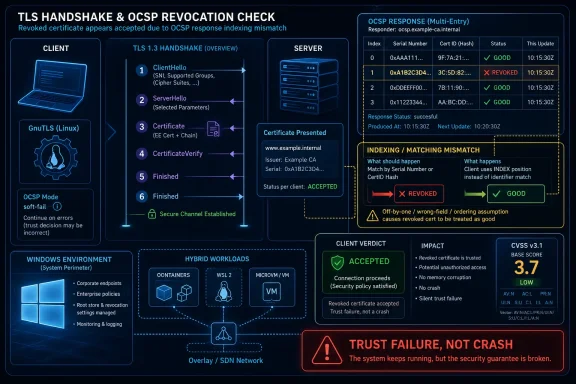 A Low CVSS Score Hides a Very Specific Trust Failure
Security scoring systems are useful until they become a substitute for thinking. CVE-2026-3832 carries a CVSS 3.1 base score of 3.7, with network attack vector, high attack complexity, no privileges required, no user interaction, unchanged scope, low confidentiality impact, and no rated integrity or availability impact. In the spreadsheet view of vulnerability management, that pushes it below the kind of remote code execution bugs that dominate emergency patch calls.The problem is that this particular “low” vulnerability lives in certificate validation, where the failure mode is not a crash, a shell, or a blue screen. It is a quiet decision: this certificate is acceptable. If the certificate has actually been revoked, the client is supposed to reject it, and a logic error that flips that answer can undermine the exact safeguard revocation was designed to provide.
The flaw is in GnuTLS, the widely used Transport Layer Security library found across Linux distributions and embedded or packaged software stacks. The issue is not that every TLS connection using GnuTLS is automatically broken. The vulnerable path involves OCSP verification and a multi-entry OCSP response, where GnuTLS reportedly checked the revocation status for the first response entry rather than the entry matching the certificate being validated.
That is a subtle bug, but subtlety is not the same as irrelevance. Certificate validation code is full of these edge cases: chain building, name constraints, stapled responses, intermediate certificates, expiration, revocation, and application-specific policy knobs. Attackers do not need the whole model to collapse; they need one path where the client and the library disagree about what has been proven.
OCSP Is the Safety Catch That Too Often Works Like a Suggestion
OCSP, the Online Certificate Status Protocol, is meant to answer a simple question quickly: has this certificate been revoked? Instead of downloading a full certificate revocation list, a client can ask an OCSP responder for the status of a particular certificate, or receive a stapled OCSP response during the TLS handshake. In theory, this gives clients fresher revocation information without the bulk of old-style CRLs.In practice, revocation has long been one of the messiest parts of public key infrastructure. Browsers, operating systems, libraries, and applications do not all treat revocation failures the same way. Some environments fail closed, some fail open, some cache, some staple, some use vendor-maintained revocation sets, and many enterprise applications expose toggles that admins only discover during an outage.
CVE-2026-3832 is a reminder that getting an OCSP response is not the same thing as binding the right OCSP status to the right certificate. A multi-entry response is not just a bigger version of a single response; it creates indexing and matching requirements. If the library validates the wrong entry, the rest of the cryptographic ceremony can look polished while the security conclusion is wrong.
That is why this bug matters beyond its severity label. Revocation is already an area where operational pressure pushes teams toward permissive behavior. A library bug that makes a revoked certificate appear acceptable does not need to be easy to exploit to be worth fixing; it needs only to exist in a trust path that an attacker can plausibly influence.
The Attack Requires Positioning, Not Magic
The user-facing advisory language is careful for a reason. A successful attack depends on conditions beyond the attacker’s control, and the attacker may need to gather environmental knowledge, prepare the target context, or place themselves in the logical network path between the victim and the requested resource. That is the “high attack complexity” portion of the score doing real work.This is not a drive-by web exploit. The attacker needs a revoked server certificate that is still useful in some way, a victim using a vulnerable GnuTLS path with OCSP verification enabled, and the ability to present or influence a crafted OCSP response during the TLS handshake. In many consumer scenarios, those preconditions will be hard to satisfy.
But enterprise networks have a habit of creating exactly the strange middle grounds vulnerability scoring tries to abstract away. TLS interception boxes, private PKI, service meshes, internal package repositories, appliance update channels, container registries, and developer tooling can all introduce unusual certificate and OCSP behaviors. When administrators say “this does not affect Windows,” they are often thinking of the Windows desktop certificate stack, not the Linux-based systems that sit beside it.
The man-in-the-middle condition is also not science fiction. Corporate proxies, captive portals, compromised routers, malicious Wi-Fi, rogue internal hosts, poisoned DNS, and BGP-level incidents all represent different flavors of traffic positioning. Most are not easy. None are impossible enough to ignore in risk models for sensitive environments.
Microsoft’s Advisory Is a Signal About the Windows Perimeter Expanding
The presence of CVE-2026-3832 in Microsoft’s Security Update Guide is not evidence that Windows’ native TLS stack suddenly became GnuTLS. It is a signal about the modern Microsoft perimeter. Microsoft’s ecosystem now spans Windows, Azure, Linux workloads, container images, developer tools, WSL, supply-chain components, and third-party open-source packages that may appear in Microsoft-managed or Microsoft-adjacent contexts.That is the new normal for patch management. A Windows shop may run Ubuntu in WSL, Linux containers on developer laptops, Red Hat or Ubuntu nodes in Azure, Linux-based security appliances, GitHub Actions runners, or applications bundled with their own TLS library. If GnuTLS is buried in one of those layers, the risk is still operationally yours, even if the vulnerable code is not part of schannel.dll.
For IT pros, the practical question is not whether the CVE has a Microsoft page. It is where GnuTLS exists in the estate and whether that copy is managed by the operating system, a container base image, an application vendor, or a developer who copied a binary into a build years ago. That inventory question is usually harder than the patch itself.
This is why open-source library advisories increasingly feel like Windows news. The enterprise Windows environment has become a hybrid estate whether or not the Active Directory diagram says so. The attack surface includes whatever code your workloads actually execute, not whatever platform your procurement spreadsheet says you standardized on.
The GnuTLS Fix Arrived Inside a Busy Security Release
Upstream GnuTLS recommends upgrading to version 3.8.13 or later to address CVE-2026-3832. That release was not a one-bug event. The same advisory set included several other certificate-processing and TLS-related issues, including higher-severity flaws around DTLS handling and authentication behavior.That matters because administrators rarely patch a single vulnerability in isolation. Distribution vendors consume upstream fixes, backport them into supported package versions, and publish advisories with their own severity ratings and package names. Ubuntu, for example, marked the issue as medium priority while retaining the CVSS low score, and listed fixed gnutls28 packages for supported releases including Ubuntu 26.04 LTS, 25.10, 24.04 LTS, and 22.04 LTS.
Red Hat’s ecosystem likewise moved updated GnuTLS packages into hardened image channels, with version 3.8.13 appearing in the listed RPM set. The exact affected status varies by product and packaging stream, which is precisely why “we have GnuTLS somewhere” is not a sufficient vulnerability-management answer. You need to know which distribution built it, which package revision is installed, and whether the consuming application actually links against the fixed library.
The backporting wrinkle is worth stressing. A fixed package on an enterprise distribution may not show the same upstream version number a scanner expects. Conversely, a container image may continue shipping an old vulnerable package long after the host has been patched. GnuTLS is the kind of library that exposes the gap between host patching and workload patching.
Revoked Certificates Are Supposed to Be Boring
The most dangerous part of revocation is that it is usually invisible when it works. A compromised private key, misissued certificate, abandoned domain, decommissioned appliance, or terminated service identity can all require a certificate to be revoked. The user does not need to know the backstory; the client simply refuses the credential.When revocation fails, the old credential may still carry enough cryptographic legitimacy to fool clients. The certificate can be expired or mismatched and still fail for other reasons, but a not-yet-expired revoked certificate is especially tricky because the signature chain may remain valid. Revocation is the mechanism that says, “The chain may look good, but trust has been withdrawn.”
CVE-2026-3832 attacks that distinction. If a client accepts a revoked certificate because the OCSP response is misprocessed, the attacker does not necessarily gain code execution or persistence. But they may gain the ability to impersonate a service long enough to observe data, redirect a workflow, or degrade trust in a connection the application treats as secure.
That explains the confidentiality-only impact rating. The canonical concern is that a victim connects to what appears to be a legitimate server, accepts a certificate it should have rejected, and leaks information across that channel. Integrity and availability are not rated as impacted in the CVSS vector, but real-world consequences depend heavily on what the TLS-protected application does next.
Windows Admins Should Look Beyond the Desktop Certificate Store
A typical Windows administrator might first ask whether this touches the Windows certificate store or the native TLS implementation used by Edge, Windows Update, and most Microsoft components. The narrow answer is that CVE-2026-3832 is a GnuTLS flaw, not a Windows schannel advisory. But the broader administrative answer is more uncomfortable: Windows estates increasingly contain many non-Windows trust engines.WSL is the obvious example. Developers using Ubuntu or other Linux distributions under WSL can have GnuTLS installed for command-line tools, package managers, language runtimes, or test services. If those environments reach internal services, pull dependencies, or authenticate against development infrastructure, they are part of the organization’s trust boundary.
Containers make the problem bigger. A Windows laptop or server can build, test, scan, and ship Linux containers without anyone thinking of it as a “Linux system” in the traditional inventory sense. The vulnerable library can live inside a base image, and the fix may require rebuilding images rather than patching the host.
Then there are third-party applications. Backup tools, security products, observability agents, VPN clients, remote management software, and cross-platform enterprise apps may bundle TLS libraries rather than rely on the host. Software bills of materials help here, but only if teams actually ingest them into vulnerability workflows and map them to deployed binaries.
The Scanner May Be Right and Still Not Tell You Enough
Vulnerability scanners will flag CVE-2026-3832 in predictable ways: an installed package version, a container layer, a distro advisory, or a component fingerprint. That is useful, but it does not answer the most important practical question: is the vulnerable code reachable in a way that validates server certificates with OCSP enabled and accepts attacker-influenced responses?Reachability is the difference between vulnerability management and asset accounting. A dormant library in a build image is not the same as a library used by an outbound client that talks to production systems. A developer test container is not the same as an internet-facing service, but the latter may depend on the former’s base image if your CI/CD process promotes images carelessly.
The attack condition also means that compensating controls matter. Network egress restrictions, certificate pinning in some applications, strict internal PKI controls, short-lived certificates, service identity rotation, and traffic monitoring all affect practical risk. None of them replace patching, but they shape the order in which teams should move.
Still, the worst response is to dismiss the finding because the CVSS score is low. The second-worst response is to treat every instance as equally urgent. The right response is to sort by exposure, role, and update path: production clients before build artifacts, internet-connected workloads before isolated labs, bundled applications before centrally managed distro packages that already have updates available.
The Real Risk Lives in the Gap Between Library and Policy
TLS libraries implement policy, but they do not invent it in a vacuum. Applications decide whether to enable OCSP, whether to treat failures as fatal, which trust stores to use, whether to staple responses, and how much diagnostic information to expose. A library bug like CVE-2026-3832 becomes dangerous when application policy assumes the library has enforced something it did not.This is especially relevant in enterprise software, where defaults often drift from security ideals. Developers may disable strict revocation checking after a customer reports connection failures. Administrators may turn off OCSP because an internal responder is unreliable. A vendor may document a flag as “recommended for compatibility” without explaining the security tradeoff.
CVE-2026-3832 is almost the mirror image of those fail-open behaviors. Here, the client may believe it performed the revocation check, and the application may record success. The failure is not a timeout, an unavailable responder, or a policy exception. It is the wrong association between the certificate and the status entry.
That makes logging and forensic confidence harder. If a client silently accepted a revoked certificate during the vulnerable window, there may be no obvious error trail. Teams investigating sensitive connections should not assume absence of revocation errors proves revocation was correctly enforced.
Why Multi-Entry OCSP Responses Are a Classic Parser Trap
Multi-record formats are where many security bugs go to hide. A single object maps cleanly to a single decision. A list of objects requires matching, ordering, duplicate handling, error handling, and a policy for what happens when one element is valid and another is not.The reported GnuTLS behavior fits this pattern. If status was checked against the first entry rather than the entry corresponding to the target certificate, a crafted response could place a benign-looking entry first and the revoked certificate’s entry elsewhere. The cryptographic signatures around the response may still validate; the error is in which signed assertion the client uses for its decision.
This is why “cryptographic bug” often means “state-machine bug” or “binding bug,” not broken math. TLS and PKI are full of places where the program must bind one identity, one key, one hostname, one certificate, and one status to one security decision. If any of those bindings are loose, an attacker may not need to forge anything.
Administrators do not need to become OCSP protocol experts to understand the lesson. When a patch note says certificate validation logic was wrong, treat it as more than a cosmetic fix. Certificate validation bugs sit at the border between authentication and encryption; mistakes there can make a secure tunnel secure to the wrong party.
Containers Turn Low-Severity Library Bugs Into Long-Tail Debt
The most likely place CVE-2026-3832 will linger is not a well-maintained Linux server with automatic security updates. It is a container image built months ago, pinned to a base layer, copied between registries, and deployed by a pipeline that never rebuilds unless application code changes. That is how low-severity library bugs become long-tail risk.Modern container workflows encourage immutability, but immutability cuts both ways. A frozen image is reproducible, which is good. It is also frozen in time, which means patched packages do not appear until someone rebuilds the image from an updated base or explicitly updates the package inside it.
For Windows-centric teams, this is a cultural adjustment. Traditional patch management taught administrators to think in terms of machines: patch the server, reboot the server, verify the server. Container patching teaches a different rhythm: rebuild, rescan, redeploy, retire old images, and ensure orchestration actually stops running vulnerable layers.
CVE-2026-3832 is a good test of whether that machinery works. If the organization cannot quickly answer which images contain GnuTLS, which of those images are running, and which external or internal services they connect to as clients, the vulnerability has already done its job as an audit finding.
The Enterprise PKI Angle Is More Interesting Than the Internet Angle
For the public web, the exploitability bar is substantial. Browsers have their own revocation strategies, major sites use short certificate lifetimes, and public certificate abuse tends to attract attention. That does not make the bug irrelevant, but it does limit the easy sensational version of the story.Enterprise PKI is different. Internal certificate authorities, private OCSP responders, TLS inspection devices, and custom trust stores are common in large organizations. Some environments also keep certificates alive longer than public web norms, rely on manual revocation workflows, or maintain legacy services with brittle TLS stacks.
In those networks, a revoked internal certificate may still be valuable. It could identify a decommissioned service, a former appliance, a compromised test endpoint, or a certificate whose private key was exposed. If a client can be steered toward accepting it, the attacker may gain access to secrets, tokens, configuration data, or service traffic that was never meant to leave the internal network.
This is where the “conditions beyond the attacker’s control” language becomes a risk-management fork. A random attacker on the Internet may not control those conditions. A malicious insider, compromised host, or attacker already inside the network may be much closer to them.
Patch Triage Should Follow Trust Paths, Not Logo Paths
The instinct in mixed Windows and Linux shops is to route GnuTLS bugs to the Linux team and move on. That is administratively tidy and technically incomplete. The better question is which business processes depend on GnuTLS-mediated TLS validation.Start with outbound clients, not just servers. Package retrieval, artifact downloads, API calls, webhooks, telemetry uploaders, update agents, monitoring probes, and internal service clients can all validate server certificates. If any of them use GnuTLS and OCSP verification, they belong in scope.
Next, look at environments where an attacker could realistically influence traffic. Developer workstations on untrusted networks, CI runners that fetch dependencies, branch offices, cloud workloads with broad egress, and segmented internal networks with weak east-west controls are more interesting than isolated systems with no meaningful outbound TLS exposure.
Finally, separate update responsibility. Distribution packages can usually be handled through normal security updates. Containers require rebuilds. Bundled libraries require vendor fixes. Appliances require firmware. Static binaries may require replacement even if the host package manager says everything is current.
This is the dull part of the work, and it is also the part that prevents a low-scoring CVE from reappearing in scan reports for the next two years.
The Security Score Is Not a Business Priority Score
CVSS is intentionally technical. It does not know whether the affected client is pulling payroll data, retrieving signing keys, talking to a hospital device, or fetching packages for production builds. It also does not know whether an organization’s internal network is flat, whether developers routinely work from coffee shop Wi-Fi, or whether TLS interception is deployed badly.That is why a low base score can still deserve prompt attention in selected environments. A GnuTLS-powered tool that retrieves sensitive data over TLS from an internal service has a different risk profile than a dormant package installed on a lab VM. A container image used in a production integration pipeline has a different profile than an image archived for testing.
The reverse is also true. Not every instance should become a midnight outage window. If the vulnerable library is present but unused, unreachable, or already mitigated by application behavior, the fix can ride the normal patch cycle. Mature vulnerability management is the ability to say both things at once.
The industry still struggles with that nuance. Vendors publish severity. Scanners publish findings. Executives ask for counts. Administrators are left to translate those signals into work that actually reduces risk. CVE-2026-3832 is a small but useful example of why that translation layer matters.
Microsoft Shops Need an Open-Source Patch Muscle
The Microsoft ecosystem has spent the last decade absorbing open source into its daily operating model. Azure runs Linux at scale. Developers use WSL. Windows shops deploy Kubernetes. .NET applications live in Linux containers. GitHub sits in the software supply chain. The result is that Microsoft-facing administrators need fluency in advisories from GnuTLS, OpenSSL, curl, glibc, systemd, Ubuntu, Red Hat, Debian, Alpine, and whatever else their workloads drag along.That does not mean every Windows admin must become a Linux maintainer. It means the organization needs a repeatable process for tracking third-party components that affect Windows-adjacent operations. The boundary is no longer “Windows versus Linux.” The boundary is “managed versus unmanaged dependency.”
CVE-2026-3832 also shows why relying exclusively on Microsoft Update, WSUS, or Intune is not enough for hybrid estates. Those tools remain essential for Windows endpoints, but they will not rebuild a stale Ubuntu container image, patch a vendor appliance, or update a statically linked application buried in a developer workflow. The patch plane has fragmented.
The good news is that the remediation path is straightforward when ownership is clear. Update GnuTLS through the relevant distribution, move to packages containing the upstream fix, rebuild affected images, and take vendor updates for bundled software. The hard part is less technical than organizational: knowing who owns each copy.
The Practical Read for WindowsForum Readers
This is not a five-alarm Windows emergency. It is a certificate-validation bug in a major TLS library, with a low CVSS score and a high-complexity attack path, that deserves targeted patching wherever GnuTLS participates in certificate revocation checks. The right posture is calm, but not casual.- Organizations should identify Linux distributions, containers, appliances, WSL environments, and bundled applications that include GnuTLS before assuming the vulnerability is irrelevant to a Windows-centered estate.
- Systems using GnuTLS for outbound TLS connections with OCSP verification enabled deserve higher priority than systems where the package is merely installed but not used in a trust decision.
- Updating to GnuTLS 3.8.13 or distribution packages containing the backported fix is the clean remediation path, but container images must be rebuilt and redeployed rather than merely patched on the host.
- Environments with private PKI, TLS interception, internal OCSP responders, or sensitive service-to-service traffic should treat the bug as more operationally relevant than its low score suggests.
- Scanner findings should be triaged by reachability, traffic positioning risk, and data sensitivity instead of being dismissed or escalated solely on CVSS.
References
- Primary source: MSRC
Published: 2026-06-03T01:45:43-07:00
Security Update Guide - Microsoft Security Response Center
 msrc.microsoft.com
- Related coverage: datacomm.com
CVE-2026-3832 Gnutls: gnutls: security bypass allows acceptance of revoked server certificates via crafted ocsp response - DataComm Networks Incorporated
Information published.www.datacomm.com - Related coverage: service.securitm.ru
CVE-2026-3832 - CVE уязвимости - SECURITM
Gnutls: gnutls: security bypass allows acceptance of revoked server certificates via crafted ocsp responseservice.securitm.ru
- Related coverage: netservicesgroup.com
CVE-2026-3832 Gnutls: gnutls: security bypass allows acceptance of revoked server certificates via crafted ocsp response - Network Services Group
Information published.www.netservicesgroup.com - Related coverage: mondoo.com
CVE-2026-3832 | Mondoo Vulnerability Intelligence
CVE-2026-3832 - LOW severity: Gnutls: gnutls: security bypass allows acceptance of revoked server certificates via crafted ocsp responsemondoo.com - Related coverage: vulnerability.circl.lu
Vulnerability-Lookup
Vulnerability-Lookup - Fast vulnerability lookup correlation from different sources.vulnerability.circl.lu
- Related coverage: thewindowsupdate.com
- Related coverage: ubuntu.com
CVE-2026-3832 | Ubuntu
Ubuntu is an open source software operating system that runs from the desktop, to the cloud, to all your internet connected things. ubuntu.com
- Related coverage: blog.oxo.is
- Related coverage: gnutls.org