
Integrated Research announced in Sydney on June 18, 2026, that its Collaborate observability product now supports NICE CXone as part of Prognosis 13.3, extending monitoring across cloud contact center traffic, bring-your-own-carrier infrastructure, and unified communications platforms including Microsoft Teams and Webex. The headline sounds like a vendor integration, but the substance is larger: contact center visibility is being pulled out of the application dashboard and pushed into the messy network path where customer experience actually lives. For WindowsForum readers, the interesting part is not that another SaaS platform has gained another connector. It is that enterprise voice, Teams collaboration, CCaaS, carrier routing, and AI-assisted troubleshooting are converging into one operational problem.
A modern contact center rarely resembles the tidy architecture diagram used to sell it. A customer may begin with a voice call, be authenticated through an IVR, move through a carrier path controlled by a bring-your-own-carrier model, land in NICE CXone, consult an agent who uses Microsoft Teams or Webex to reach an internal expert, and leave behind records in multiple systems that disagree about what happened.
That fragmentation is precisely the gap IR is trying to exploit with Collaborate for NICE CXone. The company says the new release ingests and correlates telemetry from CXone, session border controllers, UC platforms, and other systems into a common intelligence layer. In plain English, it wants to show the whole journey rather than the little patch each vendor happens to own.
This matters because the contact center has become one of the most politically exposed parts of enterprise IT. When email is slow, users complain internally. When Teams drops packets, staff grumble. When the customer support line fails, the business loses revenue, brand trust, and sometimes regulatory defensibility.
The old division between “telephony,” “collaboration,” and “customer experience” has become increasingly artificial. Microsoft Teams is now a workflow hub, CCaaS platforms are the customer-facing front door, and SBCs still sit in the middle enforcing the hard realities of signaling, routing, security, and carrier interoperability. Observability tools that stop at one boundary now risk telling the most comforting lie in IT: everything is green over here.
A queue may be healthy while callers still abandon. An agent may be available while audio quality collapses upstream. A UC platform may report an acceptable call while the customer hears jitter, delay, or silence. A cloud contact center can process events correctly and still deliver a miserable experience if the surrounding voice path is degraded.
This is why the inclusion of BYOC infrastructure is more than a feature checkbox. Bring-your-own-carrier models are attractive because they give enterprises more control over telecom costs, regional routing, number management, and migration strategy. They also create more places for fault and blame to hide.
For sysadmins and voice engineers, the promise of a “single source of truth” should always be treated cautiously. There is no magic dashboard that makes distributed systems simple. But a tool that can put SBC metrics, UC call flows, CXone events, queue data, and contact outcomes into the same investigative frame is at least asking the right question: not “which platform says it is fine?” but “where did the interaction degrade?”
The Microsoft angle is particularly relevant. NICE promotes CXone integrations with Teams, and many enterprises already use Teams as the internal collaboration fabric even when they retain separate contact center platforms. That creates a split-brain operational model: contact center leaders care about handle time, wait time, abandon rate, and resolution; IT cares about call quality, endpoint health, network path, and service availability.
Those two views often meet only during an incident review, and usually too late. IR’s pitch is that Collaborate can bridge that divide by showing operational metrics and technical telemetry together. If a spike in queue wait time coincides with SBC errors or a UC routing issue, the organization should not need three teams and four exports to begin the diagnosis.
The risk, of course, is that every observability vendor now speaks the language of “single pane of glass.” The phrase has been overused to the point of self-parody. What matters is not whether IR can display many data sources, but whether it can normalize them in ways that preserve causality, timing, identity, and business meaning.
A caller’s experience may be shaped by PSTN ingress, SIP trunk behavior, SBC policy, codec negotiation, WAN congestion, identity services, browser performance, headset configuration, VDI constraints, and the agent’s collaboration tools. A dashboard that begins at the CCaaS application layer can miss the defect before the ticket is even created.
IR’s announcement repeatedly frames the new support around the “first carrier hop to the agent’s desktop.” That is the right language because it reflects the lived reality of enterprise support. The most painful issues are often not outright outages but intermittent degradations: a regional routing problem, a subset of agents with poor media paths, a queue whose wait time expands because transfers fail, or a call flow that works technically but fails operationally.
For Windows-heavy environments, the endpoint layer adds still more complexity. Agents may run browser-based softphones, Teams, CRM tabs, identity prompts, endpoint security agents, and monitoring tools on the same Windows device. If they are in virtual desktops, the audio path may be optimized, redirected, or accidentally sabotaged by configuration drift.
That is why end-to-end observability is not a luxury feature in contact centers. It is a practical admission that customer experience is assembled from components owned by different teams, vendors, and budgets. When the business hears “the phones are bad,” IT needs evidence precise enough to say whether the problem is carrier, cloud, endpoint, app, or process.
CDRs are the fossil record of enterprise communications. They contain the who, when, where, duration, routing, disposition, and technical context of calls and interactions. In complex environments, those records are often scattered across vendor portals, SBC logs, UC admin centers, contact center reports, and exported archives.
The operational problem is not that CDRs do not exist. It is that the people who need them cannot query them quickly enough during an incident. A voice engineer may know the SBC logs, a contact center analyst may know CXone reporting, and a Teams administrator may know the Microsoft admin tools, but the customer’s call does not care about those org-chart boundaries.
A conversational interface over a unified CDR store is useful only if it respects the underlying detail. The danger with AI search in operations is that it can blur uncertainty into confidence. If Iris can help teams ask natural-language questions while still exposing the raw records, filters, timelines, and correlations underneath, it becomes a serious incident-response accelerant rather than another chatbot bolted onto an admin console.
Contact centers are seasonal systems. Retail peaks, tax deadlines, healthcare enrollment periods, travel disruptions, product launches, weather events, and regional outages all leave patterns that are easy to forget once the emergency has passed. A five-year window gives operations teams a stronger basis for capacity planning, SLA reporting, staffing alignment, and vendor accountability.
It also enables a more adult conversation about modernization. Enterprises often move to cloud contact centers expecting elasticity to solve capacity problems. Elasticity helps, but it does not eliminate carrier constraints, routing design flaws, endpoint bottlenecks, queue strategy mistakes, or poor workforce planning.
Historical observability can reveal whether problems are chronic or episodic. It can show whether abandon rates rise during predictable demand, whether specific regions suffer recurring degradation, whether agent utilization trends are sustainable, and whether a migration from legacy UC to Teams or Webex changed the real customer experience. Those are not dashboard curiosities; they are board-level operational questions once contact centers become revenue-critical.
That creates accountability problems. If an agent puts a customer on hold to consult a colleague in Teams and the handoff fails, is that a contact center issue, a UC issue, a network issue, or a human-process issue? In many organizations, the answer is “open tickets with everyone and wait.”
IR’s pitch is that correlated observability reduces that ambiguity. If the same interaction can be traced across the customer-facing contact center and the internal collaboration fabric, operations teams can stop arguing from partial telemetry. This is especially important in Microsoft-centric shops, where Teams may be managed by a different group than the contact center platform even though both shape the same customer interaction.
There is also a cultural point here. Contact center operations traditionally optimize for service levels, occupancy, and customer outcomes. UC and endpoint teams optimize for availability, call quality, policy compliance, and device health. A shared observability layer does not merge those disciplines, but it can force them to look at the same event timeline.
That multi-vendor reality is not going away. In fact, cloud migration can make it more visible. Moving the contact center to a cloud platform may reduce data center dependency, but it also increases reliance on internet paths, identity services, browser compatibility, SaaS status, APIs, and third-party integrations.
This is where IR’s positioning as an observability layer rather than a contact center platform matters. The company is not trying to replace CXone, Teams, Webex, or the carrier stack. It is trying to sit above them and make the operational state legible.
That strategy will resonate with enterprises that have learned the hard way that vendor-native dashboards mostly prove vendor-native health. A cloud service can be technically available while a particular enterprise path is impaired. A platform can process events while a subset of users is functionally blocked. A carrier can complete calls while media quality is poor enough to damage the interaction.
The market is moving toward observability because uptime alone is an insufficient metric. For contact centers, the relevant question is not simply whether a service is up. It is whether customers can reach the right agent, through the right channel, at the expected quality, within the promised time, and with enough context preserved to resolve the issue.
The strongest version of Iris would act like an expert query assistant. It would help an engineer ask for calls affected by a carrier path during a time window, compare queue behavior against historical norms, surface interactions with abnormal handle time, and correlate abandon spikes with technical events. It would shorten the distance between suspicion and evidence.
The weaker version would summarize dashboards in pleasant language while hiding the mechanics. That would be dangerous. In incident response, explanations need to be inspectable, especially when teams are assigning responsibility across vendors or documenting SLA impact.
For regulated industries, this distinction matters even more. Contact center records may intersect with financial services, healthcare, utilities, government services, and emergency-adjacent workflows. AI-assisted observability has to preserve auditability, access controls, data retention policy, and evidence quality. A conversational search layer is useful only if it does not turn operational truth into a vibe.
During a major incident, the contact center manager sees abandoned calls and angry customers. The network team sees utilization graphs. The UC team sees call quality indicators. The carrier manager waits for provider updates. The endpoint team asks whether affected agents share a Windows build, headset model, VDI pool, or security policy. The executive sponsor asks when service will recover.
A correlated system does not eliminate the incident, but it can shorten the argument. If Collaborate can show that a degradation began at a specific time, affected a specific carrier path, coincided with queue expansion, and impacted a specific set of agents or interactions, it gives the organization a working theory faster. That is often the difference between a controlled response and a blame storm.
This is the practical reason observability vendors keep moving up the stack. Logs, metrics, traces, call records, and experience analytics are not separate products in the mind of a customer who could not get help. They are fragments of one failed interaction.
Teams administrators already know that call quality complaints can originate outside Teams. The endpoint, network, proxy, firewall, carrier path, headset, virtual desktop, and third-party app all get a vote. Contact centers multiply that complexity because every failure has a customer-facing consequence.
The CXone integration is therefore a signpost. Observability is moving toward interaction-level correlation across UCaaS, CCaaS, SBCs, and endpoints. Whether the named platform is NICE, Genesys, Five9, Webex Contact Center, Dynamics 365 Contact Center, or something else, the operational requirement is converging.
Microsoft itself has been pushing deeper into customer experience and contact center-adjacent workflows, but enterprise estates will remain mixed for years. The winning operational posture is not blind faith in a single vendor stack. It is the ability to prove what happened across the stack you actually have.
Those details will determine whether the integration becomes indispensable or merely impressive in a demo. Observability platforms live or die on fidelity, latency, normalization, and trust. If the data arrives too late, too coarsely, or without enough context, teams will fall back to native tools during real incidents.
There is also the matter of operational adoption. A unified dashboard is useful only if teams agree to use it as shared evidence. If network, UC, contact center, and application teams each continue to defend their own tools as the authoritative source, correlation becomes another layer rather than a common operating picture.
The best deployments will likely pair the technology with process changes. Incident runbooks need to reference the shared observability layer. Post-incident reviews need to use the same timeline. SLA conversations need to distinguish between platform health, path health, and customer outcome. Otherwise, even the best telemetry will become shelfware with better graphics.
That engineering view is uncomfortable because it makes customer experience measurable in places where organizations prefer abstraction. If callers abandon after a queue threshold, if certain transfers increase handle time, if specific carrier paths correlate with poor outcomes, if agent utilization spikes before SLA breaches, then the journey is not just a brand concept. It is infrastructure.
Collaborate’s expanded reporting claims to track skills performance, team workload, agent utilization, queue wait times, contact outcomes, handle times, abandon rates, and first-contact-resolution proxies. Those are operationally meaningful metrics because they connect technical performance to business consequences. They also invite uncomfortable comparisons across teams and vendors.
That is the point. The contact center is where technical debt becomes audible. Customers do not experience a failed migration plan, a half-finished Teams integration, or a carrier-routing compromise as architecture. They experience waiting, repeating themselves, being transferred, hearing bad audio, or giving up.
The real goal is to stop incidents before customers become the monitoring system. Too many contact center problems are detected through complaint volume. That is not observability; it is reputational damage with timestamps.
Pre-emptive alerting also changes the economics of support. If teams can spot developing SLA risk early, they can reroute traffic, adjust staffing, engage carriers, change queue strategy, or notify business owners before the dashboard turns red. That is the difference between a service operation and a forensic exercise.
Still, alerting must be tuned carefully. Contact centers already generate enough operational noise. If Collaborate merely adds more thresholds without meaningful correlation, teams will ignore it. If it can distinguish a normal volume spike from a technically induced service degradation, it becomes far more valuable.
For years, IT teams treated voice as its own discipline. Then UC pulled voice into collaboration. Then CCaaS pulled customer engagement into cloud platforms. Now AI and observability are pulling records from all of it into investigative layers that promise to explain not just whether calls completed, but whether interactions succeeded.
IR’s move with NICE CXone fits that trajectory. It recognizes that customer-facing communications cannot be monitored from inside one vendor’s console. It also recognizes that AI’s near-term value in this domain is not replacing operations teams but helping them navigate the record sprawl they already have.
The announcement is therefore both pragmatic and ambitious. Pragmatic, because enterprises genuinely need a better way to correlate CXone, BYOC, SBC, Teams, Webex, and other UC telemetry. Ambitious, because every vendor that promises a unified view inherits the burden of proving that its view is complete enough to trust.
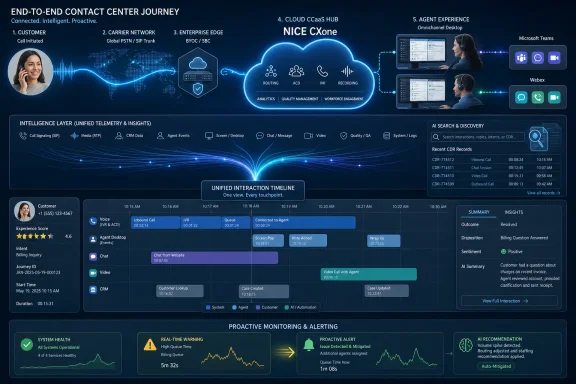 The Contact Center Is No Longer a Single System
A modern contact center rarely resembles the tidy architecture diagram used to sell it. A customer may begin with a voice call, be authenticated through an IVR, move through a carrier path controlled by a bring-your-own-carrier model, land in NICE CXone, consult an agent who uses Microsoft Teams or Webex to reach an internal expert, and leave behind records in multiple systems that disagree about what happened.That fragmentation is precisely the gap IR is trying to exploit with Collaborate for NICE CXone. The company says the new release ingests and correlates telemetry from CXone, session border controllers, UC platforms, and other systems into a common intelligence layer. In plain English, it wants to show the whole journey rather than the little patch each vendor happens to own.
This matters because the contact center has become one of the most politically exposed parts of enterprise IT. When email is slow, users complain internally. When Teams drops packets, staff grumble. When the customer support line fails, the business loses revenue, brand trust, and sometimes regulatory defensibility.
The old division between “telephony,” “collaboration,” and “customer experience” has become increasingly artificial. Microsoft Teams is now a workflow hub, CCaaS platforms are the customer-facing front door, and SBCs still sit in the middle enforcing the hard realities of signaling, routing, security, and carrier interoperability. Observability tools that stop at one boundary now risk telling the most comforting lie in IT: everything is green over here.
IR Is Selling a Map of the Whole Failure Domain
The core promise of Prognosis 13.3 is correlation. Collaborate is not merely adding a NICE CXone tile to an existing monitoring dashboard; IR is positioning it as a way to trace interactions across the contact estate, from carrier hop to agent desktop. That framing is important because most major contact center failures are not single-vendor failures.A queue may be healthy while callers still abandon. An agent may be available while audio quality collapses upstream. A UC platform may report an acceptable call while the customer hears jitter, delay, or silence. A cloud contact center can process events correctly and still deliver a miserable experience if the surrounding voice path is degraded.
This is why the inclusion of BYOC infrastructure is more than a feature checkbox. Bring-your-own-carrier models are attractive because they give enterprises more control over telecom costs, regional routing, number management, and migration strategy. They also create more places for fault and blame to hide.
For sysadmins and voice engineers, the promise of a “single source of truth” should always be treated cautiously. There is no magic dashboard that makes distributed systems simple. But a tool that can put SBC metrics, UC call flows, CXone events, queue data, and contact outcomes into the same investigative frame is at least asking the right question: not “which platform says it is fine?” but “where did the interaction degrade?”
NICE CXone Makes the Integration Strategically Useful
NICE CXone is not an obscure edge case for IR to support. It is one of the major cloud contact center platforms in the market, with a broad footprint across voice, digital engagement, routing, workforce management, analytics, AI, and integrations with collaboration platforms. Supporting CXone gives IR access to a large class of environments where contact center modernization has already moved beyond the old PBX-plus-ACD model.The Microsoft angle is particularly relevant. NICE promotes CXone integrations with Teams, and many enterprises already use Teams as the internal collaboration fabric even when they retain separate contact center platforms. That creates a split-brain operational model: contact center leaders care about handle time, wait time, abandon rate, and resolution; IT cares about call quality, endpoint health, network path, and service availability.
Those two views often meet only during an incident review, and usually too late. IR’s pitch is that Collaborate can bridge that divide by showing operational metrics and technical telemetry together. If a spike in queue wait time coincides with SBC errors or a UC routing issue, the organization should not need three teams and four exports to begin the diagnosis.
The risk, of course, is that every observability vendor now speaks the language of “single pane of glass.” The phrase has been overused to the point of self-parody. What matters is not whether IR can display many data sources, but whether it can normalize them in ways that preserve causality, timing, identity, and business meaning.
The Agent Desktop Is Only the Last Mile
Contact center vendors naturally emphasize the agent experience. That is where productivity features, AI assistance, CRM integration, and workforce optimization become visible to buyers. But the agent desktop is only the last mile of a much longer path.A caller’s experience may be shaped by PSTN ingress, SIP trunk behavior, SBC policy, codec negotiation, WAN congestion, identity services, browser performance, headset configuration, VDI constraints, and the agent’s collaboration tools. A dashboard that begins at the CCaaS application layer can miss the defect before the ticket is even created.
IR’s announcement repeatedly frames the new support around the “first carrier hop to the agent’s desktop.” That is the right language because it reflects the lived reality of enterprise support. The most painful issues are often not outright outages but intermittent degradations: a regional routing problem, a subset of agents with poor media paths, a queue whose wait time expands because transfers fail, or a call flow that works technically but fails operationally.
For Windows-heavy environments, the endpoint layer adds still more complexity. Agents may run browser-based softphones, Teams, CRM tabs, identity prompts, endpoint security agents, and monitoring tools on the same Windows device. If they are in virtual desktops, the audio path may be optimized, redirected, or accidentally sabotaged by configuration drift.
That is why end-to-end observability is not a luxury feature in contact centers. It is a practical admission that customer experience is assembled from components owned by different teams, vendors, and budgets. When the business hears “the phones are bad,” IT needs evidence precise enough to say whether the problem is carrier, cloud, endpoint, app, or process.
The New CDR Search Is the More Interesting AI Story
The announcement’s second major feature is unified Call Detail Record search through Iris, IR’s conversational AI intelligence layer. Prognosis 13.3 introduces a single CDR database with AI-powered search across CXone, UC platforms, SBCs, and other vendors. That may sound less glamorous than generative AI agents, but it is probably more useful to the people who get paged.CDRs are the fossil record of enterprise communications. They contain the who, when, where, duration, routing, disposition, and technical context of calls and interactions. In complex environments, those records are often scattered across vendor portals, SBC logs, UC admin centers, contact center reports, and exported archives.
The operational problem is not that CDRs do not exist. It is that the people who need them cannot query them quickly enough during an incident. A voice engineer may know the SBC logs, a contact center analyst may know CXone reporting, and a Teams administrator may know the Microsoft admin tools, but the customer’s call does not care about those org-chart boundaries.
A conversational interface over a unified CDR store is useful only if it respects the underlying detail. The danger with AI search in operations is that it can blur uncertainty into confidence. If Iris can help teams ask natural-language questions while still exposing the raw records, filters, timelines, and correlations underneath, it becomes a serious incident-response accelerant rather than another chatbot bolted onto an admin console.
Five Years of History Turns Monitoring Into Planning
IR says Prognosis 13.3 supports up to five years of history. That feature deserves more attention than it will probably receive, because long retention changes the value of observability data. Real-time dashboards help during incidents; historical depth helps justify architecture decisions.Contact centers are seasonal systems. Retail peaks, tax deadlines, healthcare enrollment periods, travel disruptions, product launches, weather events, and regional outages all leave patterns that are easy to forget once the emergency has passed. A five-year window gives operations teams a stronger basis for capacity planning, SLA reporting, staffing alignment, and vendor accountability.
It also enables a more adult conversation about modernization. Enterprises often move to cloud contact centers expecting elasticity to solve capacity problems. Elasticity helps, but it does not eliminate carrier constraints, routing design flaws, endpoint bottlenecks, queue strategy mistakes, or poor workforce planning.
Historical observability can reveal whether problems are chronic or episodic. It can show whether abandon rates rise during predictable demand, whether specific regions suffer recurring degradation, whether agent utilization trends are sustainable, and whether a migration from legacy UC to Teams or Webex changed the real customer experience. Those are not dashboard curiosities; they are board-level operational questions once contact centers become revenue-critical.
The Teams and Webex Angle Is About Accountability
The inclusion of Microsoft Teams and Webex in IR’s framing reflects a broader shift in enterprise communications. Collaboration platforms are no longer side channels. They are increasingly embedded into escalation, consultation, expert routing, supervisor workflows, and hybrid contact center designs.That creates accountability problems. If an agent puts a customer on hold to consult a colleague in Teams and the handoff fails, is that a contact center issue, a UC issue, a network issue, or a human-process issue? In many organizations, the answer is “open tickets with everyone and wait.”
IR’s pitch is that correlated observability reduces that ambiguity. If the same interaction can be traced across the customer-facing contact center and the internal collaboration fabric, operations teams can stop arguing from partial telemetry. This is especially important in Microsoft-centric shops, where Teams may be managed by a different group than the contact center platform even though both shape the same customer interaction.
There is also a cultural point here. Contact center operations traditionally optimize for service levels, occupancy, and customer outcomes. UC and endpoint teams optimize for availability, call quality, policy compliance, and device health. A shared observability layer does not merge those disciplines, but it can force them to look at the same event timeline.
Vendor-Neutral Observability Is Becoming a Survival Strategy
The larger market context is straightforward: enterprises are not standardizing communications as cleanly as vendors would like. A company may have Microsoft 365 everywhere, Webex in parts of the estate, NICE CXone for contact center, legacy SIP trunks in several countries, regional carriers, SBCs from one vendor, recording and compliance tools from another, and CRM workflows that predate the cloud migration.That multi-vendor reality is not going away. In fact, cloud migration can make it more visible. Moving the contact center to a cloud platform may reduce data center dependency, but it also increases reliance on internet paths, identity services, browser compatibility, SaaS status, APIs, and third-party integrations.
This is where IR’s positioning as an observability layer rather than a contact center platform matters. The company is not trying to replace CXone, Teams, Webex, or the carrier stack. It is trying to sit above them and make the operational state legible.
That strategy will resonate with enterprises that have learned the hard way that vendor-native dashboards mostly prove vendor-native health. A cloud service can be technically available while a particular enterprise path is impaired. A platform can process events while a subset of users is functionally blocked. A carrier can complete calls while media quality is poor enough to damage the interaction.
The market is moving toward observability because uptime alone is an insufficient metric. For contact centers, the relevant question is not simply whether a service is up. It is whether customers can reach the right agent, through the right channel, at the expected quality, within the promised time, and with enough context preserved to resolve the issue.
The AI Layer Must Earn Trust the Hard Way
IR’s Iris layer gives the announcement its modern AI vocabulary, but the value proposition is grounded in a very old operations desire: ask a question and get to the relevant records faster. That is a more credible use of AI than pretending a model can magically run the contact center.The strongest version of Iris would act like an expert query assistant. It would help an engineer ask for calls affected by a carrier path during a time window, compare queue behavior against historical norms, surface interactions with abnormal handle time, and correlate abandon spikes with technical events. It would shorten the distance between suspicion and evidence.
The weaker version would summarize dashboards in pleasant language while hiding the mechanics. That would be dangerous. In incident response, explanations need to be inspectable, especially when teams are assigning responsibility across vendors or documenting SLA impact.
For regulated industries, this distinction matters even more. Contact center records may intersect with financial services, healthcare, utilities, government services, and emergency-adjacent workflows. AI-assisted observability has to preserve auditability, access controls, data retention policy, and evidence quality. A conversational search layer is useful only if it does not turn operational truth into a vibe.
The Real Customer Is the War Room
The obvious buyer for Collaborate for NICE CXone is a contact center operations team. The more accurate buyer may be the cross-functional war room that forms when something goes wrong. Those rooms are where the limits of siloed monitoring become painfully visible.During a major incident, the contact center manager sees abandoned calls and angry customers. The network team sees utilization graphs. The UC team sees call quality indicators. The carrier manager waits for provider updates. The endpoint team asks whether affected agents share a Windows build, headset model, VDI pool, or security policy. The executive sponsor asks when service will recover.
A correlated system does not eliminate the incident, but it can shorten the argument. If Collaborate can show that a degradation began at a specific time, affected a specific carrier path, coincided with queue expansion, and impacted a specific set of agents or interactions, it gives the organization a working theory faster. That is often the difference between a controlled response and a blame storm.
This is the practical reason observability vendors keep moving up the stack. Logs, metrics, traces, call records, and experience analytics are not separate products in the mind of a customer who could not get help. They are fragments of one failed interaction.
Microsoft Shops Should Pay Attention, Even If They Do Not Use CXone
WindowsForum readers who do not run NICE CXone may still recognize the pattern. Microsoft 365 has become the default collaboration layer for countless enterprises, but few large organizations run a pure Microsoft communications environment from customer edge to internal escalation. The real world is hybrid, and hybrid is where monitoring gets ugly.Teams administrators already know that call quality complaints can originate outside Teams. The endpoint, network, proxy, firewall, carrier path, headset, virtual desktop, and third-party app all get a vote. Contact centers multiply that complexity because every failure has a customer-facing consequence.
The CXone integration is therefore a signpost. Observability is moving toward interaction-level correlation across UCaaS, CCaaS, SBCs, and endpoints. Whether the named platform is NICE, Genesys, Five9, Webex Contact Center, Dynamics 365 Contact Center, or something else, the operational requirement is converging.
Microsoft itself has been pushing deeper into customer experience and contact center-adjacent workflows, but enterprise estates will remain mixed for years. The winning operational posture is not blind faith in a single vendor stack. It is the ability to prove what happened across the stack you actually have.
The Fine Print Is Where Deployments Will Succeed or Fail
The announcement does not answer every question an enterprise buyer should ask. How quickly can CXone telemetry be ingested? Which events are supported at launch? How granular are the SBC correlations? How does Iris handle permissions across different operational roles? What retention costs accompany five years of history? How does the system behave when vendor APIs are delayed, incomplete, or rate-limited?Those details will determine whether the integration becomes indispensable or merely impressive in a demo. Observability platforms live or die on fidelity, latency, normalization, and trust. If the data arrives too late, too coarsely, or without enough context, teams will fall back to native tools during real incidents.
There is also the matter of operational adoption. A unified dashboard is useful only if teams agree to use it as shared evidence. If network, UC, contact center, and application teams each continue to defend their own tools as the authoritative source, correlation becomes another layer rather than a common operating picture.
The best deployments will likely pair the technology with process changes. Incident runbooks need to reference the shared observability layer. Post-incident reviews need to use the same timeline. SLA conversations need to distinguish between platform health, path health, and customer outcome. Otherwise, even the best telemetry will become shelfware with better graphics.
The Customer Journey Finally Gets an Engineering Diagram
The phrase “customer journey” is often abused by marketing teams until it means little more than sentiment wrapped around a funnel. IR’s announcement points toward a more technical definition. A customer journey is also a chain of systems, events, records, policies, queues, codecs, sessions, and human handoffs.That engineering view is uncomfortable because it makes customer experience measurable in places where organizations prefer abstraction. If callers abandon after a queue threshold, if certain transfers increase handle time, if specific carrier paths correlate with poor outcomes, if agent utilization spikes before SLA breaches, then the journey is not just a brand concept. It is infrastructure.
Collaborate’s expanded reporting claims to track skills performance, team workload, agent utilization, queue wait times, contact outcomes, handle times, abandon rates, and first-contact-resolution proxies. Those are operationally meaningful metrics because they connect technical performance to business consequences. They also invite uncomfortable comparisons across teams and vendors.
That is the point. The contact center is where technical debt becomes audible. Customers do not experience a failed migration plan, a half-finished Teams integration, or a carrier-routing compromise as architecture. They experience waiting, repeating themselves, being transferred, hearing bad audio, or giving up.
The Most Valuable Dashboard May Be the One Nobody Opens
The pre-emptive alerting in Prognosis 13.3 is less flashy than Iris but potentially just as important. Threshold-based alerts on wait times, queue volumes, and agent utilization are familiar concepts, yet their value grows when tied to cross-platform context. An alert that says “queue volume is rising” is useful; an alert that also shows a correlated technical stressor is better.The real goal is to stop incidents before customers become the monitoring system. Too many contact center problems are detected through complaint volume. That is not observability; it is reputational damage with timestamps.
Pre-emptive alerting also changes the economics of support. If teams can spot developing SLA risk early, they can reroute traffic, adjust staffing, engage carriers, change queue strategy, or notify business owners before the dashboard turns red. That is the difference between a service operation and a forensic exercise.
Still, alerting must be tuned carefully. Contact centers already generate enough operational noise. If Collaborate merely adds more thresholds without meaningful correlation, teams will ignore it. If it can distinguish a normal volume spike from a technically induced service degradation, it becomes far more valuable.
The CXone Release Shows Where Enterprise Voice Is Heading
This release should be read less as a standalone product update and more as another marker in the evolution of enterprise voice. The old telephony stack was hard to change but comparatively bounded. The new stack is more flexible, more cloud-connected, more analytics-rich, and much harder to reason about during failure.For years, IT teams treated voice as its own discipline. Then UC pulled voice into collaboration. Then CCaaS pulled customer engagement into cloud platforms. Now AI and observability are pulling records from all of it into investigative layers that promise to explain not just whether calls completed, but whether interactions succeeded.
IR’s move with NICE CXone fits that trajectory. It recognizes that customer-facing communications cannot be monitored from inside one vendor’s console. It also recognizes that AI’s near-term value in this domain is not replacing operations teams but helping them navigate the record sprawl they already have.
The announcement is therefore both pragmatic and ambitious. Pragmatic, because enterprises genuinely need a better way to correlate CXone, BYOC, SBC, Teams, Webex, and other UC telemetry. Ambitious, because every vendor that promises a unified view inherits the burden of proving that its view is complete enough to trust.
The Signal Inside IR’s Prognosis 13.3 Push
The concrete message from IR’s announcement is not complicated, but its implications reach across the communications stack.- Collaborate now supports NICE CXone as part of Prognosis 13.3, extending IR’s observability story into a major cloud contact center platform.
- The release is designed to correlate CXone events with BYOC infrastructure, SBC metrics, UC call flows, and platforms such as Microsoft Teams and Webex.
- Unified CDR search through Iris is the most operationally interesting feature because it targets the fragmented records that slow incident response.
- Five years of historical data could make the platform useful for capacity planning, SLA analysis, and long-term architecture decisions, not just real-time firefighting.
- The integration will be judged by data fidelity, latency, permissions, API coverage, and whether cross-functional teams accept it as shared evidence.
- The broader trend is clear: contact center observability is moving from platform monitoring toward interaction-level accountability across the entire communications estate.
References
- Primary source: acrofan.com
Published: 2026-06-17T19:42:08.417883
IR further extends end‑to‑end observability for contact centers with Collaborate for NICE CXone
SYDNEY, June 18, 2026 /PRNewswire/ -- Integrated Research ("IR"), a leading global observability software provider, today announced that its UC&C observability solution, Collaborate, now supports NICE CXone, one of the world's most widely adopted cloud contact center... us.acrofan.com
- Related coverage: nice.com

Contact Center - CXone Microsoft Teams Integration | NiCE CX Products
Contact Center. Discover top solutions with NiCE.
www.nice.com
- Official source: marketplace.microsoft.com
NICE CXone Mpower Agent for Microsoft Teams
Pre-built CXone and Teams integration that enables company-wide collaboration for faster servicemarketplace.microsoft.com
- Official source: azuremarketplace.microsoft.com
Microsoft Marketplace | cloud solutions, AI apps, and agents
azuremarketplace.microsoft.com
- Related coverage: route101.com
- Related coverage: forbes.com

- Related coverage: revops.tools
NICE CXone
Enterprise cloud contact center platform for exceptional customer experiences. revops.tools
- Related coverage: niceactimize.com
- Related coverage: get.nice.com
- Related coverage: resources.nice.com
- Related coverage: staging.nice.com