
Microsoft announced the Dynamics 365 ERP apps plugin for Copilot Cowork on May 5 and made it generally available on June 16, bringing ERP data, workflows, and operational context from Dynamics 365 into Microsoft 365 Copilot’s shared conversational work surface. The move is less about adding another chatbot to finance and operations than about relocating where ERP work gets coordinated. Microsoft is betting that enterprise execution no longer starts at the transaction screen. It starts in the messy human layer where decisions, exceptions, documents, approvals, and accountability collide.
ERP has always had a user-experience problem, but not the simplistic one vendors usually describe. The problem is not merely that ERP screens are dense, old-fashioned, or unloved by employees. The deeper issue is that ERP owns the process while the surrounding work happens somewhere else.
A supplier delay is not resolved inside a single module. A procurement decision does not live neatly inside a sourcing screen. A finance exception often begins in an email, gains context in a Teams thread, gets debated in a meeting, and ends with someone manually updating the system of record after everyone has already made the decision elsewhere.
That is the gap Microsoft is now trying to occupy with Copilot Cowork. The Dynamics 365 ERP apps plugin is meant to bring ERP context into the collaboration layer without pretending that Teams, Outlook, spreadsheets, and meetings can replace the controls embedded in Dynamics 365. Microsoft’s argument is that ERP should remain the operational backbone, but Copilot should become the place where employees move work forward.
This is an important distinction. Microsoft is not saying ERP disappears into AI. It is saying the interface to ERP becomes more ambient, conversational, and task-driven, with Dynamics 365 still enforcing the data model, permissions, workflows, and business rules underneath.
That is a bold architectural claim. If it works, it gives ERP a new execution surface. If it fails, it becomes another layer of automation theater on top of systems that are already difficult to govern.
But the modern workplace has already routed around ERP’s rigidity. Employees use email because suppliers reply there. They use Excel because evaluation models are easier to build there. They use Teams because decisions require people, not just fields. They use PowerPoint and Word because executives still want narratives, not transaction logs.
The result is an enterprise split-brain. ERP holds the authoritative record, while the practical work of investigation, negotiation, and decision-making happens in Microsoft 365 and adjacent tools. The more complex the process, the more likely it is to sprawl across systems.
Microsoft’s Cowork pitch lands precisely because this is not an edge case. It is normal enterprise behavior. The dirty secret of ERP transformation is that even successful implementations often leave employees stitching together the real work with screenshots, exports, forwarded attachments, and “just checking in” messages.
That stitching is expensive. It creates cycle-time drag, introduces data-entry errors, hides decision rationale, and makes exception handling dependent on the memory and discipline of individual workers. It is also where many AI productivity tools have hit their ceiling: they can generate a recommendation faster, but they cannot reliably carry that recommendation into the governed process where it matters.
Copilot Cowork is designed to operate as a shared workspace where users can delegate tasks, inspect context, collaborate on decisions, and keep the process connected to systems of record. The Dynamics 365 ERP apps plugin extends that idea into finance and operations by exposing ERP data and workflow context through Microsoft’s Dynamics 365 ERP Model Context Protocol server.
That technical plumbing matters because it is the difference between an assistant that can talk about ERP and an agentic surface that can act with ERP context. The former is a glorified search and drafting tool. The latter begins to look like an operational layer, provided the permissions, audit trails, and approval controls are strong enough.
Microsoft’s example of sourcing and supplier bid evaluation is well chosen. Procurement is a perfect test case because it is both structured and messy. There are supplier responses, scoring criteria, ERP policies, commercial tradeoffs, compliance requirements, stakeholder reviews, and downstream purchasing steps. Nobody who has lived through a real sourcing cycle believes it is simply a matter of filling out the right form.
In Microsoft’s framing, Copilot Cowork can help gather supplier responses from emails and spreadsheets, compare bids against criteria and policy, generate recommendations and scorecards, coordinate reviews, and prepare purchasing actions. That is not replacing procurement judgment. It is attacking the coordination tax that surrounds procurement judgment.
The practical question for customers is whether that coordination can happen without creating a new shadow process. If Copilot Cowork becomes the place where work is discussed but Dynamics 365 remains the place where work is validated, approved, and recorded, Microsoft may have something. If the conversational layer becomes a parallel reality that only later syncs imperfectly with ERP, administrators will recognize the smell immediately.
For Dynamics 365 finance and operations, Microsoft’s MCP server is the bridge between an AI-driven work surface and governed ERP functions. That does not make integration trivial, but it changes the conversation from “Can the assistant see this data?” to “Which actions should this agent be allowed to take, under what identity, with what controls?”
That is where enterprise IT should pay attention. The most important design question is not whether a model can summarize purchase orders or rank supplier bids. It is whether the system can preserve authorization boundaries, tenant policies, auditability, segregation of duties, and exception workflows while making the user experience feel less like manual systems integration.
This is also why Microsoft’s strategy has an advantage over standalone AI workflow startups. Microsoft already owns much of the collaboration fabric where the work happens: Outlook, Teams, SharePoint, Excel, Power BI, and the Microsoft 365 Copilot app. It also owns Dynamics 365, Power Platform, Entra identity, Purview compliance tooling, and the administrative planes that many enterprises already use.
That footprint does not guarantee success. It does, however, give Microsoft a credible path to make agentic workflows feel native rather than bolted on. For many CIOs, the appeal will not be that Copilot Cowork is the most elegant possible agent framework. It will be that it sits inside an ecosystem they already have to govern.
Most enterprise AI deployments have been evaluated at the individual productivity level. Did the employee draft faster? Did the analyst summarize more documents? Did the seller prepare for the meeting more efficiently? These are useful metrics, but they miss the operational drag that happens between people.
ERP work is rarely an individual productivity problem. It is a handoff problem, a context problem, a governance problem, and a decision-latency problem. A faster analyst still has to chase approvals. A better-generated scorecard still has to be reconciled with policy. A nicely written supplier summary still has to result in an action that the ERP system understands.
Copilot Cowork is Microsoft’s attempt to push AI from personal assistance into process execution. That is why the shared workspace matters. The agent is not merely answering one employee’s prompt; it is meant to help a group of employees coordinate the task, preserve context, and move toward an outcome.
This is where the feature could become genuinely disruptive. If ERP users begin to experience the system through intents such as “evaluate these supplier bids,” “prepare the month-end variance explanation,” or “triage delayed purchase orders,” the traditional ERP screen becomes less central to daily work. The transaction still matters, but it is no longer the primary mental model.
That matters because Microsoft’s enterprise AI strategy is increasingly about turning Microsoft 365 into the front door for work across the software estate. Windows may be the endpoint. Microsoft 365 may be the productivity layer. Dynamics 365 may be the business application layer. But Copilot is being positioned as the cross-cutting execution interface.
The arrival of Cowork on iOS and Android reinforces that point. Microsoft is not assuming agentic work only happens from a desktop ERP session. It is imagining a manager delegating a task from a phone, stepping away, and returning later to a completed or partially completed outcome with checkpoints and review points along the way.
Cowork Skills push the same idea from a different angle. Reusable instruction sets let organizations encode how tasks should be done: format, tone, process expectations, approval preferences, and team-specific standards. That is not full business-process management, but it is a step toward repeatable AI-mediated work.
The plugin ecosystem is equally telling. Microsoft has highlighted integrations across Fabric, Power BI, Dynamics 365 Sales, Customer Service, ERP applications, and partners such as Miro, monday.com, LSEG, Morningstar, Moody’s, S&P Global Energy, Harvey, Enosix, and TeamsMaestro. The direction is clear: Microsoft wants Copilot Cowork to become a hub where work can reach into specialized systems without forcing employees to live in each one all day.
A procurement analyst should not be able to approve a purchase simply because an agent assembled a convincing recommendation. A finance user should not see restricted legal-entity data because a conversational workspace blurred security boundaries. A supplier evaluation should not become untraceable because the rationale lived in a prompt history outside the formal record.
Microsoft knows this, which is why the company keeps emphasizing that Dynamics 365 remains the governed system of record. But saying governance travels with the workflow is easier than proving it in production. Enterprises will need to test how Copilot Cowork handles identity, role-based permissions, approval authority, data residency, logging, retention, and exception management.
The danger is not only malicious misuse. It is accidental process drift. A helpful agent that drafts an approval message, assembles supporting data, and suggests a decision can influence the outcome even when it does not formally approve anything. That influence should be visible, reviewable, and bounded.
There is also the familiar Microsoft licensing and administrative complexity problem. As Cowork moves from preview into general availability and consumption-based components enter the conversation, IT and finance teams will need to understand not just who can use it, but what it costs when they do. Agentic work that runs in the background can be valuable, but it also changes the shape of cost governance.
That is where admins will likely push for hard controls. They will want service-plan management, Conditional Access alignment, connector approval workflows, data-loss-prevention policies, audit exports, and a clean way to separate sanctioned plugins from experimental ones. The more powerful Cowork becomes, the less acceptable it will be as a loosely managed productivity add-on.
The strategic shift is from application UX to work orchestration. Users do not wake up wanting to navigate a procurement module. They want to resolve a supplier issue, understand a cash-flow exposure, close a month-end task, or make a compliant purchasing decision. The ERP vendor that provides the cleanest path from intent to governed execution will have an adoption advantage.
Microsoft is unusually well positioned because it can collapse boundaries between productivity tools and business applications. SAP, Oracle, Workday, ServiceNow, Salesforce, and others all have agentic AI strategies, but Microsoft’s reach into the day-to-day collaboration layer gives it a different kind of leverage. If the work begins in Outlook and Teams, Microsoft has home-field advantage.
That advantage cuts both ways. Customers may welcome fewer handoffs, but they may also worry about deeper dependency on Microsoft’s stack. The more Copilot becomes the interface to ERP, analytics, collaboration, and workflow, the more Microsoft 365 becomes not just office software but an operational control plane.
For some enterprises, that consolidation will look like simplification. For others, it will look like lock-in with a friendlier interface. Both readings can be true.
That is precisely why it matters. Enterprise AI will not be judged by whether it can produce impressive one-off artifacts. It will be judged by whether it can reduce the friction in boring, recurring processes that consume thousands of hours across large organizations.
Sourcing is a good candidate because the current process is often fragmented by design. Supplier responses arrive in varied formats. Evaluation criteria may live in templates or prior events. ERP policies govern eligibility and approval thresholds. Stakeholders care about cost, risk, delivery, quality, and strategic fit. Final decisions must be defensible.
If Copilot Cowork can assemble the relevant context, structure the evaluation, expose policy constraints, and prepare the next operational step without bypassing human review, it becomes more than a productivity assistant. It becomes a coordination layer for governed work.
But the demo also sets the bar. Customers should ask how the system handles incomplete supplier responses, contradictory data, stale spreadsheets, policy exceptions, negotiated terms, and disagreements among stakeholders. The difference between a slick demo and a useful enterprise system is how gracefully it handles the mess.
For Dynamics 365 customers, the first test is process selection. Not every ERP workflow belongs in a conversational agent surface. High-friction, cross-system, context-heavy workflows are the obvious candidates. Highly standardized transactions with mature automation may not need Cowork at all.
The second test is permission fidelity. If a user cannot perform an action in Dynamics 365, Cowork should not become a clever route around that restriction. If an approval requires a specific role or threshold, the agentic layer must respect that rule without ambiguity.
The third test is evidence. Enterprise teams should measure cycle time, rework, exception rates, manual handoffs, approval delays, and audit findings before and after deployment. “Users like it” is not enough for ERP. The business case has to survive contact with operational metrics.
The fourth test is failure handling. Agents will misunderstand context, encounter missing data, and produce recommendations that need correction. A mature deployment will define where the agent stops, where the human intervenes, and how corrections are captured so the process improves rather than merely restarts.
This is where Microsoft’s packaging as a shared workspace may help. If Cowork makes agent activity visible to the humans responsible for the process, it can become a controlled collaborator. If it behaves like a black box that returns finished-looking outputs without inspectable reasoning and checkpoints, risk teams will slow it down.
That creates a different cost profile from traditional seat-based software. A licensed user clicking through an ERP screen has predictable economics. An agent evaluating thousands of files, querying multiple systems, generating summaries, and preparing downstream artifacts introduces consumption questions that many organizations are still learning to model.
Microsoft will need to make this boringly governable. CIOs and CFOs will want visibility into usage, cost attribution, model selection, plugin calls, and runaway-task prevention. Department leaders will want enough autonomy to automate work without opening a blank check.
The uncomfortable truth is that agentic AI may reveal how much expensive coordination work enterprises have been hiding in salaried labor. If Cowork reduces that work, the business case could be strong. But if every department starts delegating poorly scoped tasks to premium models without cost discipline, the savings story can evaporate quickly.
This is why FinOps practices are likely to creep into Microsoft 365 Copilot administration. AI cost management will not remain a cloud-infrastructure issue. It will become an end-user computing, collaboration, and business-applications issue.
That would be a major shift. ERP adoption has often been measured by whether users enter data correctly and follow process steps. In the Cowork model, adoption may be measured by whether users can express intent, collaborate around context, and let the system prepare governed actions while maintaining human accountability.
This does not make the ERP screen obsolete. There will always be power users, administrators, finance specialists, and operations teams who need full application depth. But it could reduce the number of casual or occasional users who must learn complex screens just to participate in a process.
That matters for enterprises with large numbers of frontline managers, approvers, analysts, and business stakeholders who touch ERP indirectly. If those users can participate through Microsoft 365 while Dynamics 365 preserves process integrity, Microsoft can expand ERP reach without forcing everyone into ERP training.
The risk is that the experience becomes too abstract. ERP screens may be clunky, but they expose structure. Conversational interfaces can hide structure behind fluent language. Microsoft will need to ensure Cowork does not make complex processes feel deceptively simple.
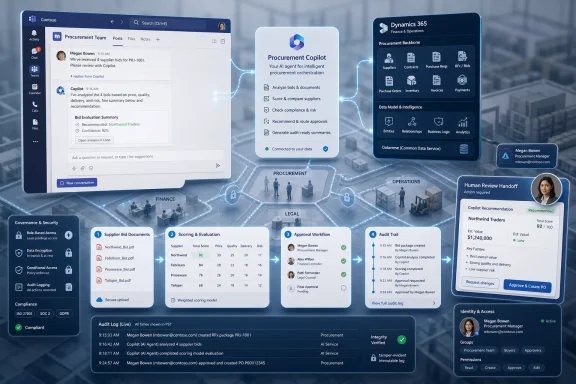 Microsoft Moves ERP Out of the Form and Into the Workstream
ERP has always had a user-experience problem, but not the simplistic one vendors usually describe. The problem is not merely that ERP screens are dense, old-fashioned, or unloved by employees. The deeper issue is that ERP owns the process while the surrounding work happens somewhere else.A supplier delay is not resolved inside a single module. A procurement decision does not live neatly inside a sourcing screen. A finance exception often begins in an email, gains context in a Teams thread, gets debated in a meeting, and ends with someone manually updating the system of record after everyone has already made the decision elsewhere.
That is the gap Microsoft is now trying to occupy with Copilot Cowork. The Dynamics 365 ERP apps plugin is meant to bring ERP context into the collaboration layer without pretending that Teams, Outlook, spreadsheets, and meetings can replace the controls embedded in Dynamics 365. Microsoft’s argument is that ERP should remain the operational backbone, but Copilot should become the place where employees move work forward.
This is an important distinction. Microsoft is not saying ERP disappears into AI. It is saying the interface to ERP becomes more ambient, conversational, and task-driven, with Dynamics 365 still enforcing the data model, permissions, workflows, and business rules underneath.
That is a bold architectural claim. If it works, it gives ERP a new execution surface. If it fails, it becomes another layer of automation theater on top of systems that are already difficult to govern.
The Old ERP Bargain Is Breaking Under Collaboration Sprawl
For decades, ERP systems made a bargain with the enterprise: accept rigid workflows and structured screens in exchange for control, auditability, and a single version of operational truth. That bargain still matters. Finance teams do not want procurement approvals happening in random chat threads, and auditors do not want material decisions living only in meeting notes.But the modern workplace has already routed around ERP’s rigidity. Employees use email because suppliers reply there. They use Excel because evaluation models are easier to build there. They use Teams because decisions require people, not just fields. They use PowerPoint and Word because executives still want narratives, not transaction logs.
The result is an enterprise split-brain. ERP holds the authoritative record, while the practical work of investigation, negotiation, and decision-making happens in Microsoft 365 and adjacent tools. The more complex the process, the more likely it is to sprawl across systems.
Microsoft’s Cowork pitch lands precisely because this is not an edge case. It is normal enterprise behavior. The dirty secret of ERP transformation is that even successful implementations often leave employees stitching together the real work with screenshots, exports, forwarded attachments, and “just checking in” messages.
That stitching is expensive. It creates cycle-time drag, introduces data-entry errors, hides decision rationale, and makes exception handling dependent on the memory and discipline of individual workers. It is also where many AI productivity tools have hit their ceiling: they can generate a recommendation faster, but they cannot reliably carry that recommendation into the governed process where it matters.
Copilot Cowork Is Microsoft’s Answer to the Last-Mile Execution Problem
The phrase agentic ERP risks becoming another vendor slogan, but Microsoft’s implementation has a concrete target: the last mile between AI output and operational follow-through. A summary is useful. A recommendation is useful. But neither is the same as advancing a sourcing event, coordinating stakeholder review, or preparing a downstream purchasing action.Copilot Cowork is designed to operate as a shared workspace where users can delegate tasks, inspect context, collaborate on decisions, and keep the process connected to systems of record. The Dynamics 365 ERP apps plugin extends that idea into finance and operations by exposing ERP data and workflow context through Microsoft’s Dynamics 365 ERP Model Context Protocol server.
That technical plumbing matters because it is the difference between an assistant that can talk about ERP and an agentic surface that can act with ERP context. The former is a glorified search and drafting tool. The latter begins to look like an operational layer, provided the permissions, audit trails, and approval controls are strong enough.
Microsoft’s example of sourcing and supplier bid evaluation is well chosen. Procurement is a perfect test case because it is both structured and messy. There are supplier responses, scoring criteria, ERP policies, commercial tradeoffs, compliance requirements, stakeholder reviews, and downstream purchasing steps. Nobody who has lived through a real sourcing cycle believes it is simply a matter of filling out the right form.
In Microsoft’s framing, Copilot Cowork can help gather supplier responses from emails and spreadsheets, compare bids against criteria and policy, generate recommendations and scorecards, coordinate reviews, and prepare purchasing actions. That is not replacing procurement judgment. It is attacking the coordination tax that surrounds procurement judgment.
The practical question for customers is whether that coordination can happen without creating a new shadow process. If Copilot Cowork becomes the place where work is discussed but Dynamics 365 remains the place where work is validated, approved, and recorded, Microsoft may have something. If the conversational layer becomes a parallel reality that only later syncs imperfectly with ERP, administrators will recognize the smell immediately.
The Model Context Protocol Is the Quiet Center of the Story
The headline product is Copilot Cowork, but the quieter architectural story is Microsoft’s embrace of Model Context Protocol-style connectivity for business applications. MCP gives AI agents a standardized way to discover tools, retrieve context, and invoke actions from connected systems. In ERP terms, that means exposing business capabilities without forcing every agent developer to reinvent integration logic.For Dynamics 365 finance and operations, Microsoft’s MCP server is the bridge between an AI-driven work surface and governed ERP functions. That does not make integration trivial, but it changes the conversation from “Can the assistant see this data?” to “Which actions should this agent be allowed to take, under what identity, with what controls?”
That is where enterprise IT should pay attention. The most important design question is not whether a model can summarize purchase orders or rank supplier bids. It is whether the system can preserve authorization boundaries, tenant policies, auditability, segregation of duties, and exception workflows while making the user experience feel less like manual systems integration.
This is also why Microsoft’s strategy has an advantage over standalone AI workflow startups. Microsoft already owns much of the collaboration fabric where the work happens: Outlook, Teams, SharePoint, Excel, Power BI, and the Microsoft 365 Copilot app. It also owns Dynamics 365, Power Platform, Entra identity, Purview compliance tooling, and the administrative planes that many enterprises already use.
That footprint does not guarantee success. It does, however, give Microsoft a credible path to make agentic workflows feel native rather than bolted on. For many CIOs, the appeal will not be that Copilot Cowork is the most elegant possible agent framework. It will be that it sits inside an ecosystem they already have to govern.
Microsoft Is Selling a New Operating Model, Not Just a Plugin
Bryan Goode’s reported line that “the bottleneck isn’t your people, it’s your operating model” is the heart of Microsoft’s argument. It is also the part customers should interrogate most aggressively. Vendors love to diagnose organizational dysfunction when selling software, but in this case the diagnosis has real bite.Most enterprise AI deployments have been evaluated at the individual productivity level. Did the employee draft faster? Did the analyst summarize more documents? Did the seller prepare for the meeting more efficiently? These are useful metrics, but they miss the operational drag that happens between people.
ERP work is rarely an individual productivity problem. It is a handoff problem, a context problem, a governance problem, and a decision-latency problem. A faster analyst still has to chase approvals. A better-generated scorecard still has to be reconciled with policy. A nicely written supplier summary still has to result in an action that the ERP system understands.
Copilot Cowork is Microsoft’s attempt to push AI from personal assistance into process execution. That is why the shared workspace matters. The agent is not merely answering one employee’s prompt; it is meant to help a group of employees coordinate the task, preserve context, and move toward an outcome.
This is where the feature could become genuinely disruptive. If ERP users begin to experience the system through intents such as “evaluate these supplier bids,” “prepare the month-end variance explanation,” or “triage delayed purchase orders,” the traditional ERP screen becomes less central to daily work. The transaction still matters, but it is no longer the primary mental model.
The Windows and Microsoft 365 Angle Is Bigger Than ERP
For WindowsForum readers, the ERP story is also a Microsoft 365 platform story. Copilot Cowork is not being positioned as a Dynamics-only experience. It is becoming part of the Microsoft 365 Copilot surface, expanding to mobile platforms, and integrating with Microsoft and third-party services through plugins and reusable Cowork Skills.That matters because Microsoft’s enterprise AI strategy is increasingly about turning Microsoft 365 into the front door for work across the software estate. Windows may be the endpoint. Microsoft 365 may be the productivity layer. Dynamics 365 may be the business application layer. But Copilot is being positioned as the cross-cutting execution interface.
The arrival of Cowork on iOS and Android reinforces that point. Microsoft is not assuming agentic work only happens from a desktop ERP session. It is imagining a manager delegating a task from a phone, stepping away, and returning later to a completed or partially completed outcome with checkpoints and review points along the way.
Cowork Skills push the same idea from a different angle. Reusable instruction sets let organizations encode how tasks should be done: format, tone, process expectations, approval preferences, and team-specific standards. That is not full business-process management, but it is a step toward repeatable AI-mediated work.
The plugin ecosystem is equally telling. Microsoft has highlighted integrations across Fabric, Power BI, Dynamics 365 Sales, Customer Service, ERP applications, and partners such as Miro, monday.com, LSEG, Morningstar, Moody’s, S&P Global Energy, Harvey, Enosix, and TeamsMaestro. The direction is clear: Microsoft wants Copilot Cowork to become a hub where work can reach into specialized systems without forcing employees to live in each one all day.
Governance Is the Product Feature Enterprises Will Actually Buy
The consumer version of AI excitement is about capability. The enterprise version is about controlled capability. ERP makes that distinction unavoidable.A procurement analyst should not be able to approve a purchase simply because an agent assembled a convincing recommendation. A finance user should not see restricted legal-entity data because a conversational workspace blurred security boundaries. A supplier evaluation should not become untraceable because the rationale lived in a prompt history outside the formal record.
Microsoft knows this, which is why the company keeps emphasizing that Dynamics 365 remains the governed system of record. But saying governance travels with the workflow is easier than proving it in production. Enterprises will need to test how Copilot Cowork handles identity, role-based permissions, approval authority, data residency, logging, retention, and exception management.
The danger is not only malicious misuse. It is accidental process drift. A helpful agent that drafts an approval message, assembles supporting data, and suggests a decision can influence the outcome even when it does not formally approve anything. That influence should be visible, reviewable, and bounded.
There is also the familiar Microsoft licensing and administrative complexity problem. As Cowork moves from preview into general availability and consumption-based components enter the conversation, IT and finance teams will need to understand not just who can use it, but what it costs when they do. Agentic work that runs in the background can be valuable, but it also changes the shape of cost governance.
That is where admins will likely push for hard controls. They will want service-plan management, Conditional Access alignment, connector approval workflows, data-loss-prevention policies, audit exports, and a clean way to separate sanctioned plugins from experimental ones. The more powerful Cowork becomes, the less acceptable it will be as a loosely managed productivity add-on.
ERP Vendors Are Being Forced to Admit the Screen Is No Longer Enough
Microsoft’s move also puts pressure on the broader ERP market. For years, ERP vendors have improved user experience by modernizing web clients, adding embedded analytics, building mobile approvals, and sprinkling AI into individual modules. Those improvements matter, but they do not fully address the fact that work increasingly happens across systems.The strategic shift is from application UX to work orchestration. Users do not wake up wanting to navigate a procurement module. They want to resolve a supplier issue, understand a cash-flow exposure, close a month-end task, or make a compliant purchasing decision. The ERP vendor that provides the cleanest path from intent to governed execution will have an adoption advantage.
Microsoft is unusually well positioned because it can collapse boundaries between productivity tools and business applications. SAP, Oracle, Workday, ServiceNow, Salesforce, and others all have agentic AI strategies, but Microsoft’s reach into the day-to-day collaboration layer gives it a different kind of leverage. If the work begins in Outlook and Teams, Microsoft has home-field advantage.
That advantage cuts both ways. Customers may welcome fewer handoffs, but they may also worry about deeper dependency on Microsoft’s stack. The more Copilot becomes the interface to ERP, analytics, collaboration, and workflow, the more Microsoft 365 becomes not just office software but an operational control plane.
For some enterprises, that consolidation will look like simplification. For others, it will look like lock-in with a friendlier interface. Both readings can be true.
The Sourcing Demo Is Useful Because It Is Boring
The most convincing enterprise AI demos are often the least glamorous. Microsoft’s supplier bid evaluation scenario is not a sci-fi spectacle. It is a familiar, tedious, cross-functional workflow full of documents, policy checks, stakeholder input, and manual coordination.That is precisely why it matters. Enterprise AI will not be judged by whether it can produce impressive one-off artifacts. It will be judged by whether it can reduce the friction in boring, recurring processes that consume thousands of hours across large organizations.
Sourcing is a good candidate because the current process is often fragmented by design. Supplier responses arrive in varied formats. Evaluation criteria may live in templates or prior events. ERP policies govern eligibility and approval thresholds. Stakeholders care about cost, risk, delivery, quality, and strategic fit. Final decisions must be defensible.
If Copilot Cowork can assemble the relevant context, structure the evaluation, expose policy constraints, and prepare the next operational step without bypassing human review, it becomes more than a productivity assistant. It becomes a coordination layer for governed work.
But the demo also sets the bar. Customers should ask how the system handles incomplete supplier responses, contradictory data, stale spreadsheets, policy exceptions, negotiated terms, and disagreements among stakeholders. The difference between a slick demo and a useful enterprise system is how gracefully it handles the mess.
The Real Test Will Come From Administrators, Not Demo Audiences
Administrators and enterprise architects will be the hardest audience for Microsoft to win, and rightly so. They have seen waves of automation arrive with promises of simplicity and leave behind new integration dependencies, new governance gaps, and new support tickets.For Dynamics 365 customers, the first test is process selection. Not every ERP workflow belongs in a conversational agent surface. High-friction, cross-system, context-heavy workflows are the obvious candidates. Highly standardized transactions with mature automation may not need Cowork at all.
The second test is permission fidelity. If a user cannot perform an action in Dynamics 365, Cowork should not become a clever route around that restriction. If an approval requires a specific role or threshold, the agentic layer must respect that rule without ambiguity.
The third test is evidence. Enterprise teams should measure cycle time, rework, exception rates, manual handoffs, approval delays, and audit findings before and after deployment. “Users like it” is not enough for ERP. The business case has to survive contact with operational metrics.
The fourth test is failure handling. Agents will misunderstand context, encounter missing data, and produce recommendations that need correction. A mature deployment will define where the agent stops, where the human intervenes, and how corrections are captured so the process improves rather than merely restarts.
This is where Microsoft’s packaging as a shared workspace may help. If Cowork makes agent activity visible to the humans responsible for the process, it can become a controlled collaborator. If it behaves like a black box that returns finished-looking outputs without inspectable reasoning and checkpoints, risk teams will slow it down.
The Economics of Agentic Work Are Still Unsettled
The productivity story is straightforward: less manual stitching, faster decisions, and fewer redundant handoffs. The economics are murkier. Agentic systems consume compute, invoke models, call plugins, and may run tasks asynchronously across large data estates.That creates a different cost profile from traditional seat-based software. A licensed user clicking through an ERP screen has predictable economics. An agent evaluating thousands of files, querying multiple systems, generating summaries, and preparing downstream artifacts introduces consumption questions that many organizations are still learning to model.
Microsoft will need to make this boringly governable. CIOs and CFOs will want visibility into usage, cost attribution, model selection, plugin calls, and runaway-task prevention. Department leaders will want enough autonomy to automate work without opening a blank check.
The uncomfortable truth is that agentic AI may reveal how much expensive coordination work enterprises have been hiding in salaried labor. If Cowork reduces that work, the business case could be strong. But if every department starts delegating poorly scoped tasks to premium models without cost discipline, the savings story can evaporate quickly.
This is why FinOps practices are likely to creep into Microsoft 365 Copilot administration. AI cost management will not remain a cloud-infrastructure issue. It will become an end-user computing, collaboration, and business-applications issue.
Microsoft’s Best Case Is a New ERP Habit
If Microsoft succeeds, employees will not think of Copilot Cowork as an AI novelty. They will think of it as the natural place to start certain kinds of operational work.That would be a major shift. ERP adoption has often been measured by whether users enter data correctly and follow process steps. In the Cowork model, adoption may be measured by whether users can express intent, collaborate around context, and let the system prepare governed actions while maintaining human accountability.
This does not make the ERP screen obsolete. There will always be power users, administrators, finance specialists, and operations teams who need full application depth. But it could reduce the number of casual or occasional users who must learn complex screens just to participate in a process.
That matters for enterprises with large numbers of frontline managers, approvers, analysts, and business stakeholders who touch ERP indirectly. If those users can participate through Microsoft 365 while Dynamics 365 preserves process integrity, Microsoft can expand ERP reach without forcing everyone into ERP training.
The risk is that the experience becomes too abstract. ERP screens may be clunky, but they expose structure. Conversational interfaces can hide structure behind fluent language. Microsoft will need to ensure Cowork does not make complex processes feel deceptively simple.
The Cowork Bet Comes Down to Five Enterprise Realities
Microsoft’s Dynamics 365 ERP plugin for Copilot Cowork should be read less as a feature announcement and more as a marker for where business applications are heading. The center of gravity is shifting from records and screens toward coordinated outcomes, but the old enterprise demands have not gone away.- Microsoft made the Dynamics 365 ERP apps plugin for Copilot Cowork generally available on June 16, after announcing it on May 5.
- The plugin brings Dynamics 365 ERP data, workflow context, and operational logic into Microsoft 365 Copilot’s shared Cowork surface.
- The strongest use cases are cross-system workflows where decisions already span ERP, email, spreadsheets, meetings, and approvals.
- Dynamics 365 remains the system of record, which means permissions, approval rules, auditability, and compliance boundaries must survive the move into a conversational workspace.
- Enterprise buyers should judge agentic ERP by reduced cycle time, fewer handoffs, better exception handling, and cleaner audit trails rather than by the novelty of AI-generated recommendations.
- The largest unresolved questions are administrative control, consumption cost, plugin governance, and how well Cowork handles messy real-world process exceptions.
References
- Primary source: erp.today
Published: Fri, 19 Jun 2026 15:33:32 GMT
Microsoft Dynamics 365 Brings Agentic ERP Into Copilot Cowork | ERP Today
Microsoft integrates Dynamics 365 ERP workflows into Copilot Cowork, enabling AI-powered, agentic procurement and sourcing decisions via natural language — without leaving Microsoft 365.erp.today - Related coverage: techradar.com
Microsoft makes Copilot Cowork open to everyone, and wants to help you tackle even the trickiest work tasks | TechRadar
Copilot Cowork gets an upgrade as it opens to all userswww.techradar.com - Official source: learn.microsoft.com
Use Model Context Protocol for finance and operations apps - Finance & Operations | Dynamics 365 | Microsoft Learn
Learn how to use a Model Context Protocol (MCP) server to create and extend agents for Microsoft Dynamics 365 finance and operations apps.learn.microsoft.com - Related coverage: randgroup.com
What is MCP for Dynamics 365 F&O? | Microsoft Partner | Rand Group
Learn what Dynamics 365 MCP is, how it works, and how it enables AI to automate tasks, execute workflows, and connect insights to action. www.randgroup.com
- Related coverage: rcpmag.com
Microsoft Announces General Availability of Copilot Cowork Following Successful Preview -- Redmond Channel Partner
Microsoft has officially launched Copilot Cowork for organizations worldwide.rcpmag.com - Official source: news.microsoft.com
Copilot Cowork ya está disponible de forma general - Source EMEA
 news.microsoft.com
- Official source: microsoft.com
How generative AI is reshaping business applications - Microsoft Dynamics 365 Blog
We’re excited to announce the new Model Context Protocol (MCP) servers for Microsoft Dynamics 365 ERP and CRM business applications. Learn more.www.microsoft.com - Official source: support.microsoft.com
- Related coverage: crosspoint365.com
¿Copilot Cowork o agentes personalizados en Dynamics 365 FO?
Descubre cuándo usar Copilot Cowork o agentes personalizados en Dynamics 365 FO. Compara ventajas, licencias y casos de uso para elegir la mejor opción.www.crosspoint365.com - Related coverage: windowscentral.com
Microsoft Copilot Wave 3 adds AI agents and E7 Frontier Suite | Windows Central
Microsoft Copilot is rolling out more agentic AI control and model support in a new subscription tier for Microsoft 365.www.windowscentral.com - Related coverage: simplydynamics.com
Dynamics 365 ERP & CRM Partner in Ireland - Simply Dynamics
Dynamics 365 ERP & CRM Partner in Ireland with Simply Dynamics delivering AI-powered ERP & CRM solutions Empowering Digital Transformation www.simplydynamics.com
