
ZoomInfo announced on June 19, 2026, that its GTM.AI context layer now integrates natively with Amazon Quick Suite, letting sales and marketing teams invoke ZoomInfo data, searches, and go-to-market skills from inside AWS’s agentic AI workspace. The announcement is not really about another connector in another enterprise dashboard. It is about the emerging fight over which system gets to supply truth to AI agents before they touch customers, pipelines, and revenue operations. For Windows-heavy organizations already juggling Microsoft Copilot, Salesforce, browser-based CRMs, and AWS-backed analytics, the deal is another sign that the agentic workplace will be won less by chat windows than by context layers.
The first wave of enterprise AI sold executives a familiar promise: ask a question in plain English, get a polished answer, move faster. The second wave is more dangerous and more interesting. It asks the same model not merely to answer but to act — enrich a lead, build an account list, prepare for a meeting, score a territory, or push a workflow toward a seller.
That changes the risk profile. A hallucinated paragraph in a memo is embarrassing; a hallucinated buying committee, stale phone number, or mis-scored enterprise account can waste sales capacity at scale. Once AI agents are allowed to operate inside real go-to-market systems, the weak link is often not the model’s grammar or reasoning but the freshness, provenance, and permissions around the data it is allowed to use.
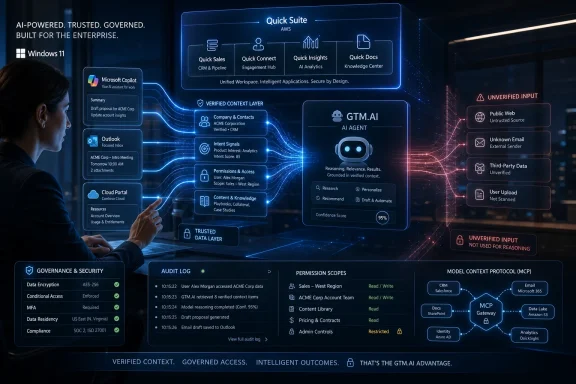
ZoomInfo is trying to make that point the center of its pitch. GTM.AI is framed as a headless go-to-market context layer, exposing ZoomInfo’s company, contact, intent, and signal graph through APIs and Model Context Protocol. In plainer English, ZoomInfo wants to be the verified B2B substrate underneath whatever AI surface a revenue team happens to use.
Amazon Quick Suite gives that strategy a conspicuous new workplace surface. Quick is AWS’s agentic AI workspace for business users, designed to turn questions into research, analysis, automations, and actions across company systems. By bringing ZoomInfo’s skills into that workspace, the two companies are effectively saying that the future sales rep may not begin in Salesforce, Outlook, LinkedIn, or a spreadsheet. They may begin in an agent workspace and ask it to assemble the work.
That ambition matters to WindowsForum readers because the modern enterprise desktop is already a messy hybrid. A typical sales or operations user may live in Windows, Outlook, Teams, Chrome or Edge, Salesforce, a BI tool, a call-recording platform, Excel, and a handful of internal portals. The “agentic workspace” pitch is that the user should not need to manually jump through all of those windows just to answer a compound business question.
The ZoomInfo example is built precisely around that pain. A user can ask Quick to build a list of 50 marketing leaders in Los Angeles, identify people showing signs of marketing initiatives, and return names, titles, emails, direct dials, mobile numbers, job start dates, and LinkedIn profiles. Quick routes the request through ZoomInfo’s MCP server and returns a downloadable list without requiring the user to leave the workspace.
The demo sounds mundane, but that is the point. Enterprise AI will not earn its keep by writing yet another poem about quarterly planning. It will earn its keep by replacing tab-switching, data exports, and brittle human copy-paste rituals with governed, repeatable actions.
A sales agent that can read a pile of records is not the same as a sales agent that knows which company entity is correct, which contacts are current, which signals are meaningful, and which fields a given user is permitted to see. That difference becomes critical when the system is asked to perform work rather than merely summarize it. Agents amplify both intelligence and rot.
ZoomInfo’s bet is that GTM teams will eventually distinguish between raw access and curated context. The company says GTM.AI exposes its verified data graph and orchestration layer through API and MCP, allowing agent surfaces to call ZoomInfo skills without forcing the user into the ZoomInfo application itself. That is a strategic repositioning: ZoomInfo does not need every seller to start their day in ZoomInfo if ZoomInfo can become the intelligence layer inside every other tool.
This is why the integration list matters. ZoomInfo says the same context layer already supports surfaces including Salesforce Agentforce, HubSpot Breeze, Microsoft Copilot, Gong, LeanData, Glean, Claude, ChatGPT, and Google Workspace. Amazon Quick Suite is therefore not an isolated launch. It is another beachhead in a broader campaign to make GTM.AI the cross-platform context fabric for revenue agents.
ZoomInfo’s Quick Suite integration runs through a custom MCP server. That detail is easy to skip, but it is arguably the most important architectural fact in the announcement. It means the connection is not merely a one-off export feature or a shallow search box. It is part of the broader shift toward AI agents invoking specialized tools through standardized interfaces.
For IT teams, MCP is both promising and unsettling. The promise is interoperability: a single controlled service can expose approved capabilities to multiple agents and applications. The concern is blast radius: once tools become callable by agents, permissions, logging, rate limits, data boundaries, and approval flows become non-negotiable.
That is why governance language appears so prominently in ZoomInfo’s announcement. The company says access remains tied to customer entitlements and permissions, and that GTM.AI applies access control, permissioning, data lineage, AI policy, and audit logging across consuming surfaces. Those claims will matter most not in the launch demo but in procurement reviews, security questionnaires, and incident postmortems.
Amazon Quick’s broader desktop and workplace ambitions are part of that trend. AWS has described Quick as a workspace that can operate across business applications, and recent integrations have expanded its reach into tools such as Google Workspace, Zoom, Airtable, and Microsoft 365-adjacent workflows. The result is a competitive landscape where Windows users may have multiple agents watching, summarizing, and acting across the same corpus of work.
That raises practical questions for admins. Which agent is allowed to access CRM data? Which one can invoke ZoomInfo enrichment? Which one can write back to Salesforce or HubSpot? Which one can copy data into a spreadsheet, send an email, or generate a prospecting sequence?
The old desktop management model assumed that applications were the primary units of control. The new model increasingly requires controlling capabilities. An AI assistant may be one window, but it can behave like a composite of search engine, automation tool, BI analyst, CRM operator, and junior sales researcher. That makes identity, conditional access, endpoint posture, and audit visibility more important than the branding on the assistant itself.
That does not make it trivial. The best sales researchers combine public signals, private CRM context, timing, organizational structure, and a sense of what actually matters. A weak agent can produce a clean-looking list that is strategically useless. A strong agent can compress hours of research into minutes while leaving the human to decide what to do with the account.
ZoomInfo’s native skills inside Quick Suite are designed around that middle layer of work. The company lists capabilities such as Account Research, Buying Committee, Enrich Company, Enrich Contact, Meeting Prep, Recommended Contacts, Score Accounts, Score Leads, TAM Sizer, Tech Stack Snapshot, and Competitor Analysis. These are not generic chatbot tricks. They are packaged go-to-market operations.
The packaging is important because enterprises do not want every user improvising prompts for sensitive workflows. They want reusable skills with known inputs, known outputs, governed access, and predictable cost. Natural language remains the user interface, but the underlying work needs to be structured enough for a business to trust it.
The real change is not that AI abolishes the list. It is that AI changes how the list is assembled, filtered, enriched, and justified. Instead of a user manually querying a database, copying records, checking LinkedIn, scanning intent signals, and cleaning columns, the agent can orchestrate that process through a governed data layer.
This is where data quality becomes the decisive factor. If contact information is stale, job changes are missed, or signals are misattributed, the agent simply produces bad work faster. For revenue operations teams, machine-speed error is worse than human-speed inconvenience.
ZoomInfo’s argument is that its graph reduces that risk by grounding agent output in continuously refreshed B2B intelligence. Buyers will still need to test that claim against their own markets, regions, privacy obligations, and tolerance for false positives. But the direction is clear: the next enterprise AI procurement question will not be “Can it answer?” It will be “What is it grounded in?”
ZoomInfo says GTM.AI carries entitlements and permissions into every surface that consumes it. That means a user invoking ZoomInfo from Quick should not magically gain access to data they could not access in ZoomInfo itself. In theory, this preserves the customer’s existing commercial and security boundaries even when the interaction happens through a third-party workspace.
The harder problem is cross-system intent. An agent may read data from ZoomInfo, combine it with CRM records, summarize it in a workspace, and export it into a file or another application. Each step may be permitted individually while the combined workflow creates a new governance question. That is where lineage, logging, and policy enforcement become essential.
This is also where Microsoft-centric shops should pay close attention. If a company has standardized on Microsoft Purview, Entra ID, Defender, Intune, and Copilot controls, introducing AWS Quick Suite plus ZoomInfo’s MCP layer may create a parallel governance path. That is not inherently bad, but it needs deliberate architecture rather than enthusiastic departmental adoption.
This is how platform gravity works. AWS does not need to own every dataset or workflow if Quick becomes the workspace where those assets are invoked. ZoomInfo does not need to own the workspace if GTM.AI becomes the trusted context layer beneath many workspaces. Each company is trying to occupy a different control point in the agentic stack.
Microsoft is pursuing a similar pattern with Copilot and Copilot Studio, Salesforce with Agentforce, Google with Workspace and Gemini, and a long list of SaaS vendors with their own embedded agents. The competitive question is not simply which assistant is smartest. It is which assistant can reach the most useful tools while preserving enterprise trust.
That makes the ZoomInfo-Amazon integration a small announcement with large implications. It shows how agent platforms and domain data providers are beginning to specialize. General agents need domain context; domain vendors need distribution. MCP gives both sides a shared technical vocabulary.
Agentic AI threatens to loosen that grip. If a seller can ask a workspace to research an account, identify contacts, enrich records, summarize meetings, draft outreach, and update fields, the CRM becomes one backend among several rather than the user’s primary environment. The database remains important, but the interface shifts.
That is why integrations with Salesforce Agentforce, HubSpot Breeze, Microsoft Copilot, and Amazon Quick Suite should be read together. ZoomInfo is hedging against interface fragmentation by making GTM.AI available wherever the seller, marketer, or RevOps lead happens to work. It is a sensible strategy in a market where no single AI workspace has yet become the default.
For CRM vendors, the risk is not immediate displacement. It is abstraction. The more work occurs through agents, the more users judge systems of record by how well they serve agents rather than by how pleasant their own screens are.
B2B contact data is regulated differently across jurisdictions, and companies have different rules about prospecting, consent, retention, and enrichment. An agent that can generate a list of contacts is not automatically authorized to use that list for every campaign. The faster the workflow, the more important it becomes to encode legal and marketing policy before the agent acts.
This is one of the under-discussed realities of agentic AI. Human workflows often contain friction that doubles as informal review. A person exporting a file, checking columns, asking a manager, or passing a campaign through operations may slow things down, but those steps also catch some mistakes. Automation removes drag, including useful drag.
The answer is not to reject agents. It is to replace accidental safeguards with explicit ones. That means approvals for certain actions, restricted fields, monitoring for unusual exports, and clear separation between research, enrichment, outreach, and system-of-record updates.
That world requires a different evaluation model. Security teams need to ask how MCP servers authenticate, what scopes they expose, how prompts and outputs are logged, whether data is retained by the calling workspace, and how user entitlements propagate. Business leaders need to ask whether automated scoring and enrichment will be reviewed, measured, and corrected over time.
Cost also deserves scrutiny. Agentic workflows can hide consumption behind natural-language convenience. A user who asks for a complex account analysis may trigger multiple tool calls, enrichment operations, search actions, and downstream automations. That may be worth it, but only if finance and operations can see what is happening.
For Windows administrators, the endpoint implications are equally concrete. Browser extensions, desktop assistants, Office integrations, and background agents are becoming the new productivity perimeter. The machine may still be managed by Intune or another endpoint tool, but the meaningful action increasingly happens in cloud-mediated agent workflows that span applications.
For sellers, the immediate benefits are easy to imagine. Meeting prep can become less manual. Account research can start from a richer baseline. RevOps teams can size markets and score accounts without waiting on bespoke analyst work. Marketers can assemble segments with more signal and less spreadsheet archaeology.
For administrators, the benefits arrive bundled with policy debt. Someone has to decide which users can run which skills, which records can be returned, which outputs can be downloaded, and which actions require approval. In a mature deployment, those choices should map to roles, regions, business units, and compliance obligations.
The organizations that get value from this will not be the ones that simply turn it on. They will be the ones that treat agentic GTM workflows as production systems. That means instrumentation, ownership, exception handling, and a willingness to shut off capabilities that produce attractive but unreliable output.
 The Agent Era Has a Data Problem Before It Has a Model Problem
The first wave of enterprise AI sold executives a familiar promise: ask a question in plain English, get a polished answer, move faster. The second wave is more dangerous and more interesting. It asks the same model not merely to answer but to act — enrich a lead, build an account list, prepare for a meeting, score a territory, or push a workflow toward a seller.That changes the risk profile. A hallucinated paragraph in a memo is embarrassing; a hallucinated buying committee, stale phone number, or mis-scored enterprise account can waste sales capacity at scale. Once AI agents are allowed to operate inside real go-to-market systems, the weak link is often not the model’s grammar or reasoning but the freshness, provenance, and permissions around the data it is allowed to use.
ZoomInfo is trying to make that point the center of its pitch. GTM.AI is framed as a headless go-to-market context layer, exposing ZoomInfo’s company, contact, intent, and signal graph through APIs and Model Context Protocol. In plainer English, ZoomInfo wants to be the verified B2B substrate underneath whatever AI surface a revenue team happens to use.
Amazon Quick Suite gives that strategy a conspicuous new workplace surface. Quick is AWS’s agentic AI workspace for business users, designed to turn questions into research, analysis, automations, and actions across company systems. By bringing ZoomInfo’s skills into that workspace, the two companies are effectively saying that the future sales rep may not begin in Salesforce, Outlook, LinkedIn, or a spreadsheet. They may begin in an agent workspace and ask it to assemble the work.
Amazon Quick Suite Wants to Be the Place Work Starts
AWS has positioned Quick Suite as more than a chatbot glued onto QuickSight. The product family has been described as an agentic workspace that can search, analyze, automate, and act across data sources and applications. Its ambitions overlap with Microsoft Copilot, Salesforce Agentforce, Google Workspace agents, and a widening ecosystem of browser and desktop assistants that want to become the universal front door for office work.That ambition matters to WindowsForum readers because the modern enterprise desktop is already a messy hybrid. A typical sales or operations user may live in Windows, Outlook, Teams, Chrome or Edge, Salesforce, a BI tool, a call-recording platform, Excel, and a handful of internal portals. The “agentic workspace” pitch is that the user should not need to manually jump through all of those windows just to answer a compound business question.
The ZoomInfo example is built precisely around that pain. A user can ask Quick to build a list of 50 marketing leaders in Los Angeles, identify people showing signs of marketing initiatives, and return names, titles, emails, direct dials, mobile numbers, job start dates, and LinkedIn profiles. Quick routes the request through ZoomInfo’s MCP server and returns a downloadable list without requiring the user to leave the workspace.
The demo sounds mundane, but that is the point. Enterprise AI will not earn its keep by writing yet another poem about quarterly planning. It will earn its keep by replacing tab-switching, data exports, and brittle human copy-paste rituals with governed, repeatable actions.
ZoomInfo Is Selling Context as the Missing Enterprise Primitive
ZoomInfo’s language around “verified context” is not accidental. In the agent market, almost every vendor claims connectivity. They can connect to a CRM, connect to a mailbox, connect to a data warehouse, connect to a collaboration suite, and connect to a large language model. But connection is a plumbing claim, not a trust claim.A sales agent that can read a pile of records is not the same as a sales agent that knows which company entity is correct, which contacts are current, which signals are meaningful, and which fields a given user is permitted to see. That difference becomes critical when the system is asked to perform work rather than merely summarize it. Agents amplify both intelligence and rot.
ZoomInfo’s bet is that GTM teams will eventually distinguish between raw access and curated context. The company says GTM.AI exposes its verified data graph and orchestration layer through API and MCP, allowing agent surfaces to call ZoomInfo skills without forcing the user into the ZoomInfo application itself. That is a strategic repositioning: ZoomInfo does not need every seller to start their day in ZoomInfo if ZoomInfo can become the intelligence layer inside every other tool.
This is why the integration list matters. ZoomInfo says the same context layer already supports surfaces including Salesforce Agentforce, HubSpot Breeze, Microsoft Copilot, Gong, LeanData, Glean, Claude, ChatGPT, and Google Workspace. Amazon Quick Suite is therefore not an isolated launch. It is another beachhead in a broader campaign to make GTM.AI the cross-platform context fabric for revenue agents.
MCP Is Becoming the Enterprise AI Adapter Layer
The Model Context Protocol has quickly become one of the more important bits of infrastructure in the agentic AI stack. Its appeal is straightforward: instead of every AI application inventing a custom way to talk to every external system, MCP offers a common pattern for exposing tools, resources, and context to models and agents. That makes it attractive both to platform vendors and to enterprise software companies that want their data to be callable from many different AI surfaces.ZoomInfo’s Quick Suite integration runs through a custom MCP server. That detail is easy to skip, but it is arguably the most important architectural fact in the announcement. It means the connection is not merely a one-off export feature or a shallow search box. It is part of the broader shift toward AI agents invoking specialized tools through standardized interfaces.
For IT teams, MCP is both promising and unsettling. The promise is interoperability: a single controlled service can expose approved capabilities to multiple agents and applications. The concern is blast radius: once tools become callable by agents, permissions, logging, rate limits, data boundaries, and approval flows become non-negotiable.
That is why governance language appears so prominently in ZoomInfo’s announcement. The company says access remains tied to customer entitlements and permissions, and that GTM.AI applies access control, permissioning, data lineage, AI policy, and audit logging across consuming surfaces. Those claims will matter most not in the launch demo but in procurement reviews, security questionnaires, and incident postmortems.
The Windows Desktop Is Still Where These Agents Collide
On paper, this is an AWS and ZoomInfo story. In practice, it lands on the same Windows endpoints where Microsoft has been pushing Copilot, where sellers live in Outlook and Teams, and where administrators are already managing browser extensions, desktop agents, identity policies, and data-loss controls. The agentic future is not replacing the Windows desktop; it is colonizing it.Amazon Quick’s broader desktop and workplace ambitions are part of that trend. AWS has described Quick as a workspace that can operate across business applications, and recent integrations have expanded its reach into tools such as Google Workspace, Zoom, Airtable, and Microsoft 365-adjacent workflows. The result is a competitive landscape where Windows users may have multiple agents watching, summarizing, and acting across the same corpus of work.
That raises practical questions for admins. Which agent is allowed to access CRM data? Which one can invoke ZoomInfo enrichment? Which one can write back to Salesforce or HubSpot? Which one can copy data into a spreadsheet, send an email, or generate a prospecting sequence?
The old desktop management model assumed that applications were the primary units of control. The new model increasingly requires controlling capabilities. An AI assistant may be one window, but it can behave like a composite of search engine, automation tool, BI analyst, CRM operator, and junior sales researcher. That makes identity, conditional access, endpoint posture, and audit visibility more important than the branding on the assistant itself.
Revenue Teams Are the Perfect Test Case for Agentic Automation
Go-to-market work is unusually well suited to agentic AI because it is repetitive, data-rich, and full of semi-structured tasks. Sellers research accounts, assemble lists, identify stakeholders, prepare for meetings, enrich records, check technology stacks, and scan for buying signals. Much of this work is high-friction but not necessarily high-judgment.That does not make it trivial. The best sales researchers combine public signals, private CRM context, timing, organizational structure, and a sense of what actually matters. A weak agent can produce a clean-looking list that is strategically useless. A strong agent can compress hours of research into minutes while leaving the human to decide what to do with the account.
ZoomInfo’s native skills inside Quick Suite are designed around that middle layer of work. The company lists capabilities such as Account Research, Buying Committee, Enrich Company, Enrich Contact, Meeting Prep, Recommended Contacts, Score Accounts, Score Leads, TAM Sizer, Tech Stack Snapshot, and Competitor Analysis. These are not generic chatbot tricks. They are packaged go-to-market operations.
The packaging is important because enterprises do not want every user improvising prompts for sensitive workflows. They want reusable skills with known inputs, known outputs, governed access, and predictable cost. Natural language remains the user interface, but the underlying work needs to be structured enough for a business to trust it.
The Spreadsheet Export Is Still the Ghost in the Machine
There is a funny tension in the launch example: the user asks for agentic help, and the result is a downloadable list. That may sound like an old-world artifact in a new-world story, but it is deeply realistic. The enterprise still runs on spreadsheets, CSV files, and lists passed between teams because those formats are portable, inspectable, and politically neutral.The real change is not that AI abolishes the list. It is that AI changes how the list is assembled, filtered, enriched, and justified. Instead of a user manually querying a database, copying records, checking LinkedIn, scanning intent signals, and cleaning columns, the agent can orchestrate that process through a governed data layer.
This is where data quality becomes the decisive factor. If contact information is stale, job changes are missed, or signals are misattributed, the agent simply produces bad work faster. For revenue operations teams, machine-speed error is worse than human-speed inconvenience.
ZoomInfo’s argument is that its graph reduces that risk by grounding agent output in continuously refreshed B2B intelligence. Buyers will still need to test that claim against their own markets, regions, privacy obligations, and tolerance for false positives. But the direction is clear: the next enterprise AI procurement question will not be “Can it answer?” It will be “What is it grounded in?”
Governance Is the Product, Not the Fine Print
Enterprise software vendors have learned to put governance near the top of every AI announcement, and for good reason. Once agents can access sensitive customer, prospect, employee, and financial data, the control plane becomes as important as the user experience. A beautiful agent that cannot be audited will not survive serious enterprise deployment.ZoomInfo says GTM.AI carries entitlements and permissions into every surface that consumes it. That means a user invoking ZoomInfo from Quick should not magically gain access to data they could not access in ZoomInfo itself. In theory, this preserves the customer’s existing commercial and security boundaries even when the interaction happens through a third-party workspace.
The harder problem is cross-system intent. An agent may read data from ZoomInfo, combine it with CRM records, summarize it in a workspace, and export it into a file or another application. Each step may be permitted individually while the combined workflow creates a new governance question. That is where lineage, logging, and policy enforcement become essential.
This is also where Microsoft-centric shops should pay close attention. If a company has standardized on Microsoft Purview, Entra ID, Defender, Intune, and Copilot controls, introducing AWS Quick Suite plus ZoomInfo’s MCP layer may create a parallel governance path. That is not inherently bad, but it needs deliberate architecture rather than enthusiastic departmental adoption.
AWS Is Building an Agent Marketplace Without Calling It That
Quick Suite’s value rises with every useful third-party capability it can invoke. A generic assistant can summarize documents; a useful enterprise agent can call approved systems of record, perform specific business functions, and return auditable results. ZoomInfo brings a particularly valuable category of capability because external B2B intelligence is hard for a general-purpose model to reconstruct.This is how platform gravity works. AWS does not need to own every dataset or workflow if Quick becomes the workspace where those assets are invoked. ZoomInfo does not need to own the workspace if GTM.AI becomes the trusted context layer beneath many workspaces. Each company is trying to occupy a different control point in the agentic stack.
Microsoft is pursuing a similar pattern with Copilot and Copilot Studio, Salesforce with Agentforce, Google with Workspace and Gemini, and a long list of SaaS vendors with their own embedded agents. The competitive question is not simply which assistant is smartest. It is which assistant can reach the most useful tools while preserving enterprise trust.
That makes the ZoomInfo-Amazon integration a small announcement with large implications. It shows how agent platforms and domain data providers are beginning to specialize. General agents need domain context; domain vendors need distribution. MCP gives both sides a shared technical vocabulary.
The AI Sales Stack Is Starting to Unbundle the CRM
For decades, the CRM has been the official center of sales operations and the unofficial graveyard of sales productivity. It is where data is supposed to live, but not always where work actually happens. Sellers often treat it as a reporting obligation rather than a daily command center.Agentic AI threatens to loosen that grip. If a seller can ask a workspace to research an account, identify contacts, enrich records, summarize meetings, draft outreach, and update fields, the CRM becomes one backend among several rather than the user’s primary environment. The database remains important, but the interface shifts.
That is why integrations with Salesforce Agentforce, HubSpot Breeze, Microsoft Copilot, and Amazon Quick Suite should be read together. ZoomInfo is hedging against interface fragmentation by making GTM.AI available wherever the seller, marketer, or RevOps lead happens to work. It is a sensible strategy in a market where no single AI workspace has yet become the default.
For CRM vendors, the risk is not immediate displacement. It is abstraction. The more work occurs through agents, the more users judge systems of record by how well they serve agents rather than by how pleasant their own screens are.
The Compliance Claims Will Meet the Reality of Regional Data Rules
ZoomInfo’s announcement references enterprise compliance posture including ISO 27701, ISO 27001, SOC 2 Type II, and TRUSTe GDPR. Those credentials matter in procurement, especially for companies nervous about sending customer or prospect data through AI workflows. But compliance badges do not eliminate the need for local policy decisions.B2B contact data is regulated differently across jurisdictions, and companies have different rules about prospecting, consent, retention, and enrichment. An agent that can generate a list of contacts is not automatically authorized to use that list for every campaign. The faster the workflow, the more important it becomes to encode legal and marketing policy before the agent acts.
This is one of the under-discussed realities of agentic AI. Human workflows often contain friction that doubles as informal review. A person exporting a file, checking columns, asking a manager, or passing a campaign through operations may slow things down, but those steps also catch some mistakes. Automation removes drag, including useful drag.
The answer is not to reject agents. It is to replace accidental safeguards with explicit ones. That means approvals for certain actions, restricted fields, monitoring for unusual exports, and clear separation between research, enrichment, outreach, and system-of-record updates.
IT Buyers Should Read the Announcement as an Architecture Signal
The practical buying question is not whether ZoomInfo inside Quick Suite is convenient. It probably is. The deeper question is whether the organization is ready for a world where major SaaS data providers expose agent-callable skills into multiple AI workspaces at once.That world requires a different evaluation model. Security teams need to ask how MCP servers authenticate, what scopes they expose, how prompts and outputs are logged, whether data is retained by the calling workspace, and how user entitlements propagate. Business leaders need to ask whether automated scoring and enrichment will be reviewed, measured, and corrected over time.
Cost also deserves scrutiny. Agentic workflows can hide consumption behind natural-language convenience. A user who asks for a complex account analysis may trigger multiple tool calls, enrichment operations, search actions, and downstream automations. That may be worth it, but only if finance and operations can see what is happening.
For Windows administrators, the endpoint implications are equally concrete. Browser extensions, desktop assistants, Office integrations, and background agents are becoming the new productivity perimeter. The machine may still be managed by Intune or another endpoint tool, but the meaningful action increasingly happens in cloud-mediated agent workflows that span applications.
The Sales Rep Gets an Intern, the Admin Gets a Control Problem
The most charitable way to view this integration is that it gives revenue teams a tireless research assistant with access to better data than a model could infer on its own. The less charitable view is that it creates yet another sanctioned path for sensitive prospect and account data to move through an AI interface. Both readings are true.For sellers, the immediate benefits are easy to imagine. Meeting prep can become less manual. Account research can start from a richer baseline. RevOps teams can size markets and score accounts without waiting on bespoke analyst work. Marketers can assemble segments with more signal and less spreadsheet archaeology.
For administrators, the benefits arrive bundled with policy debt. Someone has to decide which users can run which skills, which records can be returned, which outputs can be downloaded, and which actions require approval. In a mature deployment, those choices should map to roles, regions, business units, and compliance obligations.
The organizations that get value from this will not be the ones that simply turn it on. They will be the ones that treat agentic GTM workflows as production systems. That means instrumentation, ownership, exception handling, and a willingness to shut off capabilities that produce attractive but unreliable output.
The Real Win Is Fewer Tabs, Not Fewer People
The most concrete reading of the ZoomInfo-Amazon announcement is that go-to-market AI is moving from generic conversation toward specialized, governed work. That is good news for teams tired of demos that look impressive until they encounter real data. It is also a warning that the winners will be the organizations that understand the difference between automation and delegation.- Amazon Quick Suite now has a native path to ZoomInfo’s GTM.AI layer through a custom MCP server.
- ZoomInfo is positioning GTM.AI as a headless context layer that can serve multiple AI workspaces rather than only its own application.
- The integration’s value depends on verified, permissioned B2B data, not merely on giving a model access to more records.
- Windows and Microsoft-centric enterprises should evaluate how Quick Suite, Copilot, browser extensions, and SaaS agents overlap on the same managed endpoints.
- Security teams should treat agent-callable GTM skills as production integrations that require scopes, logging, lineage, and policy controls.
- Revenue teams should measure whether agent-generated lists, scores, and research improve pipeline outcomes rather than merely reduce manual work.
References
- Primary source: 01net
Published: 2026-06-19T15:50:18.135964
Amazon Quick Suite Now Powered by ZoomInfo's GTM.AI as the GTM Context Layer for AI Agents
ZoomInfo's verified B2B intelligence and native GTM skills are now available inside Amazon Quick Suite, AWS's agentic AI workspace, through GTM.AI.VANCOUVER, Wash.--(BUSINESS WIRE)--ZoomInfo (NASDAQ: GTM), the all-in-one AI GTM platform, has confirmed... www.01net.it
- Related coverage: aws.amazon.com
Introducing Amazon Quick Suite: your agentic AI-powered workspace - AWS
Discover more about what's new at AWS with Introducing Amazon Quick Suite: your agentic AI-powered workspaceaws.amazon.com
- Related coverage: aboutamazon.com
Amazon launches Agentic AI Quick Suite to let you automate tasks at work
Quick Suite helps you cut through the noise of fragmented information, siloed applications, and repetitive tasks to focus on what matters. www.aboutamazon.com
- Related coverage: docs.aws.amazon.com
Generate an executive summary of an Amazon Quick Sight dashboard - Amazon Quick
Learn how to generate an executive summary of a dashboard in Amazon Quick Sight.docs.aws.amazon.com
- Related coverage: techradar.com
Amazon Quick Suite wants to help your business build its AI agents in no time at all | TechRadar
AWS Quick Suite is now generally availablewww.techradar.com
