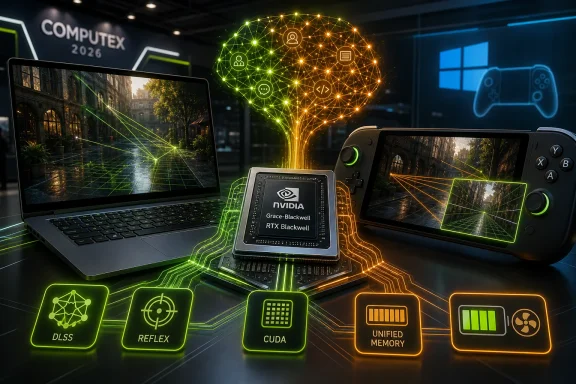
Nvidia unveiled RTX Spark at GTC Taipei during Computex 2026 as a Windows-on-Arm PC platform built with Microsoft around a Grace-based Arm CPU, Blackwell RTX graphics, unified memory, and local AI workloads rather than gaming-first laptop upgrades. That ordering matters. For years, the “AI PC” has been sold as a slightly smarter Windows machine; RTX Spark is Nvidia arguing that the PC itself should be rebuilt around local models, agentic software, and GPU memory pressure. Gaming is still in the brochure, but it is no longer the center of gravity.
The simplest way to misunderstand RTX Spark is to treat it like the next GeForce laptop part with better branding. Nvidia has spent two decades training PC buyers to read CUDA core counts, DLSS versions, ray-tracing claims, and thermal envelopes as gaming signals. RTX Spark uses the same vocabulary, but the sentence has changed.
The platform’s headline silicon, commonly discussed as the N1X-class Spark superchip, combines a 20-core Grace Arm CPU with a Blackwell RTX GPU, thousands of CUDA cores, fifth-generation Tensor Cores, and a coherent unified memory architecture. Nvidia is also leaning hard on up to 128 GB of LPDDR5X memory, a number that means more to AI developers and 3D artists than to most gamers. A gaming laptop buyer asks how fast Cyberpunk runs at 1440p; an AI developer asks whether a large model, vector database, browser automation stack, and IDE can live on the same machine without paging themselves to death.
That is why the platform feels less like a direct rival to a conventional RTX 5080 or RTX 5090 laptop and more like a miniaturized answer to Apple’s high-end MacBook Pro strategy. Apple proved that tightly integrated CPU, GPU, media engines, and unified memory could redefine professional mobile computing. Nvidia is trying to apply a similar architectural argument to Windows, but with CUDA, RTX, TensorRT, DLSS, and the enormous gravity of its AI developer ecosystem.
The risk is that this pitch will be flattened by retail shelves. Put “RTX” on a laptop, and gamers will expect a gaming laptop. Put “AI PC” on a laptop, and buyers may remember a wave of underwhelming Copilot-branded machines that promised a new era and mostly delivered better video effects, local image generation demos, and a badge on the palm rest.
RTX Spark needs to escape both categories. It is not interesting because it makes a laptop a little more intelligent. It is interesting because it asks whether a premium Windows PC should be designed first as a local compute node.
RTX Spark is a more serious argument because it starts where many local AI workloads actually break: memory. Developers can squeeze surprising models onto consumer GPUs, but VRAM limits remain brutal. A 16 GB or 24 GB discrete GPU can be excellent for games and many creative workloads, yet still become the bottleneck when models, context windows, embeddings, multiple agents, and application state pile up.
Unified memory is not magic, and LPDDR5X is not the same thing as a fat pool of GDDR7 attached to a high-end discrete GPU. But the appeal of a large shared memory space is obvious. If the CPU and GPU can address the same pool coherently, a machine becomes more forgiving for workloads that do not fit neatly into the traditional “system RAM over here, VRAM over there” model.
For creators, that can mean heavier timelines, larger scenes, more aggressive AI-assisted editing, and fewer abrupt crashes when a project grows beyond the machine’s segmented memory assumptions. For AI developers, it can mean running larger local models, keeping more context resident, or experimenting with multi-agent workflows without immediately renting cloud GPUs. For enterprise teams, it suggests a new class of portable edge workstation that can handle sensitive local inference without shipping everything to a data center.
This is the part of the AI PC story that has felt missing. A few dozen TOPS on an NPU may help with background tasks and battery-friendly inference, but the workloads that make people rethink their hardware tend to be memory-hungry and GPU-hungry. Nvidia is not merely adding an AI block to a laptop processor. It is using the PC as a beachhead for the same argument that made its data-center business dominant: modern computing is increasingly constrained by accelerated compute and how close the data can stay to it.
This is not merely an Arm laptop for web browsing, Office, Teams, and endurance. It is an Arm Windows platform aimed at developers, creators, AI researchers, and premium buyers who would otherwise look at a MacBook Pro, a mobile workstation, or a hulking gaming laptop. That changes the test. If Windows on Arm can host serious CUDA-accelerated workflows, pro apps, game libraries, and AI tools, it stops being a compatibility experiment and starts becoming a workstation architecture.
Microsoft needs that badly. Apple has spent years making the Mac feel architecturally coherent: unified memory, custom media engines, strong battery life, and a developer story that increasingly assumes Apple silicon. Windows, by contrast, remains powerful precisely because it is sprawling. That sprawl is a strength for compatibility but a weakness when trying to sell a polished, integrated future.
RTX Spark gives Microsoft a high-end story that is not just “we also have efficient Arm laptops.” It gives Windows an answer to the question of what a local AI developer machine should look like in 2026. It also gives Microsoft a way to make Windows on Arm more relevant to the people who influence software ecosystems: developers, creative professionals, and technically sophisticated buyers.
The awkwardness is that Nvidia now owns much of the excitement. Microsoft provides the operating system, app platform, and Surface showcase, but the gravitational pull comes from Nvidia’s stack. CUDA remains the closest thing AI computing has to a default native language. If RTX Spark succeeds, Windows benefits. Nvidia benefits more.
But credible is not the same as best. A conventional gaming laptop with an Intel or AMD CPU, a discrete GeForce GPU, dedicated GDDR7 VRAM, mature x86 compatibility, and years of driver tuning remains the safer choice for the buyer whose top priority is frame rate per dollar. RTX Spark’s architecture may be elegant for AI and creation, yet gaming has its own unforgiving bottlenecks: GPU clocks, memory bandwidth, driver maturity, anti-cheat support, emulation overhead, and thermal behavior under sustained load.
The Windows on Arm layer is especially important. Native Arm games remain limited compared with the enormous x86 Windows catalog. Microsoft’s Prism translation layer has improved the situation, but translation is not invisibility. Some games will run well, some will run acceptably, and some will be blocked by anti-cheat systems, launchers, drivers, or ancient assumptions buried deep in PC gaming’s back catalog.
That does not make RTX Spark a bad gaming platform. It makes it a complicated one. Nvidia’s software stack can mask many sins, and DLSS has already taught the industry that perceived performance is not the same as brute-force rasterization. A well-tuned Spark laptop may be a perfectly enjoyable gaming machine for modern titles that cooperate with the platform.
Still, the phrase that matters is gaming-capable, not gaming-first. The early positioning around creator, developer, premium productivity, and business-class systems says more than any spec sheet. Nvidia wants games in the story because games are part of RTX’s identity. It wants AI workloads to close the sale.
Nvidia’s entrance changes the hierarchy. Intel and AMD have historically controlled the CPU platform while Nvidia supplied the discrete GPU in performance laptops. RTX Spark collapses that relationship. Nvidia is no longer merely the graphics vendor attached to someone else’s PC architecture; it is proposing the central silicon around which the machine is built.
That is strategically uncomfortable for the incumbent PC chipmakers. Intel has spent years trying to defend the centrality of x86 in Windows. AMD has gained credibility by offering strong CPU, GPU, and integrated graphics performance in efficient packages. Nvidia is now saying that the most important unit of value in a premium PC may not be x86 compatibility or traditional CPU leadership at all. It may be local accelerated AI plus a software stack developers already use.
The counterargument is obvious and strong. Intel and AMD systems will remain more predictable for mainstream Windows compatibility. They will likely offer better value across a broad range of price points. Their gaming laptops will be easier for buyers to understand. Enterprises that standardize around x86 management, deployment, and app compatibility will not casually abandon that foundation because Nvidia has an exciting new platform.
But this is not only about unit volume in the first year. It is about narrative control. Nvidia wants to define the next premium PC not as a Windows laptop with an NPU, but as a personal AI workstation that happens to be portable. If that framing sticks, Intel and AMD will be forced to answer on Nvidia’s terms.
RTX Spark’s unified memory pool speaks directly to that anxiety. A machine with up to 128 GB of shared memory can be marketed not just as fast, but as roomy. That distinction matters. Many creative professionals would rather have predictable headroom than a benchmark win that disappears when the project file becomes ugly.
Nvidia’s advantage is that creative software vendors already optimize for its hardware. Adobe, Blackmagic, Autodesk, Epic, and a long tail of specialized tools have years of CUDA and RTX acceleration history behind them. If those applications become native, optimized, and stable on RTX Spark systems, the platform could feel less like a first-generation experiment and more like a continuation of existing Nvidia workflows in a new form factor.
There is still a large “if” in that sentence. Pro users are often less tolerant of architectural novelty than enthusiasts expect. They buy machines to finish work, not to validate platform transitions. A video editor who loses a plug-in, a colorist who hits a codec issue, or a game developer who finds a toolchain behaving strangely under Arm Windows will not be soothed by a petaflop claim.
That is why Surface hardware matters. Microsoft’s involvement gives the platform a reference point and a promise of seriousness. But the broader OEM wave will matter more. Lenovo, Dell, HP, ASUS, MSI, and others know how to segment mobile workstations, creator laptops, and premium notebooks. Their designs will reveal whether RTX Spark is a niche halo product or a real new tier of Windows PC.
A local AI workstation changes that balance. It does not replace cloud training clusters or frontier model inference, but it can make smaller and specialized models more useful. Developers can prototype locally. Companies can run sensitive workflows closer to the user. Researchers can iterate without a cloud bill attached to every experiment. Power users can keep documents, code, media, and prompts on a machine they control.
This is where RTX Spark could resonate with WindowsForum readers more than a conventional laptop launch. Sysadmins and IT pros are not easily impressed by keynote demos. They care about manageability, deployment, security boundaries, driver quality, update cadence, and whether a new class of machines creates more support tickets than value. Local AI is appealing only if it behaves like infrastructure rather than a magic trick.
There is also a governance angle. Organizations are already wrestling with employees pasting confidential data into cloud AI tools. A capable local AI PC does not solve policy by itself, but it gives IT departments another architectural option. Instead of choosing between banning tools and accepting cloud exposure, companies can explore managed local inference for approved models and workflows.
The catch is that local does not automatically mean safe. Models can leak data through logs, plug-ins, connectors, and poorly designed agent permissions. A machine powerful enough to automate work locally is also powerful enough to automate mistakes. RTX Spark may bring AI closer to the user, but IT will still need to decide what the user is allowed to do with it.
That creates a classic first-generation problem. The buyers who most understand RTX Spark’s value are also the buyers most likely to demand proof. AI developers may want local compute, but they can compare it against cloud credits, desktop GPUs, Apple silicon, AMD workstations, and existing RTX laptops. Creators may love the memory story, but only if their exact applications and plug-ins run reliably. Gamers may be intrigued, but a cheaper x86 RTX laptop will often be the rational buy.
For Nvidia, the goal may not be immediate mass adoption. The company can afford to seed a category, establish design wins, and let software catch up. Its data-center dominance gives it the luxury of pushing the PC market from above rather than fighting for every midrange laptop slot. RTX Spark can be expensive and still strategically successful if it shapes developer expectations and pressures OEMs to build around Nvidia’s AI-first vision.
For Microsoft, the economics are trickier. Windows thrives on breadth. A premium AI workstation tier is useful, but the company ultimately needs the platform benefits to trickle down. If RTX Spark remains a boutique class of expensive creator systems, it helps Windows look modern but does not transform the installed base. If the architecture becomes a roadmap, with future generations scaling into more accessible machines, the stakes become much larger.
This is where Nvidia’s longer roadmap matters. RTX Spark should be read less as a one-off chip and more as the first visible draft of a recurring platform strategy. If Nvidia can refresh it alongside future GPU architectures, it becomes a cadence. And in the PC industry, cadence is how experiments become defaults.
RTX Spark inherits that burden through Windows on Arm. Microsoft has done significant work on emulation, and the experience is better than it was in the early Surface Pro X era. But “better” is not the same as universal. Low-level utilities, kernel-mode drivers, hardware monitoring tools, VPN clients, anti-cheat systems, professional plug-ins, and obscure enterprise software can all become friction points.
This matters because RTX Spark is aimed at people who often have complex software environments. A casual laptop buyer may live in a browser, Office, Teams, Spotify, and a handful of store apps. A creator or developer may have plug-ins, SDKs, command-line tools, GPU libraries, license managers, virtual devices, and old project dependencies. A gamer may have launchers stacked on launchers, anti-cheat drivers, mods, overlays, and peripherals with their own software.
The platform’s success will therefore depend less on whether the keynote demos worked and more on whether the boring edge cases do. Can a studio deploy these machines without building a separate support playbook for every application? Can a developer install their toolchain without discovering that one critical dependency assumes x86? Can a gamer trust that multiplayer titles will not silently fail because an anti-cheat vendor has not blessed Arm?
If the answer is yes often enough, RTX Spark becomes credible quickly. If the answer is “mostly, except for the thing you need,” the platform risks becoming another impressive Windows-on-Arm machine admired by reviewers and avoided by cautious buyers.
A powerful local AI PC can become the front end of Nvidia’s larger ecosystem. Developers prototype on the laptop, scale to workstations or DGX-class systems, and deploy to cloud infrastructure that is also likely running Nvidia hardware. That is not a rejection of the cloud. It is a funnel into an Nvidia-shaped compute continuum.
This is why RTX Spark should not be judged only by conventional laptop metrics. Battery life, price, gaming performance, and app compatibility all matter. But Nvidia is playing a broader game: it wants CUDA and RTX to remain the default local development environment for AI, just as cloud AI normalizes GPU acceleration at industrial scale. If the personal AI era arrives, Nvidia wants the personal machine to look like a smaller node in its universe.
There is a defensive logic too. If local AI becomes important and Nvidia does not own the premium PC architecture, rivals get room to define the stack. Apple could capture creators and developers with unified-memory Macs. AMD could use aggressive pricing and large-memory designs to court local AI enthusiasts. Qualcomm could keep pushing efficient Arm PCs from below. Microsoft could abstract more workloads through APIs that reduce hardware differentiation.
RTX Spark says Nvidia would rather not wait for someone else to decide what the AI PC is.
That does not mean the platform is impractical. On paper, it maps unusually well to the moment. Local models are getting more capable. Creative tools are absorbing AI features at speed. Enterprises are looking for ways to control data exposure. Developers want machines that can run meaningful experiments without turning every iteration into a cloud-cost decision.
But the first generation will almost certainly expose gaps. Some performance claims will depend heavily on precision formats and optimized paths. Some apps will need native Arm work before they feel right. Some games will be messy. Some thermal designs will be better than others. Some buyers will discover that a traditional RTX laptop or desktop GPU still fits their workload better.
That is not failure. It is what happens when a platform tries to move the PC boundary. The original ultrabook, the first serious 2-in-1s, early Apple silicon Macs, and the first credible Copilot+ PCs all arrived with a mix of promise and compromise. The important question is whether the compromise shrinks over time while the architectural advantage grows.
 Nvidia Is Not Selling a Faster Gaming Laptop So Much as a Smaller Workstation
The simplest way to misunderstand RTX Spark is to treat it like the next GeForce laptop part with better branding. Nvidia has spent two decades training PC buyers to read CUDA core counts, DLSS versions, ray-tracing claims, and thermal envelopes as gaming signals. RTX Spark uses the same vocabulary, but the sentence has changed.The platform’s headline silicon, commonly discussed as the N1X-class Spark superchip, combines a 20-core Grace Arm CPU with a Blackwell RTX GPU, thousands of CUDA cores, fifth-generation Tensor Cores, and a coherent unified memory architecture. Nvidia is also leaning hard on up to 128 GB of LPDDR5X memory, a number that means more to AI developers and 3D artists than to most gamers. A gaming laptop buyer asks how fast Cyberpunk runs at 1440p; an AI developer asks whether a large model, vector database, browser automation stack, and IDE can live on the same machine without paging themselves to death.
That is why the platform feels less like a direct rival to a conventional RTX 5080 or RTX 5090 laptop and more like a miniaturized answer to Apple’s high-end MacBook Pro strategy. Apple proved that tightly integrated CPU, GPU, media engines, and unified memory could redefine professional mobile computing. Nvidia is trying to apply a similar architectural argument to Windows, but with CUDA, RTX, TensorRT, DLSS, and the enormous gravity of its AI developer ecosystem.
The risk is that this pitch will be flattened by retail shelves. Put “RTX” on a laptop, and gamers will expect a gaming laptop. Put “AI PC” on a laptop, and buyers may remember a wave of underwhelming Copilot-branded machines that promised a new era and mostly delivered better video effects, local image generation demos, and a badge on the palm rest.
RTX Spark needs to escape both categories. It is not interesting because it makes a laptop a little more intelligent. It is interesting because it asks whether a premium Windows PC should be designed first as a local compute node.
The Old AI PC Was a Sticker; This One Is a Bet on Memory
The first AI PC wave was defined less by architecture than by eligibility. A modern processor had an NPU. Windows could run some local AI features. Microsoft and OEMs had something new to market after years of incremental laptop upgrades. The result was real but modest: better power efficiency for certain inference tasks, camera and audio improvements, and the promise that more local AI software would eventually arrive.RTX Spark is a more serious argument because it starts where many local AI workloads actually break: memory. Developers can squeeze surprising models onto consumer GPUs, but VRAM limits remain brutal. A 16 GB or 24 GB discrete GPU can be excellent for games and many creative workloads, yet still become the bottleneck when models, context windows, embeddings, multiple agents, and application state pile up.
Unified memory is not magic, and LPDDR5X is not the same thing as a fat pool of GDDR7 attached to a high-end discrete GPU. But the appeal of a large shared memory space is obvious. If the CPU and GPU can address the same pool coherently, a machine becomes more forgiving for workloads that do not fit neatly into the traditional “system RAM over here, VRAM over there” model.
For creators, that can mean heavier timelines, larger scenes, more aggressive AI-assisted editing, and fewer abrupt crashes when a project grows beyond the machine’s segmented memory assumptions. For AI developers, it can mean running larger local models, keeping more context resident, or experimenting with multi-agent workflows without immediately renting cloud GPUs. For enterprise teams, it suggests a new class of portable edge workstation that can handle sensitive local inference without shipping everything to a data center.
This is the part of the AI PC story that has felt missing. A few dozen TOPS on an NPU may help with background tasks and battery-friendly inference, but the workloads that make people rethink their hardware tend to be memory-hungry and GPU-hungry. Nvidia is not merely adding an AI block to a laptop processor. It is using the PC as a beachhead for the same argument that made its data-center business dominant: modern computing is increasingly constrained by accelerated compute and how close the data can stay to it.
Microsoft Gets the Arm PC It Always Wanted, But with Nvidia’s Leverage
Microsoft’s role is not incidental. Windows on Arm has been a long, uneven campaign: technically promising, strategically important, and repeatedly slowed by compatibility headaches, developer inertia, and hardware that did not always justify the trade-offs. Qualcomm’s Snapdragon X generation gave the category its first truly mainstream push, especially around battery life and Copilot+ PC requirements. RTX Spark moves the battlefield upward.This is not merely an Arm laptop for web browsing, Office, Teams, and endurance. It is an Arm Windows platform aimed at developers, creators, AI researchers, and premium buyers who would otherwise look at a MacBook Pro, a mobile workstation, or a hulking gaming laptop. That changes the test. If Windows on Arm can host serious CUDA-accelerated workflows, pro apps, game libraries, and AI tools, it stops being a compatibility experiment and starts becoming a workstation architecture.
Microsoft needs that badly. Apple has spent years making the Mac feel architecturally coherent: unified memory, custom media engines, strong battery life, and a developer story that increasingly assumes Apple silicon. Windows, by contrast, remains powerful precisely because it is sprawling. That sprawl is a strength for compatibility but a weakness when trying to sell a polished, integrated future.
RTX Spark gives Microsoft a high-end story that is not just “we also have efficient Arm laptops.” It gives Windows an answer to the question of what a local AI developer machine should look like in 2026. It also gives Microsoft a way to make Windows on Arm more relevant to the people who influence software ecosystems: developers, creative professionals, and technically sophisticated buyers.
The awkwardness is that Nvidia now owns much of the excitement. Microsoft provides the operating system, app platform, and Surface showcase, but the gravitational pull comes from Nvidia’s stack. CUDA remains the closest thing AI computing has to a default native language. If RTX Spark succeeds, Windows benefits. Nvidia benefits more.
The Gaming Story Is Real, but It Is Not the Main Event
Nvidia is not pretending games do not matter. RTX Spark systems are expected to support the familiar RTX feature set: ray tracing, DLSS, Reflex, AI-enhanced rendering, and the broader GeForce software ecosystem. Microsoft has also been careful to frame Xbox on PC access as part of the platform’s appeal. A premium Windows laptop with a Blackwell RTX GPU that cannot credibly play games would be commercially absurd.But credible is not the same as best. A conventional gaming laptop with an Intel or AMD CPU, a discrete GeForce GPU, dedicated GDDR7 VRAM, mature x86 compatibility, and years of driver tuning remains the safer choice for the buyer whose top priority is frame rate per dollar. RTX Spark’s architecture may be elegant for AI and creation, yet gaming has its own unforgiving bottlenecks: GPU clocks, memory bandwidth, driver maturity, anti-cheat support, emulation overhead, and thermal behavior under sustained load.
The Windows on Arm layer is especially important. Native Arm games remain limited compared with the enormous x86 Windows catalog. Microsoft’s Prism translation layer has improved the situation, but translation is not invisibility. Some games will run well, some will run acceptably, and some will be blocked by anti-cheat systems, launchers, drivers, or ancient assumptions buried deep in PC gaming’s back catalog.
That does not make RTX Spark a bad gaming platform. It makes it a complicated one. Nvidia’s software stack can mask many sins, and DLSS has already taught the industry that perceived performance is not the same as brute-force rasterization. A well-tuned Spark laptop may be a perfectly enjoyable gaming machine for modern titles that cooperate with the platform.
Still, the phrase that matters is gaming-capable, not gaming-first. The early positioning around creator, developer, premium productivity, and business-class systems says more than any spec sheet. Nvidia wants games in the story because games are part of RTX’s identity. It wants AI workloads to close the sale.
RTX Spark Is Also a Shot Across Intel and AMD’s Bow
Intel and AMD have been preparing for the AI PC era on their own terms. Intel has its Core Ultra strategy and NPU roadmap. AMD has Ryzen AI and, at the high end, increasingly compelling integrated designs with large memory configurations. Both companies understand that the laptop CPU can no longer be just a CPU. The modern premium processor is a heterogeneous compute complex, and the marketing battle is over which part of that complex matters most.Nvidia’s entrance changes the hierarchy. Intel and AMD have historically controlled the CPU platform while Nvidia supplied the discrete GPU in performance laptops. RTX Spark collapses that relationship. Nvidia is no longer merely the graphics vendor attached to someone else’s PC architecture; it is proposing the central silicon around which the machine is built.
That is strategically uncomfortable for the incumbent PC chipmakers. Intel has spent years trying to defend the centrality of x86 in Windows. AMD has gained credibility by offering strong CPU, GPU, and integrated graphics performance in efficient packages. Nvidia is now saying that the most important unit of value in a premium PC may not be x86 compatibility or traditional CPU leadership at all. It may be local accelerated AI plus a software stack developers already use.
The counterargument is obvious and strong. Intel and AMD systems will remain more predictable for mainstream Windows compatibility. They will likely offer better value across a broad range of price points. Their gaming laptops will be easier for buyers to understand. Enterprises that standardize around x86 management, deployment, and app compatibility will not casually abandon that foundation because Nvidia has an exciting new platform.
But this is not only about unit volume in the first year. It is about narrative control. Nvidia wants to define the next premium PC not as a Windows laptop with an NPU, but as a personal AI workstation that happens to be portable. If that framing sticks, Intel and AMD will be forced to answer on Nvidia’s terms.
The Creator Pitch Is Where the Hardware Makes the Most Immediate Sense
Creators are the natural first audience because their pain is concrete. Video editors, 3D artists, game developers, designers, and AI-assisted production teams already understand what it means to hit hardware limits. They know when a timeline stutters, when a render spills over, when a scene grows too large, when an AI effect takes too long, and when a laptop technically has a powerful GPU but not enough memory to keep the workflow smooth.RTX Spark’s unified memory pool speaks directly to that anxiety. A machine with up to 128 GB of shared memory can be marketed not just as fast, but as roomy. That distinction matters. Many creative professionals would rather have predictable headroom than a benchmark win that disappears when the project file becomes ugly.
Nvidia’s advantage is that creative software vendors already optimize for its hardware. Adobe, Blackmagic, Autodesk, Epic, and a long tail of specialized tools have years of CUDA and RTX acceleration history behind them. If those applications become native, optimized, and stable on RTX Spark systems, the platform could feel less like a first-generation experiment and more like a continuation of existing Nvidia workflows in a new form factor.
There is still a large “if” in that sentence. Pro users are often less tolerant of architectural novelty than enthusiasts expect. They buy machines to finish work, not to validate platform transitions. A video editor who loses a plug-in, a colorist who hits a codec issue, or a game developer who finds a toolchain behaving strangely under Arm Windows will not be soothed by a petaflop claim.
That is why Surface hardware matters. Microsoft’s involvement gives the platform a reference point and a promise of seriousness. But the broader OEM wave will matter more. Lenovo, Dell, HP, ASUS, MSI, and others know how to segment mobile workstations, creator laptops, and premium notebooks. Their designs will reveal whether RTX Spark is a niche halo product or a real new tier of Windows PC.
Local AI Is a Privacy Argument, a Cost Argument, and a Control Argument
The phrase “personal AI agent” invites skepticism, partly because the industry has overused the term agentic to the point of exhaustion. But beneath the branding is a practical question: how much AI work should happen on the user’s own machine? Cloud AI is powerful, easy to update, and economically attractive for vendors that can meter access. It is also expensive at scale, latency-sensitive, and awkward for data that users or companies do not want to upload.A local AI workstation changes that balance. It does not replace cloud training clusters or frontier model inference, but it can make smaller and specialized models more useful. Developers can prototype locally. Companies can run sensitive workflows closer to the user. Researchers can iterate without a cloud bill attached to every experiment. Power users can keep documents, code, media, and prompts on a machine they control.
This is where RTX Spark could resonate with WindowsForum readers more than a conventional laptop launch. Sysadmins and IT pros are not easily impressed by keynote demos. They care about manageability, deployment, security boundaries, driver quality, update cadence, and whether a new class of machines creates more support tickets than value. Local AI is appealing only if it behaves like infrastructure rather than a magic trick.
There is also a governance angle. Organizations are already wrestling with employees pasting confidential data into cloud AI tools. A capable local AI PC does not solve policy by itself, but it gives IT departments another architectural option. Instead of choosing between banning tools and accepting cloud exposure, companies can explore managed local inference for approved models and workflows.
The catch is that local does not automatically mean safe. Models can leak data through logs, plug-ins, connectors, and poorly designed agent permissions. A machine powerful enough to automate work locally is also powerful enough to automate mistakes. RTX Spark may bring AI closer to the user, but IT will still need to decide what the user is allowed to do with it.
Price Will Decide Whether This Is a Platform or a Prestige Object
The first RTX Spark systems are unlikely to be cheap. That is not speculation so much as product logic. A new high-end Nvidia platform, premium Windows-on-Arm engineering, large unified memory configurations, and creator-class industrial design do not add up to a bargain laptop. Nvidia’s DGX Spark positioning also reinforces the idea that the company sees this family as serious AI hardware rather than mass-market commodity silicon.That creates a classic first-generation problem. The buyers who most understand RTX Spark’s value are also the buyers most likely to demand proof. AI developers may want local compute, but they can compare it against cloud credits, desktop GPUs, Apple silicon, AMD workstations, and existing RTX laptops. Creators may love the memory story, but only if their exact applications and plug-ins run reliably. Gamers may be intrigued, but a cheaper x86 RTX laptop will often be the rational buy.
For Nvidia, the goal may not be immediate mass adoption. The company can afford to seed a category, establish design wins, and let software catch up. Its data-center dominance gives it the luxury of pushing the PC market from above rather than fighting for every midrange laptop slot. RTX Spark can be expensive and still strategically successful if it shapes developer expectations and pressures OEMs to build around Nvidia’s AI-first vision.
For Microsoft, the economics are trickier. Windows thrives on breadth. A premium AI workstation tier is useful, but the company ultimately needs the platform benefits to trickle down. If RTX Spark remains a boutique class of expensive creator systems, it helps Windows look modern but does not transform the installed base. If the architecture becomes a roadmap, with future generations scaling into more accessible machines, the stakes become much larger.
This is where Nvidia’s longer roadmap matters. RTX Spark should be read less as a one-off chip and more as the first visible draft of a recurring platform strategy. If Nvidia can refresh it alongside future GPU architectures, it becomes a cadence. And in the PC industry, cadence is how experiments become defaults.
Compatibility Is the Tax Every New Windows Architecture Must Pay
Every Windows architecture transition eventually meets the same enemy: the old stuff. Windows is valuable because it runs decades of software, drivers, utilities, games, enterprise agents, and strange line-of-business applications no one wants to rewrite. That compatibility is the platform’s moat and its burden.RTX Spark inherits that burden through Windows on Arm. Microsoft has done significant work on emulation, and the experience is better than it was in the early Surface Pro X era. But “better” is not the same as universal. Low-level utilities, kernel-mode drivers, hardware monitoring tools, VPN clients, anti-cheat systems, professional plug-ins, and obscure enterprise software can all become friction points.
This matters because RTX Spark is aimed at people who often have complex software environments. A casual laptop buyer may live in a browser, Office, Teams, Spotify, and a handful of store apps. A creator or developer may have plug-ins, SDKs, command-line tools, GPU libraries, license managers, virtual devices, and old project dependencies. A gamer may have launchers stacked on launchers, anti-cheat drivers, mods, overlays, and peripherals with their own software.
The platform’s success will therefore depend less on whether the keynote demos worked and more on whether the boring edge cases do. Can a studio deploy these machines without building a separate support playbook for every application? Can a developer install their toolchain without discovering that one critical dependency assumes x86? Can a gamer trust that multiplayer titles will not silently fail because an anti-cheat vendor has not blessed Arm?
If the answer is yes often enough, RTX Spark becomes credible quickly. If the answer is “mostly, except for the thing you need,” the platform risks becoming another impressive Windows-on-Arm machine admired by reviewers and avoided by cautious buyers.
Nvidia’s Real Opponent Is the Cloud Bill
The most interesting competitive target for RTX Spark may not be Intel, AMD, Apple, or Qualcomm. It may be the cloud. Nvidia has made a fortune selling the hardware behind cloud AI, yet it also knows that not every inference task belongs in a data center. There is money and strategic control in defining what runs locally, what runs remotely, and how the developer moves between those worlds.A powerful local AI PC can become the front end of Nvidia’s larger ecosystem. Developers prototype on the laptop, scale to workstations or DGX-class systems, and deploy to cloud infrastructure that is also likely running Nvidia hardware. That is not a rejection of the cloud. It is a funnel into an Nvidia-shaped compute continuum.
This is why RTX Spark should not be judged only by conventional laptop metrics. Battery life, price, gaming performance, and app compatibility all matter. But Nvidia is playing a broader game: it wants CUDA and RTX to remain the default local development environment for AI, just as cloud AI normalizes GPU acceleration at industrial scale. If the personal AI era arrives, Nvidia wants the personal machine to look like a smaller node in its universe.
There is a defensive logic too. If local AI becomes important and Nvidia does not own the premium PC architecture, rivals get room to define the stack. Apple could capture creators and developers with unified-memory Macs. AMD could use aggressive pricing and large-memory designs to court local AI enthusiasts. Qualcomm could keep pushing efficient Arm PCs from below. Microsoft could abstract more workloads through APIs that reduce hardware differentiation.
RTX Spark says Nvidia would rather not wait for someone else to decide what the AI PC is.
The First RTX Spark Buyers Are Really Buying a Thesis
Early adopters should be honest about what they are purchasing. RTX Spark is not just a spec sheet; it is a belief about where Windows computing is going. The best buyer is someone whose work already benefits from Nvidia acceleration, whose local AI ambitions are constrained by memory or portability, and whose tolerance for first-generation platform wrinkles is higher than average.That does not mean the platform is impractical. On paper, it maps unusually well to the moment. Local models are getting more capable. Creative tools are absorbing AI features at speed. Enterprises are looking for ways to control data exposure. Developers want machines that can run meaningful experiments without turning every iteration into a cloud-cost decision.
But the first generation will almost certainly expose gaps. Some performance claims will depend heavily on precision formats and optimized paths. Some apps will need native Arm work before they feel right. Some games will be messy. Some thermal designs will be better than others. Some buyers will discover that a traditional RTX laptop or desktop GPU still fits their workload better.
That is not failure. It is what happens when a platform tries to move the PC boundary. The original ultrabook, the first serious 2-in-1s, early Apple silicon Macs, and the first credible Copilot+ PCs all arrived with a mix of promise and compromise. The important question is whether the compromise shrinks over time while the architectural advantage grows.
The Spark-Sized Version of the AI PC Future
RTX Spark is easiest to understand if we stop asking whether it replaces the gaming laptop and start asking what kind of Windows machine it makes newly plausible. The answer is a portable, Nvidia-accelerated AI workstation that can also create, code, render, and play.- RTX Spark’s most important feature is not its gaming branding but its large unified memory architecture for local AI and creator workloads.
- Gaming support is part of the platform, but x86 laptops with discrete RTX GPUs remain the safer choice for compatibility and raw frame-rate value.
- Microsoft gains a more ambitious Windows-on-Arm flagship, while Nvidia gains leverage over what the premium AI PC category means.
- The platform’s success will depend on native software, driver maturity, anti-cheat support, thermal design, and real-world benchmarks rather than keynote claims.
- Early systems are likely to appeal first to creators, developers, researchers, and enterprise teams that can justify premium hardware for local AI work.
- RTX Spark should be judged as the first step in a platform strategy, not as a single chip launch.
References
- Primary source: New Atlas
Published: 2026-06-20T01:09:07.439958
Nvidia RTX Spark: AI PC Powerhouse Redefines Portable Computing
Explore Nvidia's RTX Spark, a new AI PC platform prioritizing on-device AI and pro creation over traditional gaming performance.newatlas.com - Related coverage: tomshardware.com
AMD challenges Nvidia's DGX Spark with $3,999 Ryzen AI Halo with Windows 11 support — Strix Halo desktop undercuts Nvidia by $700, packs 128GB of unified memory | Tom's Hardware
The AI mini PC supports both Linux and Windows 11.www.tomshardware.com - Related coverage: nvidianews.nvidia.com
NVIDIA and Microsoft Reinvent Windows PCs for the Age of Personal AI | NVIDIA Newsroom
NVIDIA today unveiled NVIDIA RTX Spark™, a new superchip that reinvents Windows PCs for the era of personal AI agents — offering a new class of computer that moves from tool to teammate.nvidianews.nvidia.com - Related coverage: nvidia.com
NVIDIA DGX Spark: AI Supercomputer on Your Desk
Build and run autonomous AI agents securely and locally with up to 200 billion parameters. 128GB of unified system memory. Preloaded with the NVIDIA AI software stack. On your desktop.www.nvidia.com - Related coverage: pcworld.com
Nvidia's RTX Spark chip 'reinvents' laptops for agentic AI | PCWorld
Nvidia launched its RTX Spark platform, "purpose-built for personal agents," in advance of Computex Sunday night, pairing an N1X CPU along with its own Blackwell RTX GPU. Does it reinvent the PC for agentic AI, or is it just another gaming laptop?www.pcworld.com - Related coverage: gizmochina.com
NVIDIA RTX Spark Specs, Release Date, and Everything You Need to Know
NVIDIA RTX Spark launches as an Arm-based chip with a 20-core CPU, Blackwell GPU, 128GB RAM, and 1 PFLOP AI performance for Windows PCs. www.gizmochina.com
- Official source: blogs.windows.com
Introducing a powerful new chapter for Windows PCs, accelerated by NVIDIA RTX Spark
Today at NVIDIA GTC, Microsoft and NVIDIA announced the world’s most powerful and efficient thin-and-light Windows PCs ever. Accelerated by NVIDIA RTX Sparkblogs.windows.com - Related coverage: ai-tldr.dev
NVIDIA RTX Spark Unveiled at Computex 2026 —… | AI/TLDR
NVIDIA finally builds its own PC chip — a Grace Arm CPU bonded to a Blackwell RTX GPU with 128 GB of shared memory and a petaflop of FP4 throughput.ai-tldr.dev - Related coverage: insidepc.tech
NVIDIA RTX Spark: суперчип N1X и 128 ГБ для локального ИИ
NVIDIA показала RTX Spark на Computex 2026: суперчип N1X, 128 ГБ единой памяти, локальные LLM до 120B и DLSS 4.5. Что известно о сроках и характеристиках.insidepc.tech - Related coverage: bottleneckcalcs.com
Nvidia N1X (RTX Spark) Complete Guide | BottleneckCalcs
Complete guide to the Nvidia N1X (RTX Spark) laptop chip. Covers specs, release date, gaming benchmarks, and what it means for gamers and AI users. bottleneckcalcs.com
- Related coverage: blogs.nvidia.com
Faster Local AI Agents on RTX PCs and DGX Spark | NVIDIA Blog
Announced at GTC Taipei at COMPUTEX, NVIDIA OpenShell brings secure agents to Windows with 2x inference performance on llama.cpp — plus, Adobe rebuilds its apps with performance and memory enhancements, and Blender adds NVIDIA DLSS 4.5 Ray Reconstruction for NVIDIA RTX Spark.blogs.nvidia.com - Related coverage: pcgamer.com
Nvidia sets out roadmap for RTX Spark, its new PC platform, which also gives us a better idea of when to expect next-gen RTX GPUs | PC Gamer
Rubin in 2028, Feynman in 2030.www.pcgamer.com - Related coverage: windowscentral.com
Microsoft is making a Surface mini PC for AI developers: Meet the Surface RTX Spark Dev Box, featuring 128GB RAM and one petaflop of AI compute power | Windows Central
Coming later this year, Microsoft is shipping its first Surface branded mini PC, aimed solely at AI developers looking to adopt NVIDIA's new RTX Spark platform.www.windowscentral.com - Related coverage: elpais.com
Nvidia anuncia la reinvención del ordenador personal con un chip de IA con el que reta a Intel y AMD | Economía | EL PAÍS
El gigante crea un procesador diseñado junto a Microsoft. Fabricantes como Dell, HP y Asus se unen al proyectoelpais.com - Related coverage: theweek.com
Nvidia’s superchip and a new PC era | The Week
RTX Spark could be first step towards AI supercomputers becoming a common home appliance in the future, CEO tells Taiwan technology showtheweek.com - Related coverage: images.nvidia.com
</rdf:Alt> </dc:title> <dc:description> <rdf:Alt> <rdf:li xml:lang="x-default"/> </rdf:Alt> </dc:description> <dc:creator> <rdf:Seq> <rdf:li>Nick St
</rdf:Alt> </dc:description> <dc:creator> <rdf:Seq> <rdf:li>Nick Stamimages.nvidia.com
- Related coverage: signal65.com