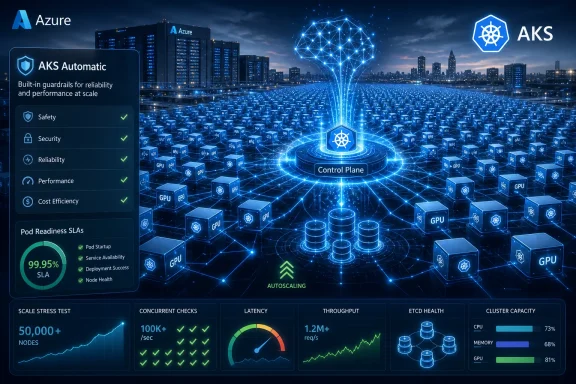
At Microsoft Build 2026, Microsoft announced Azure Kubernetes Service updates that add bare-metal deployment, Arc-enabled fleet management, managed Ray through Anyscale on Azure, and Kubernetes-native AI model deployment features intended to make AKS a more complete platform for enterprise AI workloads. The move is not just another cloud feature dump. It is Microsoft’s clearest statement yet that Kubernetes is becoming the default operating layer for AI infrastructure, not merely the place where web apps and microservices go after the interesting work is done. For WindowsForum readers who run hybrid estates, GPU clusters, regulated workloads, or developer platforms, the practical question is whether AKS is turning into a usable AI control plane — or simply absorbing another layer of complexity.
The Build 2026 AKS announcements are best read as one argument with several product names attached: Microsoft believes enterprise AI will be managed less like a science project and more like a fleet of production services. That means lifecycle policies, identity, rollout controls, cost awareness, observability, and repeatable deployment patterns. It also means the AI stack has to fit into the operational machinery companies already use.
That is why the most important word in this story is not “AI.” It is Kubernetes. Microsoft is betting that the same orchestration layer that standardized cloud-native application deployment can now standardize AI training, inference, and distributed compute. The company is not alone in that bet, but Azure’s pitch is unusually explicit: keep the open-source primitives, wrap them in Azure governance, and make AKS the place where platform teams can run models without creating a parallel infrastructure kingdom.
The timing matters. AI adoption has moved beyond pilots where a team can tolerate a hand-built GPU box, a bespoke inference endpoint, or a one-off Ray cluster that only one engineer understands. Large organizations now have to answer harder questions about where models run, how GPU capacity is shared, how workloads are secured, and how deployment changes are rolled back when the chatbot starts hallucinating in front of customers.
Microsoft’s answer is not subtle. AKS is being pushed from managed Kubernetes service to AI infrastructure substrate. That expansion is ambitious, useful, and risky in equal measure.
Bare-metal AKS is Microsoft’s attempt to preserve the Kubernetes operating model while giving demanding workloads more direct access to hardware. The appeal is obvious for large model training, distributed inference, and latency-sensitive AI services. Technologies such as NVLink and RDMA are not decorative extras in that world; they are the plumbing that determines whether expensive accelerators spend their time calculating or waiting.
This is also a shift in how Microsoft talks about hybrid infrastructure. Bare metal is not being framed as a nostalgic return to servers you can hug. It is being positioned as a practical option for workloads where the economics of GPU utilization demand fewer compromises. If a small percentage improvement in throughput can reduce the number of accelerators required, the savings can dwarf the operational inconvenience.
But bare metal also changes the risk profile. Hypervisors provide isolation, hardware abstraction, and a familiar management boundary. Removing that layer may help performance, but it also puts more pressure on firmware management, node lifecycle processes, hardware compatibility, and the maturity of the Kubernetes integration. Microsoft’s preview label is doing real work here.
For IT pros, the lesson is not that every AI workload should run on bare metal. It is that Microsoft now sees enough enterprise demand to make bare metal part of the AKS story rather than an exception outside it. That is a meaningful signal about where AI infrastructure pressure is building.
The AI angle makes the feature more important. GPU-heavy clusters are expensive, capacity-constrained, and frequently tuned around workload placement. If system pods are competing with user workloads in awkward ways, the result can be poor utilization, noisy-neighbor behavior, or operational guesswork. Microsoft is trying to make the system layer less visible and less likely to interfere with the expensive work.
AKS Automatic also reflects a broader industry trend: Kubernetes is being made more opinionated at the managed-service layer. The original promise of Kubernetes was portability and control. The managed Kubernetes promise is increasingly that sane defaults should prevent most teams from needing to become cluster mechanics.
That trade-off is not free. The more Azure manages on behalf of the customer, the more teams must understand where control has been deliberately removed. AKS Standard remains important for organizations that need unusual networking, node customization, or deep operational control. AKS Automatic is Microsoft’s way of saying that many customers no longer want full control over every cluster detail; they want Kubernetes outcomes with fewer Kubernetes chores.
The tension will be familiar to Windows administrators who have watched Microsoft move from configurable servers to managed cloud services. The platform becomes easier to consume, but harder to reason about when something unusual happens. That is not a reason to reject AKS Automatic, but it is a reason to test failure modes before handing it production AI workloads.
Microsoft’s container-focused OS strategy is an attempt to narrow that surface area. A minimal, Microsoft-maintained host reduces the number of moving pieces and aligns the node image more tightly with Azure’s Kubernetes lifecycle. For organizations operating many clusters, consistency is not merely aesthetic. It is the difference between a patch process that scales and a spreadsheet of exceptions.
The WindowsForum audience should notice the familiar pattern. Microsoft is not only selling a service; it is defining a stack. Azure Container Linux, AKS Automatic, managed node pools, Fleet Manager, Arc, and KAITO all reinforce the same gravitational pull. The closer customers stay to Microsoft’s supported path, the more operational burden Azure can absorb.
That has advantages for security-minded teams. A smaller OS footprint, managed updates, and consistent images can reduce exposure windows and make compliance reporting cleaner. It also creates a new dependency on Microsoft’s release cadence and support boundaries. When the platform chooses the default, administrators need to know how quickly that default changes and how much room remains for exception handling.
The broader point is that AI infrastructure is making old hygiene issues newly urgent. A poorly maintained container host is annoying for a web service. On a GPU cluster running regulated model workloads, it becomes a cost, security, and reliability problem all at once.
Fleet Manager extends centralized management across AKS and Arc-enabled Kubernetes clusters. In practical terms, that means policy enforcement, workload placement, staged rollouts, and access controls can be applied at fleet scope rather than per cluster. That is the difference between managing Kubernetes as a set of artisanal snowflakes and managing it as infrastructure estate.
This is where Microsoft’s Arc strategy becomes more than branding. Arc has long promised to project Azure management into non-Azure environments. Fleet Manager gives that promise a more concrete Kubernetes use case: one place to reason about clusters that may not physically live in Azure.
For AI workloads, that matters because placement decisions are rarely simple. A model might need to run near a factory floor for latency, inside a national boundary for compliance, in Azure for elastic GPU access, and in another cloud because that is where an acquired business already operates. Fleet-level scheduling and rollout controls do not solve all of those problems, but they give platform teams a vocabulary for handling them.
The governance angle is just as important. AI services are not static workloads. Models change, prompts change, safety layers change, dependencies change, and GPU demands change. Without staged rollouts and consistent policy enforcement, multi-cluster AI deployment becomes a recipe for configuration drift at high speed.
Fleet Manager is Microsoft’s acknowledgement that Kubernetes maturity is no longer measured by whether a team can stand up a cluster. It is measured by whether an organization can govern hundreds of them without losing track of who deployed what, where, and why.
By offering Anyscale on Azure, Microsoft is trying to make Ray feel like an Azure-native service while still aligning it with AKS and Azure governance. That matters because enterprises often do not reject open-source AI tools because they dislike the tools. They reject them because identity, billing, network boundaries, support paths, and compliance reviews become painful.
The managed-service wrapper is Microsoft’s familiar move. Bring the popular open-source system into Azure’s control plane, integrate it with subscriptions and policy, and reduce the friction between experimentation and production. For data science teams, the promise is less time building distributed infrastructure. For platform teams, the promise is fewer unsanctioned compute islands.
There is a subtle but important distinction here. Microsoft is not saying Ray replaces Kubernetes. It is saying Ray can run as part of a broader Kubernetes-centered operational model. Kubernetes handles the cluster substrate and governance story; Ray handles distributed AI execution patterns that Kubernetes alone does not naturally express.
That division of labor is sensible, but it also increases the number of abstractions teams must understand. A production AI platform may now include AKS, Ray, Anyscale, KAITO, vLLM, KEDA, Gateway API, Azure Policy, managed identities, and GPU scheduling constraints. The platform may be coherent, but it is not simple.
KAITO, a Kubernetes-native operator, helps deploy and manage open-source large language models on Kubernetes. Microsoft’s managed add-on integrates with inference runtimes such as vLLM and exposes model-serving capabilities in a way that fits Kubernetes operations. AI Runway builds on that idea by helping users select models, validate GPU requirements, estimate cost, and launch endpoints through Kubernetes-native abstractions.
This is an important design choice. Microsoft could have hidden Kubernetes behind a fully proprietary AI deployment service and pitched simplicity above all else. Instead, the company is trying to simplify model deployment while preserving the primitives platform engineers expect: resources, operators, autoscaling, networking, and observability.
That balance is tricky. Too much abstraction and the platform becomes a black box that operations teams distrust. Too little abstraction and every model deployment becomes a YAML apprenticeship. AI Runway’s success will depend on whether it can make common paths easy without making uncommon but necessary paths impossible.
The mention of vLLM, KEDA, and Gateway API is not incidental. Microsoft is aligning with pieces of the cloud-native AI serving ecosystem rather than pretending Azure alone invented the stack. That gives customers a better chance of avoiding dead-end architecture, but it also means Microsoft is stitching together fast-moving projects whose production edges will vary.
For administrators, the practical question is not whether KAITO is elegant. It is whether the managed add-on can make model serving repeatable enough to survive real enterprise change control. The first successful demo matters far less than the tenth upgrade, the failed rollout, the GPU shortage, and the compliance audit.
But open source in the cloud era is rarely a pure story of freedom. Managed services turn open components into productized experiences, and productized experiences create new forms of dependency. Customers may avoid being locked into a proprietary API while still becoming deeply dependent on Azure’s identity model, billing structure, support behavior, preview roadmap, and control plane.
That does not make Microsoft’s approach cynical. It makes it normal cloud business. The company is offering to absorb complexity in exchange for architectural gravity. The more AKS becomes the place where AI workloads are scheduled, served, governed, and observed, the more Azure becomes the default frame through which those workloads are understood.
This is where enterprises need to be precise. “Kubernetes-based” does not automatically mean portable in any practical sense. A workload defined with upstream Kubernetes resources may still rely on Azure-specific node images, Azure Policy, Arc agents, managed identities, Fleet Manager behavior, Azure networking, and Microsoft’s implementation of operators and add-ons.
The right question is not whether Microsoft’s AI-on-AKS stack is open or closed. It is which layers are portable, which layers are replaceable, and which layers become part of the operating contract. Smart platform teams will map those boundaries before the stack becomes too important to unwind.
Google has a strong Kubernetes lineage and a mature GKE story. AWS has enormous cloud footprint, deep infrastructure breadth, and a habit of offering customers multiple composable paths rather than one canonical platform. Microsoft’s advantage is the enterprise management layer: Entra ID, Azure Policy, Arc, Windows Server adjacency, developer tooling, and a customer base already accustomed to Microsoft as the system of record for corporate IT.
The Build 2026 AKS announcements play directly into that advantage. Fleet Manager speaks to governance. Arc speaks to hybrid reality. AKS Automatic speaks to reduced operational toil. Bare metal speaks to performance. KAITO and AI Runway speak to model deployment. Anyscale on Azure speaks to distributed AI teams that want managed open-source tooling.
The combined message is stronger than any individual feature. Microsoft is not merely saying Azure has GPUs. It is saying Azure can provide the institutional machinery around GPUs: policy, placement, identity, rollout, lifecycle, and support.
That is where many AI infrastructure projects will be won or lost. The first wave of generative AI attention went to models. The next wave is going to infrastructure operations. CIOs and platform leaders will increasingly ask not “Can we run this model?” but “Can we run this model safely, repeatedly, cheaply, and in the right place?”
The operational center of gravity is shifting. A company may still have thousands of Windows desktops and servers, but its AI workloads may run on Linux containers, GPU nodes, Kubernetes operators, and distributed Python frameworks. The bridge between those worlds is not nostalgia for Windows Server. It is identity, policy, monitoring, compliance, and automation.
That makes AKS relevant even to IT pros who do not plan to become Kubernetes specialists overnight. If your organization adopts Azure-based AI services, AKS may become part of the underlying platform even when business users only see a chatbot, document assistant, coding helper, or analytics feature. Understanding the architecture helps administrators ask better questions before costs and risks appear in production.
There is also a security dimension. Self-hosted or privately hosted models appeal to organizations that do not want sensitive data flowing through third-party APIs without strict controls. KAITO-style deployment on AKS gives those teams a potential path to keep model workloads inside controlled environments. But it also shifts responsibility back to the organization: patching, access control, network boundaries, model provenance, prompt logging, and incident response.
The Windows admin’s future is not necessarily writing Kubernetes manifests all day. It is understanding how Microsoft’s management fabric spans Windows, Linux, cloud, edge, and AI. AKS is one of the places where that fabric is becoming visible.
Public preview is useful because it lets customers test capabilities early and shape product direction. It is also a warning label. Support terms, regional availability, limitations, upgrade behavior, and pricing assumptions may change. For AI infrastructure, where hardware planning and staffing decisions have long tails, that uncertainty is not academic.
Enterprises should treat these announcements as a roadmap signal and an evaluation opportunity, not a mandate to replatform everything by next quarter. The right move is to identify workloads that would actually benefit from the new capabilities. Bare metal is compelling for some AI workloads, irrelevant for others. Fleet management is essential for multi-cluster estates, overkill for small teams. Managed Ray is powerful if Ray is already part of the data science workflow, but unnecessary if the organization has standardized elsewhere.
Microsoft’s platform story is persuasive precisely because it is integrated. The danger is adopting the whole story before understanding which pieces solve real problems. Kubernetes can bring order to AI infrastructure, but it can also become a very expensive way to distribute confusion.
A sober pilot should measure more than benchmark performance. It should measure operational recovery, upgrade friction, cost predictability, access control, telemetry quality, developer experience, and the ability to explain the system to auditors and on-call staff at 2 a.m.
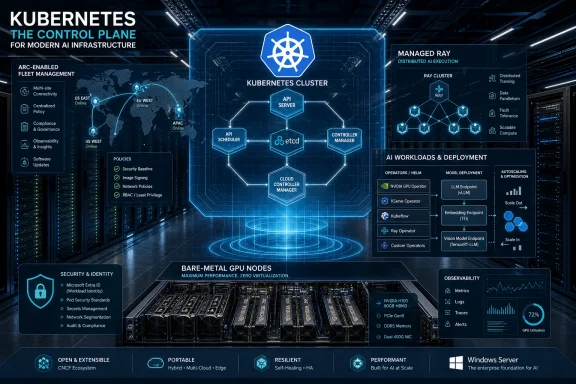 Microsoft Wants Kubernetes to Become the AI Datacenter’s Control Plane
The Build 2026 AKS announcements are best read as one argument with several product names attached: Microsoft believes enterprise AI will be managed less like a science project and more like a fleet of production services. That means lifecycle policies, identity, rollout controls, cost awareness, observability, and repeatable deployment patterns. It also means the AI stack has to fit into the operational machinery companies already use.That is why the most important word in this story is not “AI.” It is Kubernetes. Microsoft is betting that the same orchestration layer that standardized cloud-native application deployment can now standardize AI training, inference, and distributed compute. The company is not alone in that bet, but Azure’s pitch is unusually explicit: keep the open-source primitives, wrap them in Azure governance, and make AKS the place where platform teams can run models without creating a parallel infrastructure kingdom.
The timing matters. AI adoption has moved beyond pilots where a team can tolerate a hand-built GPU box, a bespoke inference endpoint, or a one-off Ray cluster that only one engineer understands. Large organizations now have to answer harder questions about where models run, how GPU capacity is shared, how workloads are secured, and how deployment changes are rolled back when the chatbot starts hallucinating in front of customers.
Microsoft’s answer is not subtle. AKS is being pushed from managed Kubernetes service to AI infrastructure substrate. That expansion is ambitious, useful, and risky in equal measure.
Bare Metal Is the Admission That Virtualization Has a Ceiling
AKS on Bare Metal, now in public preview, is the most technically revealing part of the announcement because it says something cloud providers do not always like to emphasize: abstraction has a cost. Virtual machines remain the default currency of cloud infrastructure for good reasons, but AI workloads are unusually sensitive to the seams between hardware and software. When GPUs need high-bandwidth interconnects, low-latency networking, and predictable access to memory and compute, every extra layer becomes suspect.Bare-metal AKS is Microsoft’s attempt to preserve the Kubernetes operating model while giving demanding workloads more direct access to hardware. The appeal is obvious for large model training, distributed inference, and latency-sensitive AI services. Technologies such as NVLink and RDMA are not decorative extras in that world; they are the plumbing that determines whether expensive accelerators spend their time calculating or waiting.
This is also a shift in how Microsoft talks about hybrid infrastructure. Bare metal is not being framed as a nostalgic return to servers you can hug. It is being positioned as a practical option for workloads where the economics of GPU utilization demand fewer compromises. If a small percentage improvement in throughput can reduce the number of accelerators required, the savings can dwarf the operational inconvenience.
But bare metal also changes the risk profile. Hypervisors provide isolation, hardware abstraction, and a familiar management boundary. Removing that layer may help performance, but it also puts more pressure on firmware management, node lifecycle processes, hardware compatibility, and the maturity of the Kubernetes integration. Microsoft’s preview label is doing real work here.
For IT pros, the lesson is not that every AI workload should run on bare metal. It is that Microsoft now sees enough enterprise demand to make bare metal part of the AKS story rather than an exception outside it. That is a meaningful signal about where AI infrastructure pressure is building.
AKS Automatic Is Microsoft’s Quiet Campaign Against Cluster Babysitting
If bare metal is the headline for performance engineers, Managed System Node Pools in AKS Automatic are the announcement platform teams may feel more often. The idea is straightforward: separate core Kubernetes system components from application workloads and let Azure manage the system node pool’s capacity, patching, scaling, and repair behavior. In ordinary Kubernetes clusters, that kind of housekeeping is both essential and easy to underappreciate until something breaks.The AI angle makes the feature more important. GPU-heavy clusters are expensive, capacity-constrained, and frequently tuned around workload placement. If system pods are competing with user workloads in awkward ways, the result can be poor utilization, noisy-neighbor behavior, or operational guesswork. Microsoft is trying to make the system layer less visible and less likely to interfere with the expensive work.
AKS Automatic also reflects a broader industry trend: Kubernetes is being made more opinionated at the managed-service layer. The original promise of Kubernetes was portability and control. The managed Kubernetes promise is increasingly that sane defaults should prevent most teams from needing to become cluster mechanics.
That trade-off is not free. The more Azure manages on behalf of the customer, the more teams must understand where control has been deliberately removed. AKS Standard remains important for organizations that need unusual networking, node customization, or deep operational control. AKS Automatic is Microsoft’s way of saying that many customers no longer want full control over every cluster detail; they want Kubernetes outcomes with fewer Kubernetes chores.
The tension will be familiar to Windows administrators who have watched Microsoft move from configurable servers to managed cloud services. The platform becomes easier to consume, but harder to reason about when something unusual happens. That is not a reason to reject AKS Automatic, but it is a reason to test failure modes before handing it production AI workloads.
Azure Container Linux Turns the Node OS Into Part of the Platform Contract
Azure Container Linux’s general availability as a container-optimized operating system for AKS is less flashy than bare metal, but it may matter more for day-to-day operations. The node operating system is where many enterprise Kubernetes problems quietly begin: image drift, patch inconsistency, kernel dependencies, security baselines, and subtle differences between environments that are supposed to be identical.Microsoft’s container-focused OS strategy is an attempt to narrow that surface area. A minimal, Microsoft-maintained host reduces the number of moving pieces and aligns the node image more tightly with Azure’s Kubernetes lifecycle. For organizations operating many clusters, consistency is not merely aesthetic. It is the difference between a patch process that scales and a spreadsheet of exceptions.
The WindowsForum audience should notice the familiar pattern. Microsoft is not only selling a service; it is defining a stack. Azure Container Linux, AKS Automatic, managed node pools, Fleet Manager, Arc, and KAITO all reinforce the same gravitational pull. The closer customers stay to Microsoft’s supported path, the more operational burden Azure can absorb.
That has advantages for security-minded teams. A smaller OS footprint, managed updates, and consistent images can reduce exposure windows and make compliance reporting cleaner. It also creates a new dependency on Microsoft’s release cadence and support boundaries. When the platform chooses the default, administrators need to know how quickly that default changes and how much room remains for exception handling.
The broader point is that AI infrastructure is making old hygiene issues newly urgent. A poorly maintained container host is annoying for a web service. On a GPU cluster running regulated model workloads, it becomes a cost, security, and reliability problem all at once.
Fleet Manager Is Where the Hybrid AI Story Gets Real
Azure Kubernetes Fleet Manager for Arc-enabled clusters, now generally available, is the clearest sign that Microsoft does not expect enterprise AI to live entirely inside one Azure region. Large organizations already run Kubernetes across public cloud, private datacenters, edge sites, and sometimes competing cloud providers. AI will follow the data, the latency requirements, the regulatory boundaries, and the available GPU capacity.Fleet Manager extends centralized management across AKS and Arc-enabled Kubernetes clusters. In practical terms, that means policy enforcement, workload placement, staged rollouts, and access controls can be applied at fleet scope rather than per cluster. That is the difference between managing Kubernetes as a set of artisanal snowflakes and managing it as infrastructure estate.
This is where Microsoft’s Arc strategy becomes more than branding. Arc has long promised to project Azure management into non-Azure environments. Fleet Manager gives that promise a more concrete Kubernetes use case: one place to reason about clusters that may not physically live in Azure.
For AI workloads, that matters because placement decisions are rarely simple. A model might need to run near a factory floor for latency, inside a national boundary for compliance, in Azure for elastic GPU access, and in another cloud because that is where an acquired business already operates. Fleet-level scheduling and rollout controls do not solve all of those problems, but they give platform teams a vocabulary for handling them.
The governance angle is just as important. AI services are not static workloads. Models change, prompts change, safety layers change, dependencies change, and GPU demands change. Without staged rollouts and consistent policy enforcement, multi-cluster AI deployment becomes a recipe for configuration drift at high speed.
Fleet Manager is Microsoft’s acknowledgement that Kubernetes maturity is no longer measured by whether a team can stand up a cluster. It is measured by whether an organization can govern hundreds of them without losing track of who deployed what, where, and why.
Anyscale on Azure Pulls Ray Into the Enterprise Perimeter
Anyscale on Azure, in public preview, brings managed Ray into Microsoft’s AI infrastructure story. Ray has become one of the more important open-source frameworks for distributed AI and Python workloads, particularly where teams need to scale training, tuning, batch inference, or distributed application logic across CPUs and GPUs. Managing Ray clusters, however, can be another specialized operational burden layered on top of Kubernetes.By offering Anyscale on Azure, Microsoft is trying to make Ray feel like an Azure-native service while still aligning it with AKS and Azure governance. That matters because enterprises often do not reject open-source AI tools because they dislike the tools. They reject them because identity, billing, network boundaries, support paths, and compliance reviews become painful.
The managed-service wrapper is Microsoft’s familiar move. Bring the popular open-source system into Azure’s control plane, integrate it with subscriptions and policy, and reduce the friction between experimentation and production. For data science teams, the promise is less time building distributed infrastructure. For platform teams, the promise is fewer unsanctioned compute islands.
There is a subtle but important distinction here. Microsoft is not saying Ray replaces Kubernetes. It is saying Ray can run as part of a broader Kubernetes-centered operational model. Kubernetes handles the cluster substrate and governance story; Ray handles distributed AI execution patterns that Kubernetes alone does not naturally express.
That division of labor is sensible, but it also increases the number of abstractions teams must understand. A production AI platform may now include AKS, Ray, Anyscale, KAITO, vLLM, KEDA, Gateway API, Azure Policy, managed identities, and GPU scheduling constraints. The platform may be coherent, but it is not simple.
KAITO and AI Runway Try to Civilize Model Serving Without Hiding Kubernetes
Microsoft’s AI Runway and Kubernetes AI Toolchain Operator work is aimed at one of the most common sources of enterprise AI friction: moving a model from “it runs on my notebook” to “it is a production endpoint with known cost, capacity, and operational behavior.” That transition is where many AI projects discover that model quality is only part of the problem. The rest is serving infrastructure.KAITO, a Kubernetes-native operator, helps deploy and manage open-source large language models on Kubernetes. Microsoft’s managed add-on integrates with inference runtimes such as vLLM and exposes model-serving capabilities in a way that fits Kubernetes operations. AI Runway builds on that idea by helping users select models, validate GPU requirements, estimate cost, and launch endpoints through Kubernetes-native abstractions.
This is an important design choice. Microsoft could have hidden Kubernetes behind a fully proprietary AI deployment service and pitched simplicity above all else. Instead, the company is trying to simplify model deployment while preserving the primitives platform engineers expect: resources, operators, autoscaling, networking, and observability.
That balance is tricky. Too much abstraction and the platform becomes a black box that operations teams distrust. Too little abstraction and every model deployment becomes a YAML apprenticeship. AI Runway’s success will depend on whether it can make common paths easy without making uncommon but necessary paths impossible.
The mention of vLLM, KEDA, and Gateway API is not incidental. Microsoft is aligning with pieces of the cloud-native AI serving ecosystem rather than pretending Azure alone invented the stack. That gives customers a better chance of avoiding dead-end architecture, but it also means Microsoft is stitching together fast-moving projects whose production edges will vary.
For administrators, the practical question is not whether KAITO is elegant. It is whether the managed add-on can make model serving repeatable enough to survive real enterprise change control. The first successful demo matters far less than the tenth upgrade, the failed rollout, the GPU shortage, and the compliance audit.
Microsoft’s Open-Source Embrace Is Also a Control Strategy
Microsoft’s AKS strategy leans heavily on open technologies: Kubernetes, Ray, Gateway API, vLLM, KEDA, and CNCF-aligned tooling. That is good news for customers who remember the bad old days of proprietary platform lock-in. It suggests Microsoft understands that AI infrastructure will not be won by walling off every layer.But open source in the cloud era is rarely a pure story of freedom. Managed services turn open components into productized experiences, and productized experiences create new forms of dependency. Customers may avoid being locked into a proprietary API while still becoming deeply dependent on Azure’s identity model, billing structure, support behavior, preview roadmap, and control plane.
That does not make Microsoft’s approach cynical. It makes it normal cloud business. The company is offering to absorb complexity in exchange for architectural gravity. The more AKS becomes the place where AI workloads are scheduled, served, governed, and observed, the more Azure becomes the default frame through which those workloads are understood.
This is where enterprises need to be precise. “Kubernetes-based” does not automatically mean portable in any practical sense. A workload defined with upstream Kubernetes resources may still rely on Azure-specific node images, Azure Policy, Arc agents, managed identities, Fleet Manager behavior, Azure networking, and Microsoft’s implementation of operators and add-ons.
The right question is not whether Microsoft’s AI-on-AKS stack is open or closed. It is which layers are portable, which layers are replaceable, and which layers become part of the operating contract. Smart platform teams will map those boundaries before the stack becomes too important to unwind.
The Competitive Cloud Story Is Less About Features Than Operating Models
AWS, Google Cloud, and Microsoft are all racing to become the preferred home for AI infrastructure. On paper, the competition can be reduced to service names: EKS and Bedrock, GKE and Vertex AI, AKS and Azure AI. In practice, enterprises are choosing operating models as much as they are choosing features.Google has a strong Kubernetes lineage and a mature GKE story. AWS has enormous cloud footprint, deep infrastructure breadth, and a habit of offering customers multiple composable paths rather than one canonical platform. Microsoft’s advantage is the enterprise management layer: Entra ID, Azure Policy, Arc, Windows Server adjacency, developer tooling, and a customer base already accustomed to Microsoft as the system of record for corporate IT.
The Build 2026 AKS announcements play directly into that advantage. Fleet Manager speaks to governance. Arc speaks to hybrid reality. AKS Automatic speaks to reduced operational toil. Bare metal speaks to performance. KAITO and AI Runway speak to model deployment. Anyscale on Azure speaks to distributed AI teams that want managed open-source tooling.
The combined message is stronger than any individual feature. Microsoft is not merely saying Azure has GPUs. It is saying Azure can provide the institutional machinery around GPUs: policy, placement, identity, rollout, lifecycle, and support.
That is where many AI infrastructure projects will be won or lost. The first wave of generative AI attention went to models. The next wave is going to infrastructure operations. CIOs and platform leaders will increasingly ask not “Can we run this model?” but “Can we run this model safely, repeatedly, cheaply, and in the right place?”
Windows Shops Should Read This as a Platform Engineering Story
For traditional Windows-centered organizations, AKS may still feel like a Linux and cloud-native concern. That mental model is increasingly outdated. Microsoft’s AI infrastructure push is going to land inside the same enterprises that run Active Directory histories, Windows endpoints, SQL Server estates, PowerShell automation, Microsoft Defender, and Azure governance.The operational center of gravity is shifting. A company may still have thousands of Windows desktops and servers, but its AI workloads may run on Linux containers, GPU nodes, Kubernetes operators, and distributed Python frameworks. The bridge between those worlds is not nostalgia for Windows Server. It is identity, policy, monitoring, compliance, and automation.
That makes AKS relevant even to IT pros who do not plan to become Kubernetes specialists overnight. If your organization adopts Azure-based AI services, AKS may become part of the underlying platform even when business users only see a chatbot, document assistant, coding helper, or analytics feature. Understanding the architecture helps administrators ask better questions before costs and risks appear in production.
There is also a security dimension. Self-hosted or privately hosted models appeal to organizations that do not want sensitive data flowing through third-party APIs without strict controls. KAITO-style deployment on AKS gives those teams a potential path to keep model workloads inside controlled environments. But it also shifts responsibility back to the organization: patching, access control, network boundaries, model provenance, prompt logging, and incident response.
The Windows admin’s future is not necessarily writing Kubernetes manifests all day. It is understanding how Microsoft’s management fabric spans Windows, Linux, cloud, edge, and AI. AKS is one of the places where that fabric is becoming visible.
The Preview Labels Are Where Reality Pushes Back
The announcements include a mix of generally available features and public previews, and that distinction matters. Fleet Manager for Arc-enabled clusters and Azure Container Linux as an AKS option are closer to production confidence. AKS on Bare Metal and Anyscale on Azure are still preview-stage bets, and preview-stage infrastructure should not be confused with a finished operating model.Public preview is useful because it lets customers test capabilities early and shape product direction. It is also a warning label. Support terms, regional availability, limitations, upgrade behavior, and pricing assumptions may change. For AI infrastructure, where hardware planning and staffing decisions have long tails, that uncertainty is not academic.
Enterprises should treat these announcements as a roadmap signal and an evaluation opportunity, not a mandate to replatform everything by next quarter. The right move is to identify workloads that would actually benefit from the new capabilities. Bare metal is compelling for some AI workloads, irrelevant for others. Fleet management is essential for multi-cluster estates, overkill for small teams. Managed Ray is powerful if Ray is already part of the data science workflow, but unnecessary if the organization has standardized elsewhere.
Microsoft’s platform story is persuasive precisely because it is integrated. The danger is adopting the whole story before understanding which pieces solve real problems. Kubernetes can bring order to AI infrastructure, but it can also become a very expensive way to distribute confusion.
A sober pilot should measure more than benchmark performance. It should measure operational recovery, upgrade friction, cost predictability, access control, telemetry quality, developer experience, and the ability to explain the system to auditors and on-call staff at 2 a.m.
The Kubernetes AI Era Arrives With a To-Do List
Microsoft’s Build 2026 AKS push is not a declaration that AI infrastructure is solved. It is a declaration that the problem has moved into the domain of platform engineering. The concrete implications are already clear enough for IT leaders to act on.- Organizations running serious AI workloads should evaluate whether their current cluster strategy can handle GPU placement, model rollout, identity, and cost controls across more than one environment.
- Teams considering AKS on Bare Metal should begin with workloads where hardware access and latency matter enough to justify preview risk and operational complexity.
- Enterprises with hybrid or multi-cloud Kubernetes estates should treat Fleet Manager and Arc integration as governance tools, not merely deployment conveniences.
- Platform teams should test KAITO and AI Runway against real model-serving scenarios that include upgrades, rollback, autoscaling, and observability requirements.
- Windows-heavy IT organizations should prepare for AI platforms that depend on Linux containers and Kubernetes while still relying on Microsoft identity, policy, and security infrastructure.
- Decision-makers should separate Microsoft’s persuasive platform narrative from the maturity of each individual component, especially where preview services are involved.
References
- Primary source: infoq.com
Published: Tue, 23 Jun 2026 12:00:06 GMT
Microsoft Expands Azure Kubernetes Service with Bare Metal, Fleet Management and AI Infrastructure - InfoQ
At this year's Microsoft Build 2026, Microsoft unveiled a broad set of enhancements to Azure Kubernetes Service (AKS) aimed at making Kubernetes a first-class platform for AI training, inference, andwww.infoq.com