

Anyscale put its managed Ray platform into public preview on Microsoft Azure on June 2, 2026, giving enterprises a native Azure integration for running large-scale AI data, training, inference, and agent workloads inside their own Azure tenants. The announcement is less about another AI service tile in the Azure portal than about a shift in enterprise AI economics. After two years of treating model APIs as the fastest path to production, big organizations are now asking whether the real prize is not renting intelligence, but operating it. Anyscale and Microsoft are betting that the answer, for many serious AI teams, will be yes.
The headline promise of Anyscale on Azure is straightforward: enterprises can run foundation-model-scale workloads using Ray on Azure Kubernetes Service, provisioned through Azure Resource Manager, governed by Microsoft Entra ID, Azure RBAC, Azure Policy, and billed through the familiar Azure machinery. That makes it sound like a cloud integration story, and in the narrowest sense it is. But the more important product is psychological: Anyscale is selling enterprise AI teams the idea that they can stop treating AI infrastructure as a messy sidecar to the real cloud estate.
That matters because the first wave of enterprise generative AI was built on convenience. A developer called an external endpoint, pasted an API key into a prototype, and watched a demo turn into a budget line. The pattern was intoxicating because it avoided the hard parts: GPU scheduling, distributed execution, model serving, observability, compliance review, and the thankless work of tying AI workloads back into existing enterprise identity and cost systems.
The bill, naturally, arrived later. Per-token pricing is easy to understand in a demo and harder to love when workloads become continuous, multimodal, and deeply embedded in business processes. A chatbot for a few thousand employees is one cost profile; document processing, video analysis, embedding generation, fine-tuning, evaluation, simulation, and inference running all day against proprietary data is another.
Anyscale’s argument is that production AI is no longer a single API call. It is a pipeline of CPU-heavy and GPU-heavy jobs, some latency-sensitive and some batch-oriented, stitched across data prep, model training, fine-tuning, inference, evaluation, reinforcement learning, and increasingly agentic orchestration. If that is the shape of the workload, then enterprises need something more durable than a collection of notebooks, queues, hosted APIs, and heroic YAML.
Anyscale, founded by the creators of Ray, has always had a clear commercial pitch: Ray gives developers the programming model, while Anyscale supplies the managed runtime, orchestration, autoscaling, observability, and operational polish that enterprises expect. Bringing that into Azure as a native integration sharpens the pitch. It tells Azure customers that Ray is not merely something they can deploy on Azure if they have enough Kubernetes expertise; it is something they can consume as part of the Azure operating model.
That distinction matters to platform teams. Many enterprises already have AKS, Azure Policy, Entra ID, private networking, resource groups, tagging standards, budget alerts, and compliance workflows. The problem with many AI platforms is not that they cannot run on a hyperscaler. It is that they feel like a separate country, with their own passports, billing customs, and security exceptions.
The public preview attempts to close that gap. Anyscale resources can be created through Azure Portal flows, ARM templates, or Terraform. They can appear in Azure Resource Graph. Access can flow through Entra and Azure RBAC. Usage can surface in Microsoft Cost Management and count against Microsoft Azure Consumption Commitments. None of that makes distributed AI easy, but it lowers the bureaucratic friction that often kills enterprise platforms before their technical merits are even tested.
There is also a strategic symmetry here for Microsoft. Azure already has Azure AI Foundry, Azure Machine Learning, Azure OpenAI Service, and a growing collection of model, agent, and data tooling. Anyscale does not replace those offerings so much as fill a particular gap: large-scale distributed Python execution for teams that want to build, tune, and serve their own AI systems rather than live entirely inside a managed model API.
Anyscale’s Azure announcement leans into that enterprise version of sovereignty. The platform runs in the customer’s Azure tenancy, on AKS, with customer-governed identity, policy, and billing. Proprietary data, model artifacts, and pipelines are presented as staying within the customer’s cloud boundary rather than being shipped off to an opaque external service.
That does not magically solve every regulatory or security problem. An enterprise still has to design networks correctly, configure identities properly, harden supply chains, monitor workloads, classify data, and control who can deploy what. “Inside your tenant” is not a synonym for “safe.” It is, however, a much more comfortable starting point for organizations whose legal and security teams are increasingly skeptical of uncontrolled AI sprawl.
The cost argument is just as important. Anyscale says customers can see up to 90 percent lower AI total cost of ownership compared with fragmented stacks that combine cloud-native data processing engines with hosted model APIs. As with any vendor cost claim, that number deserves caution: the savings will depend on workload shape, utilization, model choice, engineering discipline, data movement, and whether the comparison is fair. But the direction of the argument is credible. If a company has predictable, high-volume AI workloads, owning the compute path can be cheaper than renting every inference, transformation, and evaluation through a meter that ticks by token or request.
The danger is that “take control of variable API costs” can sound like “escape costs altogether.” It is not. GPUs are expensive, distributed systems require expertise, and idle capacity is its own form of waste. What Anyscale is really offering is a move from black-box consumption to governable consumption. For CFOs and FinOps teams, that may be enough.
But the API-only strategy looks weaker when AI becomes a core production system. At that point, the enterprise has to manage recurring usage, latency, availability, data governance, evaluation, model drift, and vendor dependency. A hosted API can still be the right answer for many tasks, but it is no longer obviously the only answer.
This is where open-source and self-trained models enter the frame. Smaller domain-specific models can be cheaper, faster, and easier to govern than general-purpose frontier models for constrained tasks. Fine-tuned models can encode company-specific knowledge or behavior. Retrieval systems can keep proprietary data close. Batch inference can often be scheduled and optimized more aggressively than real-time calls to external endpoints.
Anyscale’s pitch is not that every enterprise should train a frontier model from scratch. Very few should. The more realistic claim is that many enterprises will operate a portfolio: some external frontier APIs, some open-source models, some fine-tuned internal models, some embedding and ranking systems, some traditional ML, and a growing amount of agentic glue. That portfolio needs compute orchestration.
This is why Ray is relevant. It is not just a training framework or a serving tool. It is a way to span different kinds of distributed Python workloads across CPUs and GPUs. In a world where AI systems are becoming compound systems rather than single models, that breadth becomes valuable.
That is not merely administrative trivia. In large companies, AI infrastructure decisions often fail because the buyer, user, security approver, procurement team, and budget owner are not the same people. A platform that can be purchased, billed, monitored, and governed like an Azure-native service has an advantage over a tool that requires a new vendor path and a separate operating model.
The Azure integration also helps Microsoft keep AI workloads close to its cloud estate. If customers are going to build their own models or operate open-source inference, Microsoft would rather they do it on Azure than drift to specialized GPU clouds or rival hyperscalers. Anyscale gives Microsoft a credible story for customers who want something more hands-on than hosted APIs but less raw than assembling their own Ray-on-Kubernetes platform.
For Anyscale, the partnership supplies enterprise distribution and legitimacy. Ray may be familiar to cutting-edge AI teams, but Fortune 500 platform organizations often want to see first-party cloud alignment before standardizing on a technology. A native Azure presence does not guarantee adoption, but it reduces the number of reasons a cautious CIO can say no.
There is also an implicit Kubernetes politics story here. AKS is the substrate, but Ray is the developer-facing abstraction. That reflects a broader reality in cloud-native AI: Kubernetes is powerful, but most model builders do not want Kubernetes to be their primary interface. The winning platforms will let infrastructure teams govern Kubernetes while letting AI teams work in Python and higher-level workflows.
That is the point. Anyscale on Azure is aimed at organizations for which AI is not a feature sprinkled into existing software but the production engine itself. Geospatial intelligence, autonomous driving, biotech, robotics, financial modeling, personalization, simulation, media analysis, and advanced search all have the same unpleasant infrastructure profile: massive data, mixed CPU and GPU stages, bursty experiments, long-running pipelines, and pressure to keep proprietary assets under control.
For Xoople, the value proposition is moving from raw satellite data to decision-ready intelligence without asking engineering teams to babysit infrastructure. For Wayve, it is about aggregating compute across large fleets and making the AI platform resilient enough for continuous model development. These are precisely the kinds of references Microsoft wants associated with Azure’s AI infrastructure story, because they imply seriousness beyond chatbots.
They also show why public cloud AI is moving away from a simplistic “model endpoint” narrative. If your workload starts with images, video, sensor streams, lidar, satellite scenes, or simulation traces, the job is not just to call a language model. The job is to prepare, transform, label, embed, train, evaluate, serve, and monitor across a chain of systems. That chain is where costs hide and where governance often breaks.
Anyscale’s bet is that enterprises will increasingly want one compute fabric for that chain. Whether it can deliver that cleanly in real-world enterprise environments is the test that public preview begins.
Anyscale on Azure plugs into that convergence. It uses Microsoft Entra ID for authentication patterns, Azure RBAC for authorization, Azure Policy for governance, Azure Resource Manager for provisioning, and Microsoft Cost Management for spend visibility. These are not exotic AI concepts. They are the everyday tools that Azure administrators already use to keep sprawling estates from becoming unmanageable.
That familiarity could matter more than model performance in some adoption decisions. Security teams do not want every AI platform to invent its own access model. Finance teams do not want AI spend scattered across disconnected invoices. Platform teams do not want every ML group building private clusters with bespoke permissions and undocumented data flows. Anyscale’s promise is that AI workloads can be brought into the same operational envelope as the rest of Azure.
The flip side is that it raises the bar for Azure administrators. AI infrastructure is not just another web app. GPU quotas, cluster autoscaling, container images, data locality, storage throughput, private networking, model artifact access, and job scheduling all become part of the operational surface. Anyscale can abstract some of this, but it cannot make the underlying constraints disappear.
That means the likely buyer is not an isolated data science team. It is a coalition: AI engineers who need scale, platform engineers who need control, security architects who need policy continuity, and finance leaders who need visibility. If any one of those groups is ignored, the deployment will struggle.
The first hard question is performance under messy workloads. Ray is powerful, and Anyscale has deep expertise, but production AI workloads are rarely uniform. Some jobs are batch-heavy, some are latency-sensitive, some are storage-bound, some are GPU-bound, and some fail in ways that only appear at scale. Enterprises will want to know how well Anyscale handles mixed priority queues, noisy neighbors, failed nodes, quota limits, image management, and cross-region capacity constraints.
The second question is operational ownership. If Anyscale runs on AKS inside the customer’s Azure tenancy, customers gain control, but they also inherit a closer relationship with the infrastructure. The phrase “managed” can mean different things depending on which component breaks at 2 a.m. Customers will need clarity on support boundaries between Microsoft, Anyscale, and their own platform teams.
The third question is cost modeling. The promise of escaping unpredictable API economics is compelling, but GPU infrastructure introduces its own unpredictability. Utilization is the whole game. A well-scheduled GPU fleet can be a strategic asset; an underused one is a very expensive monument to optimism. Anyscale’s scheduling, autoscaling, and workload consolidation features will have to prove that they can turn theoretical savings into real savings.
The fourth question is ecosystem overlap. Azure customers already face a crowded AI menu: Azure AI Foundry, Azure Machine Learning, Azure OpenAI, Fabric, Databricks integrations, Kubernetes-native tooling, and a growing partner catalog. Anyscale needs to be clearly positioned as the distributed AI compute layer for specific classes of workloads, not as yet another dashboard in an already crowded estate.
None of these questions undermine the announcement. They simply mark the difference between a promising integration and a platform standard. Public preview is where the marketing story meets enterprise entropy.
This fragmentation is not accidental. AI has moved faster than governance. Teams reached for whatever worked: a SaaS model endpoint here, a Databricks workflow there, a Kubernetes cluster under someone’s desk metaphorically if not literally, a vector database chosen by one app team, a model registry chosen by another, and a spreadsheet somewhere tracking GPU spend with more hope than precision.
A native Azure integration is a bid to consolidate some of that chaos. It gives platform teams a way to say yes without surrendering control. It gives AI teams a way to scale without reinventing distributed infrastructure. And it gives Microsoft a way to keep enterprise AI gravity inside Azure even when customers are not using only Microsoft’s own model services.
But consolidation has a cost. Standardizing on a platform means accepting its abstractions, release cadence, limitations, and pricing model. Enterprises that adopt Anyscale on Azure will still need portability strategies, especially if their AI work spans multiple clouds or on-premises environments. Ray itself is open source, but managed platform behavior is never perfectly portable.
That is the classic cloud bargain. The more native the integration, the smoother the operations inside that cloud. The more native the integration, the more carefully customers must think about exit paths and architectural dependency. The smartest enterprises will treat Anyscale on Azure as a powerful control plane, not as an excuse to stop designing for resilience.
That middle layer is increasingly important because enterprise AI is diversifying. Not every workload needs the biggest model. Not every use case can send data to an external endpoint. Not every team wants to maintain a bespoke distributed execution platform. The market is moving toward architectures where different models, data stores, retrieval systems, evaluation loops, and serving paths are composed into systems.
Azure needs credible partners in that layer because customers will not accept a single prescribed path. Some will use Azure AI Foundry heavily. Some will standardize around Databricks or Fabric for data. Some will bring open-source models. Some will demand Kubernetes-native patterns. Some will treat Ray as the common execution layer across AI workloads. Microsoft’s advantage is not forcing one answer, but making many answers governable through Azure.
Anyscale benefits from that posture. It can be both opinionated and complementary. It does not need to own every stage of the AI lifecycle if it becomes the compute fabric across enough of the demanding stages. Data preparation, distributed training, fine-tuning, batch inference, embeddings, reinforcement learning, simulation, and composite serving are broad enough territory.
The risk is that “one platform for the full AI lifecycle” can become an overreach. Enterprises have existing investments, and no serious AI organization wants to be told that all tools must be replaced. The more persuasive argument is narrower: where workloads require distributed Python across CPUs and GPUs, Ray plus Anyscale can reduce glue code, improve utilization, and bring governance closer to existing Azure practice.
Token-based APIs create a wonderfully simple unit of consumption. That simplicity can become a trap when usage scales unpredictably, especially for applications that generate long outputs, perform repeated evaluations, process large corpora, or call models inside agent loops. The more invisible the invocation, the harder it is for finance and engineering teams to predict the bill.
Owning the compute path changes that dynamic. Enterprises can reserve, schedule, batch, autoscale, and optimize. They can choose smaller models when appropriate. They can move some workloads from real-time to batch. They can reduce data movement. They can consolidate pipelines. They can measure GPU utilization directly instead of inferring it through a vendor’s API bill.
But compute ownership does not automatically equal savings. A GPU that sits idle is not cheaper than an API. A model serving stack that requires a specialized operations team may erase some of the apparent savings. A poorly designed pipeline that copies data repeatedly across storage systems can burn money while looking sophisticated. The economics depend on engineering maturity.
This is why Anyscale’s platform argument is stronger than its raw savings claim. The real value is not simply “run your own models.” It is “run diverse AI workloads on shared infrastructure with scheduling, autoscaling, observability, and governance that make utilization possible.” If Anyscale can deliver that, the cost benefits follow. If it cannot, customers will rediscover why managed APIs were attractive in the first place.
Anyscale on Azure addresses these questions by tying into Azure’s governance model rather than asking enterprises to duplicate it. That is sensible. Most regulated organizations already have Azure policies for approved regions, identity controls, network boundaries, logging, and cost allocation. Extending those controls to AI workloads is far more plausible than building a parallel governance universe for every AI vendor.
Still, governance is only as strong as the implementation. Customers will need to examine how secrets are handled, how container images are sourced and scanned, how model artifacts are protected, how logs are retained, how network egress is controlled, and how support access works. They will also need to understand whether AI-specific risks — model leakage, prompt injection, data poisoning, unsafe outputs, and evaluation failures — are handled elsewhere in the stack.
That distinction is important. Anyscale on Azure is primarily an AI compute and orchestration platform. It can help keep workloads within governed infrastructure, but it is not by itself a complete AI risk management program. Enterprises still need model evaluation, red teaming, data governance, content safety, application security, and incident response.
The best reading of the announcement is therefore not that Azure-native Anyscale solves sovereign AI. It gives enterprises a more credible infrastructure foundation on which sovereign AI might be built.
The distinction is useful. AI tourists want quick access to impressive models. AI operators need repeatability, governance, utilization, and control. Tourists ask how fast they can build a demo. Operators ask how the system behaves under load, how it is audited, how it fails, who pays for it, and whether it can be made cheaper next quarter.
Anyscale and Microsoft are clearly chasing the operators. The references to Wayve and Xoople are not decorative; they signal workloads where AI is the product engine, not an accessory. The integration with ARM, Entra, Azure RBAC, Azure Policy, Cost Management, and MACC is not decorative either; it signals that the buyer is as much the platform organization as the ML team.
For Windows and Azure administrators, this is a preview of the next operational frontier. AI workloads will increasingly arrive not as mysterious research projects but as governed cloud resources tied to identity, policy, billing, and compliance. The admins who understand both the old enterprise controls and the new AI execution patterns will be the ones asked to make the promises real.
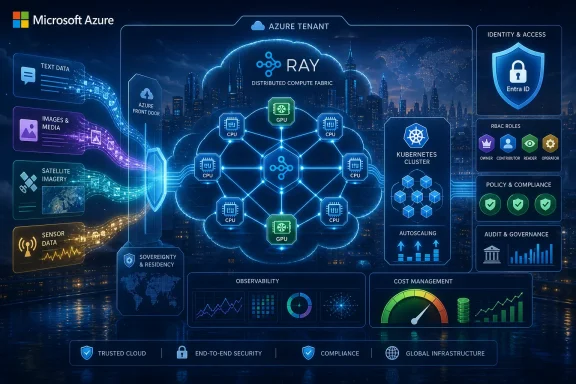 Microsoft and Anyscale Are Selling Control, Not Just Compute
The headline promise of Anyscale on Azure is straightforward: enterprises can run foundation-model-scale workloads using Ray on Azure Kubernetes Service, provisioned through Azure Resource Manager, governed by Microsoft Entra ID, Azure RBAC, Azure Policy, and billed through the familiar Azure machinery. That makes it sound like a cloud integration story, and in the narrowest sense it is. But the more important product is psychological: Anyscale is selling enterprise AI teams the idea that they can stop treating AI infrastructure as a messy sidecar to the real cloud estate.That matters because the first wave of enterprise generative AI was built on convenience. A developer called an external endpoint, pasted an API key into a prototype, and watched a demo turn into a budget line. The pattern was intoxicating because it avoided the hard parts: GPU scheduling, distributed execution, model serving, observability, compliance review, and the thankless work of tying AI workloads back into existing enterprise identity and cost systems.
The bill, naturally, arrived later. Per-token pricing is easy to understand in a demo and harder to love when workloads become continuous, multimodal, and deeply embedded in business processes. A chatbot for a few thousand employees is one cost profile; document processing, video analysis, embedding generation, fine-tuning, evaluation, simulation, and inference running all day against proprietary data is another.
Anyscale’s argument is that production AI is no longer a single API call. It is a pipeline of CPU-heavy and GPU-heavy jobs, some latency-sensitive and some batch-oriented, stitched across data prep, model training, fine-tuning, inference, evaluation, reinforcement learning, and increasingly agentic orchestration. If that is the shape of the workload, then enterprises need something more durable than a collection of notebooks, queues, hosted APIs, and heroic YAML.
The Ray Bet Moves Deeper Into Azure’s House
Ray has become one of the more important pieces of open-source infrastructure in the AI boom because it sits in the uncomfortable middle between Python simplicity and distributed systems complexity. It lets developers express distributed workloads without dropping immediately into the lower-level mechanics of cluster management. That is precisely the layer where AI teams tend to feel pain once experiments graduate into production.Anyscale, founded by the creators of Ray, has always had a clear commercial pitch: Ray gives developers the programming model, while Anyscale supplies the managed runtime, orchestration, autoscaling, observability, and operational polish that enterprises expect. Bringing that into Azure as a native integration sharpens the pitch. It tells Azure customers that Ray is not merely something they can deploy on Azure if they have enough Kubernetes expertise; it is something they can consume as part of the Azure operating model.
That distinction matters to platform teams. Many enterprises already have AKS, Azure Policy, Entra ID, private networking, resource groups, tagging standards, budget alerts, and compliance workflows. The problem with many AI platforms is not that they cannot run on a hyperscaler. It is that they feel like a separate country, with their own passports, billing customs, and security exceptions.
The public preview attempts to close that gap. Anyscale resources can be created through Azure Portal flows, ARM templates, or Terraform. They can appear in Azure Resource Graph. Access can flow through Entra and Azure RBAC. Usage can surface in Microsoft Cost Management and count against Microsoft Azure Consumption Commitments. None of that makes distributed AI easy, but it lowers the bureaucratic friction that often kills enterprise platforms before their technical merits are even tested.
There is also a strategic symmetry here for Microsoft. Azure already has Azure AI Foundry, Azure Machine Learning, Azure OpenAI Service, and a growing collection of model, agent, and data tooling. Anyscale does not replace those offerings so much as fill a particular gap: large-scale distributed Python execution for teams that want to build, tune, and serve their own AI systems rather than live entirely inside a managed model API.
Sovereign AI Has Become a Budget Argument in Disguise
The phrase sovereign AI can mean several things depending on who is saying it. Governments often use it to describe national capability, data residency, language preservation, or strategic independence from foreign platforms. Cloud providers use it to signal compliance, locality, and control. Enterprises use it more pragmatically: they want to know where their data goes, who can access it, what happens to model weights, and whether the cost curve will wreck next year’s budget.Anyscale’s Azure announcement leans into that enterprise version of sovereignty. The platform runs in the customer’s Azure tenancy, on AKS, with customer-governed identity, policy, and billing. Proprietary data, model artifacts, and pipelines are presented as staying within the customer’s cloud boundary rather than being shipped off to an opaque external service.
That does not magically solve every regulatory or security problem. An enterprise still has to design networks correctly, configure identities properly, harden supply chains, monitor workloads, classify data, and control who can deploy what. “Inside your tenant” is not a synonym for “safe.” It is, however, a much more comfortable starting point for organizations whose legal and security teams are increasingly skeptical of uncontrolled AI sprawl.
The cost argument is just as important. Anyscale says customers can see up to 90 percent lower AI total cost of ownership compared with fragmented stacks that combine cloud-native data processing engines with hosted model APIs. As with any vendor cost claim, that number deserves caution: the savings will depend on workload shape, utilization, model choice, engineering discipline, data movement, and whether the comparison is fair. But the direction of the argument is credible. If a company has predictable, high-volume AI workloads, owning the compute path can be cheaper than renting every inference, transformation, and evaluation through a meter that ticks by token or request.
The danger is that “take control of variable API costs” can sound like “escape costs altogether.” It is not. GPUs are expensive, distributed systems require expertise, and idle capacity is its own form of waste. What Anyscale is really offering is a move from black-box consumption to governable consumption. For CFOs and FinOps teams, that may be enough.
The API Era Is Not Ending, but Its Monopoly Is
The rise of hosted model APIs was not a mistake. It was the reason generative AI moved so quickly from research labs into product roadmaps. Developers could use frontier models without negotiating GPU allocations, building serving stacks, or assembling ML infrastructure teams. That convenience remains enormously valuable, especially when the workload is experimental, irregular, or dependent on proprietary frontier models.But the API-only strategy looks weaker when AI becomes a core production system. At that point, the enterprise has to manage recurring usage, latency, availability, data governance, evaluation, model drift, and vendor dependency. A hosted API can still be the right answer for many tasks, but it is no longer obviously the only answer.
This is where open-source and self-trained models enter the frame. Smaller domain-specific models can be cheaper, faster, and easier to govern than general-purpose frontier models for constrained tasks. Fine-tuned models can encode company-specific knowledge or behavior. Retrieval systems can keep proprietary data close. Batch inference can often be scheduled and optimized more aggressively than real-time calls to external endpoints.
Anyscale’s pitch is not that every enterprise should train a frontier model from scratch. Very few should. The more realistic claim is that many enterprises will operate a portfolio: some external frontier APIs, some open-source models, some fine-tuned internal models, some embedding and ranking systems, some traditional ML, and a growing amount of agentic glue. That portfolio needs compute orchestration.
This is why Ray is relevant. It is not just a training framework or a serving tool. It is a way to span different kinds of distributed Python workloads across CPUs and GPUs. In a world where AI systems are becoming compound systems rather than single models, that breadth becomes valuable.
Azure Native Integration Is a Procurement Feature Wearing an Engineering Hat
The most underrated part of the announcement may be MACC drawdown. For readers outside enterprise sales machinery, Microsoft Azure Consumption Commitments are the spend agreements large customers already make with Microsoft. If Anyscale consumption can count against those commitments, then the product has a cleaner path through procurement than a stand-alone AI infrastructure purchase.That is not merely administrative trivia. In large companies, AI infrastructure decisions often fail because the buyer, user, security approver, procurement team, and budget owner are not the same people. A platform that can be purchased, billed, monitored, and governed like an Azure-native service has an advantage over a tool that requires a new vendor path and a separate operating model.
The Azure integration also helps Microsoft keep AI workloads close to its cloud estate. If customers are going to build their own models or operate open-source inference, Microsoft would rather they do it on Azure than drift to specialized GPU clouds or rival hyperscalers. Anyscale gives Microsoft a credible story for customers who want something more hands-on than hosted APIs but less raw than assembling their own Ray-on-Kubernetes platform.
For Anyscale, the partnership supplies enterprise distribution and legitimacy. Ray may be familiar to cutting-edge AI teams, but Fortune 500 platform organizations often want to see first-party cloud alignment before standardizing on a technology. A native Azure presence does not guarantee adoption, but it reduces the number of reasons a cautious CIO can say no.
There is also an implicit Kubernetes politics story here. AKS is the substrate, but Ray is the developer-facing abstraction. That reflects a broader reality in cloud-native AI: Kubernetes is powerful, but most model builders do not want Kubernetes to be their primary interface. The winning platforms will let infrastructure teams govern Kubernetes while letting AI teams work in Python and higher-level workflows.
Xoople and Wayve Show the Workloads Microsoft Wants to Court
The customer examples in the announcement are revealing because they are not generic office copilots. Xoople is working with planetary-scale satellite imagery, turning spectral data into operational intelligence. Wayve is building autonomous driving models and needs large CPU and GPU fleets for distributed ML, inference, analytics, and dataset processing. These are not “summarize this PDF” workloads.That is the point. Anyscale on Azure is aimed at organizations for which AI is not a feature sprinkled into existing software but the production engine itself. Geospatial intelligence, autonomous driving, biotech, robotics, financial modeling, personalization, simulation, media analysis, and advanced search all have the same unpleasant infrastructure profile: massive data, mixed CPU and GPU stages, bursty experiments, long-running pipelines, and pressure to keep proprietary assets under control.
For Xoople, the value proposition is moving from raw satellite data to decision-ready intelligence without asking engineering teams to babysit infrastructure. For Wayve, it is about aggregating compute across large fleets and making the AI platform resilient enough for continuous model development. These are precisely the kinds of references Microsoft wants associated with Azure’s AI infrastructure story, because they imply seriousness beyond chatbots.
They also show why public cloud AI is moving away from a simplistic “model endpoint” narrative. If your workload starts with images, video, sensor streams, lidar, satellite scenes, or simulation traces, the job is not just to call a language model. The job is to prepare, transform, label, embed, train, evaluate, serve, and monitor across a chain of systems. That chain is where costs hide and where governance often breaks.
Anyscale’s bet is that enterprises will increasingly want one compute fabric for that chain. Whether it can deliver that cleanly in real-world enterprise environments is the test that public preview begins.
The Windows and Admin Angle Is Cloud Control by Another Name
For WindowsForum readers, the obvious question is why an Azure AI infrastructure announcement belongs in the same conversation as Windows administration, endpoint management, and Microsoft’s broader enterprise stack. The answer is that Azure has become the control plane for much of Microsoft’s enterprise future. Identity, policy, billing, security posture, compliance evidence, and workload governance increasingly converge there.Anyscale on Azure plugs into that convergence. It uses Microsoft Entra ID for authentication patterns, Azure RBAC for authorization, Azure Policy for governance, Azure Resource Manager for provisioning, and Microsoft Cost Management for spend visibility. These are not exotic AI concepts. They are the everyday tools that Azure administrators already use to keep sprawling estates from becoming unmanageable.
That familiarity could matter more than model performance in some adoption decisions. Security teams do not want every AI platform to invent its own access model. Finance teams do not want AI spend scattered across disconnected invoices. Platform teams do not want every ML group building private clusters with bespoke permissions and undocumented data flows. Anyscale’s promise is that AI workloads can be brought into the same operational envelope as the rest of Azure.
The flip side is that it raises the bar for Azure administrators. AI infrastructure is not just another web app. GPU quotas, cluster autoscaling, container images, data locality, storage throughput, private networking, model artifact access, and job scheduling all become part of the operational surface. Anyscale can abstract some of this, but it cannot make the underlying constraints disappear.
That means the likely buyer is not an isolated data science team. It is a coalition: AI engineers who need scale, platform engineers who need control, security architects who need policy continuity, and finance leaders who need visibility. If any one of those groups is ignored, the deployment will struggle.
Public Preview Is Where the Hard Questions Begin
Public preview announcements tend to sound cleaner than production life. The platform is available, the architecture is elegant, the quotes are polished, and the diagrams behave. Real enterprise deployments are less obedient.The first hard question is performance under messy workloads. Ray is powerful, and Anyscale has deep expertise, but production AI workloads are rarely uniform. Some jobs are batch-heavy, some are latency-sensitive, some are storage-bound, some are GPU-bound, and some fail in ways that only appear at scale. Enterprises will want to know how well Anyscale handles mixed priority queues, noisy neighbors, failed nodes, quota limits, image management, and cross-region capacity constraints.
The second question is operational ownership. If Anyscale runs on AKS inside the customer’s Azure tenancy, customers gain control, but they also inherit a closer relationship with the infrastructure. The phrase “managed” can mean different things depending on which component breaks at 2 a.m. Customers will need clarity on support boundaries between Microsoft, Anyscale, and their own platform teams.
The third question is cost modeling. The promise of escaping unpredictable API economics is compelling, but GPU infrastructure introduces its own unpredictability. Utilization is the whole game. A well-scheduled GPU fleet can be a strategic asset; an underused one is a very expensive monument to optimism. Anyscale’s scheduling, autoscaling, and workload consolidation features will have to prove that they can turn theoretical savings into real savings.
The fourth question is ecosystem overlap. Azure customers already face a crowded AI menu: Azure AI Foundry, Azure Machine Learning, Azure OpenAI, Fabric, Databricks integrations, Kubernetes-native tooling, and a growing partner catalog. Anyscale needs to be clearly positioned as the distributed AI compute layer for specific classes of workloads, not as yet another dashboard in an already crowded estate.
None of these questions undermine the announcement. They simply mark the difference between a promising integration and a platform standard. Public preview is where the marketing story meets enterprise entropy.
The Real Competition Is Fragmentation
Anyscale frames its competition partly as hosted APIs and fragmented AI stacks. That is fair, but the deeper rival is organizational fragmentation. Most enterprises do not have one AI architecture. They have dozens of experiments, shadow platforms, vendor pilots, model gateways, notebook environments, data pipelines, and half-approved production systems.This fragmentation is not accidental. AI has moved faster than governance. Teams reached for whatever worked: a SaaS model endpoint here, a Databricks workflow there, a Kubernetes cluster under someone’s desk metaphorically if not literally, a vector database chosen by one app team, a model registry chosen by another, and a spreadsheet somewhere tracking GPU spend with more hope than precision.
A native Azure integration is a bid to consolidate some of that chaos. It gives platform teams a way to say yes without surrendering control. It gives AI teams a way to scale without reinventing distributed infrastructure. And it gives Microsoft a way to keep enterprise AI gravity inside Azure even when customers are not using only Microsoft’s own model services.
But consolidation has a cost. Standardizing on a platform means accepting its abstractions, release cadence, limitations, and pricing model. Enterprises that adopt Anyscale on Azure will still need portability strategies, especially if their AI work spans multiple clouds or on-premises environments. Ray itself is open source, but managed platform behavior is never perfectly portable.
That is the classic cloud bargain. The more native the integration, the smoother the operations inside that cloud. The more native the integration, the more carefully customers must think about exit paths and architectural dependency. The smartest enterprises will treat Anyscale on Azure as a powerful control plane, not as an excuse to stop designing for resilience.
Microsoft’s AI Stack Gets a More Serious Middle Layer
Microsoft’s AI portfolio has sometimes looked like a two-speed machine. At one end are high-level services for developers and business users: copilots, managed model APIs, agent tooling, and increasingly integrated workflow products. At the other end is raw cloud infrastructure: GPUs, AKS, networking, storage, and identity. The middle layer — where serious AI teams build custom distributed systems without becoming infrastructure vendors themselves — is where Anyscale fits.That middle layer is increasingly important because enterprise AI is diversifying. Not every workload needs the biggest model. Not every use case can send data to an external endpoint. Not every team wants to maintain a bespoke distributed execution platform. The market is moving toward architectures where different models, data stores, retrieval systems, evaluation loops, and serving paths are composed into systems.
Azure needs credible partners in that layer because customers will not accept a single prescribed path. Some will use Azure AI Foundry heavily. Some will standardize around Databricks or Fabric for data. Some will bring open-source models. Some will demand Kubernetes-native patterns. Some will treat Ray as the common execution layer across AI workloads. Microsoft’s advantage is not forcing one answer, but making many answers governable through Azure.
Anyscale benefits from that posture. It can be both opinionated and complementary. It does not need to own every stage of the AI lifecycle if it becomes the compute fabric across enough of the demanding stages. Data preparation, distributed training, fine-tuning, batch inference, embeddings, reinforcement learning, simulation, and composite serving are broad enough territory.
The risk is that “one platform for the full AI lifecycle” can become an overreach. Enterprises have existing investments, and no serious AI organization wants to be told that all tools must be replaced. The more persuasive argument is narrower: where workloads require distributed Python across CPUs and GPUs, Ray plus Anyscale can reduce glue code, improve utilization, and bring governance closer to existing Azure practice.
The Cost Story Will Be Won or Lost in Utilization
The announcement’s cost language is aggressive because it has to be. AI budgets are becoming board-level concerns. The first year of generative AI spending was often justified by strategic urgency; the next years will be judged by repeatable value and cost discipline.Token-based APIs create a wonderfully simple unit of consumption. That simplicity can become a trap when usage scales unpredictably, especially for applications that generate long outputs, perform repeated evaluations, process large corpora, or call models inside agent loops. The more invisible the invocation, the harder it is for finance and engineering teams to predict the bill.
Owning the compute path changes that dynamic. Enterprises can reserve, schedule, batch, autoscale, and optimize. They can choose smaller models when appropriate. They can move some workloads from real-time to batch. They can reduce data movement. They can consolidate pipelines. They can measure GPU utilization directly instead of inferring it through a vendor’s API bill.
But compute ownership does not automatically equal savings. A GPU that sits idle is not cheaper than an API. A model serving stack that requires a specialized operations team may erase some of the apparent savings. A poorly designed pipeline that copies data repeatedly across storage systems can burn money while looking sophisticated. The economics depend on engineering maturity.
This is why Anyscale’s platform argument is stronger than its raw savings claim. The real value is not simply “run your own models.” It is “run diverse AI workloads on shared infrastructure with scheduling, autoscaling, observability, and governance that make utilization possible.” If Anyscale can deliver that, the cost benefits follow. If it cannot, customers will rediscover why managed APIs were attractive in the first place.
The Sovereign AI Pitch Has Teeth Only If Governance Is Real
Sovereignty has become an overloaded AI marketing term, but in enterprise settings it comes down to practical controls. Where is the data stored? Who can access it? Which identities can deploy workloads? Which regions are allowed? How are resources tagged? What appears on the invoice? Can auditors reconstruct what happened? Can security teams enforce policy without asking every AI team to behave perfectly?Anyscale on Azure addresses these questions by tying into Azure’s governance model rather than asking enterprises to duplicate it. That is sensible. Most regulated organizations already have Azure policies for approved regions, identity controls, network boundaries, logging, and cost allocation. Extending those controls to AI workloads is far more plausible than building a parallel governance universe for every AI vendor.
Still, governance is only as strong as the implementation. Customers will need to examine how secrets are handled, how container images are sourced and scanned, how model artifacts are protected, how logs are retained, how network egress is controlled, and how support access works. They will also need to understand whether AI-specific risks — model leakage, prompt injection, data poisoning, unsafe outputs, and evaluation failures — are handled elsewhere in the stack.
That distinction is important. Anyscale on Azure is primarily an AI compute and orchestration platform. It can help keep workloads within governed infrastructure, but it is not by itself a complete AI risk management program. Enterprises still need model evaluation, red teaming, data governance, content safety, application security, and incident response.
The best reading of the announcement is therefore not that Azure-native Anyscale solves sovereign AI. It gives enterprises a more credible infrastructure foundation on which sovereign AI might be built.
The Preview Draws a Line Between AI Tourists and AI Operators
Anyscale on Azure is not aimed at every organization dabbling in generative AI. It is aimed at companies that have crossed a threshold: AI workloads are becoming important enough, expensive enough, and sensitive enough that they need to be operated as first-class systems. That is a smaller group than the marketing universe of “everyone needs AI,” but it is the group that will shape enterprise infrastructure spending.The distinction is useful. AI tourists want quick access to impressive models. AI operators need repeatability, governance, utilization, and control. Tourists ask how fast they can build a demo. Operators ask how the system behaves under load, how it is audited, how it fails, who pays for it, and whether it can be made cheaper next quarter.
Anyscale and Microsoft are clearly chasing the operators. The references to Wayve and Xoople are not decorative; they signal workloads where AI is the product engine, not an accessory. The integration with ARM, Entra, Azure RBAC, Azure Policy, Cost Management, and MACC is not decorative either; it signals that the buyer is as much the platform organization as the ML team.
For Windows and Azure administrators, this is a preview of the next operational frontier. AI workloads will increasingly arrive not as mysterious research projects but as governed cloud resources tied to identity, policy, billing, and compliance. The admins who understand both the old enterprise controls and the new AI execution patterns will be the ones asked to make the promises real.
The Details That Should Survive the Hype Cycle
The launch is wrapped in big claims about sovereign AI, cost savings, and full-lifecycle platforms, but the durable points are more concrete. Anyscale on Azure is worth watching because it moves a serious distributed AI runtime closer to the native Azure management plane, where enterprises already live.- Anyscale on Azure entered public preview on June 2, 2026, after an earlier private preview announced in late 2025.
- The service runs managed Ray workloads on Azure Kubernetes Service and is designed for distributed AI jobs spanning data preparation, training, fine-tuning, inference, embeddings, reinforcement learning, simulation, and agentic workloads.
- The Azure Native Integration is meant to let customers provision and govern Anyscale through Azure Resource Manager, Microsoft Entra ID, Azure RBAC, Azure Policy, Microsoft Cost Management, and existing Azure billing flows.
- The strongest enterprise argument is not that every company should train its own frontier model, but that high-volume proprietary AI workloads need better control than an API-only strategy can provide.
- The cost-saving claims will depend on workload mix, GPU utilization, scheduling discipline, and how much fragmentation the platform actually removes.
- Public preview should be treated as the start of due diligence, not the end of it, especially for regulated organizations that need clear support boundaries, network controls, artifact protection, and audit evidence.
References
- Primary source: AiThority
Published: 2026-06-03T07:30:13.816608
Anyscale Launches on Microsoft Azure as a Native Integration for Enterprises to Build Sovereign AI and Take Control of Variable API Costs
Anyscale, the AI compute platform and creator of the Ray open-source project, announced the public preview of Anyscale on Azure. aithority.com
- Official source: azure.microsoft.com
Anyscale on Azure
Run distributed Python AI on AKS with Anyscale on Azure—managed Ray with Azure security, governance and unified billing to go from prototype to productionazure.microsoft.com
- Related coverage: anyscale.com
Anyscale on Azure Enters Public Preview: Build and Deploy AI at Scale Inside Your Own Azure Tenant
Anyscale on Azure is now in public preview, enabling enterprises to build, train, and deploy AI workloads at scale directly within their Azure tenant.www.anyscale.com - Related coverage: docs.anyscale.com
- Official source: blog.aks.azure.com
Scaling Anyscale Ray Workloads on AKS | AKS Engineering Blog
Learn how to run production-grade Ray workloads on Azure Kubernetes Service with multi-cluster multi-region, unified storage, and automated credential management for AIblog.aks.azure.com - Related coverage: streetinsider.com
Anyscale Launches on Microsoft Azure as a Native Integration for Enterprises to Build Sovereign AI and Take Control of Variable API Costs
With the Anyscale on Azure public preview, enterprises can now run foundation-model-scale AI workloads, from multimodal data preparation to training and inference, entirely inside their own Azure tenancy all while...www.streetinsider.com
- Official source: cdn-dynmedia-1.microsoft.com
The Next Wave of AI Innovation: Microsoft Introduces Azure AI Foundry, A New Unified AI, and GenAI Platform at Ignite 2024
PDF documentcdn-dynmedia-1.microsoft.com
- Official source: techcommunity.microsoft.com
Sign in to your account
techcommunity.microsoft.com
- Related coverage: isg-one.com
MSFT Blueprint 2026
Business people join puzzle pieces in office. Concept of teamwork and partnership. double exposure with light effectsisg-one.com
- Related coverage: d1.awsstatic.com
CMP331 Build and accelerate LLMs on AWS Trainium and AWS Inferentia using Ray
PDF documentd1.awsstatic.com
