
AI-augmented software delivery has moved from developer experiment to enterprise operating model between 2024 and 2026, as coding assistants spread across mainstream teams while regulators, security researchers, and software supply-chain defenders warned that generated code must be treated as untrusted input. That is the core tension now facing engineering leaders: the tools are too useful to ignore and too risky to wave through.
The old debate over whether developers should use AI coding tools is already stale. The real question is whether organizations can absorb machine-generated patches, package suggestions, refactors, and autonomous pull requests without turning the software development lifecycle into a faster way to manufacture vulnerabilities. The emerging answer is uncomfortable but workable: AI can belong in the SDLC, but only if it is fenced by provenance, scanning, review, rollback, and governance that assumes the assistant is not a trusted colleague.
The best case for AI coding assistants is not hype. Controlled studies have shown meaningful productivity gains, especially when developers are writing routine code, documentation, tests, or boilerplate. In some enterprise settings, AI-assisted developers completed substantially more pull requests per week, and junior developers often benefited more than senior engineers because the assistant reduced search costs and filled in implementation gaps.
That finding matters because it explains why adoption has been so fast. A tool that helps a junior developer navigate an unfamiliar API, draft a migration script, or produce a first-pass unit test is not a toy. For many teams, the assistant has become the new autocomplete: sometimes wrong, often useful, and increasingly embedded in the rhythm of work.
But the stronger claims collapse under context. Experienced developers working in mature codebases do not merely need syntax suggestions; they need institutional memory, architectural judgment, and sensitivity to trade-offs that are rarely present in a prompt window. In that world, AI can become a tax: reviewing plausible but wrong code, correcting hallucinated assumptions, and untangling changes that look clean locally but violate hidden project rules.
This is where the productivity debate becomes more interesting than the vendor slide deck. AI is not a universal speed multiplier. It is a task-specific accelerator whose value depends on developer experience, codebase familiarity, test coverage, review culture, and the cost of mistakes.
That changes the threat model. A hallucinated package name is not just an embarrassing autocomplete failure; it is an opportunity for an attacker to register the invented name and wait for the next generated suggestion to turn into an install command. This is the logic behind slopsquatting, a supply-chain attack that converts model error into package ecosystem compromise.
The numbers should worry anyone who has had to clean up a dependency mess after a rushed sprint. Studies have found that language models can recommend nonexistent packages at meaningful rates, with some hallucinated names recurring often enough to become predictable. Predictability is what turns randomness into an attack surface.
This is why package validation belongs before code review, not after production telemetry. If a generated pull request adds dependencies, the CI system should verify that those packages exist, are maintained, are not typosquats, have acceptable licenses, and do not carry known critical vulnerabilities. The reviewer should not have to discover that the model invented a security library that only became real after an attacker uploaded it.
That should not surprise anyone who has reviewed enough production code. Models are trained to produce likely code, not necessarily safe code. If the training corpus contains decades of examples where tutorials omit authentication, samples hardcode tokens, and demo apps concatenate SQL strings, the model has learned a style of usefulness that often conflicts with secure engineering.
The danger is magnified by developer trust. Many engineers understand that AI can hallucinate, yet still treat its code as a reasonable default when deadlines are tight. That mismatch produces the worst possible workflow: generated code is accepted quickly because it looks competent, while the security review remains calibrated for human-authored changes.
The result is not one spectacular failure mode but a thousand ordinary ones. A login handler skips validation. A file upload path fails to normalize input. A logging statement records attacker-controlled text. A server-side request helper fetches arbitrary URLs. Each defect is familiar; the novelty is the rate at which they can now be produced.
The mature model is not a blanket ban. Developers will route around tools they believe make them faster, and security teams lose when policy becomes theater. The better approach is to make the safe path the easy path: approved assistants, managed identity, repository-level controls, audit logs, CI gates, dependency checks, and review requirements that vary by risk.
There is also a Windows and enterprise IT angle that deserves more attention. Many organizations already rely on Microsoft 365 Copilot, GitHub Copilot, Azure DevOps, GitHub Actions, Microsoft Defender tooling, Purview policies, and Entra-based identity controls. AI coding governance is not a separate island; it is becoming another layer in the same administrative fabric that already governs source access, secrets, endpoint posture, and compliance evidence.
That integration cuts both ways. Microsoft shops may get better central controls over approved tools, but they also face a larger blast radius if Copilot-style workflows are deployed broadly without SharePoint hygiene, repository permissions, secret scanning, and data-loss controls. The assistant only sees what the environment lets it see. Bad access governance becomes bad AI governance.
That matters for AI-generated software because provenance is no longer a luxury. If a procurement officer, regulator, customer, or incident responder asks whether a vulnerable component came from a human developer, a generated suggestion, a transitive dependency, or an autonomous agent workflow, “we do not know” will not age well.
Copyright risk remains unresolved as well. Litigation over training data and generated output has narrowed in places but has not produced the clean legal certainty vendors and customers would like. For enterprises, that means license scanning and attribution controls still matter, even if a tool’s marketing language implies the issue has been handled upstream.
Regulation will raise the floor, not build the engineering system. A compliant organization can still ship vulnerable code. A regulated AI provider can still produce insecure suggestions. The SDLC needs its own immune system.
A sane framework starts with a tiered trust model. Raw AI output should be treated as untrusted, even when it compiles. AI-generated code that passes tests and scanning can move into a validated tier. Code that has passed human review, policy gates, and provenance capture can become attested. The point is not to stigmatize AI code forever; it is to prevent unreviewed machine output from masquerading as ordinary human work.
That model also helps with autonomy. An agent that edits documentation has a different risk profile from one that changes authentication middleware. An assistant that proposes a test is not equivalent to one that updates Terraform. A generated pull request touching payment logic, cryptography, identity, or production infrastructure should face more friction than a generated comment fix.
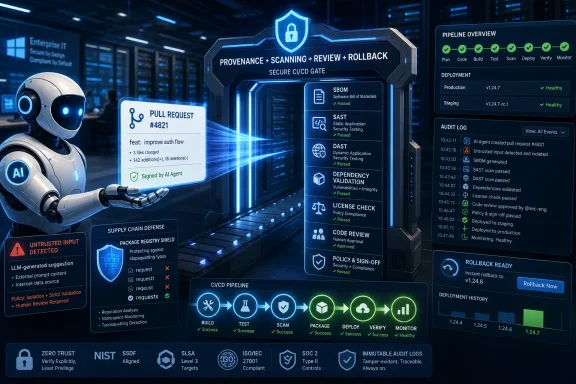
This is where many “AI-native SDLC” proposals become too vague. The valuable framework is not the one with the grandest agent diagram. It is the one that can answer four operational questions: what generated this change, what did it touch, what checks did it pass, and how quickly can we undo it?
This is not glamorous, but it is effective. AI does not remove the need for boring controls; it raises their importance. If generated code increases change volume, then manual review alone becomes a bottleneck, and automated gates become the minimum viable defense.
The pipeline should also distinguish between warnings and blockers. A generated change with a low-severity lint issue should not create the same response as one introducing a critical injection sink or a nonexistent package. Security teams have long known that noisy gates get bypassed. AI makes that lesson harsher because the volume of generated findings can grow quickly.
Rollback deserves equal attention. Organizations should be able to locate AI-generated changes in production, correlate them with incidents, and revert them without a forensic scavenger hunt. If AI provenance is not captured at merge time, it probably will not exist when the outage begins.
That is not because models are lazy. It is because architecture is contextual. Good maintainers know when not to add another helper, when to reuse a boring pattern, when to defer a feature, and when a clever refactor will confuse the next person on call. An assistant can imitate these judgments, but imitation is not the same as ownership.
The risk is that AI shifts work from writing to reviewing, debugging, and cleaning up. Teams may feel faster during implementation while paying later in larger pull requests, noisier reviews, higher churn, and more static-analysis warnings. The debt does not announce itself as “AI debt.” It arrives as another flaky test, another duplicate utility, another mystery abstraction, another service that nobody wants to touch.
This is why metrics matter. Organizations should track not only generated-code acceptance and developer satisfaction, but defect rates, rollback frequency, review time, PR size, code churn, duplicated blocks, dependency growth, and security findings by source. If AI is improving delivery, the evidence should survive beyond the sprint demo.
That distinction is critical. Human code is not magically safe, but human authorship carries social and organizational context: ownership, memory, accountability, and intent. AI output has none of those by default. It must earn trust through evidence.
A useful AI-SDLC safety model therefore has four pillars. First, classify generated code by trust level. Second, require validation gates proportional to risk. Third, attach provenance metadata to generated changes. Fourth, preserve rollback capability for AI-originated code. None of this prevents developers from using assistants; it prevents assistants from silently bypassing the controls that make software maintainable.
Tools such as dependency validators, AI-aware scanners, and MCP-connected security services can help operationalize this model. The important caveat is that a tool is not a framework. A validator that catches hallucinated npm packages is useful; it is not a substitute for review, threat modeling, testing, or governance.
But proof-of-concept results should not be oversold. A deliberately constructed sample set with known vulnerabilities can show that a pipeline detects targeted patterns. It cannot prove real-world precision, recall, or developer acceptance. One clean control sample does not establish a false-positive rate, and regex-based scanning will miss semantic bugs that require understanding program behavior.
That limitation does not weaken the case for AI-SDLC controls. It strengthens it. If even simple gates can catch obvious generated hazards, then shipping AI code without such gates looks less like innovation and more like negligence.
The harder work comes next: larger corpora, mixed human and AI changes, language-specific rules, semantic analysis, exploit-aware testing, dependency reputation scoring, and measurements of workflow friction. Safety cannot be declared because a demo blocked eleven bad samples. It has to be measured continuously inside real delivery systems.
The old debate over whether developers should use AI coding tools is already stale. The real question is whether organizations can absorb machine-generated patches, package suggestions, refactors, and autonomous pull requests without turning the software development lifecycle into a faster way to manufacture vulnerabilities. The emerging answer is uncomfortable but workable: AI can belong in the SDLC, but only if it is fenced by provenance, scanning, review, rollback, and governance that assumes the assistant is not a trusted colleague.
 The Productivity Story Is Real, but It Was Oversold
The best case for AI coding assistants is not hype. Controlled studies have shown meaningful productivity gains, especially when developers are writing routine code, documentation, tests, or boilerplate. In some enterprise settings, AI-assisted developers completed substantially more pull requests per week, and junior developers often benefited more than senior engineers because the assistant reduced search costs and filled in implementation gaps.That finding matters because it explains why adoption has been so fast. A tool that helps a junior developer navigate an unfamiliar API, draft a migration script, or produce a first-pass unit test is not a toy. For many teams, the assistant has become the new autocomplete: sometimes wrong, often useful, and increasingly embedded in the rhythm of work.
But the stronger claims collapse under context. Experienced developers working in mature codebases do not merely need syntax suggestions; they need institutional memory, architectural judgment, and sensitivity to trade-offs that are rarely present in a prompt window. In that world, AI can become a tax: reviewing plausible but wrong code, correcting hallucinated assumptions, and untangling changes that look clean locally but violate hidden project rules.
This is where the productivity debate becomes more interesting than the vendor slide deck. AI is not a universal speed multiplier. It is a task-specific accelerator whose value depends on developer experience, codebase familiarity, test coverage, review culture, and the cost of mistakes.
The Assistant Is Now a Supply-Chain Actor
The software supply chain used to begin with a developer choosing a dependency, importing a package, or copying a snippet from documentation. AI coding assistants have inserted themselves one step earlier. They now recommend the dependency, invent the import, draft the wrapper, and sometimes generate the build or deployment glue that makes the code executable.That changes the threat model. A hallucinated package name is not just an embarrassing autocomplete failure; it is an opportunity for an attacker to register the invented name and wait for the next generated suggestion to turn into an install command. This is the logic behind slopsquatting, a supply-chain attack that converts model error into package ecosystem compromise.
The numbers should worry anyone who has had to clean up a dependency mess after a rushed sprint. Studies have found that language models can recommend nonexistent packages at meaningful rates, with some hallucinated names recurring often enough to become predictable. Predictability is what turns randomness into an attack surface.
This is why package validation belongs before code review, not after production telemetry. If a generated pull request adds dependencies, the CI system should verify that those packages exist, are maintained, are not typosquats, have acceptable licenses, and do not carry known critical vulnerabilities. The reviewer should not have to discover that the model invented a security library that only became real after an attacker uploaded it.
Vulnerable Code at Machine Speed Is Still Vulnerable Code
The more serious problem is not that AI sometimes gets package names wrong. It is that generated code can be clean, idiomatic, test-passing, and insecure at the same time. Security researchers have repeatedly found high rates of exploitable patterns in AI-generated snippets, including injection flaws, weak cryptography, unsafe deserialization, path traversal, exposed secrets, and missing input validation.That should not surprise anyone who has reviewed enough production code. Models are trained to produce likely code, not necessarily safe code. If the training corpus contains decades of examples where tutorials omit authentication, samples hardcode tokens, and demo apps concatenate SQL strings, the model has learned a style of usefulness that often conflicts with secure engineering.
The danger is magnified by developer trust. Many engineers understand that AI can hallucinate, yet still treat its code as a reasonable default when deadlines are tight. That mismatch produces the worst possible workflow: generated code is accepted quickly because it looks competent, while the security review remains calibrated for human-authored changes.
The result is not one spectacular failure mode but a thousand ordinary ones. A login handler skips validation. A file upload path fails to normalize input. A logging statement records attacker-controlled text. A server-side request helper fetches arbitrary URLs. Each defect is familiar; the novelty is the rate at which they can now be produced.
Governance Is the Difference Between an Accelerator and a Liability
Enterprise adoption has outpaced enterprise control. Many organizations have allowed AI coding tools before they have written policies for prompt handling, data exposure, generated-code review, dependency validation, license risk, or retention of AI provenance. That gap is not a temporary paperwork problem; it is the place where compliance, security, and engineering reality collide.The mature model is not a blanket ban. Developers will route around tools they believe make them faster, and security teams lose when policy becomes theater. The better approach is to make the safe path the easy path: approved assistants, managed identity, repository-level controls, audit logs, CI gates, dependency checks, and review requirements that vary by risk.
There is also a Windows and enterprise IT angle that deserves more attention. Many organizations already rely on Microsoft 365 Copilot, GitHub Copilot, Azure DevOps, GitHub Actions, Microsoft Defender tooling, Purview policies, and Entra-based identity controls. AI coding governance is not a separate island; it is becoming another layer in the same administrative fabric that already governs source access, secrets, endpoint posture, and compliance evidence.
That integration cuts both ways. Microsoft shops may get better central controls over approved tools, but they also face a larger blast radius if Copilot-style workflows are deployed broadly without SharePoint hygiene, repository permissions, secret scanning, and data-loss controls. The assistant only sees what the environment lets it see. Bad access governance becomes bad AI governance.
Regulation Is Catching Up, but It Will Not Save the Pipeline
The EU AI Act has already pushed general-purpose AI providers toward documentation, transparency, and compliance obligations, with enforcement milestones arriving in stages. In the United States, federal secure-software and SBOM policy has shifted toward a more agency-led, risk-based model, but the broad expectation remains: organizations selling software into serious environments must be able to explain what is in their code and how it was secured.That matters for AI-generated software because provenance is no longer a luxury. If a procurement officer, regulator, customer, or incident responder asks whether a vulnerable component came from a human developer, a generated suggestion, a transitive dependency, or an autonomous agent workflow, “we do not know” will not age well.
Copyright risk remains unresolved as well. Litigation over training data and generated output has narrowed in places but has not produced the clean legal certainty vendors and customers would like. For enterprises, that means license scanning and attribution controls still matter, even if a tool’s marketing language implies the issue has been handled upstream.
Regulation will raise the floor, not build the engineering system. A compliant organization can still ship vulnerable code. A regulated AI provider can still produce insecure suggestions. The SDLC needs its own immune system.
Autonomous Pull Requests Need a Lower Trust Tier
The industry is moving from code search to code completion, from completion to chat, and from chat to agentic workflows that open issues, modify files, run tests, and submit pull requests. That shift changes the unit of review. The question is no longer “Did this line come from AI?” but “What authority did the agent exercise, and what evidence proves the change is safe enough to merge?”A sane framework starts with a tiered trust model. Raw AI output should be treated as untrusted, even when it compiles. AI-generated code that passes tests and scanning can move into a validated tier. Code that has passed human review, policy gates, and provenance capture can become attested. The point is not to stigmatize AI code forever; it is to prevent unreviewed machine output from masquerading as ordinary human work.
That model also helps with autonomy. An agent that edits documentation has a different risk profile from one that changes authentication middleware. An assistant that proposes a test is not equivalent to one that updates Terraform. A generated pull request touching payment logic, cryptography, identity, or production infrastructure should face more friction than a generated comment fix.
This is where many “AI-native SDLC” proposals become too vague. The valuable framework is not the one with the grandest agent diagram. It is the one that can answer four operational questions: what generated this change, what did it touch, what checks did it pass, and how quickly can we undo it?
The CI/CD Pipeline Becomes the Judge
The practical place to enforce AI safety is the pipeline. Pre-commit hooks can catch obvious secrets, malformed imports, and style violations. Pre-merge checks can run SAST, dependency validation, license scanning, package-existence checks, and tests. Pre-deploy gates can require SBOM generation, provenance metadata, integration tests, and security regression checks.This is not glamorous, but it is effective. AI does not remove the need for boring controls; it raises their importance. If generated code increases change volume, then manual review alone becomes a bottleneck, and automated gates become the minimum viable defense.
The pipeline should also distinguish between warnings and blockers. A generated change with a low-severity lint issue should not create the same response as one introducing a critical injection sink or a nonexistent package. Security teams have long known that noisy gates get bypassed. AI makes that lesson harsher because the volume of generated findings can grow quickly.
Rollback deserves equal attention. Organizations should be able to locate AI-generated changes in production, correlate them with incidents, and revert them without a forensic scavenger hunt. If AI provenance is not captured at merge time, it probably will not exist when the outage begins.
Technical Debt Is the Quiet Cost of Fast Suggestions
The security story is urgent, but technical debt may prove more expensive. AI-generated code often optimizes for local plausibility. It can duplicate logic, inflate pull requests, introduce inconsistent abstractions, or solve the immediate problem while weakening the architecture around it.That is not because models are lazy. It is because architecture is contextual. Good maintainers know when not to add another helper, when to reuse a boring pattern, when to defer a feature, and when a clever refactor will confuse the next person on call. An assistant can imitate these judgments, but imitation is not the same as ownership.
The risk is that AI shifts work from writing to reviewing, debugging, and cleaning up. Teams may feel faster during implementation while paying later in larger pull requests, noisier reviews, higher churn, and more static-analysis warnings. The debt does not announce itself as “AI debt.” It arrives as another flaky test, another duplicate utility, another mystery abstraction, another service that nobody wants to touch.
This is why metrics matter. Organizations should track not only generated-code acceptance and developer satisfaction, but defect rates, rollback frequency, review time, PR size, code churn, duplicated blocks, dependency growth, and security findings by source. If AI is improving delivery, the evidence should survive beyond the sprint demo.
The Safety Framework Is Mostly Old Wisdom Reassembled
The strongest proposed framework for AI-assisted delivery is not a revolutionary invention. It is a recomposition of controls that serious software teams already understand: secure development practices, SBOMs, SAST, DAST, software composition analysis, human review, least privilege, audit trails, and rollback plans. The novelty is applying them to AI-generated code as a distinct class of lower-trust input.That distinction is critical. Human code is not magically safe, but human authorship carries social and organizational context: ownership, memory, accountability, and intent. AI output has none of those by default. It must earn trust through evidence.
A useful AI-SDLC safety model therefore has four pillars. First, classify generated code by trust level. Second, require validation gates proportional to risk. Third, attach provenance metadata to generated changes. Fourth, preserve rollback capability for AI-originated code. None of this prevents developers from using assistants; it prevents assistants from silently bypassing the controls that make software maintainable.
Tools such as dependency validators, AI-aware scanners, and MCP-connected security services can help operationalize this model. The important caveat is that a tool is not a framework. A validator that catches hallucinated npm packages is useful; it is not a substitute for review, threat modeling, testing, or governance.
Proofs of Concept Should Be Read as Warnings, Not Victory Laps
Small validation experiments are useful because they show how easy it is to catch some classes of AI-generated failure before code lands. A scanner that blocks hardcoded secrets, SQL injection patterns, path traversal, dangerous shell execution, and hallucinated package names demonstrates a basic truth: many AI coding risks are not mysterious. They are detectable if the organization bothers to look.But proof-of-concept results should not be oversold. A deliberately constructed sample set with known vulnerabilities can show that a pipeline detects targeted patterns. It cannot prove real-world precision, recall, or developer acceptance. One clean control sample does not establish a false-positive rate, and regex-based scanning will miss semantic bugs that require understanding program behavior.
That limitation does not weaken the case for AI-SDLC controls. It strengthens it. If even simple gates can catch obvious generated hazards, then shipping AI code without such gates looks less like innovation and more like negligence.
The harder work comes next: larger corpora, mixed human and AI changes, language-specific rules, semantic analysis, exploit-aware testing, dependency reputation scoring, and measurements of workflow friction. Safety cannot be declared because a demo blocked eleven bad samples. It has to be measured continuously inside real delivery systems.
The New Contract for AI-Assisted Delivery
The practical lesson for WindowsForum’s audience is that AI coding assistants belong in the enterprise only when they are governed like other powerful development infrastructure. Treat them less like smarter autocomplete and more like a junior contractor with extraordinary typing speed, uneven judgment, and no memory of your architecture unless you provide it.- AI-generated code should enter the repository as untrusted input until automated checks and human review raise its trust level.
- Dependency suggestions from coding assistants should be verified against real registries, known vulnerability data, typosquatting signals, and license policy before merge.
- Autonomous pull requests should carry provenance showing the model, tool, prompt context, timestamp, validation results, and reviewer approval.
- Security gates should become stricter when generated changes touch authentication, payment flows, cryptography, infrastructure, privacy-sensitive data, or customer-facing execution paths.
- Engineering leaders should measure AI’s impact through defect rates, review time, rollback frequency, PR size, churn, and technical debt indicators rather than relying on perceived speed.
References
- Primary source: The AI Journal
Published: 2026-06-24T08:50:08.565326
AI-Augmented Software Delivery: From Code Search to Autonomous Pull Requests (Safely) | The AI Journal
The evidence supports four structural conclusions for practitioners implementing AI-augmented software delivery.aijourn.com - Related coverage: arstechnica.com
Study finds AI tools made open source software developers 19 percent slower - Ars Technica
Coders spent more time prompting and reviewing AI generations than they saved on coding.arstechnica.com - Related coverage: itpro.com
Think AI coding tools are speeding up work? Think again – they’re actually slowing developers down | IT Pro
AI coding tools may be hindering the work of experienced software developers, according to new researchwww.itpro.com
