

A June 2025 Cureus systematic review found that artificial intelligence and machine learning triage tools in emergency departments can shorten documentation time, improve some prediction metrics, and reduce certain mis-triage rates, but the evidence base remains small, uneven, and not yet strong enough to justify autonomous clinical deployment. The real story is not that AI has “solved” emergency triage. It is that hospitals are edging toward algorithm-assisted front doors while the proof of safer patient outcomes still lags behind the pitch. For IT leaders, clinicians, and security-minded readers, that gap is where the risk lives.
Emergency departments are one of the few places where software latency can become clinical latency. A patient’s first categorization affects who gets seen first, what resources are mobilized, and how quickly physicians recognize danger hidden inside ordinary symptoms. That makes triage a tempting target for AI vendors: the workflow is high-volume, data-rich, repetitive, and visibly strained.
The Cureus review lands at an important moment because healthcare AI is moving out of radiology demos and into operational decision support. Triage is not just another dashboard; it is a gatekeeping function. If an algorithm nudges a patient into a lower-acuity lane, the cost of being wrong can be measured in minutes, deterioration, and liability.
The reviewed studies suggest that AI can help with the mechanics of triage. Voice-based systems can reduce documentation time, machine learning models can improve some prediction scores, and symptom-assessment tools can offer structured urgency advice. But the review’s most important finding is the narrowness of the evidence: only six studies made it into the final synthesis, and they varied substantially in design, geography, system type, and outcome measurement.
That is the pattern we have seen across enterprise AI: impressive local performance, messy generalization, and a governance problem disguised as a productivity story. In an emergency department, that pattern deserves less hype and more discipline.
That diversity is both a strength and a warning. It shows that researchers are attacking triage from several angles, but it also means the field has not yet converged on a standard architecture, benchmark, or clinical endpoint. A voice documentation assistant is not the same kind of intervention as an acuity prediction model, and neither is identical to a patient-facing symptom checker.
The review reports several encouraging signals. One voice-based AI approach achieved documentation roughly 19 percent faster than manual entry. Some machine learning systems reduced mis-triage rates by margins ranging from 0.3 to 8.9 percentage points. A machine learning system in one large study reportedly improved area-under-the-curve performance compared with a traditional approach.
But “better metric” is not the same as “better medicine.” The review repeatedly returns to missing evidence on patient-centered outcomes, long-term deployment, equity, clinician acceptance, and multi-center validation. In plain English: the tools may help, but we do not yet know enough about who they help, where they fail, and whether they improve outcomes once exposed to real hospital chaos.
That is why the review’s discussion of undertriage matters more than the headline performance numbers. One symptom-assessment app showed high agreement with the Manchester Triage System, but it also had an undertriage rate and a subset of cases judged potentially hazardous. Those are not footnotes. They are the clinical edge cases that determine whether a triage system is ready for prime time.
The seductive thing about AI in triage is that aggregate performance can look reassuring. A model can post a respectable AUC, a solid F1 score, or an impressive agreement rate while still failing in the rare cases clinicians fear most. Emergency departments are built around those rare cases: the quiet myocardial infarction, the atypical stroke, the septic patient who looks deceptively stable.
This is where IT implementation and clinical safety collide. A model that performs well in retrospective data can still fail under distribution shift, missing data, noisy input, language barriers, atypical presentations, or overloaded staff behavior. The problem is not merely whether the algorithm is “accurate.” It is whether the hospital understands the shape of its errors.
This is the safest near-term lane for AI in the emergency department. Documentation support assists the workflow without necessarily deciding the workflow. It can reduce keystrokes, improve completeness, and leave the acuity decision in human hands.
Even here, the review notes limitations. Voice systems may perform unevenly across categorical variables, accents, background noise, local terminology, and workflow variations. Emergency departments are not quiet offices with perfect microphones and predictable scripts. They are loud, interrupted, emotionally charged environments.
For hospital IT, that means speech-to-text accuracy is only the beginning. The deployment question becomes whether the system integrates cleanly with the electronic health record, preserves auditability, protects sensitive data, supports correction, and avoids creating a second documentation burden when the AI gets it wrong.
The Cureus review includes models that improved predictive performance compared with traditional approaches. That matters, especially in overcrowded departments where small gains can affect resource allocation. But predictive performance is not deployment readiness.
AUC, F1 score, sensitivity, specificity, and agreement rates are useful but incomplete. They do not automatically reveal calibration, subgroup performance, workflow fit, alert fatigue, or the consequences of false reassurance. A model that is statistically impressive may still be operationally dangerous if clinicians do not trust it, misunderstand it, or override it inconsistently.
The deeper issue is that triage is not a single prediction task. It is a sequence of judgments under uncertainty. The model may predict acuity, admission, ICU need, mortality, sepsis, or resource use. Each endpoint changes the tool’s behavior and ethical profile. A system optimized to predict admission may not be the same system a nurse needs to identify a time-critical emergency.
That matters because emergency triage systems handle some of the most sensitive and time-critical data in the organization. They may process voice recordings, free-text symptoms, demographic information, medication histories, and real-time clinical observations. If the system is cloud-connected, every design choice becomes a security and compliance question.
The operational requirements are unforgiving. The system must be available during peak demand, resilient during network degradation, and recoverable during outages. It must integrate with existing identity and access controls. It must produce logs useful for clinical review without exposing unnecessary protected health information. It must survive patch cycles, endpoint failures, and vendor updates without quietly changing behavior at the point of care.
In other words, the AI triage debate is not just about model accuracy. It is about whether hospitals can govern model behavior the way they govern medication systems, imaging workflows, and critical infrastructure. Many organizations are still learning how to do that.
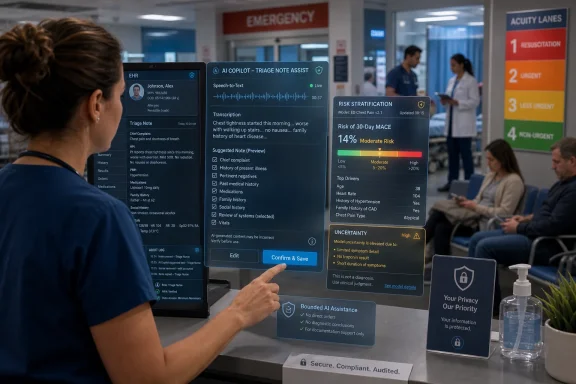
The Cureus review highlights the need for explainable algorithms and clinician engagement. That should not be read as a generic ethics line. It is a practical deployment requirement. If the system cannot show why it recommended a higher or lower acuity level, clinicians may either distrust it entirely or defer to it too readily.
Both failure modes are dangerous. Blind trust turns decision support into automation bias. Blanket distrust turns expensive software into screen clutter. The middle ground requires design: clear reasons, visible uncertainty, easy correction, and a record of when humans accepted, modified, or rejected an AI recommendation.
This is also where training becomes part of the safety case. A hospital cannot simply drop an AI triage widget into the EHR and call it modernization. Staff need to know what the tool is intended to do, what it is not intended to do, and what kinds of patients or presentations may fall outside its validated use.
The review notes equity as a key evidence gap. That is a serious limitation because triage is where disparities can begin. If a model underestimates risk for certain populations, the downstream harm may never be attributed to the software. It may simply look like another delayed diagnosis in an already overloaded system.
Bias testing needs to go beyond demographic checkboxes. Hospitals should ask whether performance varies by age, sex, race, ethnicity, language, disability status, socioeconomic proxies, arrival mode, and complaint type. They should also examine whether the model performs differently during crowding, overnight shifts, flu surges, and staffing shortages.
The uncomfortable truth is that AI can make triage more consistent without making it more just. Consistency is only valuable if the underlying logic is safe, clinically valid, and monitored across the people actually using the emergency department.
Six studies are not enough to settle clinical impact. Single-center evaluations are not enough to prove portability. Retrospective performance is not enough to prove real-time safety. Agreement with a triage scale is not enough to prove better outcomes.
That does not mean hospitals should reject AI triage tools outright. It means procurement should become more demanding. Buyers should ask for validation data from comparable settings, subgroup performance, downtime procedures, model update policies, audit logs, integration details, and post-deployment monitoring plans.
The strongest vendor pitch will not be “our AI is more accurate than nurses.” It will be “our system supports nurses, documents its reasoning, exposes uncertainty, integrates safely, and can prove performance under your conditions.” That is a much harder pitch, but it is the one emergency departments actually need.
This ambiguity creates a familiar enterprise problem: the organization deploying the system may carry much of the practical burden even when the vendor carries the branding. If a model update changes recommendations, who reviews it? If performance drifts, who detects it? If the system contributes to a delayed diagnosis, who reconstructs the decision path?
Hospitals need model governance before they need another AI steering committee slide deck. Governance should include version control, validation thresholds, incident reporting, rollback procedures, and multidisciplinary review. Emergency medicine, nursing, IT, security, compliance, legal, and patient safety teams all have a stake.
The Cureus review’s call for standardized outcome reporting is especially important. Without common measures, hospitals cannot compare tools meaningfully. The market then rewards polished interfaces and broad claims rather than demonstrated safety.
That model fits the evidence better than autonomous triage. It recognizes the reported gains in speed and predictive performance without pretending the field has solved undertriage, bias, generalizability, or clinical outcome measurement. It also gives hospitals room to learn from deployment without making patients the test harness for unproven automation.
A copilot model also aligns with how emergency departments actually work. Triage nurses already synthesize protocols, patient narratives, vital signs, intuition, and local resource realities. A useful AI tool should sharpen that synthesis, not replace it with an unexplained score.
The most valuable systems may end up being the least theatrical ones. A tool that quietly reduces documentation time, catches missing risk factors, and prompts a second look at borderline cases may save more lives than a grandly branded “AI triage engine” that overclaims its authority.
Long-term monitoring matters because emergency departments change. Seasonal disease patterns shift. New clinical protocols appear. Local populations evolve. Documentation practices drift. A model that looked safe in 2025 may not remain safe in 2027 without recalibration and oversight.
There is also a human-factors challenge. If clinicians learn that the model is usually right, they may become less vigilant. If they learn that it is often noisy, they may ignore it. Both outcomes are predictable, and both should be studied before hospitals treat AI triage as mature infrastructure.
The Cureus review is valuable because it does not confuse early promise with finished proof. It shows enough signal to justify continued development, but enough uncertainty to make aggressive deployment look premature.
 Emergency Triage Is Becoming the Next AI Control Plane
Emergency departments are one of the few places where software latency can become clinical latency. A patient’s first categorization affects who gets seen first, what resources are mobilized, and how quickly physicians recognize danger hidden inside ordinary symptoms. That makes triage a tempting target for AI vendors: the workflow is high-volume, data-rich, repetitive, and visibly strained.The Cureus review lands at an important moment because healthcare AI is moving out of radiology demos and into operational decision support. Triage is not just another dashboard; it is a gatekeeping function. If an algorithm nudges a patient into a lower-acuity lane, the cost of being wrong can be measured in minutes, deterioration, and liability.
The reviewed studies suggest that AI can help with the mechanics of triage. Voice-based systems can reduce documentation time, machine learning models can improve some prediction scores, and symptom-assessment tools can offer structured urgency advice. But the review’s most important finding is the narrowness of the evidence: only six studies made it into the final synthesis, and they varied substantially in design, geography, system type, and outcome measurement.
That is the pattern we have seen across enterprise AI: impressive local performance, messy generalization, and a governance problem disguised as a productivity story. In an emergency department, that pattern deserves less hype and more discipline.
The Cureus Review Finds Promise, Not Permission
The review followed PRISMA 2020 methodology and searched major clinical and technical databases for studies from 2020 through 2025. From 119 initial records, the authors ultimately included six studies evaluating AI-based triage systems in emergency department settings. The systems ranged from voice AI and natural language processing to machine learning classifiers, fuzzy logic, neural networks, and symptom-assessment applications.That diversity is both a strength and a warning. It shows that researchers are attacking triage from several angles, but it also means the field has not yet converged on a standard architecture, benchmark, or clinical endpoint. A voice documentation assistant is not the same kind of intervention as an acuity prediction model, and neither is identical to a patient-facing symptom checker.
The review reports several encouraging signals. One voice-based AI approach achieved documentation roughly 19 percent faster than manual entry. Some machine learning systems reduced mis-triage rates by margins ranging from 0.3 to 8.9 percentage points. A machine learning system in one large study reportedly improved area-under-the-curve performance compared with a traditional approach.
But “better metric” is not the same as “better medicine.” The review repeatedly returns to missing evidence on patient-centered outcomes, long-term deployment, equity, clinician acceptance, and multi-center validation. In plain English: the tools may help, but we do not yet know enough about who they help, where they fail, and whether they improve outcomes once exposed to real hospital chaos.
The Algorithm Is Only as Safe as Its Worst Undertriage
In emergency medicine, overtriage and undertriage are not symmetrical errors. Overtriage can crowd limited resources and slow the department. Undertriage can bury a dangerous case in a queue until the patient deteriorates.That is why the review’s discussion of undertriage matters more than the headline performance numbers. One symptom-assessment app showed high agreement with the Manchester Triage System, but it also had an undertriage rate and a subset of cases judged potentially hazardous. Those are not footnotes. They are the clinical edge cases that determine whether a triage system is ready for prime time.
The seductive thing about AI in triage is that aggregate performance can look reassuring. A model can post a respectable AUC, a solid F1 score, or an impressive agreement rate while still failing in the rare cases clinicians fear most. Emergency departments are built around those rare cases: the quiet myocardial infarction, the atypical stroke, the septic patient who looks deceptively stable.
This is where IT implementation and clinical safety collide. A model that performs well in retrospective data can still fail under distribution shift, missing data, noisy input, language barriers, atypical presentations, or overloaded staff behavior. The problem is not merely whether the algorithm is “accurate.” It is whether the hospital understands the shape of its errors.
Faster Documentation Is the Easy Win
The least controversial finding in the review is that AI can reduce documentation burden. Voice AI and natural language processing are a natural fit for triage because nurses already collect structured and semi-structured information under time pressure. If software can capture chief complaints, past medical history, and narrative details faster than manual typing, the operational case is obvious.This is the safest near-term lane for AI in the emergency department. Documentation support assists the workflow without necessarily deciding the workflow. It can reduce keystrokes, improve completeness, and leave the acuity decision in human hands.
Even here, the review notes limitations. Voice systems may perform unevenly across categorical variables, accents, background noise, local terminology, and workflow variations. Emergency departments are not quiet offices with perfect microphones and predictable scripts. They are loud, interrupted, emotionally charged environments.
For hospital IT, that means speech-to-text accuracy is only the beginning. The deployment question becomes whether the system integrates cleanly with the electronic health record, preserves auditability, protects sensitive data, supports correction, and avoids creating a second documentation burden when the AI gets it wrong.
Prediction Models Need More Than a Good AUC
Machine learning triage models often impress because they can ingest more variables than a human can comfortably weigh in the first minutes of care. Vital signs, arrival mode, age, chief complaint, prior visits, medications, free-text notes, and historical outcomes can all become model features. In theory, that should help identify risk earlier.The Cureus review includes models that improved predictive performance compared with traditional approaches. That matters, especially in overcrowded departments where small gains can affect resource allocation. But predictive performance is not deployment readiness.
AUC, F1 score, sensitivity, specificity, and agreement rates are useful but incomplete. They do not automatically reveal calibration, subgroup performance, workflow fit, alert fatigue, or the consequences of false reassurance. A model that is statistically impressive may still be operationally dangerous if clinicians do not trust it, misunderstand it, or override it inconsistently.
The deeper issue is that triage is not a single prediction task. It is a sequence of judgments under uncertainty. The model may predict acuity, admission, ICU need, mortality, sepsis, or resource use. Each endpoint changes the tool’s behavior and ethical profile. A system optimized to predict admission may not be the same system a nurse needs to identify a time-critical emergency.
Healthcare AI Has an Enterprise IT Problem
For WindowsForum readers, the hospital AI story is also an infrastructure story. These tools do not float above the enterprise. They run on endpoints, mobile devices, cloud services, local servers, EHR integrations, identity systems, logging pipelines, and increasingly complex vendor platforms.That matters because emergency triage systems handle some of the most sensitive and time-critical data in the organization. They may process voice recordings, free-text symptoms, demographic information, medication histories, and real-time clinical observations. If the system is cloud-connected, every design choice becomes a security and compliance question.
The operational requirements are unforgiving. The system must be available during peak demand, resilient during network degradation, and recoverable during outages. It must integrate with existing identity and access controls. It must produce logs useful for clinical review without exposing unnecessary protected health information. It must survive patch cycles, endpoint failures, and vendor updates without quietly changing behavior at the point of care.
In other words, the AI triage debate is not just about model accuracy. It is about whether hospitals can govern model behavior the way they govern medication systems, imaging workflows, and critical infrastructure. Many organizations are still learning how to do that.
The Black Box Is a Workflow Hazard
Clinicians do not need every model weight explained to them, but they do need to understand enough to act responsibly. A triage nurse facing a crowded waiting room cannot treat an opaque risk score as gospel. Nor can the nurse safely ignore it if hospital policy says the model is part of the standard workflow.The Cureus review highlights the need for explainable algorithms and clinician engagement. That should not be read as a generic ethics line. It is a practical deployment requirement. If the system cannot show why it recommended a higher or lower acuity level, clinicians may either distrust it entirely or defer to it too readily.
Both failure modes are dangerous. Blind trust turns decision support into automation bias. Blanket distrust turns expensive software into screen clutter. The middle ground requires design: clear reasons, visible uncertainty, easy correction, and a record of when humans accepted, modified, or rejected an AI recommendation.
This is also where training becomes part of the safety case. A hospital cannot simply drop an AI triage widget into the EHR and call it modernization. Staff need to know what the tool is intended to do, what it is not intended to do, and what kinds of patients or presentations may fall outside its validated use.
Bias Is Not a Side Issue in the Waiting Room
Emergency departments serve everyone: insured and uninsured patients, native speakers and non-native speakers, frequent visitors and first-time arrivals, elderly patients with atypical symptoms, children, people with disabilities, and people whose social circumstances complicate the clinical picture. A triage algorithm trained on incomplete or biased data can reproduce those inequities at scale.The review notes equity as a key evidence gap. That is a serious limitation because triage is where disparities can begin. If a model underestimates risk for certain populations, the downstream harm may never be attributed to the software. It may simply look like another delayed diagnosis in an already overloaded system.
Bias testing needs to go beyond demographic checkboxes. Hospitals should ask whether performance varies by age, sex, race, ethnicity, language, disability status, socioeconomic proxies, arrival mode, and complaint type. They should also examine whether the model performs differently during crowding, overnight shifts, flu surges, and staffing shortages.
The uncomfortable truth is that AI can make triage more consistent without making it more just. Consistency is only valuable if the underlying logic is safe, clinically valid, and monitored across the people actually using the emergency department.
Vendors Are Selling Certainty the Literature Has Not Earned
The gap between research and marketing is especially wide in healthcare AI. A vendor can point to a study showing reduced documentation time or improved predictive performance, then imply a broader transformation of emergency care. The Cureus review should make buyers more skeptical of that leap.Six studies are not enough to settle clinical impact. Single-center evaluations are not enough to prove portability. Retrospective performance is not enough to prove real-time safety. Agreement with a triage scale is not enough to prove better outcomes.
That does not mean hospitals should reject AI triage tools outright. It means procurement should become more demanding. Buyers should ask for validation data from comparable settings, subgroup performance, downtime procedures, model update policies, audit logs, integration details, and post-deployment monitoring plans.
The strongest vendor pitch will not be “our AI is more accurate than nurses.” It will be “our system supports nurses, documents its reasoning, exposes uncertainty, integrates safely, and can prove performance under your conditions.” That is a much harder pitch, but it is the one emergency departments actually need.
Regulation Will Lag the Deployment Curve
Healthcare AI oversight is improving, but hospital adoption is moving faster than the comfort level of many regulators, ethicists, and IT governance boards. Triage systems can fall into complicated categories depending on whether they provide documentation support, risk prediction, clinical decision support, or more direct recommendations.This ambiguity creates a familiar enterprise problem: the organization deploying the system may carry much of the practical burden even when the vendor carries the branding. If a model update changes recommendations, who reviews it? If performance drifts, who detects it? If the system contributes to a delayed diagnosis, who reconstructs the decision path?
Hospitals need model governance before they need another AI steering committee slide deck. Governance should include version control, validation thresholds, incident reporting, rollback procedures, and multidisciplinary review. Emergency medicine, nursing, IT, security, compliance, legal, and patient safety teams all have a stake.
The Cureus review’s call for standardized outcome reporting is especially important. Without common measures, hospitals cannot compare tools meaningfully. The market then rewards polished interfaces and broad claims rather than demonstrated safety.
The Best Near-Term Role Is Copilot, Not Autopilot
The sensible path is not to ban AI from triage, nor to let it quietly become the triage nurse’s invisible supervisor. The sensible path is bounded assistance. AI should help capture information, flag risk, surface relevant history, and support consistency while leaving final accountability with trained clinicians.That model fits the evidence better than autonomous triage. It recognizes the reported gains in speed and predictive performance without pretending the field has solved undertriage, bias, generalizability, or clinical outcome measurement. It also gives hospitals room to learn from deployment without making patients the test harness for unproven automation.
A copilot model also aligns with how emergency departments actually work. Triage nurses already synthesize protocols, patient narratives, vital signs, intuition, and local resource realities. A useful AI tool should sharpen that synthesis, not replace it with an unexplained score.
The most valuable systems may end up being the least theatrical ones. A tool that quietly reduces documentation time, catches missing risk factors, and prompts a second look at borderline cases may save more lives than a grandly branded “AI triage engine” that overclaims its authority.
The Waiting Room Is Where the Evidence Must Get Real
The next phase of AI triage research needs to move from model performance to clinical reality. Multi-center prospective studies should test systems across different hospitals, patient populations, staffing models, and EHR environments. Researchers should measure not only accuracy but also waiting times, deterioration events, left-without-being-seen rates, clinician workload, adverse events, and patient outcomes.Long-term monitoring matters because emergency departments change. Seasonal disease patterns shift. New clinical protocols appear. Local populations evolve. Documentation practices drift. A model that looked safe in 2025 may not remain safe in 2027 without recalibration and oversight.
There is also a human-factors challenge. If clinicians learn that the model is usually right, they may become less vigilant. If they learn that it is often noisy, they may ignore it. Both outcomes are predictable, and both should be studied before hospitals treat AI triage as mature infrastructure.
The Cureus review is valuable because it does not confuse early promise with finished proof. It shows enough signal to justify continued development, but enough uncertainty to make aggressive deployment look premature.
The Practical Read for Hospitals Considering AI at the Front Door
The most useful conclusion from the review is not that AI triage works or fails. It is that the category is separating into safer administrative augmentation and riskier clinical prioritization. Hospitals should treat those as different procurement, governance, and safety problems.- AI documentation support is the most defensible near-term use case because it can reduce burden while preserving human triage authority.
- Predictive triage models require local validation because performance in one emergency department may not transfer cleanly to another.
- Undertriage deserves special scrutiny because a small percentage of missed high-acuity patients can outweigh broad efficiency gains.
- Hospitals should demand subgroup performance data before deploying systems that may affect waiting time or acuity assignment.
- Model updates, downtime procedures, audit logs, and rollback plans should be treated as patient-safety requirements, not vendor paperwork.
- AI triage should be deployed as clinical decision support with visible uncertainty, not as an opaque automation layer over the waiting room.
References
- Primary source: Cureus
Published: Sun, 21 Jun 2026 13:41:40 GMT
Artificial Intelligence and Machine Learning-Based Triage Systems in Emergency Departments: A Systematic Review of Predictive Performance and Clinical Outcomes | Cureus
Emergency department (ED) triage systems are essential for prioritizing patients based on clinical urgency, yet traditional methods are subject to inter-observer variability and limited predictive accuracy. Artificial intelligence (AI) and machine learning (ML) have emerged as promising tools to...www.cureus.com - Related coverage: pmc.ncbi.nlm.nih.gov
Applications of Artificial Intelligence and Machine Learning in Emergency Medicine Triage - A Systematic Review - PMC
Overcrowding in Emergency departments adversely impacts efficiency, patient outcomes, and resource allocation. Accurate triage systems are essential for prioritizing care and optimizing resources. While traditional methods provide a foundation, they ... pmc.ncbi.nlm.nih.gov
- Related coverage: diagnprognres.biomedcentral.com
Using machine-learning risk prediction models to triage the acuity of undifferentiated patients entering the emergency care system: a systematic review | Diagnostic and Prognostic Research | Springer Nature Link
The primary objective of this review is to assess the accuracy of machine learning methods in their application of triaging the acuity of patients presentidiagnprognres.biomedcentral.com - Related coverage: bmcemergmed.biomedcentral.com
Improving triage performance in emergency departments using machine learning and natural language processing: a systematic review | BMC Emergency Medicine | Springer Nature Link
In Emergency Departments (EDs), triage is crucial for determining patient severity and prioritizing care, typically using the Manchester Triage Scale (MTS)bmcemergmed.biomedcentral.com - Related coverage: researchgate.net
- Related coverage: ijraset.com
- Related coverage: frontiersin.org
Untitled
Petrica A, Marza AM, Barsac C, Cebzan A, Dragan I, Zaharie D, Horhat R and Lungeanu D (2026) Artificial intelligence in emergency department triage: perspective of human professionals. Front. Digit. Health. 7:1693060. doi: 10.3389/fdgth.2025.1693060www.frontiersin.org
