
On June 23, 2026, GitHub added bring-your-own-key support to the GitHub Copilot app, letting developers run agent sessions against OpenAI, Azure OpenAI, Microsoft Foundry, Anthropic, LM Studio, Ollama, or other OpenAI-compatible endpoints from the app’s model picker. The change looks like a settings-panel feature, but it is really a shift in who controls the AI supply chain. Copilot is no longer only a hosted assistant with Microsoft-selected models; it is becoming a client for whichever model stack a developer or enterprise is willing to trust. That matters most for the WindowsForum crowd because local models, tenant-bound inference, and enterprise data boundaries are finally moving from architectural diagrams into everyday developer tooling.
The old pitch for Copilot was simple: subscribe, authenticate, and let GitHub’s hosted models help write code. The new pitch is messier, but also more powerful: bring the provider relationship you already have, wire it into the Copilot app, and decide per session which model should see the code and do the work.
That turns Copilot into something closer to an AI workbench than a single AI service. In Settings, users can add a model provider with an endpoint and API key, or in the case of local tools such as LM Studio and Ollama, a host. Once configured, those models appear alongside Copilot-hosted models in the picker, making provider choice part of the normal session workflow rather than a separate developer experiment.
This is GitHub acknowledging a reality that enterprise developers already live with. Many organizations are not waiting for a single blessed model to win. They are testing Anthropic for reasoning, OpenAI for breadth, Azure OpenAI for governance, local models for isolation, and OpenAI-compatible gateways for routing, logging, and policy enforcement.
The phrase bring your own key can sound like a billing feature. It is that, but it is also a control-plane feature. Whoever owns the key owns the quota, the region, the contract terms, and often the logging and retention posture around the requests.
The Copilot app’s implementation matters because it exposes provider configuration where ordinary users expect configuration to live. Add a provider under Model Providers, supply the endpoint and credential, and the configured models become available in the same place as GitHub’s hosted options. The workflow is intentionally boring, which is exactly the point.
GitHub says API keys are stored in the local operating system keychain and are not read back by the UI. That is an important design choice, particularly on Windows, where developers often live inside a mix of browser sessions, terminal windows, WSL environments, IDEs, and corporate credential managers. Secrets that become copy-paste text fields have a way of ending up in screenshots, shell history, support tickets, and dotfiles.
This does not make BYOK magically risk-free. A key stored locally is still a credential that can be abused if the machine is compromised. But it moves the feature away from the amateur hour pattern of pasting long-lived secrets into plain-text config and toward the same basic hygiene users expect from modern desktop software.
That is strategically useful. If a developer uses Copilot as the front end, GitHub still owns the workflow, the session experience, the agent orchestration, and the habit. The model provider becomes a replaceable backend. In platform terms, that is a better place to sit than being one more model endpoint in a crowded picker.
Azure OpenAI and Microsoft Foundry also benefit from the arrangement. Enterprises that already negotiated Microsoft cloud terms can route Copilot agent work through their own tenant rather than treating GitHub-hosted inference as a separate risk review. That gives Microsoft a way to say yes to regulated customers without forcing every customer into the same data path.
There is also a defensive angle. Developers have been wiring local models and third-party providers into editors through extensions, proxy tools, and custom scripts. If GitHub does not embrace that behavior, Copilot risks becoming the polished but inflexible option. BYOK keeps the app relevant in a world where model loyalty is weak and switching costs are falling.
GitHub’s framing is sensible: frontier models handle complexity, local models handle execution. That split maps closely to how many developers already think about AI agents. Use a powerful hosted model when a task requires deep reasoning across a large context. Use a local or self-hosted model when the job is repetitive, sensitive, cheap, latency-sensitive, or disconnected from the public internet.
On Windows, this could become especially interesting as Microsoft continues to push the idea of AI-capable PCs. The practical question has always been what normal software will do with the local model capability once the hardware exists. A Copilot app that can talk to local endpoints gives developers a plausible answer: run the agent interface you already know, but point some sessions at models that never leave the machine or the LAN.
The caveat is that local does not automatically mean safe, private, or accurate. A local model can still produce bad code, misunderstand a repository, or leak sensitive context through logs if the surrounding tooling is sloppy. But local inference changes the risk calculation. For many organizations, the ability to keep prompts and code context inside a controlled environment is worth accepting smaller models and more operational responsibility.
The feature also gives admins and platform teams a way to standardize AI access. Instead of every developer independently buying API credits or experimenting with random extensions, an organization can expose approved endpoints. That endpoint can enforce logging, data loss prevention, rate limits, model allow-lists, and audit trails.
But control cuts both ways. Once the company brings its own key, GitHub is no longer the only party responsible for whether the experience is fast, available, and predictable. If the Azure OpenAI deployment is throttled, the Anthropic key hits a quota, the internal proxy misroutes traffic, or the local Ollama host is underpowered, users will blame “Copilot” even when the failure lives outside GitHub’s hosted service.
That is the hidden cost of turning Copilot into a model router. The app may simplify the user experience, but it spreads operational responsibility across GitHub, the model provider, the enterprise network, the workstation, and the admin policy stack. IT departments that wanted model choice are also inheriting model support.
That is why “keep traffic in your tenant” is not just marketing language. Codebases contain credentials, architectural details, vulnerability clues, customer logic, proprietary algorithms, and operational habits. Even when a model provider promises not to train on submitted data, enterprises still care about where the traffic goes, who can audit it, and what legal framework governs it.
A BYOK setup can align Copilot sessions with the organization’s broader security model. If the approved path is Azure OpenAI in a specific region, or an internal OpenAI-compatible gateway that strips secrets and records prompts, the Copilot app can become a client of that path instead of an exception to it.
Security teams should still resist the temptation to treat BYOK as a silver bullet. The model endpoint is only one part of the chain. The local app, repo permissions, shell commands, generated code, dependency choices, and review practices still matter. BYOK helps answer “where did the prompt go?” It does not answer “was the agent allowed to do that?”
Developers will choose models for reasons that are not always aligned with enterprise policy. They may pick the fastest one, the one that “feels smarter,” the one with fewer refusals, the local one that avoids quota, or the expensive hosted model that gets them unstuck at 2 a.m. Once multiple providers appear side by side, model choice becomes a behavioral problem, not just a configuration problem.
Admins will therefore want policy around which providers are available and when. A local model may be acceptable for public code but not for regulated customer data if the workstation lacks the right controls. A frontier hosted model may be acceptable for design brainstorming but not for bulk repository analysis. An internal gateway may be required for anything involving production code.
This is where Copilot Business and Enterprise policy settings become important. GitHub notes that access to the Copilot app on those plans requires the organization or enterprise admin to have the Copilot CLI enabled in policy settings. That detail is easy to miss, but it signals that the app and CLI are part of a managed surface rather than a free-for-all consumer tool.
BYOK lets organizations move some of that cost into provider accounts they already manage. That can be attractive if they have committed cloud spend, negotiated rates, internal chargeback systems, or a cheaper self-hosted path. It can also be painful if developers suddenly discover an expensive model and use it for every task because it sits conveniently in the picker.
The GitHub docs around related BYOK scenarios make clear that usage tracking and rate limiting may belong to the provider rather than GitHub. That distinction matters for finance and operations teams. A Copilot seat may no longer represent the full cost of a developer’s AI usage if the session runs through an external model key.
There is a cultural effect, too. Once developers can compare models directly inside the same app, the old question “Is Copilot worth it?” becomes “Which model is worth it for this task?” That is a healthier question technically, but a harder one financially.
OpenAI-compatible APIs have become a de facto interoperability layer for AI tooling. They are not perfect standards, and compatibility can break around streaming, tool calling, structured outputs, multimodal inputs, or provider-specific quirks. But they give developers and platform teams a common enough shape to build against.
For enterprises, that opens the door to internal AI gateways. A company can put a policy layer between Copilot and the actual models, then expose a single endpoint to developers. Behind that endpoint, the organization can route requests based on cost, sensitivity, availability, or model performance.
For Windows enthusiasts and sysadmins, this is familiar territory. It resembles the way proxies, package mirrors, update services, and identity providers turned sprawling internet dependencies into managed enterprise infrastructure. AI inference is getting the same treatment, and Copilot is becoming one of the clients.
Agentic coding needs streaming, tool calling, large context handling, reliable instruction following, and enough code understanding to avoid wasting the user’s time. GitHub’s documentation for BYOK-style Copilot CLI usage points to model requirements such as tool calling and streaming, with large context windows recommended for best results. Those requirements will separate serious deployments from weekend experiments.
Local models are particularly exposed here. A small model may be perfectly adequate for explaining a function or generating a unit test template, yet struggle when asked to plan a multi-file refactor. A self-hosted endpoint may be private but slow. A cheap model may burn more human time than it saves.
This is why model choice needs to be empirical. Teams should benchmark models against their own repositories and workflows rather than relying on leaderboard vibes. A model that excels at Python web services may disappoint in C++ drivers, PowerShell automation, legacy .NET Framework code, or Windows installer projects.
The local-model angle also pairs well with Windows workstations that are increasingly being marketed as AI PCs. Developers with enough RAM and acceleration can experiment with Ollama or LM Studio while still keeping Copilot-hosted or frontier models available for harder tasks. That hybrid pattern may become the default for serious users: local first when possible, hosted when necessary.
The friction will be in setup, governance, and expectations. Local endpoints must be running. Models must be downloaded and updated. Corporate proxies and endpoint protection tools may interfere. Admins must decide whether developer-managed local models are acceptable or whether all BYOK traffic must pass through sanctioned infrastructure.
Still, this is the kind of friction that power users tend to accept when the payoff is real control. The Windows ecosystem has long thrived on configurable tools that can be bent into enterprise shapes. BYOK gives Copilot some of that character.
GitHub is conceding that the future of AI development will not be one model, one provider, or one data path. It is betting that the winning product is the layer developers return to regardless of which model is fashionable this quarter. That is classic platform strategy: abstract the volatile layer while owning the workflow above it.
For users, the upside is flexibility. For admins, the upside is control. For Microsoft, the upside is keeping Copilot central even when inference happens elsewhere. For model providers, the upside is distribution into one of the most important developer surfaces on the planet.
The risk is fragmentation. If every organization wires Copilot to a different provider stack, the support matrix gets wider and the user experience becomes less predictable. GitHub will have to make failure modes intelligible, not just integrations possible.
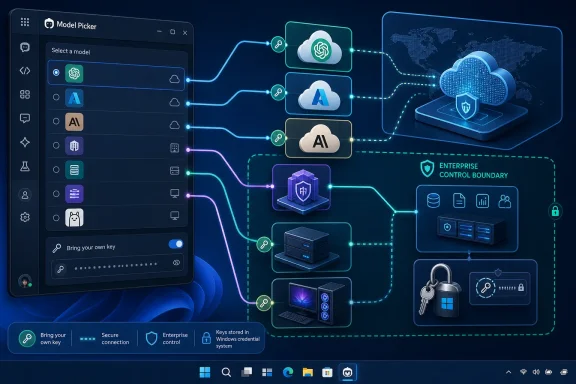 GitHub Turns Copilot From a Model Product Into a Model Router
The old pitch for Copilot was simple: subscribe, authenticate, and let GitHub’s hosted models help write code. The new pitch is messier, but also more powerful: bring the provider relationship you already have, wire it into the Copilot app, and decide per session which model should see the code and do the work.That turns Copilot into something closer to an AI workbench than a single AI service. In Settings, users can add a model provider with an endpoint and API key, or in the case of local tools such as LM Studio and Ollama, a host. Once configured, those models appear alongside Copilot-hosted models in the picker, making provider choice part of the normal session workflow rather than a separate developer experiment.
This is GitHub acknowledging a reality that enterprise developers already live with. Many organizations are not waiting for a single blessed model to win. They are testing Anthropic for reasoning, OpenAI for breadth, Azure OpenAI for governance, local models for isolation, and OpenAI-compatible gateways for routing, logging, and policy enforcement.
The phrase bring your own key can sound like a billing feature. It is that, but it is also a control-plane feature. Whoever owns the key owns the quota, the region, the contract terms, and often the logging and retention posture around the requests.
The App Interface Makes BYOK Operational, Not Experimental
BYOK has been floating around developer tooling for a while, usually as environment variables, JSON config, command-line flags, or obscure extension settings. That is fine for tinkerers, but it does not scale well to teams that want a repeatable support model.The Copilot app’s implementation matters because it exposes provider configuration where ordinary users expect configuration to live. Add a provider under Model Providers, supply the endpoint and credential, and the configured models become available in the same place as GitHub’s hosted options. The workflow is intentionally boring, which is exactly the point.
GitHub says API keys are stored in the local operating system keychain and are not read back by the UI. That is an important design choice, particularly on Windows, where developers often live inside a mix of browser sessions, terminal windows, WSL environments, IDEs, and corporate credential managers. Secrets that become copy-paste text fields have a way of ending up in screenshots, shell history, support tickets, and dotfiles.
This does not make BYOK magically risk-free. A key stored locally is still a credential that can be abused if the machine is compromised. But it moves the feature away from the amateur hour pattern of pasting long-lived secrets into plain-text config and toward the same basic hygiene users expect from modern desktop software.
Microsoft’s Cloud Strategy Is Hiding in Plain Sight
For Microsoft, this is not a retreat from hosted Copilot. It is a recognition that the AI market is becoming heterogeneous faster than any one vendor can flatten it. GitHub can keep users inside the Copilot interface even when the inference is going somewhere other than GitHub’s preferred hosted model path.That is strategically useful. If a developer uses Copilot as the front end, GitHub still owns the workflow, the session experience, the agent orchestration, and the habit. The model provider becomes a replaceable backend. In platform terms, that is a better place to sit than being one more model endpoint in a crowded picker.
Azure OpenAI and Microsoft Foundry also benefit from the arrangement. Enterprises that already negotiated Microsoft cloud terms can route Copilot agent work through their own tenant rather than treating GitHub-hosted inference as a separate risk review. That gives Microsoft a way to say yes to regulated customers without forcing every customer into the same data path.
There is also a defensive angle. Developers have been wiring local models and third-party providers into editors through extensions, proxy tools, and custom scripts. If GitHub does not embrace that behavior, Copilot risks becoming the polished but inflexible option. BYOK keeps the app relevant in a world where model loyalty is weak and switching costs are falling.
Local Models Are Now First-Class Enough to Be Boring
The inclusion of LM Studio and Ollama is the part Windows power users should notice. Local model tooling has moved quickly from novelty to practical utility, especially on high-memory desktops, developer workstations, and laptops with capable GPUs or NPUs. It still will not replace frontier hosted models for every task, but it is increasingly good enough for code search, boilerplate generation, log summarization, refactoring suggestions, and constrained internal workflows.GitHub’s framing is sensible: frontier models handle complexity, local models handle execution. That split maps closely to how many developers already think about AI agents. Use a powerful hosted model when a task requires deep reasoning across a large context. Use a local or self-hosted model when the job is repetitive, sensitive, cheap, latency-sensitive, or disconnected from the public internet.
On Windows, this could become especially interesting as Microsoft continues to push the idea of AI-capable PCs. The practical question has always been what normal software will do with the local model capability once the hardware exists. A Copilot app that can talk to local endpoints gives developers a plausible answer: run the agent interface you already know, but point some sessions at models that never leave the machine or the LAN.
The caveat is that local does not automatically mean safe, private, or accurate. A local model can still produce bad code, misunderstand a repository, or leak sensitive context through logs if the surrounding tooling is sloppy. But local inference changes the risk calculation. For many organizations, the ability to keep prompts and code context inside a controlled environment is worth accepting smaller models and more operational responsibility.
Enterprise IT Gets Control, but Also a New Support Burden
The enterprise appeal is obvious. BYOK lets organizations use existing billing relationships, quota systems, model deployments, regions, and data-handling agreements. For industries with strict data-boundary requirements, routing inference through an internal gateway or a cloud tenant under corporate control is a much cleaner story than sending code context to a vendor-managed black box.The feature also gives admins and platform teams a way to standardize AI access. Instead of every developer independently buying API credits or experimenting with random extensions, an organization can expose approved endpoints. That endpoint can enforce logging, data loss prevention, rate limits, model allow-lists, and audit trails.
But control cuts both ways. Once the company brings its own key, GitHub is no longer the only party responsible for whether the experience is fast, available, and predictable. If the Azure OpenAI deployment is throttled, the Anthropic key hits a quota, the internal proxy misroutes traffic, or the local Ollama host is underpowered, users will blame “Copilot” even when the failure lives outside GitHub’s hosted service.
That is the hidden cost of turning Copilot into a model router. The app may simplify the user experience, but it spreads operational responsibility across GitHub, the model provider, the enterprise network, the workstation, and the admin policy stack. IT departments that wanted model choice are also inheriting model support.
The Agent Era Makes Data Boundaries More Than Compliance Theater
BYOK would be useful for chat-style code completion, but it becomes more consequential in agent sessions. An agent does not merely answer a prompt. It can inspect context, propose edits, invoke tools, run commands, and iterate through a task. The more capable the agent, the more sensitive the surrounding data path becomes.That is why “keep traffic in your tenant” is not just marketing language. Codebases contain credentials, architectural details, vulnerability clues, customer logic, proprietary algorithms, and operational habits. Even when a model provider promises not to train on submitted data, enterprises still care about where the traffic goes, who can audit it, and what legal framework governs it.
A BYOK setup can align Copilot sessions with the organization’s broader security model. If the approved path is Azure OpenAI in a specific region, or an internal OpenAI-compatible gateway that strips secrets and records prompts, the Copilot app can become a client of that path instead of an exception to it.
Security teams should still resist the temptation to treat BYOK as a silver bullet. The model endpoint is only one part of the chain. The local app, repo permissions, shell commands, generated code, dependency choices, and review practices still matter. BYOK helps answer “where did the prompt go?” It does not answer “was the agent allowed to do that?”
The Model Picker Becomes a Policy Surface
The most important UI element in this release may be the model picker. On the surface, it is a convenience feature. In practice, it is where architecture, cost, risk, and productivity collide.Developers will choose models for reasons that are not always aligned with enterprise policy. They may pick the fastest one, the one that “feels smarter,” the one with fewer refusals, the local one that avoids quota, or the expensive hosted model that gets them unstuck at 2 a.m. Once multiple providers appear side by side, model choice becomes a behavioral problem, not just a configuration problem.
Admins will therefore want policy around which providers are available and when. A local model may be acceptable for public code but not for regulated customer data if the workstation lacks the right controls. A frontier hosted model may be acceptable for design brainstorming but not for bulk repository analysis. An internal gateway may be required for anything involving production code.
This is where Copilot Business and Enterprise policy settings become important. GitHub notes that access to the Copilot app on those plans requires the organization or enterprise admin to have the Copilot CLI enabled in policy settings. That detail is easy to miss, but it signals that the app and CLI are part of a managed surface rather than a free-for-all consumer tool.
BYOK Also Changes the Economics of Copilot
AI coding assistants have always had a slightly awkward economic model. Users pay a subscription, but the expensive part underneath is inference. As models become more capable and agent sessions become longer, the cost curve can look very different from old autocomplete.BYOK lets organizations move some of that cost into provider accounts they already manage. That can be attractive if they have committed cloud spend, negotiated rates, internal chargeback systems, or a cheaper self-hosted path. It can also be painful if developers suddenly discover an expensive model and use it for every task because it sits conveniently in the picker.
The GitHub docs around related BYOK scenarios make clear that usage tracking and rate limiting may belong to the provider rather than GitHub. That distinction matters for finance and operations teams. A Copilot seat may no longer represent the full cost of a developer’s AI usage if the session runs through an external model key.
There is a cultural effect, too. Once developers can compare models directly inside the same app, the old question “Is Copilot worth it?” becomes “Which model is worth it for this task?” That is a healthier question technically, but a harder one financially.
OpenAI-Compatible Endpoints Are the Quiet Power Move
Support for “any OpenAI-compatible endpoint” is doing a lot of work here. It means GitHub is not only integrating with named providers; it is integrating with an ecosystem of gateways, local runtimes, self-hosted inference stacks, and compatibility layers. That is how a feature becomes adaptable without GitHub having to bless every vendor individually.OpenAI-compatible APIs have become a de facto interoperability layer for AI tooling. They are not perfect standards, and compatibility can break around streaming, tool calling, structured outputs, multimodal inputs, or provider-specific quirks. But they give developers and platform teams a common enough shape to build against.
For enterprises, that opens the door to internal AI gateways. A company can put a policy layer between Copilot and the actual models, then expose a single endpoint to developers. Behind that endpoint, the organization can route requests based on cost, sensitivity, availability, or model performance.
For Windows enthusiasts and sysadmins, this is familiar territory. It resembles the way proxies, package mirrors, update services, and identity providers turned sprawling internet dependencies into managed enterprise infrastructure. AI inference is getting the same treatment, and Copilot is becoming one of the clients.
The Limits Are Where the Real Engineering Begins
The optimistic reading of BYOK is that everyone gets choice. The practical reading is that every model now has to prove it can behave like a Copilot agent backend. That is a higher bar than answering chat prompts.Agentic coding needs streaming, tool calling, large context handling, reliable instruction following, and enough code understanding to avoid wasting the user’s time. GitHub’s documentation for BYOK-style Copilot CLI usage points to model requirements such as tool calling and streaming, with large context windows recommended for best results. Those requirements will separate serious deployments from weekend experiments.
Local models are particularly exposed here. A small model may be perfectly adequate for explaining a function or generating a unit test template, yet struggle when asked to plan a multi-file refactor. A self-hosted endpoint may be private but slow. A cheap model may burn more human time than it saves.
This is why model choice needs to be empirical. Teams should benchmark models against their own repositories and workflows rather than relying on leaderboard vibes. A model that excels at Python web services may disappoint in C++ drivers, PowerShell automation, legacy .NET Framework code, or Windows installer projects.
Windows Developers Should See Both Opportunity and Friction
For Windows developers, the BYOK Copilot app lands in a particularly rich environment. Many already work across Visual Studio, VS Code, PowerShell, Windows Terminal, WSL, Docker Desktop, Azure, GitHub, and internal enterprise tooling. A model-router Copilot can sit across that messy reality more naturally than a single hosted assistant.The local-model angle also pairs well with Windows workstations that are increasingly being marketed as AI PCs. Developers with enough RAM and acceleration can experiment with Ollama or LM Studio while still keeping Copilot-hosted or frontier models available for harder tasks. That hybrid pattern may become the default for serious users: local first when possible, hosted when necessary.
The friction will be in setup, governance, and expectations. Local endpoints must be running. Models must be downloaded and updated. Corporate proxies and endpoint protection tools may interfere. Admins must decide whether developer-managed local models are acceptable or whether all BYOK traffic must pass through sanctioned infrastructure.
Still, this is the kind of friction that power users tend to accept when the payoff is real control. The Windows ecosystem has long thrived on configurable tools that can be bent into enterprise shapes. BYOK gives Copilot some of that character.
GitHub’s Small Settings Panel Carries a Big Platform Bet
The Copilot app’s BYOK support is easy to underestimate because it arrived as a short changelog entry. There is no grand keynote drama in adding a provider screen. But the implications are larger than the interface.GitHub is conceding that the future of AI development will not be one model, one provider, or one data path. It is betting that the winning product is the layer developers return to regardless of which model is fashionable this quarter. That is classic platform strategy: abstract the volatile layer while owning the workflow above it.
For users, the upside is flexibility. For admins, the upside is control. For Microsoft, the upside is keeping Copilot central even when inference happens elsewhere. For model providers, the upside is distribution into one of the most important developer surfaces on the planet.
The risk is fragmentation. If every organization wires Copilot to a different provider stack, the support matrix gets wider and the user experience becomes less predictable. GitHub will have to make failure modes intelligible, not just integrations possible.
The Copilot App Is Now a Trust Decision, Not Just a Download
The concrete lesson from this release is that Copilot’s value is moving beyond code suggestions and into orchestration. BYOK gives developers choice, but it also forces organizations to decide what kind of AI infrastructure they actually want.- Organizations can now route Copilot app agent sessions through OpenAI, Azure OpenAI, Microsoft Foundry, Anthropic, LM Studio, Ollama, or OpenAI-compatible endpoints they control.
- Developers can choose configured BYOK models from the same model picker as Copilot-hosted models, making provider selection part of the normal session workflow.
- API keys are stored in the local operating system keychain and are not read back by the app UI, which is better than plain-text configuration but not a substitute for endpoint security.
- Local and self-hosted models can reduce data-boundary concerns, but they also shift performance, reliability, and model-quality responsibility onto the user or organization.
- Enterprise admins should treat the model picker as a policy surface, because model choice now affects cost, compliance, logging, latency, and support.
- The most mature deployments will likely use internal gateways or tenant-bound cloud endpoints rather than letting every developer independently wire personal API keys into production workflows.
References
- Primary source: The GitHub Blog
Published: Tue, 23 Jun 2026 08:00:02 GMT
GitHub Copilot app support for BYOK - GitHub Changelog
The GitHub Copilot app now supports bring your own key (BYOK), so you can run agent sessions against your own model providers, including OpenAI, Azure OpenAI, Microsoft Foundry, Anthropic, LM Studio, Ollama, and any OpenAI-compatible endpoint.github.blog
- Official source: docs.github.com
Using your own LLM models in GitHub Copilot CLI - GitHub Docs
Use a model from an external provider of your choice in Copilot by supplying your own API key. docs.github.com
