

Visual Studio Code 1.122, released in late May 2026, lets developers use bring-your-own-key AI models for chat, tools, and MCP servers without signing in to GitHub, enabling restricted or offline workflows with providers such as Ollama and custom endpoints. The change sounds like a checkbox in a monthly release note, but it is really a shift in who gets to control the editor’s AI layer. Microsoft is still steering developers toward Copilot, yet it has conceded that the next phase of AI coding cannot be cloud-only, GitHub-only, or subscription-first. For Windows developers and IT shops, the useful question is no longer whether AI belongs in the IDE, but who is allowed to decide where that intelligence runs.
For the last two years, Microsoft’s AI strategy in developer tools has been easy to summarize: make GitHub Copilot feel native, make Visual Studio Code the most convenient place to use it, and turn the editor into a command surface for cloud-hosted models. That strategy worked because Copilot’s tight VS Code integration is genuinely useful. Inline completions, chat, workspace-aware explanations, command generation, and agent-style workflows all make more sense in the editor than in a detached browser tab.
But that convenience came with a political problem. VS Code is not just another Microsoft app; it is the default workbench for a vast ecosystem of developers who chose it partly because it felt lightweight, extensible, and not overly prescriptive. When the editor’s best AI features assumed a GitHub sign-in, Microsoft was not merely asking users to authenticate. It was asserting that the front door to AI-assisted coding should run through its identity and service stack.
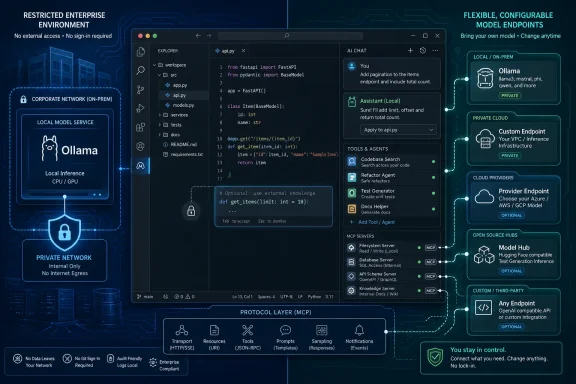
The new BYOK-without-GitHub-sign-in mode softens that stance. Developers can now configure supported model providers, including local Ollama instances and custom endpoints, and use VS Code’s chat and tool interfaces without a GitHub account in the loop. In a normal consumer setting, that may feel like a niche privacy feature. In a bank, defense contractor, hospital network, chip lab, or manufacturing plant, it is the difference between “interesting demo” and “possibly deployable.”
The catch is equally important. Microsoft has not turned VS Code into a fully provider-neutral AI editor. Inline suggestions and next-edit suggestions still require GitHub sign-in, which means the most fluid Copilot experience remains gated behind the familiar Microsoft-GitHub path. The gate has moved, not disappeared.
Many organizations are not literally air-gapped, but they are constrained by procurement rules, data-handling policies, regulatory obligations, customer contracts, or internal security reviews that make arbitrary cloud calls difficult to approve. A developer tool that phones home for authentication before activating AI features may be dead on arrival, even if the model itself could have run locally. The problem is not always model privacy; sometimes it is identity, telemetry, auditability, or the inability to prove what leaves the network.
That is why this VS Code change matters. If a team can point the editor at a local Ollama service, an internal OpenAI-compatible endpoint, Azure infrastructure under enterprise controls, or another approved model gateway, the AI feature becomes part of the organization’s architecture rather than an exception to it. The editor stops being a consumer SaaS client wearing a corporate badge and starts looking like a configurable front end.
This also reframes the local-model debate. The point is not that every local model beats a top-tier hosted model. Many do not. Smaller models can be slower, weaker at reasoning, less consistent in code generation, and more dependent on careful prompting or retrieval. But in restricted environments, “good enough and allowed” often beats “excellent and forbidden.”
Microsoft understands this. The company does not need every local model user to abandon Copilot. It needs VS Code to remain the place where those users work, even when Copilot cannot be the model behind the curtain.
MCP matters because it gives models a standardized way to interact with external context and tools. In practical terms, that can mean repository data, documentation, issue trackers, databases, build systems, internal APIs, or other resources exposed through controlled servers. Once VS Code can connect local or BYOK models to those tool surfaces without GitHub authentication, the editor starts to look like a local cockpit for enterprise AI workflows.
That is precisely why administrators will care. A chatbot that explains code is useful, but manageable. An agent that can call tools, inspect project state, propose edits, run commands, and interact with internal systems is a governance problem. The model’s location is only one part of the risk profile. The tool permissions, context boundaries, logging model, and human approval flow matter just as much.
Microsoft’s move does not solve all of that. It does, however, put the pieces into the same product surface. VS Code can now host a workflow in which the model is local, the tools are internal, and the developer never needs to authenticate to GitHub just to start the session. That is a meaningful architectural opening, even if the implementation remains young.
It is also a competitive necessity. AI-native coding tools have spent the last year attacking VS Code’s flank by offering more flexible model selection, stronger agent loops, and a less Copilot-centric posture. Microsoft can either keep VS Code tightly bound to Copilot and risk losing advanced users to forks and rivals, or it can make VS Code the place where many models compete. Version 1.122 suggests Microsoft is choosing the latter, but only as far as it can without weakening Copilot’s premium value.
Chat is useful, but inline completion is intimate. It is the feature that changes the physical rhythm of programming: type a function signature, pause for a fraction of a second, accept a suggestion, keep moving. Next-edit suggestions go further by anticipating changes across nearby code, turning the editor into a predictive system rather than a reactive assistant. If those features still require GitHub sign-in, then the most seamless parts of AI coding remain Copilot territory.
This distinction creates a two-tier experience. BYOK users can consult a local model, ask it to explain code, invoke tools, and participate in agent workflows. Copilot users still get the ambient assistance that appears directly in the act of typing. For many developers, that ambient layer is the real habit-forming feature.
There may be good engineering reasons for the restriction. Inline completions need low latency, careful ranking, editor-specific context shaping, abuse controls, and tight integration with the suggestion pipeline. Local models vary wildly in performance and capability. A bad inline model can make the editor feel broken in a way that a mediocre chat response does not.
Still, the product effect is unmistakable. Microsoft has opened the side door for local and alternative models while keeping the front-row seats for Copilot. That is not hypocrisy; it is platform strategy. The company wants to satisfy regulated environments and model-choice advocates without surrendering the strongest reason to pay for its own AI service.
On a developer workstation, the bottleneck may be RAM, GPU memory, CPU heat, or battery life. On a shared internal server, the bottleneck may be queueing, multi-user isolation, model caching, or capacity planning. In an enterprise environment, the bottleneck may be something more mundane: who owns the service, who patches it, and who signs off when it becomes part of the software delivery process.
Local models also do not automatically solve data governance. They reduce exposure to external providers, but they can still leak secrets into logs, prompt histories, crash dumps, or internal telemetry systems. They can still be connected to overly broad tools. They can still generate vulnerable code, misread context, or fabricate APIs. The fact that a model runs on your network does not make it trustworthy; it only makes it yours.
That distinction will matter as organizations move from AI pilots to production governance. Security teams that rejected cloud Copilot on data-exfiltration grounds may approve a local endpoint, but they should not treat it as risk-free. The policy conversation shifts from “Can code leave the company?” to “What is this local agent allowed to see and do?”
The better framing is that BYOK expands the deployment menu. Some teams will choose a local model for sensitive repositories. Some will use Azure-hosted models behind enterprise controls. Some will route through an approved internal gateway that brokers multiple providers. Some will continue using GitHub Copilot because the productivity gain outweighs the risk. VS Code 1.122 does not dictate the answer; it makes more answers technically plausible.
That matters because the local LLM scene has matured quickly. Ollama, LM Studio-style workflows, OpenAI-compatible local servers, and smaller code-tuned models have made it relatively easy to run an assistant on a capable desktop or laptop. The experience is not always elegant, and it will not match the best hosted models in every task, but it gives developers a private sandbox for code explanation, refactoring ideas, test generation, and tool-assisted exploration.
The appeal is especially strong for hobbyists and open-source contributors who dislike the subscription sprawl of modern development tools. BYOK means the editor can become a model-agnostic client rather than another monthly bill. A user can test a local model, switch to a paid API for heavier work, and keep the same VS Code surface.
There is also a learning benefit. Running a local model forces developers to understand context windows, model sizes, latency, quantization, and the difference between a model that can chat about code and one that can reliably edit a project. Those details are often hidden by hosted assistants. They become unavoidable when the model is running on your own machine.
Still, Windows users should temper expectations. The first experience may involve sluggish responses, model downloads large enough to annoy a storage-constrained laptop, and inconsistent quality across languages and frameworks. The win is control, not guaranteed brilliance.
BYOK without GitHub sign-in gives enterprise IT a cleaner way to separate the editor from the model contract. That separation is powerful. A company may standardize on VS Code because developers already use it, while routing AI requests through a model platform selected by security, procurement, or architecture teams. The editor becomes stable even as model strategy changes underneath it.
This is particularly relevant in organizations that do not want every development team individually pasting API keys into tools. In a mature deployment, BYOK should not mean “bring your personal key and hope finance does not notice.” It should mean “connect to the organization’s approved endpoint, under the organization’s logging, rate limits, access controls, and data-retention rules.” VS Code’s support for custom endpoints makes that model more credible.
The challenge is that developer enthusiasm often outruns governance. Once an editor supports multiple model providers, users will ask for access to all of them. Security teams will need to distinguish between a local model running on a workstation, a corporate endpoint inside the network, a public API billed to an employee credit card, and an experimental proxy someone found on GitHub. The same UI affordance can hide very different risk profiles.
Microsoft’s move therefore creates work for administrators as well as freedom for developers. The organizations that benefit most will be the ones that treat model choice as infrastructure, not a preference buried in individual settings.
This is a familiar Microsoft maneuver. The company often wins developer markets not by insisting on a single path forever, but by making its platform the place where competing paths are surfaced, governed, and eventually monetized. Azure did this with Linux. GitHub did it with third-party CI/CD integrations even as GitHub Actions grew. VS Code can do it with models.
The risk for Microsoft is that model neutrality reduces lock-in. If developers can point VS Code at Ollama today, OpenRouter tomorrow, an enterprise gateway next month, and a future in-house model after that, Copilot becomes less inevitable. The counterargument is that the editor itself becomes more entrenched. Microsoft may prefer owning the workbench even when it does not own every inference call.
That trade-off is rational. AI coding tools are moving too quickly for any vendor to assume permanent model dominance. Developers want Claude one month, Gemini the next, a specialized code model after that, and a local fallback when traveling or handling sensitive files. A tool that refuses this reality starts to feel brittle.
By allowing BYOK without GitHub sign-in, Microsoft preserves VS Code’s reputation as the flexible choice while keeping Copilot’s highest-convenience features differentiated. It is a compromise designed to keep both camps inside the same editor.
But local AI can also create new attack surfaces. A model server listening on the wrong interface, an MCP tool with excessive permissions, a malicious prompt embedded in documentation, or an unreviewed agent command can all turn a privacy win into an operational risk. The industry is still learning how to secure tool-using models, and the failure modes are not identical to traditional software vulnerabilities.
There is also the question of updates. Cloud providers can patch model behavior, safety filters, and service-side mitigations centrally. Local deployments may lag behind, especially in organizations that treat model files as static artifacts once approved. In a regulated environment, that stability can be desirable. In a security context, it can become technical debt.
The practical answer is not to reject local models, but to operationalize them. Treat the model endpoint like any other service. Document it, patch it, monitor it, restrict it, and test it. Treat MCP servers like privileged integrations, not harmless plugins. Treat generated code as untrusted until reviewed.
VS Code’s new mode makes this work possible inside a mainstream editor. It does not make the work optional.
BYOK without GitHub sign-in fits that pattern perfectly. It is a real concession to users who do not want Copilot as the mandatory broker. It is also a way to prevent those users from leaving VS Code for editors and forks that advertise model independence as their core identity. Microsoft is not giving up control so much as choosing where control matters most.
The remaining Copilot-only inline features show the boundary. Microsoft can say, accurately, that VS Code supports local and alternative models in important AI workflows. It can also preserve the premium smoothness of Copilot where developer habits are most likely to form. This is not a contradiction. It is a product ladder.
For competitors, the opening is obvious. If another editor or VS Code fork can offer local models for chat, agents, inline completions, and next-edit suggestions with strong performance, it can claim a more complete version of model freedom. But that is a hard bar. VS Code’s distribution, extension ecosystem, and user familiarity are formidable advantages.
For users, the best response is pragmatic. Take the new freedom seriously, but do not mistake it for full independence. The editor is more open than it was. It is not neutral ground.
The next fight will be over parity. Once developers can use local models for chat and tools, they will ask why the same models cannot drive inline completions, predictive edits, test generation, debugging loops, and background code review with the same polish as Copilot. Microsoft can hold that line for a while, but pressure will come from regulated customers, open-source toolmakers, and rival AI editors that see model choice as the wedge issue of the next IDE war. VS Code 1.122 does not end Microsoft’s Copilot-first era; it marks the moment Microsoft admitted that the editor’s AI future has to leave room for machines that never call home.
 Microsoft Loosens the Copilot Gate Without Removing the Fence
For the last two years, Microsoft’s AI strategy in developer tools has been easy to summarize: make GitHub Copilot feel native, make Visual Studio Code the most convenient place to use it, and turn the editor into a command surface for cloud-hosted models. That strategy worked because Copilot’s tight VS Code integration is genuinely useful. Inline completions, chat, workspace-aware explanations, command generation, and agent-style workflows all make more sense in the editor than in a detached browser tab.But that convenience came with a political problem. VS Code is not just another Microsoft app; it is the default workbench for a vast ecosystem of developers who chose it partly because it felt lightweight, extensible, and not overly prescriptive. When the editor’s best AI features assumed a GitHub sign-in, Microsoft was not merely asking users to authenticate. It was asserting that the front door to AI-assisted coding should run through its identity and service stack.
The new BYOK-without-GitHub-sign-in mode softens that stance. Developers can now configure supported model providers, including local Ollama instances and custom endpoints, and use VS Code’s chat and tool interfaces without a GitHub account in the loop. In a normal consumer setting, that may feel like a niche privacy feature. In a bank, defense contractor, hospital network, chip lab, or manufacturing plant, it is the difference between “interesting demo” and “possibly deployable.”
The catch is equally important. Microsoft has not turned VS Code into a fully provider-neutral AI editor. Inline suggestions and next-edit suggestions still require GitHub sign-in, which means the most fluid Copilot experience remains gated behind the familiar Microsoft-GitHub path. The gate has moved, not disappeared.
Air-Gapped AI Is Less About Romance Than Procurement
The phrase air-gapped AI invites a certain drama: glowing terminals in secured rooms, disconnected networks, classified code, and local models humming on expensive GPUs. Some of that exists. Most of the real market is less cinematic and more bureaucratic.Many organizations are not literally air-gapped, but they are constrained by procurement rules, data-handling policies, regulatory obligations, customer contracts, or internal security reviews that make arbitrary cloud calls difficult to approve. A developer tool that phones home for authentication before activating AI features may be dead on arrival, even if the model itself could have run locally. The problem is not always model privacy; sometimes it is identity, telemetry, auditability, or the inability to prove what leaves the network.
That is why this VS Code change matters. If a team can point the editor at a local Ollama service, an internal OpenAI-compatible endpoint, Azure infrastructure under enterprise controls, or another approved model gateway, the AI feature becomes part of the organization’s architecture rather than an exception to it. The editor stops being a consumer SaaS client wearing a corporate badge and starts looking like a configurable front end.
This also reframes the local-model debate. The point is not that every local model beats a top-tier hosted model. Many do not. Smaller models can be slower, weaker at reasoning, less consistent in code generation, and more dependent on careful prompting or retrieval. But in restricted environments, “good enough and allowed” often beats “excellent and forbidden.”
Microsoft understands this. The company does not need every local model user to abandon Copilot. It needs VS Code to remain the place where those users work, even when Copilot cannot be the model behind the curtain.
The Editor Is Becoming the AI Control Plane
The most interesting part of the 1.122 change is not simply local chat. It is the combination of chat, tools, and Model Context Protocol support. That bundle points toward an IDE that is less a text editor with autocomplete and more an orchestration surface for coding agents.MCP matters because it gives models a standardized way to interact with external context and tools. In practical terms, that can mean repository data, documentation, issue trackers, databases, build systems, internal APIs, or other resources exposed through controlled servers. Once VS Code can connect local or BYOK models to those tool surfaces without GitHub authentication, the editor starts to look like a local cockpit for enterprise AI workflows.
That is precisely why administrators will care. A chatbot that explains code is useful, but manageable. An agent that can call tools, inspect project state, propose edits, run commands, and interact with internal systems is a governance problem. The model’s location is only one part of the risk profile. The tool permissions, context boundaries, logging model, and human approval flow matter just as much.
Microsoft’s move does not solve all of that. It does, however, put the pieces into the same product surface. VS Code can now host a workflow in which the model is local, the tools are internal, and the developer never needs to authenticate to GitHub just to start the session. That is a meaningful architectural opening, even if the implementation remains young.
It is also a competitive necessity. AI-native coding tools have spent the last year attacking VS Code’s flank by offering more flexible model selection, stronger agent loops, and a less Copilot-centric posture. Microsoft can either keep VS Code tightly bound to Copilot and risk losing advanced users to forks and rivals, or it can make VS Code the place where many models compete. Version 1.122 suggests Microsoft is choosing the latter, but only as far as it can without weakening Copilot’s premium value.
The Missing Inline Piece Keeps Copilot at the Center
The limitation that local models cannot yet power inline and next-edit suggestions is not a minor technical footnote. It defines the boundary of Microsoft’s generosity.Chat is useful, but inline completion is intimate. It is the feature that changes the physical rhythm of programming: type a function signature, pause for a fraction of a second, accept a suggestion, keep moving. Next-edit suggestions go further by anticipating changes across nearby code, turning the editor into a predictive system rather than a reactive assistant. If those features still require GitHub sign-in, then the most seamless parts of AI coding remain Copilot territory.
This distinction creates a two-tier experience. BYOK users can consult a local model, ask it to explain code, invoke tools, and participate in agent workflows. Copilot users still get the ambient assistance that appears directly in the act of typing. For many developers, that ambient layer is the real habit-forming feature.
There may be good engineering reasons for the restriction. Inline completions need low latency, careful ranking, editor-specific context shaping, abuse controls, and tight integration with the suggestion pipeline. Local models vary wildly in performance and capability. A bad inline model can make the editor feel broken in a way that a mediocre chat response does not.
Still, the product effect is unmistakable. Microsoft has opened the side door for local and alternative models while keeping the front-row seats for Copilot. That is not hypocrisy; it is platform strategy. The company wants to satisfy regulated environments and model-choice advocates without surrendering the strongest reason to pay for its own AI service.
Local Models Trade Cloud Risk for Local Complexity
For WindowsForum readers, the phrase “just run Ollama locally” deserves some caution. Local inference is liberating, but it is not magic. Someone has to choose the model, provision the hardware, manage updates, validate outputs, monitor performance, and decide what happens when a 7B or 14B parameter model confidently rewrites a function incorrectly.On a developer workstation, the bottleneck may be RAM, GPU memory, CPU heat, or battery life. On a shared internal server, the bottleneck may be queueing, multi-user isolation, model caching, or capacity planning. In an enterprise environment, the bottleneck may be something more mundane: who owns the service, who patches it, and who signs off when it becomes part of the software delivery process.
Local models also do not automatically solve data governance. They reduce exposure to external providers, but they can still leak secrets into logs, prompt histories, crash dumps, or internal telemetry systems. They can still be connected to overly broad tools. They can still generate vulnerable code, misread context, or fabricate APIs. The fact that a model runs on your network does not make it trustworthy; it only makes it yours.
That distinction will matter as organizations move from AI pilots to production governance. Security teams that rejected cloud Copilot on data-exfiltration grounds may approve a local endpoint, but they should not treat it as risk-free. The policy conversation shifts from “Can code leave the company?” to “What is this local agent allowed to see and do?”
The better framing is that BYOK expands the deployment menu. Some teams will choose a local model for sensitive repositories. Some will use Azure-hosted models behind enterprise controls. Some will route through an approved internal gateway that brokers multiple providers. Some will continue using GitHub Copilot because the productivity gain outweighs the risk. VS Code 1.122 does not dictate the answer; it makes more answers technically plausible.
Windows Developers Get a Practical Privacy Win
For individual Windows developers, the change is simpler. If you want to experiment with local coding assistants without signing into GitHub, VS Code is now a friendlier place to do it.That matters because the local LLM scene has matured quickly. Ollama, LM Studio-style workflows, OpenAI-compatible local servers, and smaller code-tuned models have made it relatively easy to run an assistant on a capable desktop or laptop. The experience is not always elegant, and it will not match the best hosted models in every task, but it gives developers a private sandbox for code explanation, refactoring ideas, test generation, and tool-assisted exploration.
The appeal is especially strong for hobbyists and open-source contributors who dislike the subscription sprawl of modern development tools. BYOK means the editor can become a model-agnostic client rather than another monthly bill. A user can test a local model, switch to a paid API for heavier work, and keep the same VS Code surface.
There is also a learning benefit. Running a local model forces developers to understand context windows, model sizes, latency, quantization, and the difference between a model that can chat about code and one that can reliably edit a project. Those details are often hidden by hosted assistants. They become unavoidable when the model is running on your own machine.
Still, Windows users should temper expectations. The first experience may involve sluggish responses, model downloads large enough to annoy a storage-constrained laptop, and inconsistent quality across languages and frameworks. The win is control, not guaranteed brilliance.
The Enterprise Story Is Really About Optionality
The old Copilot adoption story was straightforward: buy licenses, sign in, let developers use the service, and configure policy controls as needed. That remains appealing for many organizations. But the next wave of AI coding adoption is messier because enterprises are no longer evaluating a single assistant. They are comparing model providers, internal platforms, retrieval systems, compliance demands, and cost structures.BYOK without GitHub sign-in gives enterprise IT a cleaner way to separate the editor from the model contract. That separation is powerful. A company may standardize on VS Code because developers already use it, while routing AI requests through a model platform selected by security, procurement, or architecture teams. The editor becomes stable even as model strategy changes underneath it.
This is particularly relevant in organizations that do not want every development team individually pasting API keys into tools. In a mature deployment, BYOK should not mean “bring your personal key and hope finance does not notice.” It should mean “connect to the organization’s approved endpoint, under the organization’s logging, rate limits, access controls, and data-retention rules.” VS Code’s support for custom endpoints makes that model more credible.
The challenge is that developer enthusiasm often outruns governance. Once an editor supports multiple model providers, users will ask for access to all of them. Security teams will need to distinguish between a local model running on a workstation, a corporate endpoint inside the network, a public API billed to an employee credit card, and an experimental proxy someone found on GitHub. The same UI affordance can hide very different risk profiles.
Microsoft’s move therefore creates work for administrators as well as freedom for developers. The organizations that benefit most will be the ones that treat model choice as infrastructure, not a preference buried in individual settings.
Copilot Becomes a Layer, Not the Whole Product
Strategically, this release signals that Microsoft knows Copilot cannot be the only answer inside VS Code. That does not mean Copilot is weakening. It means Copilot is becoming one layer in a broader AI-enabled editor.This is a familiar Microsoft maneuver. The company often wins developer markets not by insisting on a single path forever, but by making its platform the place where competing paths are surfaced, governed, and eventually monetized. Azure did this with Linux. GitHub did it with third-party CI/CD integrations even as GitHub Actions grew. VS Code can do it with models.
The risk for Microsoft is that model neutrality reduces lock-in. If developers can point VS Code at Ollama today, OpenRouter tomorrow, an enterprise gateway next month, and a future in-house model after that, Copilot becomes less inevitable. The counterargument is that the editor itself becomes more entrenched. Microsoft may prefer owning the workbench even when it does not own every inference call.
That trade-off is rational. AI coding tools are moving too quickly for any vendor to assume permanent model dominance. Developers want Claude one month, Gemini the next, a specialized code model after that, and a local fallback when traveling or handling sensitive files. A tool that refuses this reality starts to feel brittle.
By allowing BYOK without GitHub sign-in, Microsoft preserves VS Code’s reputation as the flexible choice while keeping Copilot’s highest-convenience features differentiated. It is a compromise designed to keep both camps inside the same editor.
The Security Argument Cuts Both Ways
The strongest case for local AI is security, but it is also where the argument can become sloppy. Running a model locally can reduce the risk of source code leaving the network. It can help satisfy policies that prohibit external AI services. It can keep sensitive prompts away from third-party providers. Those are real advantages.But local AI can also create new attack surfaces. A model server listening on the wrong interface, an MCP tool with excessive permissions, a malicious prompt embedded in documentation, or an unreviewed agent command can all turn a privacy win into an operational risk. The industry is still learning how to secure tool-using models, and the failure modes are not identical to traditional software vulnerabilities.
There is also the question of updates. Cloud providers can patch model behavior, safety filters, and service-side mitigations centrally. Local deployments may lag behind, especially in organizations that treat model files as static artifacts once approved. In a regulated environment, that stability can be desirable. In a security context, it can become technical debt.
The practical answer is not to reject local models, but to operationalize them. Treat the model endpoint like any other service. Document it, patch it, monitor it, restrict it, and test it. Treat MCP servers like privileged integrations, not harmless plugins. Treat generated code as untrusted until reviewed.
VS Code’s new mode makes this work possible inside a mainstream editor. It does not make the work optional.
The New Freedom Arrives With Old Microsoft Gravity
There is a cultural layer to this story that Windows veterans will recognize. Microsoft has spent years telling developers it loves openness, from open-source contributions to Linux support to VS Code’s extension ecosystem. Much of that is sincere, and much of it is also strategic. Openness is easiest when it expands the platform’s reach.BYOK without GitHub sign-in fits that pattern perfectly. It is a real concession to users who do not want Copilot as the mandatory broker. It is also a way to prevent those users from leaving VS Code for editors and forks that advertise model independence as their core identity. Microsoft is not giving up control so much as choosing where control matters most.
The remaining Copilot-only inline features show the boundary. Microsoft can say, accurately, that VS Code supports local and alternative models in important AI workflows. It can also preserve the premium smoothness of Copilot where developer habits are most likely to form. This is not a contradiction. It is a product ladder.
For competitors, the opening is obvious. If another editor or VS Code fork can offer local models for chat, agents, inline completions, and next-edit suggestions with strong performance, it can claim a more complete version of model freedom. But that is a hard bar. VS Code’s distribution, extension ecosystem, and user familiarity are formidable advantages.
For users, the best response is pragmatic. Take the new freedom seriously, but do not mistake it for full independence. The editor is more open than it was. It is not neutral ground.
The Fine Print Windows Shops Should Read Before Celebrating
The most concrete impact of VS Code 1.122 is that it lowers the authentication barrier for restricted AI development. The larger impact is that it forces teams to define what kind of AI development environment they actually want.- Developers can now use VS Code chat, tools, and MCP servers with configured BYOK models without signing in to GitHub.
- Local workflows become more realistic when the provider is something like Ollama or an internal custom endpoint that remains available inside the restricted environment.
- Inline completions and next-edit suggestions still sit outside this local-model path and continue to preserve Copilot’s privileged role.
- Enterprise teams should route BYOK through approved endpoints rather than encouraging unmanaged personal API keys.
- Security reviews should focus not only on where the model runs, but also on what tools it can call, what context it can read, and what logs it creates.
- The feature is best understood as a new deployment option for AI-assisted development, not as proof that local models are automatically safer, cheaper, or better.
The next fight will be over parity. Once developers can use local models for chat and tools, they will ask why the same models cannot drive inline completions, predictive edits, test generation, debugging loops, and background code review with the same polish as Copilot. Microsoft can hold that line for a while, but pressure will come from regulated customers, open-source toolmakers, and rival AI editors that see model choice as the wedge issue of the next IDE war. VS Code 1.122 does not end Microsoft’s Copilot-first era; it marks the moment Microsoft admitted that the editor’s AI future has to leave room for machines that never call home.
References
- Primary source: InfoWorld
Published: Wed, 24 Jun 2026 09:03:59 GMT
Using Visual Studio Code’s ‘air-gapped’ AI model mode | InfoWorld
VS Code can use models and services other than GitHub Copilot for AI-aided development, but with some limits.www.infoworld.com
- Related coverage: bighatgroup.com
VSCode 1.122: BYOK Goes Air-Gapped, Agents Get Observable | Big Hat Group Inc.
VSCode 1.122 drops GitHub sign-in requirement for BYOK, enabling AI chat in air-gapped environments — plus Agents Window upgrades, OpenTelemetry signals, and browser device emulation.www.bighatgroup.com - Related coverage: byteiota.com
- Related coverage: ntcompatible.com
Visual Studio Code 1.122.0 released
Visual Studio Code 1.122 finally drops the GitHub login requirement for Bring Your Own Key setups, letting developers run local language models completely offline without forced cloud handshakes.www.ntcompatible.com - Related coverage: code.visualstudio.com
- Related coverage: techtimes.com
VS Code Agents Hit Stable: Air-Gapped BYOK Unlocks Enterprise AI Coding
VS Code agents are now in Stable preview, and the 1.122 update removed the GitHub OAuth requirement from BYOK, letting defense, healthcare, and finance developers run fully air-gapped AI-assistedwww.techtimes.com

- Related coverage: nnets.ru
VS Code разрешили работать с нейросетями в офлайне: локальный ИИ без входа в GitHub.
Microsoft обновила VS Code до версии 1.122, добавив поддержку air-gapped BYOK для Anthropic, OpenAI, Gemini и Ollama без авторизации.nnets.ru - Related coverage: visualstudiomagazine.com
VS Code Expands AI Flexibility with Bring Your Own Key -- Visual Studio Magazine
Microsoft expanded model choice in VS Code with Bring Your Own Key (BYOK), enabling developers to connect models from any provider and manage them through a new extensible API.visualstudiomagazine.com
