
On June 25, 2026, CISA published a medical advisory warning that pydicom’s pynetdicom library versions 1.0.0 through earlier than 3.0.4 contain a path traversal flaw that could let an unauthenticated attacker write files to arbitrary locations on affected systems. The advisory lands in the Healthcare and Public Health sector, but the risk is not confined to hospital walls. It is a reminder that the quiet plumbing of medical imaging now deserves the same scrutiny that IT teams routinely give to VPN appliances, identity providers, and internet-facing management consoles.
The uncomfortable part is that pynetdicom is not some bloated enterprise appliance with a forgotten web server bolted on. It is a Python implementation of DICOM networking, the kind of specialist library developers use precisely because they do not want to reinvent the protocol that moves medical images between scanners, archives, workstations, and research systems. When a bug in that layer allows arbitrary file writes, the story is no longer just about one dependency. It is about how healthcare’s operational trust model keeps colliding with modern software supply-chain reality.
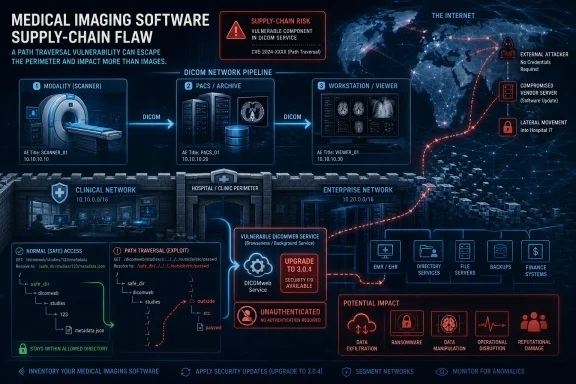
CISA’s advisory describes a classic but dangerous category of flaw: Improper Limitation of a Pathname to a Restricted Directory, better known as path traversal. In plain English, software expects a file to be written under one safe directory, but attacker-controlled input can steer that write somewhere else. If the receiving service is reachable and accepts the maliciously crafted request, the attacker does not need a username, a password, or a phishing foothold to start altering the filesystem.
The affected package range is broad: pynetdicom versions from 1.0.0 up to, but not including, 3.0.4. That matters because medical software stacks are often frozen for validation, regulatory, or operational reasons. A Python dependency that looks like a solved problem in a developer’s virtual environment can remain embedded in an imaging workflow for years.
The vendor ecosystem here is deceptively small. pydicom is well known in Python medical-imaging circles, and pynetdicom provides DICOM networking functionality used by developers building Service Class Users and Service Class Providers. That means the bug may sit inside research tools, integration glue, PACS-adjacent utilities, lab environments, import/export services, or bespoke hospital applications rather than in a single branded appliance with a tidy serial-number lookup page.
CISA assigns the advisory to Healthcare and Public Health, deployed worldwide, with a CVSS v3 score of 9.1. That is the sort of number that tends to trigger scanner dashboards and executive questions. But the better reading is not “panic because the score is high.” It is “find the exposed DICOM listeners and the Python stacks that own them, because the blast radius depends almost entirely on deployment choices.”
DICOM adds an extra layer of awkwardness because it was designed around trusted clinical workflows, not the hostile internet. The protocol is how imaging studies move between systems that often assume they are on a controlled network. Many deployments still treat a DICOM association as a semi-trusted exchange between known Application Entities, even when the surrounding network has evolved into something messier.
That is why a path traversal in a DICOM networking library deserves more than the usual shrug reserved for “input validation bug in open source package.” In a medical imaging environment, the service receiving objects may run with access to storage, queues, log directories, temporary folders, or application paths. A write outside the intended location can become operational disruption, persistence setup, data corruption, or a stepping stone into adjacent systems.
The advisory language says successful exploitation could allow an unauthenticated attacker to write to arbitrary file paths. It does not claim remote code execution, public exploitation, or patient data theft. Those distinctions matter. But arbitrary file write is still one of those primitives defenders hate because it can be chained with local conventions: startup folders, configuration files, scheduled-job directories, web roots, script locations, or application-specific import paths.
This is where the issue becomes harder than a normal patch note. Healthcare environments often contain a mix of packaged products, local scripts, academic code, and one-off integration services written by someone who moved departments three years ago. The vulnerable dependency may not appear as “pynetdicom server” on a CMDB entry. It may be buried in a small daemon that accepts studies from one modality and forwards them to another destination.
The upgrade path also has practical friction because pynetdicom 3.x requires modern Python support. Organizations that pinned old Python runtimes for compatibility may have to make a broader application change rather than merely bumping a package. That does not excuse inaction, but it explains why security teams should pair the advisory with discovery work rather than simply emailing “upgrade to 3.0.4” and assuming the risk has vanished.
Inventory should start with the places most likely to expose DICOM services. PACS gateways, research importers, de-identification pipelines, QA workstations, modality simulators, cloud ingestion tools, and Windows services wrapping Python scripts all deserve attention. In many hospitals, the riskiest systems are not the glamorous enterprise platforms but the small translation layers that keep old and new imaging workflows talking to each other.
The Windows-specific risk is not that the vulnerability behaves differently on NTFS. It is that arbitrary file write can intersect with Windows deployment habits in uncomfortable ways. Service directories, application configuration paths, user profile startup locations, IIS-accessible folders, and scheduled-task support files can all become interesting depending on privileges and local layout.
A vulnerable pynetdicom service running as a low-privilege account is still bad. A vulnerable service running as a local administrator because “the scanner integration only worked that way” is worse. The advisory does not need to promise remote code execution for administrators to ask whether the process can overwrite files that influence execution.
This is also a reminder that endpoint tooling may miss the relevant exposure. EDR can see Python processes and file writes, but it may not understand a DICOM association or flag a malformed SOP Instance UID as the start of an attack. Network monitoring may see traffic on DICOM ports, but not know whether a given association is business as usual or a hostile write attempt. Healthcare defenders need application-aware baselines, or at least tight segmentation that makes abnormal DICOM paths harder to reach.
For years, healthcare IT has lived with a split personality. On paper, clinical networks are special-purpose environments where systems communicate with known peers. In practice, they are full of vendor tunnels, research workstations, unmanaged endpoints, aging operating systems, and business-network dependencies. A DICOM listener that was once “internal only” may now be reachable from more places than anyone intends.
The advisory’s note that CISA has not seen known public exploitation specifically targeting this vulnerability should not lull anyone into passivity. Absence of known exploitation is not absence of exploitability, and specialist protocols often have a quieter exploitation curve. Attackers do not need mass scanning headlines to make use of a bug if they already have access to a hospital network through stolen credentials, a compromised contractor laptop, or an exposed remote-access path.
The important operational question is not merely “is port 104 open to the internet?” It is “which systems can initiate DICOM associations to this service, and what assumptions do we make about those systems?” If the answer is “most of the hospital network,” the environment has already granted the attacker a large staging area.
Segmentation has a reputation for being the advice everyone gives and nobody funds. But medical imaging is a strong argument for doing it anyway. Restricting DICOM flows to known sources, enforcing firewall rules by modality and destination, logging association attempts, and separating research ingestion from production archives can turn a library vulnerability from a crisis into a contained maintenance event.
The more useful lesson is about visibility. Open-source dependencies are manageable when organizations know where they are used, how they are exposed, and how quickly they can be updated. They become dangerous when they are treated as invisible implementation details hidden inside products, scripts, or containers.
This is why software bills of materials are not paperwork theater in healthcare. An SBOM that lists pynetdicom, its version, and the component that uses it gives a security team a fighting chance on day one of an advisory. Without that, defenders fall back to file searches, developer memory, vulnerability scanners with imperfect Python coverage, and vendor questionnaires that may not return in time.
The bug also underscores a gap between package-level vulnerability intelligence and deployment-level risk. A library can be vulnerable, but only certain usage patterns may expose the dangerous path. Conversely, a “minor internal tool” can become high impact if it listens on a broad network and runs with excessive privileges. Security teams need both views at once.
For vendors, the obligation is straightforward. If a product embeds pynetdicom in the affected range, customers should not have to reverse-engineer that fact. They need a clear statement: affected or not affected, fixed version or workaround, service restart requirements, validation impact, and any compensating controls. Silence forces hospitals to choose between unsafe assumptions and disruptive shutdowns.
The score reflects the technical severity of the condition as described: unauthenticated access and arbitrary path writes are a serious combination. Yet the real-world severity depends on whether the vulnerable service is reachable, whether the attacker can trigger the vulnerable code path, what privileges the process has, and what filesystem locations are writable. A hardened, segmented, low-privilege service has a different risk profile from a flat-network service running as an administrator.
That nuance should not become an excuse to defer. Healthcare environments have a long history of “temporary” exceptions becoming permanent architecture. If defenders cannot quickly answer whether the service is exposed and what account it runs under, they should treat uncertainty as risk.
The better workflow is triage in layers. First, identify use of affected pynetdicom versions. Second, identify network exposure and DICOM listener roles. Third, check process privileges and writable paths. Fourth, upgrade or isolate. Fifth, monitor for suspicious file writes and unexpected association attempts until the patch is confirmed.
Medical imaging protocols are less common in commodity exploit kits than web applications, but that is not the comfort it once was. Offensive tooling has become better at parsing niche protocols, and AI-assisted code analysis makes it easier to turn a patch diff or advisory into a working proof of concept. Even if no public exploitation is known today, the time between disclosure and opportunistic testing is not something defenders should assume will be generous.
The other reason this class travels well is that arbitrary file write can be adapted to the target. On one system, the attacker may aim for a configuration overwrite. On another, a log poisoning trick. On a third, a dropped file in a watched import directory. The vulnerability gives the attacker a write primitive; the environment decides what that primitive can become.
That makes least privilege more than a compliance talking point. A DICOM receive service should not run with broad rights to the host if its business function is to accept and store images in a bounded location. The more boring the service account, the less interesting the exploit.
A practical response begins with dependency discovery. Search repositories, package manifests,
Next, map exposure. Find systems listening on DICOM ports, but also remember that pynetdicom may be used by clients as well as servers. The advisory’s unauthenticated arbitrary write concern is most urgent where an application accepts inbound DICOM objects or associations. Internet exposure should be treated as an emergency configuration failure, not merely a vulnerability-management finding.
Then reduce privileges and narrow paths. Even after patching, DICOM receivers should write into controlled directories, run as dedicated service accounts, and avoid broad access to application or system locations. If the business workflow requires later processing, use handoff directories with explicit permissions rather than giving the receiver sweeping filesystem rights.
Finally, ask vendors direct questions. “Do you use pynetdicom?” is better than “are you affected by the CISA advisory?” because it forces a component-level answer. “Which version ships in our build?” is better still. If a vendor cannot answer quickly, that is not proof of exposure, but it is evidence that your dependency visibility is weaker than your risk model assumes.
Security teams already know these controls. The problem is that healthcare environments constantly generate exceptions: a vendor support requirement, a research collaboration, a temporary migration bridge, a modality that cannot be patched, a server nobody wants to reboot during clinical hours. Each exception is understandable. Together, they create the conditions in which a library bug becomes an enterprise incident.
This advisory is also a useful test of incident readiness. If your team can identify every pynetdicom instance, determine whether it is exposed, contact owners, patch or isolate systems, and document residual risk within a day, the organization has a mature handle on specialist software. If that process takes a week of email archaeology, the vulnerability is exposing a governance issue as much as a coding flaw.
Healthcare cybersecurity often focuses on ransomware because ransomware is visible, disruptive, and politically unavoidable. But ransomware operators succeed partly because environments are full of smaller weaknesses that provide footholds and movement opportunities. Arbitrary file write in a medical networking component is exactly the kind of primitive that can matter before the ransom note appears.
The first concrete takeaway is that affected pynetdicom versions should be upgraded to 3.0.4 or later wherever the library is present.
CISA’s pynetdicom warning is not the largest healthcare security event of the year, and there is no evidence in the advisory of known public exploitation targeting the flaw. But it is precisely the kind of notice that separates organizations with real operational visibility from those running on inherited trust. The future of healthcare security will not be decided only by how hospitals respond to headline-grabbing ransomware crews; it will also be decided by whether they can find, fix, and contain the small libraries quietly carrying clinical data across the network.
The uncomfortable part is that pynetdicom is not some bloated enterprise appliance with a forgotten web server bolted on. It is a Python implementation of DICOM networking, the kind of specialist library developers use precisely because they do not want to reinvent the protocol that moves medical images between scanners, archives, workstations, and research systems. When a bug in that layer allows arbitrary file writes, the story is no longer just about one dependency. It is about how healthcare’s operational trust model keeps colliding with modern software supply-chain reality.
 A Medical Imaging Bug Becomes an Infrastructure Problem
CISA’s advisory describes a classic but dangerous category of flaw: Improper Limitation of a Pathname to a Restricted Directory, better known as path traversal. In plain English, software expects a file to be written under one safe directory, but attacker-controlled input can steer that write somewhere else. If the receiving service is reachable and accepts the maliciously crafted request, the attacker does not need a username, a password, or a phishing foothold to start altering the filesystem.The affected package range is broad: pynetdicom versions from 1.0.0 up to, but not including, 3.0.4. That matters because medical software stacks are often frozen for validation, regulatory, or operational reasons. A Python dependency that looks like a solved problem in a developer’s virtual environment can remain embedded in an imaging workflow for years.
The vendor ecosystem here is deceptively small. pydicom is well known in Python medical-imaging circles, and pynetdicom provides DICOM networking functionality used by developers building Service Class Users and Service Class Providers. That means the bug may sit inside research tools, integration glue, PACS-adjacent utilities, lab environments, import/export services, or bespoke hospital applications rather than in a single branded appliance with a tidy serial-number lookup page.
CISA assigns the advisory to Healthcare and Public Health, deployed worldwide, with a CVSS v3 score of 9.1. That is the sort of number that tends to trigger scanner dashboards and executive questions. But the better reading is not “panic because the score is high.” It is “find the exposed DICOM listeners and the Python stacks that own them, because the blast radius depends almost entirely on deployment choices.”
Path Traversal Is Old, but DICOM Makes It Awkwardly Modern
Path traversal is one of security’s oldest mistakes. Developers concatenate a base directory with a filename, assume the filename is benign, and discover later that../, absolute paths, encoded separators, symlinks, or protocol-specific identifiers can escape the intended boundary. The primitive is simple; the consequences depend on what can be written, where it can be written, and what process will later trust that file.DICOM adds an extra layer of awkwardness because it was designed around trusted clinical workflows, not the hostile internet. The protocol is how imaging studies move between systems that often assume they are on a controlled network. Many deployments still treat a DICOM association as a semi-trusted exchange between known Application Entities, even when the surrounding network has evolved into something messier.
That is why a path traversal in a DICOM networking library deserves more than the usual shrug reserved for “input validation bug in open source package.” In a medical imaging environment, the service receiving objects may run with access to storage, queues, log directories, temporary folders, or application paths. A write outside the intended location can become operational disruption, persistence setup, data corruption, or a stepping stone into adjacent systems.
The advisory language says successful exploitation could allow an unauthenticated attacker to write to arbitrary file paths. It does not claim remote code execution, public exploitation, or patient data theft. Those distinctions matter. But arbitrary file write is still one of those primitives defenders hate because it can be chained with local conventions: startup folders, configuration files, scheduled-job directories, web roots, script locations, or application-specific import paths.
The Version Boundary Tells Admins Where to Start
The clearest remediation signal is the version boundary. pynetdicom 3.0.4 is the fixed line identified by CISA’s affected-version range, so organizations using earlier releases should treat the upgrade as the default answer unless they have a compensating control they can actually prove. In Python terms, that means checkingpip freeze, lockfiles, build manifests, container images, virtual environments, and any vendor-supplied bundles that include pynetdicom indirectly.This is where the issue becomes harder than a normal patch note. Healthcare environments often contain a mix of packaged products, local scripts, academic code, and one-off integration services written by someone who moved departments three years ago. The vulnerable dependency may not appear as “pynetdicom server” on a CMDB entry. It may be buried in a small daemon that accepts studies from one modality and forwards them to another destination.
The upgrade path also has practical friction because pynetdicom 3.x requires modern Python support. Organizations that pinned old Python runtimes for compatibility may have to make a broader application change rather than merely bumping a package. That does not excuse inaction, but it explains why security teams should pair the advisory with discovery work rather than simply emailing “upgrade to 3.0.4” and assuming the risk has vanished.
Inventory should start with the places most likely to expose DICOM services. PACS gateways, research importers, de-identification pipelines, QA workstations, modality simulators, cloud ingestion tools, and Windows services wrapping Python scripts all deserve attention. In many hospitals, the riskiest systems are not the glamorous enterprise platforms but the small translation layers that keep old and new imaging workflows talking to each other.
Windows Shops Should Look Beyond the Linux Server Room
WindowsForum readers should resist the temptation to file this under “Python library, probably Linux.” Medical imaging is one of the areas where Windows remains deeply present: radiology workstations, modality consoles, vendor service boxes, research desktops, and departmental servers. Python applications on Windows may run interactively, as scheduled tasks, under service accounts, or inside Conda environments that never appear in standard enterprise patch reports.The Windows-specific risk is not that the vulnerability behaves differently on NTFS. It is that arbitrary file write can intersect with Windows deployment habits in uncomfortable ways. Service directories, application configuration paths, user profile startup locations, IIS-accessible folders, and scheduled-task support files can all become interesting depending on privileges and local layout.
A vulnerable pynetdicom service running as a low-privilege account is still bad. A vulnerable service running as a local administrator because “the scanner integration only worked that way” is worse. The advisory does not need to promise remote code execution for administrators to ask whether the process can overwrite files that influence execution.
This is also a reminder that endpoint tooling may miss the relevant exposure. EDR can see Python processes and file writes, but it may not understand a DICOM association or flag a malformed SOP Instance UID as the start of an attack. Network monitoring may see traffic on DICOM ports, but not know whether a given association is business as usual or a hostile write attempt. Healthcare defenders need application-aware baselines, or at least tight segmentation that makes abnormal DICOM paths harder to reach.
The Real Weakness Is the Trust Boundary Around Clinical Networks
CISA’s recommended mitigations are familiar: minimize network exposure, keep control system devices off the public internet, use firewalls, isolate operational networks from business networks, and use secure remote access such as updated VPNs when remote access is required. These are not glamorous recommendations, but they are especially relevant here because the vulnerability’s usefulness rises sharply with network reachability.For years, healthcare IT has lived with a split personality. On paper, clinical networks are special-purpose environments where systems communicate with known peers. In practice, they are full of vendor tunnels, research workstations, unmanaged endpoints, aging operating systems, and business-network dependencies. A DICOM listener that was once “internal only” may now be reachable from more places than anyone intends.
The advisory’s note that CISA has not seen known public exploitation specifically targeting this vulnerability should not lull anyone into passivity. Absence of known exploitation is not absence of exploitability, and specialist protocols often have a quieter exploitation curve. Attackers do not need mass scanning headlines to make use of a bug if they already have access to a hospital network through stolen credentials, a compromised contractor laptop, or an exposed remote-access path.
The important operational question is not merely “is port 104 open to the internet?” It is “which systems can initiate DICOM associations to this service, and what assumptions do we make about those systems?” If the answer is “most of the hospital network,” the environment has already granted the attacker a large staging area.
Segmentation has a reputation for being the advice everyone gives and nobody funds. But medical imaging is a strong argument for doing it anyway. Restricting DICOM flows to known sources, enforcing firewall rules by modality and destination, logging association attempts, and separating research ingestion from production archives can turn a library vulnerability from a crisis into a contained maintenance event.
Open Source Is Not the Villain, but It Is the Visibility Test
It would be easy, and wrong, to turn this advisory into a lazy sermon about open source in critical infrastructure. The healthcare sector depends on open-source libraries because proprietary vendors depend on them too. pydicom and pynetdicom are part of a broader ecosystem that lets researchers, hospitals, device makers, and software vendors work with medical imaging without rebuilding DICOM support from scratch.The more useful lesson is about visibility. Open-source dependencies are manageable when organizations know where they are used, how they are exposed, and how quickly they can be updated. They become dangerous when they are treated as invisible implementation details hidden inside products, scripts, or containers.
This is why software bills of materials are not paperwork theater in healthcare. An SBOM that lists pynetdicom, its version, and the component that uses it gives a security team a fighting chance on day one of an advisory. Without that, defenders fall back to file searches, developer memory, vulnerability scanners with imperfect Python coverage, and vendor questionnaires that may not return in time.
The bug also underscores a gap between package-level vulnerability intelligence and deployment-level risk. A library can be vulnerable, but only certain usage patterns may expose the dangerous path. Conversely, a “minor internal tool” can become high impact if it listens on a broad network and runs with excessive privileges. Security teams need both views at once.
For vendors, the obligation is straightforward. If a product embeds pynetdicom in the affected range, customers should not have to reverse-engineer that fact. They need a clear statement: affected or not affected, fixed version or workaround, service restart requirements, validation impact, and any compensating controls. Silence forces hospitals to choose between unsafe assumptions and disruptive shutdowns.
CVSS 9.1 Is a Signal, Not the Whole Story
A 9.1 CVSS score will get attention because it sits in the critical range. That is useful for prioritization, but it can also flatten nuance. Not every vulnerable instance is equally exposed, and not every arbitrary file write becomes system takeover.The score reflects the technical severity of the condition as described: unauthenticated access and arbitrary path writes are a serious combination. Yet the real-world severity depends on whether the vulnerable service is reachable, whether the attacker can trigger the vulnerable code path, what privileges the process has, and what filesystem locations are writable. A hardened, segmented, low-privilege service has a different risk profile from a flat-network service running as an administrator.
That nuance should not become an excuse to defer. Healthcare environments have a long history of “temporary” exceptions becoming permanent architecture. If defenders cannot quickly answer whether the service is exposed and what account it runs under, they should treat uncertainty as risk.
The better workflow is triage in layers. First, identify use of affected pynetdicom versions. Second, identify network exposure and DICOM listener roles. Third, check process privileges and writable paths. Fourth, upgrade or isolate. Fifth, monitor for suspicious file writes and unexpected association attempts until the patch is confirmed.
The Exploit Primitive Is Simple Enough to Travel
One reason path traversal vulnerabilities keep reappearing is that the exploit concept is portable. Attackers do not need to understand every clinical nuance to test whether a server will accept a crafted identifier and write outside the intended directory. They need protocol fluency, a reachable service, and an idea of where a useful file might land.Medical imaging protocols are less common in commodity exploit kits than web applications, but that is not the comfort it once was. Offensive tooling has become better at parsing niche protocols, and AI-assisted code analysis makes it easier to turn a patch diff or advisory into a working proof of concept. Even if no public exploitation is known today, the time between disclosure and opportunistic testing is not something defenders should assume will be generous.
The other reason this class travels well is that arbitrary file write can be adapted to the target. On one system, the attacker may aim for a configuration overwrite. On another, a log poisoning trick. On a third, a dropped file in a watched import directory. The vulnerability gives the attacker a write primitive; the environment decides what that primitive can become.
That makes least privilege more than a compliance talking point. A DICOM receive service should not run with broad rights to the host if its business function is to accept and store images in a bounded location. The more boring the service account, the less interesting the exploit.
The Patch Is the Easy Part; Proving You Needed It Is Harder
For administrators, upgrading to pynetdicom 3.0.4 or later is the cleanest fix. But enterprise healthcare patching is not merely a command. It is a chain of validation, downtime negotiation, vendor support, and sometimes regulatory documentation. That complexity is real, but it should shape the patch plan rather than derail it.A practical response begins with dependency discovery. Search repositories, package manifests,
requirements.txt files, Poetry and Pipenv locks, Conda environments, container images, Windows service wrappers, and deployment scripts. On live systems, enumerate Python environments and query installed packages directly. Do not assume that the corporate vulnerability scanner sees every virtual environment.Next, map exposure. Find systems listening on DICOM ports, but also remember that pynetdicom may be used by clients as well as servers. The advisory’s unauthenticated arbitrary write concern is most urgent where an application accepts inbound DICOM objects or associations. Internet exposure should be treated as an emergency configuration failure, not merely a vulnerability-management finding.
Then reduce privileges and narrow paths. Even after patching, DICOM receivers should write into controlled directories, run as dedicated service accounts, and avoid broad access to application or system locations. If the business workflow requires later processing, use handoff directories with explicit permissions rather than giving the receiver sweeping filesystem rights.
Finally, ask vendors direct questions. “Do you use pynetdicom?” is better than “are you affected by the CISA advisory?” because it forces a component-level answer. “Which version ships in our build?” is better still. If a vendor cannot answer quickly, that is not proof of exposure, but it is evidence that your dependency visibility is weaker than your risk model assumes.
The Healthcare Security Lesson Is Boring, Which Is Why It Matters
The most important mitigations here are not exotic. Keep DICOM services off the public internet. Permit associations only from known systems. Place clinical devices and imaging services behind firewalls. Isolate clinical networks from business networks. Keep remote access updated and controlled. Run services with the least privilege needed to do the job.Security teams already know these controls. The problem is that healthcare environments constantly generate exceptions: a vendor support requirement, a research collaboration, a temporary migration bridge, a modality that cannot be patched, a server nobody wants to reboot during clinical hours. Each exception is understandable. Together, they create the conditions in which a library bug becomes an enterprise incident.
This advisory is also a useful test of incident readiness. If your team can identify every pynetdicom instance, determine whether it is exposed, contact owners, patch or isolate systems, and document residual risk within a day, the organization has a mature handle on specialist software. If that process takes a week of email archaeology, the vulnerability is exposing a governance issue as much as a coding flaw.
Healthcare cybersecurity often focuses on ransomware because ransomware is visible, disruptive, and politically unavoidable. But ransomware operators succeed partly because environments are full of smaller weaknesses that provide footholds and movement opportunities. Arbitrary file write in a medical networking component is exactly the kind of primitive that can matter before the ransom note appears.
The DICOM Receiver Is Now Part of the Security Perimeter
This advisory should push imaging teams and security teams toward a shared model of ownership. DICOM receivers are not just clinical middleware. They are network services that parse attacker-controlled input and write to disk. That makes them part of the security perimeter, whether or not they look like traditional infrastructure.The first concrete takeaway is that affected pynetdicom versions should be upgraded to 3.0.4 or later wherever the library is present.
- Organizations should inventory Python environments, containers, vendor bundles, and locally maintained imaging scripts for pynetdicom versions from 1.0.0 through earlier than 3.0.4.
- Internet-exposed DICOM services should be removed from direct exposure and placed behind appropriate network controls.
- DICOM traffic should be restricted to known peers rather than permitted broadly across clinical or business networks.
- Services that receive and store DICOM objects should run under dedicated low-privilege accounts with tightly scoped filesystem permissions.
- Vendors should provide explicit affected-version statements instead of broad assurances that their products are “secure.”
- Security teams should monitor for unexpected file writes, abnormal DICOM association attempts, and changes to service directories while remediation is underway.
CISA’s pynetdicom warning is not the largest healthcare security event of the year, and there is no evidence in the advisory of known public exploitation targeting the flaw. But it is precisely the kind of notice that separates organizations with real operational visibility from those running on inherited trust. The future of healthcare security will not be decided only by how hospitals respond to headline-grabbing ransomware crews; it will also be decided by whether they can find, fix, and contain the small libraries quietly carrying clinical data across the network.
References
- Primary source: CISA
Published: 2026-06-25T12:00:00+00:00
pydicom pynetdicom Library | CISA
www.cisa.gov
- Related coverage: pypi.org
- Related coverage: data.safetycli.com
pynetdicom (PyPI) — Safety Package & Vulnerability Database
A Python implementation of the DICOM networking protocoldata.safetycli.com - Related coverage: security.snyk.io
pynetdicom | Snyk
Security vulnerabilities and package health score for pip package pynetdicomsecurity.snyk.io - Related coverage: pydicom.github.io
- Related coverage: linuxsecurity.com
Fedora 42 python-pydicom Patch CVE-2026-32711 Moderate Path Traversal
A patch for CVE-2026-32711 in python-pydicom to fix a path traversal issue in Fedora 42 provides essential protection. linuxsecurity.com
- Related coverage: pynetdicom.readthedocs.io
