

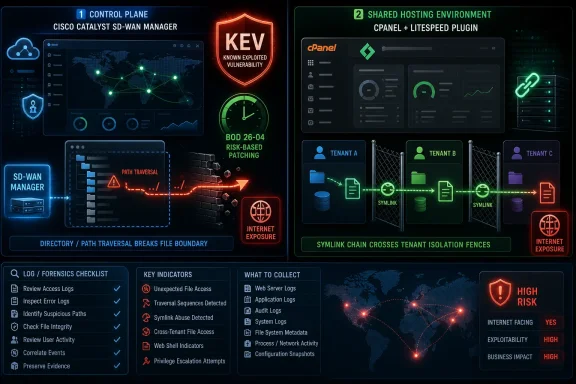
On June 15, 2026, CISA added CVE-2026-20262 in Cisco Catalyst SD-WAN Manager and CVE-2026-54420 in the LiteSpeed cPanel Plugin to its Known Exploited Vulnerabilities Catalog after confirming evidence of active exploitation in the wild. The move is not just another routine catalog update. It is one of the first practical tests of CISA’s newer risk-based patching regime, BOD 26-04, and it lands squarely on two classes of infrastructure defenders hate to touch: WAN control planes and shared hosting stacks. The message is blunt: attackers are again aiming at the systems that decide who gets in, where traffic goes, and how tenants are separated.
The KEV Catalog began life as a kind of government-backed short list for exploited vulnerabilities. If a CVE appeared there, defenders could stop arguing about theoretical severity and start dealing with observed attacker behavior. That was always useful, but under the old model it also encouraged a crude mental shortcut: KEV meant “patch now,” everything else meant “patch later.”
BOD 26-04 tries to move federal agencies away from that blunt instrument. Instead of treating every exploited vulnerability as identical, the directive emphasizes publicly exposed assets, whether exploitation grants broad control, and whether agencies must investigate possible compromise before declaring the job done. That is a more mature posture, but it is also harder to operationalize.
The two vulnerabilities added today show why the shift matters. Cisco Catalyst SD-WAN Manager is not an ordinary application server. It is the administrative nervous system for distributed enterprise networking. LiteSpeed’s cPanel plugin, meanwhile, lives inside the web-hosting ecosystem, where one weak tenant, plugin, or filesystem boundary can create consequences beyond a single account.
In both cases, the vulnerability class is familiar. Directory traversal and symlink-following bugs are old enough to feel almost boring. But “boring” vulnerability classes become newly dangerous when they appear inside modern management planes and multi-tenant platforms.
That context changes the risk calculation. A compromised workstation is bad. A compromised management interface for the network that connects branch offices, cloud workloads, and enterprise services can be much worse. SD-WAN managers are attractive because they sit at the boundary between network architecture and operational authority.
Cisco’s SD-WAN portfolio has already been under sustained scrutiny this year. Earlier 2026 reporting and advisories described active exploitation against Catalyst SD-WAN components, including authentication and privilege-related issues. The picture that emerges is not a single isolated bug, but a recurring attacker interest in SD-WAN control systems.
That should worry WindowsForum readers even if they do not run Cisco gear directly. Windows endpoints, identity providers, file servers, and application workloads often depend on the network fabric behaving as expected. If attackers can influence the control plane, they may not need to own every Windows box immediately. They can shape paths, observe traffic, create persistence opportunities, or open routes that were supposed to remain closed.
The industry spent years hardening endpoint detection and response, identity logs, and cloud consoles. Attackers responded by looking for adjacent control systems with broad blast radius and uneven monitoring. SD-WAN management belongs near the top of that list.
The endurance of the class is not mysterious. Enterprise products accumulate layers: web interfaces, APIs, legacy scripts, upload handlers, backup tools, logging systems, and appliance shells. Each layer may treat file paths slightly differently. Every time a product lets one component write, read, import, export, or stage a file for another component, the same old boundary problem returns.
That is why “just sanitize input” has never been a satisfying answer. In a platform like an SD-WAN manager, a path is rarely just a path. It can be an administrative workflow, a configuration artifact, a diagnostic bundle, a license file, or an update mechanism. Attackers look for the places where developers assumed an internal operation would never become attacker-controlled.
CISA’s addition of CVE-2026-20262 to KEV means defenders should treat exploitation as real, not hypothetical. For exposed Catalyst SD-WAN Manager deployments, the practical response should include patching or mitigation, but it should not stop there. Logs, administrative changes, unexpected file writes, unusual account activity, and strange control-plane events deserve review because the agency’s new directive explicitly raises the question of pre-patch compromise.
That is the uncomfortable part of modern vulnerability management: applying the fix may close the door, but it does not prove nobody already walked through it.
In a single-tenant server, a symlink bug may still be serious. In a multi-tenant environment, it can become a boundary collapse. Symbolic links are ordinary filesystem features, but when privileged software follows them carelessly, a user who controls one part of the filesystem may influence reads or writes somewhere they should not reach.
That is why symlink vulnerabilities have a long and ugly history in hosting. The hosting provider wants tenants isolated, but the control panel, plugin ecosystem, backup jobs, web server integrations, and administrative tools must constantly cross boundaries to do useful work. Each crossing is a chance for confusion between “the user owns this file” and “the privileged process is allowed to act on this file.”
LiteSpeed is widely deployed as a performance-oriented web server option in cPanel/WHM environments. The plugin integration is valuable precisely because it makes server management easier. But convenience layers inside hosting control panels can become attractive targets when they run with enough authority to affect multiple sites or accounts.
The CISA listing should therefore be read less as “one plugin has a bug” and more as “the hosting stack remains an attacker-favored aggregation point.” A compromised customer account, FTP credential, web shell, or vulnerable site may be only the first step. If the surrounding management tooling mishandles filesystem boundaries, the attacker may be able to turn a local foothold into broader server impact.
That matters because these platforms are often maintained by small teams with thin margins and inconsistent patch discipline. They host public-facing code by design. They also concentrate many unrelated customers on the same system, which gives attackers a clear incentive to find tenant-breakout paths.
The LiteSpeed plugin bug fits that economic reality. A symlink-following flaw may not look as glamorous as a browser zero-day or kernel remote code execution bug. But in the hosting world, it can be the connective tissue between a cheap initial compromise and a more damaging cross-account incident.
Administrators should resist the temptation to dismiss the issue because exploitation may require some level of existing access, such as FTP or web shell access. In real incidents, attackers often obtain exactly that kind of foothold through stolen credentials, vulnerable CMS plugins, abandoned staging sites, or commodity web shells. The dangerous vulnerability is not always the first bug in the chain. Sometimes it is the bug that turns a messy intrusion into a server-wide event.
This is where CISA’s KEV signal is useful. It tells defenders that attackers are not merely capable of building that chain; they have evidence such exploitation is happening. For hosting providers and agencies using external hosting, that should trigger a sharper question: which assets are really isolated, and which are merely sharing a box politely?
That phrase “total control” is doing a lot of work. It acknowledges a truth security teams have known for years: the same CVE can mean different things depending on where it sits. An exploited vulnerability on an internal lab system is not the same as an exploited vulnerability on an internet-facing management console with administrative reach.
This is a welcome correction to vulnerability management theater. Too many organizations still measure success by raw patch counts, scanner closure rates, or the average age of high-severity findings. Those metrics are easy to report and easy to game. They do not necessarily tell leadership whether the organization patched the assets attackers are actually using.
BOD 26-04 pushes agencies toward a more operational model. First, identify the exploited flaw. Then determine whether the affected asset is exposed. Then determine what an attacker gains. Then decide how quickly to remediate and whether compromise assessment is required.
That is harder than sorting by CVSS score, but it is closer to how attackers behave. Attackers do not care about severity labels in isolation. They care about reachability, reliability, privilege, and whether the target gives them leverage over more systems.
Public exposure is not just a firewall rule. It can include reverse proxies, VPN-adjacent management interfaces, forgotten cloud security groups, temporary vendor access, IPv6 listeners, NAT exceptions, misconfigured load balancers, and management portals that someone believed were “internal” because the DNS name looked private. It also changes constantly.
For Cisco SD-WAN Manager, exposure should include not only whether a login page is reachable from the internet, but also which administrative services are reachable from untrusted networks. Web UI, APIs, SSH, NETCONF, and related management paths all deserve scrutiny. A product that controls the WAN should not be casually reachable from the WAN.
For LiteSpeed and cPanel environments, exposure is inherent. The platform exists to serve public websites. The more useful question is whether tenant-level access can interact with privileged plugin behavior, and whether the hosting provider has patched, isolated, and monitored those paths. In a shared hosting scenario, “not internet-facing” is rarely a comforting phrase.
The organizations that fare best under BOD 26-04 will not be the ones with the longest spreadsheet of vulnerabilities. They will be the ones that can quickly answer: where is this running, who can reach it, what privilege does it grant, and what evidence would show abuse?
Traditional patch management is built around closure. A ticket opens, a patch is scheduled, a maintenance window happens, a scanner confirms the version changed, and the ticket closes. Active exploitation breaks that neat workflow. If attackers used the flaw before the patch, the patched system may now be a cleaner-looking compromised system.
For network management platforms, compromise assessment should include configuration integrity, unexpected administrative accounts, unusual device enrollment or peering events, suspicious file writes, and changes to routing or policy objects. Defenders should compare current state against known-good baselines, not merely scan for the CVE.
For hosting platforms, compromise assessment should include tenant account review, web shell hunting, privilege boundary checks, suspicious symlinks, unexpected file ownership changes, cron jobs, modified plugin files, and evidence that one account touched another account’s data. The point is not to panic. The point is to stop pretending patching is synonymous with eviction.
This is where many organizations discover that their logging strategy was designed for availability troubleshooting, not incident reconstruction. If the logs needed to answer “was this exploited?” do not exist, the organization is forced into probability and containment decisions. That is expensive, disruptive, and exactly why management-plane logging should be treated as security infrastructure.
A compromised SD-WAN manager can affect how Windows clients reach applications, update services, file shares, and cloud resources. It can create opportunities for interception, lateral movement, or policy manipulation. Even if the attacker’s final objective is Active Directory, the path there may run through the network fabric.
A compromised hosting stack can affect Windows users in a different way. Many organizations still host customer portals, download pages, documentation sites, or line-of-business web apps on cPanel-style infrastructure, whether directly or through vendors. If those systems are abused to host malware, steal credentials, alter downloads, or pivot into backend services, the endpoint telemetry may show only the last stage.
This is the practical lesson of KEV: defenders should stop organizing risk purely by product family. Attackers organize by opportunity. If the exploitable system gives them control, reach, or trust, it matters.
For Microsoft-heavy environments, that means vulnerability management has to include non-Windows infrastructure that underpins Windows operations. Network controllers, VPN appliances, web control panels, backup servers, identity bridges, remote monitoring tools, and hypervisor management consoles should all sit in the same risk conversation as domain controllers and Exchange servers.
That gap is where mature vulnerability management lives. Asset owners must understand the role of the system. Network teams must understand exposure. Security teams must understand exploitation. Leadership must understand whether remediation can wait for the next maintenance cycle or must interrupt normal operations.
The KEV Catalog helps by injecting real-world exploitation into the decision. But it is not magic. If an organization does not know it runs the affected LiteSpeed plugin, or does not know a Cisco SD-WAN Manager interface is exposed, the catalog entry may arrive as noise rather than action.
There is also the matter of vendor dependencies. Many organizations consume Cisco-managed, partner-managed, or hosting-provider-managed services. In those cases, the immediate task is not always “apply patch” but “obtain confirmation.” Customers should ask providers whether affected versions were present, whether fixes or mitigations were applied, whether exposure existed, and whether compromise assessment was performed.
A vague assurance that “systems are monitored” is not the same as evidence. The more privileged the platform, the more specific the answer should be.
That model better matches reality. A medium-severity bug on a public edge device with active exploitation may deserve more attention than a critical bug buried in a segmented internal application with no exploit path. Conversely, a high-scoring vulnerability in a control system may justify emergency action even if exploitation details are sparse.
The risk, of course, is that nuance becomes delay. Organizations can abuse risk-based language to rationalize inaction. “We are assessing exposure” can become the new “we are waiting for the maintenance window.” CISA’s challenge is to encourage prioritization without giving agencies a bureaucratic escape hatch.
The two CVEs here are good examples of where nuance should sharpen, not soften, response. Cisco Catalyst SD-WAN Manager belongs to a class of products where compromise can have disproportionate network consequences. LiteSpeed’s cPanel plugin sits in a multi-tenant hosting context where privilege boundaries are the whole ballgame. Neither should disappear into a generic monthly patch queue.
Risk-based vulnerability management is not slower patching. Done properly, it is faster patching of the systems attackers can actually use to hurt you.
Today’s CISA alert gives agencies a concrete test. If they run Cisco Catalyst SD-WAN Manager, can they identify affected deployments quickly? Can they tell whether management interfaces are exposed? Can they patch or mitigate without waiting for a quarterly network change board? Can they inspect for signs of compromise?
If they rely on LiteSpeed in cPanel environments, can they determine plugin versions across servers? Can they separate provider-managed from self-managed systems? Can they confirm whether CloudLinux/CageFS-hosted shared environments were exposed to the vulnerable behavior? Can they review filesystem artifacts and tenant activity for abuse?
Those are not purely technical questions. They involve procurement records, vendor relationships, configuration management databases, network architecture diagrams, and incident response authority. Vulnerability management often fails not because nobody knows a patch exists, but because nobody owns the full path from alert to verified remediation.
That ownership problem becomes acute when the affected system sits between teams. Cisco SD-WAN may belong to networking, security architecture, a managed service provider, or a federal integrator. cPanel hosting may belong to web operations, communications, a contractor, or a business unit that bought hosting years ago with a credit card. Attackers do not care which cost center owns the server.
That inventory should include third-party providers. Many organizations do not operate their own hosting stack or SD-WAN controller directly, but they depend on someone who does. The customer still owns the risk if the provider’s compromise affects the customer’s data, traffic, brand, or users.
This is also a good moment to revisit compensating controls. Management interfaces should be restricted to known administrative networks, protected by strong authentication, logged aggressively, and segmented from ordinary user traffic. Shared hosting environments should minimize cross-tenant assumptions, keep plugins current, and treat filesystem anomalies as security events rather than housekeeping noise.
None of that is glamorous. It is the discipline of reducing attacker leverage. The lesson from KEV is that adversaries repeatedly exploit the places where organizations accepted convenience as a substitute for isolation.
That should be the defender’s mental model. The severity of a path bug is not merely “can an attacker read or write a file?” It is “what does the vulnerable process represent?” If the process represents a WAN controller, the answer may involve enterprise connectivity. If it represents a privileged hosting plugin, the answer may involve tenant isolation.
The modern infrastructure stack is full of these hidden multipliers. A small mistake inside a privileged integration can become a platform incident. A local foothold can become a management-plane compromise. A tenant-level issue can become a provider-level headache.
CISA’s KEV Catalog is valuable because it identifies where attackers have already found those multipliers. BOD 26-04 is valuable if it forces organizations to rank them accordingly. Together, they point toward a more realistic form of defense: not patch everything equally, but patch the exploited, exposed, high-control systems first and then verify that the patch was not too late.
 CISA’s Catalog Is Becoming a Triage Engine, Not a Wall of Shame
The KEV Catalog began life as a kind of government-backed short list for exploited vulnerabilities. If a CVE appeared there, defenders could stop arguing about theoretical severity and start dealing with observed attacker behavior. That was always useful, but under the old model it also encouraged a crude mental shortcut: KEV meant “patch now,” everything else meant “patch later.”BOD 26-04 tries to move federal agencies away from that blunt instrument. Instead of treating every exploited vulnerability as identical, the directive emphasizes publicly exposed assets, whether exploitation grants broad control, and whether agencies must investigate possible compromise before declaring the job done. That is a more mature posture, but it is also harder to operationalize.
The two vulnerabilities added today show why the shift matters. Cisco Catalyst SD-WAN Manager is not an ordinary application server. It is the administrative nervous system for distributed enterprise networking. LiteSpeed’s cPanel plugin, meanwhile, lives inside the web-hosting ecosystem, where one weak tenant, plugin, or filesystem boundary can create consequences beyond a single account.
In both cases, the vulnerability class is familiar. Directory traversal and symlink-following bugs are old enough to feel almost boring. But “boring” vulnerability classes become newly dangerous when they appear inside modern management planes and multi-tenant platforms.
The Cisco Bug Puts the Control Plane Back Under the Microscope
CVE-2026-20262 is described as a Cisco Catalyst SD-WAN Manager directory or path traversal vulnerability. In plain terms, this kind of flaw can allow an attacker to access or manipulate files outside the intended directory boundary. The specific exploitation details matter, but the strategic concern is easier to understand: the affected product helps administer software-defined WAN infrastructure.That context changes the risk calculation. A compromised workstation is bad. A compromised management interface for the network that connects branch offices, cloud workloads, and enterprise services can be much worse. SD-WAN managers are attractive because they sit at the boundary between network architecture and operational authority.
Cisco’s SD-WAN portfolio has already been under sustained scrutiny this year. Earlier 2026 reporting and advisories described active exploitation against Catalyst SD-WAN components, including authentication and privilege-related issues. The picture that emerges is not a single isolated bug, but a recurring attacker interest in SD-WAN control systems.
That should worry WindowsForum readers even if they do not run Cisco gear directly. Windows endpoints, identity providers, file servers, and application workloads often depend on the network fabric behaving as expected. If attackers can influence the control plane, they may not need to own every Windows box immediately. They can shape paths, observe traffic, create persistence opportunities, or open routes that were supposed to remain closed.
The industry spent years hardening endpoint detection and response, identity logs, and cloud consoles. Attackers responded by looking for adjacent control systems with broad blast radius and uneven monitoring. SD-WAN management belongs near the top of that list.
Directory Traversal Is Still Winning Because Boundaries Keep Getting Reused
Directory traversal is one of those vulnerability names that sounds like it belongs in an early-2000s secure coding textbook. The underlying mistake is conceptually simple: software accepts a path from a user or process and fails to constrain it to the intended location. Add enough privilege, automation, and management-plane access, and the old bug becomes a route to modern compromise.The endurance of the class is not mysterious. Enterprise products accumulate layers: web interfaces, APIs, legacy scripts, upload handlers, backup tools, logging systems, and appliance shells. Each layer may treat file paths slightly differently. Every time a product lets one component write, read, import, export, or stage a file for another component, the same old boundary problem returns.
That is why “just sanitize input” has never been a satisfying answer. In a platform like an SD-WAN manager, a path is rarely just a path. It can be an administrative workflow, a configuration artifact, a diagnostic bundle, a license file, or an update mechanism. Attackers look for the places where developers assumed an internal operation would never become attacker-controlled.
CISA’s addition of CVE-2026-20262 to KEV means defenders should treat exploitation as real, not hypothetical. For exposed Catalyst SD-WAN Manager deployments, the practical response should include patching or mitigation, but it should not stop there. Logs, administrative changes, unexpected file writes, unusual account activity, and strange control-plane events deserve review because the agency’s new directive explicitly raises the question of pre-patch compromise.
That is the uncomfortable part of modern vulnerability management: applying the fix may close the door, but it does not prove nobody already walked through it.
LiteSpeed’s cPanel Plugin Shows the Hosting Stack Is Still a Privilege Boundary Problem
CVE-2026-54420 affects the LiteSpeed cPanel plugin and involves UNIX symbolic link following. Public vulnerability descriptions indicate the issue affects versions before the fixed plugin releases and is especially relevant in shared hosting environments using CloudLinux and CageFS. The reported exploitation context matters because shared hosting is a world of partial trust.In a single-tenant server, a symlink bug may still be serious. In a multi-tenant environment, it can become a boundary collapse. Symbolic links are ordinary filesystem features, but when privileged software follows them carelessly, a user who controls one part of the filesystem may influence reads or writes somewhere they should not reach.
That is why symlink vulnerabilities have a long and ugly history in hosting. The hosting provider wants tenants isolated, but the control panel, plugin ecosystem, backup jobs, web server integrations, and administrative tools must constantly cross boundaries to do useful work. Each crossing is a chance for confusion between “the user owns this file” and “the privileged process is allowed to act on this file.”
LiteSpeed is widely deployed as a performance-oriented web server option in cPanel/WHM environments. The plugin integration is valuable precisely because it makes server management easier. But convenience layers inside hosting control panels can become attractive targets when they run with enough authority to affect multiple sites or accounts.
The CISA listing should therefore be read less as “one plugin has a bug” and more as “the hosting stack remains an attacker-favored aggregation point.” A compromised customer account, FTP credential, web shell, or vulnerable site may be only the first step. If the surrounding management tooling mishandles filesystem boundaries, the attacker may be able to turn a local foothold into broader server impact.
The Shared Server Is the Cloud Nobody Wants to Admit They Still Run
Enterprise security teams often talk as if everything important has moved to hyperscale cloud platforms, Kubernetes clusters, or SaaS. The web does not look like that in practice. Shared hosting, reseller hosting, small-business cPanel servers, agency-managed WordPress farms, and mixed legacy hosting environments remain everywhere.That matters because these platforms are often maintained by small teams with thin margins and inconsistent patch discipline. They host public-facing code by design. They also concentrate many unrelated customers on the same system, which gives attackers a clear incentive to find tenant-breakout paths.
The LiteSpeed plugin bug fits that economic reality. A symlink-following flaw may not look as glamorous as a browser zero-day or kernel remote code execution bug. But in the hosting world, it can be the connective tissue between a cheap initial compromise and a more damaging cross-account incident.
Administrators should resist the temptation to dismiss the issue because exploitation may require some level of existing access, such as FTP or web shell access. In real incidents, attackers often obtain exactly that kind of foothold through stolen credentials, vulnerable CMS plugins, abandoned staging sites, or commodity web shells. The dangerous vulnerability is not always the first bug in the chain. Sometimes it is the bug that turns a messy intrusion into a server-wide event.
This is where CISA’s KEV signal is useful. It tells defenders that attackers are not merely capable of building that chain; they have evidence such exploitation is happening. For hosting providers and agencies using external hosting, that should trigger a sharper question: which assets are really isolated, and which are merely sharing a box politely?
BOD 26-04 Makes Exposure and Control the New Patch Clock
The most important part of today’s CISA alert may not be the two CVEs. It may be the directive language surrounding them. BOD 26-04 updates the federal approach by emphasizing risk-based remediation, especially for vulnerabilities in the KEV Catalog on publicly exposed assets that grant total control of the asset after exploitation.That phrase “total control” is doing a lot of work. It acknowledges a truth security teams have known for years: the same CVE can mean different things depending on where it sits. An exploited vulnerability on an internal lab system is not the same as an exploited vulnerability on an internet-facing management console with administrative reach.
This is a welcome correction to vulnerability management theater. Too many organizations still measure success by raw patch counts, scanner closure rates, or the average age of high-severity findings. Those metrics are easy to report and easy to game. They do not necessarily tell leadership whether the organization patched the assets attackers are actually using.
BOD 26-04 pushes agencies toward a more operational model. First, identify the exploited flaw. Then determine whether the affected asset is exposed. Then determine what an attacker gains. Then decide how quickly to remediate and whether compromise assessment is required.
That is harder than sorting by CVSS score, but it is closer to how attackers behave. Attackers do not care about severity labels in isolation. They care about reachability, reliability, privilege, and whether the target gives them leverage over more systems.
The Hard Part Is Knowing Which Systems Are Publicly Exposed
The directive’s logic depends on a deceptively simple capability: agencies must know which vulnerable assets are publicly exposed. That sounds basic until you ask a large organization to produce an accurate answer by the end of the day.Public exposure is not just a firewall rule. It can include reverse proxies, VPN-adjacent management interfaces, forgotten cloud security groups, temporary vendor access, IPv6 listeners, NAT exceptions, misconfigured load balancers, and management portals that someone believed were “internal” because the DNS name looked private. It also changes constantly.
For Cisco SD-WAN Manager, exposure should include not only whether a login page is reachable from the internet, but also which administrative services are reachable from untrusted networks. Web UI, APIs, SSH, NETCONF, and related management paths all deserve scrutiny. A product that controls the WAN should not be casually reachable from the WAN.
For LiteSpeed and cPanel environments, exposure is inherent. The platform exists to serve public websites. The more useful question is whether tenant-level access can interact with privileged plugin behavior, and whether the hosting provider has patched, isolated, and monitored those paths. In a shared hosting scenario, “not internet-facing” is rarely a comforting phrase.
The organizations that fare best under BOD 26-04 will not be the ones with the longest spreadsheet of vulnerabilities. They will be the ones that can quickly answer: where is this running, who can reach it, what privilege does it grant, and what evidence would show abuse?
Patch Management Now Includes Compromise Management
CISA’s alert highlights that BOD 26-04 establishes expectations for when agencies must check whether threat actors compromised a system before a patch was applied. That is the right move, and it is also the part that will stress understaffed teams most.Traditional patch management is built around closure. A ticket opens, a patch is scheduled, a maintenance window happens, a scanner confirms the version changed, and the ticket closes. Active exploitation breaks that neat workflow. If attackers used the flaw before the patch, the patched system may now be a cleaner-looking compromised system.
For network management platforms, compromise assessment should include configuration integrity, unexpected administrative accounts, unusual device enrollment or peering events, suspicious file writes, and changes to routing or policy objects. Defenders should compare current state against known-good baselines, not merely scan for the CVE.
For hosting platforms, compromise assessment should include tenant account review, web shell hunting, privilege boundary checks, suspicious symlinks, unexpected file ownership changes, cron jobs, modified plugin files, and evidence that one account touched another account’s data. The point is not to panic. The point is to stop pretending patching is synonymous with eviction.
This is where many organizations discover that their logging strategy was designed for availability troubleshooting, not incident reconstruction. If the logs needed to answer “was this exploited?” do not exist, the organization is forced into probability and containment decisions. That is expensive, disruptive, and exactly why management-plane logging should be treated as security infrastructure.
Windows Shops Should Care Even When the CVEs Are Not in Windows
WindowsForum readers may reasonably ask why a Cisco SD-WAN Manager issue and a LiteSpeed cPanel plugin bug belong in a Windows-focused community. The answer is that modern Windows environments are rarely compromised through Windows alone. Attackers move through identity, network control, web platforms, remote management tools, and hosting infrastructure long before they land on a domain controller.A compromised SD-WAN manager can affect how Windows clients reach applications, update services, file shares, and cloud resources. It can create opportunities for interception, lateral movement, or policy manipulation. Even if the attacker’s final objective is Active Directory, the path there may run through the network fabric.
A compromised hosting stack can affect Windows users in a different way. Many organizations still host customer portals, download pages, documentation sites, or line-of-business web apps on cPanel-style infrastructure, whether directly or through vendors. If those systems are abused to host malware, steal credentials, alter downloads, or pivot into backend services, the endpoint telemetry may show only the last stage.
This is the practical lesson of KEV: defenders should stop organizing risk purely by product family. Attackers organize by opportunity. If the exploitable system gives them control, reach, or trust, it matters.
For Microsoft-heavy environments, that means vulnerability management has to include non-Windows infrastructure that underpins Windows operations. Network controllers, VPN appliances, web control panels, backup servers, identity bridges, remote monitoring tools, and hypervisor management consoles should all sit in the same risk conversation as domain controllers and Exchange servers.
The Scanner Cannot Tell You the Whole Story
Security scanners are necessary, but the two vulnerabilities added today underline their limitations. A scanner can often tell you whether a version appears vulnerable. It may even tell you whether the asset is reachable. It usually cannot tell you whether the business impact is “one server needs a patch” or “an attacker could influence the WAN.”That gap is where mature vulnerability management lives. Asset owners must understand the role of the system. Network teams must understand exposure. Security teams must understand exploitation. Leadership must understand whether remediation can wait for the next maintenance cycle or must interrupt normal operations.
The KEV Catalog helps by injecting real-world exploitation into the decision. But it is not magic. If an organization does not know it runs the affected LiteSpeed plugin, or does not know a Cisco SD-WAN Manager interface is exposed, the catalog entry may arrive as noise rather than action.
There is also the matter of vendor dependencies. Many organizations consume Cisco-managed, partner-managed, or hosting-provider-managed services. In those cases, the immediate task is not always “apply patch” but “obtain confirmation.” Customers should ask providers whether affected versions were present, whether fixes or mitigations were applied, whether exposure existed, and whether compromise assessment was performed.
A vague assurance that “systems are monitored” is not the same as evidence. The more privileged the platform, the more specific the answer should be.
CISA Is Quietly Rewriting the Meaning of Urgency
For years, urgency in vulnerability management was expressed as a deadline. Patch this in 15 days. Patch that in 21 days. Emergency patch immediately. Those timelines remain useful, but BOD 26-04 suggests a more nuanced future: urgency is a function of exploitation, exposure, automation, and control.That model better matches reality. A medium-severity bug on a public edge device with active exploitation may deserve more attention than a critical bug buried in a segmented internal application with no exploit path. Conversely, a high-scoring vulnerability in a control system may justify emergency action even if exploitation details are sparse.
The risk, of course, is that nuance becomes delay. Organizations can abuse risk-based language to rationalize inaction. “We are assessing exposure” can become the new “we are waiting for the maintenance window.” CISA’s challenge is to encourage prioritization without giving agencies a bureaucratic escape hatch.
The two CVEs here are good examples of where nuance should sharpen, not soften, response. Cisco Catalyst SD-WAN Manager belongs to a class of products where compromise can have disproportionate network consequences. LiteSpeed’s cPanel plugin sits in a multi-tenant hosting context where privilege boundaries are the whole ballgame. Neither should disappear into a generic monthly patch queue.
Risk-based vulnerability management is not slower patching. Done properly, it is faster patching of the systems attackers can actually use to hurt you.
The Real Test Is Whether Agencies Can Prove They Looked
The federal government has spent years trying to turn vulnerability management from a compliance exercise into an operational discipline. KEV was one of the better interventions because it narrowed the field. BOD 26-04 is more ambitious because it asks agencies to connect vulnerability data with asset exposure, business context, and post-exploitation impact.Today’s CISA alert gives agencies a concrete test. If they run Cisco Catalyst SD-WAN Manager, can they identify affected deployments quickly? Can they tell whether management interfaces are exposed? Can they patch or mitigate without waiting for a quarterly network change board? Can they inspect for signs of compromise?
If they rely on LiteSpeed in cPanel environments, can they determine plugin versions across servers? Can they separate provider-managed from self-managed systems? Can they confirm whether CloudLinux/CageFS-hosted shared environments were exposed to the vulnerable behavior? Can they review filesystem artifacts and tenant activity for abuse?
Those are not purely technical questions. They involve procurement records, vendor relationships, configuration management databases, network architecture diagrams, and incident response authority. Vulnerability management often fails not because nobody knows a patch exists, but because nobody owns the full path from alert to verified remediation.
That ownership problem becomes acute when the affected system sits between teams. Cisco SD-WAN may belong to networking, security architecture, a managed service provider, or a federal integrator. cPanel hosting may belong to web operations, communications, a contractor, or a business unit that bought hosting years ago with a credit card. Attackers do not care which cost center owns the server.
The June KEV Additions Should Force a Short, Uncomfortable Inventory
The most useful response to this alert is not a ceremonial forwarding of the CISA notice. It is a short inventory exercise that produces yes-or-no answers. Do we run the affected Cisco product? Do we run the affected LiteSpeed cPanel plugin? Are any instances public-facing or reachable from untrusted networks? Are fixed versions deployed? Do we have evidence that exploitation did or did not occur?That inventory should include third-party providers. Many organizations do not operate their own hosting stack or SD-WAN controller directly, but they depend on someone who does. The customer still owns the risk if the provider’s compromise affects the customer’s data, traffic, brand, or users.
This is also a good moment to revisit compensating controls. Management interfaces should be restricted to known administrative networks, protected by strong authentication, logged aggressively, and segmented from ordinary user traffic. Shared hosting environments should minimize cross-tenant assumptions, keep plugins current, and treat filesystem anomalies as security events rather than housekeeping noise.
None of that is glamorous. It is the discipline of reducing attacker leverage. The lesson from KEV is that adversaries repeatedly exploit the places where organizations accepted convenience as a substitute for isolation.
Two Old Bug Classes, Two Modern Blast Radiuses
The particulars of CVE-2026-20262 and CVE-2026-54420 differ, but they rhyme. One is about path traversal in a network management product. The other is about symlink handling in a hosting plugin. Both involve software losing track of filesystem boundaries in contexts where the resulting authority can matter far beyond a single file.That should be the defender’s mental model. The severity of a path bug is not merely “can an attacker read or write a file?” It is “what does the vulnerable process represent?” If the process represents a WAN controller, the answer may involve enterprise connectivity. If it represents a privileged hosting plugin, the answer may involve tenant isolation.
The modern infrastructure stack is full of these hidden multipliers. A small mistake inside a privileged integration can become a platform incident. A local foothold can become a management-plane compromise. A tenant-level issue can become a provider-level headache.
CISA’s KEV Catalog is valuable because it identifies where attackers have already found those multipliers. BOD 26-04 is valuable if it forces organizations to rank them accordingly. Together, they point toward a more realistic form of defense: not patch everything equally, but patch the exploited, exposed, high-control systems first and then verify that the patch was not too late.
The Work CISA’s Alert Actually Creates
The June 15 additions are narrow enough to act on quickly, but broad enough to reveal whether an organization’s vulnerability process is serious. The action is not just “read the advisory.” It is to connect the advisory to infrastructure reality and then document the result.- Organizations running Cisco Catalyst SD-WAN Manager should treat CVE-2026-20262 as a management-plane risk and prioritize exposed or remotely reachable instances first.
- Hosting providers and site operators using the LiteSpeed cPanel plugin should verify they are on fixed versions and should not assume tenant isolation remained intact before patching.
- Federal civilian agencies must align remediation with BOD 26-04’s risk-based model, especially where exploitation, exposure, and broad system control overlap.
- Security teams should perform compromise checks where affected systems were exposed before mitigation, because patching alone does not prove attackers were absent.
- Customers of managed network or hosting providers should request specific confirmation of affected versions, exposure status, remediation dates, and any compromise assessment.
- Windows-centric environments should include SD-WAN, hosting, and other non-Windows control systems in vulnerability prioritization because attackers rarely respect platform boundaries.
References
- Primary source: CISA
Published: 2026-06-15T12:00:00+00:00
- Related coverage: tlctc.net
CISA BOD 26-04: A Step in the Right Direction — But Still Not an Attack-Path Model | TLCTC
CISA's BOD 26-04 moves federal vulnerability management toward risk-based remediation — but it still lacks a cause-side attack-path grammar. TLCTC provides the missing layer.www.tlctc.net - Related coverage: nucleussec.com
What is CISA BOD 26-04? Prioritizing Security Updates Based on Risk
CISA BOD 26-04 directs federal agencies to prioritize vulnerability remediation based on exposure, exploitability, system control, and known exploitation. Learn what the directive requires and how it impacts agency vulnerability management.nucleussec.com - Related coverage: minimus.io
Understanding CISA BOD 26-04 - Minimus
CISA BOD 26-04 shifts vulnerability management toward risk-based prioritization. Here's what changed and what it means in practice.www.minimus.io - Related coverage: vulncheck.com
Helping Federal Agencies Meet CISA’s Accelerated Remediation Timelines outlined in CISA BOD 26-04 | Blog | VulnCheck
VulnCheck provides automated SSVC decisions for federal and enterprise agencies to help address CISA BOD 26-04.www.vulncheck.com - Related coverage: afcea.org
CISA Issues Binding Directive on Security Updates to Federal Agencies
The agency aims to address high-risk cyber vulnerabilities.www.afcea.org

- Related coverage: techzine.eu
Cisco details further vulnerabilities in Catalyst SD-WAN Manager - Techzine Global
Cisco discloses five Catalyst SD-WAN Manager flaws, including a CVSS 9.8 auth bypass. Two CVEs actively exploited. Patch now — no workarounds available. www.techzine.eu
- Related coverage: automox.com
CISA BOD 26-04: The Three-Day Patching Clock | Automox
CISA's BOD 26-04 replaces CVSS severity with a risk-based model that demands three-day remediation of the highest-risk vulnerabilities. What the directive requires, how its decision tree really works, and why it will not stay federal.www.automox.com - Related coverage: techradar.com
10 emergency directives retired as CISA declares them redundant | TechRadar
The directives served their purposewww.techradar.com - Related coverage: scworld.com
CISA adds LiteSpeed cPanel plugin bug to exploited vulnerabilities list | news | SC Media
CISA warns of exploited LiteSpeed flaw putting shared hosting at risk.www.scworld.com - Related coverage: cybersecuritydive.com
CISA confirms exploitation of 3 more Cisco networking device vulnerabilities | Cybersecurity Dive
Cisco revealed six critical flaws in widely used products in February. The government has now seen evidence that hackers are abusing four of them.www.cybersecuritydive.com
- Related coverage: theregister.com
Critical cPanel exploited: 'Millions' of sites could be hit
: Exploitation was underway before patches landed, at least one victim reports ransomware demandwww.theregister.com - Related coverage: helpnetsecurity.com
CISA: Patch actively exploited SolarWinds Serv-U DoS vulnerability (CVE-2026-28318) - Help Net Security
A vulnerability (CVE-2026-28318) that can be exploited to crash SolarWinds Serv-U file transfer servers is being leveraged by attackers.www.helpnetsecurity.com - Related coverage: labs.cloudsecurityalliance.org
CISA KEV Alert: Fortinet, Adobe, and Microsoft Under Attack
PDF documentlabs.cloudsecurityalliance.org
- Related coverage: cirt.gy
