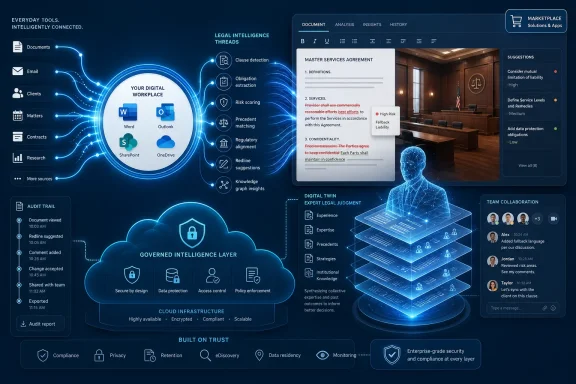
Eudia announced on June 25, 2026, from Palo Alto, California, that it is collaborating with Microsoft to bring its Expert Digital Twins and specialized legal AI agents into Microsoft 365, Microsoft Azure, Microsoft Marketplace, and Microsoft’s enterprise co-sell motion. The announcement is not just another “AI in Office” press release. It is a bet that the next valuable enterprise AI product will not be a general chatbot, but a governed imitation of how a company’s best experts actually make decisions. If Microsoft 365 is where enterprise work already lives, Eudia is trying to become the judgment layer inside it.
The phrase “Expert Digital Twin” sounds like something engineered in a marketing lab, and perhaps it was. But beneath the branding is a serious argument about where enterprise AI is heading: not toward generic productivity assistants alone, but toward systems that encode institutional precedent, risk tolerance, playbooks, and the gray-area reasoning that senior professionals usually carry around in their heads.
That matters most in legal departments because legal work is not merely document work. A contract redline is a visible artifact, but the real value sits in the choices behind it: which clause is acceptable, which fallback position is commercially safe, which risk requires escalation, and which precedent actually applies. Eudia’s pitch is that those judgments can be captured, structured, governed, and reused across the business.
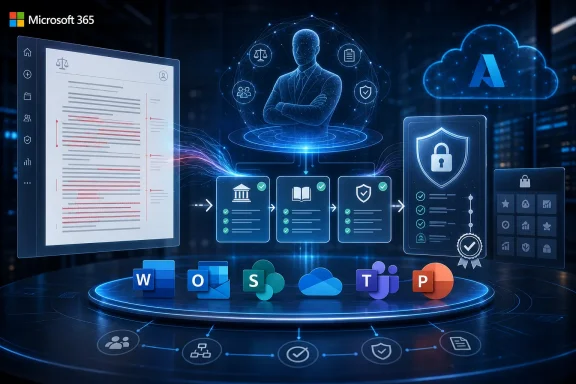
The Microsoft collaboration gives that pitch a more consequential distribution channel. Eudia says its platform already runs inside Microsoft 365 for customers including ServiceNow, Cargill, Toshiba, Ecolab, and Bayer, with integrations spanning Word, Outlook, SharePoint, and OneDrive. Teams, Microsoft 365 Copilot, and PowerPoint integrations are planned.
That sequence is revealing. Word and Outlook are where lawyers draft and negotiate. SharePoint and OneDrive are where contracts, templates, policies, and precedent documents accumulate. Teams is where everyone else interrupts legal for an answer.
Eudia’s premise is that legal AI will fail if it asks lawyers to move into yet another browser tab. The company is instead following the oldest rule in enterprise software: live where the workflow already happens, then quietly expand from tool to system of record, and from system of record to system of intelligence.
That sprawl is usually described as a problem. For AI vendors, it is also the prize.
The most important enterprise AI systems will not be the ones with the flashiest demos. They will be the ones that can safely sit next to sensitive data, understand permission boundaries, respect corporate governance, and return useful work product without forcing employees to restructure how they operate. Microsoft’s stack gives vendors like Eudia a credible path to that environment.
The announcement says Eudia is built on Azure, using scalable and compliant compute and storage, foundation models, and Microsoft security infrastructure. That phrasing is doing a lot of work. For buyers in legal, compliance, finance, and procurement, “AI” is not a neutral term; it is a risk surface. A vendor that can say it runs on Azure and integrates into Microsoft 365 starts the procurement conversation in a more familiar place.
Microsoft benefits, too. The company has spent years turning Azure and Microsoft 365 into platforms for enterprise AI, but vertical expertise does not emerge automatically from a general-purpose assistant. Legal departments do not merely need a chatbot that can summarize a contract. They need tools that understand how that company negotiates, what its lawyers have approved before, and when “standard language” is actually dangerous.
That is where partners become strategically useful. Microsoft can provide the platform, identity, security, data access, and go-to-market machinery. Eudia can bring the domain-specific logic and the legal-operational vocabulary that Microsoft is unlikely to build deeply enough for every specialized function.
That does not guarantee sales, and it certainly does not prove product maturity. But it changes the surface area of opportunity. Legal AI vendors have been racing to move beyond pilots, proofs of concept, and innovation-budget experiments. The real money is in enterprise-wide deployment, where legal operations, IT, security, procurement, and business units all have veto power.
Microsoft’s marketplace and sales organization can reduce some friction in that process. If an enterprise already has Azure commitments, Microsoft vendor review pathways, and Microsoft 365 adoption programs, Eudia can position itself as an extension of an existing estate rather than a rogue AI tool being smuggled into legal.
That is also why the customer names matter. ServiceNow, Cargill, Toshiba, Ecolab, and Bayer are not small logo decorations; they are signals aimed at cautious general counsel and CIOs. The intended message is that this is not a toy for boutique legal teams. It is meant for global companies with complex approval chains, sensitive data, and serious compliance concerns.
The practical challenge is that enterprise co-sell can amplify both strengths and weaknesses. If the product works, Microsoft’s channel can accelerate adoption. If deployments are messy, integrations shallow, or governance claims overstated, the same visibility can magnify buyer skepticism.
That tension makes legal a useful proving ground for what vendors now call agentic AI. The industry has moved from summarization and drafting toward systems that claim to analyze, decide, route, negotiate, and execute pieces of work. But the closer AI gets to decision-making, the more important it becomes to define whose judgment it is applying.
Eudia’s answer is that the system should model the organization’s own experts. Its “Enterprise Brain” is described as an intelligence layer that captures and codifies expert judgment across contracts, policies, precedents, and prior decisions. In theory, that is a stronger proposition than asking a general model to infer a company’s risk posture from a random pile of documents.
In practice, the hard part is not saying “institutional knowledge.” It is building a system that can distinguish between a precedent worth following and a one-off compromise that should never be repeated. Legal departments are full of exceptions, negotiated concessions, outdated templates, regional variations, and buried email guidance that may or may not still be valid.
This is where governance becomes more than a slide-deck word. A legal AI platform must be able to show what knowledge it used, who approved the underlying playbook, how the recommendation maps to policy, and when a human must review the output. The winners in this market will not be the vendors that simply generate faster text. They will be the vendors that make machine-assisted judgment auditable.
But deep integration creates deeper expectations. If an AI agent appears inside Word, users will expect it to understand the current document, the company’s template library, the counterparty’s proposed language, relevant fallback positions, and the attorney’s working context. If it appears inside Outlook, users will expect it to help draft responses that reflect both legal policy and commercial urgency.
The planned Teams integration may be even more consequential. Legal departments are swamped by informal requests from sales, procurement, marketing, finance, HR, and executives. If Eudia can route or answer some of those questions based on approved expert judgment, it could reduce bottlenecks. If it gives confident answers in ambiguous situations, it could create a new class of shadow legal advice.
That is the knife edge of embedded AI. The closer the system gets to everyday work, the less it feels like software and the more it feels like a colleague. That can improve adoption, but it can also blur accountability.
Microsoft 365 Copilot integration, once it arrives, will raise another strategic question: where does Microsoft’s assistant end and Eudia’s expert layer begin? Copilot is designed to operate across Microsoft 365 data. Eudia is positioning itself as a domain-specific intelligence layer for legal and adjacent teams. The cleanest version is complementary: Copilot provides the broad interface and Eudia supplies specialized legal judgment. The messier version is product overlap, competing prompts, and buyer confusion.
Contracts are the obvious example. Sales teams want faster deal cycles. Procurement wants vendor agreements cleared. Finance wants lower outside counsel spend. Marketing wants claims and assets reviewed without days of back-and-forth. Legal wants to preserve control without becoming the help desk for every routine decision.
A governed legal AI system could, in theory, let business users self-serve within boundaries. A sales rep could get approved fallback language. A procurement manager could flag nonstandard risk. A marketer could check whether a claim needs legal escalation. The legal department would then focus on exceptions, high-risk issues, and policy design.
That is the dream. It is also where organizational politics enter.
Legal departments derive authority from being the place where judgment is concentrated. Scaling that judgment across the enterprise is valuable, but it requires the department to trust a system to represent its reasoning outside the lawyer’s direct control. Business teams, meanwhile, may treat AI-generated legal guidance as permission to move faster than policy allows.
The success of Eudia’s model will depend less on whether it can draft text and more on whether it can encode boundaries. A useful digital twin of an expert is not just a replica of what that expert says yes to. It must also know when the expert would pause, escalate, or refuse.
That shift is both clever and risky. It is clever because executives understand the value of duplicating scarce expertise. Every large company has a handful of people whose judgment quietly keeps the machine running. If those people become bottlenecks, leave the company, or simply cannot scale across every matter, the organization suffers.
It is risky because human expertise is not a machine state. Senior lawyers do not simply apply rules; they weigh facts, politics, personalities, precedent, negotiation leverage, regulatory context, and business appetite. Some of that can be captured. Some of it can be approximated. Some of it may resist formalization.
Eudia’s advantage is that it is not pretending the generic model alone is enough. Its language centers on institutional knowledge, prior decisions, policies, and expert judgment. That is the right direction for enterprise AI.
Still, buyers should be wary of any implication that expertise can be cloned cleanly. A digital twin of an expert is not the expert. It is a governed model of selected reasoning patterns, trained or configured against selected artifacts, operating within selected workflows. That distinction is not academic; it is the line between useful augmentation and misplaced trust.
The Azure foundation helps Eudia answer several predictable questions. Where is the data hosted? How does the system scale? What identity and access controls are available? How does the vendor fit into existing Microsoft security and compliance practices? Can procurement happen through familiar channels?
None of that eliminates due diligence. A platform can be hosted on Azure and still have implementation, data handling, retention, or model governance issues that require scrutiny. But it starts the conversation with familiar infrastructure rather than unfamiliar promises.
This is one reason Microsoft’s ecosystem strategy is so powerful. The company does not need to build every vertical AI application itself. It needs to make Azure and Microsoft 365 the safest, easiest, and most commercially attractive place for those applications to live. Every credible partner reinforces the gravitational pull.
For Eudia, the benefit is equally clear. Legal AI is crowded, and many buyers are struggling to distinguish between document assistants, contract lifecycle tools, e-discovery vendors, legal research systems, and new agentic platforms. Aligning with Microsoft offers a way to signal enterprise seriousness.
The risk is dependence. If Eudia’s customer experience becomes tightly bound to Microsoft’s stack, it gains distribution but also inherits platform constraints, roadmap timing, and customer expectations shaped by Microsoft’s own AI products. The integration must feel native without becoming invisible.
The more ambitious part is the Expert Digital Twin concept. That is where Eudia is trying to move from task automation to institutional intelligence. Specialized agents can save time. A functioning expert twin could change how work is allocated across a legal department and its business partners.
This distinction matters because enterprises often buy AI in phases. They start with visible productivity gains, then expand into workflow transformation if the system proves trustworthy. A contract reporting agent may get the first budget approval. A digital twin of a senior commercial lawyer is the strategic prize.
The challenge is measurement. It is easy to count drafts generated, summaries produced, or hours saved. It is harder to measure whether AI advice matched the judgment of a top lawyer, reduced risk, improved negotiation outcomes, or prevented bad decisions. Eudia’s claims will need to be tested against those harder outcomes.
Legal departments should also ask what “continuous learning” means in a governed setting. Learning from decisions sounds attractive, but uncontrolled learning is dangerous. If a system absorbs every concession, workaround, and emergency exception as future precedent, it can degrade the very judgment it claims to scale.
The strongest version of this product category will treat learning as supervised institutional memory, not passive data ingestion. The system should capture decisions, but humans must decide which decisions become policy.
That is where the market appears to be moving. Contract lifecycle management systems manage documents and approvals. Legal service delivery platforms route requests. E-discovery systems process evidence and review sets. Microsoft 365 holds the daily work product. AI vendors are now trying to connect those systems with reasoning layers that can interpret, recommend, and act.
The prize is not another dashboard. It is orchestration.
If Eudia can operate inside Word, Outlook, SharePoint, OneDrive, and eventually Teams and Copilot, while also connecting to enterprise workflow platforms, it can plausibly claim a role beyond point-solution legal tech. It becomes a broker of legal judgment across the tools employees already use.
That is also why incumbent software vendors should pay attention. The most disruptive legal AI products may not arrive as replacements for existing systems. They may arrive as embedded agents that make existing systems feel smarter, then gradually capture the user relationship.
For WindowsForum readers, the broader lesson is familiar from previous platform shifts. The operating system was once the center of gravity. Then the browser. Then SaaS. In Microsoft-heavy enterprises, Microsoft 365 has become a practical operating layer for knowledge work. AI vendors are now competing to become trusted extensions of that layer.
The first question is data boundary. Legal documents include attorney-client communications, negotiation strategy, employment matters, regulatory exposure, merger activity, litigation material, and sensitive commercial terms. An AI integration that reads Word, Outlook, SharePoint, and OneDrive content must be governed by precise access controls and auditability.
The second question is explainability. If an agent recommends a clause, flags a risk, or drafts a response, users need to understand whether the output came from a policy, a precedent, an expert-approved playbook, a model inference, or some combination. “The AI said so” is not an acceptable legal workflow.
The third question is lifecycle management. Legal policies change. Templates are retired. Regulations shift. Business risk appetite evolves. A digital twin that reflects last year’s judgment may be worse than no twin at all if users assume it is current.
The fourth question is role design. Not every user should receive the same level of autonomy. A senior lawyer, a junior attorney, a sales executive, and a procurement analyst may all benefit from AI assistance, but the system must treat their authority differently.
Eudia’s Microsoft alignment may help address these concerns, but it does not answer them by itself. The integration layer is only the beginning. The real deployment work will be in permissions, governance, audit trails, escalation logic, and user education.
That shift will be uneven. Some legal teams will use systems like Eudia to accelerate contracting and reduce repetitive review. Others will struggle to clean up templates, define playbooks, and agree internally on what their “expert judgment” actually is. AI exposes process debt as much as it automates process.
Microsoft’s role is to make this transition feel operationally safe enough for large enterprises to attempt. Eudia’s role is to prove that specialized legal intelligence can produce better results than generic AI assistance. Customers’ role is to resist magical thinking and insist on measurable, governed outcomes.
This is why the announcement is more interesting than the usual partner-release choreography. It points toward a future in which enterprise AI is not a separate destination, but a layer inside the applications people already use. The companies that win will not merely generate text; they will encode how an organization wants work to be done.
 Eudia Is Selling Judgment, Not Just Automation
The phrase “Expert Digital Twin” sounds like something engineered in a marketing lab, and perhaps it was. But beneath the branding is a serious argument about where enterprise AI is heading: not toward generic productivity assistants alone, but toward systems that encode institutional precedent, risk tolerance, playbooks, and the gray-area reasoning that senior professionals usually carry around in their heads.That matters most in legal departments because legal work is not merely document work. A contract redline is a visible artifact, but the real value sits in the choices behind it: which clause is acceptable, which fallback position is commercially safe, which risk requires escalation, and which precedent actually applies. Eudia’s pitch is that those judgments can be captured, structured, governed, and reused across the business.
The Microsoft collaboration gives that pitch a more consequential distribution channel. Eudia says its platform already runs inside Microsoft 365 for customers including ServiceNow, Cargill, Toshiba, Ecolab, and Bayer, with integrations spanning Word, Outlook, SharePoint, and OneDrive. Teams, Microsoft 365 Copilot, and PowerPoint integrations are planned.
That sequence is revealing. Word and Outlook are where lawyers draft and negotiate. SharePoint and OneDrive are where contracts, templates, policies, and precedent documents accumulate. Teams is where everyone else interrupts legal for an answer.
Eudia’s premise is that legal AI will fail if it asks lawyers to move into yet another browser tab. The company is instead following the oldest rule in enterprise software: live where the workflow already happens, then quietly expand from tool to system of record, and from system of record to system of intelligence.
Microsoft 365 Has Become the Enterprise AI Battlefield
Microsoft’s advantage in enterprise AI is not simply that it owns a cloud, a productivity suite, and a rapidly expanding AI assistant. It is that Microsoft 365 remains the habitat of enterprise knowledge work. The documents are in Word. The negotiations are in Outlook. The drafts, templates, policies, and executed agreements are scattered across SharePoint and OneDrive. The cross-functional chatter is in Teams.That sprawl is usually described as a problem. For AI vendors, it is also the prize.
The most important enterprise AI systems will not be the ones with the flashiest demos. They will be the ones that can safely sit next to sensitive data, understand permission boundaries, respect corporate governance, and return useful work product without forcing employees to restructure how they operate. Microsoft’s stack gives vendors like Eudia a credible path to that environment.
The announcement says Eudia is built on Azure, using scalable and compliant compute and storage, foundation models, and Microsoft security infrastructure. That phrasing is doing a lot of work. For buyers in legal, compliance, finance, and procurement, “AI” is not a neutral term; it is a risk surface. A vendor that can say it runs on Azure and integrates into Microsoft 365 starts the procurement conversation in a more familiar place.
Microsoft benefits, too. The company has spent years turning Azure and Microsoft 365 into platforms for enterprise AI, but vertical expertise does not emerge automatically from a general-purpose assistant. Legal departments do not merely need a chatbot that can summarize a contract. They need tools that understand how that company negotiates, what its lawyers have approved before, and when “standard language” is actually dangerous.
That is where partners become strategically useful. Microsoft can provide the platform, identity, security, data access, and go-to-market machinery. Eudia can bring the domain-specific logic and the legal-operational vocabulary that Microsoft is unlikely to build deeply enough for every specialized function.
The Co-Sell Detail Is Bigger Than It Looks
The words “joint go-to-market” can be easy to skim past, but in enterprise software they often matter more than the product integration itself. A listing in Microsoft Marketplace can simplify procurement. A co-sell relationship can put a specialist vendor into conversations with Microsoft account teams that already have trusted access to large customers.That does not guarantee sales, and it certainly does not prove product maturity. But it changes the surface area of opportunity. Legal AI vendors have been racing to move beyond pilots, proofs of concept, and innovation-budget experiments. The real money is in enterprise-wide deployment, where legal operations, IT, security, procurement, and business units all have veto power.
Microsoft’s marketplace and sales organization can reduce some friction in that process. If an enterprise already has Azure commitments, Microsoft vendor review pathways, and Microsoft 365 adoption programs, Eudia can position itself as an extension of an existing estate rather than a rogue AI tool being smuggled into legal.
That is also why the customer names matter. ServiceNow, Cargill, Toshiba, Ecolab, and Bayer are not small logo decorations; they are signals aimed at cautious general counsel and CIOs. The intended message is that this is not a toy for boutique legal teams. It is meant for global companies with complex approval chains, sensitive data, and serious compliance concerns.
The practical challenge is that enterprise co-sell can amplify both strengths and weaknesses. If the product works, Microsoft’s channel can accelerate adoption. If deployments are messy, integrations shallow, or governance claims overstated, the same visibility can magnify buyer skepticism.
Legal Is the Perfect Test Case for Agentic AI’s Hardest Promise
Legal departments are natural targets for AI because they are document-heavy, precedent-driven, expensive, and frequently perceived by the business as slow. They are also unusually unforgiving environments for automation. A bad summary can mislead. A careless redline can create commercial risk. A hallucinated citation or invented policy can turn a productivity tool into a liability generator.That tension makes legal a useful proving ground for what vendors now call agentic AI. The industry has moved from summarization and drafting toward systems that claim to analyze, decide, route, negotiate, and execute pieces of work. But the closer AI gets to decision-making, the more important it becomes to define whose judgment it is applying.
Eudia’s answer is that the system should model the organization’s own experts. Its “Enterprise Brain” is described as an intelligence layer that captures and codifies expert judgment across contracts, policies, precedents, and prior decisions. In theory, that is a stronger proposition than asking a general model to infer a company’s risk posture from a random pile of documents.
In practice, the hard part is not saying “institutional knowledge.” It is building a system that can distinguish between a precedent worth following and a one-off compromise that should never be repeated. Legal departments are full of exceptions, negotiated concessions, outdated templates, regional variations, and buried email guidance that may or may not still be valid.
This is where governance becomes more than a slide-deck word. A legal AI platform must be able to show what knowledge it used, who approved the underlying playbook, how the recommendation maps to policy, and when a human must review the output. The winners in this market will not be the vendors that simply generate faster text. They will be the vendors that make machine-assisted judgment auditable.
The Microsoft Integration Cuts Both Ways
Embedding Eudia into Word and Outlook is an obvious move because those are the legal department’s daily instruments. A contract lawyer does not want to upload a document into a separate AI portal, wait for an answer, and then copy recommendations back into the negotiation draft. The closer the tool sits to the redline, the more likely it is to be used.But deep integration creates deeper expectations. If an AI agent appears inside Word, users will expect it to understand the current document, the company’s template library, the counterparty’s proposed language, relevant fallback positions, and the attorney’s working context. If it appears inside Outlook, users will expect it to help draft responses that reflect both legal policy and commercial urgency.
The planned Teams integration may be even more consequential. Legal departments are swamped by informal requests from sales, procurement, marketing, finance, HR, and executives. If Eudia can route or answer some of those questions based on approved expert judgment, it could reduce bottlenecks. If it gives confident answers in ambiguous situations, it could create a new class of shadow legal advice.
That is the knife edge of embedded AI. The closer the system gets to everyday work, the less it feels like software and the more it feels like a colleague. That can improve adoption, but it can also blur accountability.
Microsoft 365 Copilot integration, once it arrives, will raise another strategic question: where does Microsoft’s assistant end and Eudia’s expert layer begin? Copilot is designed to operate across Microsoft 365 data. Eudia is positioning itself as a domain-specific intelligence layer for legal and adjacent teams. The cleanest version is complementary: Copilot provides the broad interface and Eudia supplies specialized legal judgment. The messier version is product overlap, competing prompts, and buyer confusion.
The Real Customer Is Not Only the Legal Department
Eudia’s announcement speaks to in-house legal teams, but its business case reaches beyond them. The company explicitly points to sales, procurement, marketing, and finance as beneficiaries. That is not accidental. The most attractive legal-tech pitch in 2026 is not “make lawyers faster.” It is “make the business less dependent on waiting for lawyers.”Contracts are the obvious example. Sales teams want faster deal cycles. Procurement wants vendor agreements cleared. Finance wants lower outside counsel spend. Marketing wants claims and assets reviewed without days of back-and-forth. Legal wants to preserve control without becoming the help desk for every routine decision.
A governed legal AI system could, in theory, let business users self-serve within boundaries. A sales rep could get approved fallback language. A procurement manager could flag nonstandard risk. A marketer could check whether a claim needs legal escalation. The legal department would then focus on exceptions, high-risk issues, and policy design.
That is the dream. It is also where organizational politics enter.
Legal departments derive authority from being the place where judgment is concentrated. Scaling that judgment across the enterprise is valuable, but it requires the department to trust a system to represent its reasoning outside the lawyer’s direct control. Business teams, meanwhile, may treat AI-generated legal guidance as permission to move faster than policy allows.
The success of Eudia’s model will depend less on whether it can draft text and more on whether it can encode boundaries. A useful digital twin of an expert is not just a replica of what that expert says yes to. It must also know when the expert would pause, escalate, or refuse.
“Digital Twin” Gets a White-Collar Makeover
The term “digital twin” originally gained traction in physical systems: factories, engines, buildings, supply chains, infrastructure. A digital model reflected the state and behavior of a real-world system so operators could simulate, monitor, and optimize it. Eudia is applying the metaphor to professional judgment.That shift is both clever and risky. It is clever because executives understand the value of duplicating scarce expertise. Every large company has a handful of people whose judgment quietly keeps the machine running. If those people become bottlenecks, leave the company, or simply cannot scale across every matter, the organization suffers.
It is risky because human expertise is not a machine state. Senior lawyers do not simply apply rules; they weigh facts, politics, personalities, precedent, negotiation leverage, regulatory context, and business appetite. Some of that can be captured. Some of it can be approximated. Some of it may resist formalization.
Eudia’s advantage is that it is not pretending the generic model alone is enough. Its language centers on institutional knowledge, prior decisions, policies, and expert judgment. That is the right direction for enterprise AI.
Still, buyers should be wary of any implication that expertise can be cloned cleanly. A digital twin of an expert is not the expert. It is a governed model of selected reasoning patterns, trained or configured against selected artifacts, operating within selected workflows. That distinction is not academic; it is the line between useful augmentation and misplaced trust.
Azure Gives the Pitch Enterprise Gravity
Building on Azure is almost table stakes for a vendor that wants to sell AI into large Microsoft-centric organizations. But table stakes are still stakes. Legal departments do not buy alone. IT, security, privacy, compliance, procurement, and sometimes the board all have opinions about where sensitive legal data goes.The Azure foundation helps Eudia answer several predictable questions. Where is the data hosted? How does the system scale? What identity and access controls are available? How does the vendor fit into existing Microsoft security and compliance practices? Can procurement happen through familiar channels?
None of that eliminates due diligence. A platform can be hosted on Azure and still have implementation, data handling, retention, or model governance issues that require scrutiny. But it starts the conversation with familiar infrastructure rather than unfamiliar promises.
This is one reason Microsoft’s ecosystem strategy is so powerful. The company does not need to build every vertical AI application itself. It needs to make Azure and Microsoft 365 the safest, easiest, and most commercially attractive place for those applications to live. Every credible partner reinforces the gravitational pull.
For Eudia, the benefit is equally clear. Legal AI is crowded, and many buyers are struggling to distinguish between document assistants, contract lifecycle tools, e-discovery vendors, legal research systems, and new agentic platforms. Aligning with Microsoft offers a way to signal enterprise seriousness.
The risk is dependence. If Eudia’s customer experience becomes tightly bound to Microsoft’s stack, it gains distribution but also inherits platform constraints, roadmap timing, and customer expectations shaped by Microsoft’s own AI products. The integration must feel native without becoming invisible.
Specialized Agents Are the Near-Term Product, Expert Twins Are the Long-Term Bet
The most concrete parts of Eudia’s offering are its specialized agents: Argument Analysis, Case Analysis, Contract Reporting, and related tools. These are easier for customers to understand because they map to familiar tasks. Analyze an argument. Review a case. Generate contract reporting. Assist with specific workstreams.The more ambitious part is the Expert Digital Twin concept. That is where Eudia is trying to move from task automation to institutional intelligence. Specialized agents can save time. A functioning expert twin could change how work is allocated across a legal department and its business partners.
This distinction matters because enterprises often buy AI in phases. They start with visible productivity gains, then expand into workflow transformation if the system proves trustworthy. A contract reporting agent may get the first budget approval. A digital twin of a senior commercial lawyer is the strategic prize.
The challenge is measurement. It is easy to count drafts generated, summaries produced, or hours saved. It is harder to measure whether AI advice matched the judgment of a top lawyer, reduced risk, improved negotiation outcomes, or prevented bad decisions. Eudia’s claims will need to be tested against those harder outcomes.
Legal departments should also ask what “continuous learning” means in a governed setting. Learning from decisions sounds attractive, but uncontrolled learning is dangerous. If a system absorbs every concession, workaround, and emergency exception as future precedent, it can degrade the very judgment it claims to scale.
The strongest version of this product category will treat learning as supervised institutional memory, not passive data ingestion. The system should capture decisions, but humans must decide which decisions become policy.
The AI-Native Legal Stack Is Being Assembled in Public
Eudia’s Microsoft collaboration follows a broader pattern in the legal AI market. The company has also positioned itself alongside workflow and legal-services players, suggesting a strategy that is less about replacing a single legal tool and more about becoming an intelligence layer across the legal lifecycle.That is where the market appears to be moving. Contract lifecycle management systems manage documents and approvals. Legal service delivery platforms route requests. E-discovery systems process evidence and review sets. Microsoft 365 holds the daily work product. AI vendors are now trying to connect those systems with reasoning layers that can interpret, recommend, and act.
The prize is not another dashboard. It is orchestration.
If Eudia can operate inside Word, Outlook, SharePoint, OneDrive, and eventually Teams and Copilot, while also connecting to enterprise workflow platforms, it can plausibly claim a role beyond point-solution legal tech. It becomes a broker of legal judgment across the tools employees already use.
That is also why incumbent software vendors should pay attention. The most disruptive legal AI products may not arrive as replacements for existing systems. They may arrive as embedded agents that make existing systems feel smarter, then gradually capture the user relationship.
For WindowsForum readers, the broader lesson is familiar from previous platform shifts. The operating system was once the center of gravity. Then the browser. Then SaaS. In Microsoft-heavy enterprises, Microsoft 365 has become a practical operating layer for knowledge work. AI vendors are now competing to become trusted extensions of that layer.
Where IT Should Push Past the Demo
The announcement is written for momentum, not caution. That is what announcements do. But IT and security teams should approach legal AI with the same discipline they apply to any system touching privileged, confidential, or regulated data.The first question is data boundary. Legal documents include attorney-client communications, negotiation strategy, employment matters, regulatory exposure, merger activity, litigation material, and sensitive commercial terms. An AI integration that reads Word, Outlook, SharePoint, and OneDrive content must be governed by precise access controls and auditability.
The second question is explainability. If an agent recommends a clause, flags a risk, or drafts a response, users need to understand whether the output came from a policy, a precedent, an expert-approved playbook, a model inference, or some combination. “The AI said so” is not an acceptable legal workflow.
The third question is lifecycle management. Legal policies change. Templates are retired. Regulations shift. Business risk appetite evolves. A digital twin that reflects last year’s judgment may be worse than no twin at all if users assume it is current.
The fourth question is role design. Not every user should receive the same level of autonomy. A senior lawyer, a junior attorney, a sales executive, and a procurement analyst may all benefit from AI assistance, but the system must treat their authority differently.
Eudia’s Microsoft alignment may help address these concerns, but it does not answer them by itself. The integration layer is only the beginning. The real deployment work will be in permissions, governance, audit trails, escalation logic, and user education.
The Microsoft-Eudia Deal Shows Where Legal AI Is Actually Going
The practical story here is not that lawyers will suddenly be replaced by digital twins. That is the lazy version of the AI narrative, and it misses how enterprise adoption usually works. The more plausible story is that legal departments will become designers of governed decision systems, while routine work increasingly moves through agents embedded in the tools the business already uses.That shift will be uneven. Some legal teams will use systems like Eudia to accelerate contracting and reduce repetitive review. Others will struggle to clean up templates, define playbooks, and agree internally on what their “expert judgment” actually is. AI exposes process debt as much as it automates process.
Microsoft’s role is to make this transition feel operationally safe enough for large enterprises to attempt. Eudia’s role is to prove that specialized legal intelligence can produce better results than generic AI assistance. Customers’ role is to resist magical thinking and insist on measurable, governed outcomes.
This is why the announcement is more interesting than the usual partner-release choreography. It points toward a future in which enterprise AI is not a separate destination, but a layer inside the applications people already use. The companies that win will not merely generate text; they will encode how an organization wants work to be done.
The Fine Print Legal Teams Should Read Before the Excitement Peaks
Eudia’s Microsoft collaboration is best understood as a distribution and integration milestone, not a final verdict on the category. The opportunity is large because the pain is real: legal teams are overloaded, business teams are impatient, and institutional judgment is too often trapped in inboxes and individuals. The risk is equally real because legal judgment is not ordinary productivity work.- Eudia announced the Microsoft collaboration on June 25, 2026, with Microsoft 365 integrations, Azure deployment, Microsoft Marketplace procurement, and joint go-to-market support.
- The platform is already described as running inside Microsoft Word, Outlook, SharePoint, and OneDrive for named enterprise customers, with Teams, Microsoft 365 Copilot, and PowerPoint integrations planned.
- The company’s central claim is that Expert Digital Twins can scale the judgment of top in-house experts, not merely automate drafting or summarization.
- The strongest use cases are likely to involve contract review, legal request triage, matter analysis, compliance workflows, and self-service guidance for business teams.
- The most important deployment questions involve data boundaries, auditability, permission design, escalation rules, and whether “learning” is governed by humans rather than absorbed indiscriminately.
- Microsoft gains another vertical AI partner that makes Azure and Microsoft 365 more central to enterprise knowledge work, while Eudia gains a route into the procurement and sales machinery of large Microsoft customers.
References
- Primary source: STT Info
Published: 2026-06-25T12:42:08.767261
Eudia Announces Collaboration with Microsoft to Scale Expert Digital Twins for the Enterprise | ACCESS Newswire
Joint co-sell and technical integration across Microsoft 365 bring Eudia's Expert Digital Twins and suite of specialized agents to in-house legal departments and adjacent teams at the world's most ambitious companies PALO ALTO, CA / ACCESS Newswire / June 25, 2026 / Eudia, the System...www.sttinfo.fi - Related coverage: eudia.com
Eudia | The Enterprise Brain
Eudia creates expert digital twins, encoding your best experts’ judgment into an Enterprise Brain that makes the business self-sufficient without scaling headcount. www.eudia.com
- Related coverage: legaltech-talk.com
Eudia partners with ServiceNow to deliver agentic legal workflows - LegalTechTalk
Eudia has partnered with ServiceNow to deliver AI-powered, autonomous legal workflows across enterprise systems.www.legaltech-talk.com - Related coverage: artificiallawyer.com
Eudia Assembles Unified Workspace, Inc. Digital Twins + – Artificial Lawyer
Eudia, the multi-faceted legal AI business focused on inhouse teams, has bundled together a range of its capabilities into a single unified workspace in a bid to reduce the drag of context switchin…www.artificiallawyer.com - Official source: learn.microsoft.com
Application Information for Eudia for Outlook by Eudia Augmented Intelligence - Microsoft 365 App Certification | Microsoft Learn
All available security and compliance information information for Eudia for Outlook, its data handling policies, its Microsoft Cloud App Security app catalog information, and security/compliance information in the CSA STAR registry.learn.microsoft.com - Related coverage: media.expert.ai
- Related coverage: digital-twin-conference.com