

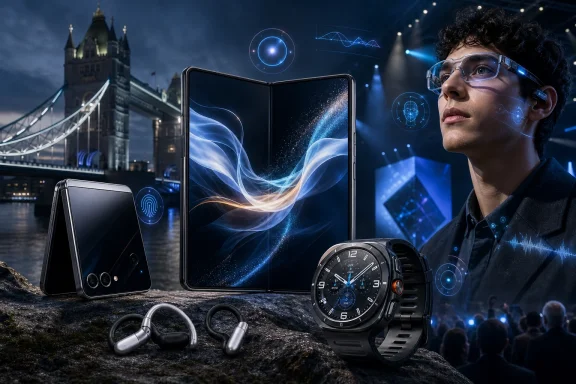
Samsung is expected to announce eight more products in 2026, including the Galaxy Z Fold 8, Galaxy Z Flip 8, Galaxy Z Fold Wide, Galaxy Watch 9, Galaxy Watch Ultra 2, Galaxy Glasses, Galaxy S26 FE, and Galaxy Buds Able, with several likely tied to a July 22 London Unpacked event. The interesting story is not simply that Samsung has more hardware coming. It is that the company appears to be stretching Galaxy from a phone line into a mesh of screens, sensors, wearables, earbuds, AI assistants, and Windows-adjacent computing habits.
That matters because Samsung is one of the few consumer electronics companies with enough hardware surface area to make ecosystem strategy feel physical. Apple can do this with iPhone, Watch, AirPods, Vision, and Mac. Google can sketch the software platform. Samsung can put the experiment on wrists, faces, desks, pockets, and living-room walls — and then ask Android, Gemini, Windows, and One UI to make it feel like one thing.
The usual Samsung rhythm is easy to caricature. Flagship Galaxy S phones in the first half, foldables in the summer, FE devices and accessories scattered around the back half, and a constant background hum of TVs, monitors, appliances, and laptops. That cadence still exists, but the 2026 version looks more ambitious because the rumored devices are not merely replacements for last year’s models.
The expected Fold 8 and Flip 8 would keep Samsung’s foldable machine moving, but the rumored Galaxy Z Fold Wide suggests the company is still searching for the right shape of premium Android multitasking. The Watch 9 and Watch Ultra 2 would refresh the wrist side of the Galaxy ecosystem just as AI health coaching becomes a more visible part of wearables. Galaxy Glasses, if Samsung does introduce them at the July event, would put the company into the still-undefined category of AI eyewear.
The pattern is obvious: Samsung is trying to own the places where the smartphone alone is starting to feel insufficient. A folding phone gives users more screen when they need it. A watch gathers health and context. Glasses promise glanceable AI without pulling out a handset. Open-ear or clip-on earbuds keep audio and assistant access available without fully sealing the user off from the world.
For WindowsForum readers, the Windows angle is indirect but real. Samsung’s Galaxy Book laptops, phone-to-PC integration, DeX-like workflows, Quick Share, Microsoft account hooks, and Android app continuity have long made Galaxy one of the more PC-aware Android ecosystems. The more Samsung extends Galaxy beyond the phone, the more pressure there is for Windows to behave not as a separate island, but as another endpoint in the personal-computing fabric.
The rumored Fold 8 changes sound evolutionary rather than revolutionary: a thicker body, an upgraded ultrawide camera, and a 5,000 mAh battery have been reported. The Flip 8 is said to be thinner, with a lighter hinge, Exynos 2600 silicon, and camera hardware broadly similar to its predecessor. If those details hold, Samsung’s priority is not reinvention. It is refinement, stamina, and manufacturability.
That is not a criticism. Foldables have reached the point where reliability and battery life matter more than stage-demo spectacle. The early question was whether screens could bend. The current question is whether a foldable can survive two or three years of ordinary abuse without making its owner feel like a beta tester.
The rumored Galaxy Z Fold Wide complicates the picture. A wider Fold variant, reportedly with a 7.6-inch inner display, a 4,800 mAh battery, and dual 50-megapixel cameras, would suggest Samsung sees more than one kind of foldable productivity user. The regular Fold may be the balanced flagship; the Wide may chase the mini-tablet user who wants a larger canvas above all else.
This is where Samsung’s competition is not just Apple or Google. It is the iPad, the Windows ultraportable, the compact tablet, and the second monitor. Every fraction of an inch in a foldable inner display is an argument about what kind of computer a pocket device can become.
The Flip is fashion, compactness, and camera convenience. The Fold is multitasking, media, and pocketable productivity. A Fold Wide would move further toward the tablet side of the spectrum, where email triage, document review, note-taking, remote desktop access, and split-screen work become more credible. That is the terrain where Windows users should pay attention.
For IT pros, foldables are still a mixed proposition. They are powerful mobile endpoints with large screens, but they can be expensive to repair, harder to case, and more awkward to standardize than conventional phones. A wider Fold would amplify both sides of that ledger: more capability, more cost, more user demand, and more procurement skepticism.
The enterprise question is not whether someone can use a Fold as a tiny work machine. They can. The question is whether organizations want to support that workflow at scale, especially when authentication, mobile device management, data leakage, screen durability, and app compatibility all become part of the support burden.
Samsung has spent years courting enterprise customers with Knox, extended updates, and Microsoft integration. A larger foldable gives that strategy a more compelling screen. It also gives administrators one more device class to evaluate before the help desk starts receiving tickets that begin with “my folding phone won’t display the remote app properly.”
Samsung has already been talking up AI-assisted Galaxy Watch features, and the rumored 2026 hardware appears to focus on battery and continuity rather than a radical redesign. Reports have pointed to a 784 mAh battery for the Galaxy Watch Ultra 2, while the 40 mm and 44 mm Watch 9 models are expected to use 382 mAh and 435 mAh batteries. Regulatory appearances have reportedly shown 10-watt wired charging, broadly in line with earlier models.
Those numbers matter less as spec trivia than as evidence of the wearable constraint Samsung has to solve. AI features are easy to promise in a keynote, but watches live and die on battery life, comfort, and trust. A health assistant that requires constant charging is a failed assistant. A rugged watch that cannot last through serious outdoor use is a fashion prop with a compass.
The Galaxy Watch Ultra 2 is especially important because Samsung skipped an Ultra successor in 2025. That creates a longer runway for expectations. Apple’s Watch Ultra line has defined the rugged smartwatch conversation for many buyers, and Samsung cannot afford to make its Ultra feel like a delayed imitation.
The absence of a Watch 9 Classic from some reported regulatory sightings is also worth watching. Samsung’s rotating bezel has loyal fans, but the company’s product logic often swings between nostalgia and simplification. If the Classic is delayed or dropped, it would suggest Samsung is prioritizing fewer, clearer wearable tiers over maintaining every design lineage.
For Windows users, the watch may seem peripheral, but it quietly affects the broader device relationship. A Galaxy user who chooses Samsung’s watch, earbuds, phone, tablet, and laptop is less likely to treat Windows as the center of computing life. Windows becomes the work surface, while the personal context lives in Galaxy.
That is not necessarily bad for Microsoft. Windows has spent years becoming more accommodating to Android phones through Phone Link and cross-device services. But the center of gravity has shifted. The PC is no longer the obvious hub; it is one screen among many, and Samsung is trying to make sure as many of the other screens as possible say Galaxy.
The more Samsung’s watch becomes an AI sensor, the more this matters. Health data, location patterns, routines, sleep quality, and exercise context are not just app features. They are inputs into future assistants. The company that gathers those inputs gets a stronger claim on the user’s daily life.
That is why a Watch 9 refresh is not merely a wearable launch. It is part of Samsung’s argument that AI should be personal, embodied, and distributed across devices. The wrist is where that argument becomes intimate.
Samsung has already shown intelligent eyewear concepts with Google, and partnerships with eyewear brands such as Gentle Monster and Warby Parker suggest the company understands that glasses are not just electronics. They are identity objects. If they look wrong, the specs do not matter.
The reported Galaxy Glasses concept is not expected to be a full mixed-reality headset in the style of a bulky spatial computer. Instead, Samsung has described eyewear that works as a phone companion using Android XR, Google’s AI stack, and voice interaction. Claimed use cases include navigation, ordering, calendar actions, and real-time audio translation.
That sounds sensible, but it also reveals the challenge. Many of those tasks can already be done on a phone or through earbuds. Glasses need to make them faster, more natural, or more context-aware. If they only move voice assistant chores from the pocket to the face, they will struggle to justify their presence.
The built-in camera issue is unavoidable. Promotional images have shown camera hardware, which may be useful for photos, video, visual search, translation, and contextual AI. It also raises the old smart-glasses privacy problem: people do not like wondering whether they are being recorded.
Samsung does not want to build the next great orphaned gadget. The company has made enough experimental hardware over the years to know that form factor alone does not create a market. Apps, services, battery life, privacy signals, developer tools, and social norms all have to arrive close enough together.
This is where the comparison with Windows is useful. Microsoft’s HoloLens demonstrated that futuristic hardware can win attention without becoming a mass-market platform. Windows Mixed Reality showed that platform branding cannot overcome weak adoption and unclear developer incentives. AI glasses could avoid those mistakes, but only if they solve a specific daily problem better than phones, watches, or earbuds.
Samsung’s best chance may be to avoid overselling the glasses as a new computer. If Galaxy Glasses are pitched as a lightweight AI companion for translation, navigation, camera-assisted queries, and quick contextual actions, they may find a plausible early audience. If they are marketed as the next smartphone, expectations will outrun reality immediately.
The first version, if it arrives this year, should be judged less by specs than by restraint. A successful smart-glasses launch may be one that does a few things reliably, looks normal enough, and does not trigger a privacy backlash in the first week.
The expected S26 FE is rumored for the coming months, with September looking plausible if Samsung follows earlier FE timing. Alleged images briefly surfaced through the Wireless Power Consortium before being removed, reportedly showing a rear camera island closer to the broader S26 family while retaining design cues from the S25 FE. A Geekbench listing reportedly pointed to an Exynos 2500 chip, Android 17, and at least 8 GB of RAM.
The more revealing detail is the display supply rumor. Samsung is reportedly planning to source the S26 FE panel from China Star Optoelectronics Technology, a departure from the heavier use of Samsung Display for Galaxy OLED needs. If accurate, that says more about 2026 than any benchmark score does.
The AI boom has driven up demand and pricing pressure across memory and storage, and consumer hardware makers are looking for savings wherever they can find them. A display supply shift would suggest Samsung is trying to protect FE pricing while keeping the phone visually close to the flagship family. That is classic mid-premium strategy: spend where buyers notice, economize where the spec sheet can absorb it.
For WindowsForum readers who buy phones as practical tools rather than luxury objects, the FE line is often where the value argument lives. The best FE phone is not the one that wins benchmarks. It is the one that gets long software support, good battery life, credible cameras, enough RAM, reliable radios, and a price that does not make device insurance feel mandatory.
If memory and storage prices are under pressure from AI infrastructure demand, consumer devices will feel it. Manufacturers can raise prices, reduce margins, alter configurations, or find alternative suppliers. The rumored S26 FE display decision fits that broader pattern. It would not necessarily mean a worse phone, but it would mean Samsung is actively rebalancing its bill of materials.
That matters for buyers because the FE promise depends on trust. Users accept compromise when they believe the compromise was chosen intelligently. They resent it when the product feels like a flagship name attached to a hollowed-out device.
Samsung has to be careful here. The S26 FE will arrive in a market where midrange Android phones are already good, older flagships are discounted, and carrier deals distort real-world pricing. A successful FE needs a clear reason to exist beyond “less expensive than the Ultra.”
Software support may be that reason. If Samsung continues to use long update commitments as a differentiator, the FE line can appeal to pragmatic buyers who keep devices for years. That is especially relevant for families, small businesses, and IT-managed fleets that want predictable support without paying top-tier flagship prices.
Reports have described Samsung’s device as a clip-on style earbud, with references appearing in One UI firmware and the Samsung Wearable app under the model SM-U600. The design is said to resemble products such as Motorola’s Moto Buds Loop and Sony’s LinkBuds Clip. Bone conduction has been suggested as a possibility because it fits the open-ear concept, though the final audio technology remains uncertain.
This would be a sensible addition to Samsung’s audio lineup. The Galaxy Buds 4 series can serve users who want conventional in-ear audio and noise control. Buds Able could target runners, cyclists, office workers, parents, and anyone else who wants background audio without losing environmental awareness.
The challenge is sound quality. Open-ear products are convenient, but physics is unforgiving. Bass response, leakage, microphone quality, wind noise, and fit consistency can make or break the experience. Samsung’s brand gives it a distribution advantage, not immunity from those problems.
Reports of delays also suggest this may not be a July Unpacked product. That is not necessarily bad. Accessories can survive a quieter launch if they are good. A rushed open-ear product that feels awkward would do more damage than a delayed one that fills a genuine gap.
This is where the ecosystem strategy becomes subtle. A user may buy a foldable after watching a keynote, but they build habits through small devices. Earbuds go in every morning. A watch stays on all night. Glasses, if they work, could become the fastest path between intent and action. The phone orchestrates, but accessories create the daily rhythm.
For Windows users, this can be either convenient or fragmented. Samsung earbuds may pair with PCs, but the richest controls usually live in Galaxy apps and phones. The more advanced the AI features become, the more likely they are to depend on the full Samsung stack. That is how ecosystems reward loyalty without explicitly punishing everyone else.
This is also where Microsoft’s cross-device ambitions face a practical limit. Windows can integrate notifications, messages, calls, photos, and app continuity with Android phones. It cannot fully own the proprietary behaviors of every wearable and accessory. The PC participates in the ecosystem, but it does not always command it.
Samsung’s advantage is that it sells the physical endpoints. If it can make those endpoints feel coordinated, the software glue becomes harder to leave.
Samsung is unusually positioned because it plays in so many of those categories while still shipping Windows laptops. Galaxy Book devices sit at the border between Microsoft’s platform and Samsung’s ecosystem. They benefit from Windows compatibility while trying to offer Galaxy-specific conveniences, from file sharing to phone integration to display continuity.
That creates a fascinating tension. Microsoft wants Windows to be the universal productivity platform. Samsung wants Galaxy to be the user’s personal technology layer. Those goals can coexist, but they are not identical. The more Samsung’s phones, watches, glasses, and earbuds know about the user, the more Galaxy becomes the continuity layer around Windows rather than beneath it.
This matters for IT departments because users increasingly bring ecosystem expectations into work. They expect devices to share files instantly, hand off calls, authenticate smoothly, and surface relevant information without manual setup. When workplace PCs do not behave that way, they feel old, even if they are technically powerful.
The answer is not for every company to standardize on Samsung. The answer is to understand that endpoint management is no longer only about laptops and phones as separate objects. It is about the relationships among them. A foldable phone with work apps, a watch with notifications, earbuds with translation, and glasses with cameras may all touch enterprise data in different ways.
If Galaxy Glasses include cameras, microphones, AI interpretation, and real-time contextual features, they create new workplace questions. Can they be worn in secure areas? Can they record meetings? Can they translate conversations that include confidential information? Can they display sensitive notifications in public? Can an organization audit or restrict what the assistant sees?
These are not theoretical concerns. Every new sensor-bearing device expands the boundary of the endpoint. A phone in a pocket is one thing. A camera on a face is another. The social and security norms are different.
Samsung and Google will need clear enterprise controls if they want AI eyewear to move beyond consumer novelty. That means device management, camera indicators, recording restrictions, app permissions, data handling transparency, and admin policy hooks. Without those, glasses will be banned in many serious workplaces before they are even evaluated.
The irony is that smart glasses may be most useful in work contexts: field service, logistics, translation, remote assistance, accessibility, hands-free documentation, and training. But those are exactly the environments where governance matters most. Samsung’s consumer launch could be the easy part; the enterprise story will be harder.
That is a hardware map for ambient computing. The assistant of the future does not live in one app. It watches through cameras, listens through microphones, infers from calendars, checks location, reads health signals, and appears on whichever screen is most convenient. Whether that future is useful or creepy depends on design, consent, security, and business incentives.
Samsung’s challenge is that it does not fully control the stack. Android, Android XR, Gemini, Windows, Microsoft services, carriers, app developers, and regional privacy rules all shape the experience. Apple’s ecosystem advantage is vertical integration. Samsung’s advantage is breadth and partnership. Its weakness is the same thing.
That is why the July Unpacked event, if it includes foldables, watches, and glasses, could be more important than a normal summer hardware show. It would be Samsung’s chance to explain how the pieces relate. Without that explanation, the lineup risks looking like a pile of gadgets connected mostly by branding.
The company does not need to solve ambient computing in one year. It does need to prove that Galaxy AI is more than a feature checklist. The hardware can get users’ attention. The workflows have to keep it.
Galaxy Glasses could define Samsung’s role in AI wearables even if first-generation sales are modest. A Fold Wide could shape the company’s view of mobile productivity even if it remains expensive. Buds Able could reveal whether Samsung sees open-ear AI audio as a serious category or a side experiment. Watch Ultra 2 could determine whether Samsung can credibly challenge Apple at the rugged high end.
The safer products pay the bills. The riskier products define the next platform fight. Samsung’s 2026 lineup appears to include both, which is why it is worth more than a routine buying-guide glance.
There is also a defensive dimension. Apple is expected to keep pushing wearables and, eventually, foldable or spatial-adjacent hardware. Google is using Gemini and Android XR to remain central to the next interface shift. Chinese phone makers continue to pressure Samsung on foldable design, charging, and value. Standing still would be more dangerous than launching a few imperfect experiments.
Samsung has never been shy about putting multiple device ideas into the market and letting demand sort them out. That can look chaotic. It can also be how a company learns faster than competitors waiting for perfect certainty.
That matters because Samsung is one of the few consumer electronics companies with enough hardware surface area to make ecosystem strategy feel physical. Apple can do this with iPhone, Watch, AirPods, Vision, and Mac. Google can sketch the software platform. Samsung can put the experiment on wrists, faces, desks, pockets, and living-room walls — and then ask Android, Gemini, Windows, and One UI to make it feel like one thing.
 Samsung’s Second Half Looks Less Like a Product Cycle Than a Territory Grab
The usual Samsung rhythm is easy to caricature. Flagship Galaxy S phones in the first half, foldables in the summer, FE devices and accessories scattered around the back half, and a constant background hum of TVs, monitors, appliances, and laptops. That cadence still exists, but the 2026 version looks more ambitious because the rumored devices are not merely replacements for last year’s models.The expected Fold 8 and Flip 8 would keep Samsung’s foldable machine moving, but the rumored Galaxy Z Fold Wide suggests the company is still searching for the right shape of premium Android multitasking. The Watch 9 and Watch Ultra 2 would refresh the wrist side of the Galaxy ecosystem just as AI health coaching becomes a more visible part of wearables. Galaxy Glasses, if Samsung does introduce them at the July event, would put the company into the still-undefined category of AI eyewear.
The pattern is obvious: Samsung is trying to own the places where the smartphone alone is starting to feel insufficient. A folding phone gives users more screen when they need it. A watch gathers health and context. Glasses promise glanceable AI without pulling out a handset. Open-ear or clip-on earbuds keep audio and assistant access available without fully sealing the user off from the world.
For WindowsForum readers, the Windows angle is indirect but real. Samsung’s Galaxy Book laptops, phone-to-PC integration, DeX-like workflows, Quick Share, Microsoft account hooks, and Android app continuity have long made Galaxy one of the more PC-aware Android ecosystems. The more Samsung extends Galaxy beyond the phone, the more pressure there is for Windows to behave not as a separate island, but as another endpoint in the personal-computing fabric.
Foldables Are No Longer the Novelty; They Are the Control Group
The Galaxy Z Fold 8 and Z Flip 8 are the least surprising entries on the expected list, which is precisely why they are important. Samsung’s foldables have moved from futuristic demonstrations to annualized products with predictable leaks, spec debates, and upgrade anxieties. That is the sign of a category becoming normal, even if it remains expensive and niche compared with slab phones.The rumored Fold 8 changes sound evolutionary rather than revolutionary: a thicker body, an upgraded ultrawide camera, and a 5,000 mAh battery have been reported. The Flip 8 is said to be thinner, with a lighter hinge, Exynos 2600 silicon, and camera hardware broadly similar to its predecessor. If those details hold, Samsung’s priority is not reinvention. It is refinement, stamina, and manufacturability.
That is not a criticism. Foldables have reached the point where reliability and battery life matter more than stage-demo spectacle. The early question was whether screens could bend. The current question is whether a foldable can survive two or three years of ordinary abuse without making its owner feel like a beta tester.
The rumored Galaxy Z Fold Wide complicates the picture. A wider Fold variant, reportedly with a 7.6-inch inner display, a 4,800 mAh battery, and dual 50-megapixel cameras, would suggest Samsung sees more than one kind of foldable productivity user. The regular Fold may be the balanced flagship; the Wide may chase the mini-tablet user who wants a larger canvas above all else.
This is where Samsung’s competition is not just Apple or Google. It is the iPad, the Windows ultraportable, the compact tablet, and the second monitor. Every fraction of an inch in a foldable inner display is an argument about what kind of computer a pocket device can become.
The Fold Wide Rumor Points at Samsung’s Real Ambition
If Samsung launches a Fold Wide, it will be tempting to treat it as just another SKU. That would miss the strategic logic. A wider foldable is a bet that the premium phone market is fragmenting into device shapes optimized for different behaviors.The Flip is fashion, compactness, and camera convenience. The Fold is multitasking, media, and pocketable productivity. A Fold Wide would move further toward the tablet side of the spectrum, where email triage, document review, note-taking, remote desktop access, and split-screen work become more credible. That is the terrain where Windows users should pay attention.
For IT pros, foldables are still a mixed proposition. They are powerful mobile endpoints with large screens, but they can be expensive to repair, harder to case, and more awkward to standardize than conventional phones. A wider Fold would amplify both sides of that ledger: more capability, more cost, more user demand, and more procurement skepticism.
The enterprise question is not whether someone can use a Fold as a tiny work machine. They can. The question is whether organizations want to support that workflow at scale, especially when authentication, mobile device management, data leakage, screen durability, and app compatibility all become part of the support burden.
Samsung has spent years courting enterprise customers with Knox, extended updates, and Microsoft integration. A larger foldable gives that strategy a more compelling screen. It also gives administrators one more device class to evaluate before the help desk starts receiving tickets that begin with “my folding phone won’t display the remote app properly.”
Watches Are Becoming AI Sensors Before They Are Becoming Computers
The expected Galaxy Watch 9 and Galaxy Watch Ultra 2 sit in a different part of Samsung’s ecosystem story. A watch is not a productivity device in the Windows sense. It is a sensor platform, notification router, health interface, authentication companion, and increasingly a front end for AI features that need personal context.Samsung has already been talking up AI-assisted Galaxy Watch features, and the rumored 2026 hardware appears to focus on battery and continuity rather than a radical redesign. Reports have pointed to a 784 mAh battery for the Galaxy Watch Ultra 2, while the 40 mm and 44 mm Watch 9 models are expected to use 382 mAh and 435 mAh batteries. Regulatory appearances have reportedly shown 10-watt wired charging, broadly in line with earlier models.
Those numbers matter less as spec trivia than as evidence of the wearable constraint Samsung has to solve. AI features are easy to promise in a keynote, but watches live and die on battery life, comfort, and trust. A health assistant that requires constant charging is a failed assistant. A rugged watch that cannot last through serious outdoor use is a fashion prop with a compass.
The Galaxy Watch Ultra 2 is especially important because Samsung skipped an Ultra successor in 2025. That creates a longer runway for expectations. Apple’s Watch Ultra line has defined the rugged smartwatch conversation for many buyers, and Samsung cannot afford to make its Ultra feel like a delayed imitation.
The absence of a Watch 9 Classic from some reported regulatory sightings is also worth watching. Samsung’s rotating bezel has loyal fans, but the company’s product logic often swings between nostalgia and simplification. If the Classic is delayed or dropped, it would suggest Samsung is prioritizing fewer, clearer wearable tiers over maintaining every design lineage.
Wearables Make the Ecosystem Stickier Than Phones Do
Phones are still the anchor, but watches are what make ecosystems sticky. Once users rely on a watch for health trends, sleep tracking, workouts, payments, notifications, and quick replies, switching platforms becomes more emotionally and practically expensive. Samsung knows this, and so does Apple.For Windows users, the watch may seem peripheral, but it quietly affects the broader device relationship. A Galaxy user who chooses Samsung’s watch, earbuds, phone, tablet, and laptop is less likely to treat Windows as the center of computing life. Windows becomes the work surface, while the personal context lives in Galaxy.
That is not necessarily bad for Microsoft. Windows has spent years becoming more accommodating to Android phones through Phone Link and cross-device services. But the center of gravity has shifted. The PC is no longer the obvious hub; it is one screen among many, and Samsung is trying to make sure as many of the other screens as possible say Galaxy.
The more Samsung’s watch becomes an AI sensor, the more this matters. Health data, location patterns, routines, sleep quality, and exercise context are not just app features. They are inputs into future assistants. The company that gathers those inputs gets a stronger claim on the user’s daily life.
That is why a Watch 9 refresh is not merely a wearable launch. It is part of Samsung’s argument that AI should be personal, embodied, and distributed across devices. The wrist is where that argument becomes intimate.
Galaxy Glasses Would Be Samsung’s Riskiest Product Because the Category Still Has No Rules
The rumored Galaxy Glasses are the most consequential expected device because smart glasses remain an unsettled market. Smartphones have known rules. Watches have known rules. Earbuds have known rules. AI glasses are still negotiating what users will tolerate on their faces, what bystanders will accept in public, and what software can actually do without becoming annoying.Samsung has already shown intelligent eyewear concepts with Google, and partnerships with eyewear brands such as Gentle Monster and Warby Parker suggest the company understands that glasses are not just electronics. They are identity objects. If they look wrong, the specs do not matter.
The reported Galaxy Glasses concept is not expected to be a full mixed-reality headset in the style of a bulky spatial computer. Instead, Samsung has described eyewear that works as a phone companion using Android XR, Google’s AI stack, and voice interaction. Claimed use cases include navigation, ordering, calendar actions, and real-time audio translation.
That sounds sensible, but it also reveals the challenge. Many of those tasks can already be done on a phone or through earbuds. Glasses need to make them faster, more natural, or more context-aware. If they only move voice assistant chores from the pocket to the face, they will struggle to justify their presence.
The built-in camera issue is unavoidable. Promotional images have shown camera hardware, which may be useful for photos, video, visual search, translation, and contextual AI. It also raises the old smart-glasses privacy problem: people do not like wondering whether they are being recorded.
Android XR Gives Samsung a Platform, Not a Guarantee
Samsung’s alliance with Google around Android XR is both strength and vulnerability. The strength is obvious: Samsung gets a software platform, developer story, Gemini integration, and a partner with AI infrastructure. The vulnerability is that the experience depends on whether Google can make XR feel coherent after years of starting, stopping, renaming, and rethinking its wearable and ambient computing efforts.Samsung does not want to build the next great orphaned gadget. The company has made enough experimental hardware over the years to know that form factor alone does not create a market. Apps, services, battery life, privacy signals, developer tools, and social norms all have to arrive close enough together.
This is where the comparison with Windows is useful. Microsoft’s HoloLens demonstrated that futuristic hardware can win attention without becoming a mass-market platform. Windows Mixed Reality showed that platform branding cannot overcome weak adoption and unclear developer incentives. AI glasses could avoid those mistakes, but only if they solve a specific daily problem better than phones, watches, or earbuds.
Samsung’s best chance may be to avoid overselling the glasses as a new computer. If Galaxy Glasses are pitched as a lightweight AI companion for translation, navigation, camera-assisted queries, and quick contextual actions, they may find a plausible early audience. If they are marketed as the next smartphone, expectations will outrun reality immediately.
The first version, if it arrives this year, should be judged less by specs than by restraint. A successful smart-glasses launch may be one that does a few things reliably, looks normal enough, and does not trigger a privacy backlash in the first week.
The Galaxy S26 FE Is the Boring Phone That Explains the Market
The Galaxy S26 FE may be less glamorous than foldables or glasses, but it could be the more important phone for ordinary buyers. Samsung’s FE line exists because flagship pricing has outpaced what many users actually want to pay. The trick is to preserve enough of the flagship identity while cutting costs in places most buyers will tolerate.The expected S26 FE is rumored for the coming months, with September looking plausible if Samsung follows earlier FE timing. Alleged images briefly surfaced through the Wireless Power Consortium before being removed, reportedly showing a rear camera island closer to the broader S26 family while retaining design cues from the S25 FE. A Geekbench listing reportedly pointed to an Exynos 2500 chip, Android 17, and at least 8 GB of RAM.
The more revealing detail is the display supply rumor. Samsung is reportedly planning to source the S26 FE panel from China Star Optoelectronics Technology, a departure from the heavier use of Samsung Display for Galaxy OLED needs. If accurate, that says more about 2026 than any benchmark score does.
The AI boom has driven up demand and pricing pressure across memory and storage, and consumer hardware makers are looking for savings wherever they can find them. A display supply shift would suggest Samsung is trying to protect FE pricing while keeping the phone visually close to the flagship family. That is classic mid-premium strategy: spend where buyers notice, economize where the spec sheet can absorb it.
For WindowsForum readers who buy phones as practical tools rather than luxury objects, the FE line is often where the value argument lives. The best FE phone is not the one that wins benchmarks. It is the one that gets long software support, good battery life, credible cameras, enough RAM, reliable radios, and a price that does not make device insurance feel mandatory.
Cost Cutting Is Becoming a Feature, Not a Flaw
The old way to judge a cheaper flagship was to identify what had been removed. Plastic back? Older chip? Weaker telephoto? Lower refresh-rate panel? The new way is more complicated because component economics are shifting under everyone’s feet.If memory and storage prices are under pressure from AI infrastructure demand, consumer devices will feel it. Manufacturers can raise prices, reduce margins, alter configurations, or find alternative suppliers. The rumored S26 FE display decision fits that broader pattern. It would not necessarily mean a worse phone, but it would mean Samsung is actively rebalancing its bill of materials.
That matters for buyers because the FE promise depends on trust. Users accept compromise when they believe the compromise was chosen intelligently. They resent it when the product feels like a flagship name attached to a hollowed-out device.
Samsung has to be careful here. The S26 FE will arrive in a market where midrange Android phones are already good, older flagships are discounted, and carrier deals distort real-world pricing. A successful FE needs a clear reason to exist beyond “less expensive than the Ultra.”
Software support may be that reason. If Samsung continues to use long update commitments as a differentiator, the FE line can appeal to pragmatic buyers who keep devices for years. That is especially relevant for families, small businesses, and IT-managed fleets that want predictable support without paying top-tier flagship prices.
Buds Able Shows Samsung Chasing the Open-Ear Moment
The rumored Galaxy Buds Able may sound like an accessory footnote, but the design category is having a moment. Clip-on and open-ear earbuds are a response to a real user complaint: sealed earbuds can be uncomfortable, isolating, and fatiguing. Not everyone wants active noise cancellation all day.Reports have described Samsung’s device as a clip-on style earbud, with references appearing in One UI firmware and the Samsung Wearable app under the model SM-U600. The design is said to resemble products such as Motorola’s Moto Buds Loop and Sony’s LinkBuds Clip. Bone conduction has been suggested as a possibility because it fits the open-ear concept, though the final audio technology remains uncertain.
This would be a sensible addition to Samsung’s audio lineup. The Galaxy Buds 4 series can serve users who want conventional in-ear audio and noise control. Buds Able could target runners, cyclists, office workers, parents, and anyone else who wants background audio without losing environmental awareness.
The challenge is sound quality. Open-ear products are convenient, but physics is unforgiving. Bass response, leakage, microphone quality, wind noise, and fit consistency can make or break the experience. Samsung’s brand gives it a distribution advantage, not immunity from those problems.
Reports of delays also suggest this may not be a July Unpacked product. That is not necessarily bad. Accessories can survive a quieter launch if they are good. A rushed open-ear product that feels awkward would do more damage than a delayed one that fills a genuine gap.
The Small Accessories Are Where AI Becomes Habit
Earbuds are not just audio devices anymore. They are voice interfaces, translation endpoints, notification filters, and increasingly AI access points. If Samsung launches Buds Able, the important question will be how deeply they connect to Galaxy AI and Gemini-powered experiences.This is where the ecosystem strategy becomes subtle. A user may buy a foldable after watching a keynote, but they build habits through small devices. Earbuds go in every morning. A watch stays on all night. Glasses, if they work, could become the fastest path between intent and action. The phone orchestrates, but accessories create the daily rhythm.
For Windows users, this can be either convenient or fragmented. Samsung earbuds may pair with PCs, but the richest controls usually live in Galaxy apps and phones. The more advanced the AI features become, the more likely they are to depend on the full Samsung stack. That is how ecosystems reward loyalty without explicitly punishing everyone else.
This is also where Microsoft’s cross-device ambitions face a practical limit. Windows can integrate notifications, messages, calls, photos, and app continuity with Android phones. It cannot fully own the proprietary behaviors of every wearable and accessory. The PC participates in the ecosystem, but it does not always command it.
Samsung’s advantage is that it sells the physical endpoints. If it can make those endpoints feel coordinated, the software glue becomes harder to leave.
The Windows PC Is Now a Participant in Samsung’s Galaxy Story
Samsung’s expected 2026 launches are not Windows products, but Windows users should not dismiss them as mobile noise. The consumer technology market is increasingly organized around ecosystems rather than device categories. Phones, PCs, tablets, watches, earbuds, TVs, and AI assistants are converging into personal infrastructure.Samsung is unusually positioned because it plays in so many of those categories while still shipping Windows laptops. Galaxy Book devices sit at the border between Microsoft’s platform and Samsung’s ecosystem. They benefit from Windows compatibility while trying to offer Galaxy-specific conveniences, from file sharing to phone integration to display continuity.
That creates a fascinating tension. Microsoft wants Windows to be the universal productivity platform. Samsung wants Galaxy to be the user’s personal technology layer. Those goals can coexist, but they are not identical. The more Samsung’s phones, watches, glasses, and earbuds know about the user, the more Galaxy becomes the continuity layer around Windows rather than beneath it.
This matters for IT departments because users increasingly bring ecosystem expectations into work. They expect devices to share files instantly, hand off calls, authenticate smoothly, and surface relevant information without manual setup. When workplace PCs do not behave that way, they feel old, even if they are technically powerful.
The answer is not for every company to standardize on Samsung. The answer is to understand that endpoint management is no longer only about laptops and phones as separate objects. It is about the relationships among them. A foldable phone with work apps, a watch with notifications, earbuds with translation, and glasses with cameras may all touch enterprise data in different ways.
Admins Should Watch the Glasses More Closely Than the Foldables
Foldables are familiar enough to manage. They are Android phones with unusual screens. They raise cost and durability questions, but the policy framework is recognizable. Smart glasses are different.If Galaxy Glasses include cameras, microphones, AI interpretation, and real-time contextual features, they create new workplace questions. Can they be worn in secure areas? Can they record meetings? Can they translate conversations that include confidential information? Can they display sensitive notifications in public? Can an organization audit or restrict what the assistant sees?
These are not theoretical concerns. Every new sensor-bearing device expands the boundary of the endpoint. A phone in a pocket is one thing. A camera on a face is another. The social and security norms are different.
Samsung and Google will need clear enterprise controls if they want AI eyewear to move beyond consumer novelty. That means device management, camera indicators, recording restrictions, app permissions, data handling transparency, and admin policy hooks. Without those, glasses will be banned in many serious workplaces before they are even evaluated.
The irony is that smart glasses may be most useful in work contexts: field service, logistics, translation, remote assistance, accessibility, hands-free documentation, and training. But those are exactly the environments where governance matters most. Samsung’s consumer launch could be the easy part; the enterprise story will be harder.
The 2026 Galaxy Roadmap Is Really an AI Hardware Map
The connective tissue across Samsung’s expected devices is AI, but not in the lazy sense that every product now gets an AI badge. The more precise point is that Samsung is building hardware positions for different kinds of context. Phones provide identity, compute, cameras, and connectivity. Watches provide biometric and routine context. Earbuds provide voice and audio context. Glasses provide visual and spatial context. Foldables provide workspace context.That is a hardware map for ambient computing. The assistant of the future does not live in one app. It watches through cameras, listens through microphones, infers from calendars, checks location, reads health signals, and appears on whichever screen is most convenient. Whether that future is useful or creepy depends on design, consent, security, and business incentives.
Samsung’s challenge is that it does not fully control the stack. Android, Android XR, Gemini, Windows, Microsoft services, carriers, app developers, and regional privacy rules all shape the experience. Apple’s ecosystem advantage is vertical integration. Samsung’s advantage is breadth and partnership. Its weakness is the same thing.
That is why the July Unpacked event, if it includes foldables, watches, and glasses, could be more important than a normal summer hardware show. It would be Samsung’s chance to explain how the pieces relate. Without that explanation, the lineup risks looking like a pile of gadgets connected mostly by branding.
The company does not need to solve ambient computing in one year. It does need to prove that Galaxy AI is more than a feature checklist. The hardware can get users’ attention. The workflows have to keep it.
The Devices That Matter Most Are Not Necessarily the Ones That Sell Most
The Galaxy S26 FE may outsell a Fold Wide. The Watch 9 may reach more wrists than Galaxy Glasses reach faces. Conventional earbuds may remain more popular than Buds Able. But strategic importance is not the same as unit volume.Galaxy Glasses could define Samsung’s role in AI wearables even if first-generation sales are modest. A Fold Wide could shape the company’s view of mobile productivity even if it remains expensive. Buds Able could reveal whether Samsung sees open-ear AI audio as a serious category or a side experiment. Watch Ultra 2 could determine whether Samsung can credibly challenge Apple at the rugged high end.
The safer products pay the bills. The riskier products define the next platform fight. Samsung’s 2026 lineup appears to include both, which is why it is worth more than a routine buying-guide glance.
There is also a defensive dimension. Apple is expected to keep pushing wearables and, eventually, foldable or spatial-adjacent hardware. Google is using Gemini and Android XR to remain central to the next interface shift. Chinese phone makers continue to pressure Samsung on foldable design, charging, and value. Standing still would be more dangerous than launching a few imperfect experiments.
Samsung has never been shy about putting multiple device ideas into the market and letting demand sort them out. That can look chaotic. It can also be how a company learns faster than competitors waiting for perfect certainty.
The Practical Read for Galaxy Buyers, Windows Users, and IT Shops
The rest of Samsung’s 2026 hardware calendar should be read as a layered ecosystem push rather than eight isolated product rumors. The products differ in maturity, risk, and likely audience, but they all point toward a Galaxy strategy built around more screens, more sensors, and more AI-mediated handoffs.- The Galaxy Z Fold 8 and Z Flip 8 are expected to be evolutionary upgrades, which means durability, battery life, thermals, and software polish will matter more than novelty.
- The rumored Galaxy Z Fold Wide would be the device to watch for mobile productivity, especially if Samsung uses the larger canvas to improve multitasking rather than merely enlarging the same apps.
- The Galaxy Watch 9 and Watch Ultra 2 should be judged by battery life, health accuracy, update policy, and AI usefulness, not just by case size or charging wattage.
- Galaxy Glasses would be Samsung’s highest-risk 2026 launch because camera-equipped AI eyewear must solve privacy, usefulness, style, and platform support at the same time.
- The Galaxy S26 FE may be the most rational purchase for many users if Samsung protects software support and everyday performance while trimming component costs intelligently.
- Galaxy Buds Able would signal Samsung’s interest in open-ear audio as an AI companion category, but comfort and sound leakage will matter as much as assistant integration.
References
- Primary source: bgr.com
Published: Sat, 27 Jun 2026 17:47:00 GMT
8 New Products Samsung Is Expected To Announce In 2026
Samsung has released several new products in 2026, with more to come. Second-half additions could include foldable phones, smartwatches, and even smart glasses.www.bgr.com
