

Samsung’s next foldable phones and Galaxy smartwatches have appeared in recent FCC certification filings in the United States in June 2026, indicating that devices expected to include the Galaxy Z Flip 8, Galaxy Z Fold 8 variants, Galaxy Watch 9 models, and Galaxy Watch Ultra 2 are moving toward launch. The filings do not amount to a product announcement, and they do not settle every rumor around Samsung’s summer hardware slate. But they do show the machinery of a U.S. release grinding into its final regulatory stage. For Samsung, that matters because foldables are no longer a science project; they are now a platform refresh cadence with carrier shelves, trade-in math, and ecosystem lock-in riding on it.
FCC filings are not glamorous. They are the bureaucracy behind the spectacle: radio tests, wireless identifiers, charger compatibility, SAR disclosures, and the unromantic paperwork that lets a device legally transmit on U.S. networks. Yet for hardware watchers, they often mark the moment when rumor begins hardening into logistics.
That is why the latest Samsung filings are more consequential than their dry format suggests. The reported listings point to the next Galaxy Z Flip, a high-end Galaxy Z Fold model, several Galaxy Watch 9 configurations, and a new Galaxy Watch Ultra-class device. In other words, Samsung appears to be preparing not a single hero product, but a familiar summer ecosystem bundle.
The important word is appears. FCC records can reveal model numbers and connectivity details, but they rarely disclose the full marketing name, launch date, final feature set, or pricing strategy. A filing can confirm that a device exists in a form ready for U.S. certification; it cannot confirm that Samsung’s keynote slide deck will match every leak attached to it.
Still, the timing is difficult to ignore. Samsung has trained the market to expect midyear Unpacked events built around foldables and wearables. When those devices begin surfacing in U.S. certification channels in June, the reasonable inference is not that a launch is years away. It is that Samsung is aligning regulatory clearance, carrier testing, inventory planning, and media theater for the same window.
That routine is Samsung’s achievement. Foldables have not replaced slab phones, and they may never do so at comparable volume. But Samsung has created a recurring premium category where buyers expect annual refinements, carrier promotions, case leaks, repair debates, and processor speculation in the same rhythm as any Galaxy S device.
The FCC listings reinforce that shift. They suggest Samsung is not merely experimenting with one folding flagship; it is maintaining a product family. A Flip, a Fold, potentially differentiated Fold variants, and a parallel smartwatch refresh are the shape of a mature portfolio, not a laboratory trial.
That maturity creates a different problem. When a category becomes routine, novelty is no longer enough. Samsung has to persuade existing Fold and Flip owners that upgrades are practical, not just impressive. Thinner bodies, improved hinges, better battery life, less visible creasing, brighter displays, stronger wireless options, and longer software support matter more than the abstract fact that the phone folds.
That clarity gives the Flip an advantage even when its spec sheet trails conventional flagships. A buyer does not need to imagine tablet-style multitasking or justify a mini workstation in a pocket. The Flip’s premise is visible the moment it closes.
The reported FCC appearance of a Galaxy Z Flip 8 model therefore matters because the Flip is Samsung’s best chance to make foldables feel emotionally mainstream. If the next model brings better durability, improved thermals, stronger cameras, or a more useful cover screen, it could make a meaningful difference to buyers who like the idea but remain worried about compromise.
The catch is that the Flip also has less room to hide its trade-offs. Battery capacity, camera hardware, heat dissipation, and cover-screen software all collide with the physical constraints of the clamshell design. Samsung can polish the experience, but it cannot repeal geometry.
Recent reporting around Samsung’s 2026 foldables has pointed to more than one Fold-style model, including talk of “Ultra” and wider variants. The FCC paperwork reportedly does not make every rumored model equally visible, which leaves room for uncertainty. That uncertainty may reflect staggered certifications, regional plans, naming confusion, or simple overinterpretation by the leak economy.
If Samsung does split the Fold line more aggressively, the move would be logical. A single Fold has to satisfy buyers who want a narrower one-handed phone, buyers who want a wider outside display, buyers who want the best cameras, and buyers who want the thinnest possible chassis. Those priorities conflict. Multiple variants let Samsung charge more for the uncompromised version while making the standard model less polarizing.
But fragmentation also risks muddling the message. The Galaxy S lineup can survive Ultra, Plus, and base tiers because the slab-phone hierarchy is widely understood. Foldables are still expensive enough that confusion becomes friction. A buyer asked to choose among Fold, Fold Ultra, Fold Wide, and region-specific availability may decide that waiting is easier.
Samsung knows this. Its watches sit at the intersection of Android, Wear OS, Samsung Health, and Galaxy phone features. They are not as dominant in Android land as the Apple Watch is for iPhone owners, but they are the closest analogue Samsung has.
The reported Galaxy Watch 9 variants and Galaxy Watch Ultra 2 certification activity suggest Samsung is maintaining the dual-track strategy it has used before: mainstream watch models for ordinary buyers, and a ruggedized Ultra pitch for customers who want endurance, outdoor styling, or simply the most expensive version. This mirrors the wider consumer electronics playbook, where “Ultra” often means both capability and margin.
For WindowsForum readers, the watch angle may seem distant from PCs. It is not. Wearables deepen the gravitational pull of the phone platform, and the phone platform increasingly mediates authentication, passkeys, notifications, file transfer, hotspot access, and cross-device workflows. The more Samsung binds phone and watch together, the more it can make Galaxy ownership feel like an ecosystem rather than a handset purchase.
A device can clear certification and still launch later than expected. A model can appear in filings and arrive under a different name. A variant can be certified for one market and withheld from another. Regulatory paperwork is strong evidence of readiness, but it is not the same as a Samsung press release.
That distinction matters because the leak cycle often turns every database entry into a certainty. Model numbers become product names. Test configurations become retail specifications. Charger references become charging promises. The public record is useful, but it is narrow.
What the filings reliably tell us is that Samsung has hardware far enough along for U.S. radio approval. What they do not tell us is whether the next Fold finally resolves the aspect-ratio debate, whether the Flip’s cameras receive a major upgrade, whether the Watch Ultra 2 materially improves battery life, or whether pricing will become more humane.
That puts Samsung in an awkward position. It is the incumbent in a category it helped define, but incumbency can become conservatism. Annual refreshes keep the line alive, yet they also expose every area where rivals appear more daring.
The reported Fold 8 and Flip 8 cycle therefore has to do more than exist. Samsung needs to show that its foldable lead is not simply historical. It must demonstrate that experience, durability, software polish, repair channels, and carrier relationships can outweigh rivals that may look bolder in side-by-side hardware comparisons.
The calendar pressure is also internal. Samsung has trained buyers to expect summer foldables, winter Galaxy S flagships, and a steady drumbeat of ecosystem accessories. Missing the rhythm would create space for competitors. Meeting the rhythm with modest upgrades risks boring the audience. That is the trap of turning a futuristic device into an annual SKU.
Samsung has spent years making Galaxy phones more useful beside Windows PCs. Link to Windows, Phone Link integration, file sharing, notification mirroring, hotspot convenience, and Samsung’s own Galaxy Book ambitions all point in the same direction. The phone is not replacing the PC, but it is increasingly part of the PC experience.
Foldables sharpen that relationship. A Fold-class device can serve as a companion screen, document viewer, remote desktop client, note-taking surface, and emergency productivity machine. A Flip-class device is less about work surface and more about portability, communication, and quick interactions. Both benefit from better continuity with Windows.
For IT administrators, the issue is less romantic. Foldables and smartwatches mean more endpoints, more Bluetooth relationships, more authentication surfaces, more personal devices near corporate data, and more pressure to support Android Enterprise policy variations. The consumer keynote may celebrate lifestyle; the admin sees inventory, compliance, and support tickets.
That evolution matters in corporate and security-conscious environments. A smartwatch can display one-time codes, approve prompts, expose notifications, store cards, and reveal sensitive snippets on a wrist. It can also provide convenience that users will not willingly surrender.
Samsung’s Watch 9 and Ultra 2, if they arrive as expected, will enter a market where health features and battery life dominate consumer discussion. But for enterprise and power users, the more durable question is how much personal context migrates onto the wrist. The watch is no longer a phone accessory in the old sense. It is a small, always-attached node in a user’s identity graph.
That is why these FCC filings belong in a broader WindowsForum conversation. The future of computing is not just faster CPUs or thinner laptops. It is a mesh of certified radios, cloud accounts, sensors, companion devices, and operating systems negotiating trust across the day.
That does not make leak coverage useless. It makes interpretation important. The strongest conclusion from the current wave is that Samsung’s next foldables and watches are progressing toward a U.S. launch. The weaker conclusion is that every rumored model, name, and feature is now settled.
There is also a tendency to treat “clears a launch hurdle” as if all hurdles are equal. FCC certification is a major U.S. requirement, but it sits alongside carrier validation, manufacturing yield, software readiness, retail training, support documentation, and inventory allocation. Hardware launches fail in the seams between these systems, not just at the regulator’s desk.
Samsung is better than most companies at this choreography. That is exactly why the filings matter. They show the choreography is underway, but they do not reveal whether the performance will be memorable.
The question is whether Samsung can make those prices feel less punitive. Trade-in offers, carrier financing, preorder storage upgrades, and bundled wearables have become the real street-price story for Galaxy flagships. Few buyers experience the sticker price in isolation, but the sticker price still frames the conversation.
If the Galaxy Z Flip 8 arrives with incremental hardware changes, its success may depend heavily on promotions. If a Fold 8 Ultra or wider Fold variant materializes, Samsung may lean into a more explicitly luxury tier. That would please enthusiasts who want the best possible hardware, but it could also widen the gap between foldables as aspiration and foldables as ordinary phones.
The watches face a similar but smaller version of the same problem. A mainstream Galaxy Watch can be justified as a health and notification tool. An Ultra model has to justify its premium with endurance, materials, durability, sensors, or ecosystem cachet. Otherwise, “Ultra” becomes a label in search of a reason.
For older Fold and Flip users, the calculus is different. Durability improvements compound over generations. Displays get brighter, chips get cooler, software gets more confident, and repair ecosystems mature. A user still holding an early Flip or Fold may find the eighth generation less exciting in headlines but far more livable in practice.
The same applies to watches. Someone wearing a Galaxy Watch 6 or older model may see a Watch 9 as a substantial improvement in performance, battery management, sensors, or software support. A Watch 8 owner may see less urgency unless Samsung delivers a standout health or endurance feature.
That is the paradox of mature hardware categories. The annual launch is marketed to everyone, but the real audience is segmented by replacement cycles. Samsung’s job is to make the newest devices look inevitable without making last year’s buyers feel foolish.
That platform logic is why the FCC filings landed with such interest. They are fragments of a larger commercial machine. The phone pulls the watch. The watch reinforces the phone. The phone connects to the Windows PC. The cloud account ties the experience together. The trade-in offer keeps the customer from wandering.
For enthusiasts, this can feel both convenient and claustrophobic. Ecosystems solve real problems. They also make exit costs higher. The more devices Samsung can refresh together, the more it can turn an upgrade decision into a bundle decision.
That is precisely where Microsoft’s world intersects with Samsung’s. Windows remains the center of gravity for many work and gaming environments, but the surrounding personal-device mesh is increasingly mobile-led. Samsung’s summer hardware is not competing with Windows so much as negotiating how much of the user’s daily computing context happens before the laptop lid opens.
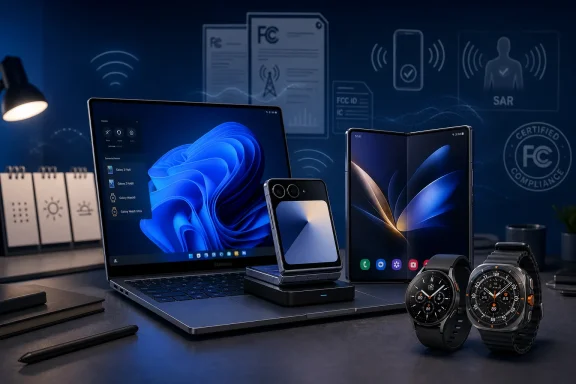 The FCC Paper Trail Is Samsung’s Quiet Launch Rehearsal
FCC filings are not glamorous. They are the bureaucracy behind the spectacle: radio tests, wireless identifiers, charger compatibility, SAR disclosures, and the unromantic paperwork that lets a device legally transmit on U.S. networks. Yet for hardware watchers, they often mark the moment when rumor begins hardening into logistics.That is why the latest Samsung filings are more consequential than their dry format suggests. The reported listings point to the next Galaxy Z Flip, a high-end Galaxy Z Fold model, several Galaxy Watch 9 configurations, and a new Galaxy Watch Ultra-class device. In other words, Samsung appears to be preparing not a single hero product, but a familiar summer ecosystem bundle.
The important word is appears. FCC records can reveal model numbers and connectivity details, but they rarely disclose the full marketing name, launch date, final feature set, or pricing strategy. A filing can confirm that a device exists in a form ready for U.S. certification; it cannot confirm that Samsung’s keynote slide deck will match every leak attached to it.
Still, the timing is difficult to ignore. Samsung has trained the market to expect midyear Unpacked events built around foldables and wearables. When those devices begin surfacing in U.S. certification channels in June, the reasonable inference is not that a launch is years away. It is that Samsung is aligning regulatory clearance, carrier testing, inventory planning, and media theater for the same window.
Foldables Have Become Routine, and That Is the Real Milestone
The first Galaxy Fold was defined by fragility, delay, and spectacle. Every subsequent generation has carried the burden of proving that folding glass could become normal enough for customers to stop treating it as a parlor trick. By the eighth generation, the more interesting story is that the filings themselves feel almost routine.That routine is Samsung’s achievement. Foldables have not replaced slab phones, and they may never do so at comparable volume. But Samsung has created a recurring premium category where buyers expect annual refinements, carrier promotions, case leaks, repair debates, and processor speculation in the same rhythm as any Galaxy S device.
The FCC listings reinforce that shift. They suggest Samsung is not merely experimenting with one folding flagship; it is maintaining a product family. A Flip, a Fold, potentially differentiated Fold variants, and a parallel smartwatch refresh are the shape of a mature portfolio, not a laboratory trial.
That maturity creates a different problem. When a category becomes routine, novelty is no longer enough. Samsung has to persuade existing Fold and Flip owners that upgrades are practical, not just impressive. Thinner bodies, improved hinges, better battery life, less visible creasing, brighter displays, stronger wireless options, and longer software support matter more than the abstract fact that the phone folds.
The Flip Remains Samsung’s Most Understandable Foldable
The Galaxy Z Flip line has always had the simpler sales pitch. It is a modern smartphone that folds into a smaller square. It is pocketability, nostalgia, fashion, and flagship pricing wrapped in a clamshell hinge.That clarity gives the Flip an advantage even when its spec sheet trails conventional flagships. A buyer does not need to imagine tablet-style multitasking or justify a mini workstation in a pocket. The Flip’s premise is visible the moment it closes.
The reported FCC appearance of a Galaxy Z Flip 8 model therefore matters because the Flip is Samsung’s best chance to make foldables feel emotionally mainstream. If the next model brings better durability, improved thermals, stronger cameras, or a more useful cover screen, it could make a meaningful difference to buyers who like the idea but remain worried about compromise.
The catch is that the Flip also has less room to hide its trade-offs. Battery capacity, camera hardware, heat dissipation, and cover-screen software all collide with the physical constraints of the clamshell design. Samsung can polish the experience, but it cannot repeal geometry.
The Fold Is Where Samsung’s Strategy Gets Complicated
The Galaxy Z Fold line is both more ambitious and harder to explain. It is a phone that becomes a small tablet, a productivity device that still has to fit in jeans, a luxury object that competes with laptops, iPads, and high-end smartphones at once. That ambiguity is part of its appeal, but also part of its ceiling.Recent reporting around Samsung’s 2026 foldables has pointed to more than one Fold-style model, including talk of “Ultra” and wider variants. The FCC paperwork reportedly does not make every rumored model equally visible, which leaves room for uncertainty. That uncertainty may reflect staggered certifications, regional plans, naming confusion, or simple overinterpretation by the leak economy.
If Samsung does split the Fold line more aggressively, the move would be logical. A single Fold has to satisfy buyers who want a narrower one-handed phone, buyers who want a wider outside display, buyers who want the best cameras, and buyers who want the thinnest possible chassis. Those priorities conflict. Multiple variants let Samsung charge more for the uncompromised version while making the standard model less polarizing.
But fragmentation also risks muddling the message. The Galaxy S lineup can survive Ultra, Plus, and base tiers because the slab-phone hierarchy is widely understood. Foldables are still expensive enough that confusion becomes friction. A buyer asked to choose among Fold, Fold Ultra, Fold Wide, and region-specific availability may decide that waiting is easier.
Wearables Are the Lock-In Layer Samsung Cannot Ignore
The Galaxy Watch filings may be less flashy than foldable phones, but they are strategically just as important. Smartwatches are not only accessories; they are retention devices. Once a user has health data, sleep tracking, notifications, payment cards, and watch faces tied to a phone ecosystem, switching becomes more annoying.Samsung knows this. Its watches sit at the intersection of Android, Wear OS, Samsung Health, and Galaxy phone features. They are not as dominant in Android land as the Apple Watch is for iPhone owners, but they are the closest analogue Samsung has.
The reported Galaxy Watch 9 variants and Galaxy Watch Ultra 2 certification activity suggest Samsung is maintaining the dual-track strategy it has used before: mainstream watch models for ordinary buyers, and a ruggedized Ultra pitch for customers who want endurance, outdoor styling, or simply the most expensive version. This mirrors the wider consumer electronics playbook, where “Ultra” often means both capability and margin.
For WindowsForum readers, the watch angle may seem distant from PCs. It is not. Wearables deepen the gravitational pull of the phone platform, and the phone platform increasingly mediates authentication, passkeys, notifications, file transfer, hotspot access, and cross-device workflows. The more Samsung binds phone and watch together, the more it can make Galaxy ownership feel like an ecosystem rather than a handset purchase.
The U.S. Launch Hurdle Is Real, but It Is Not the Finish Line
It is tempting to treat FCC clearance as a launch confirmation. That is almost right, but not quite. The FCC is a necessary gate for U.S. wireless devices, not a marketing department.A device can clear certification and still launch later than expected. A model can appear in filings and arrive under a different name. A variant can be certified for one market and withheld from another. Regulatory paperwork is strong evidence of readiness, but it is not the same as a Samsung press release.
That distinction matters because the leak cycle often turns every database entry into a certainty. Model numbers become product names. Test configurations become retail specifications. Charger references become charging promises. The public record is useful, but it is narrow.
What the filings reliably tell us is that Samsung has hardware far enough along for U.S. radio approval. What they do not tell us is whether the next Fold finally resolves the aspect-ratio debate, whether the Flip’s cameras receive a major upgrade, whether the Watch Ultra 2 materially improves battery life, or whether pricing will become more humane.
Samsung Is Fighting the Calendar as Much as Its Rivals
Samsung’s foldable competition is no longer theoretical. Chinese manufacturers have pushed aggressively on thinness, outer-display proportions, charging, and camera hardware. Google has treated foldables as a Pixel showcase. Apple’s long-rumored entry remains unannounced, but the industry behaves as if it is a matter of when, not if.That puts Samsung in an awkward position. It is the incumbent in a category it helped define, but incumbency can become conservatism. Annual refreshes keep the line alive, yet they also expose every area where rivals appear more daring.
The reported Fold 8 and Flip 8 cycle therefore has to do more than exist. Samsung needs to show that its foldable lead is not simply historical. It must demonstrate that experience, durability, software polish, repair channels, and carrier relationships can outweigh rivals that may look bolder in side-by-side hardware comparisons.
The calendar pressure is also internal. Samsung has trained buyers to expect summer foldables, winter Galaxy S flagships, and a steady drumbeat of ecosystem accessories. Missing the rhythm would create space for competitors. Meeting the rhythm with modest upgrades risks boring the audience. That is the trap of turning a futuristic device into an annual SKU.
The Windows Angle Is Cross-Device Gravity, Not Phone Envy
Windows users do not need another phone launch covered as if it were a religious event. The practical question is what Samsung’s next devices mean for the mixed-device world many people actually inhabit: Windows laptop, Android phone, Bluetooth earbuds, smartwatch, cloud storage, Microsoft 365, passkeys, and a work account with conditional access rules.Samsung has spent years making Galaxy phones more useful beside Windows PCs. Link to Windows, Phone Link integration, file sharing, notification mirroring, hotspot convenience, and Samsung’s own Galaxy Book ambitions all point in the same direction. The phone is not replacing the PC, but it is increasingly part of the PC experience.
Foldables sharpen that relationship. A Fold-class device can serve as a companion screen, document viewer, remote desktop client, note-taking surface, and emergency productivity machine. A Flip-class device is less about work surface and more about portability, communication, and quick interactions. Both benefit from better continuity with Windows.
For IT administrators, the issue is less romantic. Foldables and smartwatches mean more endpoints, more Bluetooth relationships, more authentication surfaces, more personal devices near corporate data, and more pressure to support Android Enterprise policy variations. The consumer keynote may celebrate lifestyle; the admin sees inventory, compliance, and support tickets.
The Smartwatch Is Becoming an Identity Device
The most underappreciated part of Samsung’s wearable strategy is identity. Watches began as notification screens and fitness trackers. They are becoming payment devices, health monitors, unlock companions, emergency tools, and authentication-adjacent hardware.That evolution matters in corporate and security-conscious environments. A smartwatch can display one-time codes, approve prompts, expose notifications, store cards, and reveal sensitive snippets on a wrist. It can also provide convenience that users will not willingly surrender.
Samsung’s Watch 9 and Ultra 2, if they arrive as expected, will enter a market where health features and battery life dominate consumer discussion. But for enterprise and power users, the more durable question is how much personal context migrates onto the wrist. The watch is no longer a phone accessory in the old sense. It is a small, always-attached node in a user’s identity graph.
That is why these FCC filings belong in a broader WindowsForum conversation. The future of computing is not just faster CPUs or thinner laptops. It is a mesh of certified radios, cloud accounts, sensors, companion devices, and operating systems negotiating trust across the day.
The Leak Economy Still Rewards Overconfidence
The reporting around Samsung’s next devices is credible enough to take seriously, but the industry around leaks encourages certainty where caution would be more honest. An FCC listing can reveal connectivity. A certification database can expose a model number. A supply-chain rumor can hint at glass thickness or display size. None of those fragments alone describes the product a customer will buy.That does not make leak coverage useless. It makes interpretation important. The strongest conclusion from the current wave is that Samsung’s next foldables and watches are progressing toward a U.S. launch. The weaker conclusion is that every rumored model, name, and feature is now settled.
There is also a tendency to treat “clears a launch hurdle” as if all hurdles are equal. FCC certification is a major U.S. requirement, but it sits alongside carrier validation, manufacturing yield, software readiness, retail training, support documentation, and inventory allocation. Hardware launches fail in the seams between these systems, not just at the regulator’s desk.
Samsung is better than most companies at this choreography. That is exactly why the filings matter. They show the choreography is underway, but they do not reveal whether the performance will be memorable.
Pricing Will Decide Whether Refinement Is Enough
The next Galaxy foldables will almost certainly be expensive. That is not a leak; it is the business model of the category. Flexible displays, hinge engineering, premium positioning, and lower volumes all push prices above mainstream flagships.The question is whether Samsung can make those prices feel less punitive. Trade-in offers, carrier financing, preorder storage upgrades, and bundled wearables have become the real street-price story for Galaxy flagships. Few buyers experience the sticker price in isolation, but the sticker price still frames the conversation.
If the Galaxy Z Flip 8 arrives with incremental hardware changes, its success may depend heavily on promotions. If a Fold 8 Ultra or wider Fold variant materializes, Samsung may lean into a more explicitly luxury tier. That would please enthusiasts who want the best possible hardware, but it could also widen the gap between foldables as aspiration and foldables as ordinary phones.
The watches face a similar but smaller version of the same problem. A mainstream Galaxy Watch can be justified as a health and notification tool. An Ultra model has to justify its premium with endurance, materials, durability, sensors, or ecosystem cachet. Otherwise, “Ultra” becomes a label in search of a reason.
The Upgrade Case Is Strongest for the Holdouts
For owners of very recent Samsung foldables, the next generation may not be a must-buy. Annual improvements are meaningful, but foldables have reached the point where year-to-year upgrades often require a specific pain point: battery anxiety, hinge wear, camera disappointment, display proportions, or a lucrative trade-in.For older Fold and Flip users, the calculus is different. Durability improvements compound over generations. Displays get brighter, chips get cooler, software gets more confident, and repair ecosystems mature. A user still holding an early Flip or Fold may find the eighth generation less exciting in headlines but far more livable in practice.
The same applies to watches. Someone wearing a Galaxy Watch 6 or older model may see a Watch 9 as a substantial improvement in performance, battery management, sensors, or software support. A Watch 8 owner may see less urgency unless Samsung delivers a standout health or endurance feature.
That is the paradox of mature hardware categories. The annual launch is marketed to everyone, but the real audience is segmented by replacement cycles. Samsung’s job is to make the newest devices look inevitable without making last year’s buyers feel foolish.
Samsung’s Summer Slate Is Really a Platform Renewal
The likely foldable-and-watch launch is not just about individual devices. It is about renewing the Galaxy platform before the second half of the year. Samsung wants customers thinking about phones, watches, earbuds, tablets, laptops, cloud services, AI features, and trade-ins as one purchase environment.That platform logic is why the FCC filings landed with such interest. They are fragments of a larger commercial machine. The phone pulls the watch. The watch reinforces the phone. The phone connects to the Windows PC. The cloud account ties the experience together. The trade-in offer keeps the customer from wandering.
For enthusiasts, this can feel both convenient and claustrophobic. Ecosystems solve real problems. They also make exit costs higher. The more devices Samsung can refresh together, the more it can turn an upgrade decision into a bundle decision.
That is precisely where Microsoft’s world intersects with Samsung’s. Windows remains the center of gravity for many work and gaming environments, but the surrounding personal-device mesh is increasingly mobile-led. Samsung’s summer hardware is not competing with Windows so much as negotiating how much of the user’s daily computing context happens before the laptop lid opens.
The Certification Clues Point to a Bigger Galaxy Bet
The practical reading of the filings is straightforward, but the strategic reading is more revealing.- Samsung’s next foldables and smartwatches have reportedly reached a major U.S. certification stage, which strongly suggests a launch cycle is approaching.
- FCC filings can confirm wireless-readiness signals, but they do not confirm final branding, pricing, launch dates, or every rumored specification.
- The Galaxy Z Flip remains Samsung’s clearest mainstream foldable pitch because its value is immediately understandable.
- The Galaxy Z Fold line faces a harder messaging challenge if Samsung splits it across multiple premium variants.
- The Galaxy Watch 9 and Watch Ultra 2 matter because wearables deepen ecosystem lock-in and expand the number of identity-adjacent devices users carry.
- For Windows users and IT administrators, the real impact is cross-device integration, endpoint sprawl, and the growing role of Android hardware in everyday PC workflows.
References
- Primary source: Notebookcheck
Published: Tue, 16 Jun 2026 01:54:00 GMT
FCC filings hint at Samsung’s next-gen foldables and smartwatches - Notebookcheck News
Several Samsung foldable phones and smartwatches have just surfaced on FCC certification records. The listings point to the expected Galaxy Z Flip 8, Galaxy Z Fold 8 Ultra, Galaxy Watch 9 models, and Galaxy Watch Ultra 2, though the rumored Galaxy Z Fold 8 Wide has not yet appeared. www.notebookcheck.net
- Independent coverage: Android Central
Published: Mon, 15 Jun 2026 11:39:42 GMT
Samsung's next foldables and smartwatches are one step closer to launch | Android Central
Samsung's Z Fold 8 Ultra, Z Flip 8, and more devices have appeared in FCC listings ahead of launch.www.androidcentral.com - Independent coverage: Android Authority
Published: Mon, 15 Jun 2026 09:54:31 GMT
Samsung's upcoming foldables and smartwatches clear a major US launch hurdle
New Samsung FCC filings clear the upcoming Galaxy Z Fold 8 Ultra, Z Flip 8, Galaxy Watch 9, and Galaxy Watch Ultra 2 for production.www.androidauthority.com - Related coverage: tomsguide.com
Best Samsung deals in June 2026 — here’s the best deals on Samsung TVs, Galaxy phones and more | Tom's Guide
I found the best deals on our top-reviewed Samsung Galaxy phones, OLED TVs, smartwatches and more.www.tomsguide.com - Related coverage: 91mobiles.com
Samsung Galaxy Z Flip 8 makes its appearance on FCC certification | 91mobiles.com
The Samsung Galaxy Z Flip 8 has been spotted on the FCC certification platform, indicating an imminent launch.www.91mobiles.com - Related coverage: phonearena.com
Samsung's summer Galaxy lineup clears the FCC, but two devices got left out - PhoneArena
FCC filings locked the July lineup. The two gaps hint at a delay.www.phonearena.com
- Related coverage: sammobile.com
Samsung preparing for Galaxy Z Flip 8 USA launch - SamMobile
Samsung has gotten its upcoming Galaxy Z Flip 8 certified by the United States Federal Communications Commission (FCC). - SamMobilewww.sammobile.com - Related coverage: droid-life.com
Galaxy Z Flip 8 Just Got a Major Approval For Launch
We haven't looked at FCC listings as closely as we once did because rarely do they tell us info that we don't already know or expect. Still, there is one thing they do confirm and that is timing and that a launch is near. The Galaxy Z Flip 8 just hit the FCC. A "portable handset" under the...www.droid-life.com - Related coverage: antaranews.com
Samsung Galaxy Z Flip8 telah dapatkan sertifikasi dari FCC - ANTARA News
Samsung dikabarkan telah mendapatkan sertifikasi dari Komisi Komunikasi Federal AS (FCC) untuk gawainya Galaxy Z Flip8 dengan nomor model SM-F776U.Mengingat ...www.antaranews.com - Related coverage: technobezz.com
Samsung Begins Testing One UI 9 for Galaxy Z Fold 8 and Flip 8 | Technobezz
Samsung has started internal testing of One UI 9 for its 2026 Galaxy Z Fold 8 and Flip 8, based on Android 17.www.technobezz.com - Related coverage: gadgets360.com
- Related coverage: notebookcheck.info
Samsung Galaxy Z Flip 8 foi visto com conectividade via satélite, mas sem UWB - NotebookCheck.info News
O Samsung Galaxy Z Flip8 deve ser lançado em apenas algumas semanas. O compacto dobrável de última geração já foi certificado pela Comissão Federal de Comunicações dos EUA. Essa certificação revela, entre outras coisas, que o smartphone suporta comunicação via satélite. www.notebookcheck.info
- Related coverage: en.shiftdelete.net
Samsung Galaxy Z Flip 8 Receives Official FCC Approval - ShiftDelete.Net Global
The Samsung Galaxy Z Flip 8 has received FCC approval, confirming satellite connectivity and a new hinge design for the upcoming foldable smartphone.en.shiftdelete.net - Related coverage: cincodias.elpais.com
- Related coverage: techradar.com
The design of Samsung's competitor to the iPhone Fold may have just leaked in One UI 9 | TechRadar
A sneak peekwww.techradar.com - Related coverage: los40.com
Se filtra el diseño y las dimensiones del Galaxy Z Fold 8 | Dispositivos | LOS40
Será casi igual de delgado que el Z Fold 7, pero han conseguido ponerle más batería.los40.com - Related coverage: t3.com
Samsung's wider Galaxy Z Fold 8 appears in a video – here's what you can expect from the all-new foldable, including its size and hand "holdability" | T3
The best look at Samsung's next folding phone yetwww.t3.com
