

CVE-2026-53297 is a newly published Linux kernel vulnerability disclosed by kernel.org and added to NVD on June 26, 2026, affecting Microsoft’s MANA Ethernet driver when a failed power-management resume path can cause
The story is small in code and large in context. Microsoft’s Azure networking stack now lives deep inside Linux, Linux lives deep inside Microsoft’s cloud, and the failure mode here sits at the seam between device lifecycle management, suspend/resume handling, and kernel cleanup paths. CVE-2026-53297 is a reminder that modern infrastructure reliability is often decided not by the glamorous hot path, but by the cleanup path nobody expects to run twice.
The vulnerability sits in
The bug is not in packet parsing, encryption, authentication, or the sort of exposed network surface that normally drives urgent patching. It is in the driver’s remove path. More precisely, it is in what happens after a failed resume attempt, when the driver’s cleanup routine may already have dismantled its internal state but the kernel still later asks the driver to remove the device again.
That second call is the problem. According to the CVE description, if
Before the fix, that second invocation assumed state still existed. It could attempt to read
This is the kernel equivalent of locking the office after the movers have already emptied it. The first cleanup did its job; the second cleanup needed to recognize that there was nothing left to clean.
That means most Linux desktop users can probably exhale. If your laptop or workstation is not using the Microsoft MANA driver, the bug is irrelevant to your daily suspend/resume anxiety. Even many Azure Linux VMs may never naturally hit this exact sequence, depending on kernel version, VM type, driver exposure, and operational patterns.
But “narrow” is not the same thing as “unimportant.” MANA is not some obscure hobbyist PCI card driver rotting in the back of the kernel tree. It is Microsoft’s cloud network adapter, part of Azure’s effort to give virtual machines faster and more capable networking. Bugs in that layer matter because the systems that use it tend to be servers, appliances, clustered workloads, and network-sensitive Linux guests where an unexpected panic is not a cosmetic failure.
The most interesting part is the venue. This is not Microsoft shipping a proprietary Windows driver through Windows Update. This is Microsoft-authored or Microsoft-adjacent cloud infrastructure code moving through the upstream Linux development and stable-kernel machinery, then appearing as a kernel.org CVE. That is normal now, but it still says something remarkable about where Windows, Linux, and Azure have landed.
A decade ago, a Microsoft network driver bug in the Linux kernel would have sounded like an ideological punchline. In 2026, it is routine infrastructure maintenance. The politics faded; the operational coupling remained.
That is why cleanup code is so treacherous. Developers often write teardown routines with a mental model that says: this function runs when the device is being removed, and the device has been fully initialized. Reality replies: this function may run after probe partially succeeded, after resume failed, after work queues were initialized but ports were not, after driver data was cleared, or after another callback already tried to unwind the mess.
CVE-2026-53297 is a textbook example of a teardown function that needed to be idempotent. In plain English, calling it twice should not be dangerous. If the first call tears down state and marks the object as gone, the second call should observe that state and quietly leave.
That idea is simple in application code and brutal in kernel code. A user-space service that double-closes a high-level object may throw an exception, leak a log message, or crash one process. A kernel driver that double-walks destroyed state can panic the machine. In cloud infrastructure, “the machine” may be a customer VM, a network appliance, a data-plane component, or a node in a larger service.
The patch’s early return is therefore more than a defensive programming nicety. It encodes a lifecycle contract: if
Microsoft’s documentation presents MANA as a next-generation Azure network adapter tied to Azure Boost and accelerated networking. It is designed to provide forward-compatible drivers for Windows and Linux, and Microsoft notes that Linux users may need updated kernels to access MANA or its newer capabilities. The Ethernet driver is present in modern Linux kernels, with related support for DPDK and RDMA in the broader MANA ecosystem.
That makes the affected file path particularly symbolic:
The bug also shows the cost of trying to make cloud virtual hardware behave like stable, high-performance infrastructure across kernel versions. MANA must participate in Linux’s network stack, power-management callbacks, device probing, teardown, and error unwind behavior. Those are not mere glue layers. They are the operational skeleton of the driver.
For Azure customers, the implication is not that MANA is unusually dangerous. The opposite may be closer to the truth: the bug is visible because the driver is upstream, reviewed, patched, and tracked through the kernel security process. The uncomfortable lesson is that even well-maintained cloud drivers inherit the full complexity of the kernel subsystems they inhabit.
But CVSS is a poor first lens for reliability failures in infrastructure drivers. A kernel panic may score lower than a remote exploit, and rightly so, yet it can still be operationally serious in the wrong environment. Availability is not glamorous, but it is one of the three legs of security for a reason.
The right question is not “is this a critical vulnerability?” The right question is “can this failure mode be triggered in my environment, and what would a panic cost me?” For a hobbyist machine, the answer may be “nothing, because I do not use MANA.” For a production Azure Linux VM attached to a workload that treats node crashes as expensive events, the answer may be very different.
There is also an asymmetry in how these bugs are discovered and exploited. The CVE description does not claim remote exploitability, and the path described is not an obvious internet-facing attack chain. Still, administrators should be careful about assuming that “requires weird lifecycle timing” means “cannot matter.” Cloud fleets routinely exercise lifecycle transitions: live migration, host servicing, device reset, suspend-like flows, reprovisioning, and unbind/rebind operations in testing or automation.
The exploitability may be limited; the blast radius of a panic is not. A single crash in a redundant cluster may be noise. The same crash in a network appliance, a stateful workload, or a poorly drained node can become an outage ticket.
That version language deserves careful reading. Kernel CVE records often describe affectedness in terms of upstream commits, stable branches, and backports. That is useful for kernel maintainers, but it can be awkward for enterprise administrators who consume kernels from Ubuntu, Red Hat, SUSE, Debian, Oracle, Canonical’s Azure images, Microsoft’s Azure Linux, or appliance vendors.
The practical rule is this: do not assume your system is safe or vulnerable based only on the upstream version number printed by
This is especially true in cloud images, where the kernel may be tuned, backported, or constrained by distribution support policy. If your Linux VM uses MANA, the meaningful question is whether your vendor’s kernel package includes the specific
SUSE had already referenced the MANA double-invocation fix in a Linux kernel security update before the NVD entry appeared, which underscores another pattern: distribution security advisories and upstream CVE publication do not always arrive in the order administrators expect. Sometimes the patch is in motion before the CVE entry becomes a neat row in a scanner. Sometimes the scanner catches up after the package has already landed.
For WindowsForum’s sysadmin audience, that is the familiar tension between vulnerability management and patch management. The CVE is the label. The kernel package is the remedy.
The modern Windows shop is rarely Windows-only. It has Entra ID, Azure networking, Defender, Windows Server, SQL Server, some Linux VMs, a Kubernetes cluster somebody inherited, a firewall appliance from the marketplace, and three “temporary” Ubuntu boxes that became production two years ago. A Linux kernel panic in Azure can still land on a Microsoft operations team’s desk.
MANA also illustrates Microsoft’s dual role. Microsoft is the cloud provider, the hardware and virtual hardware designer, a Linux kernel contributor, and often the vendor whose support channels enterprise customers call when Azure networking behaves oddly. That does not make Microsoft uniquely culpable for every driver bug. It does make the boundary between “Linux issue” and “Microsoft issue” less tidy than old platform tribalism suggests.
For Windows professionals, the actionable lesson is not to become kernel maintainers overnight. It is to inventory the Linux components that now underpin Microsoft-hosted workloads. If a production VM depends on accelerated networking, specialized drivers, RDMA, DPDK, or marketplace network appliances, then kernel advisories are part of your Microsoft risk surface whether or not the affected OS has a Start menu.
The line between Windows administration and cloud infrastructure administration has been fading for years. CVE-2026-53297 is a small but useful marker of that change.
But tiny patches can close large conceptual gaps. The old code implicitly assumed that
This matters because probe/remove error paths tend to rot faster than hot paths. Packet transmit and receive paths are exercised constantly. Driver initialization gets tested often enough. The strange edge where resume fails, attach returns an error, cleanup runs, unbind later happens, and a stale assumption dereferences a cleared pointer is much less likely to be covered by routine use.
The patch series around this work reportedly addressed several MANA probe/remove error-path bugs, including warnings involving uninitialized work structures, NULL pointer dereferences, masked errors, and resource leaks. That context matters. CVE-2026-53297 may be the named vulnerability, but it appears to be part of a broader tightening of the driver’s lifecycle behavior.
That is how mature kernel code improves. Not by discovering a single monster bug and slaying it, but by sanding down the awkward edges where partially initialized state meets cleanup logic.
Yet availability failures are often what users actually experience. They do not see the CVE taxonomy. They see a VM reboot, a dropped connection, a failed maintenance operation, or an appliance that vanished during a change window. In distributed systems, one crash may be survivable, but the point of infrastructure engineering is to prevent ordinary maintenance from becoming a dice roll.
MANA exists to make Azure networking better. That raises the reliability bar for its driver, not lowers it. A high-performance cloud NIC driver must be correct not only when packets are flowing, but when the system is being probed, resumed, reset, detached, rebound, upgraded, or cleaned up after something failed halfway.
This is why driver lifecycle bugs deserve a place in security coverage. A kernel panic is a security-relevant availability failure, especially in multi-layer cloud environments where infrastructure events can line up in ways that individual administrators do not fully control. If the bug is hard to trigger but the consequence is a panic, administrators should treat it as a patching issue rather than trivia.
There is no need to inflate CVE-2026-53297 into a crisis. There is also no virtue in dismissing it because the fix is small. In infrastructure, small correctness patches are often what keep the boring days boring.
On Azure Linux systems, the answer may depend on VM generation, image, kernel, accelerated networking configuration, and whether the MANA module is present or active. Microsoft’s MANA documentation notes that supported operating systems may still need newer kernels or drivers to use MANA and newer features. That means exposure is not simply “all Azure Linux” or “no Azure Linux.”
The second filter is kernel provenance. Distribution kernels may already have the fix through a security update. Custom kernels, pinned appliance kernels, older marketplace images, and vendor-controlled network virtual appliances deserve closer scrutiny. These are exactly the environments where a driver bug can linger because the owner of the workload does not directly manage the kernel package.
The third filter is operational behavior. If a system never exercises the relevant resume and unbind paths, the bug may remain theoretical. But production risk is not only about what happens every day. It is also about what happens during host maintenance, disaster recovery tests, automation failures, and the sort of rare platform events that wake up the on-call engineer at 03:00.
That is why the best response is measured patching. Identify MANA users, check vendor advisories, confirm kernel package fixes, and roll updates through the same maintenance process used for other availability-impacting kernel defects. If the system is critical and cannot be patched quickly, understand whether it can be drained, migrated, or otherwise insulated before risky lifecycle operations.
That would be understandable, but incomplete. This CVE is more interesting as an engineering case study than as a threat-intelligence siren. It shows how a failed resume path can leave the driver bound but partially torn down. It shows how a later unbind can revisit cleanup code that assumed intact state. It shows why idempotent teardown matters in kernel drivers, especially when those drivers sit under cloud networking.
The phrase “failed resume callback does not automatically unbind the driver” is the quiet center of the bug. It means the kernel’s lifecycle did not match the driver’s cleanup assumptions. Once
That mismatch is where panics are born. The fix teaches the remove path to recognize already-removed state. In doing so, it aligns driver behavior with the messier truth of kernel lifecycle management.
For developers, the lesson is to audit cleanup functions for repeat calls and partial initialization. For administrators, the lesson is that cloud drivers are not magic. They are kernel code, and kernel code’s least glamorous branches can still decide whether a server stays up.
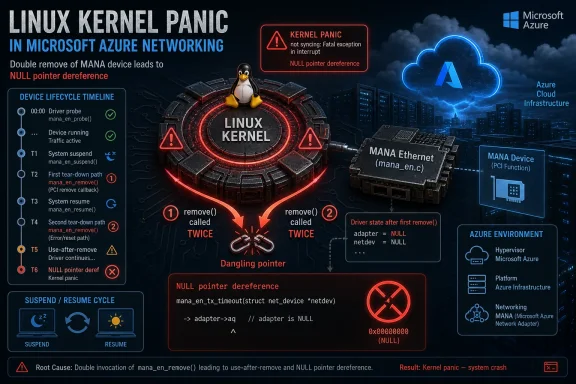
mana_remove() to run twice and dereference a NULL pointer. It is not a remote-code-execution headline, not a credential-stealing bug, and not yet scored by NVD. But it is exactly the kind of cloud-era kernel flaw that deserves more attention than its likely severity rating will suggest: a narrow driver teardown bug that turns a rare lifecycle edge case into a host panic.The story is small in code and large in context. Microsoft’s Azure networking stack now lives deep inside Linux, Linux lives deep inside Microsoft’s cloud, and the failure mode here sits at the seam between device lifecycle management, suspend/resume handling, and kernel cleanup paths. CVE-2026-53297 is a reminder that modern infrastructure reliability is often decided not by the glamorous hot path, but by the cleanup path nobody expects to run twice.
 A Kernel Panic Hiding in the Cleanup Crew
The vulnerability sits in drivers/net/ethernet/microsoft/mana/mana_en.c, the Linux Ethernet driver for the Microsoft Azure Network Adapter, or MANA. MANA is Microsoft’s newer Azure networking interface, designed to improve performance and availability for virtual machines and to support the direction of Azure’s accelerated networking stack. For WindowsForum readers, the important point is simple: this is Microsoft cloud networking code running inside the Linux kernel.The bug is not in packet parsing, encryption, authentication, or the sort of exposed network surface that normally drives urgent patching. It is in the driver’s remove path. More precisely, it is in what happens after a failed resume attempt, when the driver’s cleanup routine may already have dismantled its internal state but the kernel still later asks the driver to remove the device again.
That second call is the problem. According to the CVE description, if
mana_attach() fails during power-management resume, mana_probe() calls mana_remove() to tear down the device. During that teardown, the driver sets internal pointers such as gd->gdma_context and gd->driver_data to NULL. But a failed resume callback does not automatically unbind the driver, so when the device is eventually unbound, mana_remove() can be invoked a second time.Before the fix, that second invocation assumed state still existed. It could attempt to read
gc->dev even though gc had become NULL, producing a NULL pointer dereference and a kernel panic. The patch adds the kind of guard that looks almost insultingly obvious after the fact: return early if the state needed for removal is already gone, and only assign dev = gc->dev after confirming gc is valid.This is the kernel equivalent of locking the office after the movers have already emptied it. The first cleanup did its job; the second cleanup needed to recognize that there was nothing left to clean.
The Vulnerability Is Boring Only If You Ignore Where It Runs
On paper, CVE-2026-53297 looks like a modest local denial-of-service condition. NVD had not assigned CVSS 4.0, CVSS 3.x, or CVSS 2.0 scores at publication time, and the available description points to a kernel panic rather than privilege escalation or data exposure. It is also tied to specific driver lifecycle conditions: a failed power-management resume path, a failed attach operation, and a later device unbind.That means most Linux desktop users can probably exhale. If your laptop or workstation is not using the Microsoft MANA driver, the bug is irrelevant to your daily suspend/resume anxiety. Even many Azure Linux VMs may never naturally hit this exact sequence, depending on kernel version, VM type, driver exposure, and operational patterns.
But “narrow” is not the same thing as “unimportant.” MANA is not some obscure hobbyist PCI card driver rotting in the back of the kernel tree. It is Microsoft’s cloud network adapter, part of Azure’s effort to give virtual machines faster and more capable networking. Bugs in that layer matter because the systems that use it tend to be servers, appliances, clustered workloads, and network-sensitive Linux guests where an unexpected panic is not a cosmetic failure.
The most interesting part is the venue. This is not Microsoft shipping a proprietary Windows driver through Windows Update. This is Microsoft-authored or Microsoft-adjacent cloud infrastructure code moving through the upstream Linux development and stable-kernel machinery, then appearing as a kernel.org CVE. That is normal now, but it still says something remarkable about where Windows, Linux, and Azure have landed.
A decade ago, a Microsoft network driver bug in the Linux kernel would have sounded like an ideological punchline. In 2026, it is routine infrastructure maintenance. The politics faded; the operational coupling remained.
Double Invocation Bugs Are What Happen When State Machines Lie
The phrase “double invocation” sounds clean, but the underlying engineering smell is messier. Kernel drivers are full of lifecycle callbacks: probe, attach, suspend, resume, remove, detach, reset, error unwind, and all the odd transitions that happen when hardware, firmware, hypervisors, or buses do not behave like the happy-path diagram. The trick is not merely doing the right thing once; it is doing the right thing when the kernel re-enters a path after a partial failure.That is why cleanup code is so treacherous. Developers often write teardown routines with a mental model that says: this function runs when the device is being removed, and the device has been fully initialized. Reality replies: this function may run after probe partially succeeded, after resume failed, after work queues were initialized but ports were not, after driver data was cleared, or after another callback already tried to unwind the mess.
CVE-2026-53297 is a textbook example of a teardown function that needed to be idempotent. In plain English, calling it twice should not be dangerous. If the first call tears down state and marks the object as gone, the second call should observe that state and quietly leave.
That idea is simple in application code and brutal in kernel code. A user-space service that double-closes a high-level object may throw an exception, leak a log message, or crash one process. A kernel driver that double-walks destroyed state can panic the machine. In cloud infrastructure, “the machine” may be a customer VM, a network appliance, a data-plane component, or a node in a larger service.
The patch’s early return is therefore more than a defensive programming nicety. It encodes a lifecycle contract: if
gdma_context or driver_data is already gone, mana_remove() has nothing safe or meaningful left to do. That makes the remove path tolerate the kernel’s later unbind rather than assuming the earlier failure path never happened.Azure’s Linux Story Now Includes Linux’s Oldest Driver Problems
Microsoft’s MANA project reflects a broader cloud reality: the operating system boundary is no longer the boundary of the platform. Azure needs Linux guests to perform well, Linux needs first-class drivers for Azure hardware and virtual hardware, and Microsoft needs its cloud networking story to work cleanly across Windows and Linux. MANA is part of that compact.Microsoft’s documentation presents MANA as a next-generation Azure network adapter tied to Azure Boost and accelerated networking. It is designed to provide forward-compatible drivers for Windows and Linux, and Microsoft notes that Linux users may need updated kernels to access MANA or its newer capabilities. The Ethernet driver is present in modern Linux kernels, with related support for DPDK and RDMA in the broader MANA ecosystem.
That makes the affected file path particularly symbolic:
drivers/net/ethernet/microsoft/mana/mana_en.c. This is Microsoft’s name inside the Linux kernel tree, not as a guest, but as an infrastructure participant. When it works, nobody should notice. When it breaks, the failure follows Linux kernel rules, Linux stable-tree workflows, and Linux CVE publication practices.The bug also shows the cost of trying to make cloud virtual hardware behave like stable, high-performance infrastructure across kernel versions. MANA must participate in Linux’s network stack, power-management callbacks, device probing, teardown, and error unwind behavior. Those are not mere glue layers. They are the operational skeleton of the driver.
For Azure customers, the implication is not that MANA is unusually dangerous. The opposite may be closer to the truth: the bug is visible because the driver is upstream, reviewed, patched, and tracked through the kernel security process. The uncomfortable lesson is that even well-maintained cloud drivers inherit the full complexity of the kernel subsystems they inhabit.
The Missing CVSS Score Is Not the Missing Risk
NVD’s entry for CVE-2026-53297 had no NIST CVSS score at the time it was published. That can make the vulnerability look unfinished, and in a narrow administrative sense it is. Security teams often rely on CVSS values to sort patch queues, write exceptions, and decide whether an issue lands in “drop everything” territory.But CVSS is a poor first lens for reliability failures in infrastructure drivers. A kernel panic may score lower than a remote exploit, and rightly so, yet it can still be operationally serious in the wrong environment. Availability is not glamorous, but it is one of the three legs of security for a reason.
The right question is not “is this a critical vulnerability?” The right question is “can this failure mode be triggered in my environment, and what would a panic cost me?” For a hobbyist machine, the answer may be “nothing, because I do not use MANA.” For a production Azure Linux VM attached to a workload that treats node crashes as expensive events, the answer may be very different.
There is also an asymmetry in how these bugs are discovered and exploited. The CVE description does not claim remote exploitability, and the path described is not an obvious internet-facing attack chain. Still, administrators should be careful about assuming that “requires weird lifecycle timing” means “cannot matter.” Cloud fleets routinely exercise lifecycle transitions: live migration, host servicing, device reset, suspend-like flows, reprovisioning, and unbind/rebind operations in testing or automation.
The exploitability may be limited; the blast radius of a panic is not. A single crash in a redundant cluster may be noise. The same crash in a network appliance, a stateful workload, or a poorly drained node can become an outage ticket.
Stable Kernel Lines Tell the Real Patch Story
The CVE record lists affected Linux kernel versions beginning with 5.16, with older versions below 5.16 marked unaffected for this issue. It also identifies fixed status in later stable series, including fixed points in the 6.18 and 7.0 lines, and a fix associated with 7.1. The record also references stable-tree commits for the backported fixes.That version language deserves careful reading. Kernel CVE records often describe affectedness in terms of upstream commits, stable branches, and backports. That is useful for kernel maintainers, but it can be awkward for enterprise administrators who consume kernels from Ubuntu, Red Hat, SUSE, Debian, Oracle, Canonical’s Azure images, Microsoft’s Azure Linux, or appliance vendors.
The practical rule is this: do not assume your system is safe or vulnerable based only on the upstream version number printed by
uname -r. Enterprise distributions backport fixes without rebasing to the newest upstream kernel. A vendor kernel that looks old may include the patch. A custom kernel that looks new-ish may not.This is especially true in cloud images, where the kernel may be tuned, backported, or constrained by distribution support policy. If your Linux VM uses MANA, the meaningful question is whether your vendor’s kernel package includes the specific
mana_remove() guard, not whether the major version sounds modern.SUSE had already referenced the MANA double-invocation fix in a Linux kernel security update before the NVD entry appeared, which underscores another pattern: distribution security advisories and upstream CVE publication do not always arrive in the order administrators expect. Sometimes the patch is in motion before the CVE entry becomes a neat row in a scanner. Sometimes the scanner catches up after the package has already landed.
For WindowsForum’s sysadmin audience, that is the familiar tension between vulnerability management and patch management. The CVE is the label. The kernel package is the remedy.
This Is Not a Windows Bug, But Windows People Should Still Care
It would be easy for Windows administrators to file CVE-2026-53297 under “Linux problem” and move on. That would be technically defensible and operationally shortsighted. The vulnerability affects the Linux kernel’s MANA driver, but the platform context is Microsoft Azure, and many Windows-centric organizations now run substantial Linux estates because Azure, Kubernetes, containers, security tools, and vendor appliances demand it.The modern Windows shop is rarely Windows-only. It has Entra ID, Azure networking, Defender, Windows Server, SQL Server, some Linux VMs, a Kubernetes cluster somebody inherited, a firewall appliance from the marketplace, and three “temporary” Ubuntu boxes that became production two years ago. A Linux kernel panic in Azure can still land on a Microsoft operations team’s desk.
MANA also illustrates Microsoft’s dual role. Microsoft is the cloud provider, the hardware and virtual hardware designer, a Linux kernel contributor, and often the vendor whose support channels enterprise customers call when Azure networking behaves oddly. That does not make Microsoft uniquely culpable for every driver bug. It does make the boundary between “Linux issue” and “Microsoft issue” less tidy than old platform tribalism suggests.
For Windows professionals, the actionable lesson is not to become kernel maintainers overnight. It is to inventory the Linux components that now underpin Microsoft-hosted workloads. If a production VM depends on accelerated networking, specialized drivers, RDMA, DPDK, or marketplace network appliances, then kernel advisories are part of your Microsoft risk surface whether or not the affected OS has a Start menu.
The line between Windows administration and cloud infrastructure administration has been fading for years. CVE-2026-53297 is a small but useful marker of that change.
The Patch Is Tiny Because the Failure Was Conceptual
The fix described in the CVE is minimal: check whethergdma_context or driver_data is NULL, return early if so, and move the dev = gc->dev assignment until after that guard. That is not an architectural rewrite. It is the sort of patch that may span only a handful of lines.But tiny patches can close large conceptual gaps. The old code implicitly assumed that
mana_remove() would be called only while the relevant driver state remained intact. The new code acknowledges that teardown may be re-entered after state has already been cleared. That is a better model of kernel reality.This matters because probe/remove error paths tend to rot faster than hot paths. Packet transmit and receive paths are exercised constantly. Driver initialization gets tested often enough. The strange edge where resume fails, attach returns an error, cleanup runs, unbind later happens, and a stale assumption dereferences a cleared pointer is much less likely to be covered by routine use.
The patch series around this work reportedly addressed several MANA probe/remove error-path bugs, including warnings involving uninitialized work structures, NULL pointer dereferences, masked errors, and resource leaks. That context matters. CVE-2026-53297 may be the named vulnerability, but it appears to be part of a broader tightening of the driver’s lifecycle behavior.
That is how mature kernel code improves. Not by discovering a single monster bug and slaying it, but by sanding down the awkward edges where partially initialized state meets cleanup logic.
Cloud Availability Depends on Unglamorous Kernel Hygiene
The security industry tends to reward spectacle. Remote code execution gets headlines. Sandbox escapes get conference talks. Cryptographic breaks get logos. A NULL pointer dereference in a cloud NIC driver’s remove path sounds like janitorial work by comparison.Yet availability failures are often what users actually experience. They do not see the CVE taxonomy. They see a VM reboot, a dropped connection, a failed maintenance operation, or an appliance that vanished during a change window. In distributed systems, one crash may be survivable, but the point of infrastructure engineering is to prevent ordinary maintenance from becoming a dice roll.
MANA exists to make Azure networking better. That raises the reliability bar for its driver, not lowers it. A high-performance cloud NIC driver must be correct not only when packets are flowing, but when the system is being probed, resumed, reset, detached, rebound, upgraded, or cleaned up after something failed halfway.
This is why driver lifecycle bugs deserve a place in security coverage. A kernel panic is a security-relevant availability failure, especially in multi-layer cloud environments where infrastructure events can line up in ways that individual administrators do not fully control. If the bug is hard to trigger but the consequence is a panic, administrators should treat it as a patching issue rather than trivia.
There is no need to inflate CVE-2026-53297 into a crisis. There is also no virtue in dismissing it because the fix is small. In infrastructure, small correctness patches are often what keep the boring days boring.
The Real Work Is Finding Where MANA Exists
Administrators should start with exposure, not panic. The vulnerable code path belongs to the MANA Ethernet driver, so the first filter is whether systems are using that driver at all. Linux systems outside Azure, or Azure VMs not backed by MANA-capable networking, are unlikely to care.On Azure Linux systems, the answer may depend on VM generation, image, kernel, accelerated networking configuration, and whether the MANA module is present or active. Microsoft’s MANA documentation notes that supported operating systems may still need newer kernels or drivers to use MANA and newer features. That means exposure is not simply “all Azure Linux” or “no Azure Linux.”
The second filter is kernel provenance. Distribution kernels may already have the fix through a security update. Custom kernels, pinned appliance kernels, older marketplace images, and vendor-controlled network virtual appliances deserve closer scrutiny. These are exactly the environments where a driver bug can linger because the owner of the workload does not directly manage the kernel package.
The third filter is operational behavior. If a system never exercises the relevant resume and unbind paths, the bug may remain theoretical. But production risk is not only about what happens every day. It is also about what happens during host maintenance, disaster recovery tests, automation failures, and the sort of rare platform events that wake up the on-call engineer at 03:00.
That is why the best response is measured patching. Identify MANA users, check vendor advisories, confirm kernel package fixes, and roll updates through the same maintenance process used for other availability-impacting kernel defects. If the system is critical and cannot be patched quickly, understand whether it can be drained, migrated, or otherwise insulated before risky lifecycle operations.
The Scanner Row Will Understate the Engineering Lesson
When CVE-2026-53297 eventually receives a score, it may not look dramatic. It may be classified in the broad family of NULL pointer dereference or denial-of-service issues. Vulnerability dashboards may bury it below louder findings with scarier numbers and more obvious attack stories.That would be understandable, but incomplete. This CVE is more interesting as an engineering case study than as a threat-intelligence siren. It shows how a failed resume path can leave the driver bound but partially torn down. It shows how a later unbind can revisit cleanup code that assumed intact state. It shows why idempotent teardown matters in kernel drivers, especially when those drivers sit under cloud networking.
The phrase “failed resume callback does not automatically unbind the driver” is the quiet center of the bug. It means the kernel’s lifecycle did not match the driver’s cleanup assumptions. Once
mana_probe() had called mana_remove() during the failure path, the driver state had been dismantled. But from the broader device model’s perspective, the driver could still later be removed in the ordinary way.That mismatch is where panics are born. The fix teaches the remove path to recognize already-removed state. In doing so, it aligns driver behavior with the messier truth of kernel lifecycle management.
For developers, the lesson is to audit cleanup functions for repeat calls and partial initialization. For administrators, the lesson is that cloud drivers are not magic. They are kernel code, and kernel code’s least glamorous branches can still decide whether a server stays up.
The Azure MANA Fix Leaves Administrators With a Short, Concrete Checklist
The right response to CVE-2026-53297 is neither alarm nor indifference. Treat it as a targeted kernel reliability fix for Linux systems using Microsoft’s MANA driver, especially in Azure environments where accelerated networking and newer VM networking features may bring that driver into play.- Confirm whether affected Linux systems actually load or depend on the Microsoft MANA Ethernet driver before treating the CVE as broadly applicable.
- Check distribution and cloud-image advisories rather than relying only on upstream kernel version numbers, because vendors may backport the fix into older-looking kernels.
- Prioritize production Azure Linux VMs, marketplace appliances, RDMA or DPDK-related deployments, and custom kernels where MANA support may be operationally important.
- Treat the likely impact as availability-focused: the described failure mode is a kernel panic caused by a NULL pointer dereference after a double remove path.
- Do not wait for an NVD score if your environment depends on MANA and your vendor has already shipped a fixed kernel package.
- Use the incident as a prompt to review how your team tracks Linux kernel fixes in Microsoft-hosted infrastructure, even if the rest of the estate is Windows-first.
References
- Primary source: NVD / Linux Kernel
Published: 2026-06-28T01:03:27-07:00
NVD - CVE-2026-53297
 nvd.nist.gov
- Security advisory: MSRC
Published: 2026-06-28T01:03:27-07:00
Original feed URL
Security Update Guide - Microsoft Security Response Center
 msrc.microsoft.com
- Related coverage: stack.watch
Linux Kernel Security Vulnerabilities in 2026
 stack.watch
- Related coverage: mail-archive.com
[PATCH net v4 0/5] net: mana: Fix probe/remove error path bugs
www.mail-archive.com
- Related coverage: spinics.net
[PATCH net v4 3/5] net: mana: Guard mana_remove against double invocation — Linux Kernel
Linux Kernel: [PATCH net v4 3/5] net: mana: Guard mana_remove against double invocation www.spinics.net
- Related coverage: cve.imfht.com
CVE-2026-23454: net: mana: fix use-after-free in mana_hwc_destroy_channel() by reordering teardown - Vulnerability Platform
[-] Overview A race condition vulnerability exists in the network driver within the Linux kernel. During the execution of the function, the memory pointed cve.imfht.com
- Related coverage: archives.kernel-recipes.org
- Related coverage: kernel.org
- Official source: learn.microsoft.com
Microsoft Azure Network Adapter (MANA) overview | Microsoft Learn
Learn how the Microsoft Azure Network Adapter can improve the networking performance of Azure VMs.learn.microsoft.com - Related coverage: docs.azure.cn
Microsoft Azure Network Adapter (MANA) overview | Azure Docs
Learn how the Microsoft Azure Network Adapter can improve the networking performance of Azure VMs.docs.azure.cn - Related coverage: kernelconfig.io
config_microsoft_mana - kernelconfig.io
CONFIG_MICROSOFT_MANA - mana.ko - This driver supports Microsoft Azure Network Adapter (MANA)www.kernelconfig.io - Related coverage: linux-drivers.com
drivers/infiniband/hw/mana · keep · linux-drivers
Recommend keep (92% confidence). Microsoft Azure Network Adapter (MANA) RDMA. Real driver: local Kconfig/sources identify this as the Microsoft Azure Network… www.linux-drivers.com
- Related coverage: phoronix.com
Microsoft Adding Azure "MANA" Driver To Linux - Phoronix
Microsoft is preparing the Linux kernel for some yet-to-debut Azure network functionality.www.phoronix.com
- Official source: csrc.nist.gov
- Related coverage: docs.redhat.com
